
Last updated: 15 August 2026 · Reading time: 12 min · Author: Marc Hoffmann, Senior Visa Consultant at MyJet24 · Reviewed by: Joshua White
TL;DR — Key facts
- Call before the plane leaves. One phone call turns a "no-show" into a rebooking — and it is the single action that changes the outcome most.
- A no-show can cancel the rest of your trip. Under most Conditions of Carriage, missing one leg without telling the airline cancels every remaining segment, including your return.
- Whose fault it was decides everything. Airline's fault means free rebooking and possibly compensation; your fault means the rebooking is discretionary and usually paid.
- The "flat-tire rule" is real but informal. Many carriers quietly rebook passengers who arrive shortly after cut-off — you have to ask for it.
- Taxes are often refundable even on non-refundable fares, because unflown taxes and airport charges were never incurred.
- If your return was your proof of onward travel, you now have none — border officers check the live booking, not the PDF you printed.
If you miss your flight, the airline marks you a no-show and, under most Conditions of Carriage, automatically cancels every remaining segment on the booking — including your return. Calling before departure prevents that: a cancelled or rebooked segment is not a no-show. What you pay to get back on a plane then depends on why you missed it.
If a cancelled return leg was your proof of onward travel, you need a verifiable one before your next border.
In this guide
- What happens the moment you miss it
- The no-show rule: the part that costs most
- The first 60 minutes, in order
- Whose fault it was decides everything
- The flat-tire rule
- Missed connections are a different case
- What happens to your checked bags
- What you get back — and what you don't
- The visa problem nobody warns you about
- How to not be in this position
What happens the moment you miss it
Missing a flight is an administrative event, not a catastrophe: the airline closes the flight, marks you absent, and your ticket moves into a status that decides what you can still do with it. Nothing is destroyed instantly. What changes is that control passes from you to the airline's rules — and those rules start applying the second the gate closes.
The gate does not close at departure time. Most carriers stop accepting passengers 15 to 45 minutes before push-back, and bag drop closes earlier still. Arriving at the gate at the printed departure time means you have already missed the flight by the airline's clock, even though the aircraft is visibly still there. That gap between "the plane is at the stand" and "you are too late" is where most people lose their argument at the desk.
The aircraft still being at the gate is not the test. The check-in and boarding cut-offs are — and they have already passed.
Key takeaway: your ticket is not void the moment you miss the flight. It changes status — and how you react in the next hour decides what that status becomes.
The no-show rule: the part that costs most
A no-show is a passenger who neither travels nor tells the airline, and the standard consequence is that all remaining segments on the booking are cancelled automatically. This is written into the Conditions of Carriage of most major airlines. Miss the outbound and stay silent, and the connecting flight and the return can disappear from the reservation without anyone calling you.
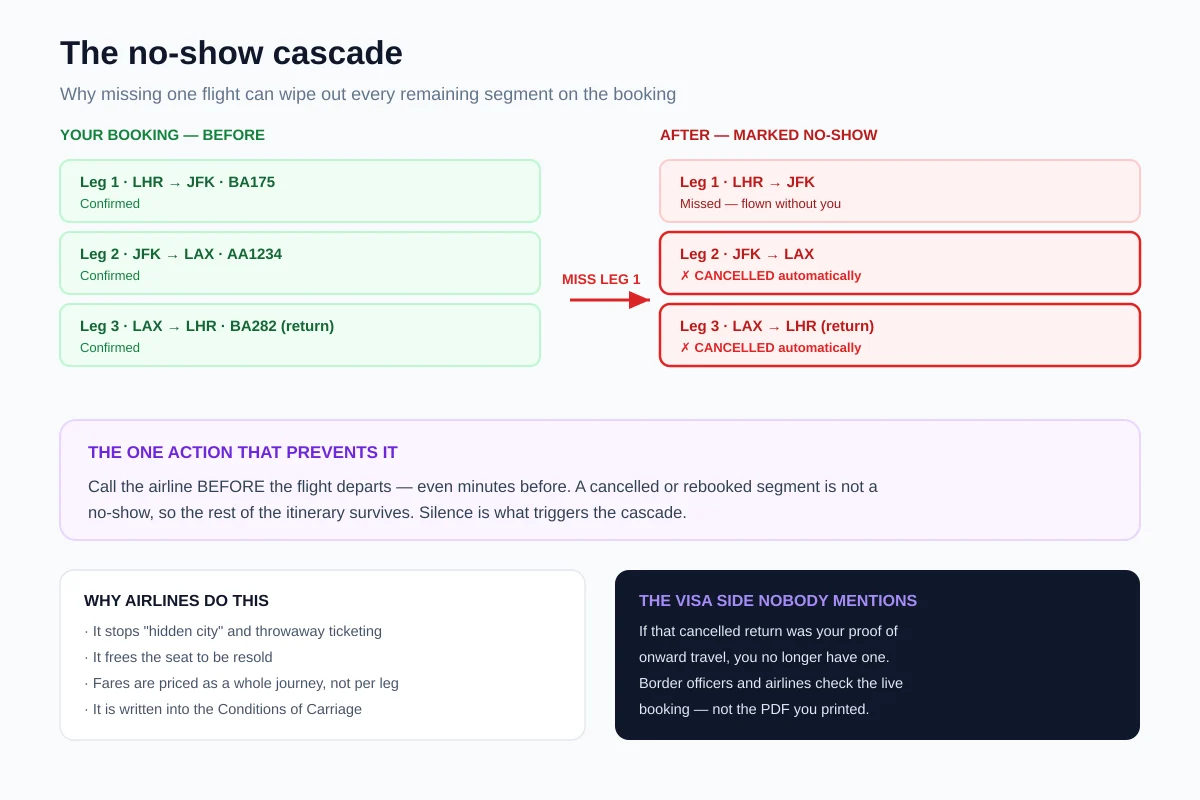
The logic is commercial rather than punitive. Return fares are priced as one journey, not as separate legs, so airlines protect that pricing by refusing to let passengers use only the convenient half — the practice known as hidden-city or throwaway ticketing. Cancelling the rest also frees seats to resell. None of that helps you at 6 a.m. in a taxi, which is why the countermeasure matters more than the reasoning: a segment you cancel or rebook is not a no-show. Silence is what triggers the cascade.
One detail decides how much time you actually have: the cancellation is usually automated and fires at or shortly after departure, not days later. That is why the advice is always "call before the plane leaves" rather than "call when you get a chance" — once the flight closes and the system processes the no-show, restoring cancelled segments becomes a favour an agent has to arrange manually, and the seats may already be resold. Before departure it is a routine change; afterwards it is a negotiation.
Key takeaway: the expensive mistake is not missing the flight. It is missing it quietly.
The first 60 minutes, in order
The correct response to a missed flight is a sequence, and the order matters because your options shrink with every minute. Call first, ask for the informal rebooking second, verify your remaining segments third, and only then think about money. Doing this in the wrong order is how people end up with a cancelled return they discover three weeks later.
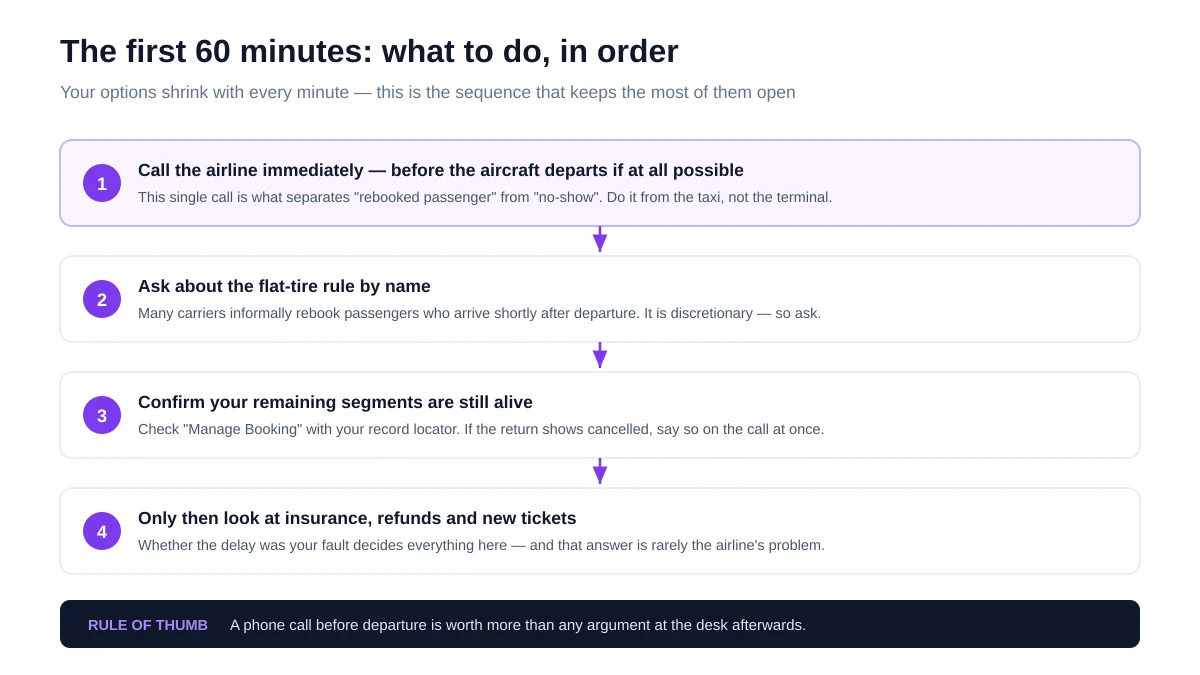
- Call the airline immediately — ideally before the aircraft departs. Do it from the taxi, not from the terminal queue. This is what separates "rebooked" from "no-show".
- Ask about the flat-tire rule by name. It is discretionary, and staff apply it far more often to passengers who ask calmly than to those who demand.
- Check your remaining segments in "Manage Booking" using your record locator. If the return already shows cancelled, say so on the same call.
- Only then handle money — rebooking fees, refundable taxes, insurance claims. That order is deliberate: fixing the itinerary is time-critical, reclaiming money is not.
In practice the phone line beats the desk. Airport staff manage a queue and a departure schedule; the call centre has the whole reservation in front of them and can act on segments the desk agent will not touch. If the hold time is long, do both at once — queue at the desk while the phone rings.
Keep the record locator visible while you do it. Every conversation about a missed flight starts with the agent finding your reservation, and the six-character booking reference is the fastest route to it — faster than your name, your ticket number or the flight you were meant to be on. Have it open on your phone before you dial.
Whose fault it was decides everything
Every outcome after a missed flight traces back to one question: who caused it. The same missed departure produces free rebooking and cash compensation in one case, and a full-price new ticket in another. Airlines apply this distinction consistently, so knowing which category you are in tells you what to ask for before you call.
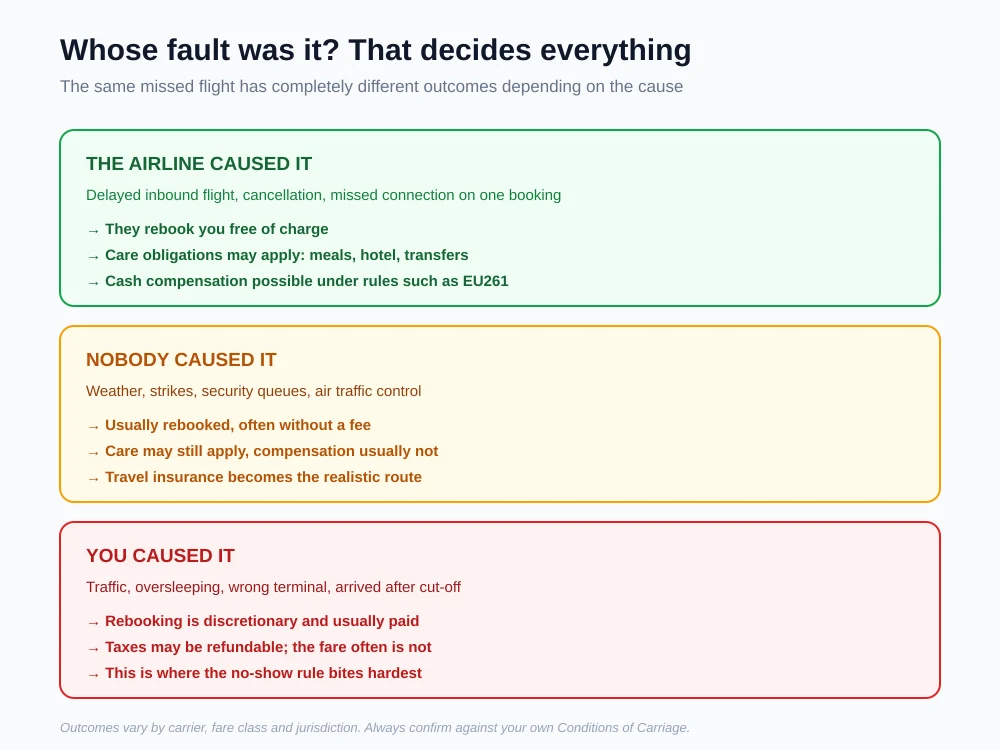
| Cause | Rebooking | Meals / hotel | Cash compensation |
|---|---|---|---|
| Airline (delay, cancellation, missed connection on one ticket) | Free | Usually yes | Possible (e.g. EU261) |
| Extraordinary (weather, strike, ATC) | Usually free | Often yes | Usually no |
| You (traffic, overslept, late to gate) | Discretionary, usually paid | No | No |
The clearest rule inside that table: if the airline broke the chain, it owns the fix. Passenger-rights regimes formalise this — in Europe, the EU's air passenger rights set out re-routing and care obligations, and cash compensation where the carrier is responsible. We cover the amounts and thresholds in our guide to EU261 delay compensation.
The flat-tire rule
The flat-tire rule is an informal industry practice of rebooking passengers who arrive at the airport shortly after their flight's cut-off, typically within about two hours, onto the next available service at little or no cost. It is not a legal right and rarely appears in published terms — it is discretion exercised at the counter, which is exactly why it is worth knowing by name.
It exists because airlines would rather fill a later seat than argue with a stranded customer over a genuine mishap. What it rewards is turning up and being reasonable: passengers who arrive soon after departure, explain briefly what happened and ask whether anything can be done tend to fare better than those who arrive hours later or open with a demand. In our experience helping travellers sort out disrupted trips, the phrase itself helps — asking "does your flat-tire rule apply here?" signals you know it is a favour, not an entitlement.
Key takeaway: the flat-tire rule is a courtesy, not a right. Ask for it early, politely, and by name.
Missed connections are a different case
A missed connection is treated as the airline's problem when both flights sit on one booking, and as your problem when they do not. That single distinction — one ticket or two — decides whether you are rebooked free of charge or buying a new fare, and it catches out travellers who assemble cheap itineraries from separate bookings.
On a single booking, the carrier accepted responsibility for the whole journey when it sold you the connection, so a late inbound flight obliges it to re-route you. On two separate bookings, the second airline has no contract covering your late arrival; from its side you simply did not show up. This is also why minimum connection times exist and why booking below them is risky — we break that down in our guide to layovers, stopovers and minimum connection times, and the related trap in open-jaw and multi-city itineraries.
A real reservation with a live booking reference — the kind an officer can actually check.
What happens to your checked bags
If your bags were already checked in and you are not on board, they come off the aircraft. Airlines are required to reconcile passengers and hold baggage, so an unaccompanied bag is offloaded before departure — which is also why a late passenger can delay a flight while ground staff search for a suitcase. Your bag does not travel ahead of you.
The practical consequence is that the bag is somewhere in the airport, not at your destination, and reclaiming it takes time you may not have if you are being rebooked onto a flight an hour later. Tell the agent immediately that you have hold baggage, because retrieving and re-checking it is the step most likely to make you miss the replacement flight too. If you are rebooked onto the same airline within a short window, staff can often keep the bag in the system rather than returning it to you — but only if they know before it is sent back to the arrivals hall. Cabin-only travel removes this problem entirely, which is one quiet argument for it on tight itineraries; our breakdown of carry-on versus checked baggage covers the trade-offs.
Key takeaway: your bag never flies without you. Mention it on the first call — retrieving it is what usually costs the next flight.
What you get back — and what you don't
On a missed flight that was your own fault, the fare is usually gone but the taxes are not. Airport charges, security fees and government taxes are levied on passengers who actually fly, so unflown taxes were never incurred and can generally be reclaimed even on a strictly non-refundable ticket. Airlines rarely volunteer this, and some deduct an administration fee, but the claim is legitimate and worth making.
What is usually recoverable
Travel insurance is the realistic route when nobody is at fault. Most policies cover missed departure caused by documented events — a traffic accident, public transport failure, illness — and exclude oversleeping and poor planning. Read the wording before you call, because the claim usually turns on evidence: a police report, a rail delay confirmation, a medical note. Compensation for airline-caused disruption is a separate track, and being denied boarding on an overbooked flight is different again — that one is not a missed flight at all, and it pays.
The visa problem nobody warns you about
If your cancelled return leg was also your proof of onward travel, you have quietly lost a document you may be required to show. Many countries expect visitors to demonstrate they will leave, and airlines check that requirement before boarding. A return flight that the no-show rule has just removed from your reservation no longer proves anything, because the checks are run against the live booking rather than the paper you carry.
This is the part travellers discover too late, usually at a check-in desk. The document in your bag looks unchanged; the reservation behind it is gone. Anyone verifying it — an airline agent, a border officer — queries the record, not the printout, which is the same reason a screenshot never satisfies the requirement. Our guide to the six ways to show proof of onward travel covers what actually holds up, and what a booking record contains explains why a live reference is what counts.
Key takeaway: after a no-show, check whether you still have onward proof — not just whether you still have a flight home.
How to not be in this position
Missed flights cluster around a handful of avoidable causes, and the fixes are unglamorous. Build the buffer around the cut-off rather than the departure time, keep the airline's number saved before you need it, and treat separate bookings as the risk they are. None of that is interesting advice — it is simply what separates a stressful morning from a cancelled itinerary.
- Target the bag-drop cut-off, not departure. Working backwards from the earlier deadline builds in the hour that actually matters.
- Save the airline's number in your phone before the trip. The call you must make happens when you have no time to search for it.
- Avoid self-connections unless you can absorb the loss, or protect them with a policy that covers missed departure.
- Check in online. A checked-in passenger is more visible in the system and easier for staff to move.
- Verify names and documents in advance — being turned away over a mismatch is its own way of missing a flight, which is why the name on your ticket deserves a second look.
Everything after a missed flight is negotiation. The only part that is purely mechanical — and purely in your control — is whether you called before the doors closed.
Next steps
To summarise: call the airline before the aircraft leaves, because a rebooked segment is not a no-show and a no-show can cancel your entire remaining itinerary. Ask about the flat-tire rule by name. Check that your return still exists. Then, and only then, chase taxes, refunds and insurance.
If the cascade already hit and your return leg is gone, the immediate gap is proof of onward travel for your next flight or border crossing. You can generate a verifiable reservation in under a minute.
Sources
- European Union — Air passenger rights (re-routing, care and compensation obligations).
- US Department of Transportation — Flight delays (US rules, guidance and enforcement on delays and on-time performance).
This guide describes standard airline practice as of 15 August 2026. No-show handling, rebooking discretion and refund rules are set by each carrier's own Conditions of Carriage and vary by fare class and jurisdiction; the flat-tire rule is an informal courtesy, not an entitlement. Always confirm with your airline. This article is informational and not legal advice.
