
Last updated: 25 August 2026 · Reading time: 13 min · Author: Marc Hoffmann, Senior Visa Consultant at MyJet24 · Reviewed by: James Mitchell, CEO & Founder
TL;DR — Key facts
- A confirmed booking and a paid ticket are two different objects. The seat is held in a reservation record; the payment is a separate 13-digit e-ticket number attached to it.
- The status code that describes a held, unpaid seat is HK — "holds confirmed" in Travelport's own definition. It confirms the seat, and says nothing at all about money.
- Every unticketed reservation carries a deadline. Lufthansa Group's agent policy states it plainly: "A date and time deadline required for ticket issuance is set in a PNR."
- When the deadline passes, the segment is cancelled automatically and quietly, usually flipping to status HX. No airline sends you a warning email first.
- Airlines do not prohibit unticketed reservations. They prohibit invented ones. The rule, traced back to IATA Resolution 830, is that a booking must answer a real request from a real named passenger.
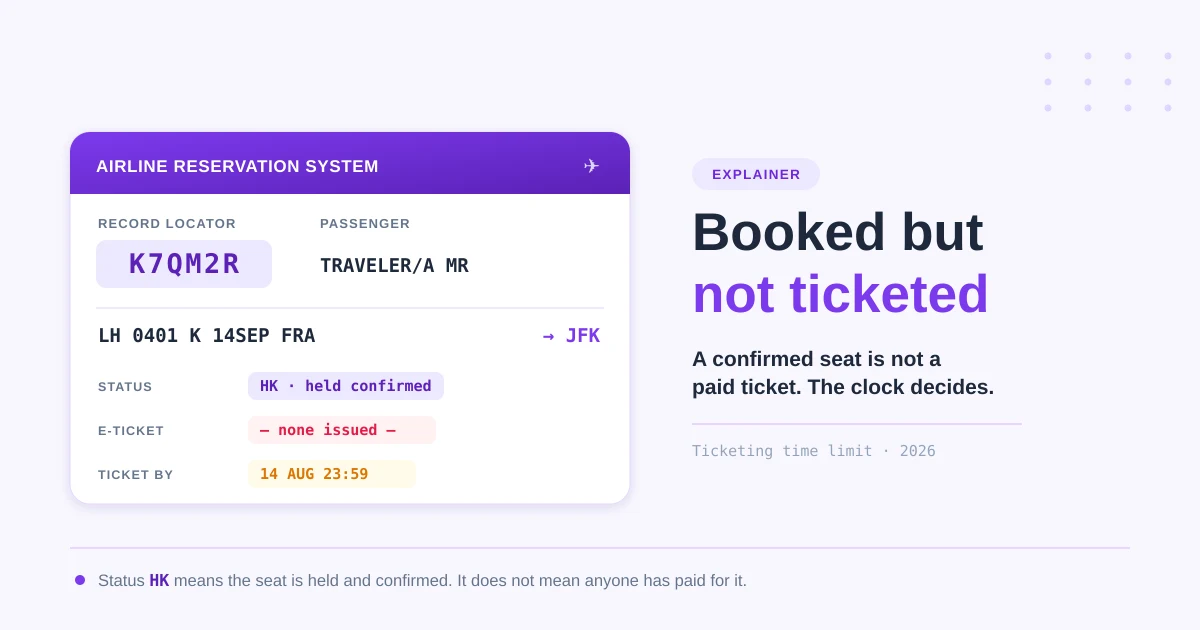
A booking is not a ticket. When a flight is reserved, the airline's system holds a seat under a record locator with the status HK — held confirmed. Payment creates a second, separate thing: a 13-digit e-ticket number attached to that record. Until that number exists, the airline is holding a seat for you rather than carrying you.
A real reservation with a locator an officer can check — not a screenshot.
What "booked but not ticketed" actually means
Booked but not ticketed is the state of a flight reservation that holds a real, confirmed seat while carrying no e-ticket number against it. The seat exists. The passenger name exists. The record is live in the airline's system and can be found by anyone with the locator and the surname. What has not happened is payment, and payment is what converts a held seat into a flown one.
This trips people up because the traveller-facing language collapses the two. A confirmation email says "confirmed". A booking page says "confirmed". Both are accurate — and neither says "paid". The airline's own record keeps the two facts in different fields, which is why a passenger can stand at a counter holding a confirmation email while an agent tells them there is no ticket.
An analogy that holds up: a restaurant taking your name for a table at eight o'clock has confirmed a reservation. It has not been paid for dinner. Cancel the table and nothing is owed. Airlines work the same way, with one difference — the airline sets a deadline by which the table must be paid for, and clears it without asking if the deadline passes.
Key takeaway: "Confirmed" describes the seat. "Ticketed" describes the money. A document that shows only the first is telling you half of what the airline knows.
The four states every reservation passes through
A flight reservation is a state machine with four stops and two possible endings. It starts as seat inventory the airline has loaded for sale, becomes a sold segment when a seller takes it, becomes a held confirmed seat inside a passenger record, and then hits a deadline that decides which way it resolves.
The two endings are not symmetrical. One requires someone to act — a ticket has to be issued and paid for. The other happens by itself, on a timer, with no message to the passenger. That asymmetry is the single most useful thing to understand about air bookings, because it means silence is not reassurance.
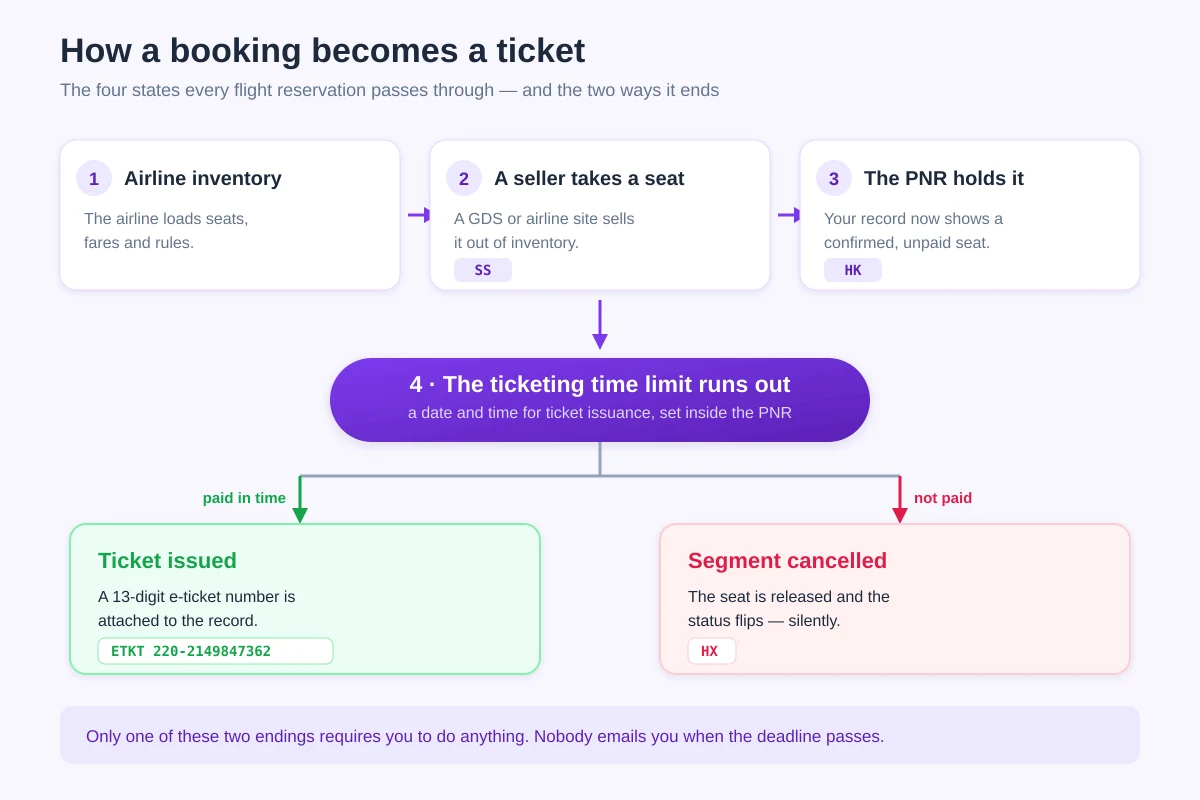
Compare two travellers who booked the same flight on the same afternoon. One paid at the point of booking, so a ticket number was attached within minutes. The other was quoted by an agent who said they would "hold it" while a corporate approval came through. Six days later, one has a ticket and one has nothing — and the second traveller's confirmation email still reads exactly as it did on day one.
Key takeaway: The document in your inbox is frozen at the moment it was generated. The record it describes keeps changing without it.
Who is actually holding the seat: inside the GDS
A global distribution system, or GDS, is the transaction layer that sits between airlines selling seats and the agencies, corporate tools and websites selling trips. It owns no inventory of its own. Airlines push availability, fares and rules into it, and sellers reach into it to take a seat out of stock in real time.
Three systems handle the overwhelming majority of this traffic: Amadeus, Sabre and Travelport, the last of which carries the older Apollo, Galileo and Worldspan platforms inside it. Sabre began life in the 1960s as a computerised reservation system built for American Airlines, which is why so much of the language a traveller sees on an itinerary — the six-character locator, the cryptic segment line, the two-letter status code — reads like a mainframe rather than a website. It is a mainframe.
This matters to a passenger for one practical reason. When a seat is sold through a GDS, the seller can hold it before paying for it. That is a designed feature, not a loophole: agencies need to assemble an itinerary, quote it, get approval and collect funds, and airlines would rather have the seat provisionally committed than lost. The record locator that identifies your reservation is created at that moment — before any money moves.
The ability to hold a confirmed seat without paying for it is not a trick played on airlines. It is a function airlines built, priced and time-limited on purpose.
Key takeaway: The unpaid hold exists because commerce needs it. What airlines control is not whether it exists, but how long it lasts.
The ticketing time limit, the deadline nobody tells you about
A ticketing time limit is the date and time by which an unticketed reservation must be paid for, written into the passenger record by the airline. Miss it and the airline's own software cancels the seat. There is no grace period and no notification to the traveller, because the deadline was never addressed to the traveller — it was addressed to whoever sold the booking.
This is not folklore. It is published policy. The Lufthansa Group Booking & Ticketing Policy for Travel Agents (version 01SEP25) devotes a section to it and states the mechanism in flat, unambiguous language.
"A date and time deadline required for ticket issuance is set in a PNR. […] Lufthansa Group airlines use an automated process to cancel segments when ticketing has not occurred by applicable time limit. The cancellation of such segment(s) is published with status code 'HX' or an immediate cancellation of such segment(s)."
— Lufthansa Group Booking & Ticketing Policy for Travel Agents, v01SEP25, §2.13
Two details in that passage repay attention. The first is "automated" — no human reviews your case, and no one weighs whether you were three hours late because a bank transfer cleared slowly. The second is that the deadline can be shorter than you were told: where the limit in the system and the limit coded in the fare rule disagree, the policy says "the most restrictive ticketing time limit will apply."
The same document adds a consequence that catches families and groups. Where a record holds several passengers and tickets are issued for only some of them, "the PNR will be split, and the unticketed names will be cancelled." A partly paid booking does not fail gracefully — it fails for exactly the people who were not paid for.
Key takeaway: Ask the seller for the ticketing deadline in writing. It is a specific date and time that already exists in your record, not an estimate anyone has to calculate.
Status codes: HK, HX and what each one is telling you
A segment status code is a two-letter field in the reservation record that states what has happened to that flight segment. It is the most honest line on any itinerary, and the one travellers skip. Travelport publishes the definitions in its air segment status code reference, and the wording is worth reading literally rather than hopefully.
| Code | Published meaning | What it means for you |
|---|---|---|
| SS | Sell segment | The seat has just been taken out of inventory for you. |
| HK | Holds confirmed | Your seat is confirmed. This code says nothing about payment. |
| HL | Holds waitlist | You are queued, not confirmed. Do not plan around it. |
| TK | Schedule change — advise passenger of new times | The airline moved the flight. Re-check every downstream connection. |
| HX | Cancel confirm hold | The confirmed hold is gone. This is what a missed deadline looks like. |
| UN | Unable — no flight | The flight itself no longer exists on that date. |
| UC | Unable to confirm or waitlist | The request failed outright. Nothing is held. |
HX is the code that ruins trips, and it is worth naming precisely why. It does not mean "cancelled by the passenger". It means a hold that was previously confirmed has been released — by a duplicate-booking check, a revenue-integrity tool, or most often a ticketing deadline that came and went. Lufthansa's policy groups HX with NO, UC, UN and US under "inactive segments" and requires agents to strip them out at least 48 hours before departure, which tells you how routinely they appear.
Key takeaway: HK is the code of a genuine unpaid hold. HX is the code of a hold that has already ended. Neither of them is the word "confirmed" in your email.
The e-ticket number is the proof that money moved
An e-ticket number is the 13-digit identifier issued when a fare is filed and paid, and it is the only field on a reservation that proves a purchase happened. Under IATA Resolution 722f it is built from a three-digit airline accounting code followed by a ten-digit document number — the reason a Lufthansa ticket starts 220 and an Emirates ticket starts 176.
Paper tickets are long gone. The industry completed its move to electronic ticketing in 2008 under IATA's Simplifying the Business programme, a shift IATA records as a major milestone for the industry. One practical result is that the receipt for your flight is now a number inside a database rather than a coupon in your pocket, which is precisely why its absence is so easy to miss.
The numbers behind the mechanism
- 13 digits — the length of every e-ticket number: three-digit airline code plus a ten-digit document number (IATA Resolution 722f).
- 2008 — the year the industry reached 100% electronic ticketing under IATA's Simplifying the Business programme.
- 48 hours — how far before departure Lufthansa Group requires inactive segments (HX, NO, UC, UN, US) to be removed (§2.6).
- ~40 minutes — the maximum time Lufthansa Group analyses as normal for closing a sale before an uncommitted booking may be cancelled by inventory tools (§2.10).
- 80% / 50% — the cancellation-ratio ceilings the same policy sets for offline and online agents respectively (§2.7).
- 24 hours — the window US carriers must give you to hold or cancel a booking without penalty, for reservations made at least seven days before departure (14 CFR § 259.5(b)(4)).
Key takeaway: If nobody can show you a 13-digit number, nobody has bought you a flight. Everything else on the document is description.
Held under a real record an airline system will still answer for.
How to check whether your booking is ticketed
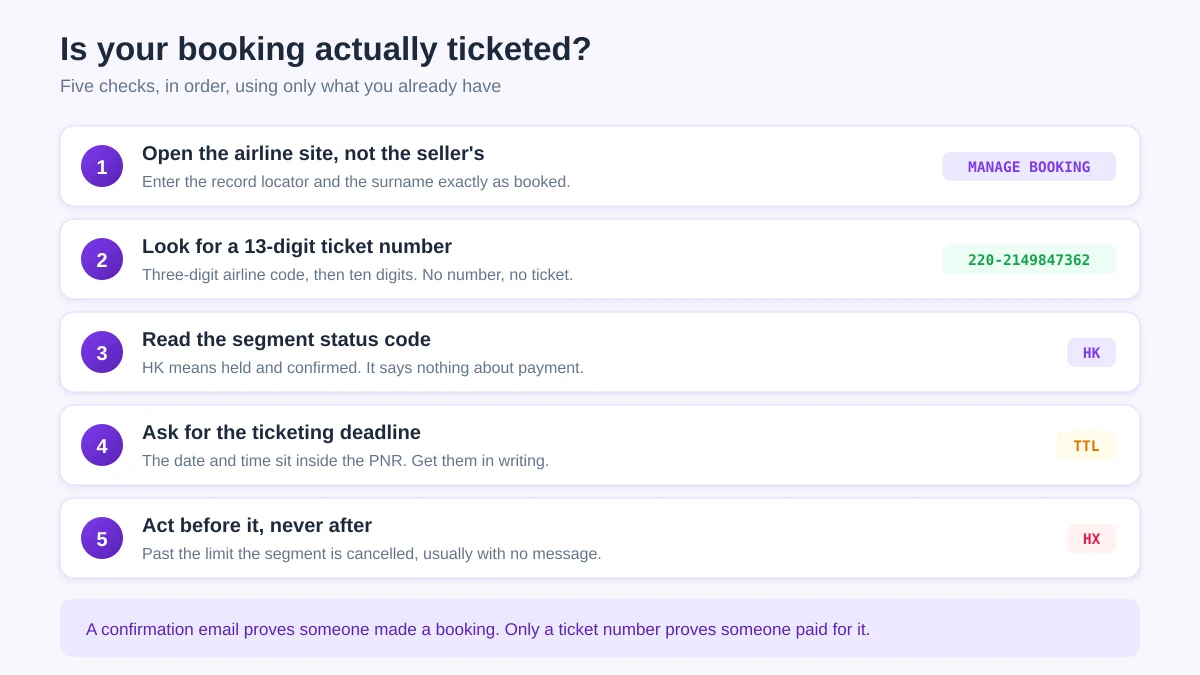
Checking is a five-minute task that needs nothing but your locator and your surname. The goal is to look past the word "confirmed" and find the two fields that actually settle the question: the ticket number and the segment status.
- Open the airline's own site, not the seller's. Use "Manage booking" and enter the record locator with the surname spelled exactly as it was booked. The airline's system is the record of truth; an agency page is a copy of it.
- Look for a 13-digit ticket number. It may be labelled e-ticket, ETKT or document number. If the field is empty or absent, the seat is held and unpaid — which is a real state, not an error.
- Read the segment status code. HK means held confirmed. HX means the hold has already been released. Anything in the UN/UC family means the request never succeeded.
- Ask the seller for the ticketing deadline in writing. The date and time sit inside the record. Any agent can read them out; vagueness here is itself the answer.
- Act before the deadline, never after. Once the segment is cancelled the fare you were quoted is gone, and rebooking means whatever the price is that morning.
In our own work verifying reservations for travellers, the field that most often settles a dispute is not the ticket number — it is whether the airline can find the record at all. A locator that returns nothing on the carrier's own site was never a booking in that airline's system, whatever the PDF says. That single check separates a reservation from an image of one, and it is the same test we walk through in our guide to verifying a locator before you submit it.
Key takeaway: Two fields decide everything — is there a ticket number, and does the airline still return the record. Check both on the carrier's site, not the seller's.
Where the line falls: held bookings versus invented ones
Airlines do not prohibit unticketed reservations. They prohibit reservations that do not correspond to a real passenger asking for a real trip. The distinction is written into the same Lufthansa policy, and it is far more specific than the internet's version of it.
Section 2.8 opens with the test: "All bookings must be directly related to a request of a passenger to purchase a ticket." The prohibited examples are named — placeholder passenger names, records built for training or testing, seats blocked "in view of expected demands", and bookings made to circumvent fare rules. The policy traces the principle to IATA Resolution 830, which does not allow "any reservation without the specific demand of a customer."
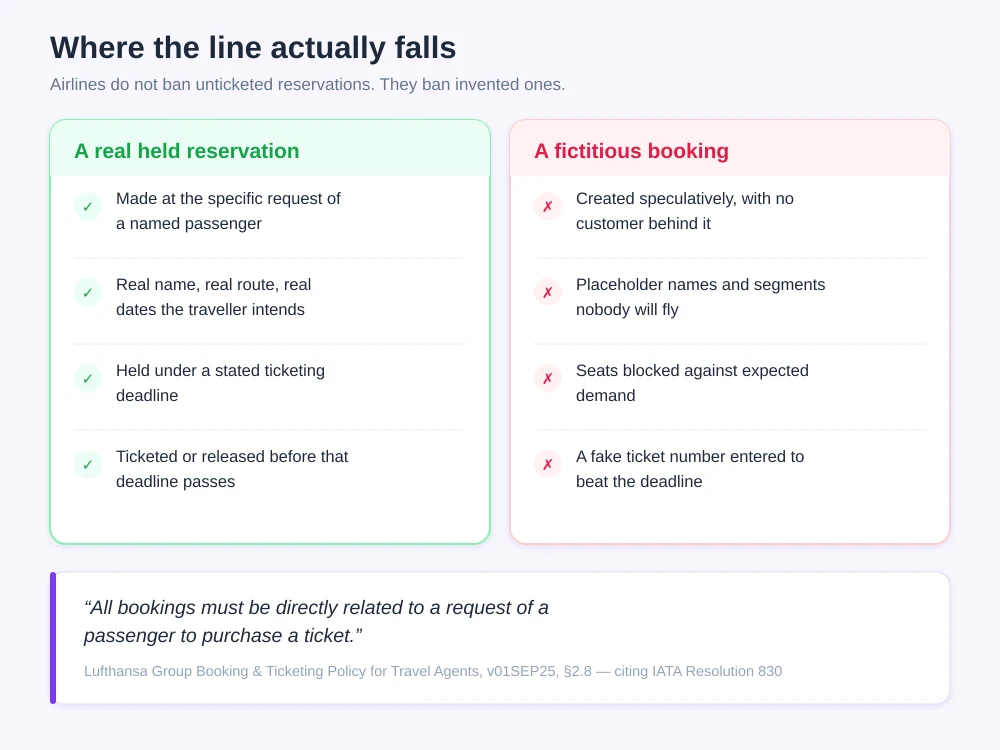
Read the two columns and the boundary stops being mysterious. A named traveller asking for a specific flight on a specific date, held under a stated deadline, sits on the permitted side — that is the transaction the hold was designed for. A record with a placeholder name, or a seat parked speculatively against demand nobody has expressed, sits on the other. The variable is not payment. It is whether a real person actually asked.
The policy also closes the obvious shortcut, in a single sentence that deserves to be better known: "A fake ticket number is considered as an intention to bypass the TTL." Typing an invented 13-digit number into a record does not extend the deadline. It is read as evasion of it — which is the clearest official statement available that a fabricated document is a worse position than an honest unpaid hold. It is also why the legality question around flight reservations turns on authenticity rather than on payment.
The airline's objection was never "you have not paid yet". It was always "this booking does not describe anybody real".
Key takeaway: The compliant position is a real reservation, in your real name, for a route you intend to fly, resolved before its deadline.
What this means at a visa desk and at the check-in counter
Two different counters care about your booking, and they care about different fields. A consulate is testing whether your stated plan is real and coherent. An airline is testing whether it can legally carry you and get you accepted at the other end. Neither of those tests is "have you already paid".
Consulates routinely accept a reservation rather than a purchased ticket, and several actively prefer it — buying a non-refundable ticket before a decision is a poor idea for the applicant and proves nothing extra to the officer. What they check is that the itinerary matches the application and that the record can be looked up. The distinction between the documents people name in this space is set out in our breakdown of a dummy ticket, an onward ticket and a flight reservation.
Airline check-in is a stricter environment, because the airline carries the cost of getting it wrong. Agents work against the rules engine described in our piece on the database that decides whether you board, and where a destination requires onward travel, a reservation the agent can see is the thing that clears you. If the record has quietly gone to HX, that check fails at the desk — which is one of the recurring reasons online check-in refuses to open in the first place.
Timing is the piece travellers get wrong most often. A reservation that expires the week before submission is worthless, and one issued far too early may lapse before the decision arrives — the balance is covered in our guide to how long a reservation stays valid, and the alternatives are ranked in six ways to show proof of onward travel.
Key takeaway: Officers and agents do not ask whether you paid. They ask whether the record is real, current and consistent with what you told them.
The mistakes that turn a held booking into a stranded passenger
Most failures in this area come from a small, repeatable set of assumptions. Each one is reasonable on its face and wrong in practice.
Treating the confirmation email as a live document. It is a snapshot, generated once. The record it describes can change ten minutes later and the email will never update. Check the record, not the receipt of the record.
Assuming somebody will warn you. The ticketing deadline is addressed to the seller, not to you. Automated cancellation is designed to run without human review, and the policy language says so explicitly.
Booking the same trip twice "to be safe". Duplicate detection is automated and blunt. Lufthansa's policy warns that duplicate segments are cancelled with the same HX code, and travellers occasionally lose both records rather than one.
Reading "confirmed" as "paid" when a third party is paying. Corporate travel, tour packages and award redemptions are exactly where a booking sits unticketed the longest, because someone else's approval sits between the hold and the payment.
Buying a ticket to satisfy a document requirement. This is the expensive mistake in reverse. A visa outcome is not improved by a purchased ticket, and refusal then leaves you holding a fare you cannot use. The cost comparison against a refundable fare makes the arithmetic plain.
Key takeaway: Nothing in this system is designed to protect an inattentive passenger. The deadline is real, the cancellation is automatic, and the only defence is checking.
Next steps
If you are holding a booking right now, do the two-field check before you do anything else: is there a 13-digit ticket number, and does the airline's own site still return the record. Those two answers tell you whether you have a ticket, a live hold, or nothing at all.
If what you need is a reservation an officer or an airline agent can verify — for a visa file, for an onward-travel check at the gate, for a border officer asking when you are leaving — then a real booking under a live record is the right instrument, and buying a fare you do not intend to fly is not. That is the specific thing MyJet24 issues.
A genuine reservation with a locator that resolves — issued in about 30 seconds.
About the author
Marc Hoffmann is a Senior Visa Consultant at MyJet24. He has spent more than a decade working with flight reservations, GDS records and consular documentation requirements, and handles escalations where a traveller's booking and an officer's expectations do not match.
Reviewed by James Mitchell, CEO & Founder of MyJet24, who built the company's reservation issuing and verification workflow.
Last reviewed on 25 August 2026 by James Mitchell.
Sources
- Lufthansa Group Airlines — Booking & Ticketing Policy for Travel Agents, version 01SEP25 (§§2.5–2.13)
- Travelport Universal API — Air Segment Status Codes
- IATA — Ensuring the viability of air transport (100% e-ticketing, 2008)
- 14 CFR § 259.5 — Customer Service Plan (24-hour reservation rule), eCFR
Methodology note: the ticketing-deadline and cancellation mechanics described here were taken verbatim from a published airline agency policy rather than from secondary summaries, and the status-code definitions from the GDS vendor's own documentation. Airline policies differ in detail; the mechanism is industry-standard, the specific deadlines are not.
Last updated: 25 August 2026 · Reviewed by James Mitchell, CEO & Founder, MyJet24
