
Last updated: 20 August 2026 · Reading time: 12 min · Author: James Mitchell, CEO & Founder of MyJet24 · Reviewed by: Marc Hoffmann, Senior Visa Consultant
TL;DR — Key facts
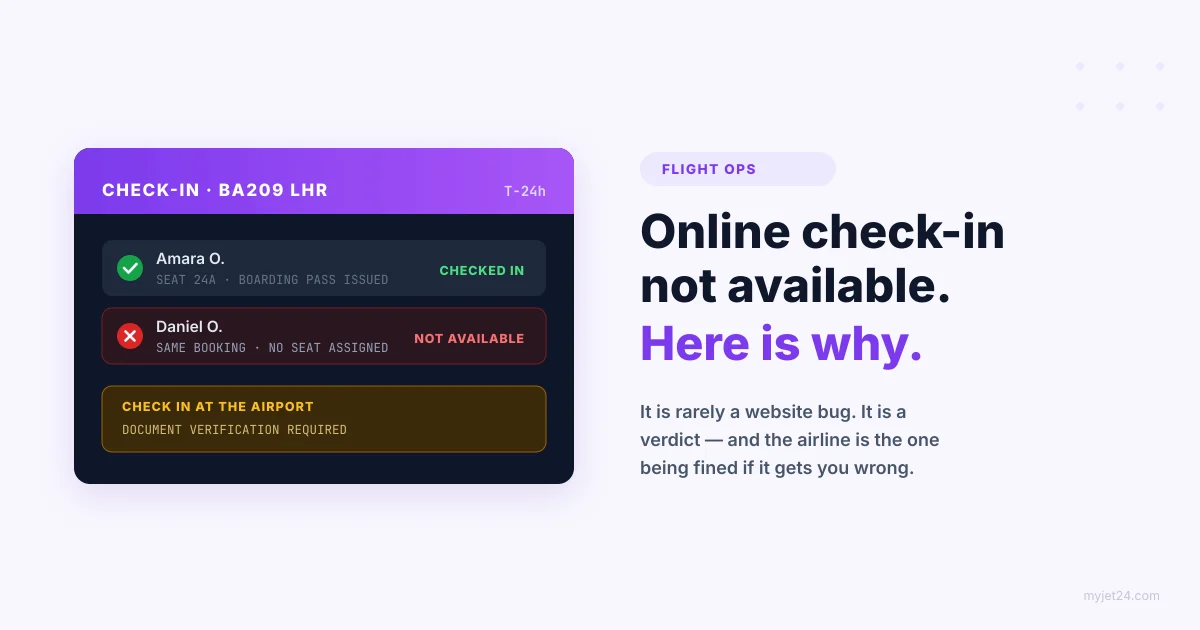
- "Check in at the airport" is a verdict, not an error. The airline's system reached a decision about your documents and is not allowed to explain it in a web form.
- One test cuts the causes by two-thirds. Ask someone on the same booking to try. If they get a boarding pass and you do not, the flight is fine and the block is attached to you.
- The airline blocks you because it pays. EU carriers face €3,000–€5,000 per improperly documented passenger under Directive 2001/51/EC; UK penalties reach £10,000.
- A missing onward or return segment is the cause travellers never see named. It reads as a generic block, because the message is generic by design.
- The block costs you more than convenience — seat assignment, bag-drop margin and your position if the flight is oversold.
Online check-in is unavailable for one of three reasons: the check-in window is not open or has closed, something specific to you needs a human (a security flag, a minor, an animal, a name mismatch), or an automated document check has returned a condition your booking does not satisfy. On international routes the third is the most common and the least visible, because airlines show a single generic message for every document verdict.
If a missing return or onward segment is what is blocking you, this is the fastest fix.
In this guide
- What the message actually means
- The three levels of a check-in block
- Level 1: the clock
- Level 2: it is you, not the flight
- Level 3: the document check nobody names
- The missing onward segment
- Why the airline would rather block you
- Five steps, in order
- What the block actually costs you
- What happens at the desk
- Next steps
What the message actually means
Online check-in is the airline's self-service route to a boarding pass, taken through its website or app, and it works only when every rule attached to your trip can be cleared without a person looking at you. When one cannot, the departure control system withholds the pass and returns a stock sentence — "online check-in is not available for this flight", or "please check in at the airport". Neither sentence is a description of the problem. Both are the same placeholder, printed whatever the reason.
That design choice is why the situation feels arbitrary. A traveller reads "not available for this flight" and reasonably concludes the flight is at fault, then reloads the page for two hours. In practice the phrase covers a dozen different findings, and several of them are about the traveller rather than the aircraft. The wording is generic because the airline has no interface for telling you, mid-form, that a rule about your passport was not met.
Two things follow. First, retrying rarely helps, because nothing in the underlying finding changes between attempts. Second, the useful question is not "is the site broken" but "which of three levels am I stuck at" — and that question you can answer yourself in about five minutes.
Key takeaway: the message you are reading is a placeholder, not a diagnosis. Treat it as "a rule was not satisfied" and go find the rule.
The three levels of a check-in block
An online check-in block sits at one of three levels: flight-level, passenger-level, or document-level. The level tells you who is affected, who can fix it, and whether waiting will help — which is the entire diagnosis in one step. Sorting an online check-in block by level is faster than working through a list of twelve causes, because each level rules out the other two.
Flight-level online check-in blocks affect everybody on the aircraft: the window has not opened, it has closed, the flight is operated by a partner airline, or the flight is oversold. Passenger-level blocks affect you alone and usually involve something the system will not automate — a security selectee code, an unaccompanied minor, a service animal, a name that does not match the passport. Document-level blocks are also personal, but they come from an entry-rules check rather than from your booking type, and they are the ones travellers misread most often.
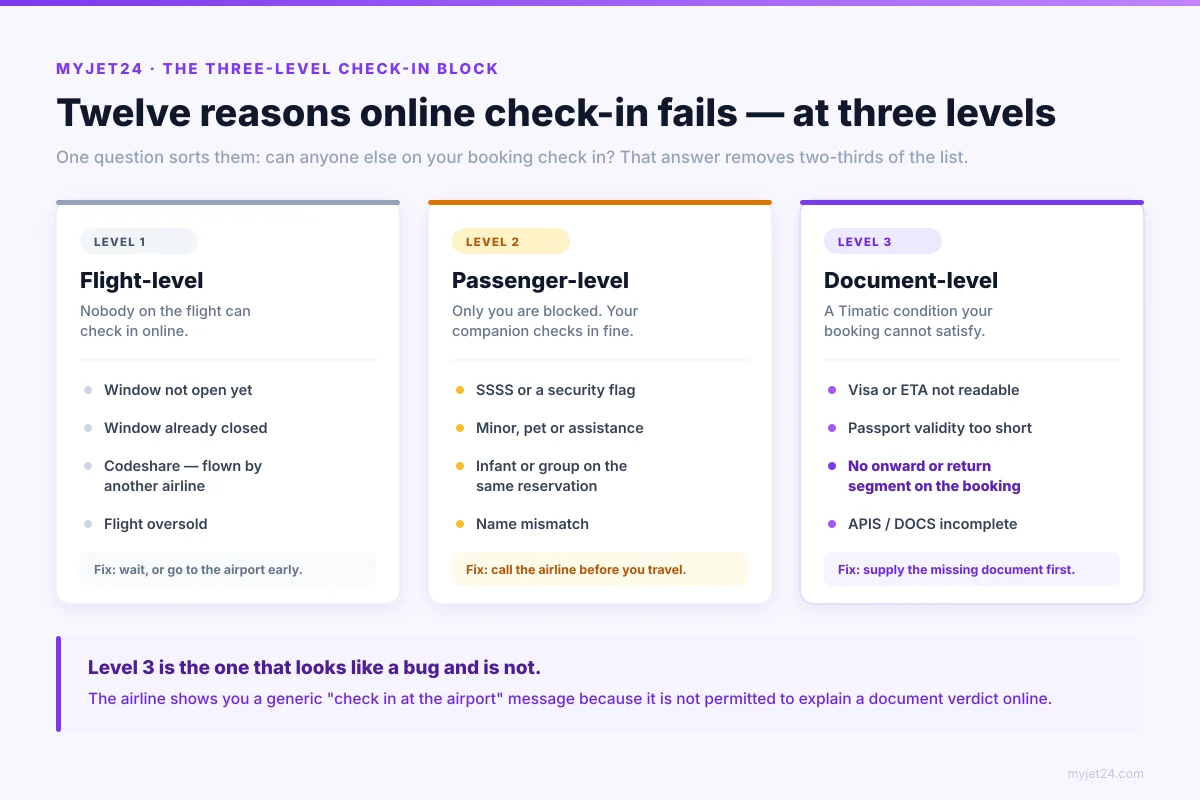
The practical difference is what each level responds to. A flight-level block responds to time. A passenger-level block responds to a phone call. A document-level block responds only to a document — no amount of calling or waiting will move it until the missing item exists.
Key takeaway: identify the level first. It converts a guessing game into three short questions.
Level 1: the clock
The check-in window is the period during which an airline will issue a boarding pass through its app or website, and it has two edges rather than one. Travellers watch the opening edge and forget the closing edge, which is why a surprising share of online check-in not available reports come from people who are late rather than early. Both edges of the online check-in window are set in local time at the departure airport, not in your phone's time zone.
Online check-in windows vary by carrier and by route, and long-haul is consistently stricter than short-haul. Full-service airlines typically open 24 hours before departure; several low-cost carriers open far earlier for passengers who paid for a seat, and charge those who did not. The table below shows the shape of the pattern rather than any single airline's rule, which changes often enough that it should always be confirmed on your own booking.
| Carrier type | Typical opening | Typical online close | What usually goes wrong |
|---|---|---|---|
| Full-service, short-haul | 24 h before | 1–2 h before | Trying at 25 hours and assuming it is broken |
| Full-service, long-haul | 24–48 h before | 1.5–3 h before | Document checks close the web channel entirely |
| Low-cost | 30 days to 24 h | 2 h before | Free window opens late unless a seat was bought |
| Codeshare, partner-operated | Operating carrier's rule | Operating carrier's rule | Checking in on the wrong airline's website |
The codeshare row deserves its own sentence, because it produces a block that looks unfixable and is trivial. If you bought the ticket from one airline but the aircraft belongs to another, check in on the operating carrier's site using its own booking reference — the one your confirmation lists as the "operated by" record locator. The selling airline often cannot check you in at all.
Key takeaway: confirm both edges of the window in airport local time, and confirm which airline actually operates the flight, before assuming anything is wrong.
Level 2: it is you, not the flight
A passenger-level block is one attached to your record rather than to the flight, which means other travellers on the same booking will check in normally while you cannot. This is the single most informative symptom available to you, and it costs nothing to test: ask whoever you are travelling with to try. If their boarding pass appears, every flight-level cause is eliminated in one move.
The usual passenger-level causes are deliberate. Passengers selected for secondary screening — the four S's printed on a US boarding pass — are routed to an agent by design. So are unaccompanied minors, passengers travelling with an animal in the cabin or hold, anyone who booked wheelchair or medical assistance, and infants added after the original reservation. Group bookings above a certain size are frequently excluded from online check-in as a matter of policy. None of these is a fault; all of them require a person.
Name mismatches sit slightly apart, because they are the one item on this list you may be able to correct in advance and the one most likely to escalate at the airport. A middle name that appears on the passport but not on the ticket is usually tolerated; a transposed surname and given name, or a different spelling, often is not. Our guide to the name on your flight ticket covers which mismatches airlines correct free of charge and which are treated as a change of passenger.
If one person on a booking gets a boarding pass and another does not, stop investigating the flight. The flight is fine. Something is attached to a name.
Key takeaway: the companion test is the highest-value thirty seconds in this entire process.
Level 3: the document check nobody names
A document-level block is the outcome of an automated entry-rules check run against your itinerary and travel documents before a boarding pass is issued. The system behind it, on most of the world's airlines, is Timatic — the travel information database IATA has maintained since 1963. It covers more than 220 countries, draws on over 2,000 sources, is updated as often as 200 times a day, and is used to check the documents of more than 700 million passengers a year.
Two IATA products decide what happens to you specifically. Timatic AutoCheck runs the rules automatically inside the airline's own systems, before you reach the airport. Timatic Doc Scan lets you photograph a passport or visa inside the airline's app so it can be verified during check-in rather than at a desk. When either returns a condition it cannot confirm, the web channel closes and the case is handed to a human. We covered how those rules are assembled and why they differ between two airlines on the same route in our explainer on the airline document check.
The most common document-level findings are mundane: a passport whose expiry falls inside the destination's validity margin, an electronic authorisation the airline cannot match to your passport number, a visa in a previous passport, or advance passenger information that is incomplete. That last one is worth naming properly — the DOCS entry in your booking carries the passport data an airline must transmit to the destination before departure, and an itinerary missing it will often refuse to produce a boarding pass. Our breakdown of what airlines send governments before you fly explains where that data sits and why it matters at exactly this moment.
Passport validity is the quietest of these, because the document looks perfectly valid to you. Many destinations require six months of remaining validity counted from arrival, some count from departure, and a handful require only the length of stay. The rules on passport validity and blank pages vary enough that a passport which cleared one border last month can block check-in for the next one.
Key takeaway: a document-level block is a finding about your paperwork, produced by a database you cannot see and will not be shown.
The missing onward segment
Proof of onward travel is a booked departure from the country you are entering, and in dozens of destinations it is a condition the airline must verify before boarding rather than a formality at the border. It is also, in our experience handling these cases, the document-level cause travellers are least likely to identify on their own — because nothing in the check-in message mentions travel dates, and because the passenger is usually thinking about the passport in their hand rather than the flight they have not booked.
The pattern is consistent. A traveller holds a one-way ticket into a country that expects visitors to demonstrate departure, arrives at the 24-hour mark, and finds the web channel closed with no explanation. Their travel companion, on a return ticket, checks in without difficulty. The rule was applied per passenger, against each itinerary, exactly as designed. Airlines enforce this at check-in rather than at the gate precisely because it is cheaper to stop a booking early — a point we set out in detail in whether airlines can deny boarding over onward travel.
What satisfies the rule is narrower than most people assume. The check is run against a live reservation, so a screenshot, an expired hold or a cancelled return leg proves nothing even though the PDF still looks intact. A booking reference that resolves in the airline's system does; one that does not, does not. Our guide to the ways to show proof of onward travel compares the six options honestly, including the ones we would not recommend, and what a passenger name record actually contains explains why a live reference is the thing being queried.
A real reservation with a PNR the airline can resolve — not a screenshot.
Key takeaway: if you are flying one-way into a country that requires proof of exit, assume this is your block until something rules it out.
Why the airline would rather block you
Carrier liability is the legal principle that makes an airline financially responsible for any passenger it carries to a border that refuses them, and it is the reason online check-in closes rather than waves you through. The airline is not expressing doubt about you. It is the party that pays if the assessment is wrong, and the amounts are large enough to make a blocked web check-in the conservative commercial choice every time.
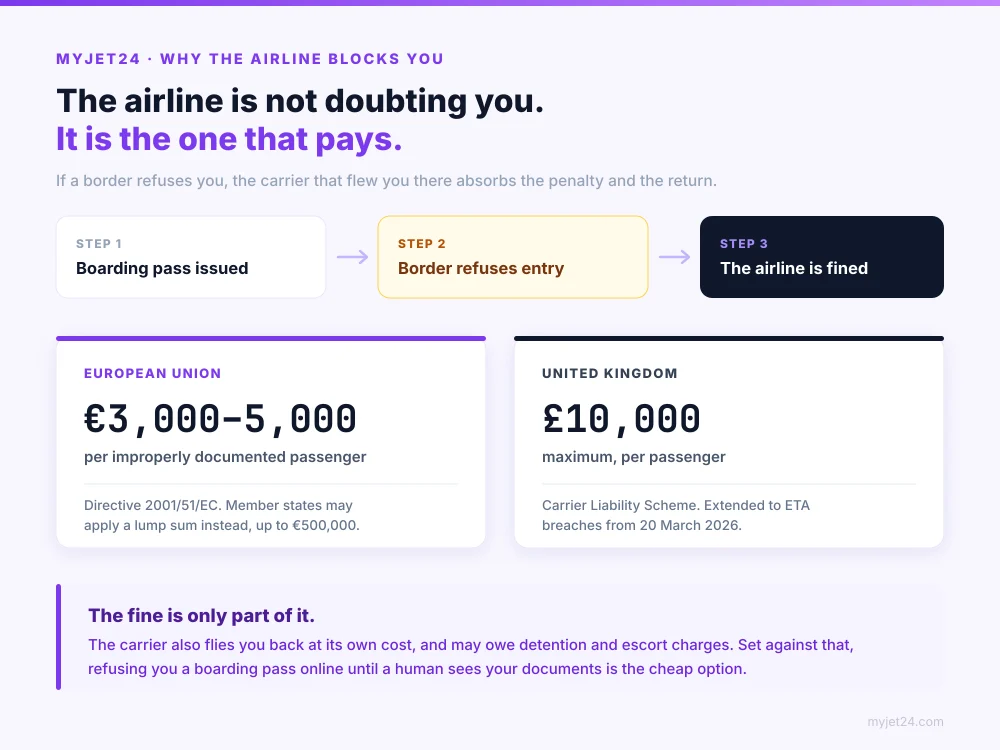
WHAT A WRONG DECISION COSTS THE AIRLINE
- €3,000–€5,000 per passenger — the range EU member states must impose on carriers bringing in improperly documented travellers, under Directive 2001/51/EC.
- €500,000 — the maximum lump sum a member state may apply per infringement instead of a per-passenger figure.
- £10,000 per passenger — the upper limit under the UK Carrier Liability Scheme, extended to electronic travel authorisation breaches from 20 March 2026.
- 700 million+ — passengers whose documents are checked against IATA's Timatic database each year.
Set the return flight, the detention charges and the escort costs alongside those figures and the incentive is obvious. A blocked online check-in costs the airline nothing at all; a wrongly boarded passenger can cost it five figures and a repatriation. Given that asymmetry, an airline will always prefer to have an agent look at your documents in person, and the marginal case is always resolved against the web channel.
Nobody at the airline decided you were suspicious. A system decided that letting you print your own boarding pass was the more expensive option.
Key takeaway: the block is a risk transfer, not a judgement — which is why arguing with it never works and supplying the missing document always does.
Five steps, in order
Diagnosing an online check-in block is a sequence, not a checklist, because each step removes causes the next one would otherwise have to consider. Running the five below takes about five minutes and, in most cases, identifies the level before you speak to anyone. Do them in order; the second is the one that does the most work.
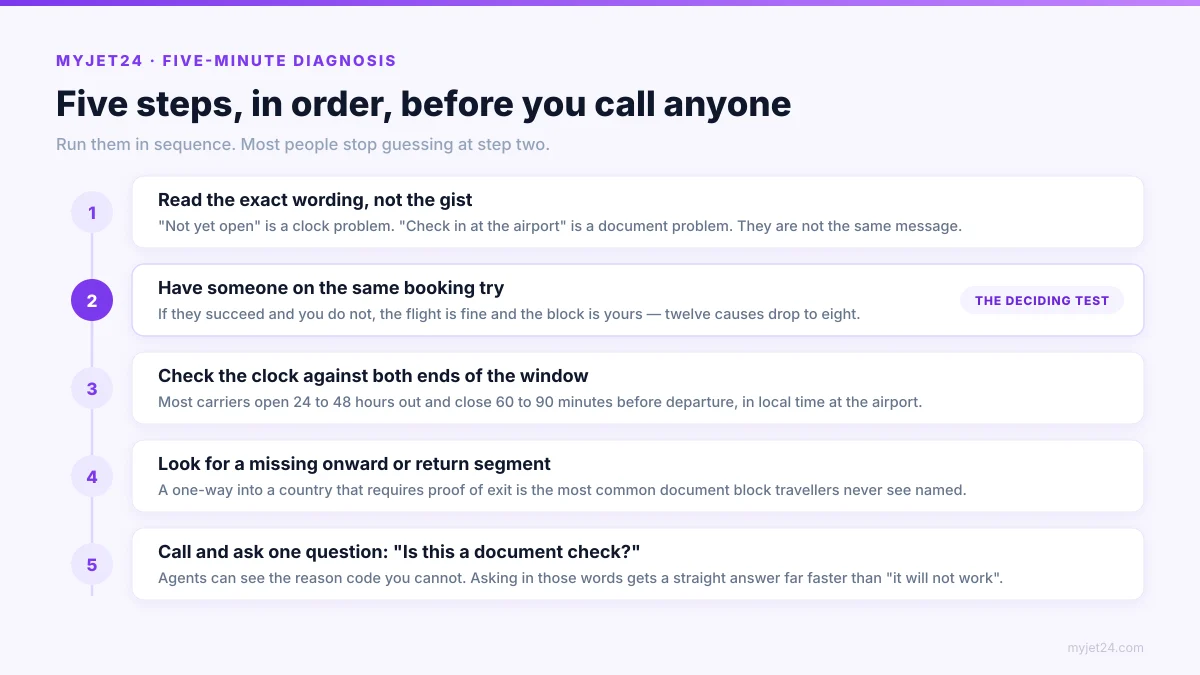
- Read the exact wording. "Online check-in is not yet open" is a clock problem and will resolve itself. "Please check in at the airport" is a document problem and will not. Screenshot whichever you get — the agent will ask.
- Have someone on the same booking try. If their pass issues and yours does not, you are at level two or three and every flight-level cause is gone. If nobody can check in, it is the flight, and you are almost certainly early or late.
- Check the clock against both edges. Confirm the opening and closing times for your specific carrier and route, in local time at the departure airport. Long-haul closes earlier than people expect.
- Read your own itinerary for a missing onward or return segment. Look at the destination's rules on proof of exit, then look at whether your booking contains a departure from that country. A one-way into a country that requires proof of onward travel is the most commonly missed cause on this list.
- Call and ask one question: "Is this a document check?" Agents can see a reason code you cannot. Naming the category gets you a specific answer far faster than describing the symptom, and it lets them tell you which document is missing while you still have time to produce it.
Key takeaway: ask the companion first and phone last. Reversing that order wastes the hours you may need.
What the block actually costs you
A blocked online check-in is not merely an inconvenience; it changes your position on the flight in three measurable ways. Understanding what you lose is what makes the difference between resolving it tonight and resolving it in a queue tomorrow morning. The costs are small individually and compound badly together.
| What you lose | Why it happens | How much it matters |
|---|---|---|
| Seat choice | Free seats are assigned as passengers check in | Moderate — worst on long-haul and for families |
| Time margin | You now need the desk, not just bag drop | High — add 45–60 minutes to your airport plan |
| Priority if oversold | Checked-in passengers are generally bumped last | High on full flights, irrelevant on empty ones |
| Time to fix | A document found missing at the desk cannot be booked calmly | Decisive — this is the real cost |
The last row is the one that matters. A missing onward booking discovered at 24 hours is a two-minute task at home. The same finding at the desk, ninety minutes before departure, with a queue behind you and an agent who cannot wait, is how people miss flights they were fully entitled to take.
Key takeaway: the expensive part of a check-in block is not the block. It is discovering the cause too late to act on it.
What happens at the desk
Airport check-in for a passenger blocked from online check-in is a manual document verification: an agent opens your record, sees the condition the automated check flagged, and either clears it or does not. The interaction is usually short and unremarkable. Bring the passport, any visa or electronic authorisation, and evidence of your onward travel, and most blocks clear in under two minutes.
Arrive earlier than the airline's stated minimum, because a document check is not a bag drop. Where a standard passenger might comfortably arrive two hours before a long-haul departure, a flagged passenger should treat that as the point by which the conversation should already be over. If the agent needs a supervisor, or if you need to make a booking on the spot, the extra half hour is what saves the flight.
If the agent tells you something is missing, ask exactly what would satisfy the requirement and in what form. Answers are specific and usually reasonable — a confirmed reservation out of the country, a visa page from a previous passport, an authorisation number tied to the passport you are actually carrying. Nothing about this stage is adversarial; the agent is trying to issue the boarding pass, and needs a defensible reason to do it.
Key takeaway: treat a known block as a reason to arrive early, not a reason to arrive resigned. Most clear in minutes if you brought the right document.
Next steps
To summarise: read the exact wording, ask a companion on the same booking to try, check both edges of the check-in window, then read your own itinerary for a missing onward or return segment before you call anyone. If the phrase your online check-in returned is "check in at the airport" on an international route, treat it as a document finding rather than a fault, and spend your remaining time producing the document rather than reloading the page.
If the missing piece turns out to be proof that you will leave the country, that is the one cause on the list you can resolve tonight, from where you are sitting, before the desk ever becomes part of the story.
Sources
- European Union — Financial penalties on passenger carriers (Directive 2001/51/EC: EUR 3,000–5,000 per passenger; lump sum up to EUR 500,000).
- IATA — Timatic solutions and Timatic AutoCheck (coverage, update frequency, automated document verification).
- European Union — Air passenger rights (denied boarding, care and compensation).
This guide describes standard airline practice as of 20 August 2026 and was reviewed by Marc Hoffmann, Senior Visa Consultant at MyJet24. Check-in windows, document requirements and carrier policies are set by each airline and each destination government, and change without notice; penalty figures reflect the cited legislation at the date of publication. Always confirm requirements with your airline and the destination's authorities before you travel. This article is informational and not legal advice.
