
Last updated: 10 August 2026 · Reading time: 14 min · Author: Marc Hoffmann, Entry-Requirements Writer at MyJet24 · Reviewed by: Joshua White
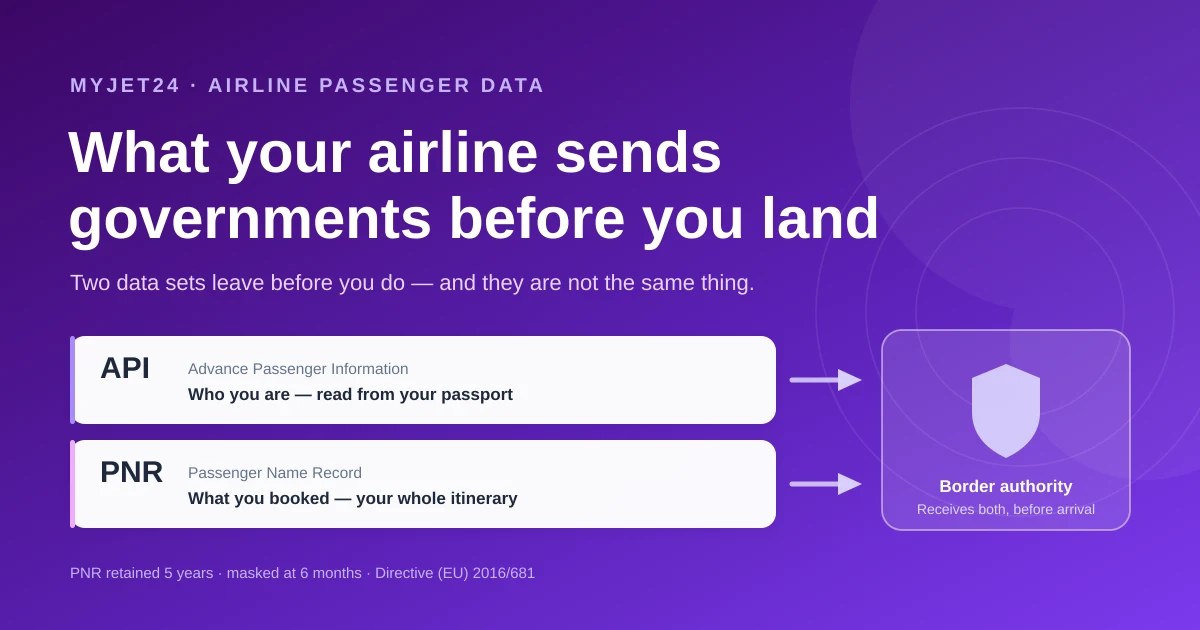
TL;DR — Key Facts
- Airlines send two different data sets, not one. API is who you are, read from your passport. PNR is what you booked, taken from your reservation. Different content, different laws, different timing.
- Your PNR includes your complete itinerary — travel dates, routing, contact details, payment information, seat and baggage. Your return or onward flight is part of that record.
- The data arrives before you do. API is transmitted prior to take-off, so a destination's authorities can hold your identity details while you are still in the air.
- Retention is long and defined by statute. Under Article 12 of the EU PNR Directive, PNR data is kept for five years, and is depersonalised by masking after six months.
- 2026 is a turning point in the EU. Regulations (EU) 2025/12 and 2025/13 route all API and PNR transfers through a single router developed and managed by eu-LISA, and require carriers to capture data by automated means.
- The practical takeaway: the booking you show at check-in is also the booking in the record. A genuine reservation exists in that data; a fabricated PDF does not.
Airlines transmit two distinct data sets to governments. API — Advance Passenger Information — is identity data read from your travel document: name, date of birth, nationality, document number and expiry, plus flight and port details. PNR — Passenger Name Record — is your booking: travel dates, full itinerary, contact details, payment information, seat and baggage. API exists for border control and is sent before take-off; PNR is commercial data reused for law enforcement. In the EU, PNR is retained for five years and masked after six months.
A real booking with a live PNR — the kind that exists in the record, not just on paper.
In this guide
Two data sets, not one
API and PNR are two separate passenger data sets that airlines transmit to state authorities under different legal regimes. API describes the traveller; PNR describes the trip. Conflating them is the single most common error in explanations of airline data sharing, and it makes the rest of the subject incoherent.
The origins explain the difference. API was introduced as a border-control measure — an identity check performed in advance rather than at the desk — and expanded internationally after 2001 at the initiative of United States authorities. PNR was never designed for governments at all: it is the commercial record an airline or travel agency creates to sell and service your booking, later made available to law enforcement. One is a document read; the other is a business file handed over.
Key takeaway: if a claim about "airline data sharing" does not say whether it means API or PNR, treat it as unreliable. The two differ in content, in timing, in retention and in which authority receives them — and almost every practical question depends on which one you are asking about.
What API actually contains
Advance Passenger Information is the identity data taken from your travel document plus the basic facts of the flight. It is deliberately narrow: it answers "who is on this aircraft, and where is it going," and nothing more.
The set comprises the type, number, country of issuance and expiry date of your identity document; your nationality, family name, given name, gender and date of birth; and the airline, flight number, departure and arrival dates, departure and arrival ports, and departure and arrival times. Notice what is absent — no payment details, no address, no seat, no baggage, no travel agent. That narrowness is the point: API is a border-control instrument, so it carries only what a border authority needs to identify a traveller and match them to a flight. Most of it comes straight from the machine-readable zone of your passport, which is why the accuracy of that scan matters so much at check-in.
Key takeaway: API is your passport, digitised and sent ahead. If your document is misread at the desk — a truncated name, a mistyped number — the error propagates into the data a border authority receives before you land, which is one reason document capture is handled so carefully. Our explainer on how the airline document check works covers that capture stage in detail.
What PNR actually contains
A Passenger Name Record is the airline's commercial file on your booking, and it is considerably richer than API. Where API describes a person, PNR describes a plan — including the parts of it you never showed anyone.
PNR data may include the dates of travel and the complete travel itinerary of the passenger or group travelling together; contact details such as address and telephone number; all forms of payment information; the seat number; and baggage information. It also carries the identifiers travel systems attach along the way — the booking reference, the agency that made the reservation, frequent-flyer details and free-text "general remarks." Two consequences follow. First, PNR reveals associations: people booked together sit in the same record. Second, it reveals the shape of a trip, not just a single flight, which is precisely why authorities value it for pattern analysis. Our guide to verifying that a PNR is genuine covers the record from the traveller's side.
API is a photograph of your passport. PNR is a photograph of your plans — who you are travelling with, how you paid, where you can be reached, and where you said you were going next.
Key takeaway: the PNR is the more revealing of the two by a wide margin. If you have ever wondered whether an authority could know your return date before you arrive, the answer sits in this data set rather than in API.
API vs PNR side by side
Placing the two sets against each other resolves most confusion in one view. They differ on origin, content, purpose, timing and retention — five axes, and they diverge on all five.
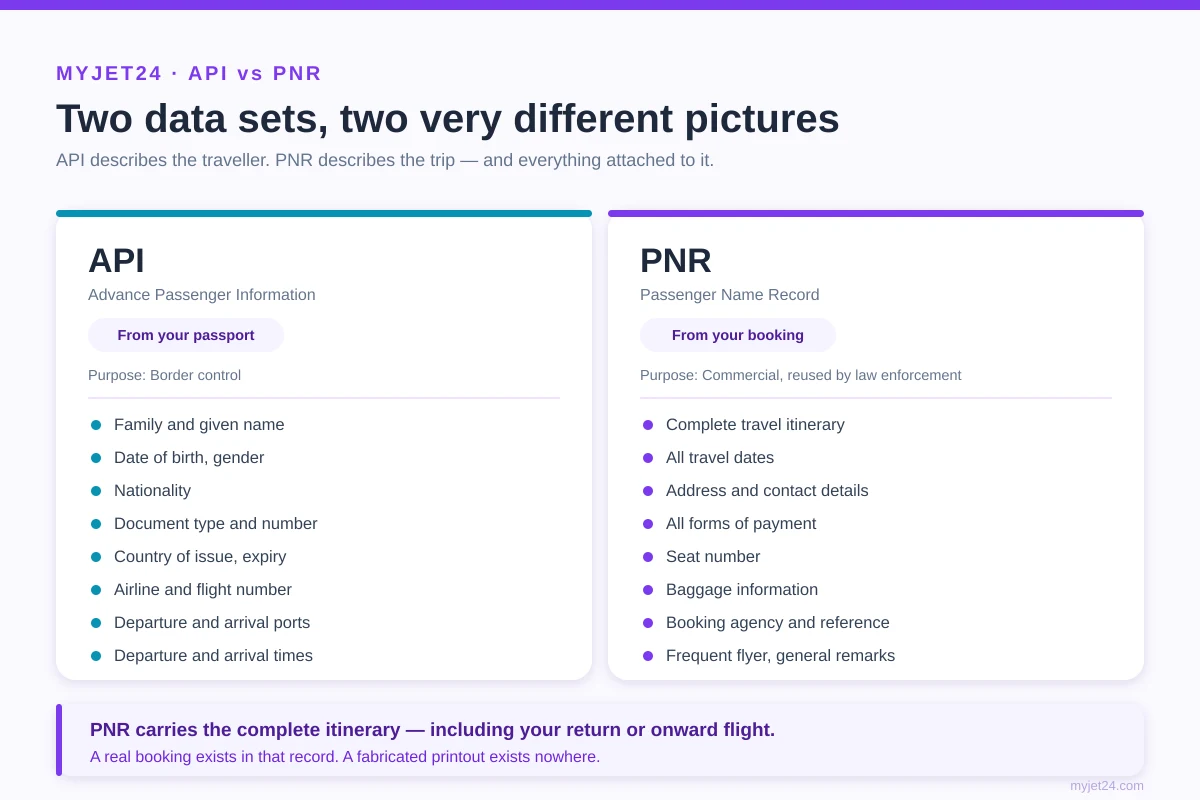
| API | PNR | |
|---|---|---|
| Stands for | Advance Passenger Information | Passenger Name Record |
| Source | Your travel document, scanned | Your booking file |
| Describes | Who you are | What you booked |
| Includes payment | No | Yes |
| Includes itinerary | One flight only | The complete trip |
| Original purpose | Border control | Commercial, reused for law enforcement |
| EU legal basis | Regulations (EU) 2025/12 and 2025/13 | Directive (EU) 2016/681 |
Key takeaway: API is small, standardised and identity-focused; PNR is large, messy and plan-focused. When people worry about airline data sharing, the concern almost always belongs to the PNR column.
When each one is sent
The transfers happen at different moments, and the sequence matters because it determines what an authority knows and when. Your data leaves the airline in stages rather than in a single transmission at the gate.
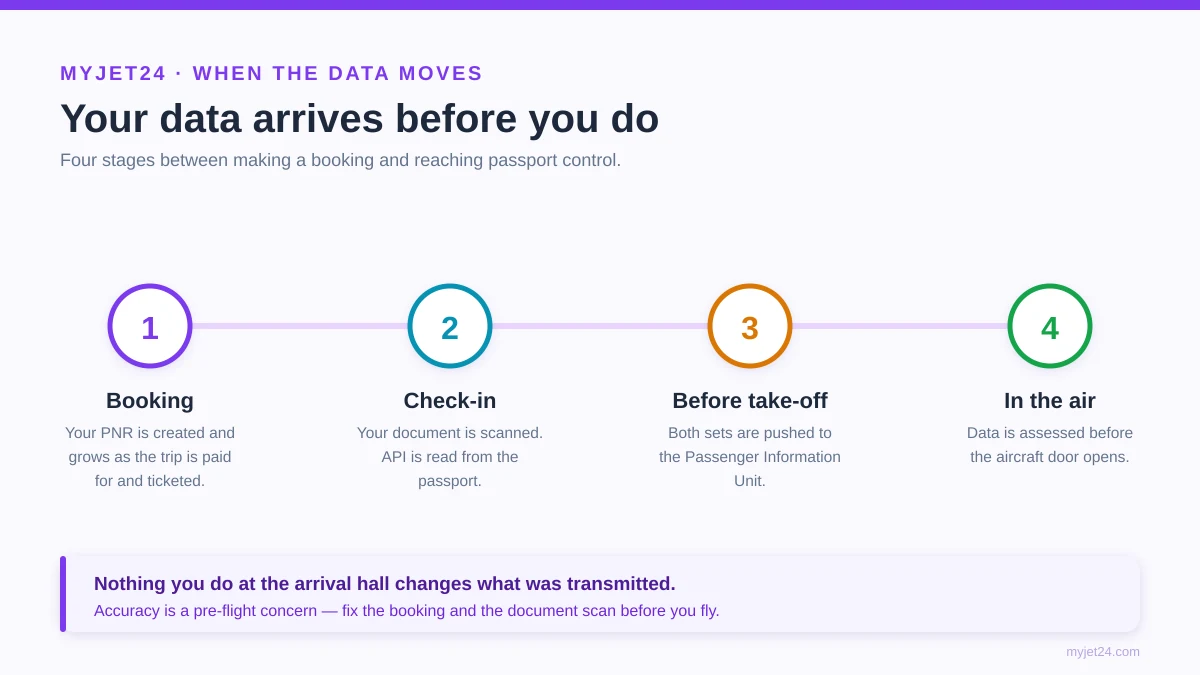
It runs in four stages. Your booking creates the PNR, which then grows as the trip is amended, paid for and ticketed. Check-in captures API by reading your travel document. Both sets are then pushed to the receiving authority — under the EU framework, air carriers transfer the data by the "push method" to a national Passenger Information Unit, with API sent prior to take-off. Finally the data is assessed while you are in the air, so that any question about you exists before the aircraft door opens. The contrast with the airline's own document check is worth holding onto: that check decides whether you board, and it happens in front of you; this transfer decides what the state knows, and it happens invisibly.
Key takeaway: by the time you reach passport control, your identity data has already been sent, received and processed. Nothing you do at the arrival hall changes what was transmitted — which is why the accuracy of your booking and your document scan is a pre-flight concern, not an arrival one.
A verifiable reservation with a live PNR, ready in about 30 seconds.
How long it is kept
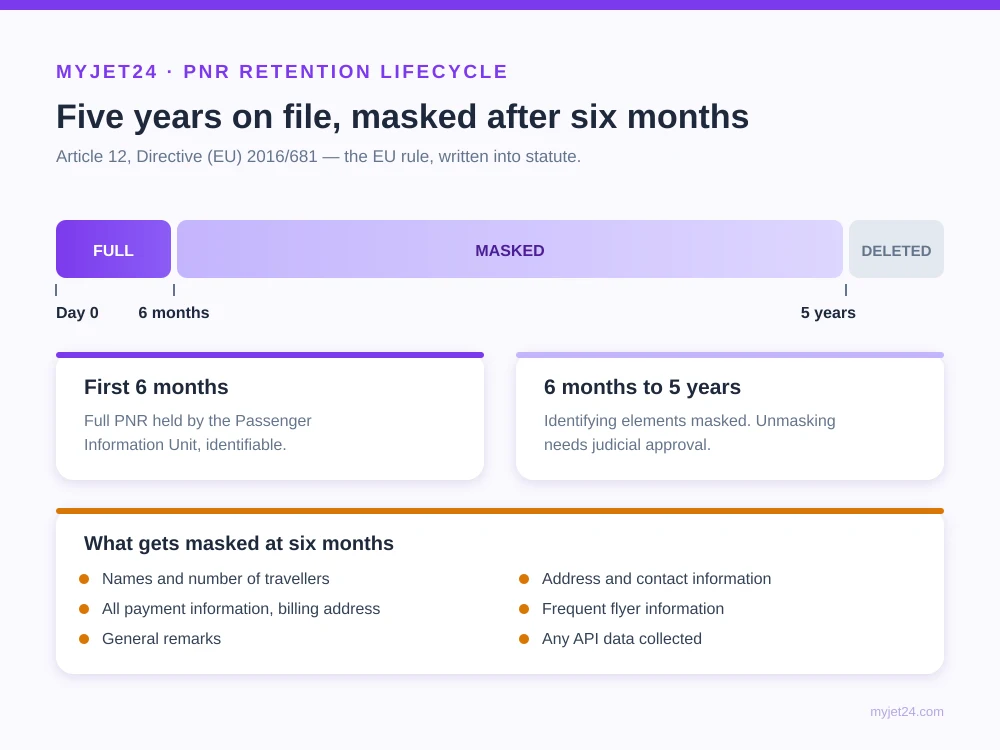
In the European Union, PNR retention is fixed by statute rather than by policy, and the period is long. Article 12 of the PNR Directive sets it out precisely, including a mandatory reduction in how identifiable the data remains.
PNR data provided by air carriers is retained in a database at the Passenger Information Unit for a period of five years. Upon expiry of a period of six months after transfer, the data must be depersonalised by masking out the elements that identify you directly: names, including the names of other passengers on the record and the number of travellers; address and contact information; all forms of payment information, including billing address; frequent-flyer information; general remarks; and any API data that has been collected. After that six-month point, disclosure of the full data requires approval from a judicial or other competent national authority, with review by a data protection officer.
The numbers worth remembering. Under Article 12 of Directive (EU) 2016/681, PNR data sits with a Passenger Information Unit for five years, with depersonalisation by masking at six months and six categories of element masked. The API Regulations, (EU) 2025/12 and (EU) 2025/13, were adopted on 19 December 2024 and entered into force on 28 January 2025. On the other side of the flight, Eurostat recorded 132,600 refusals of entry at EU external borders in 2025, of which 40,185 — 30.3% — were for "purpose and conditions of stay not justified," the category an unconvincing travel plan falls into. The Schengen proof-of-funds rules cover the money side of the same assessment.
Key takeaway: a flight you took four years ago is still in a European database, though in masked form after the first six months. Retention is not indefinite, and it is not discretionary — the five-year ceiling and the six-month masking are both written into the directive.
What changes in 2026
The European Union is consolidating passenger data transfer into a single technical channel. Two regulations adopted on 19 December 2024 — Regulation (EU) 2025/12 for border control and Regulation (EU) 2025/13 for law enforcement — entered into force on 28 January 2025 and apply once the new infrastructure goes into service.
Two changes matter to travellers. First, a single API/PNR router, developed and managed by eu-LISA, replaces the patchwork of bilateral connections between carriers and individual member states; API and PNR data will flow to Passenger Information Units through that one channel. Second, carriers must collect API data by automated means, with manual entry permitted only in exceptional cases — a shift away from an agent typing details from a passport and towards machine capture at the document scan. The practical effect is fewer transcription errors and more consistent data, and it sits alongside the biometric border changes travellers already meet in Europe, which our EES guide and ETIAS vs EES comparison cover.
Key takeaway: the direction is centralisation and automation. Nothing about this expands what a traveller must personally do — there is no form to file and no fee to pay — but it does mean the data reaching authorities will increasingly be machine-read rather than hand-typed.
Your onward flight is in the record
Because PNR carries the complete travel itinerary rather than a single leg, any return or onward flight held in the same booking forms part of the data transmitted. This is the point at which an abstract privacy topic becomes a practical travel one.
Be precise about what this does and does not mean. It does not mean a border officer routinely audits your onward booking, and it does not create any legal requirement to hold one — that comes from a destination's own entry rules, if at all. What it does mean is that the record describing your trip is a real database entry generated by an actual reservation system, and that it exists independently of whatever document you print. A genuine reservation is in that record. A fabricated PDF with an invented booking code is not in any record at all, which is exactly why it fails when anyone looks it up. The distinction between the two is the subject of our comparison of dummy tickets, onward tickets and flight reservations.
The document you show is a printout. The booking is the record. Systems check the record — which is why "does it look convincing?" is the wrong question, and "does it exist?" is the right one.
Key takeaway: hold a real, verifiable booking rather than something that merely resembles one. Our guide to the six ways of showing onward travel ranks the legitimate options by cost and risk, and every one of them shares the same property: it exists in a system.
What you can do about it
You have limited control over the transfer itself — it is a legal obligation on the carrier, not a consent-based collection — but you do have rights over the data and meaningful control over its accuracy. Both are worth exercising for different reasons.
- Check that your name matches your passport exactly when you book. API is read from the document while PNR comes from the booking; a mismatch between them is a common source of trouble at check-in.
- Keep one trip in one booking where you can. Separate bookings produce separate records, which is what leads to a connection or an onward flight being invisible in the record the airline is looking at.
- Use a real reservation for any onward-travel evidence. Whatever you show should correspond to an actual booking, for the reason set out above.
- Exercise your data rights if you want to see what is held. In the EU, you can make a subject access request to the relevant Passenger Information Unit, and the directive requires a data protection officer to oversee access to unmasked data.
- Correct errors before you fly, not after. Once data has been pushed prior to take-off, the version an authority holds is the version that was sent — amendments at the arrival hall do not retroactively change it.
Key takeaway: you cannot opt out, but you can make the data correct. Accuracy is the part within your control, and it is also the part that determines whether your travel goes smoothly — a lesson that applies equally to boarding decisions at the gate.
Frequently asked questions
What is the difference between API and PNR?
API is identity data read from your travel document — name, date of birth, nationality, document number and expiry — plus the flight and port details. PNR is your booking file, including the full itinerary, contact details, payment information, seat and baggage. API describes the traveller for border control; PNR describes the trip and was created for commercial purposes.
Can immigration see my return flight before I arrive?
Potentially, yes, because the PNR includes the complete travel itinerary and is transferred to the receiving authority in advance. That is not the same as an officer actively reviewing it — most passengers are never looked at individually. It does mean that the itinerary in the system is the booking you actually made, rather than whatever document you happen to be carrying.
How long do authorities keep my booking data?
In the EU, Article 12 of the PNR Directive sets retention at five years in the Passenger Information Unit's database. After six months the data must be depersonalised by masking the identifying elements, and unmasking it after that point requires approval from a judicial or other competent national authority with data protection officer review.
Does my payment information really get shared?
Payment information is among the elements a PNR may contain, so where the airline holds it, it can form part of the transfer. It is also one of the categories that must be masked once the six-month depersonalisation point is reached, along with names, contact details, frequent-flyer information and general remarks.
Can I refuse to have my data sent?
No. The transfer is a legal obligation imposed on air carriers, not a consent-based collection you can decline, and refusing to provide the underlying document data would simply prevent you from travelling. What you can do is ensure the data is accurate and exercise your access rights over what is held afterwards.
What is the API/PNR router?
It is a single technical channel through which API and PNR data will be transferred from air carriers to member states' Passenger Information Units, replacing many separate bilateral connections. It is developed and managed by eu-LISA, the EU agency responsible for large-scale IT systems, under Regulations (EU) 2025/12 and 2025/13.
Does this apply to flights outside the EU?
The regulations and directive described here are EU instruments, but advance passenger data schemes are not unique to Europe — API in particular spread internationally as a border-control measure and operates in many countries under their own national rules. The specific retention periods, masking requirements and oversight arrangements differ by jurisdiction, so treat the EU figures as EU figures.
Is my booking reference the same as my PNR?
The booking reference, or record locator, is the six-character code that points to your Passenger Name Record; the PNR itself is the underlying file containing the itinerary and details. In everyday use the terms are treated as interchangeable, but the distinction matters when you are asked to prove a booking exists, since the code is only useful if a real record sits behind it.
Does booking through an agent change what is collected?
The content of the record can differ, because a PNR carries identifiers for the agency that made the booking along with the itinerary and payment details it holds. The obligation to transfer sits with the air carrier regardless of how the booking was made. Splitting a trip across several agents or airlines tends to create several records rather than one.
Do children have their own record?
Passengers travelling together are frequently held in a single Passenger Name Record, which is why the masking requirements explicitly cover the names of other passengers on the record and the number of travellers. That grouping is one of the reasons PNR is considered more revealing than API, since it exposes associations between people rather than only individual identities.
The bottom line
Two data sets leave the airline before you land. One is your passport, digitised. The other is your plan — where you are going, who with, how you paid and when you leave again. They travel under different laws, arrive at different moments and are kept for different periods, and the EU is now consolidating both into a single router with machine capture at the source. None of it requires anything from you procedurally, which is exactly why so few travellers know it happens.
What it does change is how you should think about evidence. The systems that matter check records, not printouts, so the only travel document worth holding is one that corresponds to something real. Make sure the name on your booking matches your passport, keep a trip in a single record where you can, and when you need to show onward travel, use a booking that genuinely exists. Create a verifiable onward ticket with a live PNR, and the record and the paper will say the same thing.
A real reservation with a live PNR — the record and the printout in agreement.
Marc Hoffmann — Entry-Requirements Writer, MyJet24
Marc covers immigration and entry-requirement policy for MyJet24, tracking how border authorities and carriers exchange traveller data across 60+ countries. Methodology note: the retention figures and masked-element list in this guide are quoted from Article 12 of Directive (EU) 2016/681 as published, and the 2025 API Regulations are cited by number and date of entry into force rather than paraphrased from press coverage. Where a rule is EU-specific, it is labelled as such. Reviewed on 10 August 2026 by Joshua White, Immigration Policy Writer at MyJet24.
Sources
- Directive (EU) 2016/681 (PNR Directive), Article 12 — retention of PNR data (five years; depersonalisation at six months; masked elements)
- European Commission, Migration and Home Affairs — Travel information policy (API and PNR)
- eucrim — New legal framework on collection and transmission of API (Regulations (EU) 2025/12 and 2025/13; eu-LISA router)
- Eurostat — Refusals of entry at EU external borders, 2025 (132,600 refusals; 40,185 for unjustified purpose)
This guide explains airline passenger data transfer as of 10 August 2026, drawing on Directive (EU) 2016/681, Regulations (EU) 2025/12 and (EU) 2025/13, European Commission material and Eurostat statistics. The retention and masking rules described are EU rules; other jurisdictions operate their own advance passenger data schemes with different terms. Requirements change, and national implementations vary. Verify with the relevant airline, data protection authority and official immigration authority before you travel. This article is informational and not legal advice.
