
Last updated: 22 August 2026 · Reading time: 12 min · Author: James Mitchell, CEO & Founder of MyJet24 · Reviewed by: Joshua White, Travel Documentation Writer
TL;DR — Key facts
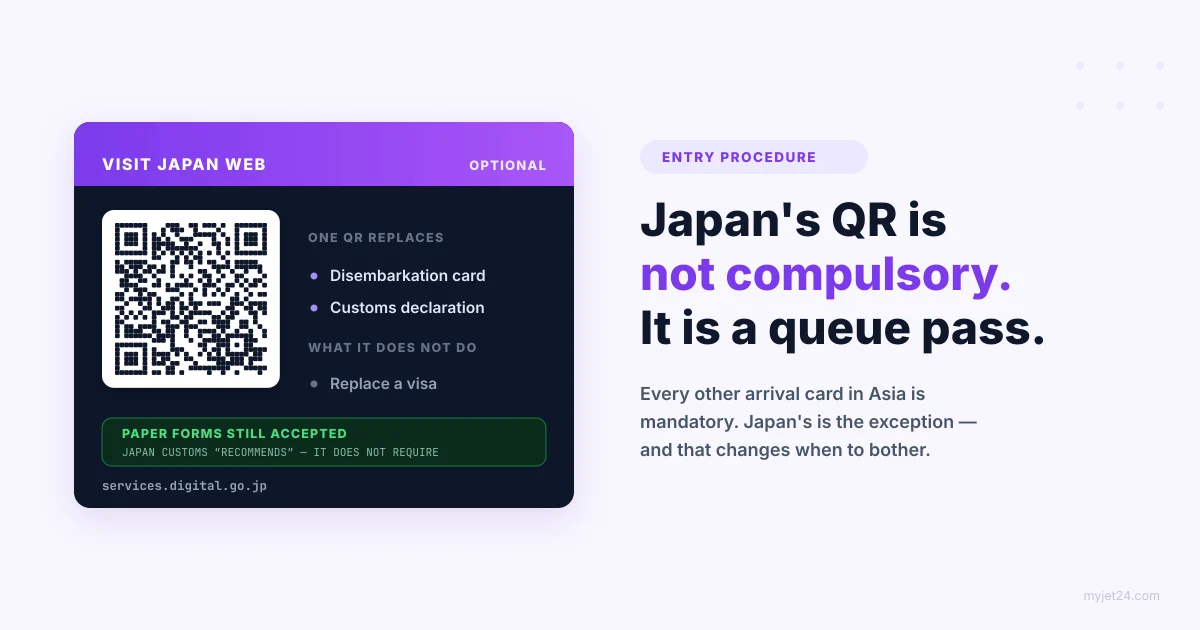
- It is not mandatory. Japan Customs says it "recommends" electronic declaration through Visit Japan Web, and confirms paper forms are still handed out on the plane and accepted at Customs.
- Japan is the regional exception. Cambodia, Thailand, Malaysia, Singapore and Taiwan all made their arrival cards compulsory. Japan did not.
- Skipping it costs queue time, not compliance. There is no fine, no refusal and no secondary inspection for arriving without a QR code.
- It covers two things only — the disembarkation card and the customs declaration. It is not a visa and grants no permission to enter.
- Register up to two weeks ahead and finish at least six hours before landing, or the code may not be ready when you need it.
Visit Japan Web is Japan's optional online service for submitting your immigration and customs forms before you land, run by the Digital Agency. It produces a QR code you scan at the airport instead of filling in paper. Registration is recommended, not required — Japan Customs still distributes paper declaration forms on board and accepts them at every airport.
Japan's forms are the easy part. The airline check before boarding is where one-way travellers get stuck.
In this guide
What Visit Japan Web is
Visit Japan Web is an online service operated by Japan's Digital Agency that lets travellers submit their entry paperwork before arriving. It covers exactly two procedures — the disembarkation card for immigration and the declaration for customs — and issues a QR code that replaces the printed forms at the counter.
The service consolidated in mid-2023. Where travellers once handled immigration and customs as separate steps with separate codes, a single QR now carries both, and several major airports read it at a joint kiosk rather than at two desks. That consolidation is the whole product: no new permission, no new check, just the same two forms moved off paper.
The service dates from the pandemic border regime, when it carried vaccination and testing records alongside the entry forms. Those health functions were removed after Japan lifted all COVID-19 border measures on 29 April 2023, and what remained was the immigration and customs half. Knowing that history explains why older guides describe a far heavier process than the one you will meet.
Compare it with an e-visa and the difference becomes obvious. An e-visa is an application that a government approves or refuses before you travel. The service produces no decision at all — you submit data, you receive a code, and nothing about your admissibility has changed. That is why registration takes fifteen minutes and confirms instantly.
Key takeaway: it is a form-delivery mechanism, not a permission. Nothing about it can be approved or refused.
Is it mandatory? The government's own wording
Registration is not mandatory for any nationality. Japan Customs states on its official passenger page that it recommends submitting declarations electronically through the service, and in the same place confirms that "Customs declaration forms are available on the plane, the ship, or at Customs." A body that hands out the paper alternative is not enforcing the digital one.
That single verb settles a question the search results disagree on. Page one for this query contains titles asserting a "mandatory QR code" alongside titles asking whether you need it at all, and none of them cites a source in either direction. The Japanese government does, in one sentence, and it says recommends.
Two further signals point the same way. Japan Customs describes electronic declaration gates at seven international airports as an alternative route rather than the route. And the UK Foreign Office's entry requirements for Japan — which does list Cambodia's e-Arrival Card as a requirement on its Cambodia page — makes no mention of the service at all.
"Japan Customs recommends submitting declarations electronically via the Visit Japan Web." Recommends. Not requires. Everything else about this question follows from that word.
Key takeaway: nobody has ever been refused entry to Japan for arriving without a QR code, because there is nothing to refuse.
Why Japan is the regional exception
Japan is the only major Asian destination whose digital arrival system remains voluntary. Every comparable country has moved the other way over the past two years, making its card a condition of smooth entry rather than a convenience. That contrast is what makes Japan easy to get wrong: travellers who have just done Thailand or Singapore reasonably assume the same rule applies.
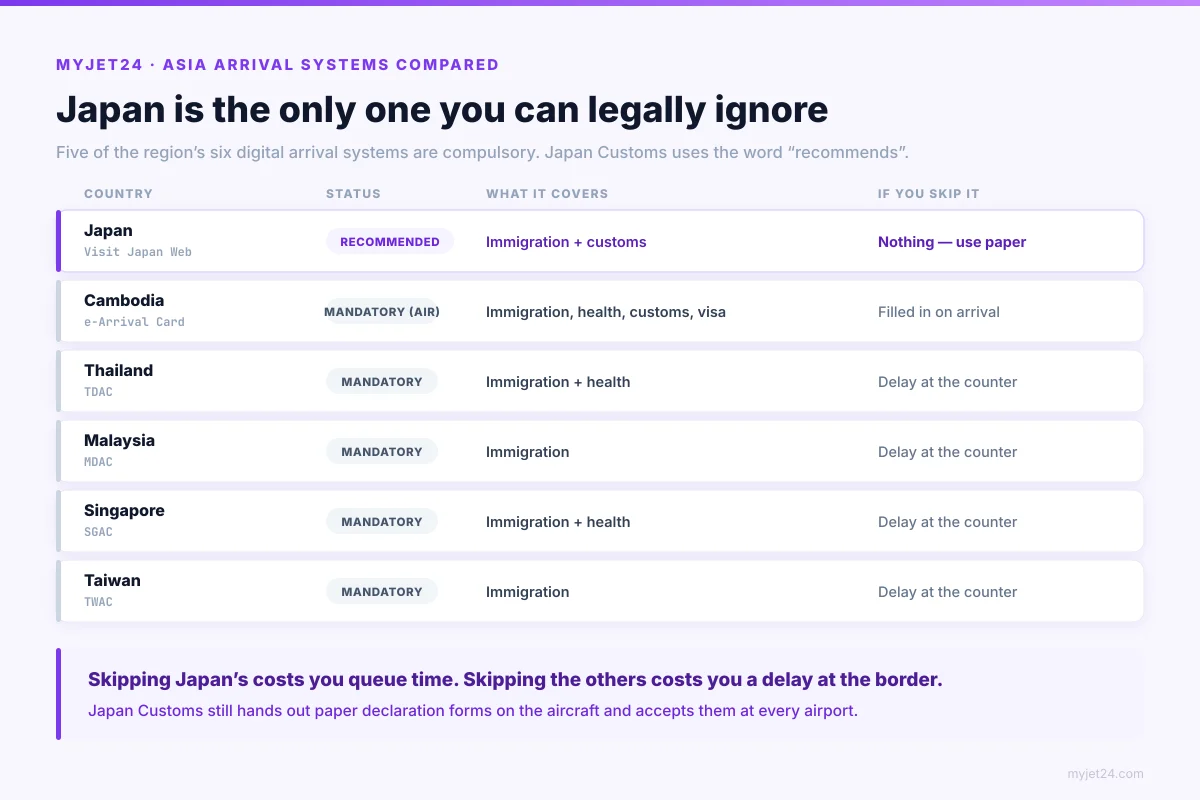
| Country | System | Status | If you skip it |
|---|---|---|---|
| Japan | Visit Japan Web | Recommended | Nothing — use paper |
| Cambodia | e-Arrival Card | Mandatory (air) | Completed on arrival instead |
| Thailand | TDAC | Mandatory | Delay at the counter |
| Malaysia | MDAC | Mandatory | Delay at the counter |
| Singapore | SGAC | Mandatory | Delay at the counter |
| Taiwan | TWAC | Mandatory | Delay at the counter |
The practical lesson is to check per country rather than per region. If you are routing through several of these on one trip, our overview of digital arrival cards across Asia covers the set, and the filing guides for Cambodia's e-Arrival Card and Thailand's TDAC go field by field on the two that genuinely require action.
Key takeaway: five of six are compulsory. Assuming Japan matches its neighbours is the mistake, not skipping the form.
When it is worth fifteen minutes
Because registration is voluntary, the only sensible question is whether the time you spend now beats the time you save later. The service trades roughly fifteen minutes of form-filling at home against a shorter queue on arrival, and that trade is clearly worthwhile at some airports and pointless at others.
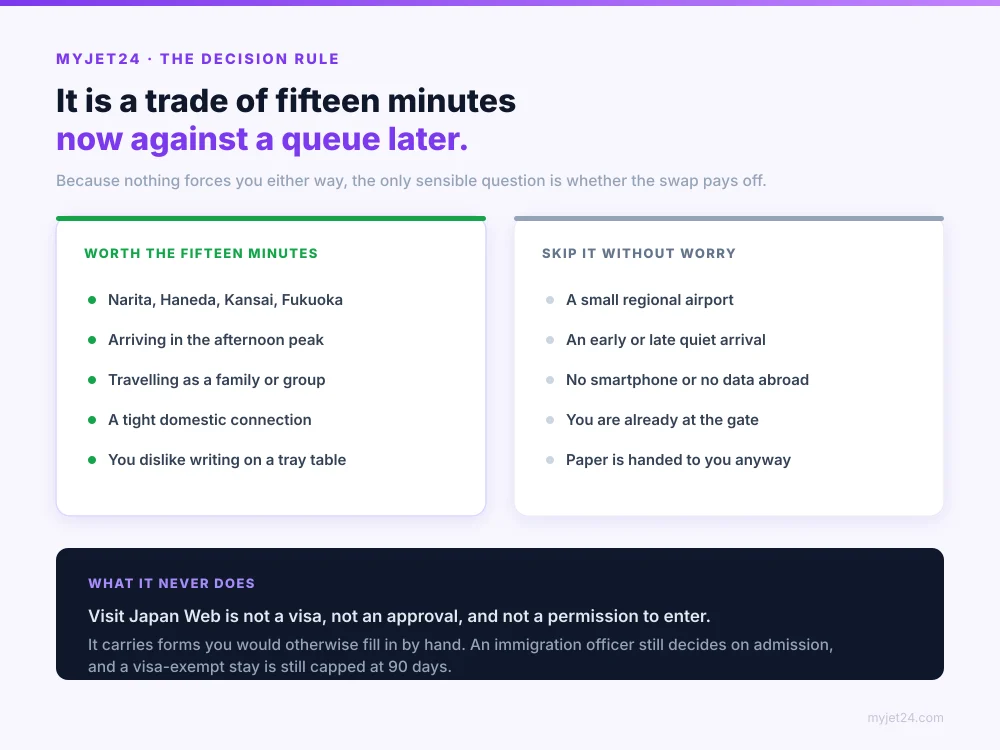
It pays off at the big hubs during peak arrival banks, where the digital lane is materially shorter and the joint kiosk removes a second stop. It pays off for families, because one adult can hold everyone's registration and nobody is writing on a tray table. And it pays off before a tight domestic connection, where twenty minutes at immigration is the difference between making the onward flight and not.
There is a second-order benefit worth naming, because it is the one frequent visitors cite. A saved account carries your passport details forward, so the second and third trips take a fraction of the first. For anyone visiting Japan more than once a year, the fifteen minutes is a one-off cost rather than a recurring one, which shifts the calculation decisively.
It is close to worthless at a small regional airport at a quiet hour, where there is no queue to skip and the paper form takes two minutes. The same applies if you have no data abroad and no way to load the code, which converts a time saving into a scramble.
Key takeaway: big hub at peak, or travelling as a group — register. Quiet regional arrival — the paper form is faster than the website.
How to register
Registering takes about fifteen minutes and is done entirely on the Digital Agency's site, free of charge. The window opens two weeks before travel, and the practical deadline is at least six hours before you land so the code has time to generate. Doing it the night before departure is the sweet spot.
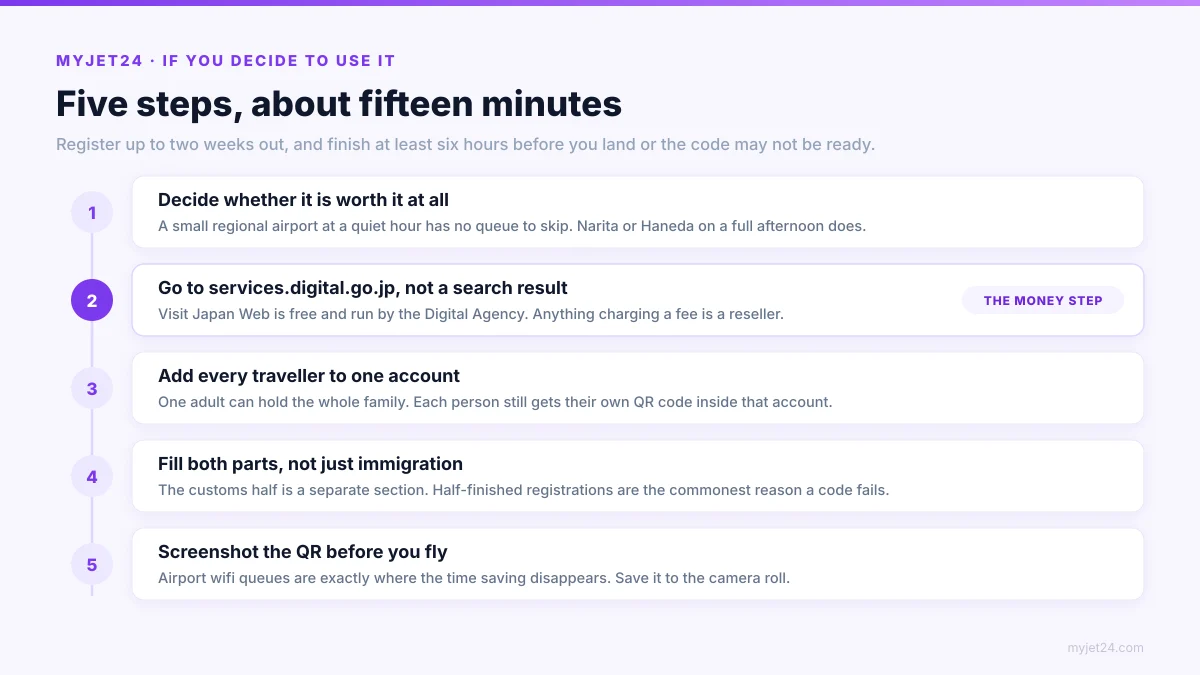
- Decide whether it is worth it at all. Apply the test above first. There is no penalty for concluding that it is not, and no record kept of travellers who did not register.
- Go to the Digital Agency's site directly. Registration is free. Any page charging a fee for it is a reseller retyping your answers into the same government form — the same pattern that runs through fake travel-document services generally.
- Add every traveller to one account. One adult can hold a whole family. Each person still receives their own code inside that account, so nobody needs a separate login.
- Complete both halves, not just immigration. The customs declaration is a separate section, and finishing only the first one produces a registration that fails at the joint kiosk. This is the single commonest complaint travellers report.
- Screenshot the QR code before you fly. Save it to the camera roll, not to an email. Hunting for airport wifi is precisely where the time saving disappears.
What to have ready before you start
Have the passport open, the arrival flight number and date to hand, and the address and telephone number of your first night's accommodation. The customs section additionally asks whether you are carrying goods over the duty-free allowance, cash above the declarable threshold, or restricted items. None of it is difficult, but hunting for a hotel address halfway through is what turns fifteen minutes into forty.
Key takeaway: both sections, one account, and the code saved offline. Those three cover almost every failure mode.
What happens at the airport
On arrival you present the QR code rather than a completed paper form, and the data you submitted appears on the officer's screen. At Narita Terminal 3, Haneda, Kansai and Fukuoka a joint kiosk reads it once for both immigration and customs, so the second queue disappears entirely. Japan Customs also operates electronic declaration gates at seven international airports.
The interaction itself is unchanged. An immigration officer still checks your passport, still asks where you are staying and how long, and still decides on admission — the questions are the same ones asked at any border, which we set out in our guide to what immigration officers ask and why. The QR code removes paperwork, not scrutiny.
Do not read the joint kiosk as a fast track in the immigration sense. It is not a trusted-traveller programme, confers no priority, and does not shorten the passport check itself. What it removes is the walk to a second desk and the handover of a second piece of paper — real, but smaller than the marketing language around it suggests.
If the code does not scan, nothing is lost. Staff will hand you the paper form and you complete it there, exactly as you would have without registering. Travellers occasionally describe this as being "rejected", which it is not — it is the fallback the system was designed around.
Key takeaway: a failed scan drops you back to paper. The downside of a broken QR code is two minutes, not a problem.
What it does not do
The service is not a visa and carries no permission of any kind. It does not create an entry authorisation, does not extend or alter the 90-day visa-exempt stay available to many nationalities, and has no bearing on whether an officer admits you. Registering changes how your forms arrive, and nothing else.
This matters because the QR code looks official enough to be mistaken for clearance. A traveller who needs a Japanese visa still needs one, and applies for it separately — our Japan e-visa guide covers who qualifies for the electronic route and what it now costs.
The distinction is the same one that trips people up with Cambodia, where the arrival card genuinely does carry a visa application inside it. Japan's does not. Two superficially similar QR systems, two entirely different scopes.
Key takeaway: if you need a visa for Japan, this does nothing for you. Handle the visa separately and first.
The check that does catch people
The requirement travellers actually get stopped by is not Japanese paperwork at all — it is the airline's document check before boarding. Carriers absorb the cost of an inadmissible passenger, so they verify entry conditions at check-in and apply them conservatively, particularly to one-way itineraries into a visa-exempt country.
Japan's published entry rules are unusually light: the UK Foreign Office notes only that your passport must be valid for the length of your stay, with a blank page for the stamp, and no additional validity margin. No onward-ticket rule appears there. The airline, however, is a separate party applying its own risk assessment, and a visa-exempt traveller with no departure booked is exactly the profile that prompts questions at the desk.
What satisfies that check is a live reservation, not a document. A screenshot proves nothing and a lapsed hold still looks intact as a PDF while resolving to nothing when the reference is queried. Our guide to showing proof of onward travel compares the six options and is honest about which ones we would not use.
A real reservation with a PNR that resolves when the check-in agent queries it.
Key takeaway: spend your preparation on the airline check, not the QR code. Only one of the two can stop you boarding.
What goes wrong
Registration problems cluster into a short list, and all of them are procedural rather than technical. The system is stable; the failures come from partial submissions and from travellers expecting the code to do more than it does.
THE FIVE MOST COMMON FAILURES
- Completing immigration but not customs, then finding the joint kiosk rejects a half-finished registration.
- Registering under six hours before landing, when the code may not have generated.
- Leaving the QR code in an email that will not load without a connection on arrival.
- Paying a reseller for a free government service.
- Assuming it replaces a visa, and arriving without the permission actually required.
Note what is absent from that list: being penalised for not registering. In our reading of the official guidance and the reports travellers publish, no consequence attaches to arriving without a code — the fallback is a pen and a form, which is where you would have been anyway.
Every real problem with this system is a problem of doing it badly. There is no problem in not doing it at all.
Key takeaway: half-finished beats not started only in effort, not in outcome. Either complete both sections or take the paper.
Next steps
To summarise: Visit Japan Web is recommended by Japan Customs, not required by it, and paper forms remain available on the aircraft and at every airport. Register if you are landing at a major hub at a busy hour, travelling as a family, or connecting onward domestically. Skip it without concern otherwise. If you do register, complete both the immigration and customs sections and save the code offline.
Then spend the attention you saved on the check that can actually stop you — the airline's document review before boarding, which is where visa-exempt travellers on one-way tickets run into trouble long before they reach a Japanese kiosk.
Sources
- Japan Customs — Information for passengers (recommends electronic declaration via Visit Japan Web; paper forms available on the plane, ship or at Customs; electronic declaration gates at seven airports).
- Digital Agency, Government of Japan — Visit Japan Web (the official service; free of charge).
- UK Foreign, Commonwealth & Development Office — Japan: entry requirements (passport valid for the length of stay, blank page required, 90-day visa-exempt entry).
This guide describes Japanese entry procedure as of 22 August 2026 and was reviewed by Joshua White, Travel Documentation Writer at MyJet24. The mandatory-versus-recommended status, airport coverage and registration windows are set by the Japanese authorities and can change without notice; the statement that registration is recommended rather than required reflects Japan Customs' own published wording at the date of publication. Always confirm current requirements before you travel. This article is informational and not legal advice.
