
Last updated: 21 August 2026 · Reading time: 13 min · Author: Joshua White, Travel Documentation Writer at MyJet24 · Reviewed by: Marc Hoffmann, Senior Visa Consultant
TL;DR — Key facts
- The burden of proof is on you, not the officer. Entry law requires the traveller to establish admissibility; the questions are the mechanism for doing it.
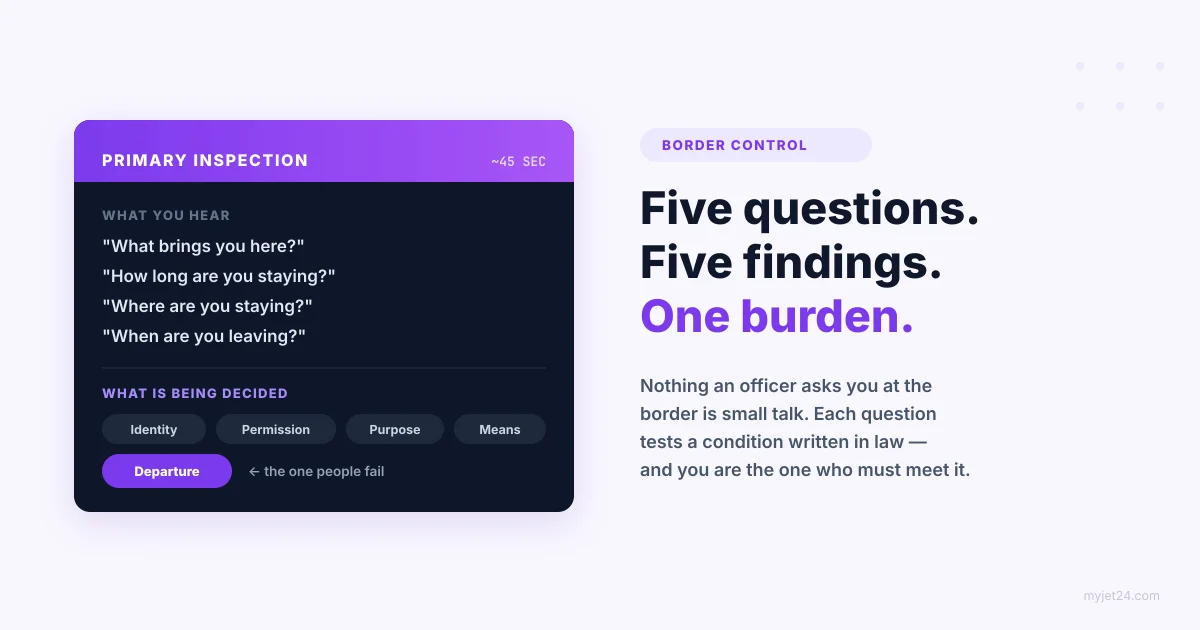
- Every question maps to one of five findings — identity, permission, purpose, means, departure. Nothing asked at a border is small talk.
- Four of the five are settled before you speak. Your document and your record are read by machine; the conversation exists to close the ones a screen cannot.
- Departure is the finding travellers fail. It is the only one you can arrive physically unable to answer, and "I'll book it later" is not an answer.
- Being sent to secondary inspection is a queue, not a verdict. It means the decision needs more time or a document, and most people referred are admitted.
Immigration officers ask about your purpose, your length of stay, where you will sleep, how you are funding the trip and when you are leaving. Each question tests a legal condition of entry rather than your character. Answer briefly, answer consistently, and be able to show the document behind each answer — particularly the one proving you will leave.
"When are you leaving?" is the question you should never answer with a shrug.
In this guide
- Who has to prove what
- The five findings behind every question
- The questions, and what each one tests
- The departure question
- What happens, in order
- Consistency, not truth, is what is checked
- Secondary inspection
- How to answer, in five rules
- Where the emphasis changes
- The mistakes that create problems
- Next steps
Who has to prove what
The burden of proof at a border sits on the traveller. An immigration officer does not have to establish that you should be refused; you have to establish that you should be admitted, and an immigration officer's questions are simply how that is done in the ninety seconds available. Understanding this one asymmetry changes how the whole encounter reads.
Both major legal systems say so plainly. Under the Schengen Borders Code, a traveller must "justify the purpose and conditions of the intended stay" and show sufficient means of subsistence, including for the return or onward leg. In the United States, a person at a port of entry is an "applicant for admission" who bears the burden of proving admissibility, and a visitor is presumed to intend immigration until they demonstrate otherwise. Neither framework asks the immigration officer to prove anything in order to let you in.
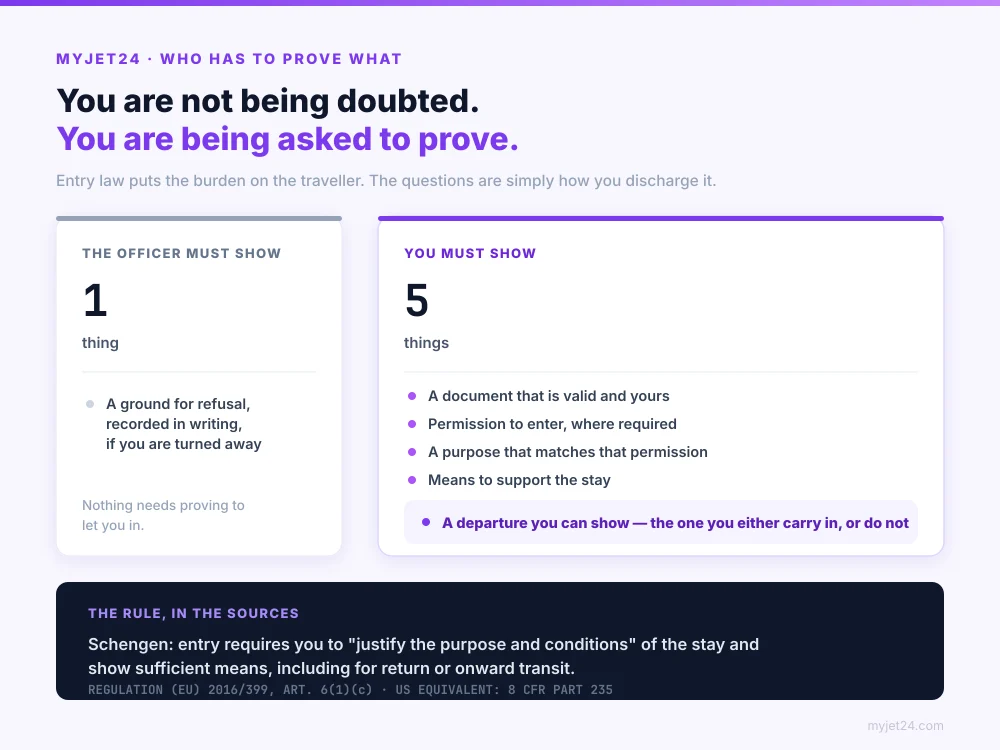
The practical consequence is that silence and vagueness work against you in a way they would not in most other official encounters. "I'm not sure yet" is a complete failure to discharge a burden, even when it is the honest answer. The immigration officer is not required to fill the gap in your favour.
Key takeaway: you are not being doubted. You are being asked to prove — and the law puts that job on you.
The five findings behind every question
An immigration officer's question is a probe for one of exactly five findings: identity, permission, purpose, means and departure. Immigration officers work through them because entry law requires each to be established before admission, not because any individual question is interesting. Once you can name the five, every question you are asked becomes predictable.
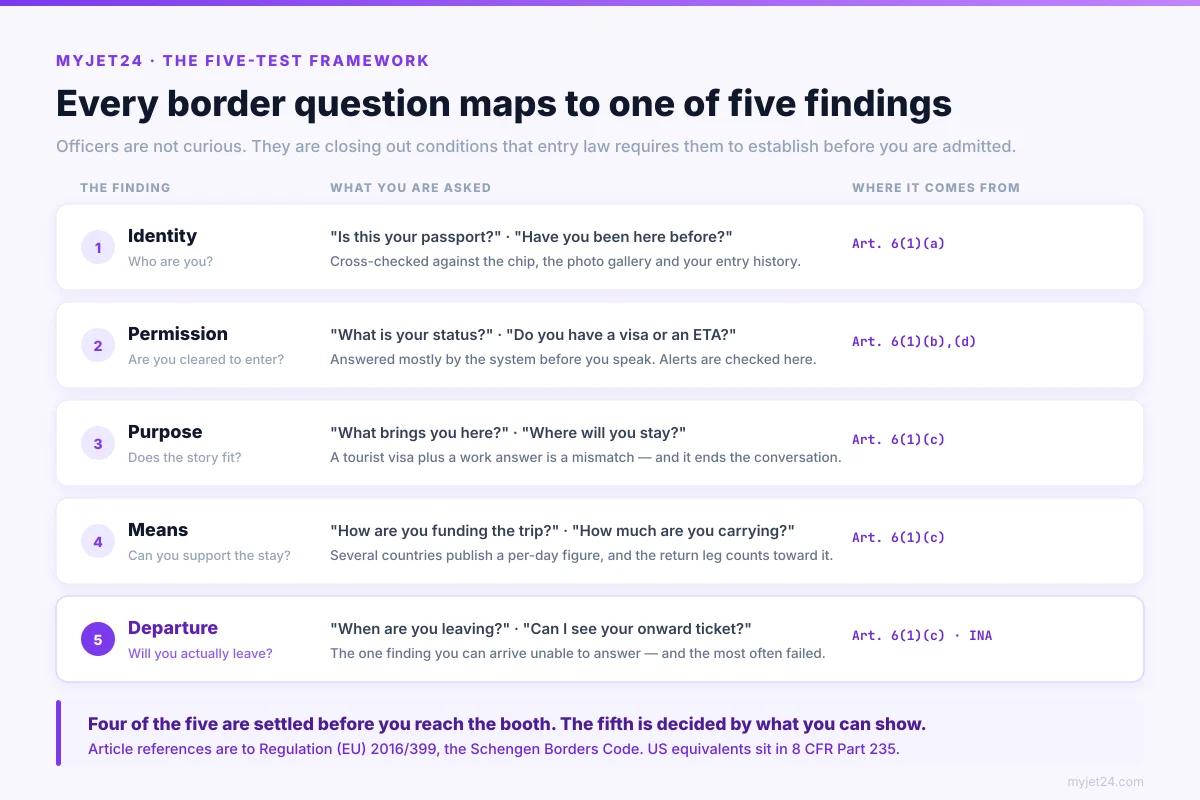
The five are not evenly weighted, and this is the part most guides miss. Identity and permission are largely resolved by machine before you open your mouth — the chip in the passport, the stored photographs, the alert databases, the advance passenger data your airline transmitted at departure. Purpose, means and departure are the three a screen cannot settle, which is precisely why they are the three you are asked about.
Compare two travellers on the same flight. One holds a tourist visa, names a hotel, and shows a return flight in eleven days. The other holds the same visa, mentions a job interview, and has no departure booked. Nothing about the second traveller is dishonest; they have simply failed two of the five findings, and the encounter will get longer.
Key takeaway: five findings, of which three are decided by what you say and what you can show.
The questions, and what each one tests
An immigration officer's question is a compressed test, and the phrasing is deliberately casual so that a rehearsed answer stands out against a real one. The table below maps the questions travellers actually hear to the finding each one closes, and to the answer that creates work rather than resolving it. It is the mapping we use when preparing clients for a border they are nervous about.
| What you are asked | What it tests | The answer that creates work |
|---|---|---|
| "What brings you here?" | Purpose | An activity your permission does not cover |
| "How long are you staying?" | Purpose + departure | A figure that does not match your ticket |
| "Where are you staying?" | Purpose | "I haven't booked anything yet" |
| "Who are you visiting?" | Purpose | A relationship you cannot describe simply |
| "How are you funding the trip?" | Means | A sponsor you did not mention on the form |
| "Have you been here before?" | Identity + compliance | A denial contradicted by your stamps |
| "When are you leaving?" | Departure | "I'm not sure yet" — with no booking |
Notice what the third column has in common. None of those answers is a lie. Each simply leaves a required finding open, which obliges the immigration officer to keep working — and the way an officer keeps working is by asking more questions or moving you to a room where there is time to ask them.
Key takeaway: an answer that leaves a finding open costs you as much as a wrong one.
The departure question
"When are you leaving?" is the question that decides the fifth finding, and it is the only one of the five a traveller can arrive physically unable to answer. Identity, permission, purpose and means are all things you either have or do not have by the time you land. A departure booking is the one you could have arranged and simply did not.
The requirement is written into the law rather than invented by officers. The Schengen entry conditions count means of subsistence "for the return to the country of origin or transit to a third country", which is why sufficient funds and a departure plan are assessed together rather than separately. In the United States the same ground appears as the presumption of immigrant intent — a visitor is presumed to be staying until they show otherwise. Different words, identical practical effect at the booth. The EU's own guidance for non-EU travellers is blunter still, listing a "return or round-trip ticket" among the supporting documents a border officer may ask to see, alongside proof of lodging.
What satisfies the requirement is narrower than travellers expect. The immigration officer is looking at a live reservation, not at a document you are holding, which is why a screenshot, a lapsed hold or a cancelled return leg proves nothing while still looking perfectly normal on paper. Our guide to the ways to show proof of onward travel compares the six options and is honest about which ones we would not use, and what a passenger name record actually contains explains why a resolvable reference is the thing being queried.
Four of the five findings are decided by who you are and what you were granted before you travelled. The fifth is decided by whether you bothered to book the way out.
A real reservation with a PNR that resolves when an officer checks it.
Key takeaway: arrive with a date and a booking that supports it. This is the one finding entirely within your control.
What happens, in order
Border inspection is a sequence that starts before departure and ends with a recorded admission, and the conversation sits fourth in it rather than first. Knowing the order tells you how much has already been decided by the time an immigration officer looks up. In most cases, the answer is: nearly everything.
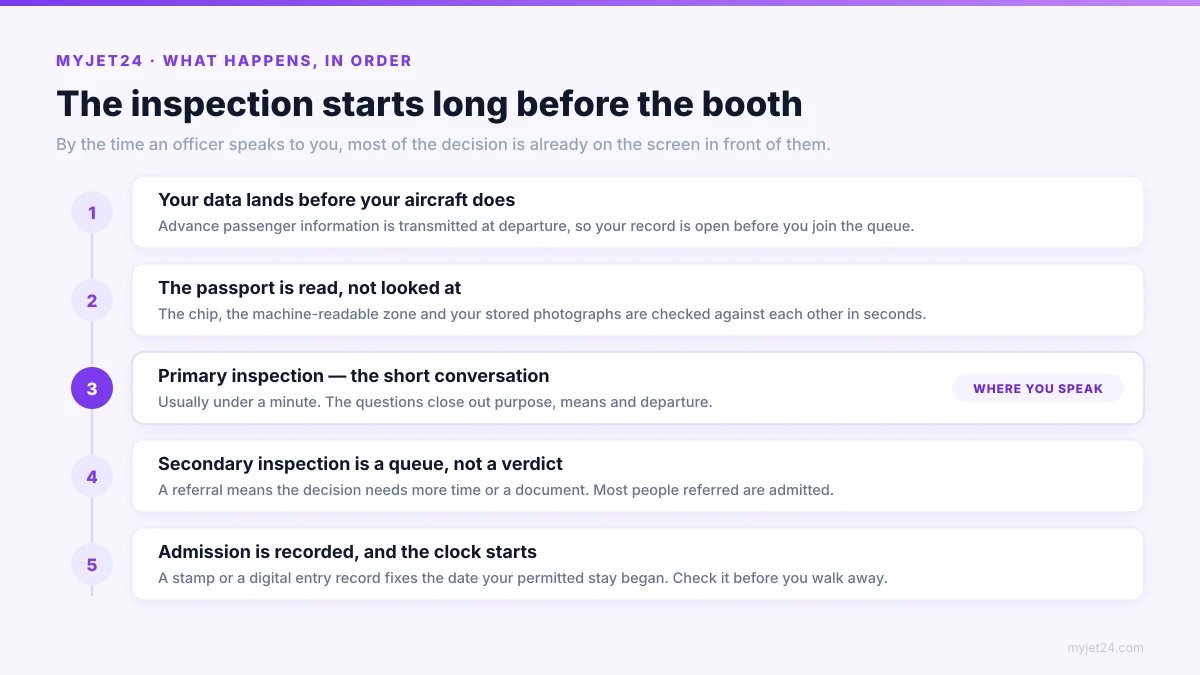
Two stages deserve attention. Your data arrives first — airlines transmit advance passenger information at departure, so a record is open before you reach the hall, a mechanism we set out in what airlines send governments before you fly. Then the document is read rather than inspected, with the chip, the machine-readable zone and stored photographs compared automatically, which is what is really happening when they scan your passport.
The final stage matters more than travellers realise. Admission is recorded, by stamp or by digital entry record, and that record fixes the date your permitted stay began. Check it before you leave the hall — a wrong date is trivial to fix at the desk and expensive to argue about on the way out.
Key takeaway: by the time you speak, the machine has answered two of the five findings. Your job is the other three.
Consistency, not truth, is what is checked
An immigration officer cannot verify whether your account is true, but they can verify whether it is consistent — and consistency is what the questioning is built to test. Your spoken answers are compared against your arrival card, your booking record and the passenger data already transmitted, all of which are visible on the screen while you talk. Contradiction is the signal; sincerity is not measurable.
This explains the behaviour travellers find most unnerving: the same question asked twice, sometimes in slightly different words, sometimes several minutes apart. It is not an attempt to catch you out emotionally. It is a check on whether the second answer matches the first, and it is standard practice rather than a sign that something has gone wrong.
The practical implication runs against instinct. Elaborating makes things worse, because a longer answer contains more claims and therefore more surface for a mismatch. A traveller who says "two weeks, at the Ibis near the station, flying home on the twelfth" has closed three findings in one sentence. A traveller who narrates the whole trip has opened several.
The immigration officer is not reading your face. They are reading your answer against three records that were on the screen before you arrived.
Key takeaway: short and consistent beats detailed and sincere. Every extra sentence is another thing to contradict.
Secondary inspection
Secondary inspection is a separate interview area where a traveller is sent when admissibility cannot be decided at the booth. It is a referral for more time, not a decision against you, and most people who go through it are admitted and continue their trip. Treating it as a verdict is the most common misreading of the whole process.
Referrals happen for ordinary reasons: a name that resembles one in a database, a document that needs verifying with another authority, an answer that left a finding open, a random check, or simply a queue that has grown too long for a two-minute conversation. In our experience helping travellers reconstruct what happened, the trigger is far more often a missing document than anything a person said.
What to do there is unglamorous. Answer the same way you did at the booth, produce documents when asked rather than pre-emptively, and do not change an answer to make it sound better — an amended answer is the one thing that turns a routine referral into a real problem. If it does go the other way, what actually happens when entry is refused covers the form, the appeal and who pays for the flight back.
Key takeaway: secondary is a queue for a decision, not the decision. Stay consistent and let the documents do the work.
How to answer, in five rules
Answering well at a border is a technique rather than a personality trait, and it reduces to five rules that work in every jurisdiction. They are built around the five findings: each rule exists to close one of them cleanly. Follow them in order and a normal inspection takes under a minute.
- Answer the question asked, then stop. One sentence closes a finding. Three sentences open two more. If the officer wants detail, they will ask for it.
- Give a number wherever a number is possible. "About two weeks" is weaker than "eleven days, back on the twelfth". Numbers can be checked against your booking, which is exactly what makes them persuasive.
- Name the place you are sleeping tonight. Not the whole itinerary — the first address. It closes the purpose finding faster than any explanation of your plans.
- Have the departure booking retrievable, not described. Reference number on your phone, offline, before you land. An officer who can see it stops asking; one who is told about it does not.
- Never amend an earlier answer to improve it. If you misspoke, say you misspoke. A quietly revised answer reads as a changed story, and a changed story is the thing that turns two minutes into two hours.
Key takeaway: brevity, numbers, an address, a retrievable booking, and no revisions.
Where the emphasis changes
The five findings are universal, but which one an immigration officer leans on varies by destination — and this is where advice written for a single country stops being useful. The framework travels; the weighting does not. Knowing which finding a given border cares about tells you which document to have ready in your hand.
| Where | Heaviest finding | What to have ready |
|---|---|---|
| United States | Purpose, and intent to return | A clear reason for the visit and a return date |
| Schengen area | Means, and the 90/180 count | Funds, accommodation, and your day count |
| United Kingdom | Purpose, and permission | Authorisation matching the passport you carry |
| Southeast Asia | Departure | An onward ticket, frequently checked before boarding |
The bottom row is the one that catches experienced travellers. In several Asian destinations the departure finding is enforced by the airline at check-in rather than by the officer on arrival, which is why the problem surfaces at a desk in your departure city. Our explainer on the airline document check covers how that verification is run and why two carriers on the same route can reach different conclusions.
The Schengen row carries its own arithmetic. Immigration officers examine entry and exit stamps to work out how long you have already spent in the area, which is a calculation you should have done yourself before arriving — the 90/180-day rule is counted on a rolling basis, not per calendar year.
Key takeaway: the five findings are the same everywhere; only the order of emphasis moves.
The mistakes that create problems
Most difficult border encounters come from a small set of avoidable mistakes, and almost none of them involve dishonesty. They involve travellers leaving a required finding open and then trying to close it verbally. The pattern is consistent enough that it can be listed.
The first is arriving with no departure booked and no date in mind. The second is describing an activity the permission does not cover — saying "meetings" on a tourist authorisation, or "looking for work" in any context. The third is packing the departure booking into checked luggage or leaving it in an email that will not load without roaming. The fourth is treating the encounter as a conversation and volunteering context nobody asked for.
The fifth is subtler and worth naming on its own: contradicting your own arrival card. Travellers fill in a form on the aircraft, forget what they wrote, and then say something different at the booth. The immigration officer has both in front of them. If you are unsure what a country's arrival form will ask before you fill it in, the digital arrival cards now used across Asia repeat the same handful of fields.
Key takeaway: the common failures are logistical, not moral. Fix them before you board.
Next steps
To summarise: the burden of proof is yours, every question probes one of five findings, and identity and permission are settled by machine before you speak. Purpose, means and departure are what the conversation exists to close. Answer briefly, give numbers, name tonight's address, and keep your answers consistent with the form you filled in on the aircraft.
Of the five, departure is the only one you can fix in the next two minutes — and the only one where arriving without an answer is a choice rather than a circumstance.
Sources
- European Union — Regulation (EU) 2016/399 (Schengen Borders Code), Article 6(1) entry conditions and Article 8(3) thorough checks on entry.
- European Union — Entry requirements for non-EU nationals (supporting documents at the border, including proof of lodging and a return or round-trip ticket).
- US Government — 8 CFR Part 235, Inspection of Persons Applying for Admission (burden of proof, primary and secondary inspection).
This guide describes standard border practice as of 21 August 2026 and was reviewed by Marc Hoffmann, Senior Visa Consultant at MyJet24. Entry conditions, questioning practice and documentary requirements are set by each destination government and applied at officer discretion; the framework here explains what is being assessed and does not guarantee any outcome. Always confirm requirements with the destination's immigration authority before you travel. This article is informational and not legal advice.
