
Last updated: 22 August 2026 · Reading time: 12 min · Author: Marc Hoffmann, Senior Visa Consultant at MyJet24 · Reviewed by: James Mitchell, CEO & Founder
TL;DR — Key facts
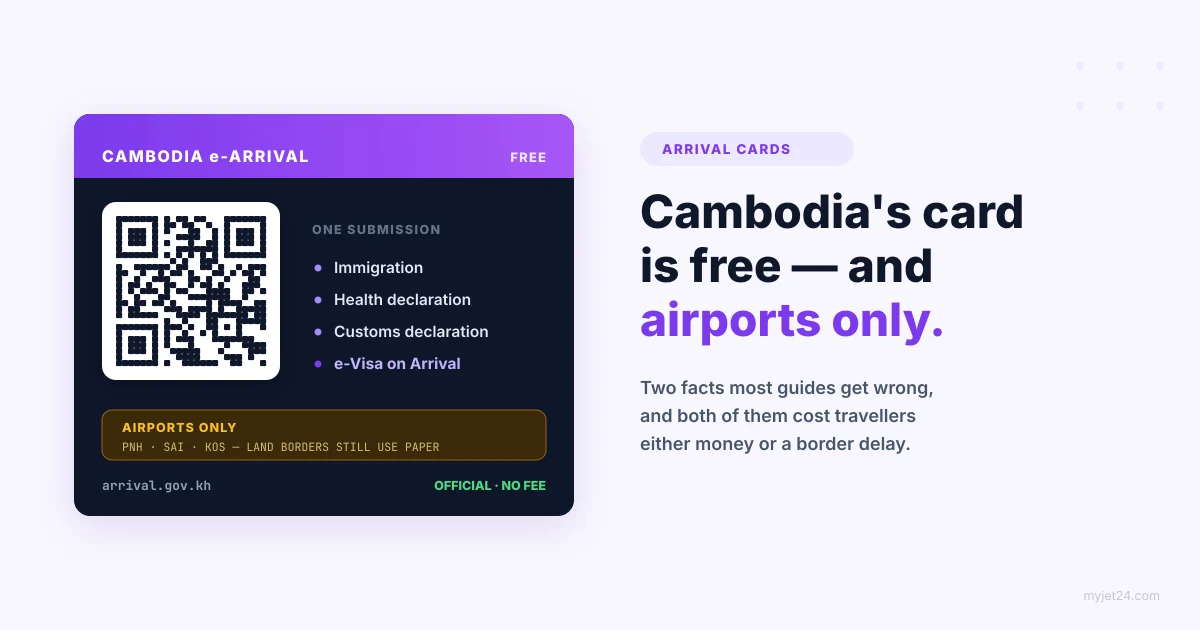
- It is free. The official portal is arrival.gov.kh and it charges nothing. Every site asking you to pay for the card itself is a reseller.
- It is for airports only. Phnom Penh, Siem Reap–Angkor and Sihanoukville. Arriving overland at Poipet, Bavet or Koh Kong still means a paper form at the counter.
- It replaces four paper forms with one. Immigration, health and customs declarations are bundled, and the visa on arrival application sits in the same submission.
- File within seven days of arrival, ideally 24 to 72 hours before departure, once your flights are settled. You get a QR code — save it offline.
- Cambodia publishes no onward-ticket rule — but your airline runs its own document check before boarding, and a one-way into the region still draws questions.
The Cambodia e-Arrival Card is a free digital form every air passenger must submit before landing in Cambodia. File it at arrival.gov.kh within seven days of arrival and you receive a QR code that is scanned at immigration and customs. It is not required at land borders or seaports, which still use paper forms handed out on site.
Cambodia does not demand one, but the airline that flies you there may still ask.
In this guide
What the card actually is
The Cambodia e-Arrival Card, or CeA, is a digital pre-arrival declaration that replaced the paper forms once handed out on the aircraft. It became mandatory on 1 September 2024, and by 2026 it is the standard route into the country for anyone flying in. Every passenger needs their own submission, including infants travelling on a parent's lap.
Functionally it is a data-collection step, not a permission. Filing it does not grant you entry, does not replace a visa, and produces no approval decision — it produces a QR code confirming your declaration has been recorded. Admission is still decided by an immigration officer at the counter, exactly as it was when the form was paper.
That distinction matters because it sets expectations correctly. A traveller who submits the card is not waiting for an outcome, and there is nothing to be refused. Compare it with an e-visa, which is an application that can be approved or declined: the Cambodia e-Arrival Card has no equivalent state, which is why it can be completed in minutes and confirmed instantly.
Key takeaway: the card is a declaration, not an approval. It records information; it does not decide anything.
Who has to file it — and who does not
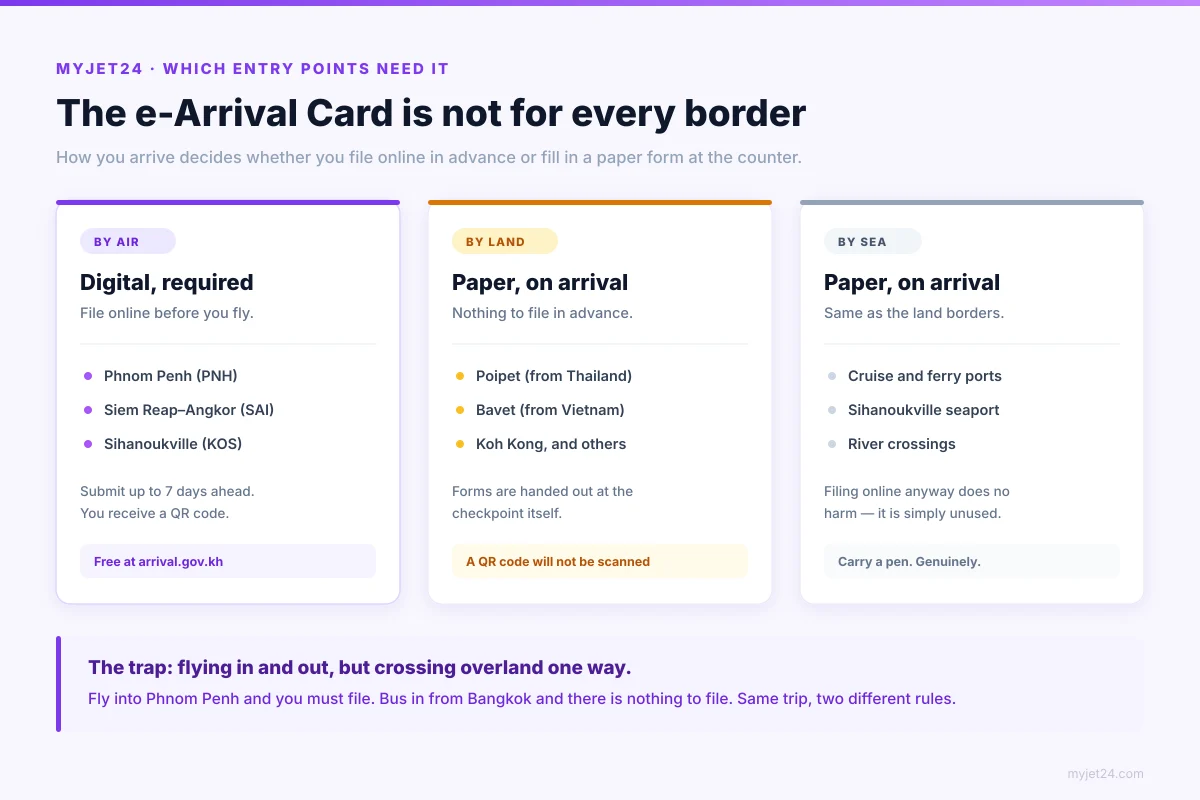
The Cambodia e-Arrival Card is required of air passengers only. Travellers arriving overland or by sea still complete paper arrival and departure forms at the checkpoint itself, and no online submission is expected of them. This split is the most consequential fact about the card and the one most guides state incorrectly.
| How you arrive | Example entry points | What you file |
|---|---|---|
| By air | Phnom Penh, Siem Reap–Angkor, Sihanoukville | e-Arrival Card, online, before departure |
| By land | Poipet, Bavet, Koh Kong and other crossings | Paper form, at the checkpoint |
| By sea | Cruise and ferry arrivals | Paper form, at the port |
The awkward case is a mixed itinerary. Fly into Phnom Penh and leave overland to Vietnam, and you file once for the arrival. Bus in from Bangkok and fly home from Siem Reap, and you file nothing at all, because the card covers arrival rather than departure. Same country, same traveller, opposite answers — decided entirely by how you crossed the line.
Key takeaway: the question is never "am I going to Cambodia". It is "am I flying in".
What it costs
The Cambodia e-Arrival Card is free. The official government portal is arrival.gov.kh, it takes no payment at any point in the process, and there is no premium, expedited or priority version of the submission. Any page that asks for money to file the card itself is a reseller, not the government.
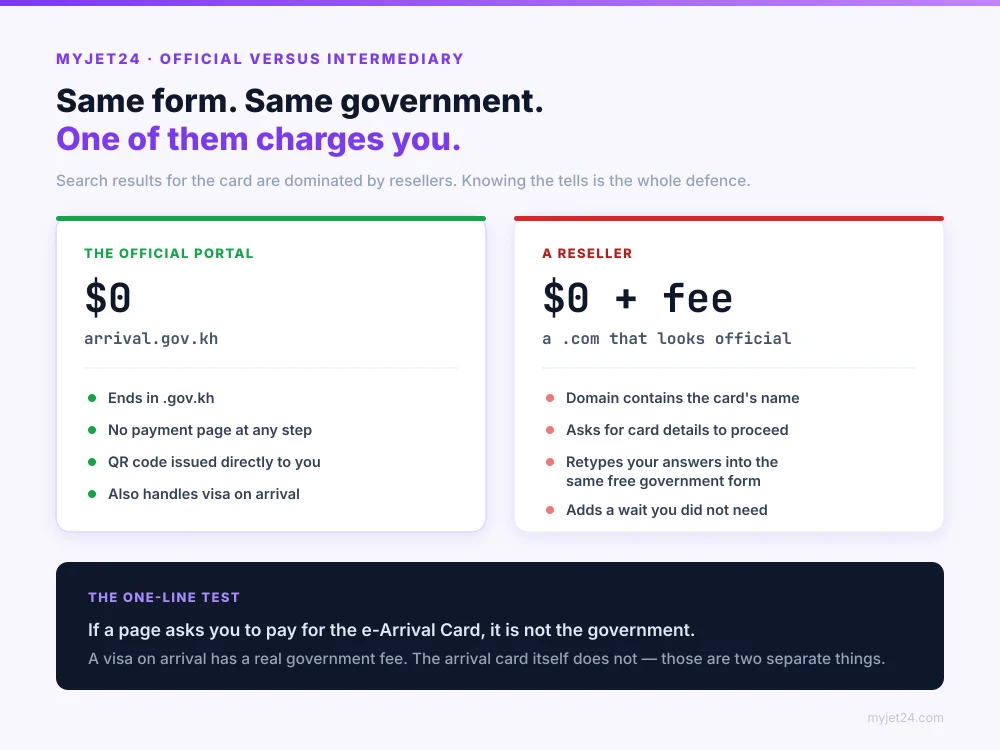
This needs saying plainly because search results for the card are dominated by intermediaries. When we reviewed the first page of results while researching this guide, the majority were commercial sites whose domains contain the card's own name and whose "apply" button leads to a payment page. What they sell is data entry: your answers are retyped into the same free form, and you wait longer for the same QR code.
One genuine fee does exist nearby, and conflating the two is how people talk themselves into paying. A Cambodian visa on arrival carries a real government charge; the arrival card does not. If you need a visa, you are paying for the visa — never for the declaration that carries it. The pattern is the same one we documented in our guide to spotting fake travel-document services: an official process, a lookalike domain, and a fee attached to something that was free.
If a page asks you to pay for the e-Arrival Card, it is not the government. Type arrival.gov.kh into the address bar rather than searching for it.
Key takeaway: zero for the card, a real fee for a visa. Two different things, and only one of them is legitimate to charge for.
Four declarations in one form
The Cambodia e-Arrival Card bundles four separate declarations into a single submission: immigration, health, customs and, where needed, the electronic visa on arrival application. That consolidation is unusual among the region's arrival cards, most of which handle immigration and health but stop short of carrying a visa.
Practically, it means the form is longer than a Thai or Malaysian equivalent and asks for things travellers do not expect. The customs section wants to know about goods and currency above the declarable threshold. The health section asks about recent symptoms and countries visited. The immigration section covers the familiar ground — accommodation, purpose, length of stay, flights in and out.
The upside is that one submission clears all of it. A traveller who fills the card properly walks past three counters that would otherwise each want a piece of paper, which is the entire point of the system and the reason it survived the transition from a pandemic-era health measure into permanent infrastructure.
Key takeaway: budget ten minutes, not two. It is four forms wearing one coat.
How to file it
Filing the card is a five-step process that takes about ten minutes when your travel details are already settled. Do it once, do it late enough that nothing will change, and save the result somewhere it will open without a signal. The order below is the one that avoids having to start again.
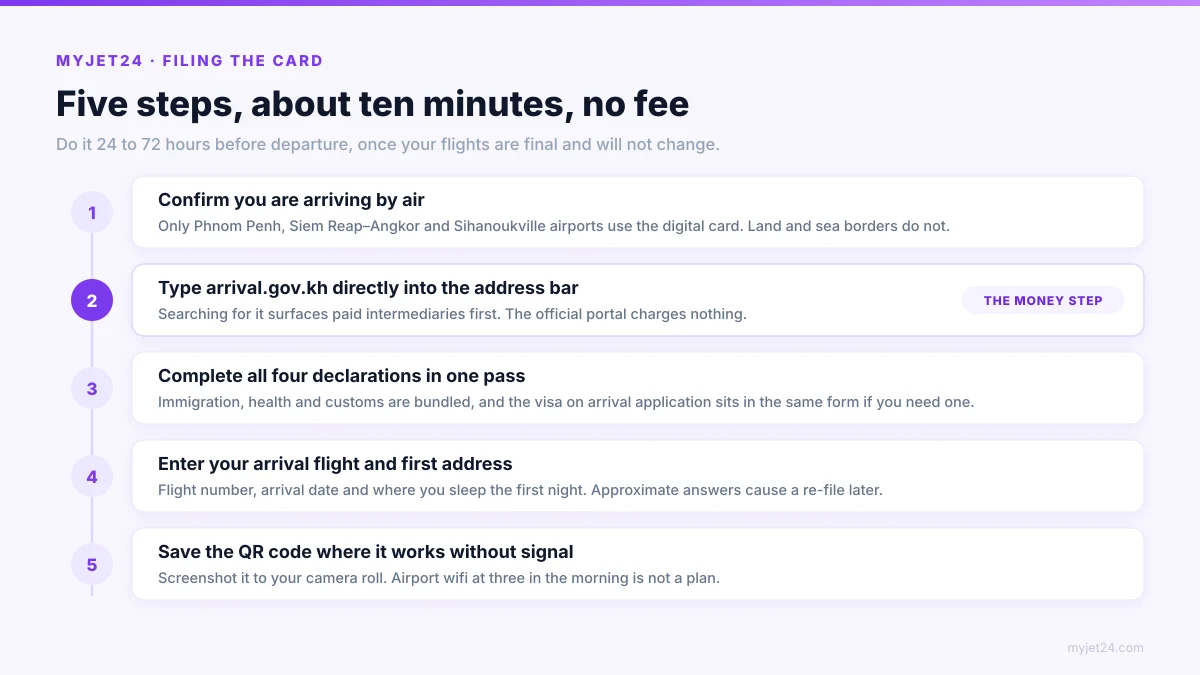
- Confirm you are arriving by air. If you are crossing a land border, stop here — there is nothing to file, and a QR code will not be scanned at Poipet.
- Type arrival.gov.kh into the address bar. Do not search for the card and click the first result. This single habit is the difference between paying nothing and paying a reseller.
- Complete all four declarations in one pass. Immigration, health and customs are compulsory; the visa on arrival section appears only if your nationality needs one. Have your passport open in front of you.
- Enter your arrival flight and your first address. Flight number, arrival date and where you are staying the first night. Approximate answers here are what force people to redo the submission later.
- Save the QR code to your camera roll. Not to an email, not to a browser tab. Airport wifi at three in the morning after a delayed flight is not a plan.
Key takeaway: address bar, not search bar. Then screenshot the QR code before you close the tab.
Timing and the seven-day window
The submission window opens seven days before arrival and closes when you land, which sounds generous and is narrower than it looks. Filing on day seven means committing to details that may still change; filing in the taxi means relying on mobile data you may not have. The workable slot is 24 to 72 hours before departure, once check-in is imminent and the itinerary has stopped moving.
There is a second reason to avoid filing too early. The form captures your flights, your accommodation and your health status, and an amended plan means an amended submission. A traveller who books a different hotel after filing has a card that no longer matches their answers, which is precisely the kind of inconsistency an officer notices when the QR code is scanned.
Contrast this with the regional norm. Thailand's card opens a similar window and Malaysia's is tighter still, but neither carries a visa application, so a re-file costs nothing but time. In Cambodia's case a re-file can mean redoing the visa section too, which is a stronger argument for waiting until the details are final.
Key takeaway: 24 to 72 hours before departure is the slot. Early filing buys nothing and risks a mismatch.
Does Cambodia need an onward ticket?
Cambodia does not publish a proof-of-onward-travel requirement for entry. The UK government's own advice for Cambodia lists the e-Arrival Card, a passport valid for at least six months, and the visa routes — and says nothing about holding a ticket out. On the government's side, a one-way arrival is not a stated problem.
The airline is a different party with a different incentive. Carriers absorb the cost of an inadmissible passenger, so they run their own document checks at check-in and apply them conservatively across the region. A traveller flying one-way into Southeast Asia is asked about their exit far more often than the destination's published rules would suggest, and the question is answered at a desk in the departure city rather than on arrival in Phnom Penh.
Cambodia is a mild case by regional standards, because a visa on arrival is available to most nationalities at airports and land crossings, which gives an agent an easy way to resolve doubt. Thailand and the Philippines are considerably stricter, as our guides to how to show proof of onward travel and the country-by-country picture set out. What satisfies an airline is a live reservation rather than a document: a screenshot proves nothing, and a lapsed hold still looks intact as a PDF while resolving to nothing when the reference is queried.
For the check-in desk, not the border — a real reservation with a PNR that resolves.
Key takeaway: the border does not ask. The airline might — and that is the check you have to satisfy first.
How it compares with the region
Cambodia's card sits at the heavier end of Southeast Asia's arrival-card systems, because it is the only one of the major five that carries a visa application. Every country in the region now runs some version of a digital arrival declaration, and the differences between them are large enough that experience with one is a poor guide to another. The table below is drawn from our own coverage of each.
| Card | Cost | Carries a visa? | Applies at land borders? |
|---|---|---|---|
| Cambodia CeA | Free | Yes — visa on arrival | No — paper forms |
| Thailand TDAC | Free | No | Yes |
| Malaysia MDAC | Free | No | Yes |
| Singapore SGAC | Free | No | Yes |
| Taiwan TWAC | Free | No | Not applicable |
Two patterns are worth extracting. Every one of these cards is free at its official portal, which makes the reseller problem a regional phenomenon rather than a Cambodian one. And Cambodia is the outlier on entry points: the others generally apply however you arrive, while Cambodia's digital card stops at the airport perimeter.
If you are moving through several of these countries on one trip, our regional overview of digital arrival cards across Asia covers the whole set, and the individual filing guides for Thailand's TDAC and Malaysia's MDAC go field by field.
Key takeaway: all free, all different. Cambodia is the one that carries a visa and the one that skips land borders.
What happens on arrival
On landing, the QR code is scanned at immigration and again at customs, and the declarations you filed appear on the officer's screen. The process is quick precisely because the data arrived ahead of you: there is no form to complete in the hall and no queue for a pen. The conversation is short, and the officer is confirming rather than collecting.
If your nationality requires a visa on arrival and you completed that section, it is processed at the same point. A visa on arrival is available at the airports and at land crossings, needs a passport photo and is paid in US dollars — this is the legitimate charge, paid to the government at the counter rather than online in advance to a third party. Your passport must also be valid for at least six months from the date you arrive, undamaged and with no missing pages.
If something has changed since you filed, say so at the counter rather than hoping it passes. A different hotel or a moved departure date is a two-second correction when volunteered and a longer conversation when discovered. Officers are comparing your card against your documents, so a discrepancy you flag yourself reads very differently from one they find.
Key takeaway: the scan is a confirmation step. Volunteer any change before it becomes a discrepancy.
What goes wrong
Almost every problem with the Cambodia e-Arrival Card comes from one of five avoidable mistakes, and none of them involves the form being difficult. They involve travellers filing the wrong thing, at the wrong time, on the wrong site, or without the information the form needs.
THE FIVE THAT COST PEOPLE MONEY OR TIME
- Paying a reseller for a submission the government provides at no charge.
- Filing before an overland crossing, where the card is not used and paper forms are issued on site.
- Filing more than seven days out, outside the window, and assuming it was accepted.
- Opening the form without your flight number and first address, then abandoning it half-finished.
- Leaving the QR code in an email that will not load on arrival without a connection.
The reseller mistake is the expensive one and the easiest to avoid: the official domain ends in .gov.kh, and no legitimate step in the process asks for card details. Everything else on that list costs time rather than money, and all five are fixed by the same discipline — file late, file direct, file once your plans are actually fixed.
Nothing about this form is hard. Every problem with it is a problem of timing, of the wrong website, or of a flight you had not booked yet.
Key takeaway: file late, file direct, and have the outbound flight in hand first.
Next steps
To summarise: if you are flying into Phnom Penh, Siem Reap–Angkor or Sihanoukville, file the Cambodia e-Arrival Card at arrival.gov.kh in the 24 to 72 hours before departure, complete all four declarations, and save the QR code to your phone's camera roll. If you are crossing a land border instead, ignore all of it and take a pen.
Cambodia itself does not require you to hold a ticket out. Your airline is the one that may ask, at a check-in desk, hours before you would have thought about it — which is the only reason to settle the question early rather than on arrival.
Sources
- Kingdom of Cambodia — Cambodia e-Arrival official portal (the only site that files the card, at no charge).
- UK Foreign, Commonwealth & Development Office — Cambodia: entry requirements (e-Arrival Card since 1 September 2024, seven-day window, no charge, visa on arrival, six-month passport validity).
This guide describes Cambodian entry procedure as of 22 August 2026 and was reviewed by James Mitchell, CEO and Founder of MyJet24. Arrival-card scope, entry-point coverage, visa fees and filing windows are set by the Cambodian authorities and change without notice; the air-only scope of the digital card in particular has shifted since the system launched. Always confirm current requirements at arrival.gov.kh before you travel. This article is informational and not legal advice.
