Which airports in Philippines check proof of onward travel?
+
Onward-travel checks for Philippines happen mainly at the country's international gateways — Manila (MNL), Cebu (CEB), Davao (DVO) and Kalibo (KLO). There, the Bureau of Immigration (BI) and airline check-in agents may ask to see a return or onward ticket before boarding and again at the immigration desk. Carry a flight reservation showing departure within your 30 days (extendable at BI) stay.
How long can I stay in Philippines, and is an exit ticket required?
+
Philippines allows visa-free entry (30 days (extendable at BI)). On arrival, the Bureau of Immigration (BI) verifies that you intend to leave within the permitted period — a return or onward ticket dated within your allowance is the standard proof, and overstaying can lead to fines or future entry bans. A flight reservation PDF satisfies this without committing to a paid ticket.
What is a common onward-ticket route from Philippines?
+
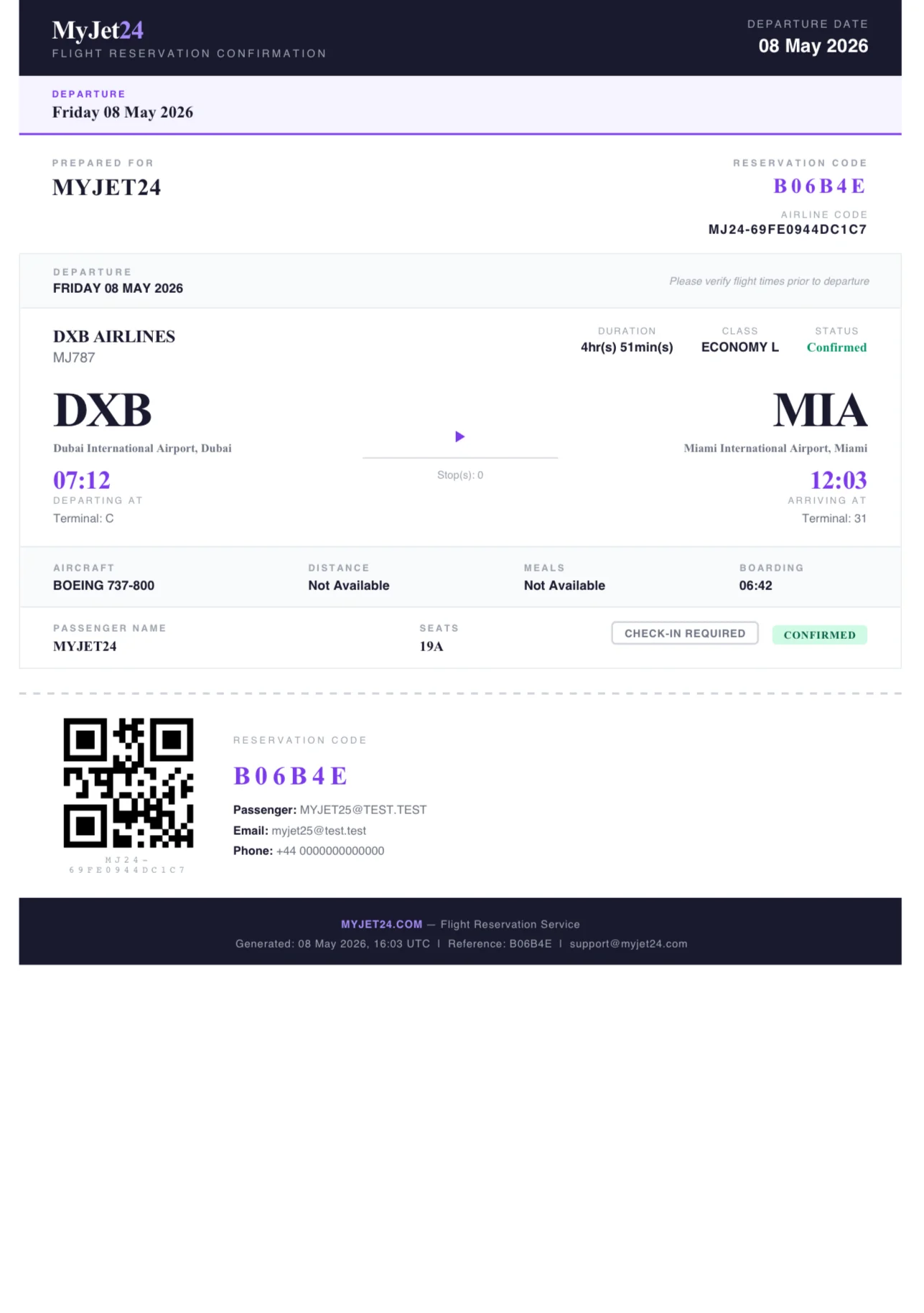
Travellers leaving Philippines often book short regional hops such as Manila to Singapore, Manila to Hong Kong and Cebu to Kuala Lumpur. Enter your Philippines departure airport (for example Manila (MNL)), an onward destination and a travel date in the generator above, and MyJet24 produces a flight reservation PDF with a real PNR in about 30 seconds — free, with no account.
Is travel insurance required to enter Philippines?
+
Travel insurance is not strictly mandatory for Philippines, but it is strongly recommended and some airlines or the Bureau of Immigration (BI) may request it. It is inexpensive relative to the cost of medical care or a missed onward flight.
How do I apply for a Philippines e-Visa via evisa.gov.ph in 2026?
+
The Philippines Bureau of Immigration (BI) launched its unified e-Visa portal evisa.gov.ph in 2025 for tourist 9(a) visa applications by non-visa-free nationalities (China, India, Pakistan, Bangladesh, Egypt and others). The 9-step process: (1) Create account at evisa.gov.ph with email verification. (2) Select visa type — 9(a) Tourist Single Entry, 9(a) Multiple Entry, or transit. (3) Upload passport bio page (PDF or JPEG, under 5 MB, validity at least 6 months beyond entry). (4) Upload 2×2 inch (51×51 mm) photo with white background — Philippines uses the US Passport size, different from Schengen 35×45 and UAE 43×55. (5) Upload return or onward flight reservation — a dummy ticket from MyJet24 with a real PNR is accepted. (6) Upload hotel reservation covering entire stay OR Philippine host details. (7) Upload financial proof — bank statement showing USD 1,000 minimum for Tourist Visa. (8) Pay USD 30 (single entry) or USD 60 (multiple) via card. (9) Receive e-Visa PDF in 5-10 working days. Print and carry — required at airline check-in plus Philippine immigration.
What documents do I need for a Philippines 9(a) tourist visa application?
+
Philippine 9(a) Tourist Visa requires 6 mandatory documents under BI Operations Order SBM-2014-059: (1) PASSPORT — coloured scan of bio page, validity at least 6 months beyond Philippine entry, 2 blank visa pages. (2) PHOTO — recent 2×2 inch (51×51 mm) colour photograph with white background, neutral expression, no glasses, taken within last 6 months (this is the US Passport size, NOT Schengen 35×45 or UAE 43×55). (3) FLIGHT — confirmed return or onward flight reservation showing entry to Philippines and exit within 59 days (dummy ticket from MyJet24 accepted by Philippine Consulates and BI). (4) ACCOMMODATION — hotel reservation covering entire stay OR Philippine host details (host's National ID copy, phone, address, relationship). (5) FINANCIAL — bank statement showing USD 1,000 minimum (covering last 3 months) with stable balance trend. (6) PURPOSE — cover letter explaining trip purpose, day-by-day itinerary, employment letter or business registration. Chinese, Indian, Pakistani, Bangladeshi, Egyptian and select African applicants undergo additional background-check tier processing.
What is the SRRV (Special Resident Retiree's Visa) and how do I apply in 2026?
+
The Philippine SRRV is one of Asia's most popular long-stay retirement visas, administered by the Philippine Retirement Authority (PRA) — not the Bureau of Immigration. It offers multi-entry, indefinite-stay residency for foreign retirees. Four sub-categories: (1) SRRV Smile (ages 35+, USD 20,000 PRA deposit, single/no dependents). (2) SRRV Classic (ages 35+, USD 10,000-50,000 deposit depending on age, with monthly pension USD 800 single / USD 1,000 with spouse). (3) SRRV Human Touch (ages 35+, USD 10,000 deposit, must show medical condition requiring care). (4) SRRV Expanded Courtesy (ages 35+, USD 1,500 deposit, exclusive to former Filipinos, retired military, retired diplomats from selected countries). Application is at PRA Manila office, not online. Required: passport, NBI/police clearance from home country (apostilled), medical exam in Philippines, 8 passport-size photos, marriage certificate (if with spouse), birth certificates for dependents, USD deposit at PRA-accredited bank. Total cost USD 1,400-1,500 in PRA fees plus the deposit. Processing 30-60 days. SRRV holders get full multi-entry privileges, tax exemption on pension, and can convert the deposit into approved investments after 30 days.
How much money do I need to show for a Philippines tourist visa application?
+
Philippine visa financial proof requirements under BI Operations Order SBM-2014-059: TOURIST VISA 9(a) SINGLE ENTRY — USD 1,000 equivalent (~PHP 56,000) per applicant in bank statements covering last 3 months. TOURIST VISA 9(a) MULTIPLE ENTRY — USD 5,000 equivalent recommended, bank statement covering 6 months. SRRV CLASSIC — USD 10,000 to 50,000 PRA deposit depending on age tier (50+ USD 10k, 35-49 USD 50k), plus monthly pension USD 800-1,000. SRRV SMILE — USD 20,000 PRA deposit, no pension requirement. SIRV (Special Investor's Resident Visa) — USD 75,000 investment in approved Philippine corporation. 13(a) Permanent Resident — proof of stable income from Filipino spouse + financial capacity to support. Show via bank statement (3-6 months stable trend), NOT a single recent large deposit. Suspicious deposits within 30 days of application trigger refusal. Acceptable additional proof includes salary slips, tax return, fixed deposit certificate, or sponsor declaration with sponsor's bank statement.
Why was my Philippines visa application rejected — what are the most common reasons in 2026?
+
Philippine Bureau of Immigration (BI) and Philippine Consulate rejections cite 10 most common reasons under BI Operations Order SBM-2014-059: (1) Passport validity less than 6 months from entry or fewer than 2 blank pages. (2) Photo non-compliance — wrong size (Philippine uses 2×2 inch / 51×51 mm, not Schengen 35×45), off-white background, glasses on, older than 6 months. (3) Mismatched details between passport and form (especially name spelling and birth date). (4) Insufficient financial proof — bank balance below USD 1,000 or suspicious recent deposit. (5) No confirmed return or onward flight reservation. (6) No accommodation proof for full stay. (7) Previous Philippine overstay flagged in BI database. (8) Previous visa refusal from US, Canada, UK, Australia, Schengen, or Japan (these are shared with Philippines under bilateral arrangements). (9) Common name match with security flag (false positive). (10) Inconsistent itinerary — dates on flight, hotel, and application form do not align. Re-applications are accepted after 7 days minimum waiting period. For repeated rejections, switch to in-person Philippine Consulate application instead of evisa.gov.ph — consulate processing allows direct interview clarification.
Is the Philippines eTravel registration mandatory in 2026?
+
Yes. Since 1 September 2023, the eTravel system (etravel.gov.ph) is mandatory for every traveler entering or leaving the Philippines — Filipino citizens included. File the eTravel form within 72 hours before arrival or departure. The system replaces the old paper arrival cards. Submission is free; third-party 'eTravel service' sites charging fees are scams. Your onward ticket is part of the required data fields on the form.
Does Cebu Pacific (5J) check for onward tickets at check-in for Manila?
+
Yes — Cebu Pacific is among the strictest carriers in Asia for the Philippines onward ticket rule. Their counter agents at Manila NAIA, Singapore Changi, Hong Kong, Bangkok, and Tokyo Narita verify proof of onward travel by visual PDF review plus occasional live PNR lookup. Philippine Airlines (PR) and Philippines AirAsia (Z2) apply equally strict checks. Foreign carriers (Emirates EK, Qatar QR, Singapore Airlines SQ) verify at hub transit gates. Without a valid onward ticket, you are denied boarding and may face $300–$1,000 emergency-ticket purchases at the airport counter.
What is the 30-day rule for Philippines visa-free entry?
+
Most nationalities (US, UK, EU, Canada, Australia, Japan, etc.) receive 30 days of visa-free entry to the Philippines on arrival, requiring only a valid passport (6+ months), proof of onward travel, and sufficient funds. The 30-day stamp can be extended once for 29 days (₱3,030 fee) at any Bureau of Immigration office, then 1–2 months per renewal up to a maximum of 36 months. Your onward ticket exit date must fall within the current authorized stay — not the maximum extension period.
How much does a Philippines visa extension cost at the Bureau of Immigration?
+
The first 29-day extension at any Bureau of Immigration (BI) office costs ₱3,030 (approximately USD 55) including visa waiver fee, immigration fee, and express lane fee. The application can be filed at NAIA Manila (Terminal 3), MCIA Cebu, Clark (CRK), Davao (DVO), Iloilo, or the BI head office in Intramuros, Manila. Bring your passport, departure card, completed application form, and onward ticket. Processing takes 1–2 business days. Further extensions of 1–2 months each are also available.
Which onward destinations from Manila are accepted by immigration?
+
International onward flights to any country are accepted: Hong Kong (HKG), Singapore (SIN), Kuala Lumpur (KUL), Bangkok (BKK), Tokyo (NRT/HND), Seoul (ICN), Taipei (TPE), and any further long-haul destination. Intra-Philippines flights (e.g., Manila to Cebu, Manila to Davao) do NOT count as onward travel for foreign visitors — immigration requires proof of leaving the country, not just a domestic move. A MyJet24 onward ticket to any regional Asian airport satisfies the requirement.
Is an onward ticket required for the Philippines?
+
Yes — strictly enforced. You can be offloaded without one.