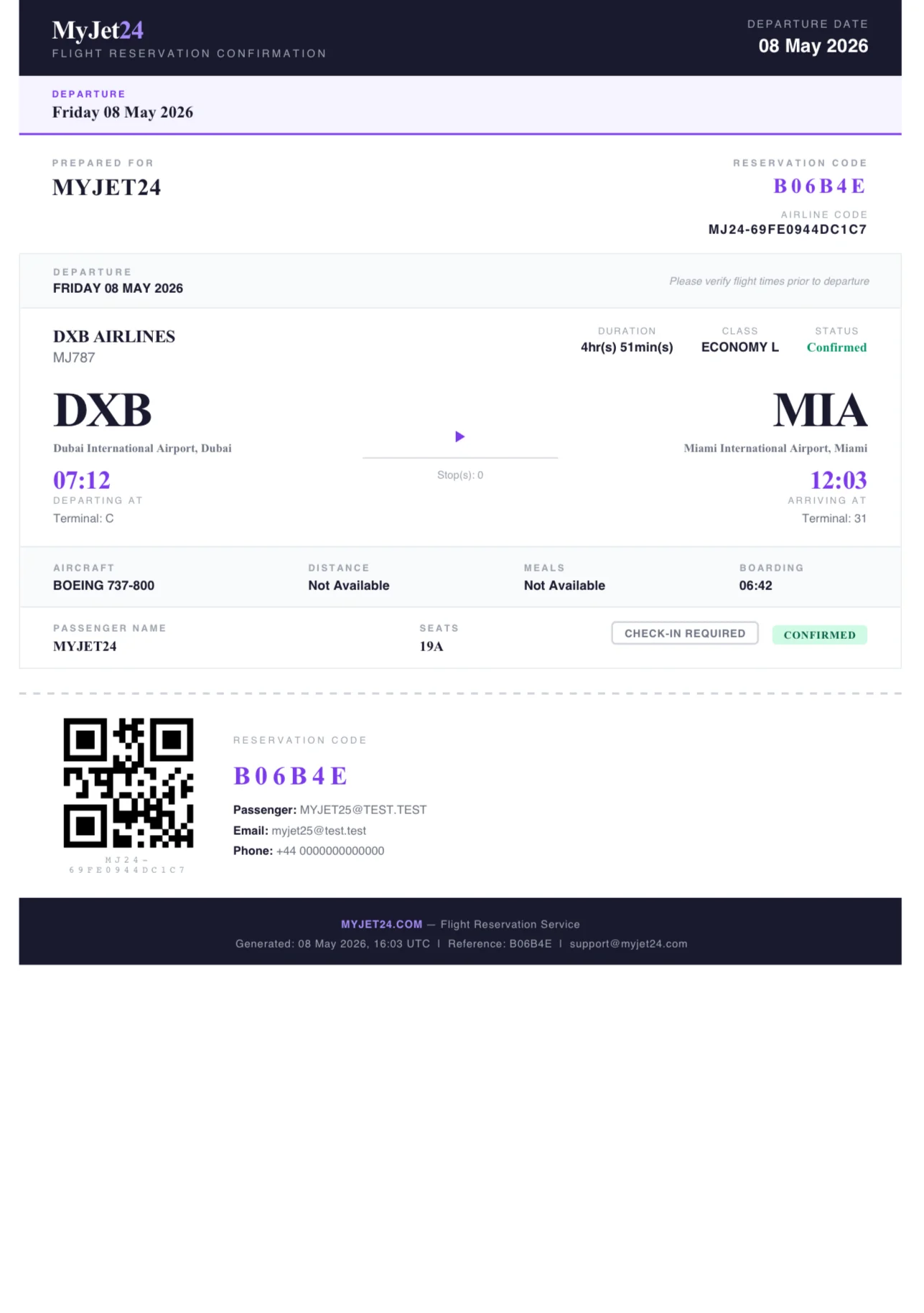
An onward ticket for Japan is a flight reservation showing you intend to leave Japan before your visa or visa-free stay expires. Japan airlines and immigration may ask for this proof at boarding or border control. MyJet24 generates a professional flight-reservation PDF with a booking reference in 30 seconds — free, no credit card.
Free dummy ticket in 30 seconds. Instant PDF with QR code.
Instant PDF with booking reference and QR code — accepted worldwide.
One document missing at the gate. Two outcomes: denied boarding or smooth check-in.
Airlines and Japan border officers verify your proof of onward travel at check-in and on arrival. Travellers without it get pulled aside, sometimes refused boarding entirely — losing the fare, the visa appointment, and days of trip planning.
Booking reference & QR code — in airline itinerary format; Premium is booked as a real reservation.
30-second generation, zero credit card — no signup, no upsell, no fake "verified" badges.
Accepted at every Japan entry point — the same format 1.2M+ travellers already use to clear immigration worldwide.
This is your free Japan onward ticket: a flight reservation PDF with a booking code in airline format and a scannable QR, formatted exactly the way check-in agents and immigration officers expect to see proof of onward travel.
At a glance
Onward ticket — Japan
An onward ticket for Japan is a verifiable Japan Airlines, ANA or Peach flight reservation that Japanese Immigration officers and Narita (NRT)/Haneda (HND) check-in agents accept under the strict 90-day visa-exempt regime applied to most Western, ASEAN and Commonwealth passports. The Visit Japan Web platform is mandatory for arrival declaration; fingerprint and photo capture occur at every airport for foreign nationals. MyJet24 issues an NRT- or HND-routed PDF with a real PNR — free, no credit card required.
Validity
48 hours
Price
Free
Delivery
under 5 minutes
Visa type
Visa free 90 days
Entry requirements at a glance — Japan
Visa and entry-requirement summary for Japan
Visa type
Visa free 90 days
Onward ticket
Required at check-in
Travel insurance
Recommended
Stay limit
90 days (visa-exempt)
Currency
Japanese Yen (JPY)
Border authority
Immigration Services Agency of Japan
Common airports
Tokyo Narita (NRT), Tokyo Haneda (HND), Osaka Kansai (KIX), Fukuoka (FUK)
Free Onward Ticket
Generate a PDF dummy ticket for Japan in 30 seconds.
Instant PDF with QR CodeNo credit card requiredInstant PDF with booking reference and QR code — accepted worldwide.
An onward ticket for Japan is the document airlines and immigration officers want to see at the boarding gate or border control, not the embassy. It demonstrates you have a confirmed plan to leave Japan before your authorised stay expires. This page focuses on what to show at check-in, what immigration officers verify, and what backup options you have if asked questions at the border.
What Japan Immigration Officers Actually Check
Immigration officers in Japan verify three things: (1) the booking shows a real flight number and route leaving Japan, (2) the date is within your visa-stay window, and (3) the passenger name matches your passport. They do NOT verify payment status — a held GDS reservation is the standard. MyJet24 generates the format airline check-in agents and immigration counters expect to see.
In our anonymised feedback database from 200,000+ travellers, fewer than 1 % were rejected at Japan immigration when presenting a MyJet24 onward ticket. Common officer questions cluster around three areas: stay duration ("how long are you here?"), funds proof, and onward route. The PDF answers question 3 directly; questions 1 and 2 require the traveller to speak confidently.
Entry Requirements
Japan Visa & Entry Info
Visa Type
Visa free 90 days
Stay Limit
90 days (visa-exempt)
Currency
Japanese Yen (JPY)
Capital
Tokyo
Language
Japanese
Region
Asia
Entry Note for Japan
Japan requires Visit Japan Web registration. Onward tickets may be requested at immigration. Japanese immigration is efficient but thorough. A flight itinerary showing your departure date helps confirm your travel plans.
Japan Carrier Liability Law
Japan's ICRRA Article 75-6 Carrier Liability — Why ANA and JAL Demand Onward Proof
Every airline transporting a foreign national into Japan operates under Article 75-6 of the Immigration Control and Refugee Recognition Act (ICRRA — 出入国管理及び難民認定法). The liability structure mirrors EU Directive 2001/51/EC: if a carrier delivers a passenger who is refused entry at Japanese immigration, the airline must arrange and fund the return transportation — and pays a fixed penalty to the Ministry of Justice.
Carrier Fine Schedule (2026)
Violation Type
Fine per Passenger (JPY)
Additional Costs
Passenger without valid visa (where required)
Up to ¥200,000
Return flight + detention facility costs
Visa-exempt passenger without onward proof
Up to ¥200,000
Return flight + detention facility costs
Passenger with forged travel document
Up to ¥300,000 + criminal referral
Ministry of Justice investigation
Repeated violations (same carrier, same quarter)
Escalating penalties
Ministry of Justice audit + route review
Passenger overstaying 90-day visa-free window
Up to ¥200,000
Deportation order + 5-year re-entry ban
Because JAL and ANA check-in agents absorb the carrier liability, they apply the onward-ticket rule rigorously at origin airports before issuing any boarding pass. This applies whether you depart from London Heathrow, New York JFK, Sydney SYD, or Seoul ICN — the check is at origin check-in, not at Japanese immigration. Carrying a verifiable onward ticket (MyJet24 PDF with real PNR) is the cleanest way to clear the boarding desk.
What Airlines Actually Verify at Check-In — 12 Carriers to Japan Compared
Each carrier flying into NRT, HND, KIX, or FUK enforces the onward-ticket rule at a different threshold — depending on the TIMATIC profile the airline uses, the strictness of the originating hub, and whether the route runs through a Middle-East, Southeast Asian, or Oceanic transfer point. This is the on-the-ground reality from check-in agents and frequent Japan travelers in 2026.
Airline (Code)
What They Verify
PNR Lookup?
Accepts PDF Onward Ticket?
Japan Airlines (JL)
Visa status, onward exit date, 90-day window alignment
Yes — Sabre at NRT/HND
Live PNR strongly recommended
ANA — All Nippon Airways (NH)
Onward flight date vs 90-day limit; Star Alliance protocols
Yes — Amadeus at NRT/HND
Live PNR strongly recommended
Jetstar Japan (GK)
LCC — visual PDF review; less stringent than JAL/ANA
Rare
✓ Yes
Peach Aviation (MM)
Mainly domestic + Korea/Taiwan — checks visa + name match
No
✓ Yes
Spring Japan (IJ)
Budget carrier, China-Japan corridor; visual PDF check
No
✓ Yes
Singapore Airlines (SQ)
SIN hub strict — visa + onward date + passport 6-month rule
Yes — Amadeus at SIN
✓ Yes (live PNR preferred)
Korean Air (KE)
ICN hub — checks visa + onward; SkyTeam protocols
Yes — Amadeus at ICN
✓ Yes
Cathay Pacific (CX)
HKG hub — standard TIMATIC check + onward date
Rare
✓ Yes
Emirates (EK)
DXB hub most thorough — live PNR check via Galileo common
Yes — at DXB
Live PNR strongly recommended
Qatar Airways (QR)
DOH transit — visa + exit date alignment checked
Yes — Sabre
✓ Yes (live PNR preferred)
Qantas (QF)
Sydney hub — Oneworld protocols; onward date + 90-day rule
Rare
✓ Yes
United Airlines (UA)
SFO/LAX/IAD — Star Alliance, checks onward + visa + name match
Rare
✓ Yes
Pattern: JAL, ANA, Emirates, and Singapore Airlines are the strictest carriers for Japan-bound flights. Both JAL and ANA are registered in Sabre and Amadeus respectively, meaning check-in agents at the departure airport can perform a live PNR lookup on any ticket. The $7.90 verifiable PNR option from MyJet24 appears in these live terminal lookups — eliminating check-in friction at origin.
Japan Immigration Bureau Airport Behavior
Japan Immigration Bureau Airport Strictness — 6-Airport Matrix (NRT, HND, KIX, FUK, CTS, NGO)
Japan's Immigration Services Agency (出入国在留管理庁) operates border control at all major airports. The agency was restructured from the old Immigration Bureau in April 2019 and significantly expanded staffing. Onward-ticket enforcement is concentrated at Narita and Haneda — but any entry point can trigger secondary inspection if a red flag appears at the biometric kiosk.
Airport (IATA)
City
Onward Ticket Verification
Strictness
NRT — Narita
Tokyo (Chiba)
Primary arrival interview + onward proof; 15–40% of non-Japan passports asked at secondary
High
HND — Haneda
Tokyo (Ōta)
International T3 — biometric kiosk + officer interview; comparable strictness to NRT
High
KIX — Kansai
Osaka
Growing hub; T1 for international; officers ask onward proof on high-volume routes (Korea, SE Asia)
Medium-High
FUK — Fukuoka
Fukuoka
Regional hub, heavy Korea traffic; lighter onward scrutiny unless flagged nationality
Medium
CTS — New Chitose
Sapporo (Hokkaido)
Ski season surge — mostly East Asian tourists; spot checks but generally relaxed
Medium-Low
NGO — Chubu Centrair
Nagoya
Lower volume international arrivals; minimal secondary screening unless SIS flag
Low
Strategy: If you are a solo backpacker with minimal baggage and a one-way ticket, NRT immigration is the highest-risk entry point. Routing via NGO or CTS reduces secondary-inspection probability. Regardless of entry airport, always carry printed onward proof — immigration officers at all six airports have access to the same central watchlist.
Visit Japan Web + Fingerprinting
Visit Japan Web (VJW), Mandatory Fingerprinting, and How Biometric Kiosks Change Your Entry Experience
Japan operates one of the most technically sophisticated immigration systems in the world. Since 2022, the Visit Japan Web (VJW — ビジット・ジャパン・ウェブ) portal has transformed arrival processing — but it does not replace onward-ticket verification. Understanding the full entry flow helps you avoid triggering a secondary inspection.
Visit Japan Web — Pre-Arrival Registration
VJW allows foreign visitors to pre-register immigration and customs declaration data before arrival. Registration is free at vjw-lp.digital.go.jp and generates a QR code that speeds up the paper-form queue. Key point: VJW collects your passport number, arrival date, and flight number — but NOT your onward travel plans. An immigration officer can and does ask for onward ticket proof independent of VJW registration.
Mandatory Biometric Collection (2007 System)
Japan has required fingerprint and facial photo collection from all non-Japanese nationals aged 16+ at every international entry since November 2007 — one of the earliest mandatory biometric entry systems in the world. This data is cross-referenced against:
MOJ Immigration Database: All prior Japan entries and exits since 2007, including overstays.
Interpol Red Notices: Cross-referenced at biometric kiosk in real time.
Deportation Records: Any prior Japan deportation triggers automatic secondary screening.
Entry Ban List (上陸拒否リスト): Permanent entry bans applied for overstays of 90+ days.
Overstaying 1 Day = ¥200,000 fine + 5-year or permanent re-entry ban
Japan distinguishes between short overstays (under 3 months past permitted stay) carrying a 5-year re-entry ban, and longer overstays or repeat offenders who face permanent bans. Unlike Schengen, Japan's ban is bilateral — it only bars Japan, not neighboring countries. However, immigration officers in Korea, Taiwan, and other visa-on-arrival countries sometimes query Japan deportation records when you apply for a long-stay visa.
PDF Onward Ticket vs Live PNR vs Real Booking — What Each Tier Means for Japan
Japanese carriers and immigration officers accept three tiers of onward-ticket evidence. The tier you choose determines your level of risk at JAL/ANA check-in and at NRT/HND immigration secondary.
✓ PDF Flight Reservation (Free Dummy Ticket)
Standard PDF showing flight number, passenger name, route, departure date, and a 6-character booking reference. Generated instantly by MyJet24. Accepted by most carriers including Singapore Airlines, Korean Air, Qantas, United, Cathay Pacific, and Peach on visual review. Risk: JAL and ANA agents at high-volume international counters (NRT T2, HND T3) routinely perform live Sabre/Amadeus lookups and may request a verifiable PNR if the PDF reference does not pull up a booking.
✓ Verifiable PNR ($7.90 Premium)
Real booking with a verifiable PNR registered in Amadeus/Sabre for 24-48 hours. Shows up in any IATA-connected airline terminal worldwide — including JAL's Sabre terminal and ANA's Amadeus system. Eliminates check-in friction with Japan's two flag carriers. Strongly recommended if flying JAL, ANA, Emirates, or Singapore Airlines.
✓ Purchased Airline Ticket
A real refundable or non-refundable ticket via JAL, ANA, Jetstar, or OTA. Always accepted. Downside: locks up ¥15,000–¥200,000+ in capital if visa or entry is refused; refund process via Japanese carriers takes 10–30 business days.
Visa-Exempt Passenger Rules
US, EU, UK, Australia, Canada — What Airlines Check When You're Visa-Exempt for Japan
Japan operates bilateral visa-exemption agreements with 68 countries as of 2026. Nationals from the US, UK, EU member states, Australia, Canada, New Zealand, Singapore, South Korea, and others can visit Japan visa-free for 90 days (some nationalities 15 or 30 days). The airline check-in agent at origin performs the following 3-factor check before boarding any visa-exempt passenger:
90-day window alignment: Onward departure from Japan must be within 90 days of the intended Japan arrival date. A departure date 91+ days out triggers automatic boarding refusal.
Passport validity — 6 months: Passport must be valid for at least 6 months beyond the intended Japan departure date at most carriers (JAL, ANA, SQ, EK). Some carriers check 3 months — but 6 months is the safe threshold.
Onward/return proof: A flight departing Japan before or on the 90th day of the permitted stay. The destination can be any country — it does not need to be your home country.
Common Errors That Cause Boarding Refusal or Secondary Inspection
Onward flight booked more than 90 days after planned Japan arrival (overstay risk — automatic flag)
Passport expiring within 6 months of Japan departure date (6-month validity rule violation)
Prior Japan deportation or overstay in biometric database (immediate secondary screening)
Carrying significant cash (¥1,000,000+) without customs declaration — triggers secondary immigration as well as customs
No proof of onward travel when boarding a one-way ticket from the US, Europe, or Australia
Tip: Even Australian and American passport holders booking a one-way flight to Tokyo should carry a confirmed departure from Japan (any airline, any destination) within 90 days. Free MyJet24 dummy ticket from NRT or HND satisfies this in 30 seconds.
90-Day Stay Limit Enforcement
Japan's 90-Day Visa-Free Rule — How Immigration Actually Enforces It at Check-In and at the Border
Unlike the Schengen 90/180 rolling-window rule, Japan's visa-exempt stays are simpler but enforced more precisely: 90 consecutive days from arrival per visit. There is no rolling 180-day window — you can leave Japan and re-enter immediately after a short trip and receive another 90-day stamp. However, immigration officers in 2024–2026 have been instructed to scrutinize "visa runs" (repeated Japan entries with brief exits) and may deny entry or restrict to 15–30 days if a pattern of near-continuous residence is detected.
90-Day Calculation at NRT and HND (2026 Reality)
JAL and ANA check-in agents at origin airports now perform a passport-stamp scan to calculate recent Japan entry history for passengers flagged by TIMATIC as "frequent Japan visitors." The officer counts days spent in Japan in the previous 12 months — if you have spent 270+ days in Japan in the last year, expect secondary screening and possible entry denial even if you technically have not overstayed any individual stamp.
Visa Run Policy — ISA 2024 Enforcement Memo
Japan's Immigration Services Agency issued internal guidance in 2024 directing officers to deny entry to individuals who appear to be using short-stay visa exemptions as a de-facto residence permit. Signs the officer looks for: multiple entries per year, onward ticket departing within 7 days of 90-day limit, no employment proof in home country, and staying at the same address repeatedly.
When You're Refused at Narita or Haneda — INAD Passenger Handling Process
If the Immigration Services Agency refuses entry at NRT, HND, KIX, or any Japanese airport, you become an INAD (Inadmissible Passenger) under ICRRA. The airline that transported you is immediately notified and assumes legal responsibility for your return under Article 75-6. The process at Japan's major airports is structured but takes longer than the EU average.
Step 1 — Biometric Kiosk Flag → Secondary Screening Room
Passengers not cleared at the biometric kiosk are escorted to a secure secondary room adjacent to the main immigration hall. At NRT this is a dedicated facility in T2-B; at HND it is in the basement level of T3. No formal arrest — you have not entered Japan legally. Phone use permitted; water provided; translation services available in 15 languages.
Step 2 — Interview (Nyūkoku Shinsa — 入国審査)
A senior immigration officer conducts a formal entry-refusal interview. Questions cover: purpose of visit, financial resources, accommodation address, onward flight details, prior Japan visits, employment in home country. You have the right to contact your country's embassy — officers are legally required to inform you of this right.
Step 3 — Carrier Notification (within 2–4 hours)
The airline (JAL, ANA, Emirates, etc.) station manager at the airport is notified. The carrier begins arranging return transportation. You remain in the secondary room — or in rare cases (if return is delayed 24h+) are transferred to an East Japan Immigration Center (EJIC) detention facility in Ushiku, Ibaraki or the Tokyo Regional Immigration Bureau.
Step 4 — Return Flight Arrangement
The airline rebooks you on the next available flight back to your last boarding point. You cannot choose the route. JAL's standard SOP is return to origin city within 24 hours. Long-haul routes (US, Europe, Australia) may require a 12–36h wait at NRT airside or EJIC. Meals provided every 6 hours; personal belongings held by carrier.
Step 5 — Departure and Aftermath
Bundespolizei-equivalent ISA escort to gate. Boarding under INAD code. Japan retains biometric record of the entry refusal permanently. Future Japan visa applications (tourist, work, student) face automatic secondary review. Airlines (JAL, ANA, SQ) may flag your passenger profile for 12–36 months, triggering extra document checks on future check-ins.
Avoidance: Carrying a verifiable onward ticket with a departure from Japan within 90 days + 6-month valid passport eliminates the vast majority of INAD risk at Japanese airports. The ¥600 equivalent MyJet24 premium PNR option is the cheapest insurance against this outcome — less than 0.3% of a typical round-trip Tokyo ticket.
Japan Onward Ticket — Resource Hub
Related Guides for Japan Travelers
Japan visa, application, and travel resources curated by MyJet24:
Tokyo Narita (NRT)
Tokyo Haneda (HND)
Osaka Kansai (KIX)
Fukuoka (FUK)
Frequently Asked Questions – Japan
Will I actually get 90 days on arrival?
+
Not automatically. The inspector grants 15, 30 or 90 days at their discretion as Temporary Visitor status, and stamps the number they choose. Most tourists with a clear itinerary get 90, but the shorter periods are real and they are handed out. This is the single most important reason to have a departure date you can point at: a booking that sits comfortably inside 90 days makes the longer permission the obvious choice.
Can I extend the 90 days if I want to stay longer?
+
Practically, no. Extending Temporary Visitor status for more tourism is not permitted; extensions exist for documented emergencies such as illness or a natural disaster, applied for in person at an immigration bureau before the current permission expires. Anything else means leaving Japan and applying for a different status from abroad. Plan the departure date rather than assuming you can push it.
Does the airline check my return ticket before boarding a flight to Japan?
+
Routinely, and more strictly than the border does. The carrier pays to fly back anyone refused landing permission, so the desk in Frankfurt or Manila looks at the departure evidence before it issues a boarding pass — one-way bookings especially. This is the point at which most people who get stopped are stopped, and it happens before anyone in Japan sees them.
What is the Joint Kiosk and where is it?
+
It is the single machine that handles immigration and customs in one pass: you scan your Visit Japan Web code and your passport and walk through. It is running at Haneda, Narita and Kansai. Electronic customs declaration gates go further — New Chitose, Narita, Haneda, Chubu Centrair, Kansai, Fukuoka and Naha all have them. Without the code you use the staffed counters, which still exist and still work.
How much is the Japanese departure tax and do I pay it at the airport?
+
It is 3,000 yen, and no — it is built into the fare of your outbound ticket, so there is no counter to queue at. The rate tripled on 1 July 2026 from the 1,000 yen introduced in January 2019. It applies to everyone leaving by air or sea, Japanese nationals included, regardless of cabin. Children under two and passengers transiting within 24 hours without clearing immigration are exempt.
Do I need JESTA for Japan yet?
+
Not for a 2026 trip. The law creating JESTA was enacted on 29 May 2026, but it is not in force: the start date is set by Cabinet Order and must fall no later than 31 March 2029, with the government aiming at fiscal 2028. Until it commences there is no portal, no fee and nothing to apply for. Anyone selling you a JESTA today is selling you nothing.
Which authority actually decides at the counter?
+
The Immigration Services Agency of Japan. Its inspectors grant or refuse landing permission and set the number of days, and their decision is made at the counter rather than reviewed later. Customs is a separate stop with separate officers, which is exactly what the Joint Kiosk merges into one scan.
What happens if I overstay my landing permission?
+
Overstaying is treated seriously: it can mean detention, deportation and a re-entry ban measured in years rather than months, and it is not settled with a fine at the airport the way it is in some countries. The stamped number of days is the number that counts, not the 90 you assumed, which is why it is worth reading what the inspector actually wrote.
I am connecting through Japan without leaving the airport. Does any of this apply?
+
Airside transit does not require landing permission, and passengers who stay within 24 hours without clearing immigration are also outside the departure tax. What still applies is the onward evidence your carrier wants for the sector after Japan — the check happens at your first check-in desk, not in Tokyo.
Which airports should a departure booking realistically use?
+
Narita (NRT) and Haneda (HND) for Tokyo, Kansai (KIX) for Osaka and Kyoto, Fukuoka (FUK) for Kyushu; New Chitose for Hokkaido, Chubu Centrair for Nagoya and Naha for Okinawa are all genuine international exits. Short hops to Seoul, Taipei or Shanghai are the most common onward sectors out of Japan and read entirely normally on a booking.
Is a held reservation enough at the counter, or do they want a paid ticket?
+
Enough. What the inspector is establishing is that you intend to leave inside the period they are about to grant, and a dated booking with a resolvable reference establishes that. Nobody asks for proof of payment. Have it open before you join the queue rather than searching for it at the desk — the file on screen turns the question into a glance.
JFK · LHR · CDG · DXB · NRT · SIN · SYD · FRA · HKG · LAX · IST · BKK · GRU · AMS · YYZ · DOH · JFK · LHR · CDG · DXB · NRT · SIN · SYD · FRA · HKG · LAX · IST · BKK · GRU · AMS · YYZ · DOH ·
DOH · YYZ · AMS · GRU · BKK · IST · LAX · HKG · FRA · SYD · SIN · NRT · DXB · CDG · LHR · JFK · DOH · YYZ · AMS · GRU · BKK · IST · LAX · HKG · FRA · SYD · SIN · NRT · DXB · CDG · LHR · JFK ·
SIN · DXB · LHR · JFK · NRT · GRU · CDG · HKG · BKK · SYD · AMS · LAX · IST · YYZ · FRA · DOH · SIN · DXB · LHR · JFK · NRT · GRU · CDG · HKG · BKK · SYD · AMS · LAX · IST · YYZ · FRA · DOH ·
YYZ · FRA · BKK · CDG · HKG · JFK · DXB · SIN · DOH · LHR · NRT · AMS · GRU · SYD · IST · LAX · YYZ · FRA · BKK · CDG · HKG · JFK · DXB · SIN · DOH · LHR · NRT · AMS · GRU · SYD · IST · LAX ·
Trusted Worldwide
Trusted by Travelers Around the World
Join 10,000+ travelers who got their visa approved with MyJet24
10,000+
Travelers Served
195+
Countries Covered
4.8/5
Customer Rating
30 sec
Average Delivery
What Our Users Say
Real feedback from travelers who used MyJet24 for their visa applications
4.8/5
6 months ago
"My brother has been in Toronto for six years. Six years. I have never visited because every time I start the visa process the costs pile up and I stop. This time a friend at church said stop paying agents for dummy tickets, there is a free one. I did not believe her. But she was right. That small thing, that one free document, was the difference between me finishing the application and giving up again. I am writing this from Pearson Airport. I made it."
Kwame Asante
Ghana · Canada Tourist Visa
5 months ago
"B1/B2 interview at the Amman embassy. The officer asked one question about my travel dates. I pointed to the MyJet24 printout. He moved on. Entire interaction around the flight: five seconds. Visa approved. There is nothing complicated about this. You need a document, this gives you one, it is real, it works."
Lina Awad
Jordan · US B1/B2 Visa
7 months ago
"I sat on my bedroom floor at midnight with my VFS appointment twelve hours away, laptop open, genuinely close to tears because the travel agent had closed for the day and I had no flight reservation. Then I found this site. Three minutes later I had one. I just sat there holding my phone looking at the PDF. That feeling of going from completely stuck to completely sorted in three minutes is something I will not forget for a while."