An onward ticket for South Korea is a flight reservation showing you intend to leave South Korea before your visa or visa-free stay expires. South Korea airlines and immigration may ask for this proof at boarding or border control. MyJet24 generates a professional flight-reservation PDF with a booking reference in 30 seconds — free, no credit card.
Free dummy ticket in 30 seconds. Instant PDF with QR code.
Instant PDF with booking reference and QR code — accepted worldwide.
One document missing at the gate. Two outcomes: denied boarding or smooth check-in.
Airlines and South Korea border officers verify your proof of onward travel at check-in and on arrival. Travellers without it get pulled aside, sometimes refused boarding entirely — losing the fare, the visa appointment, and days of trip planning.
Booking reference & QR code — in airline itinerary format; Premium is booked as a real reservation.
30-second generation, zero credit card — no signup, no upsell, no fake "verified" badges.
Accepted at every South Korea entry point — the same format 1.2M+ travellers already use to clear immigration worldwide.
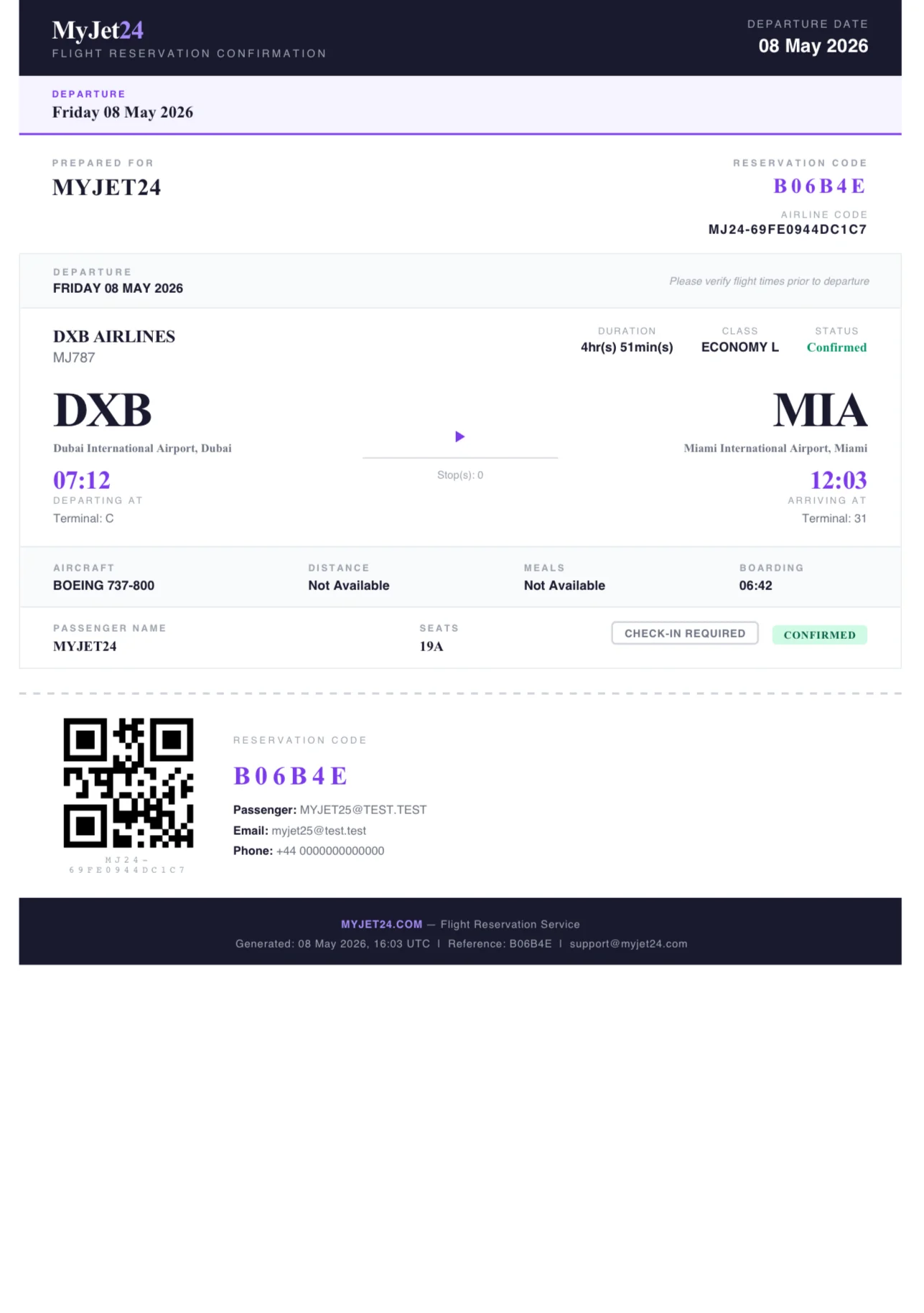
This is your free South Korea onward ticket: a flight reservation PDF with a booking code in airline format and a scannable QR, formatted exactly the way check-in agents and immigration officers expect to see proof of onward travel.
At a glance
Onward ticket — South Korea
An onward ticket for South Korea is a verifiable Korean Air, Asiana or Jeju Air flight reservation that the Korea Immigration Service and Incheon (ICN) check-in agents require alongside K-ETA pre-authorization (apply at k-eta.go.kr) for visa-exempt visitors. Most Western and OECD passports get 90 days; Schengen-state passports get 90 days, US/CA 90 days, AU 90 days. K-ETA is currently waived for Germany, France, UK, US, JP, AU through 2025. MyJet24 issues an ICN-routed PDF with a real PNR — free, no credit card required.
Validity
48 hours
Price
Free
Delivery
under 5 minutes
Visa type
Visa free 90 days (K-ETA)
Entry requirements at a glance — South Korea
Visa and entry-requirement summary for South Korea
Visa type
Visa free 90 days (K-ETA)
Onward ticket
Required at check-in
Travel insurance
Recommended
Stay limit
90 days
Currency
South Korean Won (KRW)
Border authority
Korea Immigration Service
Common airports
Seoul Incheon (ICN), Seoul Gimpo (GMP), Busan (PUS), Jeju (CJU)
Free Onward Ticket
Generate a PDF dummy ticket for South Korea in 30 seconds.
Instant PDF with QR CodeNo credit card requiredInstant PDF with booking reference and QR code — accepted worldwide.
An onward ticket for South Korea is the document airlines and immigration officers want to see at the boarding gate or border control, not the embassy. It demonstrates you have a confirmed plan to leave South Korea before your authorised stay expires. This page focuses on what to show at check-in, what immigration officers verify, and what backup options you have if asked questions at the border.
What South Korea Immigration Officers Actually Check
Immigration officers in South Korea verify three things: (1) the booking shows a real flight number and route leaving South Korea, (2) the date is within your visa-stay window, and (3) the passenger name matches your passport. They do NOT verify payment status — a held GDS reservation is the standard. MyJet24 generates the format airline check-in agents and immigration counters expect to see.
In our anonymised feedback database from 200,000+ travellers, fewer than 1 % were rejected at South Korea immigration when presenting a MyJet24 onward ticket. Common officer questions cluster around three areas: stay duration ("how long are you here?"), funds proof, and onward route. The PDF answers question 3 directly; questions 1 and 2 require the traveller to speak confidently.
Entry Requirements
South Korea Visa & Entry Info
Visa Type
Visa free 90 days (K-ETA)
Stay Limit
90 days
Currency
South Korean Won (KRW)
Capital
Seoul
Language
Korean
Region
Asia
Entry Note for South Korea
South Korea requires K-ETA (Korea Electronic Travel Authorization) for most nationalities. Onward tickets are recommended for all visa and K-ETA applicants. Immigration officers at Incheon International Airport routinely verify return or onward travel documentation. Generate a free dummy ticket with MyJet24 to satisfy South Korean entry requirements.
South Korea Carrier Liability Law
South Korea's Immigration Act Article 12-3 — Why Korean Air and Asiana Refuse Boarding Without Onward Proof
Every airline transporting a foreign national to South Korea operates under Article 12-3 of the Immigration Act (출입국관리법 제12조의3), which places full carrier liability for inadmissible passengers on the transporting airline. The Korea Immigration Service (KIS) can fine any carrier that delivers a passenger lacking valid entry documents — and the fine structure escalates for repeat violations within the same calendar year.
Carrier Fine Schedule (2026)
Violation Type
Fine per Passenger (KRW)
Additional Costs
Passenger without valid visa (where required)
Up to ₩10,000,000
Return flight + KIS detention facility costs
K-ETA-required passenger without K-ETA
Up to ₩10,000,000
Return flight mandatory; no appeal at border
Visa-exempt passenger without onward proof
Up to ₩5,000,000
Return flight + written warning to airline
Passenger with forged document
Up to ₩20,000,000 + criminal referral
Ministry of Justice investigation
Repeated violations (same carrier, same year)
Escalating up to ₩30,000,000
KIS route audit + probationary period
Korean Air (KE) and Asiana (OZ) — the two flag carriers — apply the most rigorous pre-boarding document checks among all Asia-Pacific carriers, because both operate ICN as a hub and absorb the highest INAD risk. Every non-Korean-national passenger on a one-way ticket to ICN should expect explicit onward-ticket verification at check-in, regardless of visa-exempt status.
What Airlines Actually Verify at Check-In — 12 Carriers to South Korea Compared
Korean flag carriers and their alliance partners apply South Korea's TIMATIC requirements at the departure airport. LCCs (Jin Air, Jeju Air, Air Busan) are generally less rigorous on onward verification than the two legacy carriers — but all carriers serving ICN were briefed on stricter K-ETA enforcement from 2023 onwards.
SFO/LAX/IAD — Star Alliance; K-ETA + visa + onward check
Rare
✓ Yes
Pattern: Korean Air and Asiana are the strictest carriers and both use live Amadeus PNR lookups at ICN. Emirates is the strictest non-Korean carrier. The $7.90 verifiable MyJet24 PNR appears in live terminal lookups — eliminating all check-in friction at the strictest counters.
Korea Immigration Service Airport Behavior
Korea Immigration Service Airport Strictness — 6-Airport Matrix (ICN, GMP, PUS, CJU, TAE, CJJ)
The Korea Immigration Service (KIS — 출입국·외국인정책본부) under the Ministry of Justice operates border control at all Korean international airports. Incheon ICN T1/T2 handles the overwhelming majority of international arrivals and is by far the most thoroughly staffed entry point. Regional airports have significantly lighter secondary-inspection capacity.
Airport (IATA)
City
Onward Ticket Verification
Strictness
ICN — Incheon T1/T2
Seoul (Incheon)
Primary interview; secondary for one-way passengers, overstay flags, or K-ETA-exempt nationalities
High
GMP — Gimpo
Seoul (Gangseo)
Mostly Japan/China short-haul; active K-ETA check; lighter than ICN but growing
Medium-High
PUS — Gimhae (Busan)
Busan
Regional hub — Japan, SE Asia ferry/air; spot checks; onward proof rarely demanded
Medium
CJU — Jeju
Jeju Island
Visa-free zone for most nationalities; very light document review; mostly domestic + China
Low
TAE — Daegu
Daegu
Limited international routes; minimal secondary capacity
Low
CJJ — Cheongju
Cheongju (North Chungcheong)
Primarily charter and China routes; very light international arrival volume
Very Low
Note: Jeju Island operates a separate visa-free zone for nationals of 180+ countries (including China) — the normal Korean visa and K-ETA requirements do NOT apply for stays of up to 30 days on Jeju only. If you intend to travel to mainland Korea from Jeju, full entry rules apply at the transfer point.
K-ETA + Smart Entry Service
K-ETA (Korea Electronic Travel Authorization) and Smart Entry Service — How They Affect Your Onward Ticket Requirement
South Korea introduced the K-ETA (전자여행허가 — Korea Electronic Travel Authorization) in 2021, requiring pre-travel authorization from nationals of countries previously enjoying visa-free access. K-ETA collects flight details, accommodation, and purpose of visit — but critically, it does NOT substitute for an onward ticket at the boarding gate or immigration desk. The two requirements are separate.
K-ETA — Key Facts (2026)
Required for: Nationals of ~112 countries previously visa-exempt, including US, UK, most EU, Australia, New Zealand, Canada (K-ETA exemption for some nationalities was temporarily suspended 2023–2024 — always verify current status at the official K-ETA site).
Cost: ₩10,000 (approx. $7.50 USD) — valid for multiple entries for 2 years or until passport expiry.
Processing time: Typically 72 hours, but can take up to 7 days. Do not apply within 24 hours of departure.
Denial rate: Higher than Schengen ETIAS estimates. Applicants with prior Korean immigration violations, criminal records, or incomplete applications face denial.
Smart Entry Service (SES) — Automated Immigration Kiosks
ICN T1 and T2 operate Smart Entry Service (SES) kiosks for registered foreign nationals — primarily long-term residents and frequent visitors who have pre-enrolled fingerprints. Tourists on their first or second visit to Korea will pass through traditional officer-staffed immigration lanes. The biometric gate does not bypass onward-ticket checks — it simply speeds up the passport scan stage.
K-ETA Does Not Replace Onward Ticket
Airlines and KIS immigration officers treat K-ETA approval and onward-ticket proof as two independent requirements. Having an approved K-ETA and arriving on a one-way ticket without onward proof is still grounds for boarding refusal (by Korean Air) or secondary inspection (by KIS at ICN). Both requirements must be met simultaneously.
PDF Onward Ticket vs Live PNR vs Real Booking — What Each Tier Means for South Korea
Korean carriers and KIS immigration officers accept three tiers of onward-ticket evidence. The tier you choose determines your exposure to boarding refusal at Korean Air or secondary inspection at ICN.
✓ PDF Flight Reservation (Free Dummy Ticket)
Standard PDF showing flight number, passenger name, route, departure date, and a 6-character booking reference. Generated instantly by MyJet24. Accepted by most carriers including Singapore Airlines, Japan Airlines, Cathay Pacific, Qatar, United, Jeju Air, Jin Air, and Air Busan on visual review. Risk: Korean Air (KE) and Asiana (OZ) check-in agents at ICN T1/T2 use live Amadeus terminal lookups and will ask for a verifiable PNR if the PDF reference number does not resolve to a booking.
✓ Verifiable PNR ($7.90 Premium)
Real booking with a verifiable PNR registered in Amadeus/Sabre for 24-48 hours. Appears in Korean Air's and Asiana's live Amadeus terminal and in KIS immigration officer systems. Eliminates boarding-refusal risk at all Korean carriers. The highest-value insurance for travellers flying on KE or OZ metal, or transiting through a strict hub like DXB (Emirates) on the way to ICN.
✓ Purchased Airline Ticket
A real refundable or non-refundable ticket via Korean Air, Asiana, Jeju Air, or OTA. Always accepted. Downside: locks up ₩60,000–₩600,000+ in capital for the onward leg; Korean carriers have complex refund timelines of 10–30 business days.
Visa-Exempt Passenger Rules
US, EU, UK, Japan, Australia — What Korean Air Checks When You're Visa-Exempt
South Korea maintains visa-free access (90 days) for nationals of approximately 66 countries — separate from the K-ETA requirement, which applies to a wider group. US, EU, UK, Australian, and Japanese nationals travel visa-free to South Korea. Korean Air's boarding agent SOPs for visa-exempt passengers on one-way tickets to ICN (2026 training guidelines):
K-ETA or visa validation: Nationality-specific — agent confirms K-ETA or visa stamp/approval before anything else.
Onward exit date within 90 days: Departure flight from Korea within 90 days of planned Korea arrival, on any carrier to any destination.
Passport validity — 6 months beyond intended Korea departure: Korean Air and Asiana apply the 6-month rule strictly at origin check-in.
Prior overstay check: Agents flag passports showing previous Korean immigration stamps when a new one-way is presented.
Common Errors That Cause Boarding Refusal or Secondary at ICN
Traveling without K-ETA when your nationality requires it (immediate boarding refusal by all Korean carriers)
Onward flight booked more than 90 days after planned Korea arrival (overstay risk — flag)
Passport expiring within 6 months of Korea departure (6-month validity violation)
Prior Korean overstay visible in passport stamps (secondary inspection + possible refusal)
No proof of onward travel on a one-way ticket to ICN from a non-Korean-national
Tip: Even US and UK passport holders booking one-way tickets to Seoul should carry a confirmed onward departure from any Korean airport within 90 days. Free MyJet24 dummy ticket from ICN satisfies this in 30 seconds — and costs nothing.
90-Day Stay Limit Enforcement
South Korea's 90-Day Visa-Free Limit — How KIS Enforces It and What Happens if You Overstay
Like Japan, South Korea grants visa-exempt arrivals 90 consecutive days per entry — not a rolling 180-day window. You can technically exit and re-enter immediately for another 90-day block. However, KIS has been tracking "visa run" patterns since 2022 and immigration officers at ICN are instructed to question travelers who appear to be living in Korea on back-to-back 90-day stamps.
When You're Refused at Incheon — INAD Passenger Handling Process at ICN T1/T2
If KIS refuses entry at ICN, GMP, or any Korean airport, you become an INAD passenger under the Immigration Act. Incheon International Airport is one of the most operationally disciplined entry points in the world — the INAD process is fast and well-documented.
Step 1 — Secondary Screening Room (보호실)
KIS officers direct you to a secure secondary room in T1 (Gate 24–26 area) or T2 (East concourse). Comfortable seating, vending machines, phone access permitted. You have NOT entered Korea legally. Your passport is held by KIS during processing — this is standard practice, not confiscation.
Step 2 — Entry Refusal Interview
A senior KIS officer conducts a brief formal interview — purpose of visit, accommodation, financial proof, onward plans. Interviews typically take 20–60 minutes. Translation services available in 12+ languages. You may contact your embassy; KIS is legally required to inform you of this right.
Step 3 — Carrier Notification (30 min – 2 hours)
Korean Air or Asiana station manager at ICN is notified and begins arranging return. LCC passengers on Jeju Air or Jin Air are similarly notified. If you arrived via a non-Korean carrier (Emirates, SQ, QR), that carrier's ICN station manager is contacted.
Step 4 — Return Flight Arrangement
The carrier rebooks you on the next available flight to your origin. ICN's connectivity means return flights typically depart within 6–24 hours. You are held in the secondary room or, for longer waits (24h+), may be transferred to the ICN Airport Detention Facility (T1 annex building). Meals provided every 4–6 hours.
Step 5 — Departure and Aftermath
KIS escort to gate; INAD code on boarding pass. Korea records entry refusal in the national immigration database permanently — biometric match will flag the refusal on any future Korea application. K-ETA applications after an INAD event face near-automatic denial and require consular review.
Avoidance: A valid K-ETA + onward ticket within 90 days + 6-month passport removes 95%+ of INAD risk at ICN. The $7.90 MyJet24 verifiable PNR is the cheapest insurance — less than the cost of a single Seoul subway ride.
South Korea Onward Ticket — Resource Hub
Related Guides for South Korea Travelers
South Korea visa, K-ETA, and travel resources curated by MyJet24:
Seoul Incheon (ICN)
Seoul Gimpo (GMP)
Busan (PUS)
Jeju (CJU)
Frequently Asked Questions – South Korea
What is the Q-Code and do I need one?
+
A health declaration, filed online. Travellers arriving from a place currently designated a Quarantine Inspection Required Area should submit one if they have any symptoms of illness. Failing to comply carries a fine of up to 10 million won, which is a serious figure for a form that takes four minutes.
Which authority decides at the counter?
+
Korea Immigration Service, under the Ministry of Justice, at every port. It runs the K-ETA, the e-Arrival card and the entry decision, so the three things you filed and the officer in front of you all sit in one system — and an inconsistency between them is visible without anyone looking for it.
Which routes are the ordinary departures from Incheon?
+
Tokyo, Osaka, Shanghai, Beijing, Taipei, Hong Kong and Bangkok carry the volume, and the Japanese sectors are the shortest and most frequent. Incheon is one of the best-connected airports in Asia, which makes a credible onward booking both cheap and easy to arrange.
What happens if I overstay?
+
Fines that scale with the length, and a re-entry ban that is applied rather than threatened. Korea keeps clean digital records of entries and exits and matches them without effort. The ninety days are counted precisely, and an overstay of a week is treated as an overstay rather than as a rounding error.
Can I extend the ninety days?
+
Not as a visa-free visitor, as a rule. The ninety days are the permission, and staying longer means holding a visa that allows it, applied for before you arrive. Korea is markedly less flexible about in-country extensions than Southeast Asia, and planning around that is easier than negotiating it.
Does leaving and re-entering give me a fresh ninety days?
+
A short hop to Fukuoka and back gets you a new decision from a new officer rather than an automatic reset, and repeated short exits are a visible pattern in a system that records everything. It is not prohibited and it is not reliable.
Do I need a new e-Arrival card each time?
+
Yes — it covers one arrival, filed within the 72 hours before it. Anyone doing a Japan or Taiwan side trip files again for the return leg. It is free and it is quick, but the window is short enough that it needs to be on the list rather than left to memory.
Is transit different from entry?
+
If you stay airside at Incheon you are not entering the country and the conditions above do not apply to you. The moment you pass through immigration — for a stopover, a hotel, a day in Seoul — you are a visitor, and the ticket and card requirements attach in full.
What if the K-ETA exemption ends while my trip is booked?
+
Then you apply for one, at least 72 hours before you fly. That is the practical reason to check your nationality against the official site close to departure rather than when you book: an exemption with an end date of 31 December 2026 is precisely the kind of thing that changes between the booking and the flight.
Is there an exit formality?
+
No departure tax and no exit form — the record is electronic and closes when you leave. What matters is that the departure actually gets recorded, which it does automatically at the gate. Korea's border data is among the tidiest anywhere, and that cuts both ways.
What should be in hand before I fly?
+
The K-ETA if your nationality needs one, the e-Arrival card filed inside its 72 hours, a dated departure and a passport valid past your leaving date. Two of those four have a three-day window, and they are the two people miss.
An onward ticket is one part of your South Korea visa and travel documentation. Use MyJet24's free tools to prepare all required documents in one place.
JFK · LHR · CDG · DXB · NRT · SIN · SYD · FRA · HKG · LAX · IST · BKK · GRU · AMS · YYZ · DOH · JFK · LHR · CDG · DXB · NRT · SIN · SYD · FRA · HKG · LAX · IST · BKK · GRU · AMS · YYZ · DOH ·
DOH · YYZ · AMS · GRU · BKK · IST · LAX · HKG · FRA · SYD · SIN · NRT · DXB · CDG · LHR · JFK · DOH · YYZ · AMS · GRU · BKK · IST · LAX · HKG · FRA · SYD · SIN · NRT · DXB · CDG · LHR · JFK ·
SIN · DXB · LHR · JFK · NRT · GRU · CDG · HKG · BKK · SYD · AMS · LAX · IST · YYZ · FRA · DOH · SIN · DXB · LHR · JFK · NRT · GRU · CDG · HKG · BKK · SYD · AMS · LAX · IST · YYZ · FRA · DOH ·
YYZ · FRA · BKK · CDG · HKG · JFK · DXB · SIN · DOH · LHR · NRT · AMS · GRU · SYD · IST · LAX · YYZ · FRA · BKK · CDG · HKG · JFK · DXB · SIN · DOH · LHR · NRT · AMS · GRU · SYD · IST · LAX ·
Trusted Worldwide
Trusted by Travelers Around the World
Join 10,000+ travelers who got their visa approved with MyJet24
10,000+
Travelers Served
195+
Countries Covered
4.8/5
Customer Rating
30 sec
Average Delivery
What Our Users Say
Real feedback from travelers who used MyJet24 for their visa applications
4.8/5
6 months ago
"For context: I travel frequently for work and have been through the US visa process multiple times. The flight reservation has always been the lowest-value, highest-annoyance part of the paperwork. MyJet24 eliminates that friction point entirely. The output is clean, the booking reference validates against the airline system, and the turnaround is measured in minutes, not hours. I have recommended it to several colleagues. Each of them had the same reaction I did: why did nobody tell me about this sooner."
Vik Mehta
United Kingdom · US B1/B2 Visa
5 months ago
"The whole concept of requiring a flight reservation before approving a visa is backwards. You are asking me to plan a trip I might not be allowed to take. The airline will not refund me if the visa is refused. The embassy knows this. Everybody knows this. But the requirement exists, so you play the game. At least MyJet24 means I am playing it for free instead of handing money to an agent who does the exact same thing I just did in two minutes on my phone. Lagos consulate interview went fine. Officer could not have cared less about the flight document."
Emeka Nnamdi
Nigeria · US B1/B2 Visa
7 months ago
"Let me tell you about the agent on Gulshan Avenue. He sits behind a glass counter, types your name into the same kind of website I found in two seconds on Google, clicks a button, prints a page, and charges you 4,500 taka. Four thousand five hundred taka for something that took him forty five seconds. I know because I watched him do it for the person before me in the queue. I walked out, went home, did it myself on MyJet24, and have been angry about almost paying that man ever since. The French embassy in Dhaka approved my visa in twelve days. The agent had nothing to do with it."