
Last updated: 15 September 2026 · Reading time: 23 min · Author: James Mitchell, CEO & Founder of MyJet24 · Reviewed by: Marc Hoffmann, Senior Visa Consultant
TL;DR — Key facts
- A visa label in an old passport often keeps working. The United States, Canada and Germany let you travel with the old passport that holds the visa and the new passport together.
- Electronic travel authorizations do not move. The US ESTA, Canada’s eTA, the UK ETA, New Zealand’s NZeTA and Australia’s ETA all need a new application on the new passport.
- Electronic visas have to be re-linked. The UK (UKVI account), Australia (ImmiAccount) and New Zealand (visa transfer) want the new passport attached to the record.
- Never move a visa label yourself. The US State Department says a visa removed from the old passport and stuck into the new one is no longer valid.
- Renew first, apply second. An authorization issued on a passport number cannot be used once you travel on a different passport.
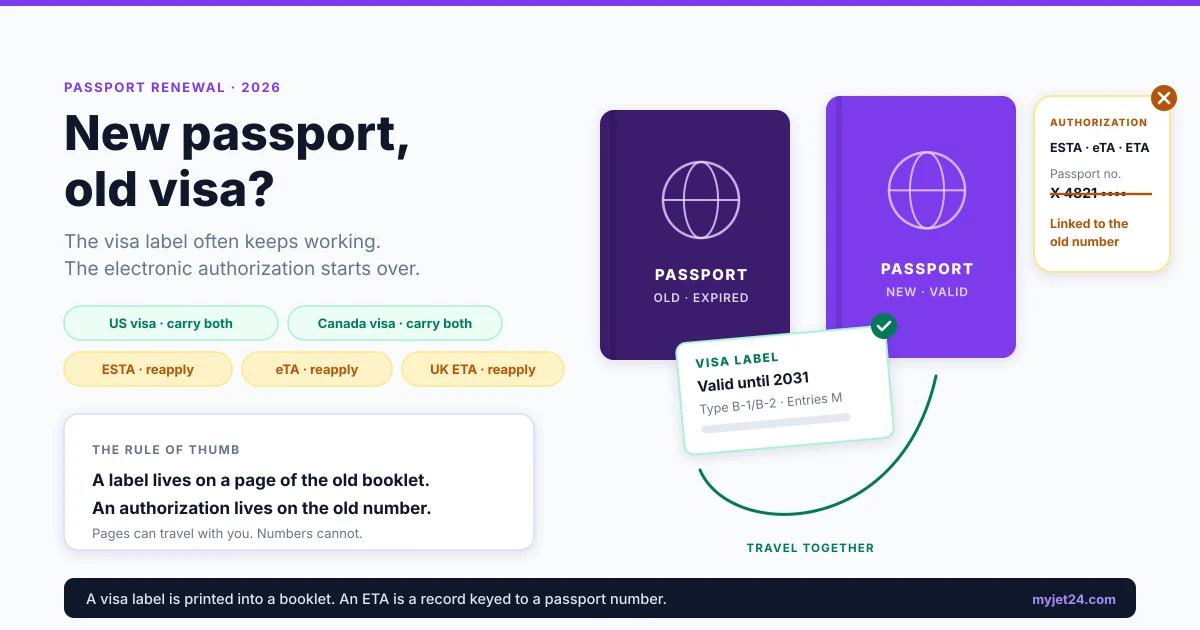
Yes, a valid visa in an old passport usually still works: carry the old passport with the visa and your new passport together, as the US, Canada and Germany allow. Electronic authorizations are different. An ESTA, eTA, UK ETA, NZeTA or Australian ETA is tied to the old passport number, so you apply again before you fly.
Made out in the exact name on your new passport. Free, no card required.
What happens to your visa when you get a new passport?
A passport renewal is the point at which every travel permission you hold gets matched against a new document number. What happens next depends on the kind of permission, not on the country you plan to visit or on how much validity the permission has left.
There are three outcomes. A visa label printed into the old booklet usually keeps working, as long as you carry the old passport alongside the new one. An electronic visa stays valid but has to be re-linked to the new passport in a government account. An electronic travel authorization, the ETA-style approval that visa-exempt travellers get online, cannot be moved at all and has to be requested again.
Take a traveller who renews a passport in spring and holds three permissions from the old one: a US visitor visa label, a Canadian eTA and a UK ETA. After the renewal the US visa still works if both passports travel together. The eTA and the UK ETA do not. Both are attached to the old passport number, so the traveller applies again, at CAD 7 and £20. Nothing was refused and nothing expired; the permissions simply belong to a document that is no longer the one in use.
When we checked the official pages for this guide on 15 September 2026, every government that runs an electronic authorization said the same thing in slightly different words. The visa side was less uniform: three governments accept a visa in the other passport, three want the record moved, and one of them, New Zealand, applies the transfer rule even to printed labels.
Key takeaway: before you ask “is my visa still valid?”, ask what kind of document it is. The answer follows from that.
Why does a visa survive a new passport when an ETA does not?
A visa label is a secure sticker printed into one particular booklet, while an electronic travel authorization is a database record keyed to a passport number. That difference explains almost every rule in this guide.
The label carries its own information: your name, the visa type, the number of entries and its own validity dates. When the booklet around it expires, the label can still be read, so an issuing country can decide to accept it next to a new passport. An authorization has nothing you can carry. At check-in, the airline reads the passport you hand over and asks the government system whether that document has an approval. A new passport has a new number, and the system has no approval on file for it.
The official wording makes the link explicit. Immigration, Refugees and Citizenship Canada says: “Your eTA is electronically linked to your passport.” US Customs and Border Protection lists the first trigger for a new ESTA as the moment “the traveler is issued a new passport”. The UK Home Office says people “must travel using the same passport they used when they applied for their ETA.” We explain how these schemes differ from visas in our guide to visa-free entry, ETAs, eVisas and visas on arrival.
The European Union wrote the same principle into law before its own scheme has even started:
“A travel authorisation shall be valid for three years or until the end of validity of the travel document registered during application, whichever comes first.”
— Regulation (EU) 2018/1240, Article 36(5) (ETIAS)
The phrase “the travel document registered during application” is the whole story. ETIAS is not operating yet, as our update on the ETIAS launch timetable explains, but when it does, a renewed passport will end the old approval by definition.
Key takeaway: pages can travel with you in an old booklet. A number stored in a database cannot be carried anywhere.
Can you enter the United States with a visa in your old passport?
Yes. VIOPP, short for “visa in other passport”, is the annotation a US officer adds to the admission stamp when a traveller enters on a visa that sits in a different passport, and the State Department describes the process in its visa FAQ.
The State Department’s answer to the question “Do I need to apply for a new visa with my new passport?” is no. You can travel with your two passports as long as the visa is valid, is not damaged, and is the right type for the main purpose of your trip, such as a tourist visa for tourism. Both passports should be from the same country and of the same type, for example two regular passports. At the port of entry the officer checks the visa in the old passport and, if you are admitted, stamps the new passport with the VIOPP note.
Two conditions trip people up. The first is nationality: a dual national cannot combine a US visa in one country’s passport with a passport from another country, because the two booklets must come from the same country. The second is the label itself. The State Department is blunt about it:
“Do not try to remove the visa from your old passport and stick it into the new valid passport. If you do so, your visa will no longer be valid.”
— U.S. Department of State, Visa FAQ
Visa Waiver travellers are in the opposite position. An ESTA is approved “for a two-year period or until the applicant’s passport expires, whichever is sooner”, according to CBP, and a new passport means a new ESTA application with a new fee, $40 since 30 September 2025.
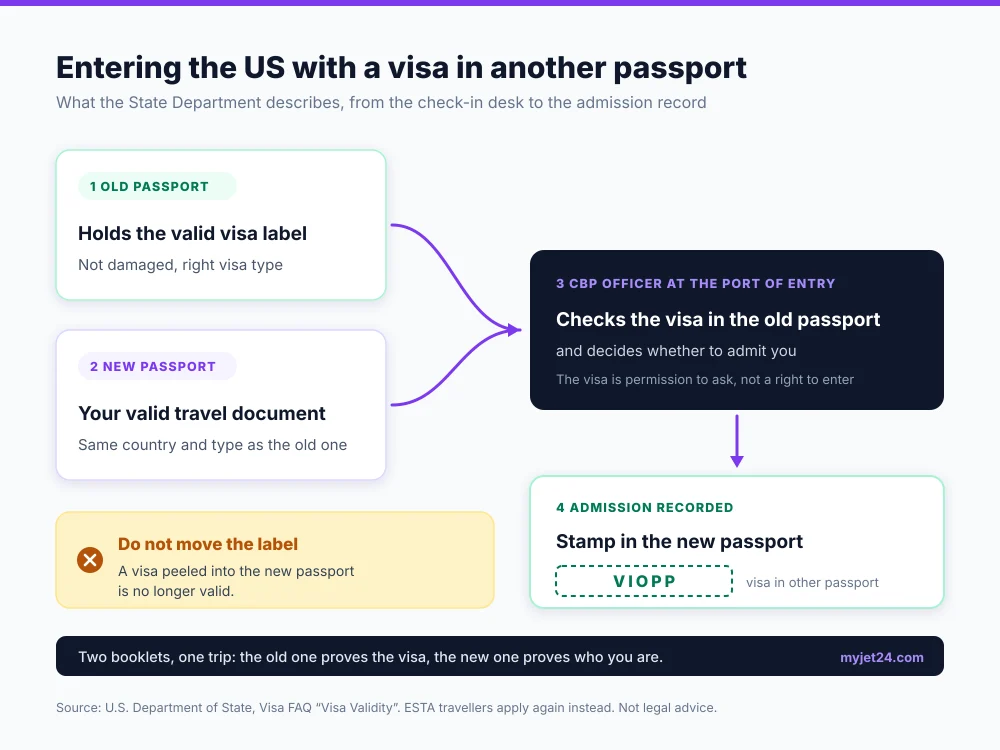
Key takeaway: a US visa follows you to a new passport only if the label stays where it was printed and both booklets come from the same country.
Does a Schengen or Canadian visa in an expired passport still work?
A Schengen visa is a uniform visa label issued under the EU Visa Code and affixed to one travel document. The Visa Code does not set out a procedure for moving a visa to a new passport, so the practical answer comes from the member states that issue them.
Germany’s Federal Foreign Office gives the clearest official statement. Travellers with a valid Schengen visa for the whole planned trip in the old passport may use it with the new passport “if the new passport is attached to the old one and if the spelling of the name and alphanumerical data is exactly the same between the two passports.” If a transliteration changed, or the new booklet shows your name differently, that condition is not met and you should ask the consulate that issued the visa before you travel. Other Schengen states publish their own guidance, and the safe step is to check with the issuing consulate.
The new passport still has to pass the ordinary Schengen document test. Article 6 of the Schengen Borders Code requires a travel document valid for at least three months after the date you intend to leave and “issued within the previous 10 years”. The Visa Code adds, for applications, that the passport must contain at least two blank pages.
Canada’s rule is close to the US one. IRCC answers “Yes” to the question of using a valid visa in an old passport, provided you bring both the old passport with the visa and your new valid passport. It adds two notes worth taking seriously: “You may need to explain why your old passport isn’t valid,” and IRCC recommends a new visa in the valid passport “to avoid delays at the border.”
Compared side by side, the three rules test different things. The US checks that both passports are from the same country and type. Germany checks that the personal data is identical. Canada accepts the pair but warns you may have to explain it.
Key takeaway: for a Schengen visa, identical data in both passports matters as much as the visa dates.
Which countries make you move the visa to the new passport?
An electronic visa is a visa that exists only as a government record, so the record has to point to the passport you actually carry. Carrying the old booklet does not help, because there is no label in it to show.
United Kingdom. GOV.UK says you should update your UKVI account if you change your passport or travel document. You can still travel on your current passport, but “if your UKVI account is not up to date you might experience delays when you travel or when waiting for a visa decision.”
Australia. The Department of Home Affairs asks visa holders: “Tell us when you get a new passport so that we can link it to your visa or citizenship application, or your existing visa.” The quickest route is the “Change of passport details” option in ImmiAccount. ETA holders are excluded from that process, as the next section shows.
New Zealand. Immigration New Zealand requires you to transfer your visa to the renewed passport before you use it to travel, and the rule applies to printed visa labels as well as eVisas. It runs an online form for the transfer. New Zealand is the one country in this guide where even a label does not simply ride along in the old booklet.
The contrast with the label systems is practical. A US or Canadian visa holder can fix the situation at the airport by bringing the old passport. A UK, Australian or New Zealand visa holder has to fix it online before leaving home.
Key takeaway: if your visa was never a sticker, the fix is an account update, and it has to happen before the trip.
Who has to apply again for an ESTA, eTA, ETA or NZeTA?
An electronic travel authorization is pre-travel permission for visa-exempt travellers, and every major scheme ties it to the passport you applied with. Anyone who renews a passport while holding one has to apply again before flying on the new document.
The rules are consistent across all five schemes that are running today. CBP requires a new ESTA when a traveller is issued a new passport. Canada says: “If you get a new passport, you need to get a new eTA,” at CAD 7. The UK ETA costs £20 and must be used with the passport you applied with; our UK ETA guide covers the application itself. Australia’s Home Affairs says of its ETA: “Your existing ETA cannot be transferred to a new passport.” Immigration New Zealand says the details in your NZeTA “must always match the details in the passport you will be using to travel”, so a new passport number means a new request before you fly.
| Document | What it is | What a new passport does | Official source |
|---|---|---|---|
| US visa | Label | Keeps working with both passports; entry noted VIOPP | US State Department |
| Canadian visa | Label | Keeps working with both passports; new visa recommended | IRCC |
| Schengen visa (Germany) | Label | Usable if passports are attached and the data is identical | Federal Foreign Office |
| UK eVisa | Electronic visa | Update the UKVI account | GOV.UK |
| Australian visa | Electronic visa | Change passport details in ImmiAccount | Department of Home Affairs |
| New Zealand visa | Label or eVisa | Transfer to the new passport before travel | Immigration New Zealand |
| US ESTA | Authorization | New application, $40 | CBP |
| Canada eTA | Authorization | New eTA, CAD 7 | IRCC |
| UK ETA | Authorization | Tied to the passport used to apply; new ETA, £20 | UK Home Office |
| NZeTA | Authorization | Details must match the travel passport; new request, from NZ$17 | Immigration New Zealand |
| Australian ETA (601) | Authorization | Cannot be transferred; apply again | Department of Home Affairs |
| EU ETIAS (not yet live) | Authorization | Ends with the registered travel document | Regulation (EU) 2018/1240, Art. 36(5) |
Read down the table and a pattern appears: 3 of the 12 documents keep working in the old passport, 3 need the record moved, and all 6 authorizations start over. The country-specific detail is in our guides to the Canada eTA, the NZeTA and ETIAS.
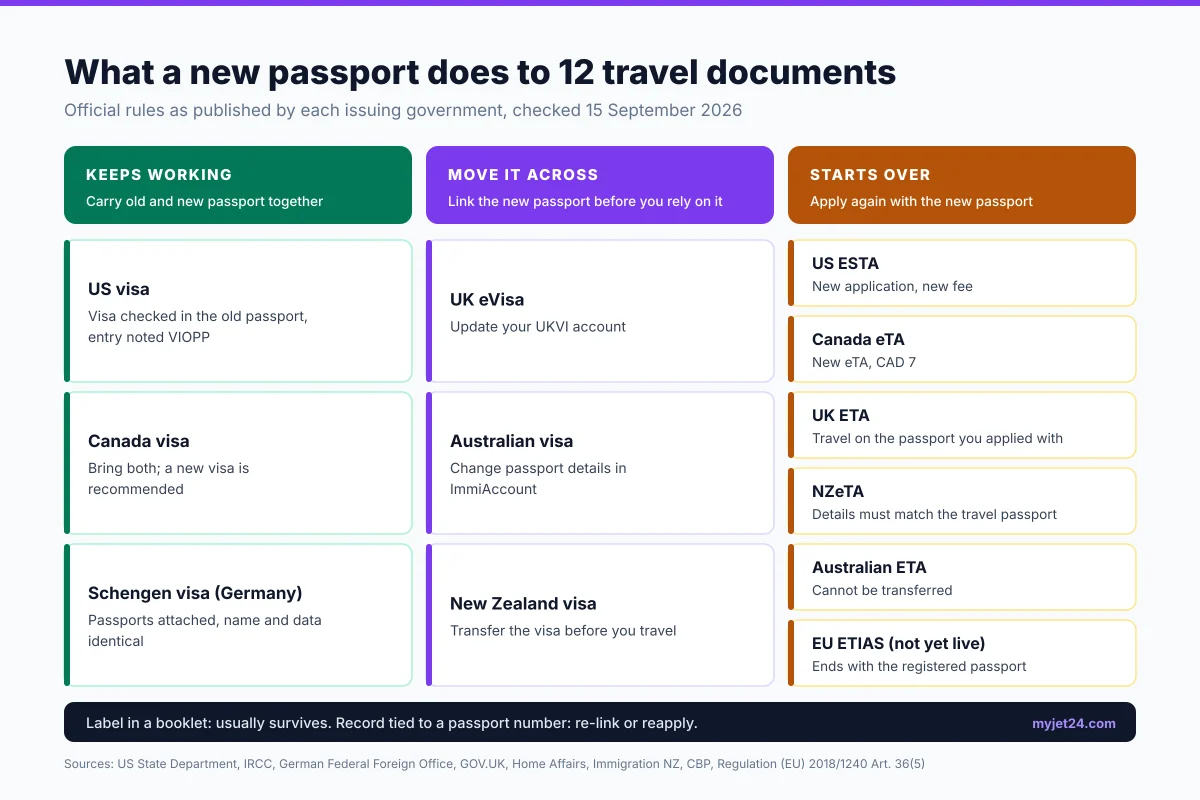
Key takeaway: if you are visa-exempt and hold an ETA-style approval, a new passport always means a new application. There is no transfer button anywhere.
When should you renew your passport before a trip?
Passport timing is the order in which you renew, apply and fly, and the rule that follows from this guide is simple: renew first, then apply for anything tied to the passport number. Doing it the other way round means paying twice.
Most authorizations also expire with the passport they were issued on. CBP grants an ESTA for two years “or until the applicant’s passport expires, whichever is sooner.” The UK ETA runs “over two years or until the holder’s passport expires – whichever is sooner.” Canada’s eTA is valid “for up to five years or until the passport expires, whichever comes first.” So an authorization obtained on a passport with eight months left lasts eight months, however long the scheme advertises.
The passport itself has its own clock. Schengen requires three months of validity beyond your departure and an issue date within the last ten years, as described above. The US State Department warns that some destinations require six months beyond the trip and that “some airlines will not let you board if this requirement is not met.” If your passport is close to either line, renewing before you book is cheaper than renewing in a hurry.
Data: what a renewal sets off
- 27.3 million US passports were issued in fiscal year 2025, a new annual record (Congressional Research Service, IF12466).
- 3 / 3 / 6: of the 12 documents in the table above, 3 keep working in the old passport, 3 must be moved to the new one, and 6 start over.
- Re-application fees per person after a renewal: ESTA $40, UK ETA £20, Canada eTA CAD 7, NZeTA from NZ$17.
- A family of four holding all four authorizations pays $160, £80, CAD 28 and at least NZ$68 again, because each scheme charges per applicant.
Method: the passport figure is quoted from the CRS report. The 3/3/6 split is our classification of the official rule for each document. Fees are the published government prices on 15 September 2026, without any levy charged alongside them; we did not convert currencies, because exchange rates move.
Key takeaway: never apply for an ESTA, eTA or ETA on a passport you are about to replace.
How do you travel with two passports, step by step?
Travelling on two passports means presenting the old booklet for the visa it contains and the new booklet as your valid travel document, on the same trip and at the same counters. It works best when everything that depends on the passport number was sorted out before you left.
- Keep the old passport and inspect the visa label. It must be valid and undamaged. If a cancellation hole or cut went through the label itself, ask the issuing embassy before relying on it.
- Confirm that the issuing country accepts a visa in the other passport. The US and Canada say yes. Germany says yes with identical data. New Zealand says transfer it first. For other countries, ask the consulate that issued the visa.
- Compare the two data pages. Name spelling, nationality and passport type should match. A change of name or a new transliteration is the moment to ask for a new visa instead.
- Apply again for every electronic authorization. ESTA, eTA, UK ETA, NZeTA and Australian ETA all need the new passport.
- Re-link electronic visas. Update your UKVI account, change passport details in ImmiAccount, or transfer a New Zealand visa.
- Enter the new passport number with the airline. Online check-in collects travel document details for the passenger data sent to governments.
- Carry both booklets together. Hand over both at check-in and at immigration when you use the visa in the old passport.
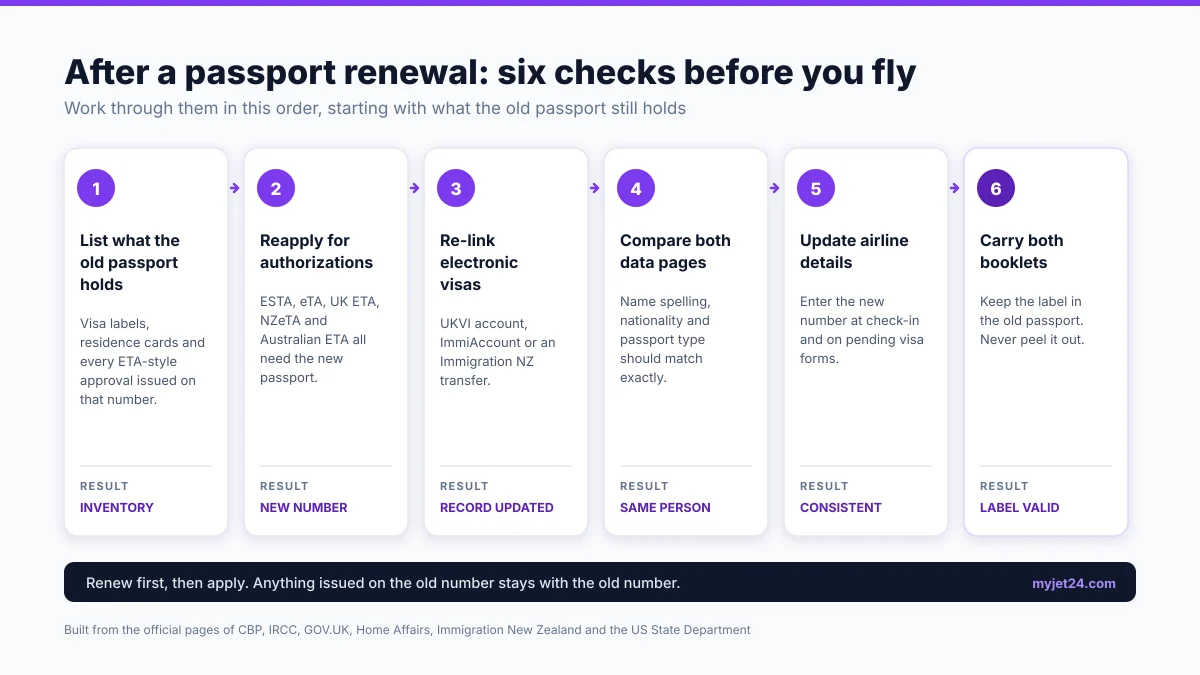
The old passport answers one question, whether you hold a visa. The new passport answers the other, who you are. Bring both and neither officer has to guess.
Key takeaway: the two-passport method only covers visa labels. Authorizations and electronic visas have to be settled online before departure.
Where does the new passport have to match?
Your passport is a data record as much as a booklet, and its details travel into three other places: visa application forms, the passenger data your airline sends to governments, and the name on your bookings. A renewal only goes smoothly when all three follow the new document.
Visa applications. If you apply for a visa after renewing, the form should carry the new passport, and the Schengen document test in Article 12 of the Visa Code applies to that passport. A form filled in with the old number and a new booklet at the appointment is the kind of inconsistency explained in our guide on what has to match between a visa form and a flight booking.
Airline passenger data. Airlines send travel document details to many governments before departure. That is separate from the booking record, as we explain in what your airline sends governments before you land. Update the passport number when you check in, even if you booked the flight months before the renewal.
Flight reservations. A flight reservation is made out in a passenger’s name, and that name has to be spelled the way the passport you travel or apply with spells it. If the new passport shows a different name, after marriage for example, the reservation and the application should follow the new passport. Our guide to names on flight tickets covers the details. Children are a common case too: US passports issued to children under 16 are valid for five years, so families renew more often, as our guide to children’s travel documents sets out.
Renewed and applying for a visa?
Create a flight reservation in your new passport nameFor the visa file, without buying a ticket. Free, no card required.
Key takeaway: after a renewal, every document you file should describe the passport you will actually carry.
What if the old passport is lost, damaged or cancelled?
A lost passport takes its visa label with it, because the label exists only on that page. The two-passport method assumes you still hold the old booklet in usable condition.
For US visas the State Department is direct: “If your visa has been damaged in any way, you will need to reapply for a new visa at a U.S. Embassy or Consulate abroad.” If a passport containing a visa is lost or stolen, it points travellers to its separate process for lost and stolen passports and visas. The same logic applies elsewhere: without the label there is nothing for an officer to check.
A cancelled passport is a different situation. Many passport offices return the old booklet after issuing a new one; the US State Department, for example, mails a previous passport back with the other supporting documents. The State Department also tells US citizens that once they apply for a new passport, the old one can no longer be used for travel, and that anyone with a visa in it should check with the embassy that issued the visa. Cancellation invalidates the booklet as a travel document, not automatically the visa inside it. Where the cancellation mark touches the label, ask the issuing embassy.
Electronic authorizations are unaffected by the condition of the old booklet, because they were never in it. A lost passport means a new passport, and a new passport means a new authorization anyway. A new booklet also does not wipe your travel history, a point we cover in what happens when they scan your passport.
Key takeaway: a visa label is only as good as the page it is printed on. Protect the old passport until the visa inside it expires.
Frequently asked questions
Can I use a US visa from one nationality’s passport with a passport from another country?
No. The State Department says both passports should be from the same country and of the same type, for example two regular passports. A dual national with a visa in one country’s passport who travels on the other country’s passport needs a visa in that passport.
Will the airline accept a visa that is in my old passport?
Airlines check your documents against the destination’s entry rules, and the US and Canadian rules allow a visa in an old passport used together with a new one. Show both passports at check-in. If an agent is unsure, point to the official State Department or IRCC wording quoted in this guide.
Do I pay the full ESTA fee again after renewing my passport?
Yes. A new passport requires a new ESTA application, and CBP charges the fee for each new application submitted. There is no reduced renewal price.
Should I apply for a UK ETA now if my passport is being renewed?
No. The Home Office says you must travel with the same passport you used to apply for the ETA. Wait until the new passport arrives and apply with it; an ETA granted on the old passport cannot be used with the new one.
Does my old eTA carry over if I renew my passport in Canada or abroad?
No. IRCC says your eTA is electronically linked to your passport and that a new passport needs a new eTA. It makes no difference where the passport was renewed.
Do children need new authorizations when their passports are renewed?
Yes. Authorizations are issued per passport, and children hold their own passports. Child passports are renewed more often, since US passports issued under age 16 are valid for five years, so check each child’s authorizations after every renewal.
I renewed my passport while my visa application was pending. What now?
Tell the authority handling the application and give it the new passport details. In the UK, an out-of-date UKVI account can delay a visa decision. For Schengen applications, the visa is issued into the passport you present, so the consulate needs the new one.
Is a visa in an old passport valid for a different purpose than the one it was issued for?
No. For the United States the visa must be the appropriate type for the main purpose of the trip, for example a tourist visa for tourism. A new passport does not change what the visa allows.
Next steps
A new passport changes the document number everything else is attached to. Sort your permissions into the three groups and handle each one in order:
- Visa labels (US, Canada, Germany): keep the old passport, check the data matches, carry both.
- Electronic visas (UK, Australia, New Zealand): update or transfer the record before you travel.
- Authorizations (ESTA, eTA, UK ETA, NZeTA, Australian ETA): apply again on the new passport, after it arrives.
- Applications and bookings: use the new passport details and the exact name it shows.
New passport, new visa application?
Show your travel dates with a flight reservation in the name on your new passport.
Create your free flight reservationReady in minutes, no card required.
Sources
- U.S. Department of State, Visa FAQ: Visa Validity, Lost and Stolen Visas; After You Get Your New Passport.
- U.S. Customs and Border Protection, FAQ about the Visa Waiver Program and ESTA.
- IRCC, valid visa in an old passport, eTA and a new passport, eTA facts.
- German Federal Foreign Office, Frequently asked questions on visas.
- Regulation (EU) 2016/399 (Schengen Borders Code), Article 6; Regulation (EC) No 810/2009 (Visa Code), Article 12; Regulation (EU) 2018/1240 (ETIAS), Article 36.
- GOV.UK, Update your UK Visas and Immigration account details; UK Home Office, ETA factsheet, April 2026.
- Australian Department of Home Affairs, You have a new passport.
- Immigration New Zealand, Managing your visa and passport and NZeTA.
- Congressional Research Service, U.S. Passport Services: Background and Issues for Congress (IF12466).
About the author
James Mitchell is the CEO and Founder of MyJet24, the travel documentation platform he built in Dubai in 2021. He writes about visa rules, travel authorizations and the documents airlines and consulates ask for, working from the official pages of the governments that issue them.
Last reviewed: 15 September 2026 by Marc Hoffmann, Senior Visa Consultant & Travel Documentation Expert. Methodology: each rule in the comparison table was checked against the issuing government’s own page or the legal text on 15 September 2026. Quotations are taken from those pages. Where a government publishes no rule, as with most Schengen states other than Germany, this guide says so instead of guessing.
This guide is general information about travel documents, not legal advice. Rules change, and the issuing embassy or immigration authority has the final word on a specific visa.
