
Last updated: 31 July 2026 · Reading time: 16 min · Author: Joshua White, Travel Documentation Writer at MyJet24
TL;DR — Key Facts
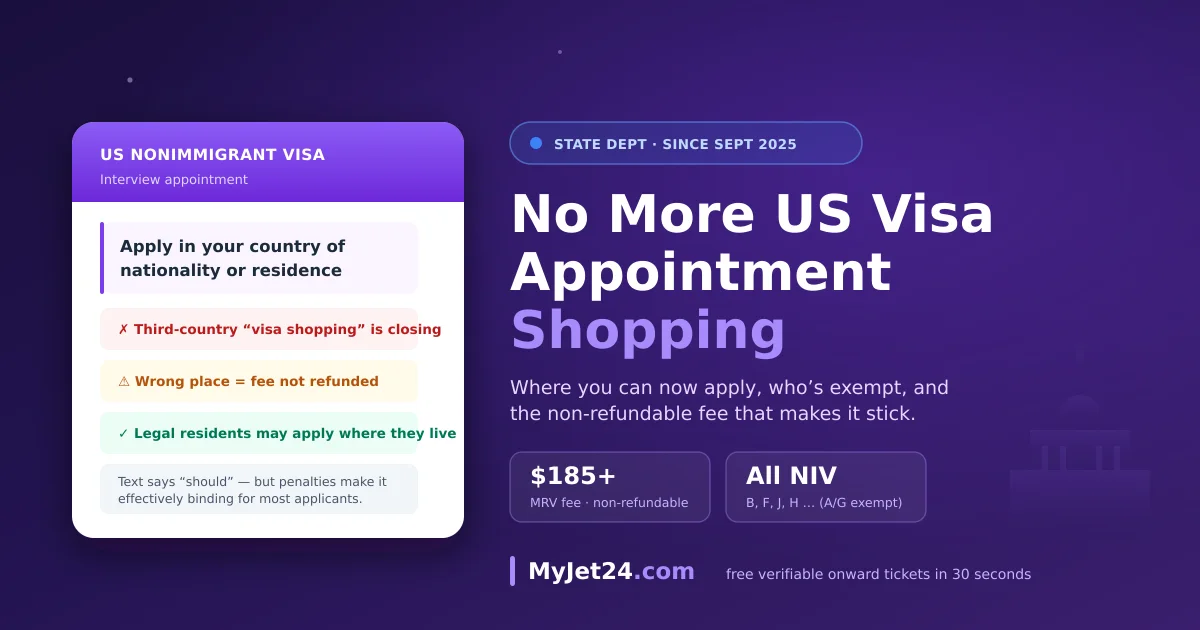
- US nonimmigrant visa applicants should now schedule their interview in their country of nationality or legal residence — not in whichever country has the shortest appointment queue.
- The word is "should," not "must" — but treat it as binding. The State Department's own text says "should," yet applying in the wrong place means a non-refundable fee, longer waits, and a harder path to approval.
- It's not brand new. The guidance was first issued on 6 September 2025 and reaffirmed with a 15 July 2026 update — despite headlines framing it as a mid-2026 debut.
- It applies to all nonimmigrant visa classes — B-1/B-2 visitors, F/M students, J exchange, and H/L/O/P workers. Diplomatic and international-organisation categories (A, G, C-2, C-3, NATO) are exempt.
- If you apply on a residence basis, you must prove it — a residence permit or long-term visa in the third country. Legal residents can still apply where they live.
- The MRV fee is non-refundable. "Fees paid for such applications will not be refunded and cannot be transferred," in the State Department's words — so getting your location right is a money question, not just a paperwork one.
The US State Department says nonimmigrant visa applicants should schedule their visa interview at the US embassy or consulate in their country of nationality or legal residence, rather than "shopping" for a faster appointment in a third country. The guidance was first issued on 6 September 2025 and updated on 15 July 2026. The text uses "should," not "must," but it is effectively binding: applicants who apply elsewhere are told to expect significantly longer waits, a harder path to qualify, and — critically — that their MRV visa fee "will not be refunded and cannot be transferred." It applies to all nonimmigrant visa classes, with exemptions for diplomatic and international-organisation categories (A, G, C-2, C-3, NATO). Third-country nationals who can demonstrate legal residence may still apply where they live.
In this guide
- What the rule actually says
- It's not brand new: the real timeline
- Who it applies to, and who's exempt
- What counts as "resident" — and proving it
- The end of visa shopping
- The non-refundable-fee trap
- How it fits the other 2026 US changes
- What you still need for the interview
- Seven mistakes to avoid
- Frequently asked questions
- The bottom line
What the rule actually says
For years, a well-known workaround circulated among people applying for US visas: if your home country's embassy had an eighteen-month wait, book your interview somewhere with a shorter queue. It was legal, common, and — as of the current State Department guidance — strongly discouraged, to the point of being effectively off the table for most applicants.
The State Department's notice, "Adjudicating Nonimmigrant Visa Applicants in Their Country of Residence," puts it in one sentence: applicants for US nonimmigrant visas "should schedule their visa interview appointments at the U.S. Embassy or Consulate in their country of nationality or residence." That's the whole rule. The nuance that most coverage misses is in a single word.
"Should," not "must" — but don't relax. The primary State Department text says applicants should apply in their country of nationality or residence. Some law firms and universities paraphrase it as "must," which overstates the letter of the rule but captures the reality. Because applying elsewhere triggers a non-refundable fee, longer waits and a harder adjudication (all spelled out below), the practical effect is close to a requirement. Read it as: you can technically apply in a third country, but the system is now built to punish it.
It's not brand new: the real timeline
If you saw this described as a "new July 2026 rule," that's not quite right — and the distinction matters if you're trying to work out whether an appointment you already booked is affected.
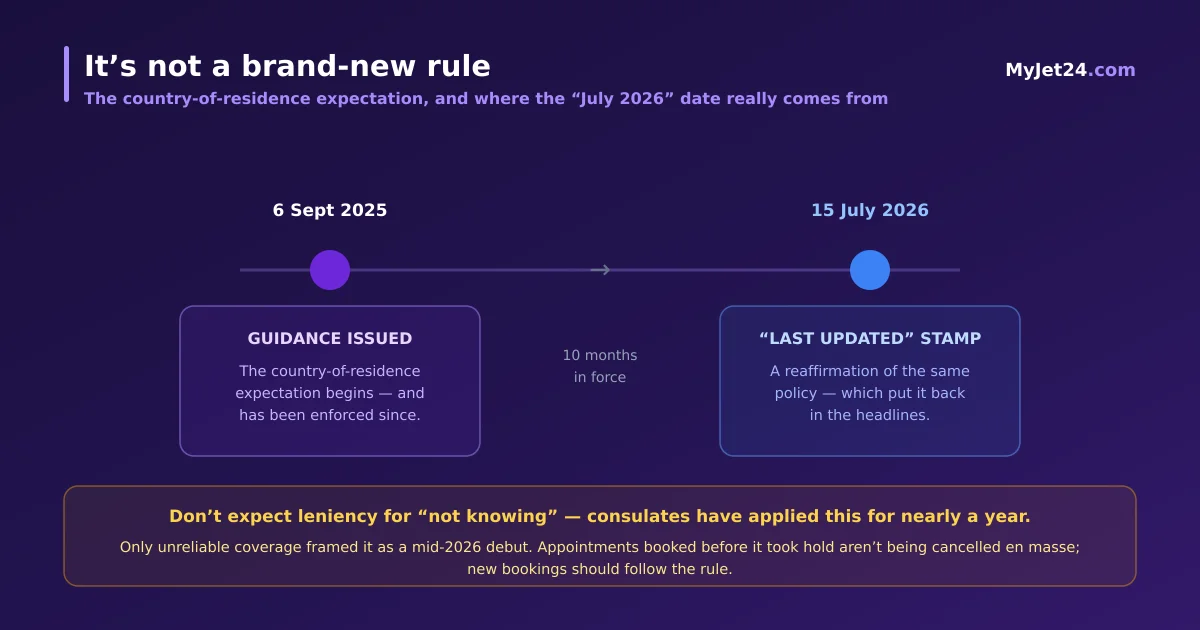
The State Department first issued this guidance on 6 September 2025. The version that circulated widely in mid-2026 carries a "Last Updated: 15 July 2026" stamp — an update and reaffirmation of the existing policy, not the birth of a new one. So the correct framing is: the country-of-residence expectation has been in force since September 2025, and the July 2026 refresh brought it back into the headlines.
Why does that matter to you? Two reasons. First, if you booked a third-country appointment before the guidance took hold, existing appointments are generally not being cancelled — but new bookings should follow the rule. Second, don't assume this is a fresh, untested policy that consulates are still figuring out. It has been the operating expectation for the better part of a year, and posts apply it accordingly.
Who it applies to, and who's exempt
The rule is broad. It covers essentially every temporary (nonimmigrant) visa category, with a narrow set of diplomatic and international-organisation exemptions.
| Applies to | Exempt |
|---|---|
| B-1/B-2 (business & tourism) | A (diplomatic) |
| F and M (students) | G (international organisation) |
| J (exchange visitors) | C-2 and C-3 (transit to the UN / officials) |
| H, L, O, P (temporary workers) | NATO categories |
| Most other nonimmigrant classes | UN Headquarters Agreement travellers |
Beyond those exemptions, the guidance allows "rare exceptions" for humanitarian or medical emergencies and foreign-policy reasons — genuinely narrow carve-outs, not a general escape hatch. If you're a student, a tourist, a business traveller or a worker, assume the rule is yours. Our guides to documents required for a US visa interview and what officers actually ask cover the interview itself once your location is sorted.
What counts as "resident" — and proving it
The rule says nationality or residence, and that "or" is where legitimate flexibility lives. You are not forced back to your passport country if you genuinely live elsewhere — but you have to prove it.
The State Department is explicit: "Applicants must be able to demonstrate residence in the country where they are applying, if the place of application is based on their residency." In practice, that means:
- A residence permit or long-term visa for the country where you're applying is the cleanest proof.
- Genuine ties — a lease, employment, or study enrolment in that country — support the claim.
- A tourist stamp doesn't count. Being physically present in a country is not the same as residing in it, and this is exactly the gap the rule closes.
So a Nigerian citizen legally resident in the UAE can apply in the UAE; a Nigerian citizen who flies to a third country purely to grab an earlier slot cannot. If you have no single country of residence, or your situation is unusual, the guidance is less specific — check with the relevant consulate before booking, because a wrong assumption here costs you the fee.
The end of visa shopping
"Visa shopping" — booking your interview in whichever country has the shortest wait — grew directly out of the appointment backlogs that built up after the pandemic. When your home post quoted a year-plus wait and a consulate two countries over had slots next month, the maths was obvious. Whole cottage industries sprang up to find and book third-country appointments.
This rule is aimed squarely at that practice, for two stated reasons: security screening and fraud reduction (an applicant's ties and background are easier to assess where they actually live), and workload management (spreading applicants back to their home posts rather than flooding a handful of low-wait consulates). Whatever you think of it, the practical upshot is clear: the third-country shortcut is closing, and the answer to a long home-country wait is now to plan earlier, not to fly elsewhere.
The non-refundable-fee trap
This is the part that turns a scheduling rule into a financial one. The visa application fee — the MRV fee — is paid up front, and the State Department could not be clearer about what happens if you apply in the wrong place: "Fees paid for such applications will not be refunded and cannot be transferred." Apply in a third country where you can't prove residence, and you can lose the fee and have to pay again to apply correctly.
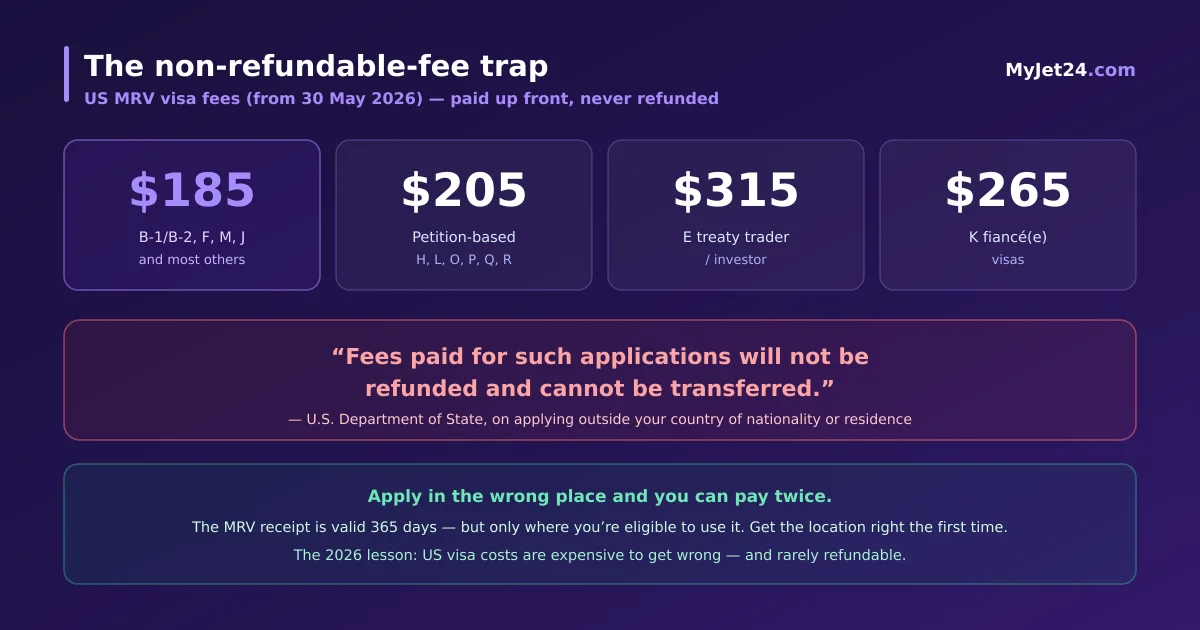
| Visa type | MRV fee (from 30 May 2026) |
|---|---|
| B-1/B-2, F, M, J and most | $185 |
| Petition-based: H, L, O, P, Q, R | $205 |
| E (treaty trader/investor) | $315 |
| K (fiancé(e)) | $265 |
The MRV receipt is valid for 365 days once paid, so paying it isn't the risk — paying it and then applying in a location that gets rejected is. The lesson generalises to the whole US visa process in 2026: it has become an expensive one to get wrong, and the cost of a mistake is rarely refundable. That's a theme worth holding onto when you plan the rest of your application.
How it fits the other 2026 US changes
2026 has been a busy year for US visa policy, and the changes are easy to blur together. They're separate, and a single applicant can be touched by more than one. Here's how the interview-location rule sits alongside the others.
| Change | What it is |
|---|---|
| Interview location (this article) | Where you apply — your country of nationality or residence. |
| $250 visa integrity fee | A surcharge on most visa issuances, on the books but with uneven collection. See our integrity fee guide. |
| Visa bond pilot | A refundable $5,000–$15,000 deposit for B-1/B-2 nationals of ~50 countries. See our visa bond guide. |
| $750 fast-track interview | A paid option to expedite a B-1/B-2 appointment. See our fast-track guide. |
Note the interaction the fast-track option creates: paying to expedite an interview only helps if you're booking it in the right place to begin with. The location rule sits upstream of the others — get it wrong and the money you spend on speed or fees is spent in a consulate that may turn you away.
What you still need for the interview
Getting the location right is step one, not the whole job. Everything that made a strong US visa application before this rule still applies — the rule just determines which consulate you make that case at.
You still complete the DS-160 online form, pay the MRV fee, and attend in person. And at the interview, the officer is still assessing the same thing they always have under section 214(b): whether you intend to return home. That means demonstrating ties to your country of residence and a coherent, temporary travel plan — which is where a clear itinerary earns its keep.
On travel bookings — an honest note. This rule does not add a flight-ticket requirement; nothing about the interview-location policy demands an onward ticket. But a US visa interview has always gone more smoothly with a clear, credible travel plan, and buying a paid, dated ticket before your visa is approved is a well-known way to lose money if the application is refused. A verifiable flight reservation gives you a real, checkable itinerary to show intent without committing to a fare — the same logic our US B-1/B-2 flight-reservation guide lays out in full. In a year where so many US visa costs are non-refundable, not pre-buying a flight is simply good risk management.
Seven mistakes to avoid
- Booking a third country just for a shorter wait. That's exactly what the rule targets. Without proof of residence there, you risk losing the fee.
- Reading "should" as "optional." Technically it's not mandatory; practically, the penalties make it binding. Follow it.
- Assuming a tourist stamp proves residence. It doesn't. Only a residence permit or long-term visa and genuine ties count.
- Thinking it's a brand-new July 2026 rule. It dates from September 2025 and has been enforced since. Don't expect leniency for "not knowing."
- Confusing it with the bond, the $250 fee or fast-track. They're separate changes; you can be hit by several at once.
- Pre-buying a paid flight before approval. US visa fees are non-refundable, and a purchased ticket adds to what you lose on a refusal.
- Leaving it late because your home post has a long queue. The answer is now to apply earlier at home, not to fly elsewhere.
Frequently asked questions
Can I still apply for a US visa in a third country in 2026?
Only if you legally reside there and can prove it. The State Department says applicants should schedule their interview in their country of nationality or residence, and if you apply on a residence basis you must demonstrate that residence — typically a residence permit or long-term visa. Flying to a third country purely to get an earlier appointment no longer works and risks a non-refundable fee.
Is applying in your country of residence a "must" or a "should"?
The State Department's own text says applicants "should" apply in their country of nationality or residence — not "must." However, applying elsewhere triggers a non-refundable fee, significantly longer waits, and a harder path to approval, so in practice it functions as a requirement. Some law firms paraphrase it as "must," which overstates the letter of the rule but reflects the real-world effect.
When did the US visa interview location rule take effect?
The guidance was first issued on 6 September 2025 and updated on 15 July 2026. Despite headlines calling it a mid-2026 change, it has been the operating expectation since September 2025. The July 2026 date is an update and reaffirmation of the existing policy, not the start of a new one.
Which visa types does the rule apply to?
All nonimmigrant visa classes — including B-1/B-2 visitor, F and M student, J exchange, and H, L, O and P worker visas. Diplomatic and international-organisation categories are exempt: A, G, C-2, C-3 and NATO visas, plus travellers under the UN Headquarters Agreement. Rare exceptions also exist for humanitarian, medical or foreign-policy reasons.
What proof of residence do I need to apply in another country?
You must be able to demonstrate legal residence in the country where you're applying — a residence permit or long-term visa is the clearest evidence, supported by genuine ties such as a lease, job or study enrolment. A tourist stamp or short visit does not qualify. If you can't prove residence in the country where you apply, you risk refusal and loss of the fee.
Will I lose my visa fee if I apply in the wrong place?
You can. The State Department states plainly that "fees paid for such applications will not be refunded and cannot be transferred." If you apply in a third country where you can't demonstrate residence, you may lose the MRV fee and have to pay it again to apply in the correct location. The MRV receipt is valid for 365 days, but only where you're eligible to use it.
How much is the US visa (MRV) fee in 2026?
As of 30 May 2026, the MRV fee is $185 for B-1/B-2, F, M and J visas and most others; $205 for petition-based categories (H, L, O, P, Q, R); $315 for E treaty trader/investor visas; and $265 for K fiancé(e) visas. It is paid up front, is non-refundable, and the payment receipt is valid for 365 days.
If I already booked a third-country appointment, is it cancelled?
Generally not. Existing appointments booked before the guidance took hold are not being cancelled en masse. However, new bookings should follow the country-of-residence rule, and you should still be prepared to demonstrate residence if your appointment is in a country other than your nationality. If in doubt, confirm with the consulate where you're booked.
Why did the US introduce this rule?
The State Department cites security screening, fraud reduction and workload management. Assessing an applicant where they actually live makes it easier to verify ties and background, and returning applicants to their home posts eases the pressure on the handful of low-wait consulates that "visa shoppers" had been flooding. It's part of a broader 2026 tightening of US visa processes.
Does this rule require a return or onward ticket?
No. The interview-location rule does not add any flight-ticket requirement. However, a US visa interview still assesses whether you intend to return home under section 214(b), so a clear, credible travel plan helps. A verifiable flight reservation lets you show that intent without buying a paid ticket before approval — sensible in a year when US visa fees are non-refundable.
Is this the same as the rule for immigrant (green card) visas?
No — that's a separate, parallel notice. The State Department issued a companion rule for immigrant visa applicants around November 2025, with its own terms. This article covers the nonimmigrant (temporary) visa rule. If you're applying for an immigrant visa, check the specific immigrant-visa guidance, as the details differ.
Can students renew a US visa in a third country while travelling?
It's discouraged. Universities are advising F and M students not to travel to a third country solely to renew a visa, and to apply in their country of nationality or residence, demonstrating residence if applying on that basis. Third-country student renewals now face longer waits, enhanced scrutiny and the same non-refundable-fee risk as any other applicant.
The bottom line
The country-of-residence rule is, on paper, a small change — one word, "should," in a short notice. In practice it closes a workaround that millions of applicants relied on, and it does so with a financial edge: get your location wrong and the fee is gone. The two things worth remembering are the ones the headlines tend to miss — that it's technically "should" but effectively binding, and that it's been in force since September 2025, not a fresh mid-2026 surprise.
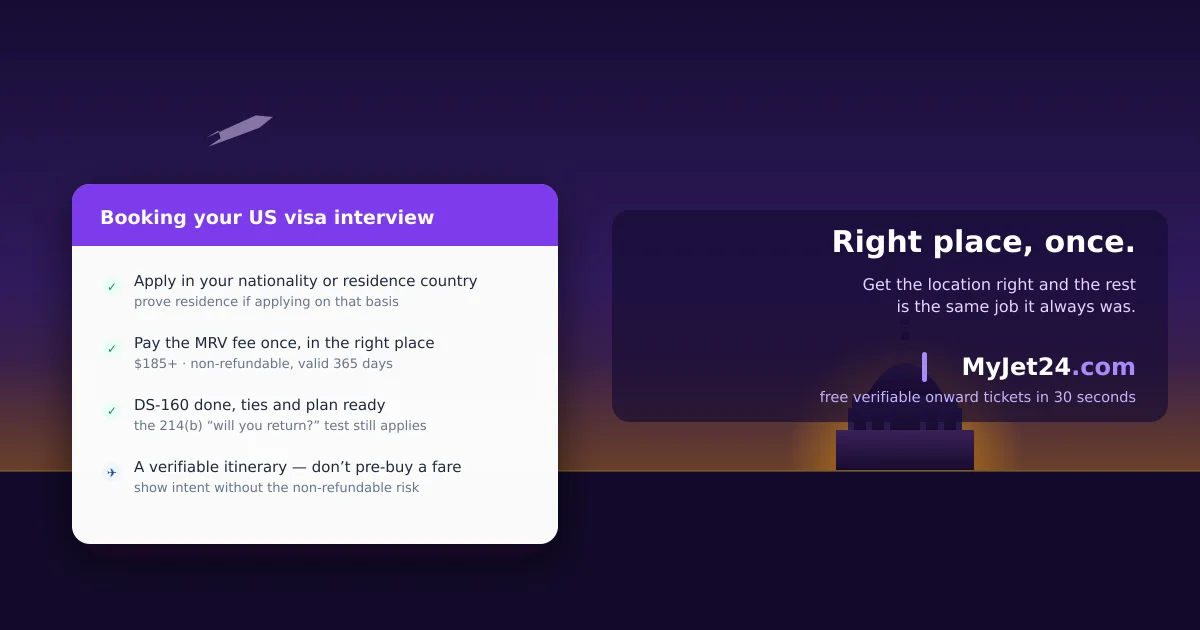
So the plan is straightforward. Apply in your country of nationality, or in a country where you can prove you legally reside. Pay the MRV fee once, in the right place. Complete your DS-160, gather your ties, and build a credible, temporary travel plan — and because so much of the 2026 US visa process is now non-refundable, resist the urge to buy a flight before you're approved. A verifiable onward itinerary shows the officer exactly what they need to see, at none of the risk. Get the location right and the rest of the application is the same job it always was — just done in the one place the system now expects.
Sources
- US Department of State — "Adjudicating Nonimmigrant Visa Applicants in Their Country of Residence" (issued 6 Sept 2025; updated 15 July 2026): https://travel.state.gov/content/travel/en/News/visas-news/adjudicating-niv-applicants-in-their-country-of-residence.html
- US Department of State — Fees for Visa Services (MRV amounts): https://travel.state.gov/content/travel/en/us-visas/visa-information-resources/fees/fees-visa-services.html
- NAFSA — DoS announces NIV applicants should schedule interviews in country of residence: https://www.nafsa.org/regulatory-information/dos-announces-niv-applicants-should-schedule-visa-interview-appointments
- AILA — DoS update on adjudicating NIV applicants in their country of residence (Doc. 25121209): https://www.aila.org/library/dos-update-on-adjudicating-nonimmigrant-visa-applicants-in-their-country-of-residence-2
- Northeastern University Office of Global Services — visa interview appointments in country of residence: https://international.northeastern.edu/ogs/visa-interview-appointments-must-be-scheduled-in-country-of-residence-or-nationality/
This guide reflects the US State Department's nonimmigrant visa interview-location guidance, first issued 6 September 2025 and updated 15 July 2026, with MRV fee amounts effective 30 May 2026, as of 31 July 2026. The guidance uses "should"; consular practice and exceptions can vary, and rules and fees can change. Verify on travel.state.gov and with the relevant US embassy or consulate before applying. This article is informational and not legal or immigration advice.
