
Last updated: 16 July 2026 · Reading time: 14 min · Author: Joshua White, Travel Documentation Writer at MyJet24
TL;DR — Key Facts
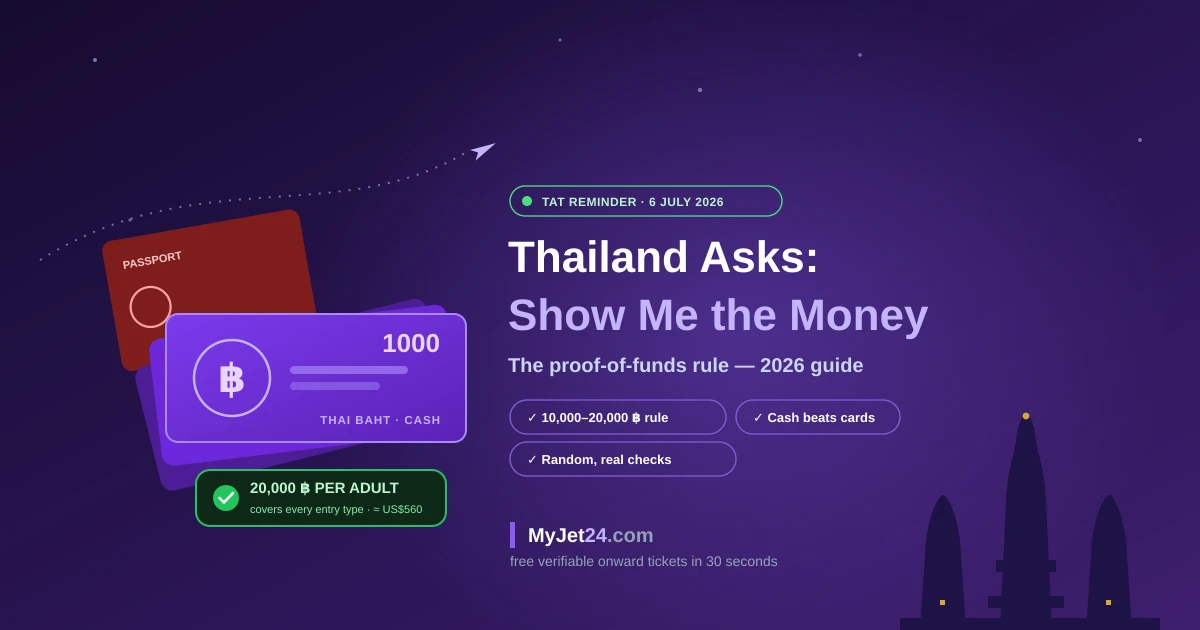
- Thailand can legally require you to show cash at the border — and just reminded everyone. On 6 July 2026 the Tourism Authority of Thailand published a notice telling foreign visitors to be ready to prove "sufficient financial resources" on arrival, under a rule that has existed since 1980.
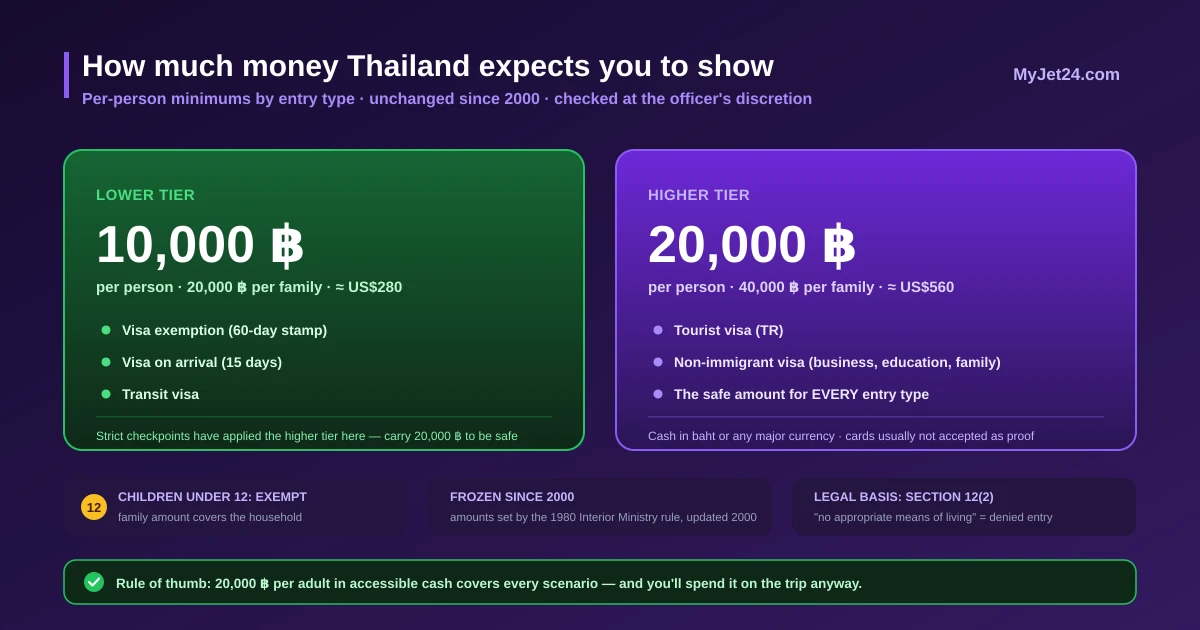
- The amounts depend on how you enter: 10,000 baht per person (20,000 per family) for visa-exempt, transit and visa-on-arrival entries; 20,000 baht per person (40,000 per family) on a tourist or non-immigrant visa. Children under 12 are exempt. The figures haven't changed since 2000.
- Cash wins arguments; cards usually don't. Officially you may show Thai baht, an equivalent in another currency, or "documents proving payment or access" to the amount — but in practice, especially in secondary inspection, officers want to see physical money, not a credit card or a banking app.
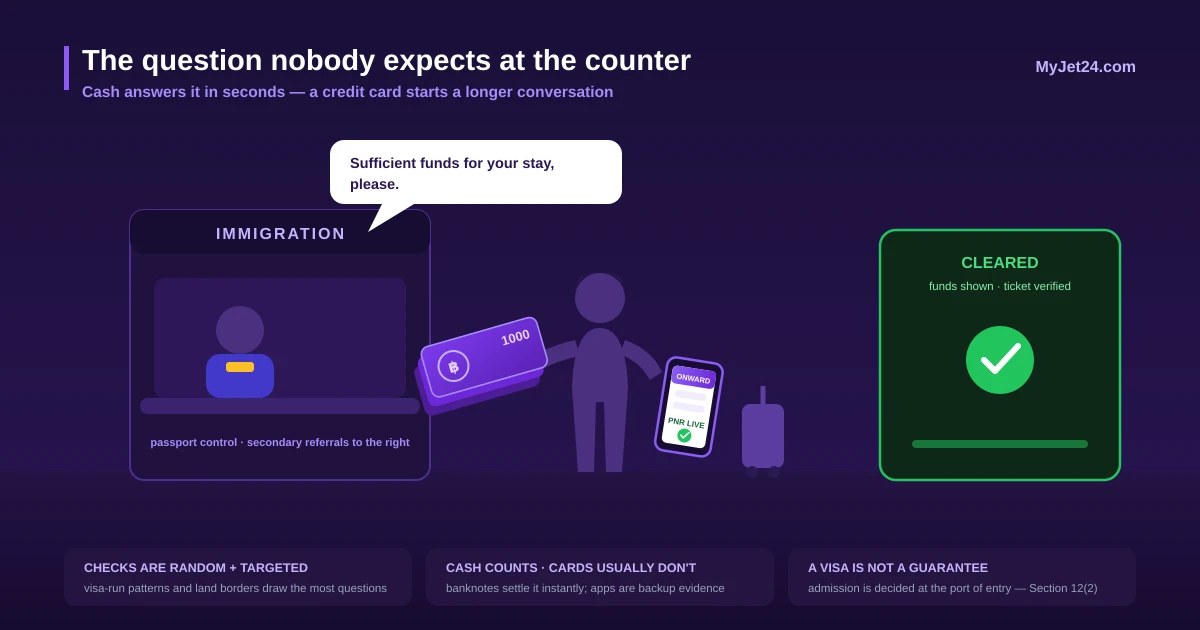
- Checks are random and targeted, not universal. Most airport arrivals with a return ticket and hotel booking never get asked. The rule is enforced hardest against visa-run patterns, back-to-back exempt entries, land-border crossings and one-way travelers with no paperwork.
- Failing the check can mean denied entry under Section 12(2) of Thailand's Immigration Act — "no appropriate means of living." A valid visa does not guarantee admission; the funds check, the TDAC and an onward ticket are all separate hurdles.
Thailand's proof of funds rule allows immigration officers to ask arriving foreigners to show adequate money for their stay: 10,000 baht per person or 20,000 baht per family for visa-exempt, transit and visa-on-arrival entries, and 20,000 baht per person or 40,000 baht per family for tourist and non-immigrant visa holders — roughly US$280–560 per person at mid-2026 rates. The requirement dates from a 1980 Ministry of Interior announcement (amounts last updated in 2000) and is enforced at the officer's discretion, with physical cash the safest form of proof. Travelers who cannot demonstrate funds can be refused entry under Section 12(2) of the Immigration Act, which is why the Tourism Authority of Thailand reminded visitors of the rule on 6 July 2026.
In this guide
- What is Thailand's proof of funds rule?
- The exact amounts, by entry type
- Why the reminder now — and what it signals
- What counts as proof (and why cash beats cards)
- Who actually gets checked
- What happens if you can't show the money
- Funds, TDAC, onward ticket: Thailand's three entry checks
- How to prepare: a 10-minute checklist
- Six mistakes to avoid
- Frequently asked questions
What is Thailand's proof of funds rule?
Buried in Thai immigration law is a power most visitors never encounter — until the one day it matters. Under Section 12(2) of the Immigration Act B.E. 2522 (1979), Thailand may refuse entry to any foreigner who has "no appropriate means of living" in the Kingdom. A Ministry of Interior announcement from 1980 turned that principle into concrete numbers: minimum amounts of money that arriving travelers must be able to show on request, per person and per family, varying by entry category. The amounts were last revised in 2000 and have stood still ever since.
Two things follow from that legal setup, and they explain almost every confused forum thread about the rule:
- It is a power, not a routine procedure. Officers may ask; they do not ask everyone. Millions of tourists enter Thailand each year without ever being questioned about money.
- It sits on top of your visa, not inside it. Showing funds when applying for a tourist visa at an embassy does not exhaust the requirement — the border officer can independently ask again, and as the Tourism Authority of Thailand put it in its July notice, holding a visa "does not automatically guarantee admission."
The rule applies at every port of entry — Suvarnabhumi and Don Mueang airports, Phuket, the land crossings from Malaysia, Laos and Cambodia, and seaports — and to every short-stay entry category: visa exemption, visa on arrival, tourist visa and non-immigrant visa alike.
The exact amounts, by entry type
The figures are set per person, with a doubled figure covering a family traveling together. Children under 12 are exempt — a family of two adults and two young kids needs the family amount, not four individual shares.
| How you enter | Per person | Per family | ≈ USD (mid-2026) |
|---|---|---|---|
| Visa exemption (60-day stamp for most Western & many Asian passports) | 10,000 ฿ | 20,000 ฿ | ≈ $280 / $560 |
| Visa on arrival (15 days, ~30 nationalities) | 10,000 ฿ | 20,000 ฿ | ≈ $280 / $560 |
| Transit visa | 10,000 ฿ | 20,000 ฿ | ≈ $280 / $560 |
| Tourist visa (TR) | 20,000 ฿ | 40,000 ฿ | ≈ $560 / $1,120 |
| Non-immigrant visa (business, education, family…) | 20,000 ฿ | 40,000 ฿ | ≈ $560 / $1,120 |
A quirk worth knowing: the visa-exempt threshold (10,000 ฿) is lower than the tourist-visa threshold (20,000 ฿), because the exemption was designed for shorter stays. In practice, individual checkpoints have been known to apply the higher figure to exempt entries during stricter screening periods — which is why seasoned travelers treat 20,000 baht as the safe carry amount regardless of entry type. Since the amounts have been frozen since 2000 while prices roughly doubled, this is one of the cheapest compliance requirements in Asian travel — the trap is purely logistical, not financial.
Why the reminder now — and what it signals
The rule is 46 years old; the reminder is brand new. On 6 July 2026, the Tourism Authority of Thailand published a notice urging foreign visitors to have their financial proof ready at the border, spelling out the amounts and stressing that admission is decided at the port of entry — visa or no visa.
Official reminders of dormant rules rarely appear by accident. This one lands in a specific context:
- Thailand's entry process has just been digitized. The Thailand Digital Arrival Card (TDAC) replaced the old TM6 paper card and is now standard for air arrivals — giving immigration cleaner data on who is entering, how often, and on what basis. Screening that used to be impossible at scale is now a database query.
- Visa-exempt abuse is under scrutiny. The generous 60-day exemption has drawn years of back-to-back "border run" usage by de-facto residents. Funds checks are one of the tools officers use to separate tourists from people living in Thailand on tourist stamps.
- The regional pattern is tightening, not loosening. Across 2026 we've covered the same drift country by country — India's e-Arrival Card, Vietnam's pre-arrival form, South Africa's mandatory SARS declaration. Pre-arrival data plus on-arrival discretion is the new normal.
None of this means mass wallet inspections at Suvarnabhumi. It means the legal basis is being kept warm, and the traveler who can't demonstrate funds when asked has less room for sympathy than five years ago.
What counts as proof (and why cash beats cards)
The official formulation is broader than the street wisdom. Per the TAT notice, acceptable proof is:
- Thai baht in cash — the gold standard, zero interpretation required;
- An equivalent amount in foreign currency — euros, dollars, pounds all fine, converted at the day's rate;
- "Documents proving payment or access to an equivalent amount" — the elastic clause that in principle covers bank statements and similar evidence.
Now the practice. Reports from travelers and immigration lawyers consistently agree on three points:
- Physical cash settles the question instantly. An officer can count banknotes; he cannot audit your banking app in a queue.
- Credit and debit cards are generally not accepted as stand-alone proof — a card shows access to credit, not "means of living" in the legal sense, and this is exactly the distinction secondary inspection applies.
- Phone banking screenshots are a coin flip. Some officers accept a live balance in a banking app; others wave it away. Nobody has ever been turned away for showing real banknotes.
The practical translation: carry 20,000 baht's worth of cash per adult (any major currency), keep it accessible in your hand luggage — not in a checked bag — and treat everything digital as backup evidence, not primary proof. You'll almost certainly re-spend the money during the trip anyway; think of it as your first ATM withdrawal, made early.
Who actually gets checked
Honest answer: few people — but not random people. The checks are discretionary, and discretion follows patterns. Enforcement is consistently reported to concentrate on:
- Passports full of Thai stamps — frequent entries, long cumulative stays, and anything resembling a visa-run rhythm (exit Tuesday, re-enter Thursday);
- Back-to-back visa-exempt entries, especially at land borders from Malaysia, Laos or Cambodia, where the "tourist or resident?" question writes itself;
- One-way arrivals with no paperwork — no onward ticket, no accommodation booking, vague plans (the funds question is often the second question after the onward-ticket question);
- Secondary inspection referrals — once you're pulled aside for any reason, the funds check becomes near-standard as officers build a Section 12 file.
Conversely, the profile that essentially never gets asked: round-trip ticket, hotel confirmation, TDAC filed, ordinary tourist itinerary. The three documents reinforce each other — each one you're missing raises the odds the next one is demanded.
What happens if you can't show the money
There's no fine, no payment plan, and no "come back tomorrow." A traveler who cannot demonstrate appropriate means of living, and can't produce them on the spot, faces:
- Refusal of entry under Section 12(2), recorded in the immigration system;
- Return travel on the next available flight — at your expense or your airline's, which is precisely why airlines pre-screen documents at check-in;
- A harder conversation next time — a prior refusal is visible to every future officer and colors every future entry.
In reality, borderline cases usually resolve less dramatically: travelers are given a chance to reach an ATM in the arrivals hall, call a companion who is carrying the family funds, or produce a booking that changes the picture. Officers use the rule to filter bad-faith entries, not to trap tourists a few hundred baht short. But that grace is informal — the law itself allows a straight denial, and during tightened screening periods, straight denials happen.
One myth worth killing: there is no legitimate "fee" that substitutes for the funds check. Anyone suggesting money can change hands to skip it is describing a bribe, and attempting one converts a paperwork problem into a criminal one.
Funds, TDAC, onward ticket: Thailand's three entry checks
Thailand's border process in 2026 is best understood as three independent gates. Clearing one says nothing about the others:
| Check | Who verifies it | When | How to satisfy it |
|---|---|---|---|
| TDAC (digital arrival card) | Airline + immigration | Within 72h before arrival | File free at the official site — our TDAC guide |
| Onward/return ticket | Airline at check-in (mainly), immigration (sometimes) | Before boarding | Real ticket or a verifiable onward reservation for Thailand with a live PNR (MyJet24 Premium, $7.90) |
| Proof of funds | Immigration only | On arrival, on request | 10,000–20,000 ฿ per person in cash (this guide) |
The onward-ticket gate deserves its own emphasis because it's checked far more often than funds — by airlines, before you ever reach Thailand. If you're flying one-way while you decide between Laos, Vietnam or a beach month, generate a free onward ticket before check-in; our Thailand dummy ticket guide covers exactly how carriers verify reservations, and the proof of onward travel guide explains the rule worldwide.
How to prepare: a 10-minute checklist
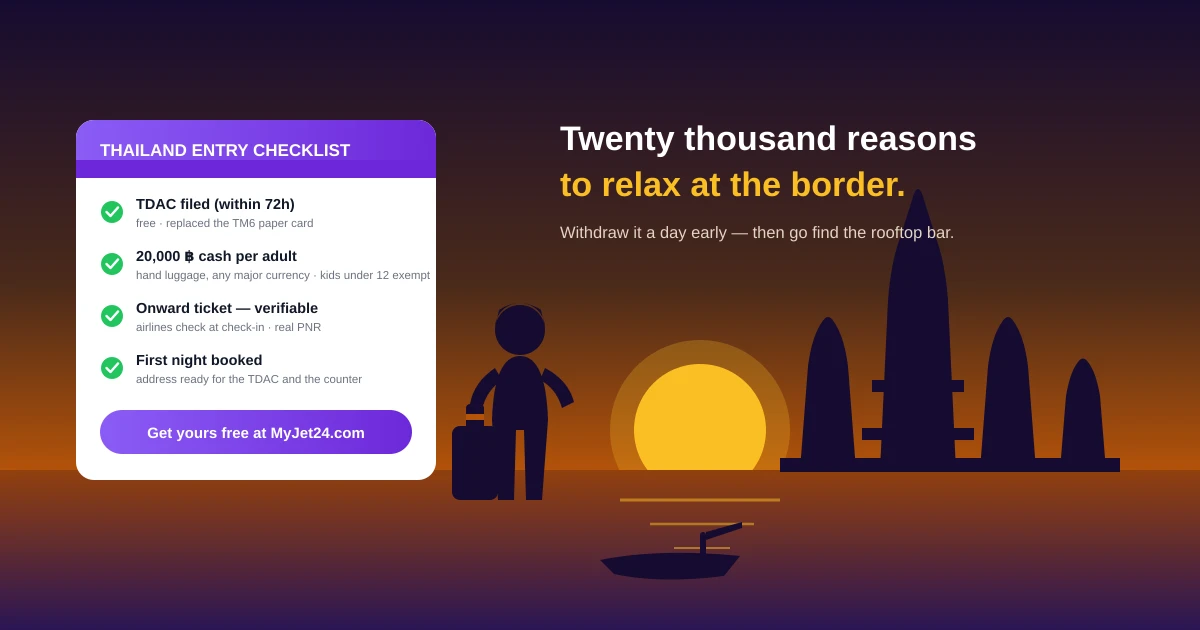
- Withdraw or exchange the equivalent of 20,000 ฿ per adult before departure — about US$560, €520 or £430 at mid-2026 rates. Any major currency works; baht is cleanest.
- Carry it in hand luggage, split between wallet and a second pocket. Money in a checked bag doesn't exist as far as the immigration counter is concerned.
- File your TDAC within 72 hours of arrival — it's free and takes five minutes.
- Hold an onward or return ticket — booked flight or a verifiable reservation (MyJet24 Premium, $7.90); screenshot it for offline access.
- Have your first accommodation address handy — the TDAC asks for it, and the counter sometimes does too.
- Families: know your math. Two adults + kids under 12 = one family amount (20,000 or 40,000 ฿ depending on entry type), and the person carrying it should be in the same queue.
- Keep digital backup — a bank app showing a healthy balance strengthens a borderline case even if it can't carry one alone.
Six mistakes to avoid
- Assuming the rule is a myth because you've never been checked. Twenty smooth entries prove nothing about the twenty-first — enforcement is discretionary and profiles-based, and the July 2026 reminder shows the rule is anything but dead.
- Relying on a credit card. The one form of money most travelers carry is the one form officers most consistently reject. Cards demonstrate credit, not means of living.
- Landing with only large foreign notes in a checked bag. Proof you can't reach is proof you don't have. Hand luggage, accessible pocket.
- Confusing embassy requirements with border requirements. Showing a bank statement for your tourist-visa application doesn't pre-clear the border check — Section 12(2) applies at the port of entry, independently.
- Arriving one-way with no paperwork and expecting only the funds question. Missing documents compound: no onward ticket invites the funds check, which invites the accommodation question. Close all three gates before departure.
- Treating a land border like an airport. The Malaysia, Laos and Cambodia crossings see the strictest funds enforcement — especially on repeat visa-exempt entries. If that's your route, carry the full 20,000 ฿ without exception.
Frequently asked questions
How much money do I need to show to enter Thailand?
It depends on your entry type: 10,000 baht per person (20,000 per family) for visa-exempt, transit and visa-on-arrival entries, and 20,000 baht per person (40,000 per family) for tourist and non-immigrant visa holders. At mid-2026 rates that's roughly US$280–560 per person. Carrying 20,000 baht regardless of entry type is the safe play.
Does Thai immigration really check proof of funds?
Yes, but selectively. Checks are discretionary and concentrate on visa-run patterns, back-to-back exempt entries, land borders and travelers without onward tickets or bookings. Most ordinary tourists arriving by air with complete paperwork are never asked — which is exactly why the rule surprises the people it catches.
Is the 20,000 baht rule new in 2026?
No. It stems from a 1980 Ministry of Interior announcement under the Immigration Act, with the current amounts set in 2000. What's new is the Tourism Authority of Thailand's 6 July 2026 reminder telling visitors to have proof ready — a signal of stricter screening, not a new law.
Can I show a credit card instead of cash?
Usually not. Cards are generally not accepted as stand-alone proof because they demonstrate access to credit rather than "means of living." Physical cash — baht or a major foreign currency — is the form of proof officers accept without argument.
Does a bank statement or banking app count as proof?
Officially, "documents proving payment or access to an equivalent amount" are acceptable, which covers bank evidence in principle. In practice acceptance varies by officer, and screenshots carry little weight in secondary inspection. Use digital proof as backup for cash, not as a substitute.
How much money does a family need to show?
The family amounts are 20,000 baht (visa exemption, visa on arrival, transit) or 40,000 baht (tourist or non-immigrant visa) for a family traveling together — not a per-person multiplication. Children under 12 are exempt from individual amounts.
Do children need their own proof of funds for Thailand?
No — children under 12 are exempt. A family unit is covered by the family amount, carried by the accompanying adult. Teenagers 12 and over technically fall under the per-person figures, though in practice families are assessed together.
Is the amount different for visa exemption vs a tourist visa?
Yes, counterintuitively: visa-exempt entries carry the lower 10,000-baht threshold, tourist-visa entries the higher 20,000-baht one. Because individual checkpoints have applied the higher bar to exempt entries during strict periods, carrying 20,000 baht covers you in every scenario.
What is the proof of funds amount for visa on arrival?
10,000 baht per person or 20,000 baht per family. Visa-on-arrival travelers should budget for this on top of the 2,000-baht VoA fee, and note that VoA counters are among the more consistent places to be asked.
What happens if I can't show the funds?
You can be refused entry under Section 12(2) of the Immigration Act ("no appropriate means of living") and returned on the next flight. In practice, officers often allow a trip to an arrivals-hall ATM or a call to a travel companion first — but that's informal grace, not a right. There is no fee or fine that substitutes for the requirement.
Does the money have to be in Thai baht?
No. An equivalent amount in any convertible currency — dollars, euros, pounds, yen — satisfies the requirement, converted at current rates. Baht simply removes the arithmetic from the conversation.
Are funds checks stricter at land borders?
Consistently, yes. Crossings from Malaysia, Laos and Cambodia see the most frequent checks, particularly for travelers on repeat visa-exempt entries. If you're overlanding into Thailand, carry the full amount in cash without exception.
Does filing the TDAC replace the proof of funds check?
No. The Thailand Digital Arrival Card is a separate pre-arrival registration that replaced the TM6 paper card — it doesn't ask about money and doesn't pre-clear any funds check. TDAC, onward ticket and proof of funds are three independent requirements.
Do I also need an onward ticket for Thailand?
Yes — and it's checked far more often than funds, usually by your airline at check-in before departure. One-way travelers can satisfy it with a verifiable onward reservation carrying a live PNR, like the MyJet24 Premium onward ticket ($7.90), ready in about 30 seconds.
The bottom line
Thailand's proof of funds rule is the border equivalent of a smoke detector: silent for years, decisive in the one moment it goes off. The July 2026 reminder didn't change the law — it told you the detector has batteries again. Compliance costs nothing you weren't going to spend anyway: 20,000 baht per adult in accessible cash, withdrawn a day early instead of at the arrivals ATM.
Stack it with the other two gates and Thai immigration becomes a formality: TDAC filed within 72 hours, cash in your hand luggage, and an onward ticket the airline can verify — booked, or generated free in about 30 seconds at MyJet24. Then the only baht question left is street food or rooftop bar.
Sources
- VisasNews — Thailand reminds travelers to be ready to show proof of funds on arrival (7 July 2026, on the TAT notice of 6 July 2026): https://visasnews.com/en/thailand-reminds-travelers-to-be-ready-to-show-proof-of-funds-on-arrival/
- Immigration Act B.E. 2522 (1979), Section 12(2) — grounds for refusing entry ("no appropriate means of living"): https://library.siam-legal.com/thai-law/thai-immigration-act-entering-and-departing-the-kingdom-sections-11-22/
- Royal Thai Police — Immigration Act B.E. 2522, official translation (PDF): https://royalthaipolice.go.th/downloads/laws/laws_03_03-03.pdf
- ThaiEmbassy.com — Thailand Tourist Visa & entry financial requirements: https://www.thaiembassy.com/thailand-visa/thailand-tourist-visa
- The Thaiger — Thailand visa exemption in 2026: every nationality covered: https://thethaiger.com/guides/visa-information/thailand-visa-exemption
This guide reflects the rules publicized by the Tourism Authority of Thailand and the Immigration Bureau as of 16 July 2026. Amounts, enforcement practice and entry policies can change — verify against official Thai government channels before you travel. This article is informational and not legal advice.
