
Last updated: June 9, 2026
- Peru requires foreign tourists to hold a return or onward ticket. The airline checks it before boarding and Peruvian immigration can ask for it on arrival.
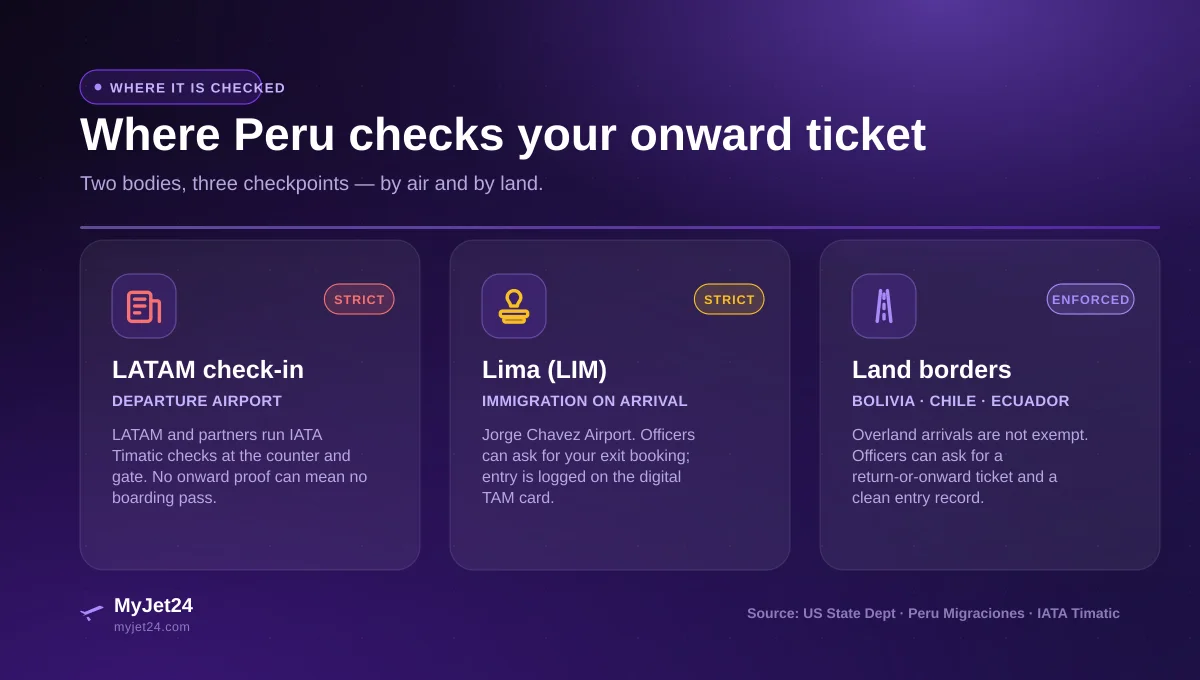
- LATAM, Peru's largest carrier, runs IATA Timatic checks at Lima (LIM) and your departure gate, and can deny boarding without onward proof — especially on one-way tickets.
- Most nationalities get up to 90 days, extendable at the officer's discretion to a 183-day annual cap. Book your exit inside what you are granted, not the 183-day maximum.
- The TAM (Andean Migration Card) is now fully digital and auto-generated at immigration — there is no mandatory pre-arrival online registration.
- A dummy ticket clears check-in and immigration in 30 seconds — free with a booking reference, or verifiable with a real PNR via MyJet24 Premium ($7.90); no wasted fare.
An onward ticket for Peru is documented proof that you will leave the country before your authorized stay ends. Peru admits most tourists visa-free, but airlines and immigration both expect evidence of departure. Without it, the airline can refuse to board you and immigration can refuse entry. A confirmed onward flight, a return flight, or a verifiable flight reservation all satisfy the rule.
What an onward ticket means for Peru
An onward ticket is a booking that shows your exit from Peru on a specific date by a recognized carrier. Peru's tourist admission, like that of its Andean Community neighbors, is conditional on a visitor being able to show they intend to leave inside the granted stay. The onward ticket is the document that proves that intent.
This is separate from a visa. Citizens of the United States, Canada, the UK, the EU/Schengen area, Australia, and many other countries enter Peru visa-free for tourism. What they must still carry is a passport valid for at least six months and credible proof of onward travel. A return flight, a flight to a third country, or a verifiable reservation each meet the standard.
Visa-free does not mean check-free. In Peru the exit-proof question is asked at two separate points — the airline gate and the immigration desk.
Does Peru require proof of onward travel?
Yes. Proof of onward or return travel is an entry condition for visa-free visitors to Peru, and both the airline and immigration are entitled to ask for it. The absence of an exit booking is grounds for an airline to refuse boarding and for an officer to question or refuse entry. The rule is enforced most visibly at Lima's Jorge Chávez International Airport (LIM), the gateway for the vast majority of arrivals.
Two bodies enforce the same expectation at two moments. The airline checks at check-in or the gate in your departure country. Peruvian immigration can check again on arrival. Clearing one does not clear the other, so carry the document for both. Enforcement is consistent rather than seasonal, and it does not relax for short stays or well-known nationalities. Treat the onward ticket as a core travel document for Peru, packed alongside your passport.
90 days vs 183 days: the discretion trap
Peru's tourist stay is granted at the officer's discretion. Most visitors receive up to 90 days, and the legal maximum is 183 days within any 183-day period, counted from your first entry. The exact number you are given is decided at the border — not by you, and not by the maximum.
This matters for your onward ticket: the exit date on your proof must fall inside the period you are actually granted. If you assume 183 days, book an exit on day 150, and the officer stamps you for 90, your proof now shows an apparent overstay and invites scrutiny. Keep the onward booking within 90 days of arrival unless a longer stay is confirmed at the desk. Peru no longer offers tourist extensions inside the country the way it once did, so the days you receive on arrival are effectively the days you have.
| Requirement | Peru tourist entry (2026) |
|---|---|
| Visa | Visa-free for US, Canada, UK, EU, Australia and most Western passports |
| Length of stay | Up to 90 days; 183-day max per 183-day period (officer discretion) |
| Passport validity | 6 months from entry + 1 blank page |
| Onward/return ticket | Required — checked by airline, may be checked by immigration |
| Migration card (TAM) | Digital, free, auto-generated at immigration — no pre-registration |
| Currency declaration | Required for amounts over US$10,000 |
The TAM Virtual: no pre-registration needed
The TAM (Tarjeta Andina de Migración, or Andean Migration Card) is Peru's digital record of your entry and exit. Peru stopped stamping passports and now generates the TAM automatically when you pass through immigration control, according to the Superintendencia Nacional de Migraciones. It is free, and you can download it later from the Migraciones portal if a hotel or tax office asks for proof of your entry date.
Here is what many guides get wrong: there is no mandatory online registration before you fly to Peru. The TAM is created for you at the border, not by you in advance. Do not pay any third-party site that claims to "register" your TAM for a fee before arrival — that is not a real requirement. What you do need ready is your passport and your onward ticket, the two documents that actually get checked.
When the onward-ticket rule is triggered
The requirement bites in three common cases. If any applies, expect to be asked for proof:
- You are flying on a one-way ticket. No return leg means no built-in proof of exit, so the airline asks for a separate onward booking.
- Your return is dated beyond your permitted stay. A return more than your granted period after arrival does not prove a lawful exit and may be rejected.
- You enter and leave through different countries. Flying into Lima but planning to cross overland into Bolivia, Chile, or Ecuador reads as one-way to the inbound airline.
Round-trip travelers usually pass without friction, because the return leg is the proof. The travelers who get stopped are one-way flyers, South America backpackers, and digital nomads chaining countries together.
Why LATAM and airlines enforce it
Airlines enforce proof of onward travel because they carry the financial risk. Under IATA Timatic — the travel-document database every check-in agent queries — Peru is flagged as expecting onward travel. If a carrier boards a passenger who is then refused entry, the airline must fly that person back at its own cost and can be fined.
LATAM is the dominant carrier at Lima Jorge Chávez and the enforcer most travelers meet, applying Timatic checks consistently across its network. The same liability rule drives Avianca, Copa, American, Delta, and Iberia. We explain the mechanism in our guide to whether airlines can deny boarding without proof of onward travel.
Accepted forms of proof, compared
Peru accepts several forms of onward proof, and they differ in cost, risk, and flexibility. A confirmed paid onward or return flight is accepted without question, and a flight reservation with a real, verifiable PNR is accepted by both the airline and immigration.
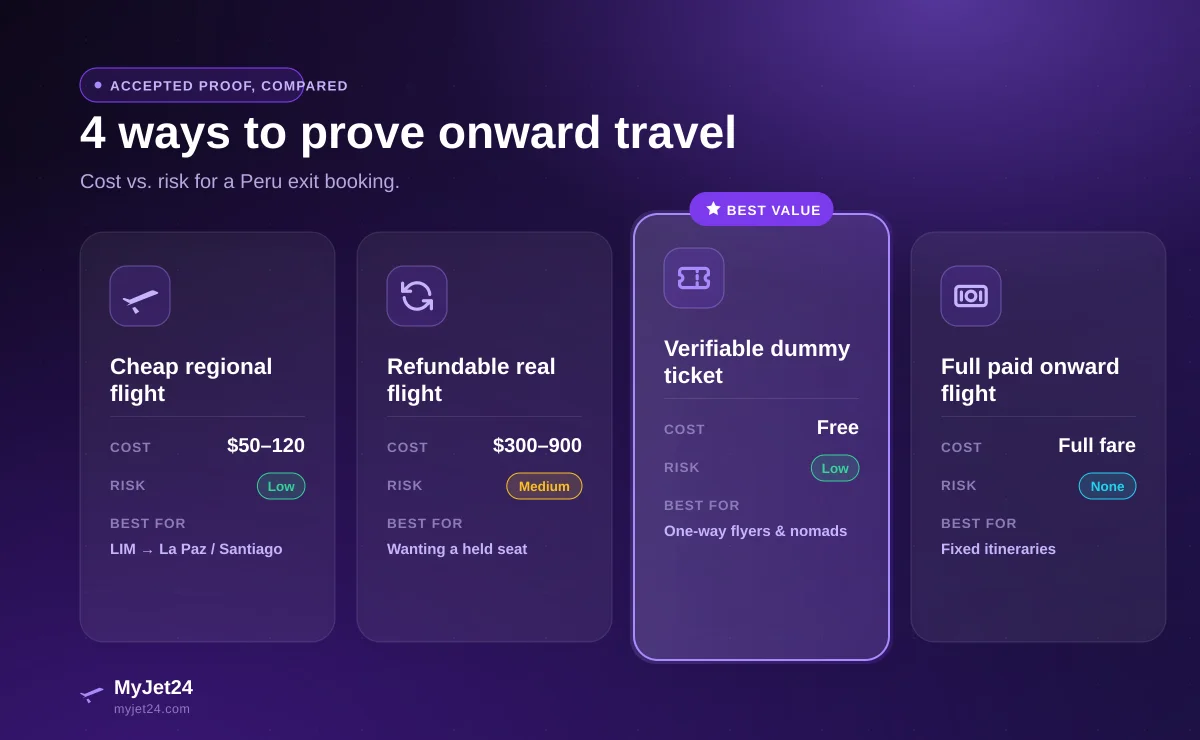
| Option | Cost | Risk | Best for |
|---|---|---|---|
| Cheap regional flight | $50–120 | Low | LIM to La Paz or Santiago |
| Refundable real flight | $300–900 | Medium — must cancel in time | Travelers wanting a held seat |
| Dummy ticket | Free (verifiable PNR: $7.90 Premium) | Low | One-way flyers, nomads |
| Full paid onward flight | Full fare | None | Fixed itineraries |
The cheap-regional-flight route (and its limits)
A genuinely cheap onward flight is the classic Peru workaround. A one-way Lima (LIM) to La Paz (LPB), Santiago (SCL), or Guayaquil (GYE) ticket on a low-cost carrier can run $50–120 and is unquestioned onward proof. Some travelers buy it intending to actually use it; others treat it as a throwaway.
The limits are cost and commitment. Even a cheap fare is real money you may not use, prices climb in the June–August high season, and a non-refundable throwaway is wasted if plans change. If your route is fixed, buy the real seat. If it is flexible, a verifiable reservation does the same job at the gate for $7.90 (MyJet24 Premium).
How to get a free or verifiable onward ticket in 30 seconds
A dummy ticket — also called a flight reservation or onward ticket — is, with MyJet24 Premium ($7.90), a real, verifiable booking with a genuine PNR you can present as proof without buying a full fare. It is the cleanest answer to Peru's requirement when your plans are flexible.
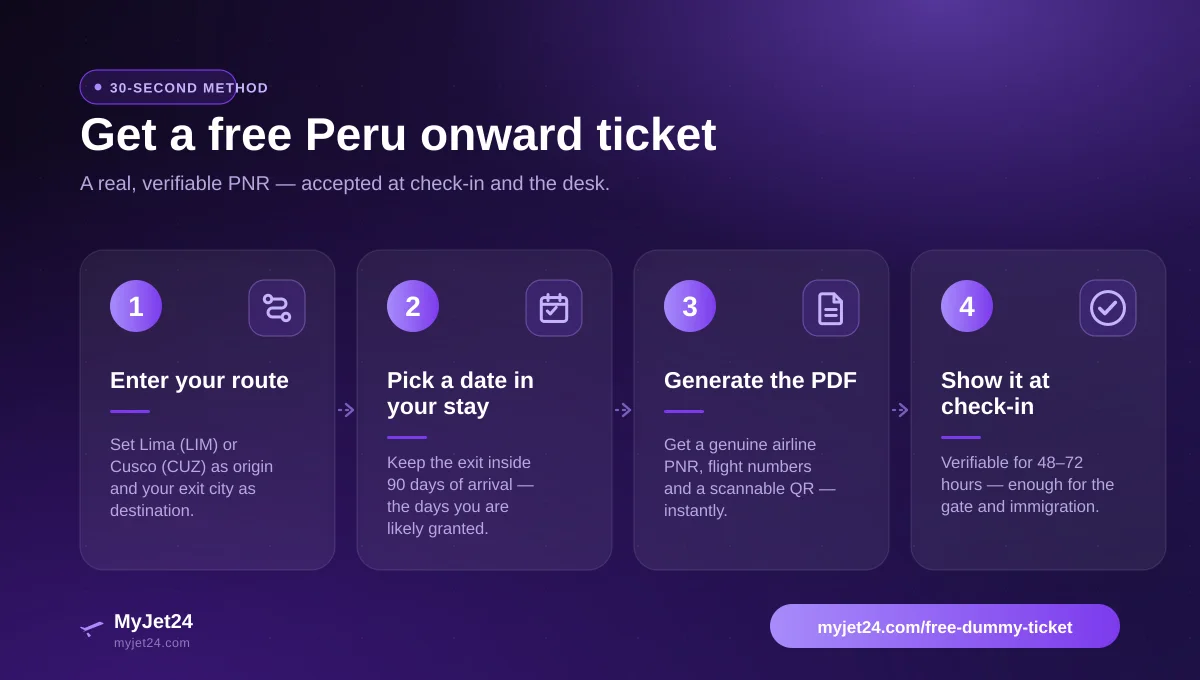
- Enter your route. Set Lima (LIM), Cusco (CUZ), or Arequipa (AQP) as the origin and your exit city as the destination.
- Pick a date inside your stay. Choose a departure within the days you expect to be granted — keep it inside 90 days of arrival.
- Generate the PDF. You get a booking reference, flight numbers, and a scannable QR code, issued instantly — a real airline PNR with Premium ($7.90).
- Show it at check-in and immigration. With Premium, the reservation is verifiable for 24–72 hours — enough for both checks.
You can generate a free onward ticket here or use the full dummy ticket tool for round trips. For the wider requirement, see our pillar on proof of onward travel.
A verifiable reservation answers the only question the LATAM gate agent is really asking: "If Peru turns this passenger away, can we prove they were leaving?"
Verify the PNR before you fly
A dummy ticket only works if the booking is real and checkable. Before you travel, confirm the reference resolves to a live booking and that the passenger name matches your passport exactly. We cover this in how to verify your dummy ticket PNR. A reference that cannot be looked up is worse than none, because it invites scrutiny.
Is using a dummy ticket for Peru legal?
Using a verifiable flight reservation as proof of onward travel is legal. You are showing a genuine booking that exists in an airline system, not an edited document. Immigration authorities accept reservations precisely because travelers should not have to buy tickets they may never use. The line you must not cross is inventing a confirmation or editing a PDF — that is fraud. See what a dummy ticket is for the full picture.
The exit trap: no entry record, no departure
Peru ties your exit to your entry record, and this is where unprepared travelers get hurt. Because the TAM is digital, every traveler must have a clean electronic entry record to leave the country. The US State Department warns that travelers who exit Peru without a proper entry record can face fines and, in serious cases, a re-entry ban of up to 15 years.
The practical lesson is to clear immigration properly on the way in — including answering the onward-travel question cleanly — so your record is complete. A traveler who is waved into secondary inspection for lacking an onward ticket, or who enters at a remote land border without being processed, risks an incomplete record that surfaces only at departure. Getting the entry right protects the exit.
LATAM, Lima Jorge Chávez, and the cheapest exits
Lima Jorge Chávez (LIM) is the busiest airport in Peru and one of the major hubs on South America's Pacific coast, with a new terminal that opened in 2025. Nearly every international arrival passes through it, which is why airline and immigration enforcement is most visible there. If you are connecting through Lima and then leaving the airport, you are a visitor, and the onward ticket applies.
The cheapest reliable exits from Lima run to nearby capitals: LIM to La Paz, Santiago, Bogotá, Quito, or Guayaquil on LATAM, Avianca, JetSMART, and Sky. Any of these, booked and confirmed, is accepted onward proof at check-in and the desk. What matters is booking quality: your passport name, a Peruvian airport as origin, a destination, a flight number and date, and a confirmation code that resolves to a live booking.
Passport validity and proof of funds
Peru requires a passport valid for at least six months from your date of entry, with at least one blank page for records. While Peru is not famous for hard proof-of-funds checks, immigration can ask a visitor to show they can support the stay, typically satisfied by a credit card or a bank statement. Travelers carrying more than US$10,000 in cash must declare it on arrival.
These checks travel in the same short conversation as the onward ticket: how long are you staying, where are you going next, and may I see your ticket out. A specific date plus a real booking ends it in seconds; vague answers trigger secondary questioning.
Onward ticket vs return ticket: the difference
An onward ticket and a return ticket are not the same thing, though both satisfy Peru. A return ticket sends you back to your origin country; an onward ticket sends you to any next country. For Peru, either works, because the immigration concern is only that you leave before your stay expires — not where you go.
This distinction matters for one-way and open-jaw travelers. If you flew into Lima from Miami but plan to continue to La Paz overland or by air, you do not need a flight back to Miami; a confirmed Lima–La Paz booking is valid onward proof. South America backpackers rely on this constantly: the rule accommodates multi-country routes as long as the exit booking is real, dated inside your stay, and in your passport name.
Common Peru onward-ticket mistakes
- Assuming visa-free means no checks. You still must prove exit at the gate and the desk.
- Booking an exit beyond your stamp. Keep it within 90 days unless a longer stay is confirmed on arrival.
- Paying to "pre-register" the TAM. It is automatic and free — no advance registration exists.
- Relying on a screenshot. Carry a clean PDF with a referenceable PNR.
- Entering without a proper record. An incomplete entry can block your exit later.
- Name mismatches. The booking name must match your passport exactly.
How Peru compares to other strict countries
Peru sits alongside its Andean and Latin American neighbors on onward-travel enforcement, in the same tier as Colombia, Panama, and Costa Rica. What these destinations share is dual enforcement: the airline screens you before departure and immigration can screen you on arrival. Weaker-enforcement countries rely on only one checkpoint, which is why travelers sometimes pass without proof elsewhere and wrongly assume Peru will be the same.
The upside of consistency is predictability. Because the requirement is known and stable, satisfying it in advance is trivial. Travelers who prepare never see a problem; only the unprepared do. Build your exit proof before you leave home and Peru becomes one of the easiest entries in the region.
What happens if you arrive without an onward ticket
Two failure points exist, and the earlier one is more common. At your departure airport, the airline can refuse to check you in or board you, because under carrier-liability rules it would have to fly you back at its own expense if Peru turns you away. Travelers report being sent from the counter to buy an onward ticket on the spot — at full walk-up prices — before they are allowed to fly.
The second point is on arrival. Peruvian immigration can route a passenger without exit proof into secondary inspection, where you may be asked to show a booking, demonstrate funds, or, in the worst case, be refused entry and returned. Neither outcome is exotic; both are routine for unprepared one-way arrivals. Carrying a verifiable onward ticket removes both risks before they start.
Conclusion and next steps
Peru is a strict onward-travel destination — not because the rule is unusual, but because LATAM and Peruvian immigration both enforce it, and because the digital TAM ties your exit to a clean entry. Carry credible exit proof dated inside your stay, keep it within the 90 days you are likely to receive, and ignore any site asking you to pre-register the TAM for a fee. If your plans are fixed, a real or cheap regional flight is fine. If they are flexible, a reservation is the lowest-risk, lowest-cost answer — free with a booking reference, or verifiable with a real PNR for $7.90 (MyJet24 Premium). Compare strict destinations in our pillar guide to which countries require proof of onward travel.
Ready to fly? Generate a free onward ticket for Peru in 30 seconds — booking reference, QR code, accepted at check-in. No credit card, no account. A real, verifiable PNR comes with Premium ($7.90).
Last updated: June 9, 2026 · Sources: US State Department — Peru · Superintendencia Nacional de Migraciones (Peru) · IATA Timatic
