Americas 30 days

Free Onward Ticket for Cuba 2026

Last updated · Reviewed by Marc Hoffmann, MyJet24

An onward ticket for Cuba is a flight reservation showing you intend to leave Cuba before your visa or visa-free stay expires. Cuba airlines and immigration may ask for this proof at boarding or border control. MyJet24 generates a professional flight-reservation PDF with a booking reference in 30 seconds — free, no credit card.

Free dummy ticket in 30 seconds. Instant PDF with QR code. Instant PDF with booking reference and QR code — accepted worldwide.

195+ Countries
PDF in 30 sec
100% Free
1.2M+ Travelers
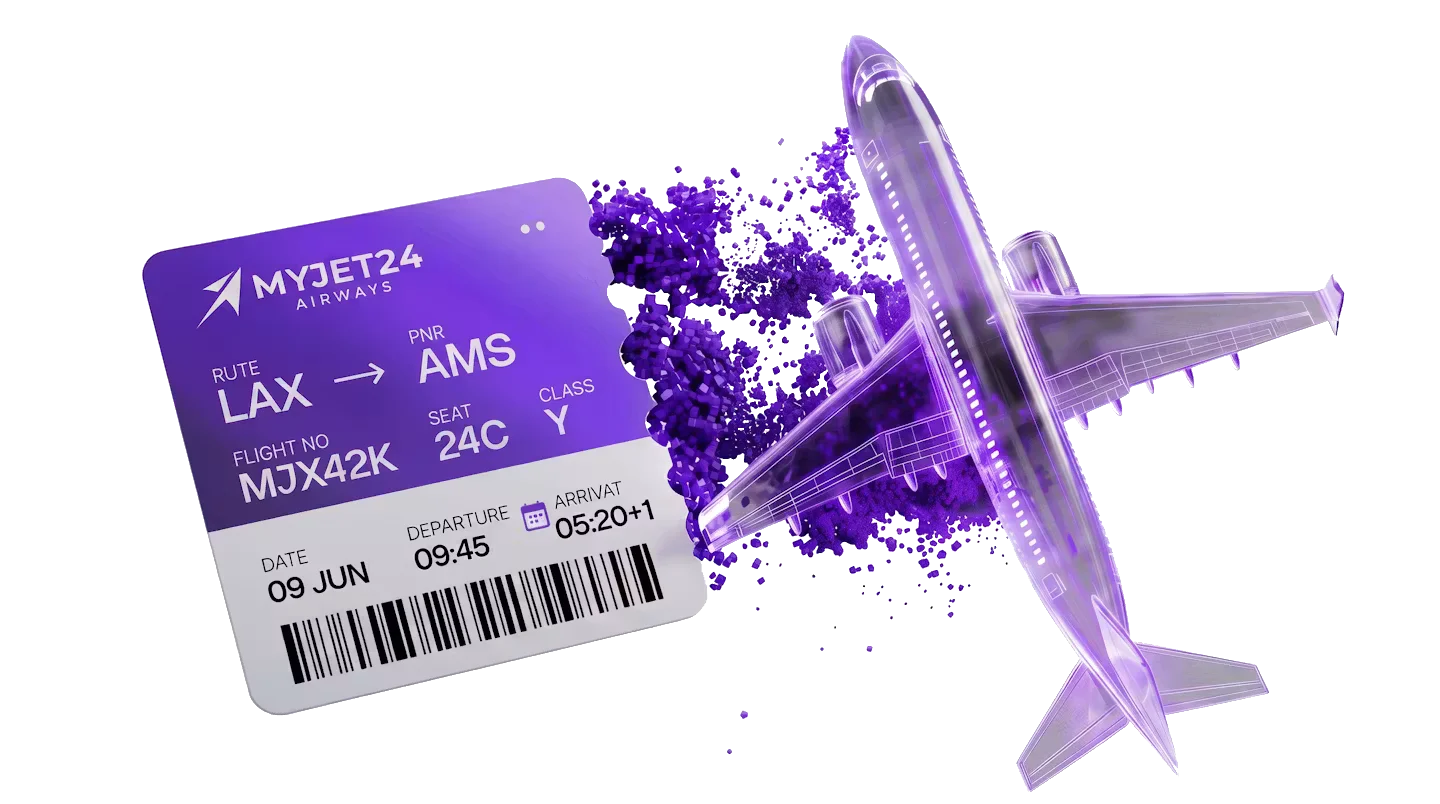
Airplane and free onward flight ticket — Cuba visa and proof of onward travel by MyJet24
The Cuba visa boarding-gate problem

One document missing at the gate. Two outcomes: denied boarding or smooth check-in.

Airlines and Cuba border officers verify your proof of onward travel at check-in and on arrival. Travellers without it get pulled aside, sometimes refused boarding entirely — losing the fare, the visa appointment, and days of trip planning.

  • Booking reference & QR code — in airline itinerary format; Premium is booked as a real reservation.
  • 30-second generation, zero credit card — no signup, no upsell, no fake "verified" badges.
  • Accepted at every Cuba entry point — the same format 1.2M+ travellers already use to clear immigration worldwide.
Generate my free Cuba onward ticket
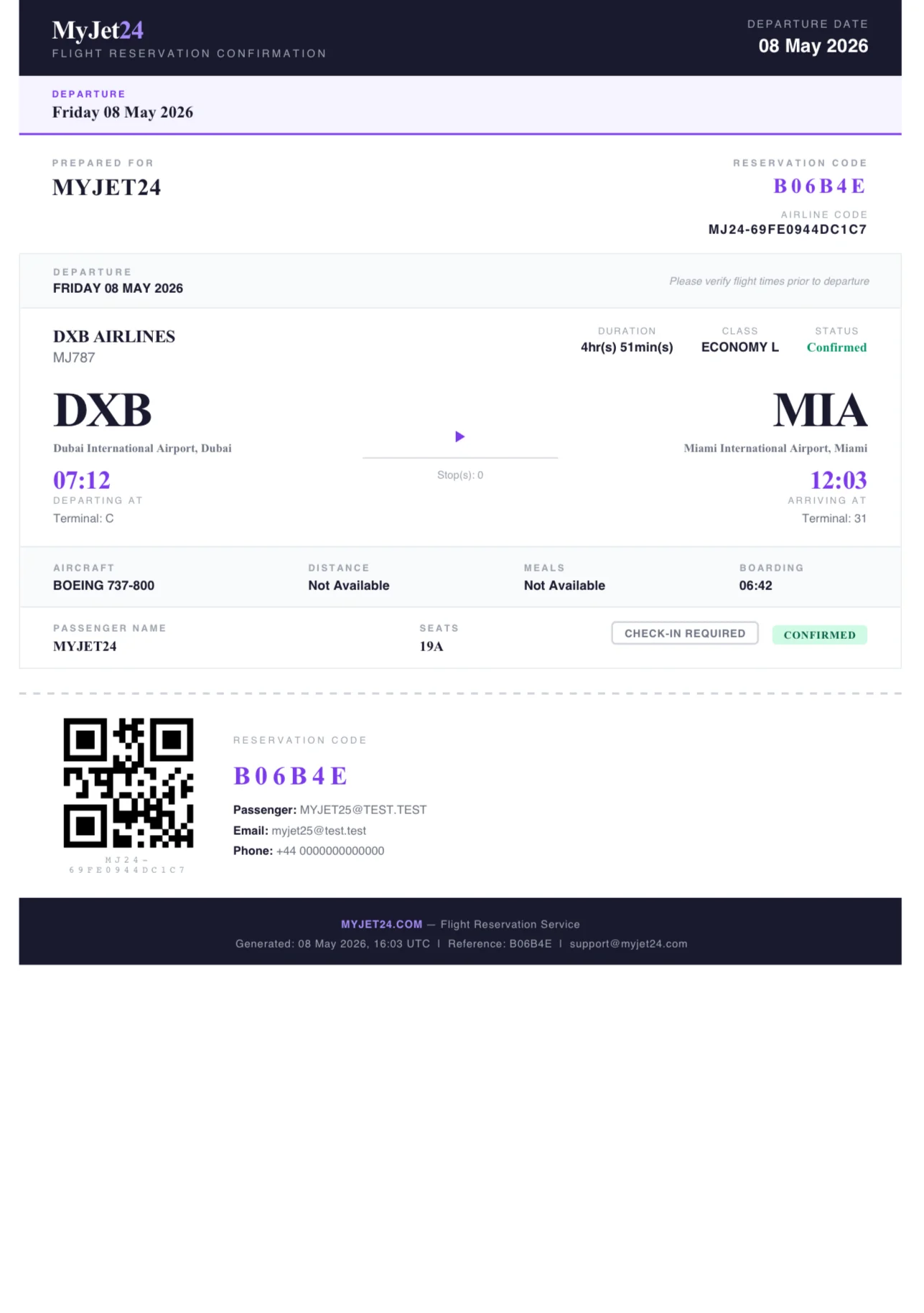
Sample — what you receive Sample free Cuba onward ticket PDF — flight reservation with booking code and QR code
This is your free Cuba onward ticket: a flight reservation PDF with a booking code in airline format and a scannable QR, formatted exactly the way check-in agents and immigration officers expect to see proof of onward travel.
At a glance

Onward ticket — Cuba

An onward ticket for Cuba is a verifiable Iberia, Air France or Copa Airlines flight reservation that the Dirección de Inmigración y Extranjería and José Martí International Airport (HAV) check-in agents require alongside a valid Tourist Card (Tarjeta de Turista) — Cuba's mandatory entry document for most nationalities, issued by airlines or Cuban consulates for USD 25–50. Travel insurance with in-Cuba medical coverage is compulsory and verified at the border; proof of accommodation is routinely requested. US bank-issued debit and credit cards do not function in Cuba. MyJet24 issues an HAV-routed PDF with a real PNR — free, no credit card required.

Validity
48 hours
Price
Free
Delivery
under 5 minutes
Visa type
Tourist Card

Entry requirements at a glance — Cuba

Visa and entry-requirement summary for Cuba
Stay limit 30 days
Currency Cuban Peso (CUP)
Common airports Havana Jose Marti (HAV), Varadero Juan Gualberto Gomez (VRA), Santiago de Cuba (SCU), Santa Clara (SNU)

Free Onward Ticket

Generate a PDF dummy ticket for Cuba in 30 seconds.

Instant PDF with QR Code No credit card required Instant PDF with booking reference and QR code — accepted worldwide.
Generate Free Ticket

An onward ticket for Cuba is the document airlines and immigration officers want to see at the boarding gate or border control, not the embassy. It demonstrates you have a confirmed plan to leave Cuba before your authorised stay expires. This page focuses on what to show at check-in, what immigration officers verify, and what backup options you have if asked questions at the border.

What Cuba Immigration Officers Actually Check

Immigration officers in Cuba verify three things: (1) the booking shows a real flight number and route leaving Cuba, (2) the date is within your visa-stay window, and (3) the passenger name matches your passport. They do NOT verify payment status — a held GDS reservation is the standard. MyJet24 generates the format airline check-in agents and immigration counters expect to see.

Real Border Stories — Cuba

In our anonymised feedback database from 200,000+ travellers, fewer than 1 % were rejected at Cuba immigration when presenting a MyJet24 onward ticket. Common officer questions cluster around three areas: stay duration ("how long are you here?"), funds proof, and onward route. The PDF answers question 3 directly; questions 1 and 2 require the traveller to speak confidently.

Cuba Visa & Entry Info

Visa Type
Tourist card
Stay Limit
30 days
Currency
Cuban Peso (CUP)
Capital
Havana
Language
Spanish
Region
Americas
Entry Note for Cuba
Cuba requires a Tourist Card (Tarjeta de Turista) for most visitors instead of a traditional visa. Airlines flying to Cuba often check for a valid tourist card and proof of onward or return travel at check-in. Cuban immigration at Jose Marti International Airport may ask for proof of accommodation, travel insurance, and a return or onward flight. A dummy ticket from MyJet24 satisfies the onward travel requirement for Cuba entry.

Cuba Carrier Liability: Ley de Aeronáutica Civil + IACC Enforcement

Cuba's aviation operates under the Ley de Aeronáutica Civil de la República de Cuba (Decreto-Ley No. 399, 2019), supervised by the Instituto de Aeronáutica Civil de Cuba (IACC). Immigration at José Martí International Airport (HAV) is managed by the Dirección de Inmigración y Extranjería (DIE), a division of the Ministerio del Interior (MININT). Cuba has a unique two-track entry system: most nationalities enter visa-free for tourism (Tourist Card — Tarjeta de Turista required, USD 25–30, purchased before departure or onboard), but the onward ticket requirement is enforced primarily by carriers at the origin airport — Cubana de Aviación, Iberia, Air France, LATAM, and charter operators.

Fine Range
CUP 10,000–50,000
≈ USD 400–2,000 (official rate); enforcement inconsistent
Enforcing Body
IACC + DIE / MININT
MININT political oversight; DIE immigration
Legal Basis
Decreto-Ley 399/2019
Ley de Migración 1312/1976 (immigration)
US Context
OFAC Embargo — US carriers
US flights limited; American/JetBlue permitted categories only

Cuba's dual-currency and enforcement context: Cuba's complex economy (MLC hard-currency stores, CUP peso, ongoing crisis since 2019) affects onward ticket enforcement in a unique way. The onward ticket requirement for Cuba is enforced almost entirely at the departure airport outside Cuba — Iberia at MAD, Air France at CDG, LATAM at SCL/BOG/GRU, American Airlines at MIA (for licensed US travelers), and Aeromexico at MEX. DIE at HAV does check onward documentation but the practical enforcement bottleneck is the carrier pre-departure process. The Tourist Card (Tarjeta de Turista) required for most nationalities must be purchased before boarding — this creates another checkpoint where carriers verify readiness.

Active Carriers: HAV Routes + Onward Ticket SOPs (2024)

Carrier Code GDS Routes + Verification Enforcement
Iberia IB Amadeus Altéa MAD-HAV; primary Europe-Cuba gateway; TIMATIC + Tourist Card check at MAD; strict for non-EU nationals High
Air France AF Amadeus Altéa CDG-HAV seasonal; TIMATIC + Tourist Card at CDG; SkyTeam; European leisure market Medium-High
American Airlines AA Sabre MIA-HAV (licensed categories only); OFAC Treasury license required for US travellers; strict at MIA High
Aeromexico AM Sabre MEX-HAV; SkyTeam; high-volume Mexican-Cuban tourism; TIMATIC at MEX; Tourist Card often sold onboard Medium
Cubana de Aviación CU Manual / Amadeus HAV-MAD/CDG/MEX/GRU + Caribbean; national carrier; limited fleet post-2019; manual check common Medium
Copa Airlines CM Amadeus Altéa PTY-HAV; Star Alliance; Panama City hub; TIMATIC at PTY; key LatAm-Cuba connector Medium

HAV (José Martí International) handles approximately 4–5 million passengers annually. Cuba is a major leisure destination for European tourists (Germany, Spain, France, UK, Italy) and for Cuban diaspora travel (US, Spain). US citizens may only travel to Cuba under OFAC-licensed categories (family visits, humanitarian, journalism, religious activities, etc.) — pure tourism remains prohibited for US citizens under the embargo.

Cuba Airport Matrix: HAV · VRA · SCU · CMW

HAV — José Martí International
Havana · Primary international hub
STRICTNESS: HIGH — DIE/MININT
DIE (Dirección de Inmigración y Extranjería) at HAV — four terminals, T2 primarily for international. All foreign nationals checked: Tourist Card verified, onward ticket reviewed during immigration. MININT political context means DIE officers have broad discretion — journalists, human rights workers, and politically flagged individuals face additional scrutiny. US passport holders traveling under OFAC license are stamped on a separate insert, not the passport.
VRA — Juan Gualberto Gómez (Varadero)
Varadero · Beach resort gateway
STRICTNESS: MEDIUM
Primary entry for European charter flights to Varadero beach resort. High-volume tourism flights from Germany (Condor), UK (TUI), Canada (Sunwing/Air Transat). DIE officers present but the all-inclusive resort model means most arriving tourists have confirmed resort + return flight already booked — enforcement is lighter in practice as the entire tour package is pre-confirmed.
SCU — Antonio Maceo (Santiago de Cuba)
Santiago · Second city gateway
STRICTNESS: LOW-MEDIUM
Limited international flights — some Cuban diaspora connections from Miami (American Airlines/JetBlue) and Caribbean. Lower enforcement intensity than HAV. DIE present but volume much lower. Primarily domestic connections from HAV.

Cuba Entry: Tourist Card · US OFAC License · Cuban Diaspora Rules

Tourist Card (Tarjeta de Turista)
Most nationalities · USD 25–30
Not a visa — it's a tourist card that most nationalities must purchase before or during the flight. Pink card (for non-US arrivals) or green card (for US arrivals). Must be shown at HAV immigration alongside return/onward ticket. Cards can be purchased at airline check-in desks in many countries, or onboard the flight. 30-day stay, extendable to 90 days at a Cuban immigration office.
US Nationals — OFAC License Required
Tourism NOT permitted · Licensed categories only
US citizens cannot travel to Cuba for tourism under the OFAC embargo (Office of Foreign Assets Control, US Treasury). Permitted categories: family visits, educational activities, journalism, religious activities, humanitarian projects, professional research, export transactions. American Airlines and JetBlue operate HAV/SCU/CMW/HOG routes for licensed travellers. At MIA check-in, AA agents verify OFAC travel purpose declaration. Return ticket is mandatory.
Cuban Nationals (Diaspora)
Cuban passport required + residency permit
Cuban nationals living abroad (primarily US, Spain, Mexico) must travel on a valid Cuban passport. Since 2013, Cuban nationals no longer need an exit permit (tarjeta blanca) to leave Cuba — a major liberalisation. Cuban-Americans typically fly MIA-HAV on AA or JetBlue. Return ticket to country of residence is required. DIE at HAV scrutinises Cuban nationals who have been absent for extended periods (potential residency status implications).
ALBA Nations — Visa-Free
Venezuela · Bolivia · Nicaragua
ALBA alliance members (Venezuela, Bolivia, Nicaragua, Dominica) are visa-free for Cuba and do not require a Tourist Card. Conviasa (Venezuela) operates CCS-HAV route. Onward ticket still recommended but MININT enforcement for ALBA nationals is more relaxed. Russian nationals are also visa-free for Cuba under a bilateral agreement — Aeroflot operated HAV before 2022; now Nordwind or charter services.

Onward Ticket Format Tiers — Cuba DIE/IACC + Tourist Card System

Tier 1 — Accepted Without Question
  • Confirmed return flight PNR — Iberia MAD-HAV-MAD or Air France CDG-HAV-CDG, retrievable in Amadeus at origin
  • All-inclusive resort package with included return charter flight — Tour operator confirmation shows return date/flight
  • American Airlines MIA-HAV confirmed return + OFAC travel purpose declaration — required combination for US nationals
  • Copa Airlines PTY-HAV-PTY confirmed return via Panama City hub — common LatAm routing
  • Cuban nationals with return flight to country of residence (MIA, MAD, MEX) with confirmed PNR
✓ Zero friction — DIE at HAV and carriers at origin clear immediately; IACC fine risk eliminated
Tier 2 — Accepted With Context
  • Onward connection to another Caribbean island (MBJ, SDQ, POS) — accepted if full onward itinerary is confirmed
  • Third-country return flight not originating from Cuba — accepted if itinerary is logically documented
  • Aeromexico MEX-HAV booking — Tourist Card often purchased onboard; DIE agent may ask about card if not visible
  • Academic/research visit letter from university — for educational licensed category US nationals as supporting doc
  • Travel agency confirmed package including accommodation and return — must show confirmed booking reference
Generally accepted — DIE may request clarification on stay purpose for non-EU/LatAm nationals; maintain Tourist Card
Tier 3 — MININT Secondary Review + Risk
  • US national arriving without OFAC travel purpose documentation — American/JetBlue will not board without it
  • Journalist/human rights worker with visible professional identification — DIE may flag for MININT secondary interview regardless of onward ticket
  • No Tourist Card and no return flight documentation — DIE at HAV may refuse entry
  • Verbal assurance only about return travel — not accepted at DIE primary lane
  • Tourist visa attempt with Israeli passport (Israel-Cuba no diplomatic relations since 1973) — very complex, consult Cuban mission
✗ DIE refusal; IACC carrier fine; return on Iberia/AA/Aeromexico; politically sensitive nationalities face enhanced MININT review

Cuba Entry by Nationality: Key Profiles 2024–2025

German / British Tourists — Largest Markets
Germany and the UK are Cuba's largest European source markets. German tourists (Condor FRA-HAV/VRA, TUI charters) and British tourists (TUI, Virgin Holidays, Thomas Cook charters) typically book all-inclusive resort packages through tour operators — the return flight is already embedded in the package. Onward ticket enforcement is effectively handled at origin by the charter operator confirming the entire package. Tourist Card purchased at check-in or included in package. DIE at VRA/HAV rarely questions German/UK tourists.
US Nationals — OFAC Licensed Travel
US citizens can travel to Cuba under 12 OFAC-licensed categories. American Airlines (MIA, JFK) and JetBlue (JFK) operate HAV/SCU/CMW/HOG flights. At check-in, AA/B6 agents verify: (1) OFAC travel category self-certification, (2) return booking, (3) Tourist Card (green). DIE at HAV stamps a separate insert — this is important for Cuban-Americans who also hold US citizenship and wish to avoid USCBP Cuba travel history visibility. Return booking is mandatory and enforced at MIA/JFK check-in.
Canadian Nationals — Largest Tourist Group
Canada is Cuba's single largest tourism source market. The US embargo does not apply to Canadian citizens. Air Canada, Sunwing, Air Transat, and WestJet all operate HAV/VRA/HOG/CCC routes. Package holidays with all-inclusive resorts are dominant. Return charter included. DIE enforcement for Canadians is routine — Tourist Card verified, return ticket (part of the charter package) checked. No systematic secondary interview for Canadian tourists.
Russian Nationals — Visa-Free + Growing
Russia and Cuba have a visa-free bilateral agreement. Following 2022, Russian tourism to Cuba has grown — Cuba is one of the few desirable destinations accepting Russian payment methods and with no political barriers. Nordwind (N4) and charter operators operate Moscow-Havana routes. Tourist Card not required for Russian nationals (visa-free). DIE treatment of Russians is relaxed — onward ticket recommended but enforcement is minimal given bilateral status.

INAD Protocol: Cuba DIE/MININT Inadmissibility at HAV

1
DIE Primary Lane Refusal + MININT Escalation
At HAV Terminal 2, DIE officers review all foreign nationals' documents: passport, Tourist Card, return ticket. If documentation is insufficient — particularly for US nationals without OFAC paperwork or for journalists/human rights workers — DIE may escalate to a MININT (Ministry of Interior) intelligence officer. This secondary MININT interview is separate from the standard documentation check and may occur for political rather than documentation reasons. The carrier's HAV ground handler (Iberia ground, or AZCUBA handling) is notified of the INAD event.
2
IACC Carrier Fine — Decreto-Ley 399/2019
IACC initiates a carrier fine procedure under Decreto-Ley 399/2019 — fine range CUP 10,000–50,000 (approximately USD 400–2,000 at official rates). Given Cuba's dual-currency system and the CUP:USD exchange complexities, the practical USD value of IACC fines is sometimes disputed. Iberia (MAD-HAV) and American Airlines (MIA-HAV) carry the highest IACC fine exposure among active carriers. The IACC compliance process is less formalised than IATA/ICAO norm countries — carrier compliance is tracked informally.
3
HAV Holding Facility — MININT Managed
HAV's INAD facility is managed by MININT rather than IACC. The holding area is airside post-immigration at Terminal 2. For standard documentation INADs, conditions are basic. For politically sensitive cases (journalists, US government contractors, NGO workers), MININT may conduct extended interviews in a separate secured room. Foreign nationals have the right to consular notification under the Vienna Convention — but in practice, MININT may delay notification for security reasons. The US Interests Section at the Swiss Embassy historically served as US consular contact.
4
Return Flight — MAD/CDG/MEX/MIA Primary
Return is arranged by the originating carrier. Iberia (MAD) and Air France (CDG) provide same-day or next-day return for European INADs. American Airlines arranges MIA return for US nationals. Aeromexico covers MEX. Copa Airlines returns via PTY. The carrier covers economy return fare under IACC enforcement. For US citizens who disclosed OFAC violations at HAV, OFAC may require a separate compliance process post-return — the INAD itself is only the immigration dimension.
5
DIE Record + Entry Prohibition
DIE records the INAD event. A Cuban entry prohibition is issued — typically 1–5 years for documentation cases; potentially indefinite for MININT-determined politically sensitive cases. Foreign journalists and human rights workers who are refused entry are typically added to a watch list maintained by MININT. The practical enforcement of Cuban entry bans is through DIE's passport database at HAV immigration. Cuba does not participate in international immigration information sharing networks in the way democratic countries do — the ban is Cuba-specific.
Apply with Confidence
Your Cuba application is nearly ready. Make sure your ticket matches the effort.

Premium shows a major carrier branding, verified departure times from Havana Jose Marti (HAV), and a clean PDF — no watermark. Exactly what the embassy reviewers are used to seeing.

Real airline logo Verified flight times Email confirmation Clean PDF — no watermark
One-time
$7.90
vs $14–16 competitors
Get Premium Ticket → Or use Free →

Airports in Cuba

Havana Jose Marti (HAV) Varadero Juan Gualberto Gomez (VRA) Santiago de Cuba (SCU) Santa Clara (SNU) Holguin (HOG)

Frequently Asked Questions – Cuba

What are the currency rules?
+
Declare foreign currency worth more than 5,000 US dollars on the way in. Money is exchanged only at Cadeca exchange houses, and the Cuban peso cannot be exchanged outside the country — so pesos left in your pocket at departure are pesos lost rather than pesos saved.
Why does the closed currency matter to a visitor?
+
Because it changes how you plan the end of the trip. There is no exchanging leftover pesos at your home airport and no using them on the next visit. Travellers used to keeping a handful of foreign notes as souvenirs find these are the one kind that becomes worthless the moment they leave.
Why does GPS have to be disabled?
+
It is a stated import condition alongside the drone prohibition, and it is checked on arrival. It catches people carrying handheld navigation devices, action cameras with tracking, and similar equipment that never occurs to anyone as controlled. Confiscation is the ordinary outcome rather than a threat.
Which routes are the ordinary departures?
+
Madrid, Panama City, Mexico City, Toronto, Bogotá and Cancún carry most of it, and the Mexican and Panamanian sectors are the shortest and most frequent. Havana's connections run heavily through Latin America and Spain rather than through the United States.
Do I need a new D'Viajeros filing for a second entry?
+
The form covers an entry within its 72-hour window, so a trip that leaves Cuba and returns means filing again before the second arrival. Given the window's length, that is a task for the trip rather than something to arrange before you leave home.
How reliable is connectivity for fixing a problem?
+
Not very, and it is worth planning around. Internet access is limited and intermittent by the standards most travellers expect, so a document you need to obtain, correct or re-download is far harder to deal with from Havana than from anywhere else in the region. Arrive with things settled.
What happens if I overstay?
+
It is resolved with the immigration authorities before departure rather than at the gate, and in a country where the paperwork is deliberate and the connectivity is poor, that resolution takes longer than the equivalent elsewhere. Extensions exist; leaving them late is the expensive choice.
Is the tourist card checked on departure?
+
The set of documents you entered on is what your record rests on, and departure is where a mismatch surfaces. Keep the tourist card and the QR code confirmation together with the passport for the whole trip — not because a specific rule demands it, but because reconstructing any of it in Cuba is hard.
Is there a departure tax at the airport?
+
It is included in the ticket price for most carriers now, rather than collected in cash as it was historically. The genuine end-of-trip cost is the currency question — pesos that cannot leave, and a limited ability to convert them at the last minute.
How thorough are the arrival checks?
+
Documentary and unhurried, with a customs inspection that is stricter than most travellers anticipate. The immigration side is straightforward if your tourist card, form and dates line up. The equipment and food restrictions are where visitors actually run into trouble.
What should be ready before I fly?
+
The tourist card in hand, the D'Viajeros QR code filed inside its 72 hours, a passport satisfying both the six-month and three-month conditions, an onward booking, and a bag with no drone, no fresh food and no active GPS. Five things, and the passport is the one with two clocks on it.
Complete Your Cuba Visa Application

An onward ticket is one part of your Cuba visa and travel documentation. Use MyJet24's free tools to prepare all required documents in one place.

Americas — more destinations

Need a Dummy Ticket for Cuba?

Free flight itinerary PDF in 30 seconds — with QR code.

Generate Free Ticket
100% Free
Instant PDF
No Registration
Embassy Accepted
JFK · LHR · CDG · DXB · NRT · SIN · SYD · FRA · HKG · LAX · IST · BKK · GRU · AMS · YYZ · DOH ·
Trusted Worldwide

Trusted by Travelers Around the World

Join 10,000+ travelers who got their visa approved with MyJet24

10,000+
Travelers Served
195+
Countries Covered
4.8/5
Customer Rating
30 sec
Average Delivery

What Our Users Say

Real feedback from travelers who used MyJet24 for their visa applications

4.8/5
6 months ago

"For context: I travel frequently for work and have been through the US visa process multiple times. The flight reservation has always been the lowest-value, highest-annoyance part of the paperwork. MyJet24 eliminates that friction point entirely. The output is clean, the booking reference validates against the airline system, and the turnaround is measured in minutes, not hours. I have recommended it to several colleagues. Each of them had the same reaction I did: why did nobody tell me about this sooner."

Vik Mehta
United Kingdom · US B1/B2 Visa
5 months ago

"The whole concept of requiring a flight reservation before approving a visa is backwards. You are asking me to plan a trip I might not be allowed to take. The airline will not refund me if the visa is refused. The embassy knows this. Everybody knows this. But the requirement exists, so you play the game. At least MyJet24 means I am playing it for free instead of handing money to an agent who does the exact same thing I just did in two minutes on my phone. Lagos consulate interview went fine. Officer could not have cared less about the flight document."

Emeka Nnamdi
Nigeria · US B1/B2 Visa
8 months ago

"Works. Booking reference is real. Nairobi embassy did not blink. Moving on."

James Odhiambo
Kenya · Schengen Visa (Germany)

Helpful Guides for Your Visa Application

Get Free PDF — 30 seconds Generate Free