
Last updated: 24 August 2026 · Reading time: 12 min · Author: Joshua White, Travel Documentation Writer at MyJet24 · Reviewed by: James Mitchell, CEO & Founder
TL;DR — Key facts
- In speech they are the same. On a checklist they may not be. "Dummy itinerary" and "dummy ticket" are used interchangeably, but a consulate asking for an itinerary often means something a single booking does not contain.
- Three different documents get called an itinerary — a one-flight reservation, a written day-by-day plan, and a full multi-segment routing. Only one of them is a booking with a reference.
- Count the segments to know what you are holding. One means a reservation. None means a plan. Three or more means the routing a multi-country application actually needs.
- A return flight proves you come back. It says nothing about how you move between countries — which is exactly what a Schengen file is assessed on.
- None of this requires buying tickets. A held, verifiable routing satisfies the same requirement as a purchased one.
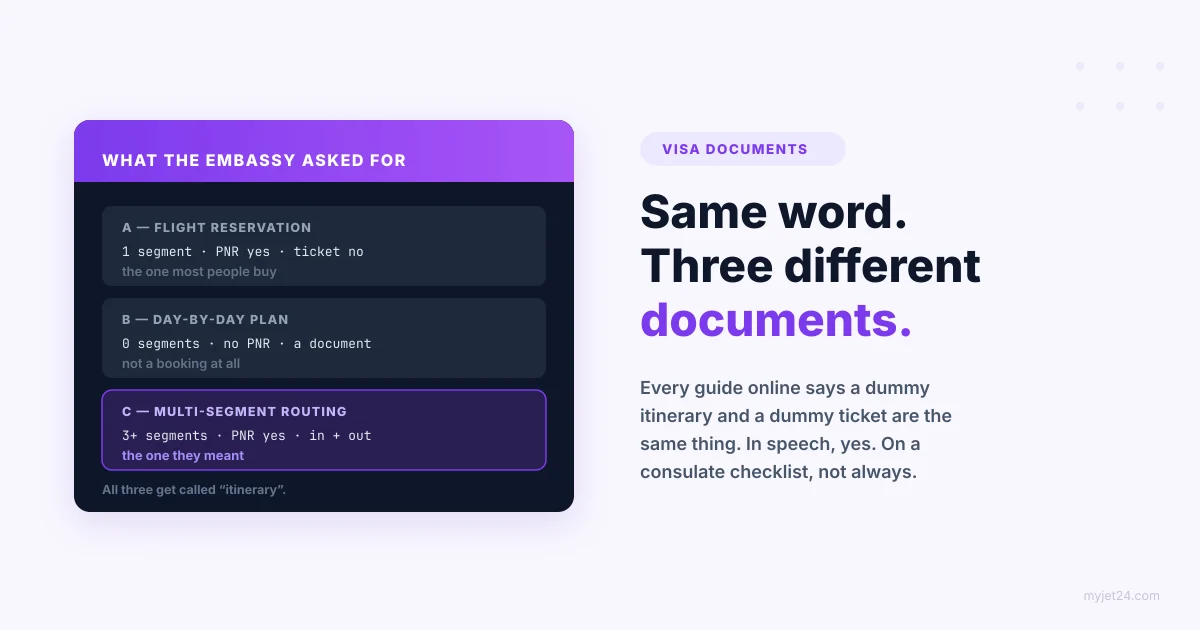
A dummy itinerary is a flight itinerary held rather than purchased, used as proof of travel plans in a visa application. Most guides say it is identical to a dummy ticket, and as everyday shorthand that is true. As a document it is not always: "itinerary" can mean a single reservation, a written travel plan, or the complete multi-segment routing — and consulates ask for different ones.
Multi-segment routing with a live PNR — held, not bought.
In this guide
What a dummy itinerary is
A dummy itinerary is a flight itinerary that is reserved rather than paid for, produced so a visa applicant can show planned travel without committing thousands to tickets they may never use. It carries the same fields a purchased itinerary carries — passenger name, flight numbers, dates, airline, a booking reference — and differs in one respect: no ticket has been issued against it.
The word "dummy" describes the payment status, not the authenticity. A properly made dummy itinerary is a real reservation sitting in a real airline system, retrievable by anyone who queries the reference. That is what separates it from a fabricated PDF, which we cover separately in our piece on how to spot fake travel-document services.
Compare it with the two things it is often confused with. A purchased ticket has been paid and issued, and carries a ticket number as well as a reference. A fabricated document has neither and resolves to nothing. A dummy itinerary sits between them: real record, no ticket number.
Where the record physically lives is worth understanding, because it explains why some documents verify and others do not. A genuine reservation is created in an airline's own system or in a global distribution system — the booking infrastructure travel agents have used for decades — and the reference on your PDF is the key to that record. When a consular officer or an airline agent types it in, they are reading the same row you were sold. Nothing about the PDF matters at that moment; the PDF is a printout of something that either exists or does not.
Key takeaway: "dummy" refers to the payment, not the document. A real reservation that nobody paid for is still a real reservation.
Is it the same as a dummy ticket?
As everyday shorthand, yes — travellers, agents and most websites use "dummy itinerary" and "dummy ticket" to mean the same thing, and correcting people on it would be pedantry. Every guide on the first page of search results states flatly that there is no difference. For the purpose of buying one, that is accurate.
As a document, the words are not always interchangeable, and the gap shows up on consulate checklists rather than in conversation. A checklist that says "flight reservation" is asking for one booking. A checklist that says "travel itinerary" is often asking for something broader: the shape of the whole trip, including how you move between countries. Handing over a single return booking answers the first request and only partly answers the second.
This is not a technicality invented to sell something. It is why our library carries a separate guide to building a day-by-day travel plan — because a meaningful share of applicants who ask for a "dummy itinerary" turn out to need that document, not a flight booking at all.
The two words are synonyms in speech and sometimes different requests on paper. The safest habit is to stop reading the label and start reading the checklist.
Key takeaway: treat them as synonyms when talking, and as separate requests when a consulate wrote the word down.
Three documents, one word
Three genuinely different documents travel under the name "itinerary", and they prove different things. Knowing which one a checklist means removes most of the confusion around this topic, because the three are not interchangeable in what they demonstrate.
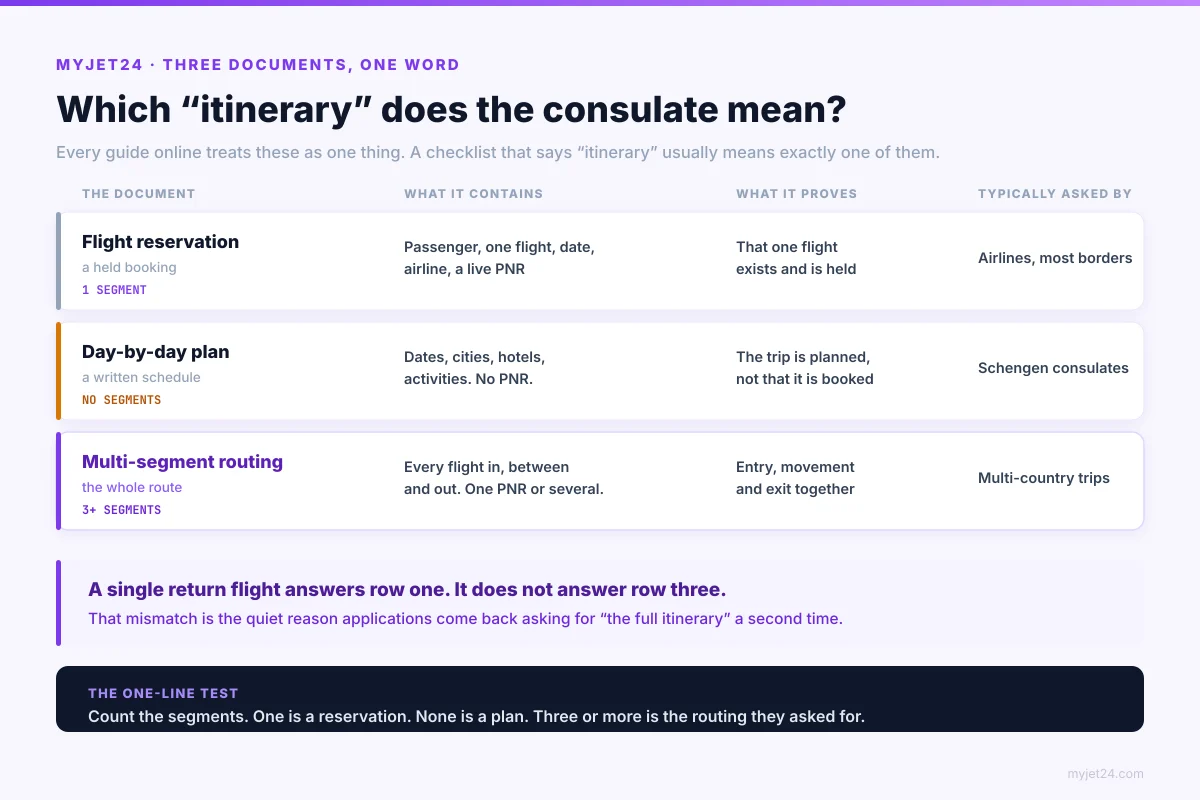
| Document | Segments | Has a reference? | What it proves |
|---|---|---|---|
| Flight reservation | 1 | Yes | That one flight is held |
| Day-by-day plan | 0 | No | The trip is planned, not booked |
| Multi-segment routing | 3+ | Yes | Entry, movement and exit together |
The middle row is the one people never expect. A day-by-day plan is a written schedule with no airline involvement at all — no reference, nothing to verify — and several consulates ask for exactly that alongside the flight booking, not instead of it. Submitting one when the other was wanted is the commonest version of this mistake.
Key takeaway: one document is a booking, one is a schedule, one is a route. Only the checklist tells you which was meant.
How to tell what you are holding
Identifying a travel document takes about two minutes and needs nothing but the PDF itself. Four of the five checks below are visible on the page in front of you; the fifth is a re-read of the requirement you were given. Run them before uploading, not after a rejection.
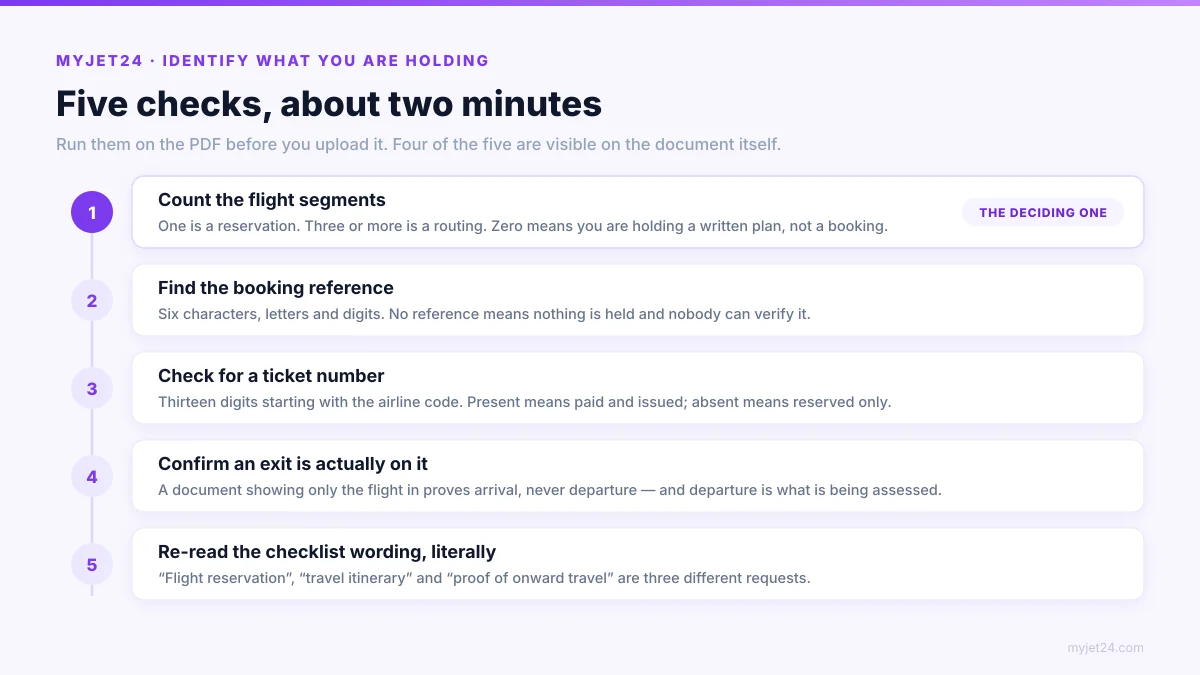
- Count the flight segments. One is a reservation. Three or more is a routing. Zero means you are holding a written plan, and no amount of formatting will turn it into a booking.
- Find the booking reference. Six characters, letters and digits mixed. If there is no reference, nothing is held and nobody can check it — the mechanics of which we set out in what a passenger name record actually contains.
- Check for a ticket number. Thirteen digits, beginning with the airline's three-digit code. Present means paid and issued. Absent means reserved, which is exactly what a dummy itinerary is supposed to be.
- Confirm an exit is on it. A document showing only the inbound flight proves arrival and says nothing about departure — and departure is the thing being assessed.
- Re-read the checklist wording, literally. "Flight reservation", "travel itinerary" and "proof of onward travel" are three separate requests. Match the document to the words used, not to what you assume they meant.
If one of the checks fails
A failed check is not automatically a problem — it tells you which document you have, not whether it is usable. No ticket number is expected on a held reservation and is not a defect. No exit segment, on the other hand, means the document cannot answer the question most consulates and airlines are asking, and needs fixing before submission. No reference at all is the one result that ends the discussion: there is nothing behind the page.
The check that most often surprises people is the segment count. Travellers who bought a "dummy itinerary" for a three-country trip frequently find a single return booking in the file, because that is what the product was — and nobody told them the application needed more.
Key takeaway: segments, reference, ticket number, exit. Four fields settle what kind of document you have.
The multi-country case
A multi-country trip is where the distinction stops being academic, because a return flight answers one question and the file contains three. Two weeks across three Schengen states generates a set of movements that a single inbound-and-outbound booking simply does not describe.
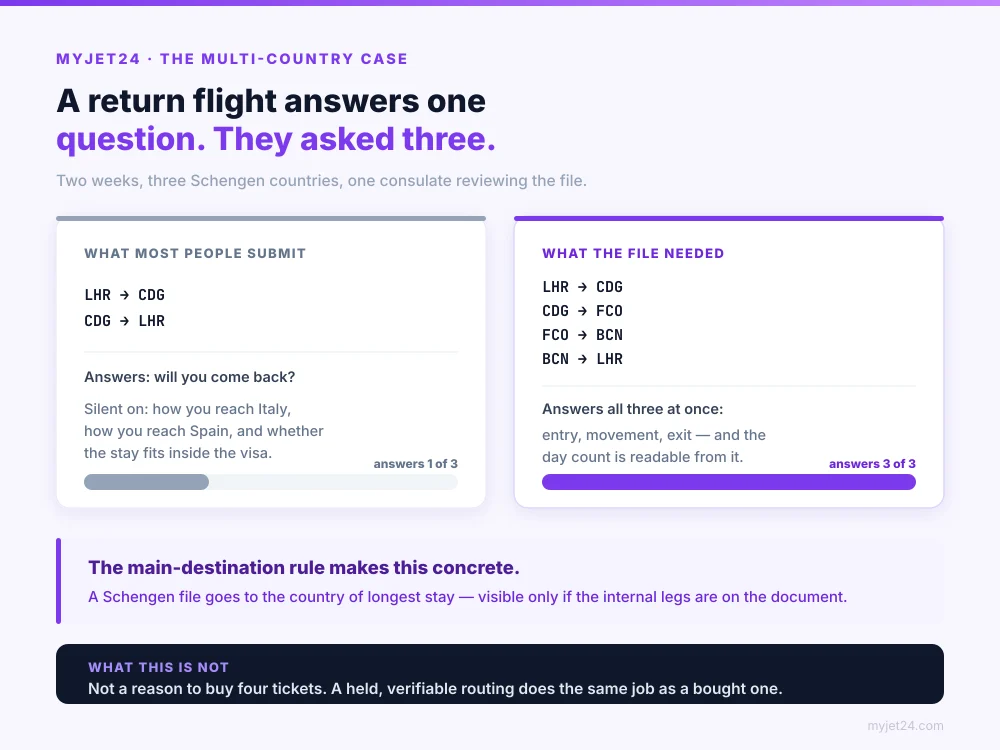
The reason this matters for Schengen specifically is procedural, and it is written into the Visa Code. Article 5 makes the competent member state the one "whose territory constitutes the main destination of the visit(s) in terms of the length or purpose of stay" — and where no main destination can be determined, the state whose external border you intend to cross first. A consulate can only apply that test if it can see the internal legs. A London–Paris–London booking hides the fact that most of the trip happens in Italy.
Note the wording: length or purpose. Nights alone do not always decide it. A conference in Milan can make Italy the main destination even if more nights are spent elsewhere, which is one more reason the document should show the shape of the trip rather than just its endpoints.
The same regulation explains why the itinerary carries weight at all. Article 14 requires applicants to present "documents indicating the purpose of the journey" and information allowing the consulate to assess the applicant's "intention to leave the territory" before the visa expires. A routing does both in one page: it states the purpose implicitly through where you go, and it demonstrates the exit explicitly. A single return booking demonstrates only the second.
The same logic reaches the border. Officers assess whether your stay fits the permission you hold, and the arithmetic of that is easier to demonstrate with a routing than with two flights and an explanation — which is the practical argument behind the Schengen document checklist asking for the trip rather than the flight.
Every leg on one document, with a reference that resolves.
Key takeaway: if the trip crosses borders internally, the internal legs belong on the document. That is what turns a reservation into an itinerary.
Why verifiability decides everything
Verifiability is the single property that determines whether a travel document is worth submitting, and it has nothing to do with how the PDF looks. A document is verifiable when the reference printed on it resolves to a live record in an airline or reservation system when someone queries it. Everything else — layout, logos, fonts — is decoration.
Consular staff and airline agents check the same way: they take the reference and look it up. A cancelled reservation, an expired hold or a fabricated code all fail identically at that moment, and all three look completely normal on paper until then. This is the reason a screenshot has never satisfied anyone: an image cannot be queried.
The practical consequence is that validity has a clock. Held reservations expire, sometimes within days, and a document that verified last week may resolve to nothing today. Our comparison of flight reservations, dummy tickets and onward tickets sets out how long each type typically survives and what that means for application timing.
Key takeaway: if the reference does not resolve, you are holding a picture of a booking. Check it yourself before anyone else does.
Is it legal?
Holding a reservation you have not paid for is a normal function of airline booking systems, not a loophole. Reservations exist so that travellers and agents can hold seats while arrangements are finalised, and using one as evidence of intended travel is a legitimate use of a legitimate record. Consulates have accepted held reservations for as long as the systems have existed.
Where it stops being legitimate is fabrication. A PDF with an invented reference, or a real reference belonging to someone else's booking, is a false document — and submitting a false document to a consulate is a materially different act with materially different consequences. The line is clean: a real record with no payment is fine, an unreal record is not.
Two practical caveats. Some consulates explicitly require confirmed, paid tickets, and where they say so, a held reservation will not do — read the checklist rather than assuming. And a held reservation is not a travel document: it will not board you, because boarding requires a ticket number.
The "confirmed ticket" requirement is rarer than nervous applicants assume, but it is real and it clusters. It tends to appear for long-stay and work-related categories rather than short-stay tourism, and for applicants whose file already carries a refusal. Where it applies, the checklist says so in words — "confirmed", "issued", "paid" — and the absence of those words is itself informative.
Worth separating from all of this: a held reservation is not deception even when a consulate would have preferred a purchase. Deception requires misrepresentation, and a document that accurately shows a reservation, presented as a reservation, misrepresents nothing. What you must not do is describe a held booking as a purchased ticket if you are asked directly.
Key takeaway: unpaid but real is legitimate. Invented is not. The distinction is the whole question.
What goes wrong
Problems with dummy itineraries cluster into a short list, and none of them is about the document being a reservation rather than a ticket. They are about mismatch — wrong document, wrong scope, wrong moment.
THE FIVE THAT COST APPLICATIONS
- Submitting a return booking where a multi-country routing was requested.
- Submitting a flight booking where a written day-by-day plan was requested — or the reverse.
- Letting the reservation expire before the appointment, so the reference no longer resolves.
- Using a fabricated document that has no record behind it at all.
- Assuming a held reservation boards you. It does not — that needs a ticket number.
Four of the five are avoidable in the two minutes it takes to run the checks above. The fifth is avoidable by not using a service that produces documents rather than records — and the way to tell the difference is to query the reference yourself before you submit anything.
Almost nobody is refused because their itinerary was reserved instead of bought. They are refused because the document answered a question nobody asked.
Key takeaway: the failure mode is mismatch, not payment status.
Next steps
To summarise: a dummy itinerary is a held flight itinerary used as evidence of travel plans. Treat it as a synonym for a dummy ticket in conversation, and as a possibly different request when a consulate has written the word on a checklist. Count the segments, find the reference, confirm an exit is on the document, and match it to the words you were actually given.
If the trip crosses more than one border, the internal legs belong on the same document — that is the difference between a reservation and an itinerary, and it is the version most multi-country applications need.
Sources
- European Union — Regulation (EC) No 810/2009 (Visa Code), Article 5 — which member state is competent to examine an application (main destination, then first entry).
- European Union — Entry requirements for non-EU nationals (supporting documents at the border, including proof of lodging and a return or round-trip ticket).
This guide describes consular and border practice as of 24 August 2026 and was reviewed by James Mitchell, CEO and Founder of MyJet24. Documentary requirements are set by each consulate and change without notice; some explicitly require confirmed paid tickets, in which case a held reservation is not sufficient. Always read the checklist issued for your specific application. This article is informational and not legal advice.
