
Last updated: 23 July 2026 · Reading time: 15 min · Author: Joshua White, Travel Documentation Writer at MyJet24
TL;DR — Key Facts
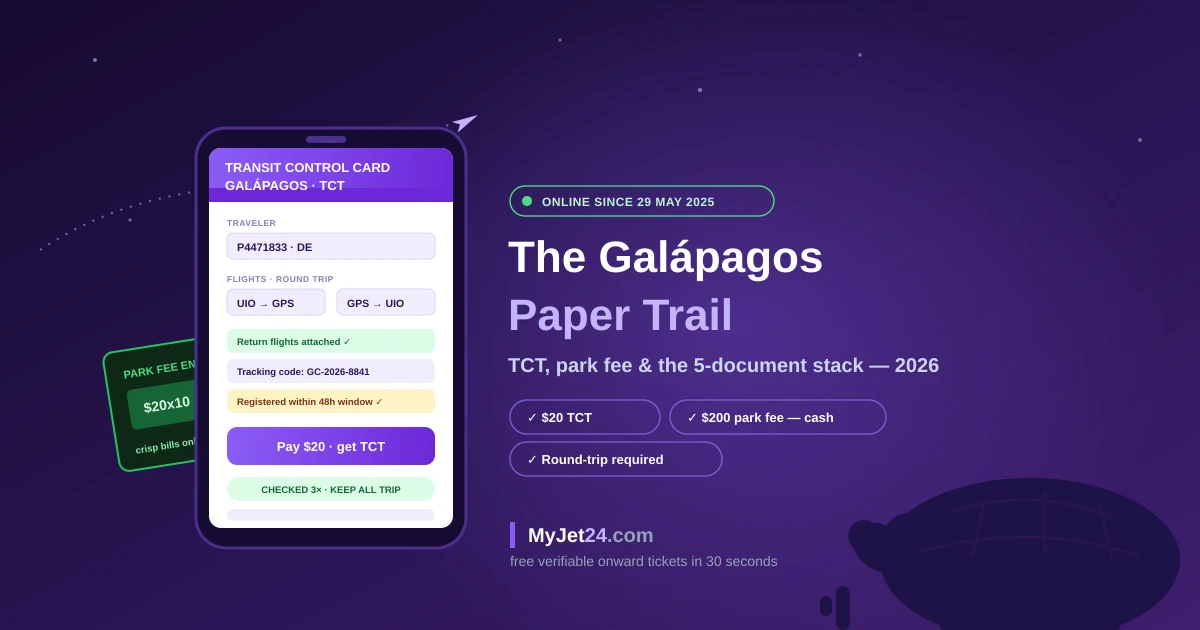
- The Galápagos are the most document-heavy domestic flight on Earth. Before boarding a plane from Quito or Guayaquil to the islands, every visitor needs the $20 Transit Control Card (TCT) — and since 29 May 2025 you register for it online, ideally within 48 hours of your flight, instead of queueing at an airport counter.
- The park fee doubled in 2024 and stays doubled: foreign adults pay US$200 in cash on arrival (children under 12: $100, under 2: free). Rangers famously reject torn or scribbled banknotes — bring crisp bills.
- One-way tickets don't fly. The TCT registration requires your round-trip flights, and airlines enforce it at check-in — the Galápagos rule is the hardest onward-travel check in the Americas.
- Two more free forms complete the stack: the online biosafety declaration for the islands (within 48 hours of flying) and Ecuador's FRA customs form for entering the country itself (required since July 2025).
- Five documents, one checklist: passport (6 months validity), TCT, biosafety declaration, FRA form, and $200 cash. Miss one and you're solving it in an airport queue — this guide walks through all five in order.
To visit the Galápagos Islands in 2026 you need five things: a passport valid for six months; the $20 Transit Control Card (TCT), registered online with the Galápagos Governing Council — ideally within 48 hours of your flight — with your round-trip tickets attached; a free online biosafety declaration; Ecuador's free FRA customs form (for entering Ecuador, required since July 2025); and US$200 in cash for the Galápagos National Park entrance fee, paid on arrival at Baltra or San Cristóbal (children under 12 pay $100, under 2 enter free). The TCT is checked at check-in, on arrival and again when you leave — and without round-trip flights, airlines won't board you.
In this guide
- What is the Galápagos Transit Control Card?
- The five-document stack for 2026
- Getting the TCT online, step by step
- The $200 park fee: who pays what, and the cash rules
- The round-trip rule: why one-way tickets don't board
- The two free forms: biosafety declaration & FRA
- The airport flow: Quito/Guayaquil → Baltra/San Cristóbal
- What it all costs: the honest total
- Six mistakes to avoid
- Frequently asked questions
What is the Galápagos Transit Control Card?
The Transit Control Card — Tarjeta de Control de Tránsito, or TCT (older sources say TCC or "INGALA card") — is a mandatory registration document issued by the Governing Council of the Galápagos Islands (Consejo de Gobierno). Every non-resident traveler needs one before boarding any flight to the archipelago, and it exists for a reason that has nothing to do with bureaucratic habit: the Galápagos operate under some of the strictest population and visitor controls of any inhabited place on the planet.
The card records who enters the islands, for how long, and confirms they leave again — which is why it's checked three times: by your airline at check-in on the mainland, on arrival in the islands, and again on departure. Losing it mid-trip means paperwork at the Governing Council office instead of a snorkel session.
Three fundamentals:
- It costs $20, per person, every visit — children included;
- It's now an online process: since 29 May 2025, registration happens on the Governing Council's web platform instead of the old queue at Quito or Guayaquil airport counters;
- It is not a visa and not the park fee — it's the transit registration layer of a multi-part system, sitting alongside Ecuador's normal entry rules and the separate $200 National Park fee.
The five-document stack for 2026
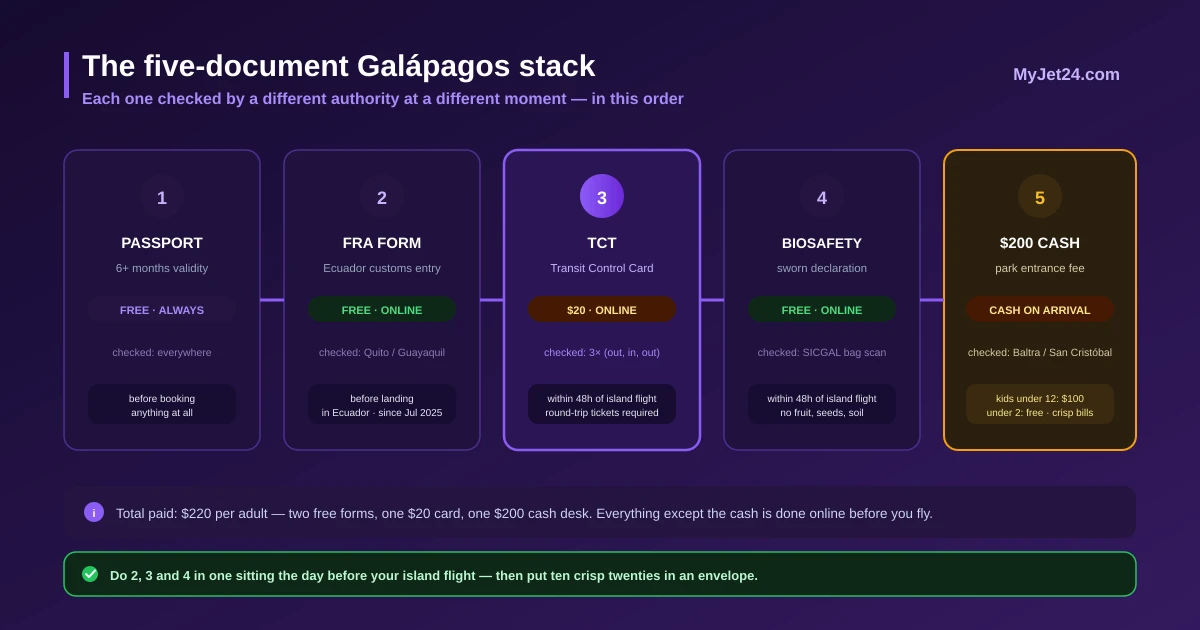
Galápagos trips fail at counters, not on boats. Here is everything a foreign visitor needs in 2026, in the order you'll use it:
| Document | Cost | When | Where |
|---|---|---|---|
| 1 · Passport (6+ months validity) | — | Before booking | — |
| 2 · FRA customs form (Ecuador entry) | Free | Before landing in Ecuador | Online (since Jul 2025) |
| 3 · Transit Control Card (TCT) | $20 | Within 48h of the island flight | Online (Governing Council) |
| 4 · Biosafety declaration | Free | Within 48h of the island flight | Online |
| 5 · Park entrance fee | $200 cash (adults) | On arrival in the islands | Baltra / San Cristóbal fee desk |
Two of the five are free, two are paid, and one is just your passport — but each is checked by a different authority at a different moment, which is exactly why travelers who "did everything" still get stuck: they did four of five.
Getting the TCT online, step by step
The May 2025 move online replaced one of South America's most notorious airport queues. The process now:
Step 1 — Open the Governing Council's TCT platform
Registration runs on the official Consejo de Gobierno de Galápagos website. As with every government travel form we cover, type the address directly and ignore paid "assistance" sites — the real registration is $20, not $50 with a service fee.
Step 2 — Enter your trip inside the 48-hour window
The recommended window is within 48 hours before your island flight. You'll accept the data-use agreement, review the current entry rules, and enter passport details, island itinerary, accommodation (or cruise) information — and your flight details in both directions.
Step 3 — Attach your round-trip tickets and pay
The system asks for proof of your return flight off the islands — one-way registrations don't complete. Pay the $20 online, note your personal tracking code, then reload the page ("Recargar página") to access the finished card.
Step 4 — Save it twice, show it three times
Download the digital TCT to your phone and keep a printed copy — island Wi-Fi is an optimist's game. You'll present it at mainland check-in, at the island arrival desk, and again on departure, where the card is closed out.
Cruise passengers: most cruise operators and many tour agencies pre-register the TCT for their guests — confirm this in writing before doing it yourself, because duplicate registrations create exactly the airport conversation the online system was built to eliminate.
The $200 park fee: who pays what, and the cash rules
The Galápagos National Park entrance fee doubled on 1 August 2024 — the first increase since 1998 — and the 2026 rates hold at that level:
| Visitor | Adults | Children under 12 |
|---|---|---|
| Foreign visitors (most nationalities) | US$200 | US$100 |
| Andean Community & Mercosur nationals | US$100 | US$50 |
| Children under 2 (any nationality) | Free | |
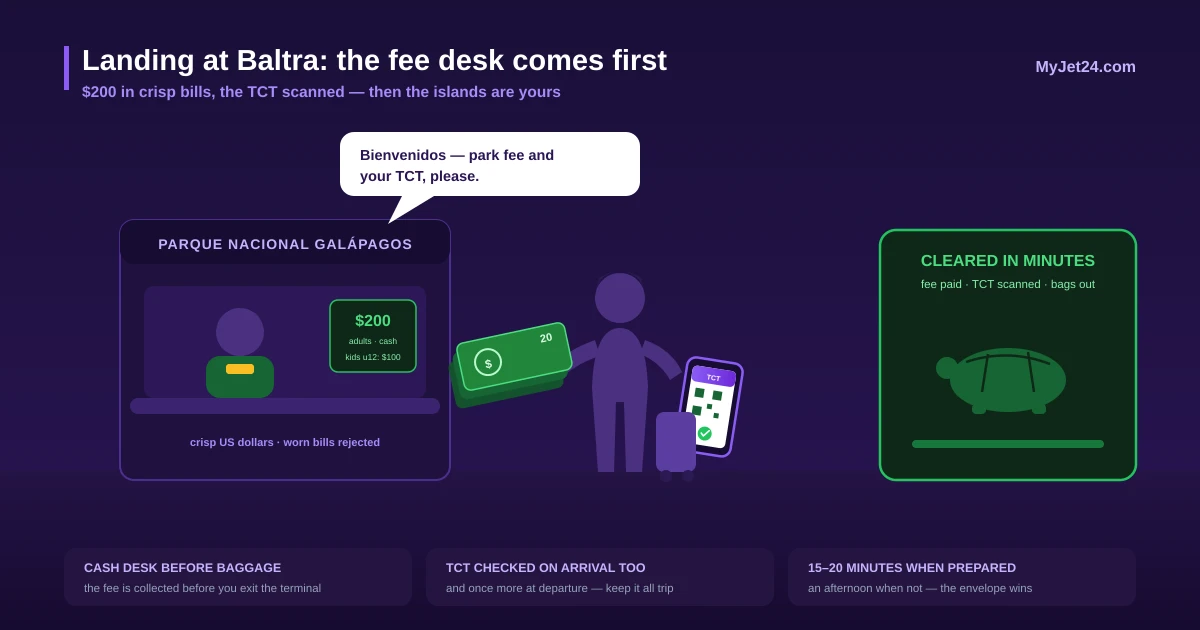
The fee is collected by park staff at a dedicated desk in the arrivals area of Baltra (GPS) or San Cristóbal (SCY), after you land and before you exit the terminal. The rules that actually catch people:
- Cash, in US dollars — Ecuador's currency. Card payment exists at some counters but is unreliable and may carry a surcharge; treat cash as mandatory;
- Crisp bills only. Park cashiers (like most of Ecuador) reject torn, taped, heavily worn or marked notes. Withdraw fresh bills on the mainland, not at the last minute;
- Per person, on the spot. A family of four (two adults, two kids over 2 and under 12) hands over $600 in cash before touching their luggage — budget it consciously.
The round-trip rule: why one-way tickets don't board
Most onward-ticket rules we cover are enforced with discretion — an airline agent may ask, an immigration officer might not. The Galápagos version is structural: the TCT registration itself requires your return flight, and without a completed TCT, the airline won't issue a boarding pass for the island leg. There is no "I'll figure it out there" — the system checks before you fly, on arrival, and when the card is closed at departure.
The logic is conservation math: the islands cap how long visitors stay (tourists get up to 60 days per year in the archipelago), and an open-ended traveler is an enforcement problem in a UNESCO World Heritage site with strict population rules. Practically, this means:
- Book the island flights as a round trip — Quito/Guayaquil → Baltra or San Cristóbal and back. Open-jaw within the islands (fly into GPS, out of SCY) is fine; missing the return leg entirely is not;
- Your international travel is a separate question. Ecuador itself expects visitors to show onward travel out of the country when asked — the classic check our global onward-ticket guide covers. If your South America plans are open-ended, a verifiable onward reservation for Ecuador with a live PNR — generated at MyJet24 with Premium for $7.90 in about 30 seconds — answers the mainland question, while your real round-trip island tickets satisfy the TCT;
- Keep both documents accessible — the island round trip for the TCT layers, the onward proof for Ecuador's border and your airline home. Continuing through South America? The same logic applies at the next border — our Peru onward-ticket guide covers the neighbor most Galápagos travelers visit next, and the proof of onward travel overview explains how airlines verify reservations everywhere.
The two free forms: biosafety declaration & FRA
Two more online forms complete the stack, and both are free — which is exactly why paid lookalike sites love them:
- The Galápagos biosafety declaration — a sworn statement, completed online within 48 hours of your island flight, that you're not carrying prohibited organic material: fresh fruit, seeds, plants, untreated wood, soil on your boots. It pairs with the physical SICGAL luggage inspection at the mainland airport, where your bags are scanned and sealed before the island flight. Declare honestly; the islands' entire ecosystem runs on this filter;
- Ecuador's FRA customs form — required for entering Ecuador itself since July 2025, filed online before you land in Quito or Guayaquil. It's the customs-declaration layer (goods, currency), the same pattern as South Africa's SARS declaration or the customs layer inside Indonesia's arrival card — free, quick, and easy to forget because it belongs to the mainland part of the trip.
Neither form costs anything, and both follow the rule we've verified across every arrival system this year: if a website charges for a free government form, it's a middleman — file on the official portals only.
The airport flow: Quito/Guayaquil → Baltra/San Cristóbal
- Before the trip: FRA form filed for Ecuador entry; TCT registered and paid online with round-trip flights attached; biosafety declaration submitted — all three on your phone and printed;
- Mainland airport (UIO/GYE), island flight day: first stop is the SICGAL biosecurity point — bags scanned and sealed. Then the airline counter, where the agent verifies your TCT before issuing the boarding pass;
- Arrival at Baltra or San Cristóbal: the park fee desk first — $200 cash per adult, crisp bills — then the TCT arrival check, then baggage. Total added time when prepared: 15–20 minutes. When not: the queue watches you count worn banknotes;
- Departure from the islands: the TCT is presented one last time and closed out — keep it safe for the whole trip, it's not a one-way document.
What it all costs: the honest total
For a foreign adult in 2026, the compliance bill is $220 flat: $20 TCT + $200 park fee (the FRA and biosafety forms are free). Add the realistic extras and the honest arrival budget looks like this: some inhabited islands charge small municipal docking fees (typically $5–$15, cash, e.g. when landing at Isabela by boat), and inter-island ferries run about $30–$35 per leg — cash again. The pattern is unmistakable: the Galápagos run on crisp US dollars, and the ATMs on the islands are few, fee-heavy and occasionally empty. Arrive with the cash layer solved.
Worth saying plainly: $220 per person sounds steep until you see where it goes — the park fee funds one of the most successful conservation programs on the planet, and the TCT is the mechanism that keeps visitor pressure inside sustainable limits. It's the rare travel fee where the value proposition swims past you with sea lions attached.
Six mistakes to avoid
- Planning around the old $100 fee. It doubled in August 2024 — every pre-2024 blog post, guidebook and forum thread quoting $100 is out of date. It's $200 cash for foreign adults.
- Assuming the TCT is still an airport-counter job. Since May 2025 it's an online registration with a 48-hour window — the counter queue you read about in older guides is exactly what the new system replaced.
- Booking one-way to the islands "to stay flexible." The TCT won't complete without return flights, and the airline won't board you without the TCT. Flexibility lives in changeable fares, not missing ones.
- Arriving with $200 in worn bills — or no cash at all. Park cashiers reject damaged notes and card payment is a gamble. Fresh bills from a mainland bank, split between two pockets.
- Forgetting the FRA form because it's "for Ecuador, not Galápagos." The mainland entry layer is part of the same trip — file it before landing in Quito or Guayaquil, or start your vacation in a customs line.
- Packing fresh fruit, seeds or muddy hiking boots. The biosafety declaration is sworn and the SICGAL scan is real. Clean gear, no organics, honest answers — the islands' rules exist for the wildlife you came to see.
Frequently asked questions
What is the Galápagos Transit Control Card (TCT)?
A mandatory $20 registration document issued by the Governing Council of the Galápagos Islands, required for every non-resident traveler flying to the archipelago. It records your entry, stay and departure, and is checked at mainland check-in, on arrival and when you leave.
How do I get the TCT in 2026?
Online, via the Galápagos Governing Council's official platform — the process moved off airport counters on 29 May 2025. Register within 48 hours of your island flight, attach your round-trip tickets, pay $20 online, and save the digital card to your phone plus a printed copy.
How much does the Galápagos park entrance fee cost?
US$200 in cash for foreign adults, US$100 for foreign children under 12, free under 2 — paid at the fee desk on arrival at Baltra or San Cristóbal. Andean Community and Mercosur nationals pay $100/$50. The fee doubled from $100 on 1 August 2024.
Can I pay the park fee by card?
Treat it as cash-only. Card terminals exist at some counters but fail often enough — and may add surcharges — that rangers and every serious operator advise crisp US dollar bills. Damaged, torn or marked notes are routinely rejected.
Do I need a round-trip ticket for the Galápagos?
Yes — structurally. The TCT registration requires your return flight off the islands, and airlines verify the completed TCT before boarding. One-way travel to the archipelago isn't a discretionary risk; the system simply doesn't process it.
Do children need their own TCT?
Yes — every traveler needs an individual $20 TCT regardless of age; parents register on behalf of children. Children's park fees are reduced ($100 under 12) and infants under 2 enter the park free, but the TCT applies to everyone.
What is the biosafety declaration?
A free sworn statement, filed online within 48 hours of your island flight, confirming you're not carrying prohibited organic material (fresh produce, seeds, plants, soil). It works alongside the SICGAL baggage inspection at the mainland airport, where bags are scanned and sealed before island flights.
What is Ecuador's FRA form and do Galápagos travelers need it?
The FRA is Ecuador's online customs declaration, required since July 2025 for travelers entering the country — so yes, you file it before landing in Quito or Guayaquil, before the Galápagos leg even begins. It's free and separate from both the TCT and the biosafety declaration.
How long can tourists stay in the Galápagos?
Up to 60 days per calendar year in the archipelago as a tourist — tracked precisely through the TCT's entry and exit records. Staying beyond your registered period triggers fines and enforcement by the Governing Council, not a friendly reminder.
Is the TCT the same as the INGALA card or TCC?
Yes — older guides use INGALA (the former institute's name) or TCC interchangeably. Today's official document is the Transit Control Card (TCT) issued by the Governing Council; the $20 fee and purpose are the same, only the online process is new.
Do cruise passengers need to arrange the TCT themselves?
Usually not — most cruise lines and many tour operators pre-register TCTs for their guests as part of the package. Confirm it in writing before traveling; if it's not included, the online self-registration takes minutes.
What happens if I lose my TCT on the islands?
Report to the Governing Council office on your island for a replacement before your departure flight — the card is presented and closed out when you leave. Keeping a photo of the card plus the printed copy in separate bags makes loss a non-event.
Do I also need proof of onward travel for Ecuador itself?
Ecuador expects visitors to be able to show onward travel out of the country when asked at entry — separate from the island round-trip inside your TCT. One-way South America travelers can satisfy the mainland check with a verifiable onward reservation carrying a live PNR, like MyJet24's Premium onward ticket ($7.90).
Are there extra fees on individual islands?
Some inhabited islands charge small municipal fees — most famously about $10–$15 in cash when arriving at Isabela by ferry — and inter-island speedboats run roughly $30–$35 per leg, cash. None replace the $200 park fee; they're local add-ons worth a few spare bills.
The bottom line
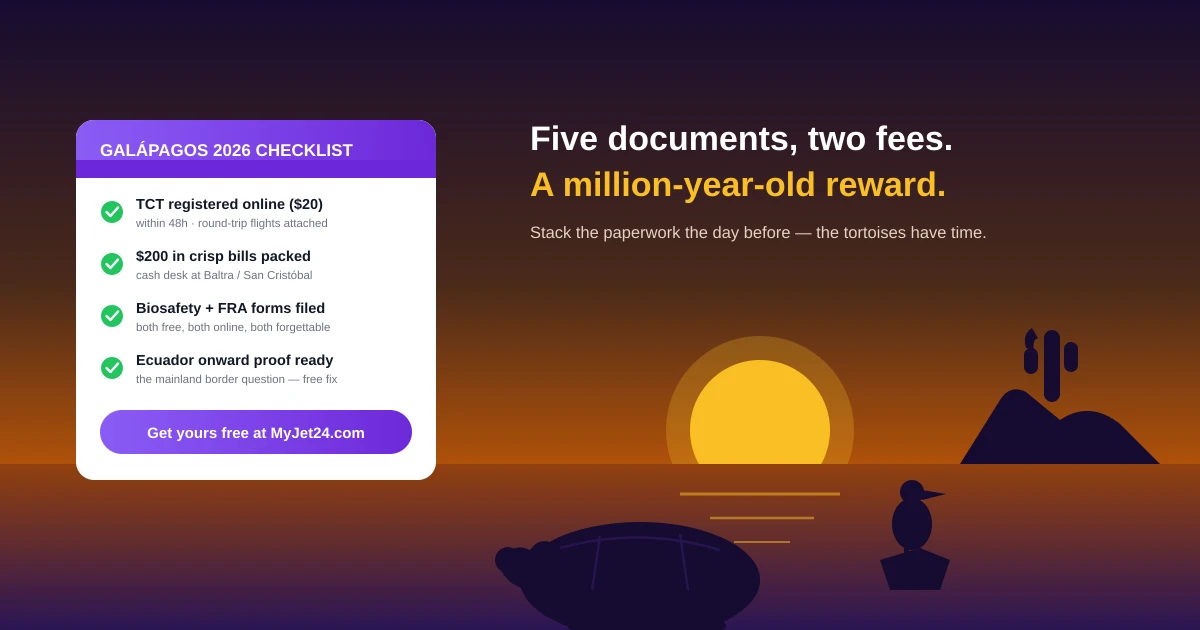
The Galápagos ask more paperwork of a domestic flight than most countries ask at their borders — and it's the best-justified bureaucracy in travel. The 2026 formula is fixed: five documents, two of them paid, $220 total, and everything except the cash handled online within 48 hours of your flight. Do the TCT and biosafety forms with your online check-in, file the FRA before you land in Ecuador, and put ten crisp twenties in an envelope the day you exchange money.
And split the ticket question correctly: the island round trip lives inside your TCT — non-negotiable, book it real — while Ecuador's own onward-travel expectation is the familiar check that a verifiable onward ticket from MyJet24 Premium ($7.90) answers in about 30 seconds. Stack the five, land at Baltra with the envelope ready, and spend your energy where it belongs: deciding whether the sea lions or the boobies get your last camera battery.
Sources
- Galakiwi — Galápagos TCT Guide: How to Get Your Transit Control Card: https://www.galakiwi.com/blog/galapagos-tct-guide/
- Original Ecuador — New Online TCT Registration for Galapagos Travel: https://www.originalecuador.com/blog/item/53-new-online-tct-registration-for-galapagos-travel-what-you-need-to-know-for-2025.html
- Choko Tours — Requirements for Traveling to Galapagos and Online TCT in 2026: https://www.choko.tours/requirements-galapagos/
- Happy Gringo — Galapagos Entry Fee: Your Ticket to the Galapagos Islands: https://happygringo.com/blog/galapagos-entry-fee/
- Galapagos Land Tours — Galapagos National Park Entrance Fee 2026: https://galapagoslandtours.com/galapagos-national-park-entrance-fee/
- Galapatours — What is INGALA fee? What is the TCC? What is the TCT?: https://www.galapatours.com/faq/what-is-ingala-fee-what-is-the-tcc-what-is-the-tct
This guide reflects the Galápagos entry rules, TCT process and fee schedule as published by the Governing Council, the Galápagos National Park and specialist operators as of 23 July 2026. Fees, registration windows and municipal charges can change — verify against the official Consejo de Gobierno and park channels before you travel. This article is informational and not legal advice.
