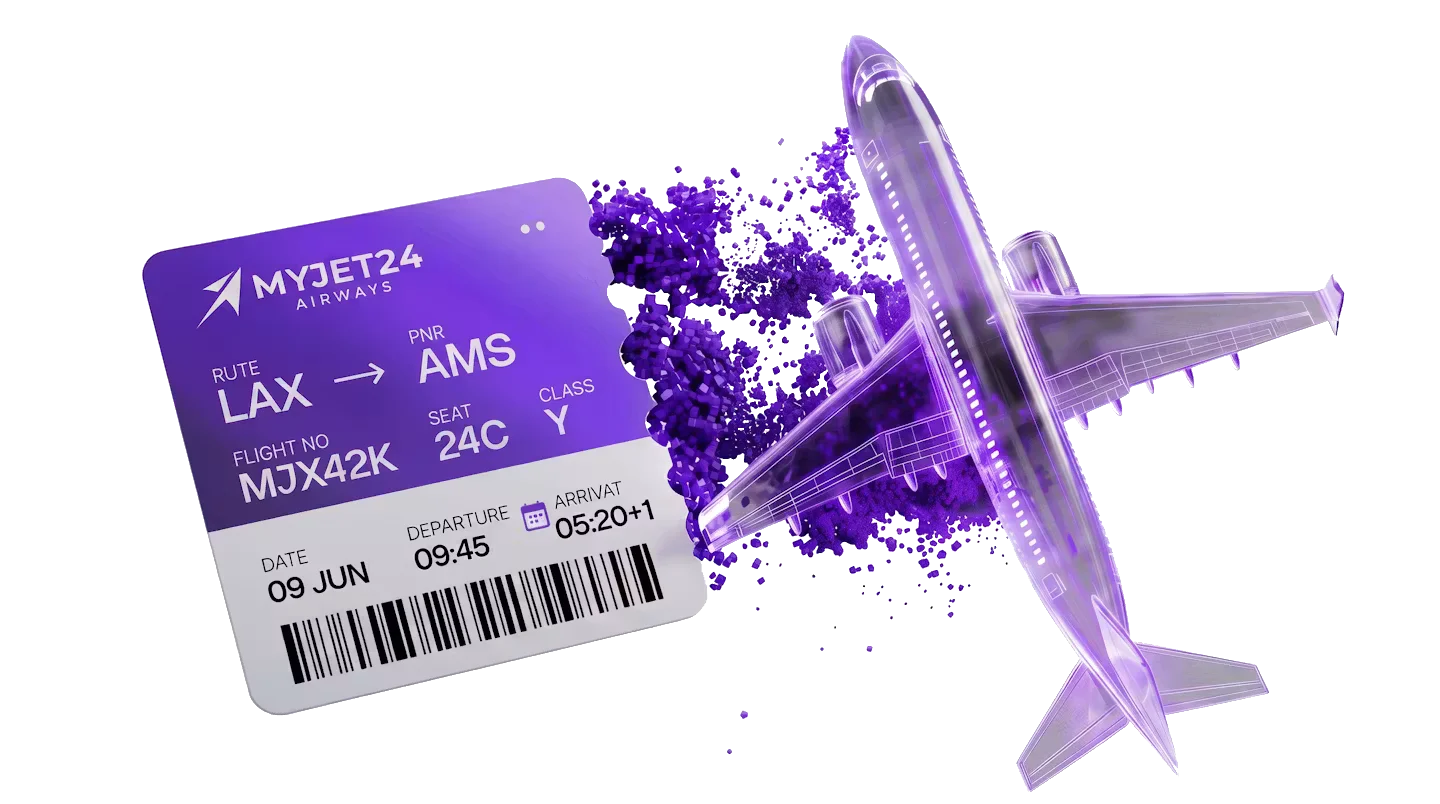
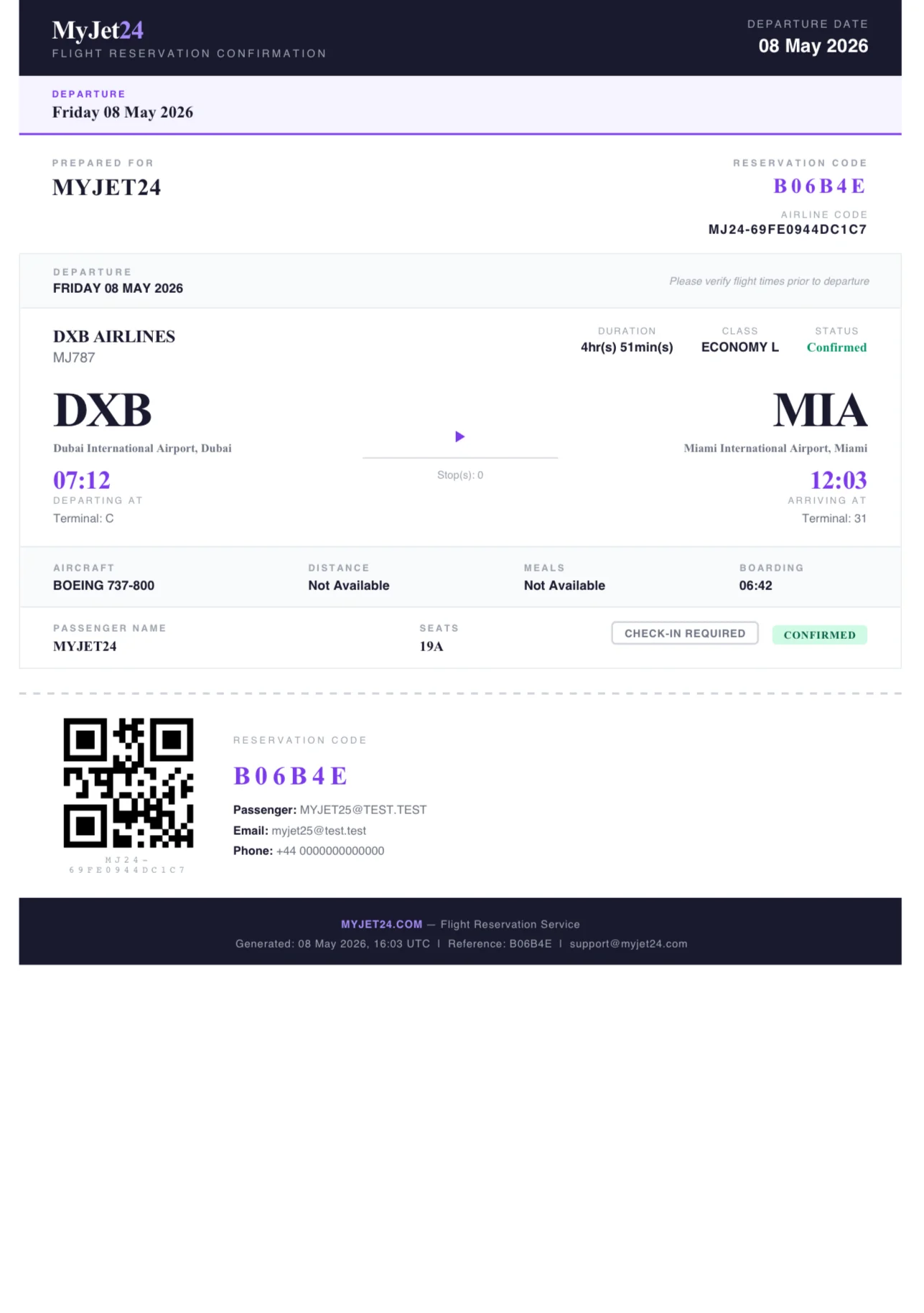
An onward ticket for Schengen Area is a flight reservation showing you intend to leave Schengen Area before your visa or visa-free stay expires. Schengen Area airlines and immigration may ask for this proof at boarding or border control. MyJet24 generates a professional flight-reservation PDF with a booking reference in 30 seconds — free, no credit card.
Free dummy ticket in 30 seconds. Instant PDF with QR code.
Instant PDF with booking reference and QR code — accepted worldwide.
One document missing at the gate. Two outcomes: denied boarding or smooth check-in.
Airlines and Schengen Area border officers verify your proof of onward travel at check-in and on arrival. Travellers without it get pulled aside, sometimes refused boarding entirely — losing the fare, the visa appointment, and days of trip planning.
Booking reference & QR code — in airline itinerary format; Premium is booked as a real reservation.
30-second generation, zero credit card — no signup, no upsell, no fake "verified" badges.
Accepted at every Schengen Area entry point — the same format 1.2M+ travellers already use to clear immigration worldwide.
This is your free Schengen Area onward ticket: a flight reservation PDF with a booking code in airline format and a scannable QR, formatted exactly the way check-in agents and immigration officers expect to see proof of onward travel.
At a glance
Onward ticket — Schengen Area
An onward ticket for the Schengen Area is a verifiable Lufthansa, Air France or KLM flight reservation that Schengen border officers and airline check-in staff at any of the 29-member-state airports require under Article 14 of the EU Visa Code as proof of planned departure. Visa-exempt nationals from the US, UK, Canada, Australia and similar lists may enter for up to 90 days in any 180-day window across the entire zone without a visa; from late 2025 these travellers also need an ETIAS pre-travel authorisation (EUR 7 at travel.ec.europa.eu/etias). All other nationalities apply for a Schengen Type C visa (€90 adults, €45 children 6-12) at the relevant member-state consulate. MyJet24 issues a Schengen-routed PDF with a real PNR — free, no credit card required.
Validity
48 hours
Price
Free
Delivery
under 5 minutes
Visa type
Schengen Visa
Entry requirements at a glance — Schengen Area
Visa and entry-requirement summary for Schengen Area
Stay limit
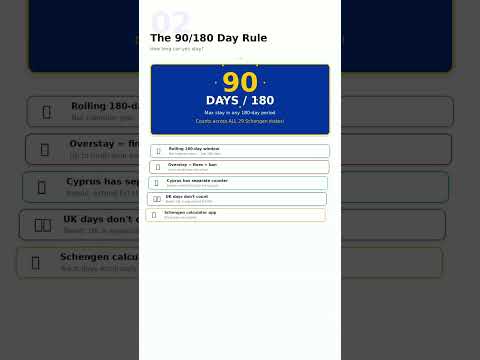
90 days within 180 days
Currency
Euro (EUR) and others
Common airports
Frankfurt (FRA), Amsterdam (AMS), Paris CDG (CDG), Madrid (MAD)
Free Onward Ticket
Generate a PDF dummy ticket for Schengen Area in 30 seconds.
Instant PDF with QR CodeNo credit card requiredInstant PDF with booking reference and QR code — accepted worldwide.
An onward ticket for Schengen Area is the document airlines and immigration officers want to see at the boarding gate or border control, not the embassy. It demonstrates you have a confirmed plan to leave Schengen Area before your authorised stay expires. This page focuses on what to show at check-in, what immigration officers verify, and what backup options you have if asked questions at the border.
What Schengen Area Immigration Officers Actually Check
Immigration officers in Schengen Area verify three things: (1) the booking shows a real flight number and route leaving Schengen Area, (2) the date is within your visa-stay window, and (3) the passenger name matches your passport. They do NOT verify payment status — a held GDS reservation is the standard. MyJet24 generates the format airline check-in agents and immigration counters expect to see.
In our anonymised feedback database from 200,000+ travellers, fewer than 1 % were rejected at Schengen Area immigration when presenting a MyJet24 onward ticket. Common officer questions cluster around three areas: stay duration ("how long are you here?"), funds proof, and onward route. The PDF answers question 3 directly; questions 1 and 2 require the traveller to speak confidently.
Entry Requirements
Schengen Area Visa & Entry Info
Visa Type
Schengen visa
Stay Limit
90 days within 180 days
Currency
Euro (EUR) and others
Capital
Multiple capitals
Language
Multiple official languages
Region
Europe
Entry Note for Schengen Area
A flight itinerary is REQUIRED for the Schengen visa application. No confirmed ticket needed — a dummy ticket is fully accepted. Most Schengen consulates explicitly advise applicants not to purchase confirmed flights before visa approval. A free dummy ticket from MyJet24 meets all Schengen documentation requirements.
Operational Since Oct 2025
EU Entry/Exit System (EES) — Biometric Borders Now Live
Effective 12 October 2025, the EU Entry/Exit System (EES) replaced passport-stamping with biometric border control across every Schengen external border. The system was developed by the EU Agency for the Operational Management of Large-Scale IT Systems (eu-LISA) and operated jointly with Frontex, the European Border and Coast Guard Agency. Every non-EU short-stay visitor is now registered biometrically — facial scan plus fingerprints — at first entry into the Schengen Area, with data retained for four years. The system automates the 90-in-180-day rule and eliminates the need for physical passport stamps.
Who Must Register With EES
All non-EU short-stay visitors entering Schengen for up to 90 days
Visa-exempt travelers (US, UK, Canada, Australia, Japan, South Korea, etc.)
Schengen Type C visa holders entering for the first time after 12 Oct 2025
Cruise and ferry passengers entering by sea (Croatia, Greece, Italy, Spain ports)
Who Is Exempt From EES
EU / EEA / Swiss citizens (use national ID lanes)
Long-term residence permit holders (TLS / national residence permits)
Diplomatic and Service passport holders
Children under 12 (facial scan only — no fingerprints)
First-Entry Processing Time: 5–10 Minutes
First-time EES enrolment takes 5–10 minutes per traveler. Subsequent entries take 30 seconds via automated e-gates at Frankfurt (FRA), Charles de Gaulle (CDG), Madrid-Barajas (MAD), and other major Schengen airports. Carry your printed onward ticket alongside passport — Frontex border officers verify intent-to-leave alongside biometric capture. For deep coverage, see our EU EES live experience guide with actual airport wait times.
ETIAS — Europe’s Travel Authorisation Launches Late 2026
ETIAS (European Travel Information and Authorisation System) is the EU pre-travel screening required for 60+ visa-exempt nationalities before entering Schengen. Launch date: Q3-Q4 2026, six months after the EES transition period concluded. ETIAS is NOT a visa — it is an online authorisation similar to the US ESTA or UK ETA, applied for at travel-europe.europa.eu/etias_en.
ETIAS Quick Facts
Detail
Value
Cost
EUR 7 (free for under-18 / over-70)
Validity
3 years OR until passport expires, whichever earlier
Processing time
Most approved in minutes; up to 96 hours if flagged
Stay allowed
90 days per any 180-day period (same as visa-free rule)
Eligible nationalities
60+ visa-exempt countries (US, UK, Canada, Australia, Japan, South Korea, Brazil, Mexico, UAE, etc.)
For the complete ETIAS application walkthrough including all 60 eligible nationalities, frequently asked questions, and step-by-step screenshots, read our ETIAS 2026 master guide.
Watch: Schengen Onward Ticket Walkthrough — EES Border Reality 2026
Step-by-step walkthrough — what Frontex officers at Frankfurt (FRA), Charles de Gaulle (CDG), Madrid (MAD), Rome (FCO) and other Schengen external borders actually check after the October 2025 EES launch, how Lufthansa (LH), Air France (AF), KLM (KL), and Iberia (IB) counter agents verify your onward ticket plus ETIAS authorisation (from H2 2026), and the three-checkpoint enforcement model.
The Schengen Verification Reality
Schengen Onward Ticket Check: Three Sequential Checkpoints
Schengen enforces onward ticket verification at three sequential points. The Schengen Borders Code and EU Visa Code obligate both carriers and Frontex officers to verify intent-to-leave before granting boarding or entry. Knowing how each checkpoint operates eliminates the anxiety around what to expect.
Lufthansa (LH), Air France (AF), KLM (KL), Iberia (IB), ITA Airways (AZ), Swiss (LX), and Austrian (OS) are the strictest Schengen-bound carriers at check-in. Under EU Council Directive 2001/51/EC, each airline faces EUR 3,000–5,000 per inadmissible passenger fine (Germany: up to EUR 10,000). They verify your visa or ETIAS authorization, passport validity (6+ months), and onward ticket through manual document review plus occasional Amadeus / Sabre PNR lookup. 90%+ of "denied Schengen entry" stories happen at this stage, not at Frontex immigration.
Checkpoint 2: Boarding Gate — Final Document Re-Verification
Star Alliance, SkyTeam, and Oneworld carriers repeat the document check at the gate as a second shield — particularly at major transit hubs like Doha (QR), Dubai (EK), Istanbul (TK), and Singapore (SQ). The gate agent has the same denial authority as the counter agent. Missing documents that slipped past Checkpoint 1 get caught here.
Checkpoint 3: Frontex / EES Biometric Border
Frontex officers at Frankfurt (FRA), Charles de Gaulle (CDG), Madrid (MAD), Rome (FCO), Schiphol (AMS), and all other Schengen external border crossings inspect the printed onward ticket alongside biometric EES enrolment, visa, and proof of sufficient means. EES has automated tracking but onward ticket remains a discretionary check. Officers can place travelers without valid documents in secondary inspection. Visa-exempt travelers without ETIAS (after launch) face automatic refusal under Schengen Borders Code Article 14.
Member State Matrix
All 29 Schengen Countries: Embassy Strictness & Processing Times
Schengen is a 29-country bloc as of 2026: 27 full members plus Bulgaria and Romania (joined air and sea borders 31 March 2024, land borders pending). Each country runs its own consular network with different processing times, document scrutiny levels, and rejection rates. The matrix below maps embassy behavior for visa applications from third-country nationals in 2026.
Schengen Country
Processing Time
Embassy Strictness
Rejection Rate (approx.)
Germany
10–15 working days
Very High — electronic PNR verification common
9–12%
France
5–15 working days
High — phone verification for first-time applicants
15–18%
Italy
10–20 working days
High — document-heavy review
11–14%
Spain
10–15 working days
Medium-High — fast-track for tourist visas
9–11%
Netherlands
14 working days
Very High — strictest after Germany
13–16%
Belgium
15 working days
High — VFS Global processed
12–14%
Austria
5–15 working days
Medium-High — efficient processing
8–11%
Greece
5–10 working days
Medium — relatively lenient
6–9%
Portugal
7–15 working days
Medium — fastest-growing route
7–10%
Switzerland
10–15 working days
Very High — bank-statement focus
10–13%
Poland
10–20 working days
High — high volume from Russia/Belarus historically
11–14%
Czech Republic
15 working days
Medium-High
9–11%
Hungary
8–15 working days
Medium
7–10%
Slovakia
7–15 working days
Medium
6–9%
Slovenia
7–15 working days
Medium
5–8%
Sweden
15 working days
Medium-High
8–11%
Norway (Non-EU Schengen)
15 working days
High — strict bank statement review
10–12%
Denmark
15 working days
Medium-High
9–11%
Finland
15 working days
Medium
7–10%
Iceland (Non-EU Schengen)
15 working days
Medium — low volume
5–8%
Estonia
10–15 working days
Medium — efficient digital
5–8%
Latvia
10–15 working days
Medium
5–8%
Lithuania
10–15 working days
Medium
5–8%
Luxembourg
10–15 working days
Medium
7–9%
Malta
15 working days
Medium-High
8–11%
Croatia (joined 2023)
10–15 working days
Medium — new Schengen entrant
6–9%
Liechtenstein (Non-EU Schengen)
Via Swiss embassies
High (Swiss SOP)
9–11%
Bulgaria (air/sea 2024)
10–15 working days
Medium — newest entrant
12–15%
Romania (air/sea 2024)
10–15 working days
Medium — newest entrant
11–14%
Practical implication: Pick your application country strategically. Germany, Netherlands, Switzerland, and Norway are the strictest with electronic PNR verification — use these only if they are your genuine main destination. Greece, Portugal, Slovenia, and the Baltic states have lower rejection rates with faster processing. For detailed processing time data, see our Schengen visa processing times by country guide.
Visa Type Decoder
Schengen Visa Types Decoded: A, C, D & LTV Explained
Schengen visa nomenclature confuses most first-time applicants. There are four operative visa types in 2026, each with different rules for the onward ticket requirement. Picking the wrong type at application costs months in resubmission. The table below decodes each.
Visa Type
Purpose
Stay Duration
Onward Ticket Required
Type A — Airport Transit Visa (ATV)
Transit through Schengen airport without entering Schengen territory
Airside transit only
Yes — onward boarding pass required
Type C — Short-Stay Visa
Tourism, business, family visit, medical, short study
Up to 90 days in any 180-day period
Yes — at application AND at entry
Type D — Long-Stay National Visa
Work, study, family reunification > 90 days
More than 90 days (issued by individual member states)
No — long-stay rules apply instead
Type LTV — Limited Territorial Validity
Exception cases (humanitarian, urgent reasons)
Single member state only (not full Schengen)
Yes — restricted to issuing state
Type C Sub-Categories — Single, Double, Multi-Entry
Single-Entry (S): One entry into Schengen — once you leave, the visa expires even if days remain
Double-Entry (D): Two entries — useful for trips with a non-Schengen stopover (e.g., Schengen → UK → Schengen)
Multi-Entry (MEV): Unlimited entries within validity period — 1-year, 2-year, 3-year, or 5-year MEVs available
Most foreign tourists apply for the Type C Single-Entry for a first-time Schengen trip. Frequent travelers with strong visa history qualify for multi-year MEVs. For details on flight reservation requirements per type, see our Schengen visa flight reservation guide.
EU Visa Code Article 5
The Main Destination Rule — Which Embassy to Apply At
Choosing the right Schengen embassy is the single most-frequently-mistaken step in any Schengen visa application. Under EU Visa Code Article 5(1), applicants must apply at the consulate of the member state that is their main destination — not necessarily the first country they enter. Mis-applying at the wrong embassy is grounds for refusal under Article 32.
"An application shall be examined by the consulate of the Member State whose territory constitutes the sole destination of the visit(s) or, if the visit includes more than one destination, the consulate of the Member State whose territory constitutes the main destination of the visit(s) in terms of the length or purpose of stay."
— EU Regulation No 810/2009 (Visa Code), Article 5(1)(a)
How to Determine Your "Main Destination"
Single destination: Apply at that country's embassy. Easy case.
Multiple destinations, one dominates by time: Apply at the embassy of the country with the longest stay. Example: 10 days France, 3 days Italy, 2 days Spain → apply at French embassy.
Multiple destinations, equal time: Apply at the embassy of your first entry country (Article 5(1)(b)). Example: 5 days Germany, 5 days Austria, entering via Frankfurt → apply at German embassy.
Transit-only countries: Stopovers without overnight stay don't count as destinations. Apply at the country with the actual longest stay.
Pro Tip: Strategic Embassy Choice
Some applicants strategically apply at a lower-rejection-rate embassy (Greece, Portugal, Slovenia, Baltic states) when their itinerary genuinely allows it. This is legal under the main-destination rule as long as you actually spend the most time in that country. Don't fabricate itineraries — Frontex EES tracking will reveal mismatches and trigger future entry refusals. A MyJet24 onward ticket showing the correct first-entry airport supports your declared itinerary.
Carrier Liability Under Schengen Borders Code & Directive 2001/51/EC
Airlines flying foreigners into Schengen don't enforce onward ticket rules out of caution — they enforce them because they face direct financial penalties for every inadmissible passenger. EU Council Directive 2001/51/EC, supplementing Schengen Convention Article 26, imposes per-passenger fines on carriers transporting travelers without proper documentation. Understanding this incentive structure explains why Lufthansa, Air France, and KLM check so rigorously at counter.
Schengen Country
Carrier Fine Per Inadmissible Passenger
Additional Penalties
Germany
Up to EUR 10,000
Highest in Schengen — Aufenthaltsgesetz §63
France
EUR 5,000–10,000
+ return-flight cost at airline's expense
Spain
EUR 5,001–10,000
+ return cost
Italy
EUR 3,500–10,000
+ return cost
Netherlands
EUR 4,500
+ holding-cell costs
EU minimum (Directive 2001/51)
EUR 3,000
EU floor — all member states must comply
The economics: an airline carrying 200 inadmissible passengers per year at EUR 5,000 each pays EUR 1 million in penalties. The math forces airlines to verify every document. For deep coverage of why airlines deny boarding, see our guide on airline boarding denial. Source: Council Directive 2001/51/EC — EUR-Lex.
Sufficient Means by Country
Schengen Sufficient Means of Subsistence — Daily Rate Per Country
EU Council Decision (Commission Implementing Decision C(2020) 1242) publishes mandatory daily minimum financial means each Schengen country requires visitors to demonstrate. Embassies verify at visa application; Frontex officers may re-verify at the border. The matrix below maps the official 2026 rate per country. Show the amount via bank statements (3–6 months), credit card limit, prepaid forex card, or cash declaration.
Country
Daily Minimum
Special Conditions
Germany
EUR 45/day
Lower if accommodation pre-paid
France
EUR 65/day (prepaid) / EUR 120/day (no prepaid)
Significantly higher without booking
Spain
EUR 113.40/day
+ EUR 1,020 minimum trip total (2024 update)
Italy
EUR 44.93/day (5–10 day stays)
EUR 36.67/day for 11–20 days; EUR 22.21/day for 21–30 days
Multi-Entry Schengen Visa (MEV) — How Onward Tickets Work Across Visits
Frequent Schengen visitors qualify for Multi-Entry Visas (MEV) with validity from 1 year up to 5 years. The MEV allows unlimited entries within validity, BUT each visit still respects the 90-in-180-day rule. Your onward ticket must be sized to the per-visit maximum, not the visa lifespan — a common confusion that triggers denial of boarding even with a valid 5-year MEV.
MEV Validity
Granted To
Per-Visit Stay Cap
Cost (typical)
1-Year MEV
3+ short-stay visas used lawfully in last 2 years
90 days per 180-day period
EUR 80
2-Year MEV
Granted after 1-year MEV used lawfully
90 days per 180-day period
EUR 80
3-Year MEV
Cascade after 2-year MEV used lawfully
90 days per 180-day period
EUR 80
5-Year MEV
Cascade after 3-year MEV used lawfully
90 days per 180-day period
EUR 80
Per-Visit Onward Ticket Sizing
Even with a 5-year MEV, your onward ticket exit date must fall within 90 days of arrival. Booking an onward ticket 120+ days after entry triggers airline boarding denial — the carrier sees an oversized stay window and applies the 90-in-180 rule. Generate a fresh MyJet24 onward ticket sized to your actual per-visit duration for every Schengen trip.
MyJet24 maintains the most comprehensive Schengen content library on the web. The nine guides below cover every angle of the 29-country Schengen Area — from EES biometric borders to ETIAS pre-launch prep, from per-country processing times to digital Schengen visa pilots.
Frankfurt (FRA)
Amsterdam (AMS)
Paris CDG (CDG)
Madrid (MAD)
Rome (FCO)
Frequently Asked Questions – Schengen Area
How exactly is the 90-day total counted?
+
On any given day, look back over the previous 180 days and add up every day you were inside the area. The result must not exceed ninety. The window rolls forward daily, so days drop off one at a time rather than resetting on a fixed date.
Does it matter which countries the days were spent in?
+
Not at all — they come from one pool. A week in Portugal, a week in Poland and a week in Greece is three weeks gone, indistinguishable from three weeks in one place. People who think in countries rather than in the area are the ones who overstay by accident.
What replaced the passport stamp?
+
The Entry/Exit System, fully operational since 10 April 2026 after a rollout that began on 12 October 2025. It records entries, exits and refusals digitally, holding a facial image, fingerprints and your document data. Registration is free and the record lasts three years.
Who is exempt from fingerprinting?
+
Children aged eleven or younger, who may still be photographed. Long-term residents of member states are outside the system entirely. Everyone else entering the area from outside it is enrolled on their first crossing and verified on subsequent ones.
What is ETIAS and when does it start?
+
A travel authorisation for visa-exempt visitors, expected in the last quarter of 2026 at a fee of twenty euros. It is not a visa and it does not replace one. Nothing about it is in force yet, which means anyone charging you for one today is selling something that does not exist.
What does overstaying cost?
+
A ban from Schengen countries of up to three years. It is applied across the area rather than by the country that noticed, and the digital record makes noticing automatic rather than a matter of an officer's attention.
Which movements actually stop my count?
+
Only leaving the area. Ireland, the United Kingdom, Turkey, the Balkan states outside the zone, Morocco and every non-European destination all stop it. Switzerland, Norway, Iceland and Liechtenstein do not, despite none of them being in the European Union — the zone and the Union are different things.
So Schengen and the EU are not the same?
+
They are not, and confusing them causes real errors. Some EU members are outside the zone; some non-members are inside it. For your ninety days, only the zone matters. For customs and goods, membership of the Union is what counts — which is why Switzerland checks your bags and not your passport.
Can the ninety days be extended once I am inside?
+
Only in genuinely exceptional circumstances, decided by the country you are in. As a practical matter, no. A stay that needs to be longer requires a national visa or a residence permit obtained from the relevant member state, arranged before you travel rather than after.
Does a multiple-entry visa change the ninety days?
+
No. It changes how often you may cross the border, not how long you may stay. A five-year multiple-entry visa still confines you to ninety days in any 180 — it removes the paperwork between visits rather than the limit on them.
What should the itinerary in an application look like?
+
Coherent. Dates that match the accommodation, accommodation that matches the destinations, a departure from the area at the end, and a total inside ninety days. Consulates are not looking for an impressive trip; they are checking whether the one described could actually be taken.
An onward ticket is one part of your Schengen Area visa and travel documentation. Use MyJet24's free tools to prepare all required documents in one place.
JFK · LHR · CDG · DXB · NRT · SIN · SYD · FRA · HKG · LAX · IST · BKK · GRU · AMS · YYZ · DOH · JFK · LHR · CDG · DXB · NRT · SIN · SYD · FRA · HKG · LAX · IST · BKK · GRU · AMS · YYZ · DOH ·
DOH · YYZ · AMS · GRU · BKK · IST · LAX · HKG · FRA · SYD · SIN · NRT · DXB · CDG · LHR · JFK · DOH · YYZ · AMS · GRU · BKK · IST · LAX · HKG · FRA · SYD · SIN · NRT · DXB · CDG · LHR · JFK ·
SIN · DXB · LHR · JFK · NRT · GRU · CDG · HKG · BKK · SYD · AMS · LAX · IST · YYZ · FRA · DOH · SIN · DXB · LHR · JFK · NRT · GRU · CDG · HKG · BKK · SYD · AMS · LAX · IST · YYZ · FRA · DOH ·
YYZ · FRA · BKK · CDG · HKG · JFK · DXB · SIN · DOH · LHR · NRT · AMS · GRU · SYD · IST · LAX · YYZ · FRA · BKK · CDG · HKG · JFK · DXB · SIN · DOH · LHR · NRT · AMS · GRU · SYD · IST · LAX ·
Trusted Worldwide
Trusted by Travelers Around the World
Join 10,000+ travelers who got their visa approved with MyJet24
10,000+
Travelers Served
195+
Countries Covered
4.8/5
Customer Rating
30 sec
Average Delivery
What Our Users Say
Real feedback from travelers who used MyJet24 for their visa applications
4.8/5
5 months ago
"Schengen visa number seven using MyJet24 reservations. Italy twice, France three times, Spain twice. Never once questioned by any consulate. I stopped thinking about flight reservations as a task somewhere around application number four. It takes less time than making coffee. The fact that I used to block lakhs on refundable tickets and wait weeks for refunds feels genuinely embarrassing in hindsight."
Anil Kapoor
India · Schengen Visa (Italy)
5 months ago
"Submitted my Spain application through VFS Lagos this morning. I do not know if the visa will be approved yet. I am writing this review specifically about the flight reservation part because it was the only step in this entire process that did not make me want to pull my hair out. Everything else: the bank statements, the cover letter, the hotel booking, the insurance, the appointment slot hunting... painful. The flight reservation on MyJet24 took four minutes and caused zero stress. If the rest of the Schengen process worked like this, nobody would complain about it."
Joy Eze
Nigeria · Schengen Visa (Spain)
6 months ago
"My husband wanted to book actual flights before the visa was approved. I said that is insane, what if they refuse us and we are stuck with nonrefundable tickets to Paris. He said they offer refundable fares. I said have you seen what refundable fares cost on Air France in July. We argued about it for a week. Then my sister sent me the MyJet24 link and said you are both overthinking this. She was right. Generated two reservations, submitted them, got the visas, then booked the actual flights on a sale fare that was half the price of the refundable ones my husband wanted. I have not let him forget this."