
TL;DR
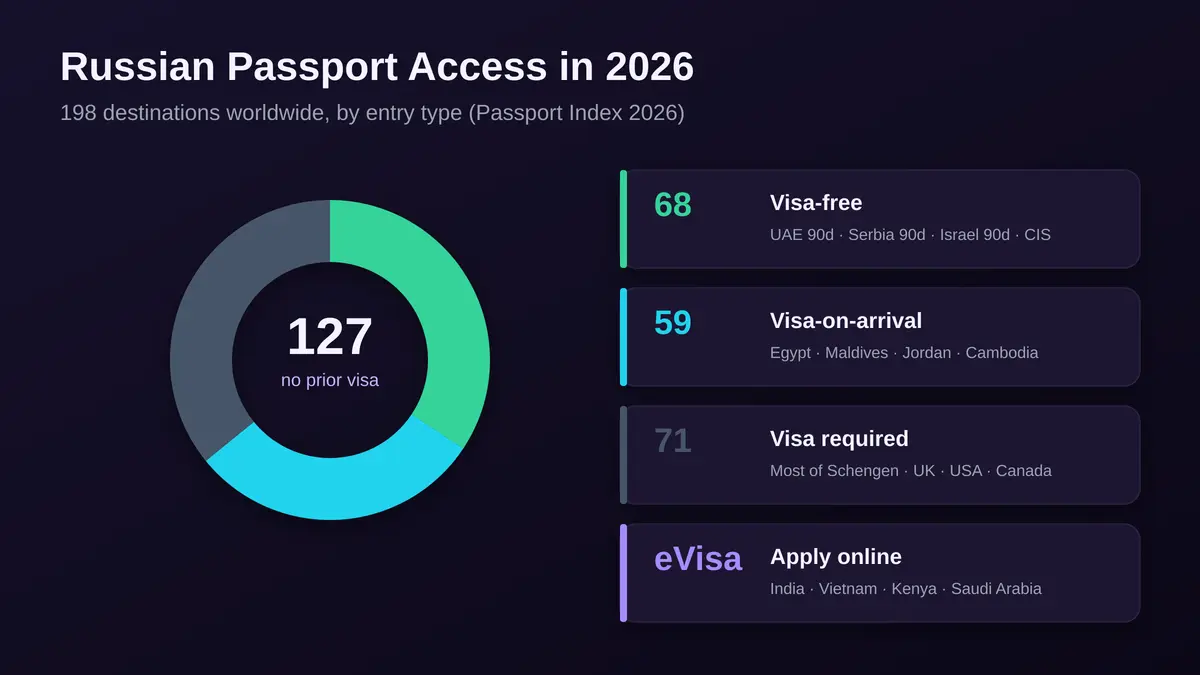
- In 2026 a Russian passport reaches about 127 destinations without a prior visa — roughly 68 visa-free and 59 visa-on-arrival (Passport Index 2026).
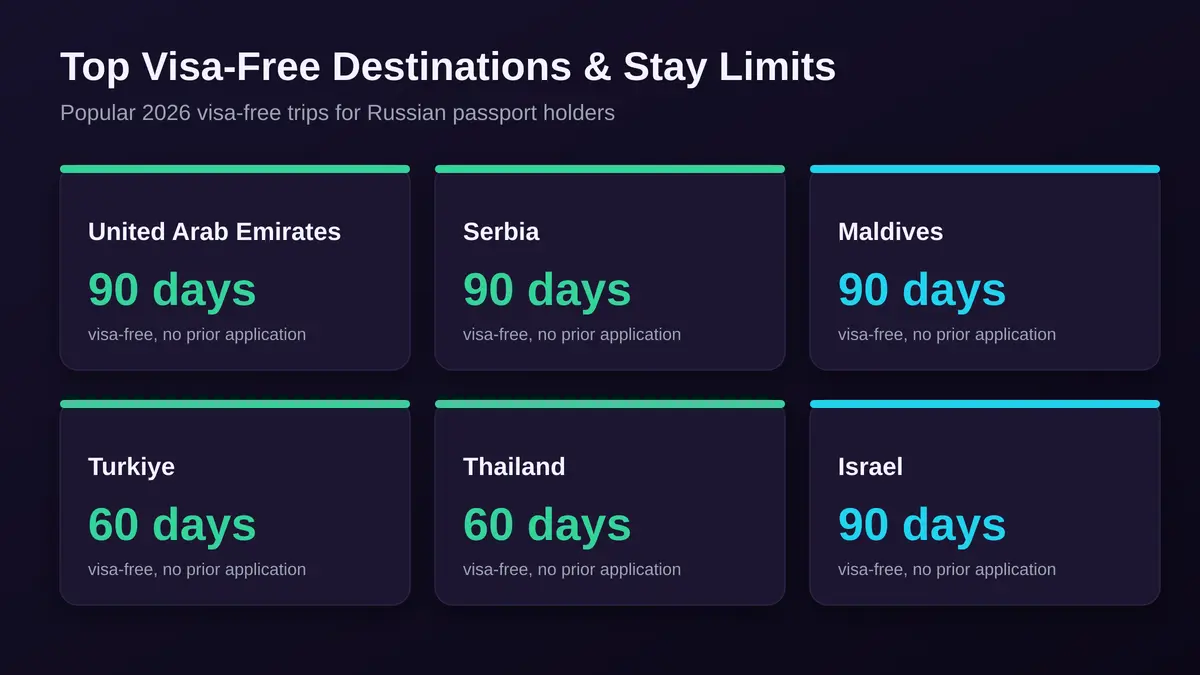
- Top visa-free trips: UAE 90 days, Serbia 90, Israel 90, Maldives 90, Turkiye 60, Thailand 60.
- Schengen, UK, USA, Canada and Australia still require a visa applied for in advance.
- Visa-free is not requirement-free: most countries and airlines still want proof of onward / return travel, funds and accommodation.
- India, Vietnam, Kenya, Sri Lanka and Saudi Arabia are reached with a quick eVisa applied for online.
Russian citizens can travel to around 127 countries and territories in 2026 without arranging a visa in advance — about 68 are visa-free on arrival and another 59 grant a visa on arrival at the airport or border. That is roughly 64% of the world. The catch most travellers miss: visa-free entry still comes with conditions, and the one that strands people at the gate is proof of onward or return travel.
Quick answer
A Russian passport holder can enter ~68 countries visa-free and ~59 more with a visa on arrival in 2026 (~127 total). Popular visa-free options include the UAE (90 days), Turkiye (60), Thailand (60), Serbia (90), Maldives (90) and Israel (90). Europe’s Schengen Area, the UK and the USA still require a visa in advance, and almost every destination expects a confirmed onward ticket.
How many countries can Russian citizens visit visa-free in 2026?
According to the Passport Index 2026 dataset, the Russian Federation passport carries access to roughly 127 destinations without a prior visa, split between fully visa-free entry and visa-on-arrival. The full picture across 198 destinations looks like this:
| Entry type | Count | What it means |
|---|---|---|
| Visa-free | ~68 | Just arrive and you are admitted |
| Visa on arrival | ~59 | Apply & pay at the airport/border |
| eVisa (apply online) | several | Approved online before you fly |
| Visa required (in advance) | ~71 | Embassy/consulate application |
Numbers shift as bilateral agreements change, so treat this as the 2026 baseline and confirm the rule for your exact destination before booking.
Visa-free countries by region
Russian passport holders enjoy genuinely broad visa-free access outside the Western blocs. The strongest regions are the post-Soviet space, the Balkans, Latin America and parts of the Middle East and Asia.
- CIS & post-Soviet: Armenia, Azerbaijan, Belarus, Kazakhstan, Kyrgyzstan, Tajikistan, Uzbekistan, Moldova.
- Balkans & Europe: Serbia (90 days), Bosnia & Herzegovina, Montenegro, North Macedonia.
- Middle East: United Arab Emirates (90), Turkiye (60), Israel (90), Qatar (visa-free/VOA).
- Latin America: Argentina, Brazil, Chile, Peru, Colombia, Ecuador (typically 90 days).
- Asia & islands: Thailand (60), Maldives (90), Sri Lanka (eTA), plus VOA across Southeast Asia.
- Africa: Tunisia, Morocco (check current rule), Seychelles, Mauritius.
Visa-on-arrival countries
A visa on arrival (VOA) is issued when you land — you fill a short form, pay a fee (usually in cash) and show a passport photo plus an onward ticket. Around 59 destinations offer this to Russian travellers, including:
- Egypt — VOA on arrival, popular for Red Sea resorts.
- Maldives — free 30-day stamp for all nationalities (Russians enjoy a longer bilateral allowance).
- Jordan, Cambodia, Laos, Nepal — straightforward VOA with fee and photo.
- Several island and African nations issuing on arrival.
"A visa on arrival is only granted once you have already flown in — which is exactly why airlines insist on seeing your onward ticket before they let you board."
eVisa countries: apply online before you fly
Some of the most-searched destinations are neither visa-free nor VOA, but use a fast online eVisa. For Russian citizens the key ones in 2026 are:
- India — e-Tourist visa applied for on the official portal.
- Vietnam — 90-day e-Visa, single or multiple entry (see our Vietnam e-Visa guide).
- Kenya — electronic travel authorisation.
- Sri Lanka — ETA, free for many nationalities.
- Saudi Arabia — tourist eVisa for eligible travellers.
Always apply on the official government domain and keep the printed approval — agencies charge a markup for the same government document and cannot approve it faster.
Top visa-free destinations & stay limits
| Destination | Stay | Type | Onward ticket? |
|---|---|---|---|
| United Arab Emirates | 90 days | Visa-free | Usually yes |
| Serbia | 90 days | Visa-free | Recommended |
| Maldives | 90 days | Visa-free / VOA | Yes |
| Turkiye | 60 days / 180 | Visa-free | Recommended |
| Thailand | 60 days | Visa-free | Yes (+ TDAC) |
| Israel | 90 days | Visa-free | Recommended |
Thailand keeps its 60-day visa-free entry for Russians in 2026 even after trimming it for other nationalities, but you must complete the Thailand Digital Arrival Card and show onward travel.
Visa-free does not mean requirement-free
This is the single most important section. A visa-free stamp removes the embassy paperwork — it does not remove the conditions of entry. Airlines are legally liable for carrying improperly documented passengers, so they verify the basics before boarding, and immigration can ask again on arrival.
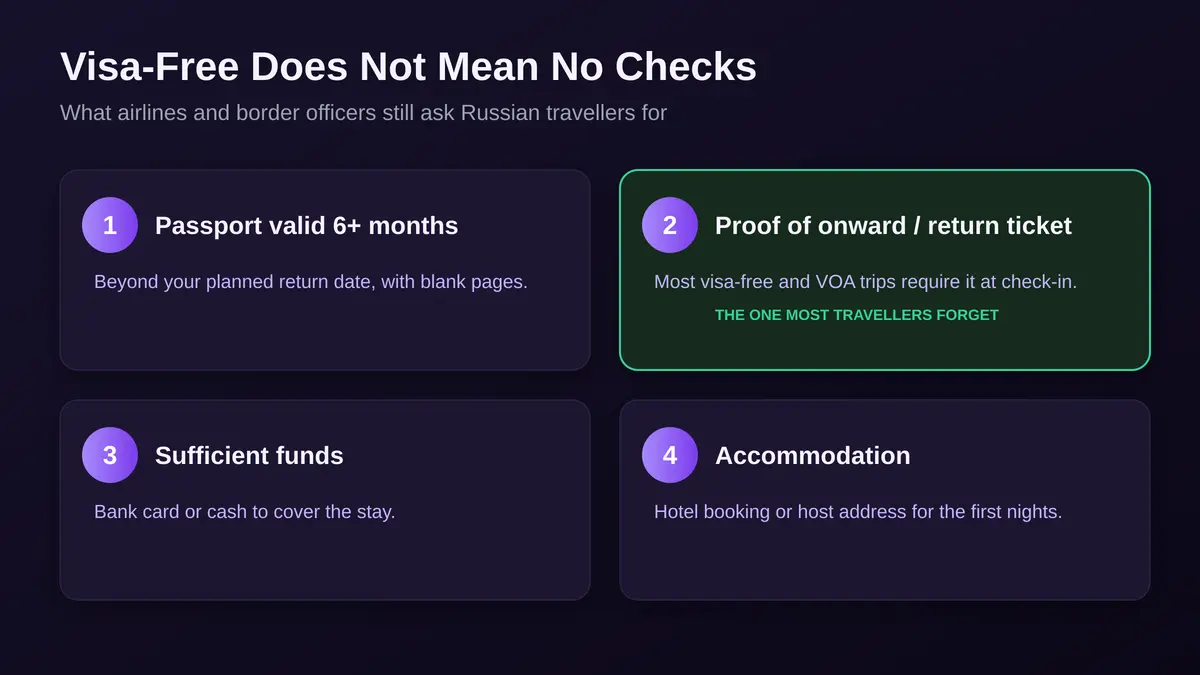
The requirement that strands the most travellers is proof of onward or return travel. You can be turned away at check-in for a country you are legally allowed to enter, simply because you cannot show how you will leave. Our pillar guide on which countries require proof of onward travel and the explainer on whether airlines can deny boarding cover this in depth. If you have not yet booked a return leg — common for open-ended or one-way trips — a confirmed onward reservation solves it without locking in a fare; you can generate one with our onward-ticket itinerary generator.
Countries that still require a visa in advance
About 71 destinations still require Russian citizens to obtain a visa before travel. The headline ones are:
- The Schengen Area — all 29 members; a Type C visa, and the process is stricter since 2022.
- United Kingdom & Ireland.
- United States (B1/B2) and Canada.
- Australia & New Zealand.
- Japan and several others require an advance visa or eVisa.
For these you apply at the consulate (often via VFS Global, BLS or TLScontact), and proof of onward travel and accommodation is part of the file rather than just an airline check.
How to travel visa-free without problems: step by step
- Confirm the current rule for your exact destination — visa-free, VOA or eVisa — and the allowed days.
- Check passport validity — at least six months beyond your return date, with blank pages.
- Book a confirmed onward / return ticket covering your departure within the allowed stay.
- Arrange accommodation for at least the first nights and keep the confirmation handy.
- Have proof of funds — a bank card or cash appropriate to the trip length.
- Complete any arrival card (e.g. Thailand TDAC, Malaysia MDAC) before or on arrival.
- Keep everything reachable offline — printouts or screenshots for check-in and immigration.
"Treat ‘visa-free’ as ‘no embassy queue’ — not as ‘turn up with only a passport’. The onward ticket is what gets you on the plane."
Common mistakes Russian travellers make
- Assuming visa-free = no checks and arriving without an onward ticket.
- Letting the passport drop under six months validity before the trip.
- Confusing VOA with visa-free — VOA still needs a fee, photo and onward proof.
- Overstaying the day limit (e.g. Turkiye’s 60-in-180 rule), which harms future entries.
- Booking a non-refundable return just to satisfy the rule, instead of a confirmed reservation.
How long can you stay? Reading the day limits
A visa-free allowance is not unlimited time — each country sets its own clock, and overstaying even by a day can lead to fines, deportation and bans that follow you into future trips. There are two patterns to understand. The first is a simple per-entry limit: the UAE gives Russians 90 days per visit, Serbia 90 days, the Maldives up to 90 under the bilateral arrangement, and Thailand 60 days that can be extended once locally by 30. The second is a rolling window, used most famously by Turkiye, which allows 60 days within any 180-day period. Under a rolling rule the system looks back 180 days from the day you are standing at the border and adds up how long you have already been in the country; if that total has hit the cap, you are refused even if you flew straight in. Russian travellers who hop in and out of Turkiye or the Balkans for property, business or long winters need to track these totals carefully, because the count is now largely automated at modern borders. When in doubt, plan your trip so your departure is comfortably inside the allowance rather than on the final permitted day, and always hold a dated onward ticket that proves it.
Visa-on-arrival: what to bring and what it costs
A visa on arrival feels effortless, but it is the category where unprepared travellers get caught out, because everything happens at the counter after a long flight. In practice you should arrive with a passport valid at least six months, one or two passport-size photos, the fee in cash in US dollars or the local currency (card machines are unreliable at land borders), a completed arrival form, and crucially a confirmed onward or return ticket plus an address for your first nights. Egypt, Jordan, Cambodia, Laos, Nepal and the Maldives are among the smoothest VOA experiences for Russian passport holders, while some African and island nations want the onward ticket shown twice — once by the airline at departure and again by immigration on arrival. The fee varies widely, from free (the Maldives 30-day stamp) to roughly 25 to 50 US dollars for many Asian destinations, so check the current amount and carry small notes. Because a VOA is only issued after you land, the airline cannot rely on a visa to admit you and will instead scrutinise your passport validity and onward ticket before boarding — which is why so many VOA-bound travellers are stopped at check-in rather than at the destination.
A closer look at the strongest regions
The Russian passport is at its most powerful well away from the Western blocs, and four regions carry the bulk of the visa-free value.
- The post-Soviet space remains the easiest: Armenia, Azerbaijan, Belarus, Kazakhstan, Kyrgyzstan, Tajikistan, Uzbekistan and Moldova generally admit Russians visa-free, many on an internal passport or for long stays, making them the default for work, family and relocation.
- The Balkans are the main European gateway. Serbia is the standout with 90 visa-free days and direct flights, while Bosnia & Herzegovina, Montenegro and North Macedonia add further visa-free options, several of them seasonal or capped at 30 days.
- Latin America is unexpectedly open: Argentina, Brazil, Chile, Peru, Colombia and Ecuador typically grant around 90 days visa-free, turning the continent into a realistic long-trip destination despite the distance and the need for connecting flights.
- The Middle East and Asia combine the highest-traffic trips — the UAE’s 90 days, Turkiye’s 60, Thailand’s 60 and the Maldives’ beaches — with a dense layer of visa-on-arrival and eVisa options across Southeast Asia.
Because these rules rest on bilateral agreements that can change with little notice, the smart habit is to re-check your specific destination in the week before you fly rather than relying on a list you saw months earlier.
Schengen and the West: the realistic picture in 2026
For Russian citizens the hardest doors in 2026 are the ones most travellers most want. The Schengen Area still requires a short-stay visa applied for in advance, the visa-facilitation agreement that once sped up the process is suspended, fees are higher and several member states have narrowed tourist issuance, so applications are slower and more document-heavy than they were. The United Kingdom, Ireland, United States, Canada, Australia and New Zealand likewise require a visa secured before departure. None of this makes travel impossible, but it does mean these destinations sit in a different category from the visa-free world: you build a full application file — including flight reservations and accommodation — and submit it through a visa centre such as VFS Global, BLS or TLScontact, often weeks ahead. Where a visa-free trip is mostly about turning up prepared, a Western visa is a project you start early.
Onward ticket vs return ticket: what actually counts
Travellers often ask whether they specifically need a return ticket or whether an onward ticket to a third country is enough. For most visa-free and visa-on-arrival entries, either works — what officers and airline staff are checking is simply that you have a confirmed, dated flight that takes you out of the country within your permitted stay. A one-way arrival with no exit plan is the classic trigger for extra questioning or a boarding refusal. If your plans are genuinely open-ended, or you intend to leave overland, the cleanest solution is a confirmed onward reservation with a verifiable PNR that satisfies the check without committing you to an expensive non-refundable fare you may never fly. This is legitimate and widely used; what is not acceptable is an edited ticket. The goal is a real reservation that proves intent to leave — nothing more, nothing less.
Dual nationality and the “which passport” question
If you hold a second passport, choose at booking the one that gives the easier entry for that destination, and travel on it consistently — check in, board and clear immigration on the same document so your records line up. Use your Russian passport for the countries where it shines (the CIS, the Balkans, Latin America, the UAE and Turkiye) and your other passport where it opens the Schengen Area or the UK without a prior visa. Mixing documents mid-journey, or showing one at check-in and another at the border, is what creates confusion and delays. Whichever passport you fly on, the universal rule still applies: six months of validity and a confirmed onward ticket.
Money and payment: a practical note for 2026
One detail that catches Russian travellers off guard has nothing to do with visas: payment abroad. Since 2022, Visa and Mastercard cards issued by Russian banks do not work outside Russia, and Apple Pay and Google Pay are unavailable, so you cannot rely on a domestic card at your destination. Plan ahead: carry enough US dollars or euros in cash for arrival costs (visa-on-arrival fees, transport, the first hotel), and where possible use a card issued in a country where you can open an account, or a UnionPay or Mir card in the limited markets that accept them. This matters at the border too — when an officer asks for “proof of funds”, a working card or visible cash is the answer, and a Russian-issued Visa that will be declined everywhere is not. Budget for the fact that ATMs at your destination may not accept your card at all, and split your cash across more than one place in your luggage. Combined with a valid passport and a confirmed onward ticket, sorted money is the third pillar of a smooth visa-free trip.
Frequently asked questions
How many visa-free countries can Russian citizens visit in 2026?
Around 127 destinations without a prior visa — about 68 visa-free and 59 visa-on-arrival (Passport Index 2026).
Do I need a return ticket for visa-free travel?
Usually yes. Airlines and immigration routinely require proof of onward or return travel even for visa-free countries.
Is Europe visa-free for Russians?
No. The Schengen Area requires a visa in advance. Serbia (90 days) is the main visa-free option in Europe.
Flying somewhere visa-free without a return ticket?
Generate an onward / return flight reservation in under a minute — free PDF, or a real PNR with Premium ($7.90) — for check-in worldwide, no non-refundable fare.
Create your onward ticket →Marc Hoffmann
Travel-documents specialist at MyJet24. Covers visas, passport access and proof-of-onward-travel rules for travellers worldwide.
