
Last updated: 22 July 2026 · Reading time: 15 min · Author: Joshua White, Travel Documentation Writer at MyJet24
TL;DR — Key Facts
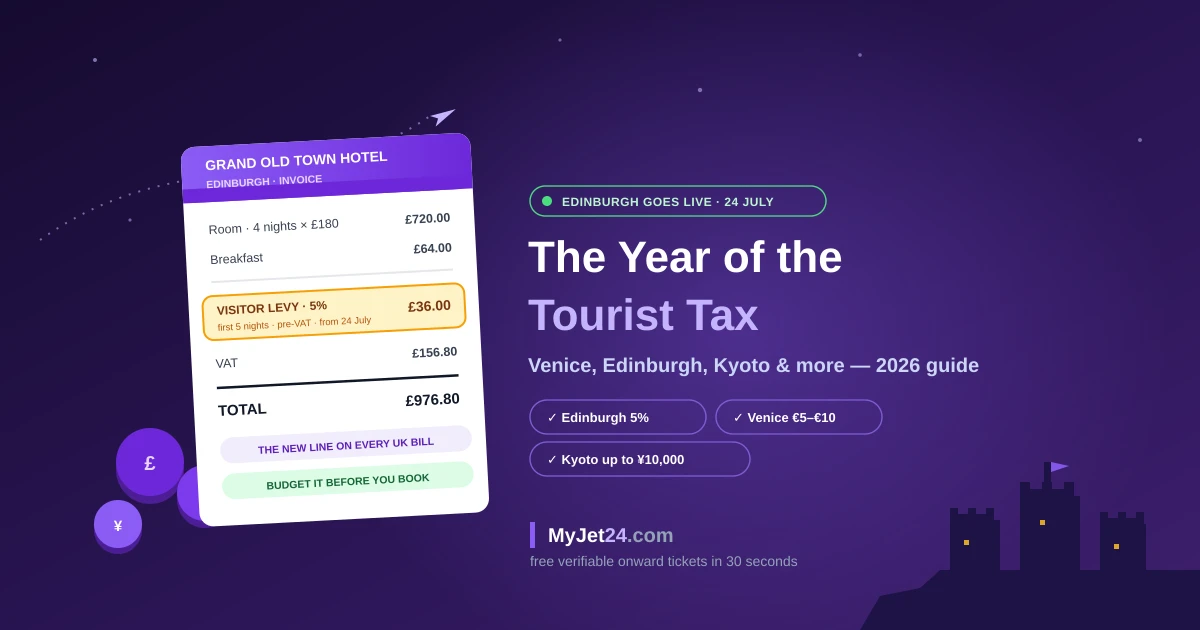
- 2026 is the year tourist taxes went mainstream — and this week they reach the UK. On 24 July 2026, Edinburgh becomes the first British city with a visitor levy: 5% on accommodation, charged on the first five nights. One trap: stays booked on or after 1 October 2025 pay it even if you booked before the launch date.
- Venice is running its longest day-tripper season yet: the access fee applies on 60 days between 3 April and 26 July 2026 — €5 if you book at least four days ahead, €10 if you leave it late. Overnight guests don't pay, but still need the free QR code.
- Kyoto now has Japan's steepest lodging tax: since 1 March 2026, five price tiers from ¥200 up to ¥10,000 per person per night for luxury stays — up to ten times the old rate.
- Amsterdam holds Europe's highest percentage at 12.5% — and its new city government wants 16% in 2027, rising to 20% by 2030. Percentage-based levies quietly outgrow flat fees as room rates climb.
- A tourist tax is a budget line, not a border requirement. It doesn't replace visas, arrival cards or onward tickets — think of it as the fourth, purely financial layer of 2026's increasingly layered trips.
Tourist taxes in 2026 come in three forms: percentage levies on accommodation (Edinburgh's new 5% visitor levy from 24 July 2026, Amsterdam's 12.5%), flat per-night lodging taxes (Kyoto's five tiers of ¥200–¥10,000 per person since March 2026, Lisbon's ~€4, Greece's climate fee), and entry fees for day visitors (Venice's €5–€10 access fee on 60 dates through 26 July 2026, Bali's IDR 150,000 levy). They're collected by your accommodation, booking platform or a dedicated app — not at passport control — and they don't replace visas, arrival cards or onward-ticket requirements.
In this guide
- Why 2026 is the year of the tourist tax
- Edinburgh: the UK's first visitor levy (from 24 July)
- Venice: the day-tripper access fee, season three
- Kyoto: Japan's steepest lodging tax
- Amsterdam: Europe's highest rate — heading for 20%
- The big table: what major cities charge in 2026
- The three models — and who actually collects the money
- Tourist tax ≠ visa ≠ arrival card ≠ onward ticket
- Six mistakes to avoid
- Frequently asked questions
Why 2026 is the year of the tourist tax
Tourist taxes are older than most travelers realize — European spa towns have charged Kurtaxe for a century, and city taxes have sat quietly at the bottom of hotel bills for decades. What changed in 2026 is scale and visibility: within five months, Kyoto multiplied its lodging tax up to tenfold (March), Venice ran its longest-ever paid-entry season (April–July), Amsterdam's incoming government announced a path to a 20% rate (June), and this week Edinburgh switches on the first visitor levy in the United Kingdom (24 July).
The drivers are the same everywhere: post-pandemic overtourism concentrated in a handful of iconic cities, strained local infrastructure, and municipal budgets that noticed visitors were the one group who don't vote locally. Whatever the politics, the practical effect for travelers is identical — a new line on the bill that can add anywhere from pocket change to hundreds of euros on a longer luxury stay.
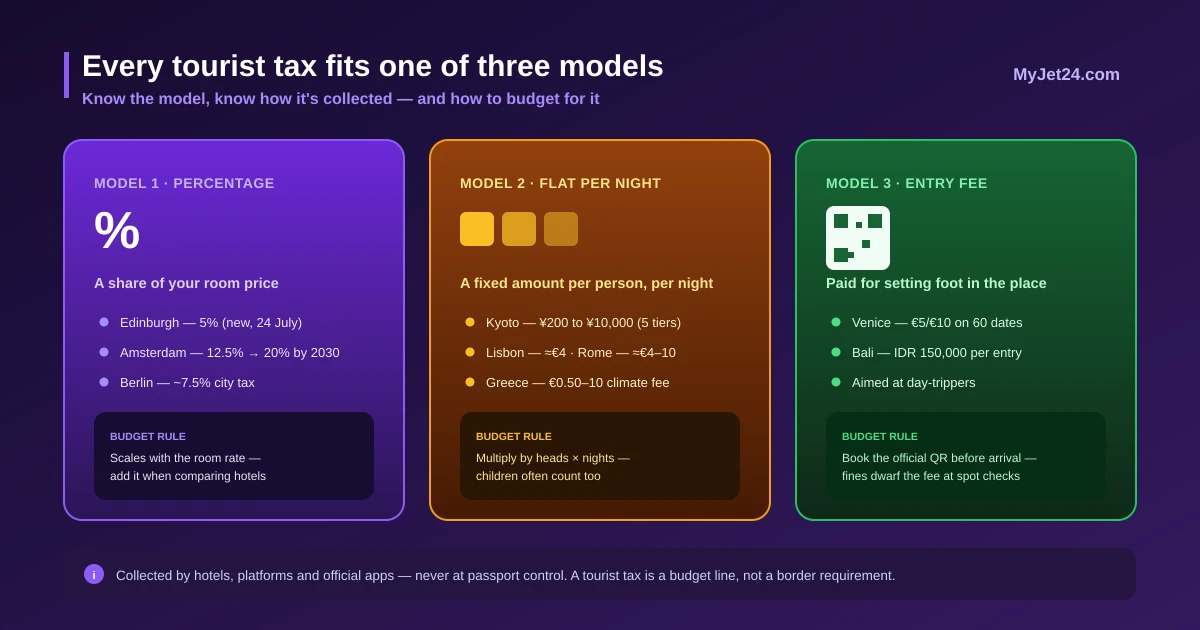
Every tourist tax in the world fits one of three models, and knowing which one you're facing tells you how it's collected and how to budget for it:
- Percentage levies — a share of your accommodation cost (Edinburgh 5%, Amsterdam 12.5%, Berlin's city tax). These scale with room rates: the nicer the hotel, the bigger the tax.
- Flat per-night taxes — a fixed amount per person or room per night, often tiered by hotel category or price (Kyoto's ¥200–¥10,000 tiers, Lisbon's ~€4, Rome's category-based rates, Greece's climate fee).
- Entry fees — charged for setting foot in a place at all, aimed at day-trippers (Venice's €5–€10 access fee, Bali's IDR 150,000 levy).
Edinburgh: the UK's first visitor levy (from 24 July)
Two days from now, Edinburgh makes British tourism history. From 24 July 2026, every paid overnight stay in the city carries a 5% visitor levy, under the Visitor Levy (Scotland) Act 2024. The mechanics matter:
- Rate: 5% of the accommodation cost, calculated before VAT — extras like parking, meals, drinks and transport are not taxed;
- Cap: charged on the first five consecutive nights only — from night six, your stay is levy-free;
- Scope: hotels, B&Bs, hostels, serviced apartments, holiday lets and campsites within the City of Edinburgh — collected by the accommodation as part of your bill;
- The booking-date trap: stays on or after 24 July 2026 that were booked on or after 1 October 2025 pay the levy. Only reservations both booked and fully paid before 1 October 2025 escape it — booking early in 2026 for the August Festival did not dodge the charge;
- Exemptions: deliberately narrow and social, not touristic — people who are homeless or at risk, those fleeing domestic abuse or violence, and asylum seekers and refugees. There is no child exemption and no business-traveler carve-out.
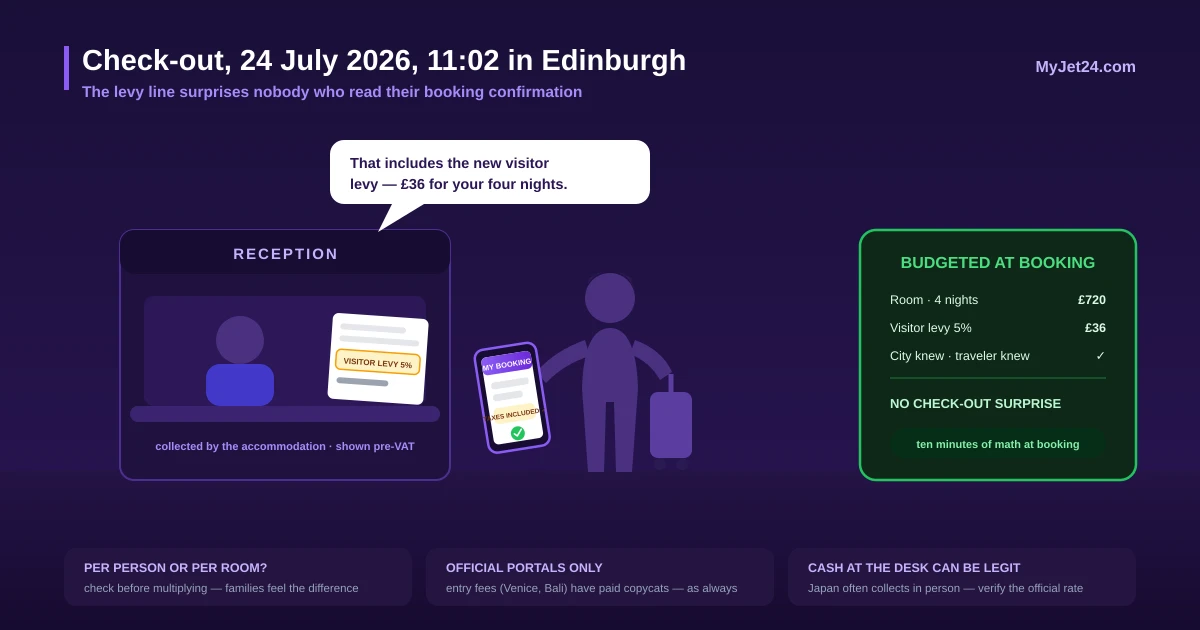
For a typical Festival-season visit — say £180 a night for four nights — the levy adds £36. Modest, but Edinburgh is the door-opener: other Scottish councils (and Welsh cities, under their own new legislation) are watching this launch before setting their own rates. The UK's levy-free era ends this week.
Venice: the day-tripper access fee, season three
Venice's Contributo di Accesso is the purest entry-fee model in Europe — and 2026 is its longest season yet: 60 selected dates between 3 April and 26 July, mostly weekends and holidays, covering the historic center between 8:30 and 16:00.
- Who pays: day-trippers aged 14+ entering the old city on fee days. Overnight guests don't pay the access fee — their hotel stay already carries the separate lodging tax — but they must still register online for a free exemption QR code;
- How much: €5 if booked at least four days in advance, €10 for late deciders booking within four days of the visit — the surge price introduced to make spontaneous day-trips think twice;
- How it works: pay online, receive a QR code, and be ready to show it at spot checks near Santa Lucia station and the main entry points. Fines for skipping it run far above the fee itself;
- Timing note: the 2026 season's final fee date is 26 July — this Sunday. From Monday, entry is free again until the 2027 calendar lands, but the QR-registration habit is clearly here to stay.
Venice's fee is less about revenue than behavior: the city wants day-trippers to pre-commit, spread across quieter dates, or stay overnight instead. Judged by imitators — Bali's levy, and feasibility studies in other European cities — the model is winning.
Kyoto: Japan's steepest lodging tax
Kyoto has charged a lodging tax since 2018, but the version that took effect on 1 March 2026 is in a different league — the steepest municipal accommodation tax in Japan, restructured into five price-based tiers, per person, per night:
| Room rate (per person/night) | Tax (per person/night) | ≈ at mid-2026 rates |
|---|---|---|
| Under ¥6,000 | ¥200 | ≈ US$1.30 |
| ¥6,000 – under ¥20,000 | ¥400 | ≈ US$2.60 |
| ¥20,000 – under ¥50,000 | ¥1,000 | ≈ US$6.50 |
| ¥50,000 – under ¥100,000 | ¥4,000 | ≈ US$26 |
| ¥100,000 and above | ¥10,000 | ≈ US$65 |
The bottom tiers barely moved — budget travelers still pay a coffee's worth. The top tier is the story: luxury guests paying ¥100,000+ per night now add ¥10,000 per person per night — a family of four in a high-end ryokan for three nights contributes ¥120,000 (≈ US$780) in tax alone. Kyoto's calculation is explicit: fund overtourism management from the wallets least likely to notice, without pricing out the hostel crowd.
Two details worth knowing: the tax is per person (children included — there's no age exemption), and it's collected by the accommodation at check-in or through your booking platform, so it may not appear in the advertised room rate you compared online.
Amsterdam: Europe's highest rate — heading for 20%
Amsterdam's 12.5% tourist tax on accommodation (calculated on the room price excluding VAT) was already Europe's highest percentage when it took effect in 2024. In June 2026, the city's new coalition government announced the next act: a proposed rise to 16% in 2027, then one percentage point per year until hitting 20% in 2030 — alongside closing the sea cruise terminal to cut cruise tourism entirely.
Percentage levies deserve special respect in your budget math because they compound with room-rate inflation. A €250-a-night Amsterdam hotel already carries €31+ per night in tourist tax today; at 20% it would be €50 — per night, before VAT, per room. For a five-night stay, that's the price of another flight. Day visitors aren't spared either: Amsterdam charges cruise and transit passengers a separate per-head day fee.
The takeaway: in percentage-levy cities, the tax belongs in your accommodation comparison, not as an afterthought — a cheaper room in a levy city can beat a "deal" once the percentage lands on top.
The big table: what major cities charge in 2026
| City | Model | 2026 rate | Notes |
|---|---|---|---|
| Edinburgh | Percentage | 5% (pre-VAT) | From 24 Jul 2026 · first 5 nights only · UK first |
| Amsterdam | Percentage | 12.5% | Proposed: 16% in 2027 → 20% by 2030 |
| Berlin | Percentage | ~7.5% | "City Tax" on the room rate |
| Kyoto | Flat, tiered | ¥200–¥10,000 p.p./night | Since 1 Mar 2026 · Japan's highest · no child exemption |
| Lisbon | Flat | ≈ €4 p.p./night | Capped at 7 nights · under-13s exempt |
| Rome | Flat, by category | ≈ €4–€10 p.p./night | Scales with hotel stars · caps vary |
| Greece (nationwide) | Flat, seasonal | ≈ €0.50–€10 /room/night | "Climate Crisis Resilience Fee" · peaks in summer |
| Barcelona | Flat, stacked | ≈ €5–€8 p.p./night combined | Regional tax + rising municipal surcharge |
| Venice (day visit) | Entry fee | €5 / €10 | 60 dates, 3 Apr–26 Jul 2026 · overnighters exempt w/ QR |
| Bali | Entry fee | IDR 150,000 (≈ US$9) | Once per entry via Love Bali — payment guide |
Rates marked ≈ are typical 2026 ranges — flat taxes in Lisbon, Rome, Greece and Barcelona vary by season, hotel category and district, so treat them as budgeting figures and check your booking confirmation for the exact line item.
The three models — and who actually collects the money
Where visas and arrival cards are checked at borders, tourist taxes are collected by businesses and apps — which is why they feel invisible until the bill arrives:
- Percentage and flat lodging taxes are collected by your accommodation, either inside the booking total (common on Booking.com and Expedia in Europe) or as a separate charge at check-in/check-out. In Japan, expect the front desk to collect it in person — sometimes cash — even if you prepaid the room online;
- Entry fees run on dedicated platforms: Venice's QR through the official cda.ve.it portal, Bali's through the Love Bali system. As with every official travel payment we've covered this year, copycat sites exist — pay only on the official government pages;
- Short-term rentals (Airbnb and co.) increasingly auto-collect city taxes at booking in major destinations — but not everywhere, so a host asking for the legal city tax in cash isn't automatically a scam. Check the city's official rate before paying anything beyond the booking total.
Tourist tax ≠ visa ≠ arrival card ≠ onward ticket
2026 trips increasingly stack four separate layers, and confusing them costs either money or boarding. The tourist tax is the only one that's purely financial:
| Layer | What it decides | Who checks it |
|---|---|---|
| Visa / travel authorization | Whether you may enter (ETIAS, UK ETA…) | Airline + border officers |
| Arrival card / declaration | Registering your entry (Asia's QR cards, Indonesia's AIAC) | Airline + immigration |
| Onward/return ticket | Proof you'll leave — the check that stops boardings | Airline at check-in (hard), immigration (sometimes) |
| Tourist tax | Only what you pay — never whether you enter | Hotel, platform or app — not passport control |
The third row is the one with teeth. No city will deny you entry over a lodging tax — but an airline will absolutely deny you boarding without proof of onward travel where it's required. If your itinerary is one-way or open-ended, a verifiable onward reservation with a live PNR — generated at MyJet24 with Premium for $7.90 in about 30 seconds — closes the only layer of the four that can actually strand you at a counter.
Six mistakes to avoid
- Assuming your Edinburgh booking escaped the levy because you booked "before launch." The cutoff is the booking date of 1 October 2025, not 24 July 2026 — anything booked since last autumn for a post-launch stay pays the 5%.
- Walking into Venice on a fee day without the QR. Spot-check fines dwarf the €5–€10 fee — and overnight guests get caught too, because they skip registering for the free exemption code.
- Comparing hotel prices without the tax layer. A 12.5% Amsterdam levy or a ¥10,000-per-person Kyoto night changes the real price ranking of your shortlist — add the tax before you decide, not after.
- Budgeting per room when the tax is per person. Kyoto, Lisbon, Rome and most flat-rate cities charge each guest — a family of four pays four times what the headline number suggests, children often included.
- Paying an "official tourist tax site" from an ad. Venice and Bali fees have spawned the same paid-copycat ecosystem as every arrival form we've covered — pay only on the official city or government platforms.
- Confusing the money layer with the permission layers. Paying every tax on this page does nothing for your visa, arrival card or onward-ticket obligations — and vice versa. Four layers, four separate checkboxes.
Frequently asked questions
What is a tourist tax?
A charge levied by a city, region or country on visitors — either as a percentage of accommodation cost, a flat amount per person per night, or a one-off entry fee. It funds local infrastructure and overtourism management, and it's collected by hotels, booking platforms or official apps rather than at the border.
When does Edinburgh's tourist tax start and how much is it?
The Edinburgh Visitor Levy starts 24 July 2026: 5% of the accommodation cost (before VAT), charged on the first five consecutive nights of a stay, across hotels, B&Bs, hostels, holiday lets and campsites. It's the first visitor levy in the UK.
I booked my Edinburgh stay months ago — do I still pay the levy?
If you booked on or after 1 October 2025 for a stay on or after 24 July 2026, yes. Only bookings made and fully paid before 1 October 2025 are exempt, even when the stay falls after the launch date.
How much is the Venice access fee in 2026?
€5 per day-tripper when booked at least four days ahead, €10 within four days of the visit — applied on 60 selected dates between 3 April and 26 July 2026, between 8:30 and 16:00, for visitors aged 14 and over entering the historic center.
Do I pay the Venice fee if I'm staying overnight in Venice?
No — overnight guests are exempt from the access fee because their stay already carries Venice's lodging tax. But exemption isn't automatic: you must register online for a free QR code and show it at spot checks, just like paying visitors.
How much is Kyoto's lodging tax in 2026?
Since 1 March 2026, five tiers per person per night based on the room rate: ¥200 (under ¥6,000), ¥400 (¥6,000–20,000), ¥1,000 (¥20,000–50,000), ¥4,000 (¥50,000–100,000) and ¥10,000 (¥100,000+). It's Japan's highest municipal lodging tax, with no child exemption.
Which European city has the highest tourist tax?
By percentage, Amsterdam at 12.5% of the room price — with an approved trajectory toward 16% in 2027 and 20% by 2030. In absolute terms, a luxury stay in Kyoto can exceed anything in Europe at ¥10,000 (≈ US$65) per person per night.
Are children exempt from tourist taxes?
It varies city by city — that's the trap. Venice exempts under-14s from the access fee and Lisbon exempts under-13s from its night tax, but Kyoto's tiers and Edinburgh's 5% levy apply regardless of age. Check each city's rules rather than assuming a family discount.
How are tourist taxes collected — can I refuse to pay?
Lodging taxes are collected by your accommodation or booking platform as a legal requirement — refusing means the hotel simply can't complete your check-out, and entry fees like Venice's carry fines many times the fee at spot checks. The only real choice is budgeting for them in advance.
Does Airbnb include tourist tax in the price?
In many major destinations Airbnb auto-collects city taxes at booking, but coverage is patchy — in some cities hosts legally collect it in person instead. Compare any cash request against the city's official published rate before paying beyond your booking total.
What's the difference between a tourist tax, a city tax and a resort fee?
"Tourist tax" and "city tax" are the same thing — a government levy. A "resort fee" is different: a private charge hotels (mainly in the US) add for amenities, set by the business, not the law. Only the government levy is unavoidable everywhere and fixed by published rates.
Do tourist taxes replace visas or arrival cards?
No. Taxes are purely financial. Your visa or travel authorization (like ETIAS or the UK ETA), any digital arrival card, and onward-ticket requirements are separate layers checked by airlines and border officers — paying a levy has no effect on any of them.
Which cities are introducing tourist taxes next?
Edinburgh's launch is being watched closely: other Scottish councils have the same legal power under the Visitor Levy (Scotland) Act, Welsh legislation enables levies from 2027, and Amsterdam's ratchet to 20% gives other capitals political cover. The direction of travel is one way — more cities, higher rates.
Do any tourist taxes cover my onward-ticket requirement?
None. Tourist taxes buy you nothing at the border — where a country requires proof of onward travel, airlines check it at check-in regardless of any levy you've paid. A verifiable onward reservation with a live PNR, like MyJet24's Premium onward ticket ($7.90), is what satisfies that check.
The bottom line
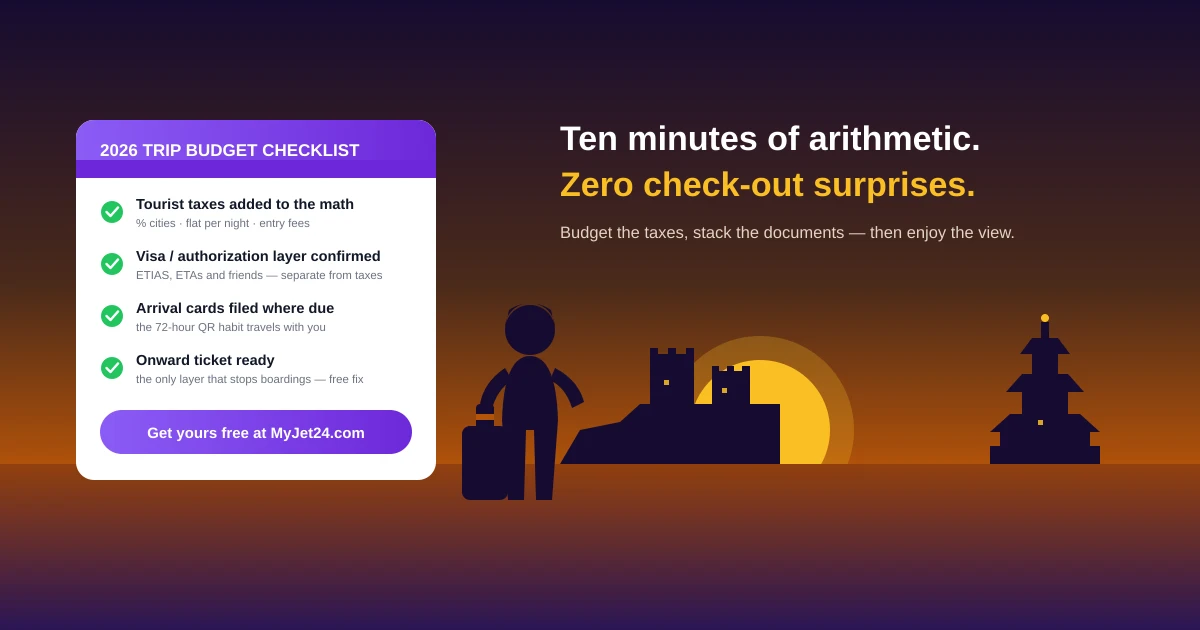
Tourist taxes won't ruin a trip — unbudgeted, they just sour the bill. The 2026 rule of thumb: in percentage cities (Edinburgh, Amsterdam, Berlin), add the levy when comparing hotels; in flat-rate cities (Kyoto, Lisbon, Rome), multiply by heads and nights; in entry-fee cities (Venice, Bali), book the official QR before you arrive. Ten minutes of arithmetic at booking time beats every surprise at check-out.
And keep the four layers straight: the tax is money, but the visa, the arrival card and the onward ticket are permission — and only the permission layers can stop you at a counter. The cheapest of the four to solve is the onward ticket: free with a booking reference, or verifiable with a live PNR for $7.90 (Premium), in about 30 seconds at MyJet24. Budget the taxes, stack the documents, and let the only surprise in Edinburgh be the weather.
Sources
- City of Edinburgh Council — About the Edinburgh Visitor Levy: https://www.edinburgh.gov.uk/business/visitor-levy-edinburgh
- Forever Edinburgh — Visitor levy for Edinburgh: https://edinburgh.org/planning/local-information/visitor-levy-for-edinburgh/
- Venezia Unica — What is the Venice Access Fee (official portal): https://cda.veneziaunica.it/en/access-fee
- Japan Travel — Kyoto Lodging Taxes to Increase From March 2026: https://en.japantravel.com/news/kyoto-lodging-taxes-to-increase-from-march-2026/71333
- City of Amsterdam — Tourist tax (toeristenbelasting): https://www.amsterdam.nl/en/municipal-taxes/tourist-tax/
- DutchNews — Amsterdam to hike tourist tax to 20%, close sea cruise terminal (June 2026): https://www.dutchnews.nl/2026/06/amsterdam-to-hike-tourist-tax-to-20-close-sea-cruise-terminal/
This guide reflects tourist tax rates and rules as published by city authorities and reported as of 22 July 2026. Rates marked as approximate vary by season, hotel category and district, and cities revise levies frequently — check the official city website and your booking confirmation for the exact amount before you travel. This article is informational and not tax or legal advice.
