
TL;DR
- A dummy ticket is a temporary flight reservation with a real airline PNR, used as proof of onward travel for visa applications. In 2026 it typically costs $5–$49.
- The only price that matters is the cheapest one that an embassy can still verify. Free PDF generators usually produce no real PNR and fail verification.
- Too-cheap ($5–$14) services are often unverifiable or expire within hours. An unverifiable ticket that triggers a visa refusal is the most expensive ticket you can buy.
- A genuinely verifiable dummy ticket costs $7.90 with MyJet24 Premium — about half what typical providers charge — a verifiable flight reservation with real PNR you can check yourself, delivered as an instant PDF.
- Always confirm a PNR on the airline's official "Manage Booking" page before you pay or submit it.
A dummy ticket costs between $5 and $49 in 2026; a verifiable PNR costs $7.90 with MyJet24 Premium. Price alone is meaningless for a dummy ticket — what matters is whether an embassy officer can verify the booking code in the airline's system. Free generators are the cheapest, yet they usually create unverified PDFs with no real PNR, which can get a visa refused. This guide breaks down real prices, what drives them, and how to get the cheapest ticket that actually passes verification.
What determines a dummy ticket's price?
A dummy ticket's price is set by how the reservation is created and how long the PNR stays live. A PNR (Passenger Name Record) is the six-character booking code an airline or GDS like Amadeus or Sabre issues for a held seat. Creating a genuine PNR uses real inventory, so providers charge for it; faking a PDF costs nothing, which is why "free" tickets almost never carry a verifiable code.
Four factors move the price:
- Real PNR vs unverified PDF — a genuine GDS reservation has a cost; a Photoshopped PDF does not.
- Validity window — a code held for 48 hours is cheaper than one guaranteed for 14 days.
- One-way vs return — return itineraries hold two segments, so they cost slightly more.
- Delivery speed — instant automated delivery is cheaper than manual agent processing.
Understanding these drivers protects you in both directions. It explains why a $0 PDF cannot be a real reservation — nobody holds airline inventory for free — and why a $49 price tag is usually padding rather than a better product. Once you know a verifiable PNR has a small but genuine cost, the right budget becomes obvious: enough to cover a real, checkable hold for your submission window, and not a cent more. That figure, in 2026, is about $8.
If you are new to the document itself, our complete guide to what a dummy ticket is explains the format, and which countries require proof of onward travel shows where you actually need one.
How much does a dummy ticket cost in 2026?
A dummy ticket costs $5 to $49 in 2026, with most verifiable options clustering around $8 to $20. Prices vary by provider model rather than by airline. The table below maps the four price tiers to what you actually receive.
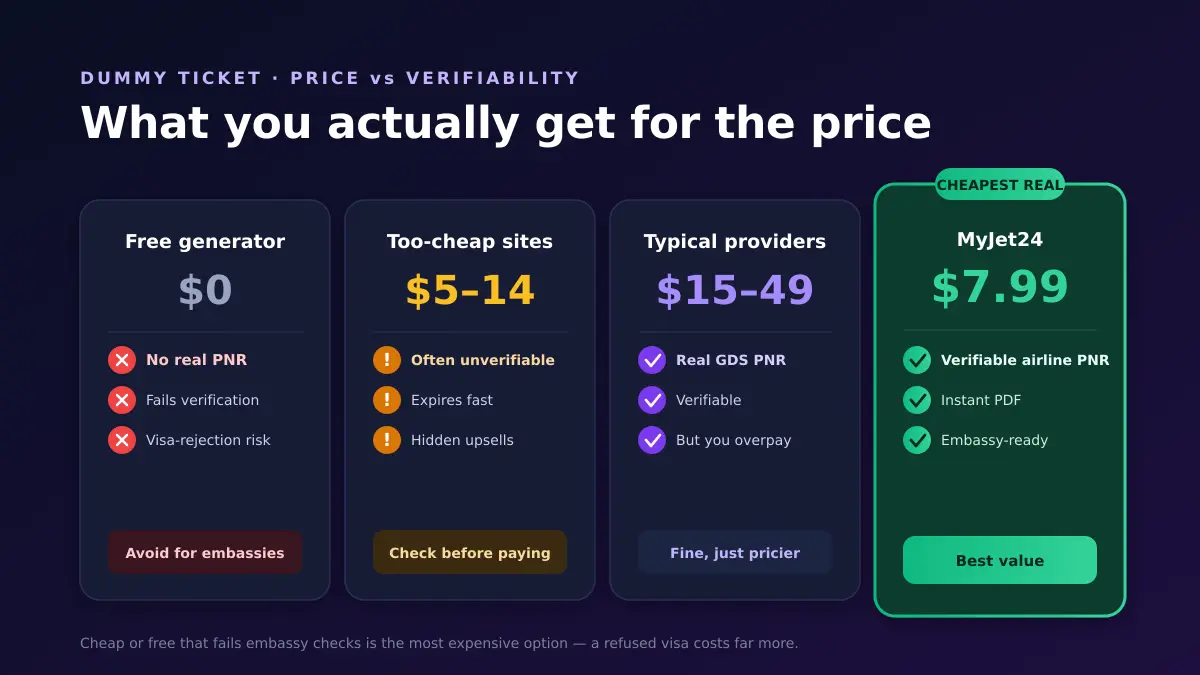
| Option | Price | Real PNR? | Embassy-safe? |
|---|---|---|---|
| Free PDF generator | $0 | No | No |
| Too-cheap sites | $5–$14 | Sometimes | Risky |
| Typical providers | $15–$49 | Yes | Yes |
| MyJet24 | $7.90 | Yes | Yes |
The pattern is clear: the lowest prices buy the weakest documents, and the mid-tier providers charge $15–$49 for the same verifiable PNR you can get for $7.90. Paying more does not buy a "more real" reservation.
Notice what does not change the price: the airline, the route, or the destination country. A held seat on a long-haul carrier costs a provider the same to reserve as a short regional hop, because no money actually changes hands for the fare — only the reservation is created. So if a site charges you more "because it's a US route" or "a premium airline," that is marketing, not cost. The price should reflect the reservation and its validity window, nothing else.
Price vs verifiability: the matrix that matters
Verifiability is the single quality that decides whether a dummy ticket works. An embassy officer does not care what you paid; they type the PNR into the airline's system and check that the flight exists. If it does not appear, the document is worthless regardless of price.
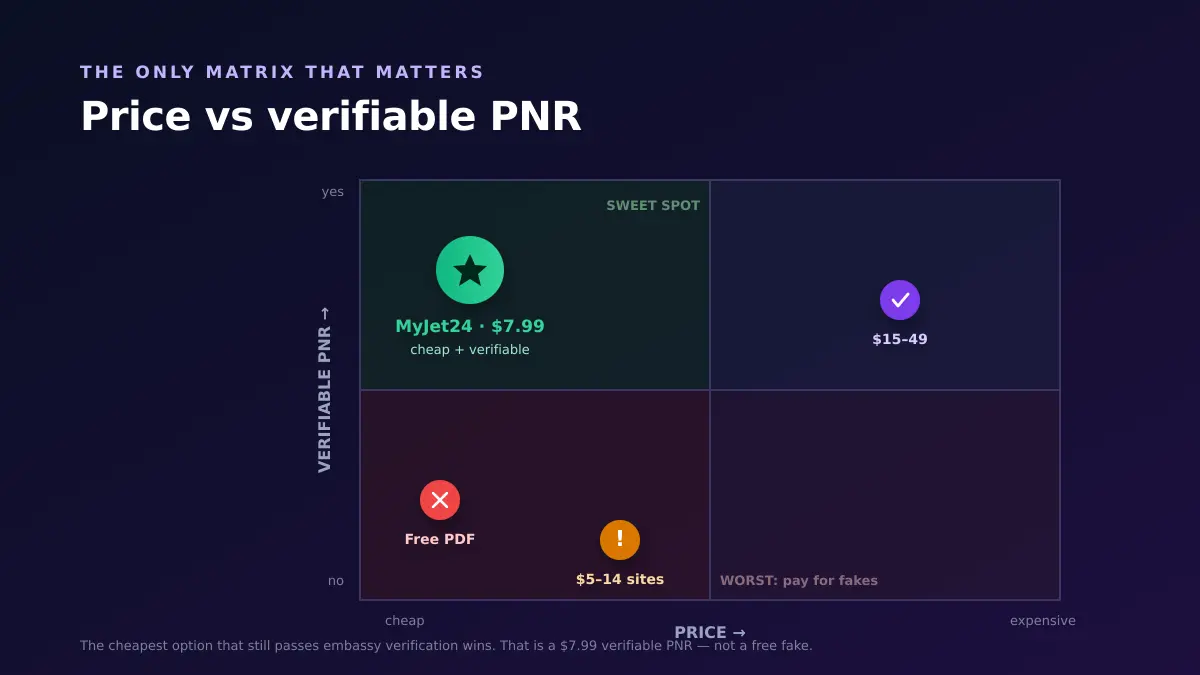
Plot every option on two axes — price and verifiability — and only one quadrant is worth being in: cheap and verifiable. Free PDFs and bargain sites sit in the danger zone (low price, no verification). Premium agencies sit top-right (verifiable but overpriced). The sweet spot is a low-cost, fully verifiable PNR.
"The right question is not 'what is the cheapest dummy ticket?' It is 'what is the cheapest dummy ticket an embassy can still verify?'"
Why "free" and "too cheap" can cost you the most
Free and ultra-cheap dummy tickets are usually the most expensive choice once you count risk. A free generator outputs a PDF that looks like a ticket but carries no live PNR, so the moment an officer checks it, nothing appears. The result can be a refused application, a non-refundable visa fee, and a rejection on your record that complicates future applications.
Consider the real math. A Schengen visa fee is around €90, a US B1/B2 fee is $185, and a UK visit visa is roughly £127. Risking any of those to save $8 is a bad trade. A "free" ticket that triggers a refusal can cost you hundreds — plus the trip itself.
"A free dummy ticket is only free until an embassy verifier types the PNR and nothing comes up."
A typical failure looks like this: an applicant downloads a free PDF, it looks flawless, and they submit it for a Schengen appointment. The consulate clerk opens the airline site, enters the booking code, and gets "reservation not found." The application is flagged, the fee is gone, and the refusal sits on the record for the next application. The traveler then pays for a real ticket anyway — so the "free" route cost the visa fee, the delay, and the price of a proper ticket on top. Spending $7.90 first would have avoided all three.
This is why free tools have their place for previews and mock-ups, but not for a real submission. If you want to understand the limits of no-cost options, our breakdown of whether free dummy ticket generators actually work covers exactly where they fail.
A cheap verifiable option: a $7.90 PNR
MyJet24's $7.90 reservation is a cheap verifiable dummy ticket for 2026. It is a genuine airline-system PNR — not a static PDF — so you and the embassy can confirm it on the carrier's official site. It arrives as an instant, embassy-ready PDF with the booking code, passenger name, and flight details laid out exactly as officers expect.
That price sits below the $15–$49 most agencies charge for an equivalent verifiable booking, and unlike many $5–$14 bargain sites, the PNR is real and checkable. In other words, it sits at the low end of what still passes verification — the sweet spot from the matrix above.
What you get for $7.90 is deliberately simple: a real airline PNR, a clean PDF with the booking code and passenger details formatted the way officers expect, and the ability to confirm it yourself before you submit. There is no upsell maze, no "premium verification" tier, and no rush fee, because the document is already instant and already verifiable. The point is to remove every reason a cheaper-looking option exists — you get the verifiable result at the bargain-tier price.
"$7.90 for a verifiable airline PNR is the floor for a document that actually works. Cheaper than that, you are usually paying for an invented booking."
Dummy ticket prices by region
Dummy ticket prices look different across markets because providers price in local currency and target local visa flows. The underlying product — a verifiable PNR — is the same everywhere. The table consolidates the ranges travelers report in 2026.
| Market | Typical local price | ≈ USD |
|---|---|---|
| US / global | $12–$30 | $12–$30 |
| Europe (Schengen) | €10–€25 | $11–$27 |
| India | ₹699–₹1,500 | $8–$18 |
| Gulf (UAE) | AED 49–79 | $13–$22 |
Across every region, $7.90 for a verifiable PNR sits below what most local agencies charge while keeping the one feature that counts. Currency changes; the verification test does not.
One regional nuance is worth knowing: some markets advertise eye-catching low numbers — ₹699 in India or AED 49 in the Gulf — that convert to single digits in dollars. Those headline prices are real, but they often apply to short-validity or one-way holds, and the verifiability still varies provider to provider. Convert the price to your own currency, then apply the same test you would anywhere: can the PNR be checked on the airline's site, and will it still be live on your submission date? If yes, the local price is fair; if no, it is not cheap, it is a gamble.
How to verify a PNR before you pay
You can confirm a PNR is real in under two minutes, and you should do it before paying any provider or submitting to an embassy. A legitimate service is happy to let you check; a scam relies on you not checking.
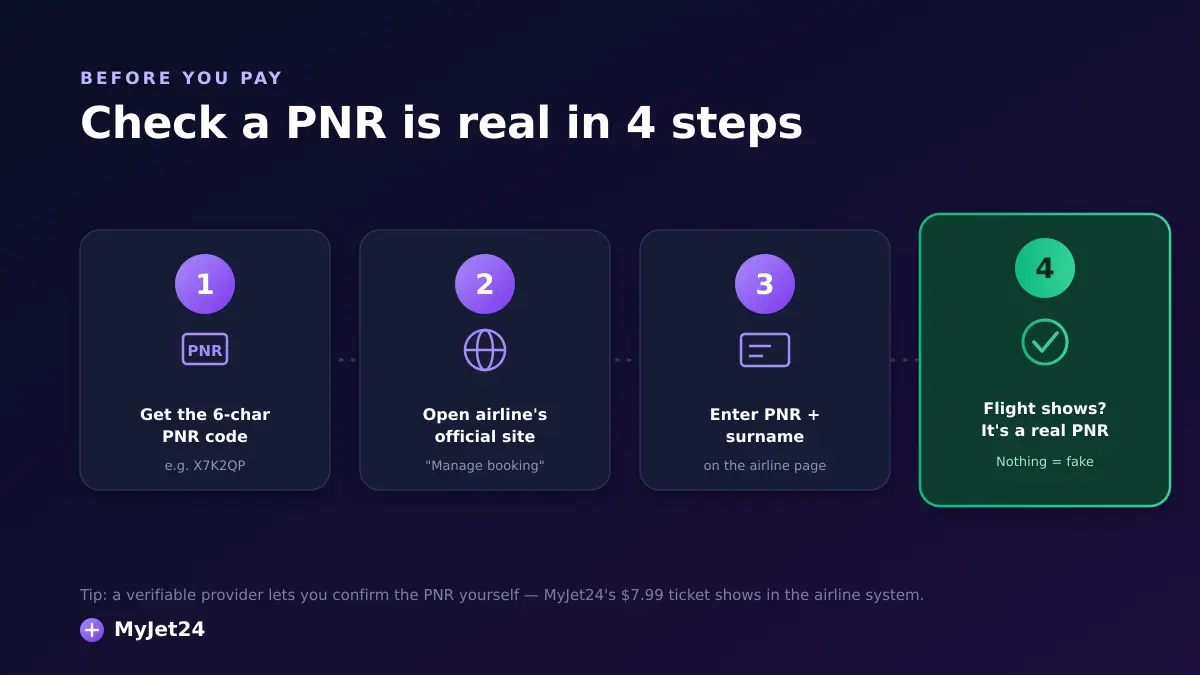
- Get the six-character PNR. It appears on the ticket near the passenger name, for example X7K2QP.
- Open the airline's official website. Go to its "Manage Booking" or "My Trips" section — never a third-party link.
- Enter the PNR and surname. Type the booking code and passenger last name exactly as written.
- Confirm the flight appears. If the itinerary loads, the PNR is real. If nothing shows, it is not a live reservation — do not submit it.
For a deeper walkthrough, see our guide on how to verify your dummy ticket PNR before you submit it. The standard itself is defined by industry body IATA, and many governments — such as the UK government — note that carriers may require proof of onward travel before boarding.
What you should never pay extra for
Several common upsells add cost without adding value. Knowing them keeps your price at the real floor.
- "Premium verification" fees. A real PNR is already verifiable for free on the airline site; you should not pay extra to verify it.
- "Express" delivery. A genuine automated reservation is already instant; rush fees are padding.
- Long validity you will not use. Most embassies only need the booking valid through your interview or submission date.
- Bundled "insurance" or "guarantees." These rarely pay out and inflate a simple document into a $40 purchase.
How long the PNR stays valid (and why it affects price)
PNR validity is the second-biggest price driver after verifiability. A booking code is a temporary hold, so airlines and GDS systems release it after a set window — sometimes a few hours, sometimes up to two weeks. Providers that guarantee a longer live window pay to maintain the hold, and they pass that cost on to you.
For most applications you do not need a long validity. Embassies check the document at submission or at your interview, so the PNR only has to be live on that date. Buying a 30-day hold when your appointment is in three days is wasted money. The practical move is to match the validity to your timeline: generate the ticket a day or two before you submit, confirm the code is live, then upload it.
This is also why ultra-cheap tickets disappoint. A $6 reservation that expires in two hours is technically a real PNR for those two hours, but it is dead by the time an officer checks it the next morning. Our guide to verifying your PNR before submission includes checking that the hold is still active, not just that it once existed.
"Match the validity to your submission date. You are paying for the code to be live when an officer checks it — not a day longer."
Red flags of a too-cheap dummy ticket
A suspiciously cheap dummy ticket usually signals an invented booking. Bargain sites compete on price precisely because they skip the one expensive step — issuing a real reservation. Watch for these warning signs before you pay:
- No way to verify the PNR. The site avoids showing which airline issued the code, so you cannot check it.
- Payment only in crypto or gift cards. Untraceable-only payment is a classic scam tell.
- PNR delivered as a flat image, not text. A screenshot you cannot copy into a verification field is a red flag.
- "Valid for minutes" disclaimers. If the hold expires almost immediately, it will be dead at review.
- No company details, reviews, or support. Legitimate providers have a traceable presence.
The honest test is simple: if a provider will not let you verify the PNR on the airline's own site before you rely on it, treat the document as worthless no matter how little it costs. Quality matters more than the headline price, which is why our honest provider comparison ranks services on verifiability first.
When is a free dummy ticket actually enough?
A free dummy ticket is fine only when nobody will verify it. There are a few low-stakes situations where a non-verifiable PDF does no harm: drafting your travel plan, showing a rough itinerary to a host, or testing how a document looks before you buy the real one. In those cases, a free mock-up saves time.
It is not enough the moment a third party checks the booking — which is exactly what embassies, airlines at check-in, and some insurers do. For any official submission, the document must survive a live PNR lookup. That is the line between "free preview" and "real proof," and it is the line most rejected applicants cross by accident. When the check is real, pay the $7.90 and remove the risk entirely.
Dummy ticket vs refundable vs real ticket
A dummy ticket is the cheapest way to satisfy an onward-travel requirement, far below a real or refundable fare. A refundable ticket can cost hundreds and ties up your money until the airline processes the refund, which can take weeks. A real ticket is the most expensive and the least flexible if your plans change.
For visa proof, paying full fare is unnecessary risk to your cash flow. We compare the trade-offs in detail in dummy ticket vs refundable flight: cost and risk, and if you want a quality ranking of paid options, our honest comparison of 10 dummy ticket providers shows how they stack up.
How to get the cheapest verifiable dummy ticket
Getting the lowest safe price is a short, repeatable process. Follow these steps to avoid both overpaying and invented bookings.
- Decide one-way or return based on what your embassy checklist asks for.
- Pick a provider that issues a real, checkable PNR and shows the price up front — no hidden upsells.
- Generate the reservation and download the PDF with the booking code visible.
- Verify the PNR yourself on the airline site using the four steps above.
- Submit it within the validity window so the code is still live at review.
Conclusion: cheapest that actually works
The cheapest dummy ticket is not the one with the lowest sticker price — it is the lowest price that still passes embassy verification. Free PDFs and many $5–$14 bargain sites lose that test and put your visa at risk. A $7.90 verifiable airline PNR keeps you at the low end without giving up the one test that matters.
Need one now? Get a verifiable dummy ticket from MyJet24 for $7.90 — a real airline PNR you can check yourself, delivered as an instant embassy-ready PDF, for visa applications and proof of onward travel worldwide.
