
Last updated: 12 July 2026 · Reading time: 14 min · Author: Joshua White, Travel Documentation Writer at MyJet24
TL;DR — Key Facts
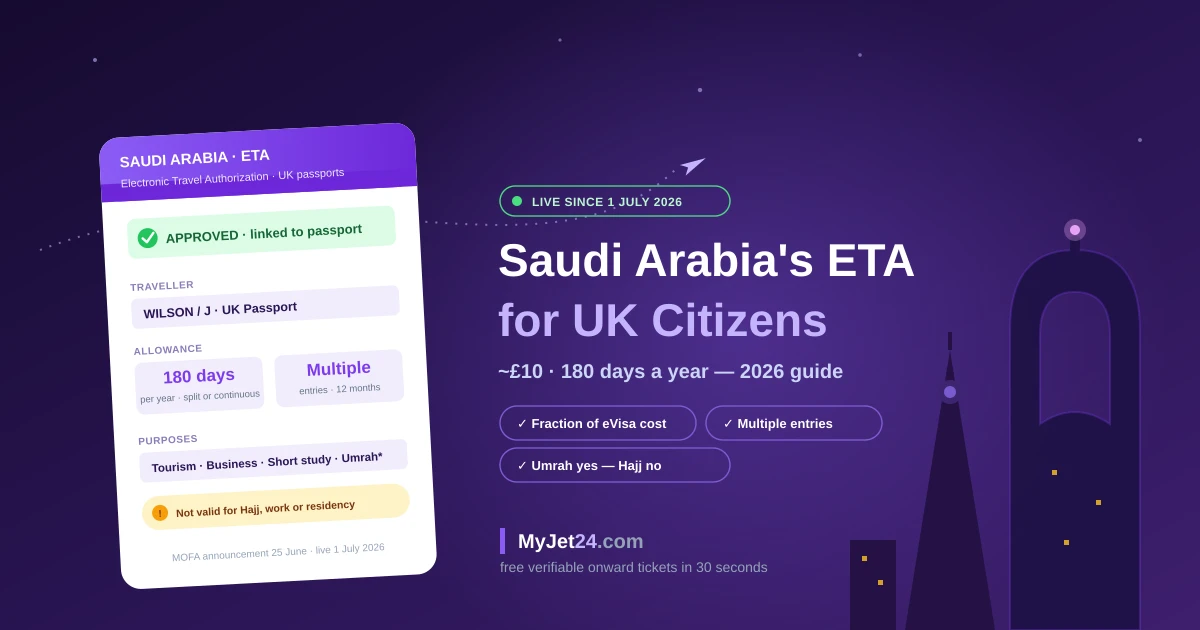
- Since 1 July 2026, UK passport holders have their own Saudi ETA — a lightweight electronic travel authorization announced by Saudi Arabia's Ministry of Foreign Affairs on 25 June, open to all UK passport types.
- The headline numbers beat the tourist eVisa on every line: multiple entries across a 12-month validity, and up to 180 days of stay per year — continuously or spread over several trips — versus the eVisa's 90 days.
- It's dramatically cheaper. The government charge is reported at around SAR 50 (roughly £10), against SAR 500–600 (£100–130, insurance included) for the classic tourist eVisa — confirm the exact amount in the official portal when you apply.
- It covers tourism, business visits and short-term study — not Hajj, work or residency. Umrah continues to follow the tourism umbrella outside Hajj season, exactly as it does on the tourist eVisa; Hajj always requires its own visa.
- It's a reciprocity story: the UK required Saudis to hold a £16 UK ETA — Saudi Arabia has now mirrored the arrangement for Britons. And as with every Saudi entry route, airlines can ask one-way travelers for onward proof at check-in: a free verifiable onward ticket answers that in 30 seconds.
Saudi Arabia launched an Electronic Travel Authorization (ETA) for UK citizens on 1 July 2026, announced by the Ministry of Foreign Affairs on 25 June. It applies to all UK passport types and allows multiple entries over a 12-month period, with stays totaling up to 180 days per year — taken continuously or across several trips — for tourism, business visits and short-term study. It does not cover work, residency or Hajj, which still require their own visas. The ETA mirrors the UK's own ETA requirement for Saudi nationals and is substantially cheaper than the SAR 500–600 tourist eVisa, with the government charge reported at around SAR 50.
For years, the standard advice for Britons heading to Riyadh, Jeddah or AlUla was simple: get the tourist eVisa, pay the roughly £100–130 including mandatory insurance, and plan within its 90-day stay limit. That advice aged out overnight on 1 July 2026, when Saudi Arabia switched on a dedicated Electronic Travel Authorization for UK citizens — cheaper by an order of magnitude, valid for multiple entries, and doubling the annual stay allowance to 180 days.
The launch went strangely under-covered outside Gulf business media, and the coverage that exists repeats the press release without answering the questions UK travelers actually type into Google: is Umrah allowed on it, what happens to the eVisa I already hold, how do the 180 days count, and what does the border actually check. This guide answers all of it — including the comparison table that makes the decision for most readers in ten seconds, and the one requirement that hasn't changed: being able to show your way out of the Kingdom. It slots into our Gulf series alongside the Saudi tourist eVisa guide and the GCC unified visa overview.
What Launched on 1 July — and Why It's a Big Deal
The official parameters, from the Saudi Ministry of Foreign Affairs announcement of 25 June 2026 and the legal-alert coverage that followed:
- Who: holders of all types of UK passports — the scheme is nationality-specific, not residence-based.
- What it allows: travel for tourism, business visits and short-term study, with multiple entries across a 12-month validity.
- How long you can stay: up to 180 days in total per year — in one continuous stay or split across several trips.
- What it excludes: employment, long-term residence, and Hajj — each of those keeps its dedicated visa route.
- What it costs: the government charge is reported at around SAR 50 (~£10), non-refundable — a fraction of the tourist eVisa. The exact figure is shown in the official portal at application; treat any third-party site quoting a much higher "service fee" as a middleman markup.
Why it matters: Saudi Arabia has been methodically lowering entry friction as tourism becomes a pillar of Vision 2030 — and the UK is one of its largest Western visitor markets. A ~£10, multi-entry, 180-day authorization turns the Kingdom from a "plan a dedicated trip" destination into a "add three days after Dubai" destination for Britons. For frequent business travelers on the London–Riyadh corridor, it simply removes the visa line from the spreadsheet.
ETA vs Tourist eVisa vs Umrah Visa: the Comparison That Decides
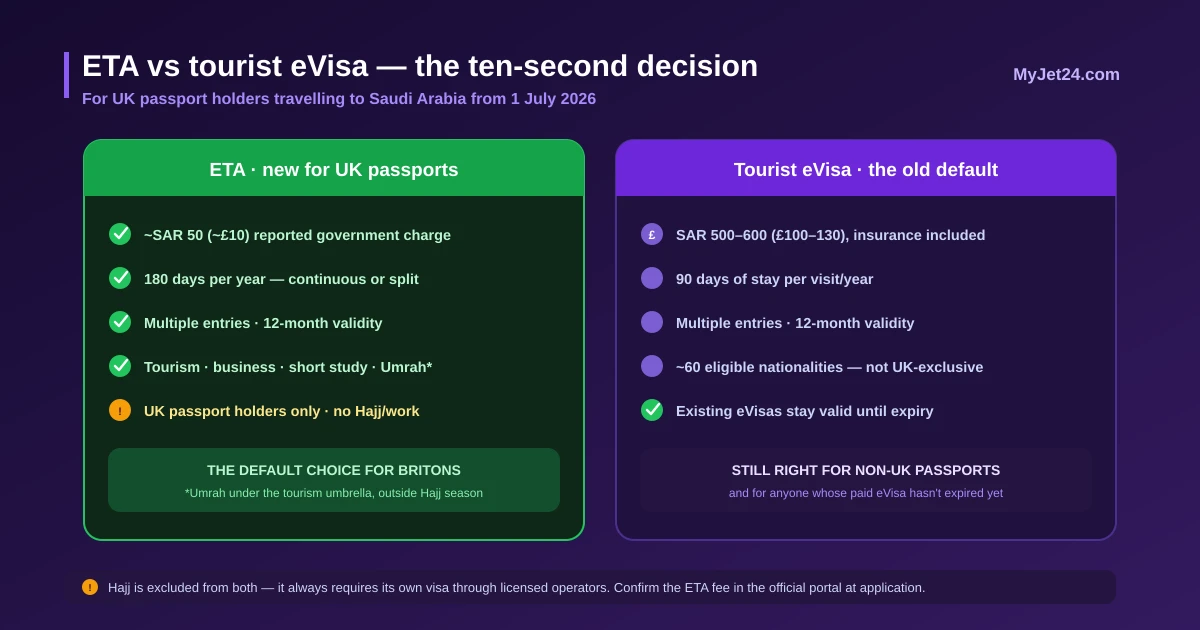
| ETA (new, UK only) | Tourist eVisa | Agency Umrah visa | |
|---|---|---|---|
| Government cost | ~SAR 50 (~£10, reported) | SAR 500–600 (£100–130, insurance included) | £120–250 via agents, package-dependent |
| Stay allowance | 180 days/year, continuous or split | 90 days per stay/year | Trip-length, tied to the package |
| Entries / validity | Multiple / 12 months | Multiple / 12 months | Usually single trip |
| Purposes | Tourism · business visits · short-term study (Umrah under the tourism umbrella) | Tourism (incl. Umrah outside Hajj season) | Umrah specifically |
| Hajj | No — excluded explicitly | No | No — Hajj has its own visa |
| Who can use it | UK passport holders only | ~60 eligible nationalities | Muslim travelers via licensed agents |
The ten-second read: for almost every UK traveler, the ETA wins. The eVisa remains relevant mainly for non-UK nationals, for UK residents traveling on other passports, and for anyone whose eVisa is already paid and valid — existing eVisas keep working until they expire. The agency Umrah route survives where pilgrims want the package (transport, accommodation, guidance) rather than just the entry permission.
The 180-Day Mechanics: Continuous or Split
The stay allowance is the ETA's most generous feature and the one worth understanding precisely. The official framing allows up to 180 days of stay within the 12-month validity, taken either as one continuous stay or across multiple visits. In practice that supports three very different travel patterns:
- The frequent flyer: a dozen short business trips through the year — each entry counts its days against the 180-day pool, no single-visit ceiling to trip over.
- The long stayer: a single half-year block — winter in Riyadh or a full season working remotely around AlUla (remember: remote work for a foreign employer is a gray zone everywhere; local employment is explicitly excluded).
- The combiner: Saudi legs stitched around Gulf itineraries — into Jeddah, out of Dammam, back via Riyadh weeks later — where multiple entries matter more than raw days.
Keep your own day count. Like every "N days per year" allowance (Schengen's 90/180 being the famous cousin), the traveler is responsible for not overdrawing the pool — and Saudi border systems track entries and exits digitally. A simple note of each entry/exit date is enough; overstaying triggers fines and future entry problems in a system that increasingly talks to other Gulf states.
How to Apply: Portal, Documents, Timing
- Use the official channels only: the KSA visa platform (visa.visitsaudi.com) and the Nusuk app are the government's front doors. Third-party "ETA portals" add service fees for a form that takes minutes — and some are outright copycats. The pattern from our Vietnam fake-site warning applies to every new travel authorization.
- Have the basics ready: UK passport (valid for the trip — six months' validity is the safe standard for the region), a passport-style photo, contact and accommodation details, and a payment card for the fee.
- Answer the purpose questions accurately. Tourism, business visit or short-term study — the ETA covers all three; picking the honest one costs nothing and avoids questions later.
- Apply a few days ahead. Electronic authorizations in the Saudi system typically clear within 24–72 hours; ahead of Ramadan and peak Umrah weeks, add margin. Print or save the approval with your travel documents.
- Check the insurance line at checkout. The tourist eVisa bundles mandatory medical insurance into its fee; whether and how the ETA flow attaches insurance is shown at application — don't assume you're covered until the confirmation says so, and carry travel insurance either way.
Umrah Yes, Hajj No: Where the Line Runs
The question every British Muslim traveler asks first, answered precisely:
- Umrah: Saudi Arabia has for years allowed Umrah on tourism-purpose entries outside the Hajj season — that's exactly how millions perform it on the tourist eVisa, booking rituals through the Nusuk platform. The ETA's tourism umbrella follows the same logic, and UK Umrah operators began marketing ETA-based trips the week it launched. Book your Nusuk permits as usual once your entry authorization is issued.
- Hajj: explicitly excluded from the ETA, exactly as it is from the eVisa. Hajj runs on its own visa, allocated through national quotas and licensed operators — no electronic authorization of any kind substitutes for it, and attempting Hajj on a non-Hajj status carries serious penalties including multi-year entry bans.
- Timing nuance: in the weeks around Hajj, access to Makkah is restricted for non-Hajj visa holders regardless of what document you hold. If your trip brushes that window, check the year's restriction dates before booking.
The Reciprocity Story: Mirroring the UK ETA
The Saudi announcement itself framed the scheme as reciprocal — and the mirror is almost exact. Since the UK rolled out its own Electronic Travel Authorisation, Saudi nationals visiting Britain visa-free have needed a £16 UK ETA, applied for online, valid for two years and multiple entries (our UK ETA guide covers it end to end). Saudi Arabia has now extended the same courtesy class to Britons: light-touch, digital, multi-entry.
This is the direction the whole map is moving — the UK ETA, Europe's ETIAS arriving in late 2026, Japan's JESTA around 2028, and now Gulf states building their own layer. The passport-stamp era is ending not with visas getting harder, but with authorizations getting universal: small fees, online forms, and databases that know you're coming before you board. Each one is easy; the failure mode is not knowing which ones apply to your route.
At Check-in and the Border: What Gets Verified
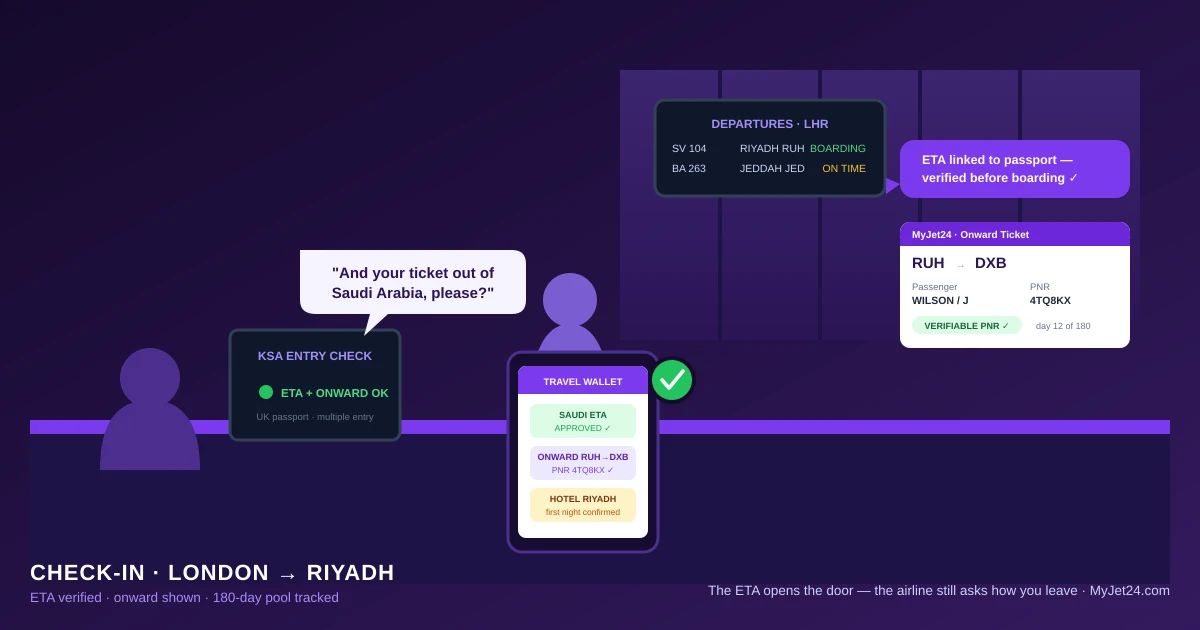
Three checks stand between a UK traveler and a Saudi arrivals hall, and the ETA only answers the first:
- Authorization check: the airline verifies your ETA (electronically linked to the passport) before boarding — the same gate ESTA and UK-ETA travelers know.
- Onward-travel check: flying one-way, you can be asked at check-in how you leave the Kingdom. Saudi practice mirrors the wider region: carriers verify a return or onward booking for visitors, because the airline owns the cost if you're refused. A verifiable onward ticket with a live PNR settles it in 30 seconds without buying a flight you haven't planned yet — the same instrument covered across our proof of onward travel guide.
- Arrival formalities: biometrics at the border, accommodation address, and the usual questions about purpose. Keep your first hotel booking handy — a hotel confirmation answers the address question cleanly.
Who Should Still Use the eVisa or a Different Visa
| Traveler | Right instrument |
|---|---|
| UK passport holder — tourism, business visit, Umrah, short study | ETA — cheaper, longer, multiple entry |
| UK resident traveling on a non-UK passport | Tourist eVisa if the nationality is eligible; otherwise embassy visa — the ETA is passport-based, not residence-based |
| Holder of a valid, already-paid tourist eVisa | Keep using it until expiry; switch to the ETA at renewal |
| Working in KSA, relocating, or joining Hajj | Work / residence / Hajj visa respectively — all outside the ETA |
| Multi-country Gulf trip beyond Saudi | ETA for the Saudi leg now; watch the GCC unified visa as it rolls out for the single-permit future |
Six Mistakes to Avoid With the New ETA
- Paying a third-party "portal" ten times the fee. The official charge is a fraction of the eVisa's — any site quoting eVisa-level prices for the ETA is selling you a markup or worse.
- Assuming it covers Hajj. It explicitly doesn't. Umrah under the tourism umbrella yes; Hajj never without the dedicated visa.
- Confusing 180 days of stay with 12 months of living. The pool is 180 days per year — and local employment is excluded no matter how many days remain.
- Ignoring the day count across trips. Multiple entries share one pool; track your entries and exits like a Schengen regular.
- Flying one-way with nothing to show. The ETA authorizes entry; the airline still wants to see how you leave. Carry a verifiable onward reservation.
- Assuming insurance is bundled. The eVisa includes it; verify what the ETA flow attaches at checkout and carry proper travel insurance regardless.

Frequently Asked Questions
What is the new Saudi Arabia ETA for UK citizens?
An Electronic Travel Authorization launched on 1 July 2026 for holders of all types of UK passports, announced by Saudi Arabia's Ministry of Foreign Affairs on 25 June. It allows multiple entries over a 12-month validity with stays totaling up to 180 days per year, for tourism, business visits and short-term study — replacing the need for the pricier tourist eVisa for most UK travelers.
How much does the Saudi ETA cost for UK citizens?
The government charge is reported at around SAR 50 (roughly £10) and is non-refundable — compared with SAR 500–600 (£100–130, insurance included) for the classic tourist eVisa. Confirm the exact current amount in the official portal when applying, and avoid third-party sites adding service markups.
How long can I stay in Saudi Arabia on the ETA?
Up to 180 days in total within the 12-month validity — taken either as one continuous stay or split across multiple trips. That's double the tourist eVisa's 90-day allowance. You're responsible for tracking your own day count across entries, as the pool is shared by all your trips in the year.
Can I perform Umrah on the Saudi ETA?
Yes — Umrah follows the tourism umbrella outside the Hajj season, exactly as it does on the tourist eVisa, with rituals booked through the Nusuk platform. UK Umrah operators adopted the ETA immediately at launch. Hajj is different: it is explicitly excluded and always requires its own visa through licensed channels.
Can I do Hajj on the Saudi ETA?
No. Participation in Hajj is explicitly excluded from the ETA, as it is from the tourist eVisa. Hajj runs on a dedicated visa allocated through national quotas and licensed operators, and attempting it on any other status carries severe penalties including entry bans.
Which passports qualify for the new ETA?
All types of UK passports. The scheme is nationality-based: UK residents holding other passports don't qualify through residence and should use the tourist eVisa (if their nationality is among the ~60 eligible) or an embassy visa. Other nationalities may see similar ETAs later if Saudi Arabia extends the model.
I already have a valid Saudi tourist eVisa — is it still good?
Yes. Existing eVisas remain valid until their expiry and work exactly as before. There's no need to switch mid-validity; move to the ETA when your eVisa lapses — you'll pay a fraction of the renewal cost and gain the 180-day allowance.
How do I apply for the Saudi ETA?
Through the official Saudi visa platform (visa.visitsaudi.com) or the Nusuk app: passport details, a photo, contact and accommodation information, purpose questions and the fee. Electronic authorizations typically clear within 24–72 hours; apply a few days ahead, more before Ramadan and peak Umrah periods.
Why did Saudi Arabia introduce an ETA just for the UK?
Reciprocity and market size. Since the UK's own ETA launched, Saudi nationals have needed a £16 UK ETA for visa-free visits to Britain; the Kingdom has now mirrored the arrangement. The UK is also one of Saudi tourism's priority Western markets under Vision 2030, so lowering entry friction serves both diplomacy and tourism strategy.
Does the Saudi ETA include medical insurance?
The tourist eVisa famously bundles mandatory medical insurance into its fee; for the ETA, check what the official application flow attaches at checkout before assuming coverage. Either way, carry proper travel insurance for the Gulf — medical costs for the uninsured are substantial.
Do I need a return or onward ticket to enter Saudi Arabia on the ETA?
Expect the airline to ask, especially on one-way bookings — carriers across the region verify how visitors will leave, because they bear the cost of a refused passenger. A verifiable onward reservation with a live PNR answers the check without buying a flight prematurely; keep it alongside your ETA approval and first-night hotel confirmation.
Can I work in Saudi Arabia on the ETA?
No. Employment in the Kingdom is explicitly excluded, along with long-term residence. Those routes keep their dedicated visa processes. The ETA's "short-term study" purpose covers courses and programs, not employment contracts.
Is the Saudi ETA the same as the GCC unified tourist visa?
No — they're separate developments. The ETA is a bilateral UK–Saudi arrangement for entering Saudi Arabia alone; the GCC unified visa is the planned Schengen-style single permit for six Gulf states, still rolling out. For a Saudi-only or Saudi-heavy trip the ETA is your tool today; multi-Gulf itineraries will eventually benefit from the unified permit.
What documents should I carry at the Saudi border with an ETA?
Your UK passport (the ETA links to it electronically), the ETA approval saved or printed, your first accommodation's address and confirmation, and — if traveling one-way — a verifiable onward reservation. Biometrics are captured on arrival; the questions are routine when your documents tell one consistent story.
Sources & further reading
- Saudi Press Agency — MOFA launches Electronic Travel Authorization for UK citizens (25 June 2026)
- Envoy Global — legal alert on the ETA's parameters
- Visit Saudi — official visa platform
- GOV.UK — Saudi Arabia entry requirements for British citizens
Fees, insurance bundling and application-flow details are being finalized during the rollout; confirm current figures in the official portal before applying. This guide reflects conditions documented as of July 2026.
