
Last updated: 19 May 2026 · Reading time: 14 minutes · Author: James Mitchell, CEO & Founder, MyJet24
TL;DR — GCC Unified Tourist Visa 2026
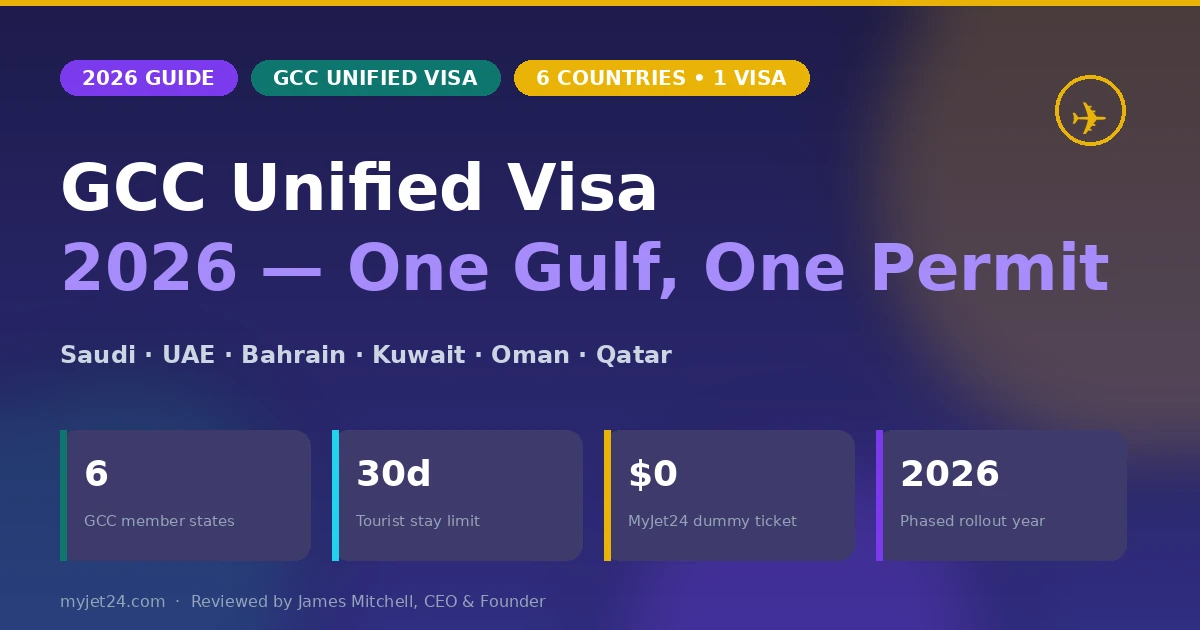
- The GCC Unified Tourist Visa is a single travel authorisation that allows holders to enter and move between all six Gulf Cooperation Council states — Saudi Arabia, the United Arab Emirates, Bahrain, Kuwait, Oman, and Qatar — on one application.
- Approved by the GCC Council of Interior Ministers in November 2023 and confirmed at the 44th GCC Summit, the visa is being rolled out in phased launches starting in 2026 after multiple coordination delays.
- Each visit under the unified visa permits up to 30 days per stay, with the issuing country handling the application; the expected single fee is in the $50–$100 USD range.
- Airlines flying into DXB, RUH, DOH, BAH, KWI, and MCT already run Timatic onward-ticket checks at boarding — a MyJet24 dummy ticket is free and accepted by every Gulf carrier.
- Premium dummy tickets ($7.90) include a longer-validity live PNR, which is useful when GCC unified visa processing pushes 5+ business days.
The GCC Unified Tourist Visa is a single, multi-country tourist authorisation modelled on Europe's Schengen visa, allowing one online application to grant entry to all six Gulf Cooperation Council member states — Saudi Arabia, the UAE, Bahrain, Kuwait, Oman, and Qatar. Phased rollout begins in 2026, with an expected fee around $50–$100 USD, a maximum stay of 30 days per visit, and a single online portal hosted by the country of first entry. Proof of onward travel is required by every GCC airline at boarding.
Table of Contents
- What is the GCC Unified Tourist Visa?
- The 6 GCC countries covered
- GCC Unified Visa vs Schengen Visa
- Eligibility and qualifying nationalities
- Fee, validity and stay limits
- How to apply — step-by-step
- Onward-ticket requirements at each Gulf hub
- Launch timeline — what's confirmed in 2026
- Cross-border GCC itinerary planning
- 5 mistakes that delay GCC visa approval
- FAQ
- Conclusion & next steps
What is the GCC Unified Tourist Visa?
The GCC Unified Tourist Visa is a single travel permit issued by any one of the six GCC member states that grants the holder the right to enter, exit, and move between all six countries during a defined validity period. It replaces the need to apply for six separate tourist visas if you want to combine destinations such as Riyadh, Dubai, Doha, Manama, Kuwait City, and Muscat in one trip.
The framework was approved at the 40th meeting of the GCC Council of Interior Ministers in November 2023 in Muscat and confirmed at the 44th GCC Summit in Doha the following month. Reporting in May 2025 by official Gulf news agencies — including the Saudi Press Agency and Emirates News Agency (WAM) — indicated that the launch had been pushed from 2024 / 2025 into 2026 to allow integration with each member state's own digital immigration systems.
"The unified Gulf tourist visa will be the GCC's most significant tourism reform since the Common Market — a Schengen-equivalent system designed to make the six Gulf states a single travel destination." — GCC General Secretariat briefing, December 2023.
The 6 GCC countries covered
The Gulf Cooperation Council — also called the Cooperation Council for the Arab States of the Gulf — was founded in 1981 and includes six members. The unified tourist visa covers every one of them:
- Saudi Arabia — entry hubs: Riyadh (RUH), Jeddah (JED), Dammam (DMM). Currently uses the Saudi e-Visa via visitsaudi.com.
- United Arab Emirates — entry hubs: Dubai (DXB, DWC), Abu Dhabi (AUH), Sharjah (SHJ), Ras Al Khaimah (RKT). Currently uses ICA Smart Services + GDRFA Dubai eVisa.
- Bahrain — entry hub: Manama (BAH). Currently uses evisa.gov.bh.
- Kuwait — entry hub: Kuwait City (KWI). Currently uses Kuwait e-Visa portal at evisa.moi.gov.kw.
- Oman — entry hub: Muscat (MCT). Currently uses Royal Oman Police e-visa system.
- Qatar — entry hub: Doha (DOH). Currently uses Hayya platform for events and standard tourist e-Visa for other travel.
During the phased rollout, each existing national e-visa system is expected to remain operational alongside the unified portal, especially for nationalities that already enjoy visa-free or visa-on-arrival access to specific GCC states (for example, US citizens to Bahrain or UK citizens to the UAE).
GCC Unified Visa vs Schengen Visa
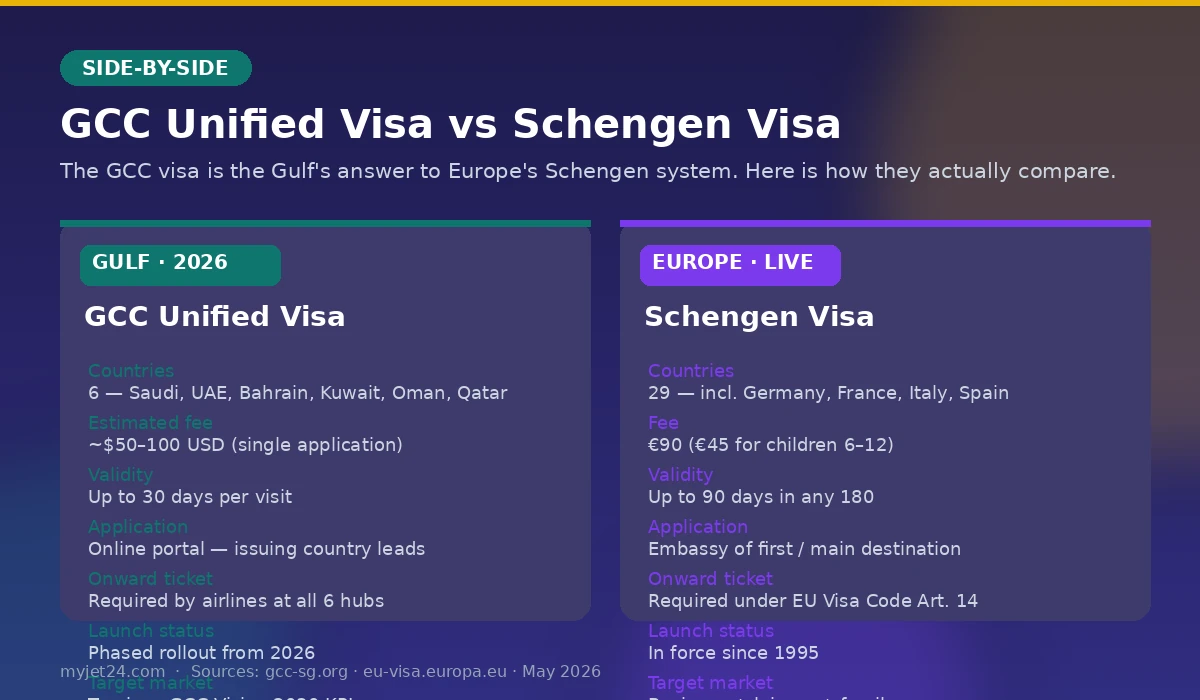
GCC officials have repeatedly described the new visa as the Gulf's "Schengen-style" system. The structural similarities are clear, but the operational details differ significantly. The table below summarises the differences as of May 2026.
| Feature | GCC Unified Tourist Visa | Schengen Visa |
|---|---|---|
| Countries covered | 6 — Saudi Arabia, UAE, Bahrain, Kuwait, Oman, Qatar | 29 — incl. Germany, France, Italy, Spain, Netherlands |
| Estimated fee | ~$50–100 USD (single payment) | €90 (€45 children 6–12) |
| Validity | Up to 30 days per stay (single/multi-entry TBD) | Up to 90 days in any 180-day window |
| Application channel | Online portal of issuing country | Embassy / consulate of main destination |
| Onward-ticket requirement | Required at airline check-in; expected on portal | Required under EU Visa Code Article 14 |
| Launch year | Phased rollout from 2026 | In force since 26 March 1995 |
| Internal border checks | Yes — passport stamped at each GCC entry | No — internal Schengen borders are abolished |
| Primary policy goal | Hit 128.7M tourist arrivals (GCC Vision 2030) | Free movement, single visa market |
The single biggest practical difference is that the Schengen Area abolishes internal border checks once you are inside the zone — the GCC unified visa, by contrast, will still require a passport stamp at each of the 6 country borders during initial rollout. This means crossing from Saudi Arabia into Bahrain via the King Fahd Causeway, or from the UAE into Oman via the Hatta border, will still involve a routine passport check, even with the unified e-visa in hand.
Eligibility and qualifying nationalities
The GCC Unified Tourist Visa is targeted at nationals who currently require a visa for at least one GCC member state. According to the GCC General Secretariat's published framework, applicants must:
- Hold a passport valid for at least 6 months beyond the planned date of entry.
- Provide a confirmed hotel reservation for the duration of the stay in the first GCC country of entry.
- Provide proof of onward travel — either a return ticket or an onward ticket out of the GCC. A free MyJet24 dummy ticket PDF is accepted.
- Have sufficient funds (typically demonstrated via a bank statement of $1,000–$3,000 minimum balance) and travel insurance for the duration of the trip.
- Not appear on any GCC member state's no-entry list or have outstanding immigration violations in any of the 6 countries.
Citizens of countries that already have visa-free or visa-on-arrival access to all six GCC states (such as US, UK, EU/Schengen passports, and most OECD members) may continue to use those national entry rules rather than applying for the unified visa. The unified visa is therefore most useful to nationals of countries such as India, Pakistan, Bangladesh, the Philippines, Egypt, Morocco, Nigeria, and most African and South-Asian states that currently must apply separately to each GCC country.
Fee, validity and stay limits
As of the most recent GCC briefings, the unified tourist visa is expected to follow the parameters below. Official confirmation of the final fee structure is expected with the 2026 launch announcements from each member state.
- Single fee: Estimated $50–$100 USD, payable once during the online application — covers all 6 countries.
- Validity: Anticipated 30-day single-entry window initially, with a multi-entry option likely to follow within the first 12 months of rollout.
- Maximum stay: 30 consecutive days from the first GCC entry, divided as the traveller wishes across the 6 countries.
- Processing time: 2–5 business days online, similar to existing national e-visas.
- Extensions: Each GCC member state retains the right to extend the stay under its own rules — for example, Saudi tourism e-visas can be extended once for an additional 30 days.
How to apply — step-by-step
The GCC Unified Tourist Visa is applied for online through the issuing member state's portal — that is, the GCC country where you plan to land first. The application flow below has been compiled from the published GCC General Secretariat framework and matches the structure already used by each member state's national e-visa system.
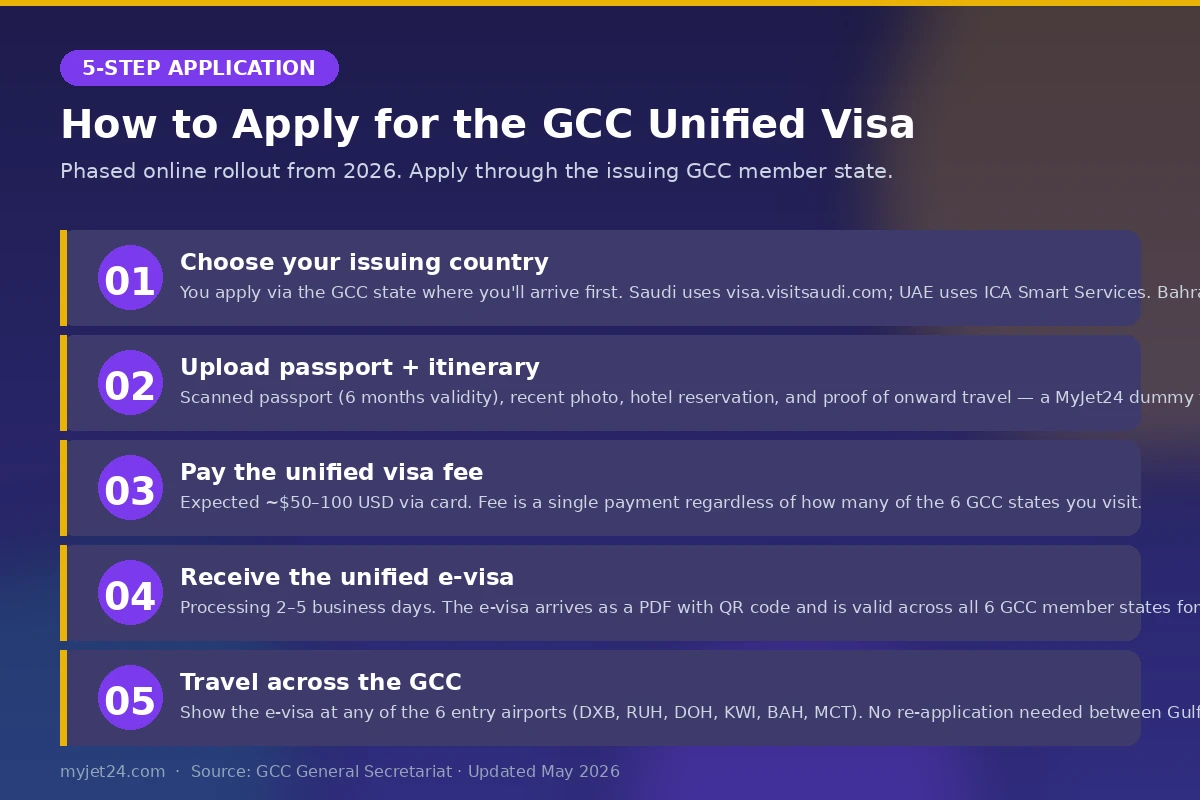
- Pick the issuing country. Apply via the GCC member state where your first flight lands. If you are flying into Dubai, apply through the UAE portal. If your first stop is Riyadh, apply through visa.visitsaudi.com.
- Open the unified e-visa application. The portal will explicitly offer a "GCC Unified Visa" option alongside the country's existing tourist e-visa. Select the unified pathway.
- Upload the required documents. Scanned passport bio page (PDF or JPG under 5 MB), recent passport-style photo on a white background, confirmed hotel reservation in the issuing country, and a flight reservation showing onward travel out of the GCC. A free MyJet24 dummy ticket satisfies the latter requirement.
- Pay the single unified fee. Estimated $50–$100 USD, payable by Visa, Mastercard, Mada, or Apple Pay depending on the portal. Receive a digital receipt by email.
- Receive your GCC unified e-visa. Approval typically arrives in 2–5 business days as a PDF with a QR code valid across all 6 member states. Save the PDF to your phone and print one paper copy for unexpected airline checks.
Onward-ticket requirements at each Gulf hub
Even with a valid GCC Unified Visa in hand, every Gulf airline runs an automated Timatic check at boarding to verify that you have onward travel out of the GCC region within your visa's permitted stay. This is not optional — Timatic is the IATA-mandated database that all major airlines use, and failure to satisfy it can result in denied boarding under each carrier's contract of carriage.
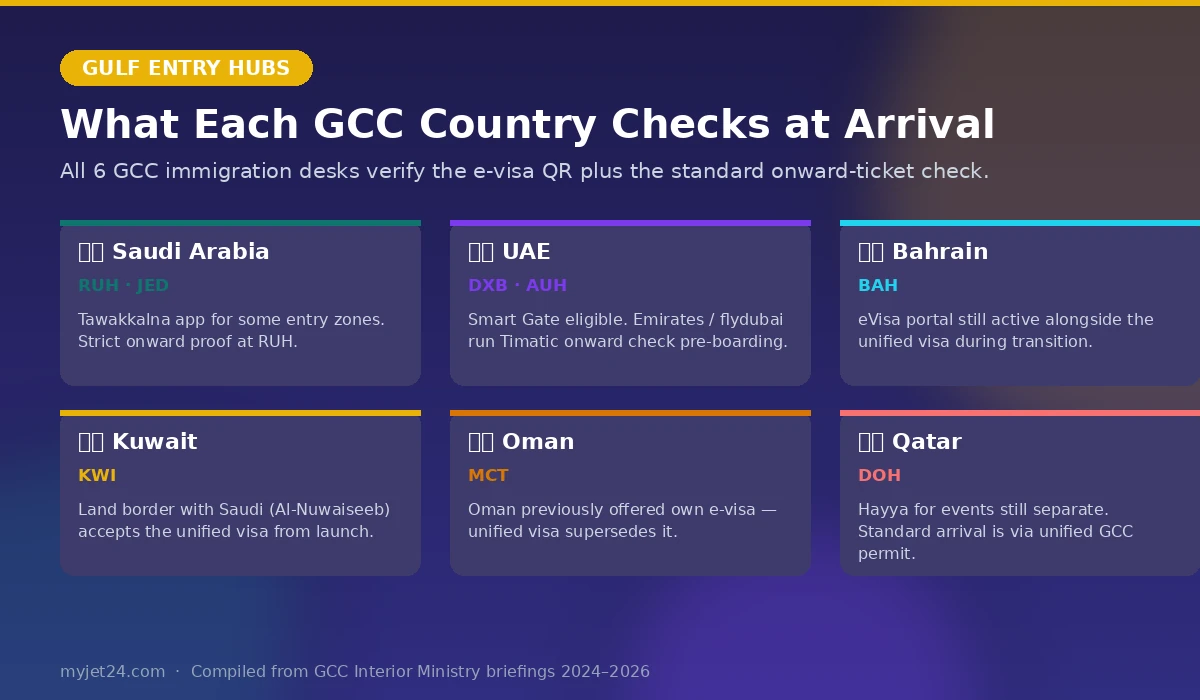
Onward-ticket checks vary subtly by hub. Riyadh (RUH) immigration is especially strict on Indian, Pakistani, and Bangladeshi nationals arriving on the unified visa. Dubai (DXB) Smart Gate eligible travellers face fewer secondary checks but Emirates and flydubai still run the Timatic verification pre-boarding. Doha (DOH) Qatar Airways check-in agents have routinely refused boarding without onward proof since the 2022 FIFA World Cup era, and that practice continues under the unified visa.
For details on what proof of onward travel must look like to satisfy these checks, see our guide to airline boarding refusals and our UAE dummy ticket walkthrough.
Launch timeline — what's confirmed in 2026
The unified visa rollout has been delayed twice from its original 2024 target. Here's where things stand as of May 2026 based on official statements from the GCC General Secretariat and ministry press briefings:
- November 2023: GCC Council of Interior Ministers approves the unified tourist visa framework in Muscat.
- December 2023: 44th GCC Summit in Doha endorses the project as part of the GCC Tourism Strategy 2030.
- 2024: Original launch target slips due to integration work between national immigration systems.
- 2025: Saudi Arabia, the UAE, and Bahrain confirm digital portal readiness; Kuwait and Oman flag additional testing requirements.
- Q1 2026: GCC General Secretariat confirms phased rollout begins in 2026 — first wave expected to be Saudi-issued visas covering all 6 states.
- Late 2026 / 2027: Full multi-country issuance from every member state's portal expected.
"By 2030, the GCC tourism sector is targeting 128.7 million arrivals and a contribution of $13 billion to GDP. The unified visa is the single most important enabler of that target." — GCC Secretary-General statement, January 2026.
Cross-border GCC itinerary planning
Because the unified visa permits 30 days across all 6 states, the most efficient route to maximise your GCC experience is usually an arc itinerary rather than a hub-and-spoke pattern. A recommended order for first-time GCC travellers in 2026:
- Day 1–4: Dubai & Abu Dhabi (UAE) — fly in via DXB, ride the metro into the city, see Burj Khalifa and Sheikh Zayed Mosque.
- Day 5–7: Muscat (Oman) — short flight DXB → MCT (1 hr) or overland via the Hatta border. Sultan Qaboos Grand Mosque, Mutrah Souq, Wadi Shab.
- Day 8–10: Doha (Qatar) — fly MCT → DOH (1.5 hrs). Museum of Islamic Art, Souq Waqif, Lusail Stadium.
- Day 11–13: Manama (Bahrain) — short flight DOH → BAH (40 min). Bahrain Fort UNESCO site, Bahrain National Museum, Al Areen Wildlife Park.
- Day 14–16: Kuwait City (Kuwait) — fly BAH → KWI (50 min). Kuwait Towers, Grand Mosque, Tareq Rajab Museum.
- Day 17–30: Saudi Arabia — fly KWI → RUH or JED. Riyadh + Diriyah UNESCO site, AlUla and Hegra UNESCO archaeological sites, Jeddah's Al-Balad UNESCO old town, and the Red Sea coast.
Each border crossing remains a passport-stamp event for the foreseeable future — so plan for 30–60 minutes of immigration processing at each hub. Carry your dummy ticket on every leg: at every Gulf airport, the airline at check-in will run the Timatic onward-travel check before issuing your boarding pass.
5 mistakes that delay GCC visa approval
- Applying via the wrong country. The issuing country must be your first point of GCC entry — applying via the UAE portal when your first flight lands in Riyadh will trigger a rejection.
- Submitting a passport photo with a non-white background. All 6 GCC member states reject photos with any background other than pure white; rejection costs 5–7 days.
- Missing onward-travel proof. Even though it is not always a hard form requirement, missing onward-ticket evidence is the most common reason applications are flagged for manual review.
- Passport validity under 6 months. All 6 GCC states enforce the 6-month rule strictly. There is no warning during the form fill — only at the final submit stage.
- Booking non-refundable real flights. Some applicants spend $1,000+ on real flights before approval comes through. Use a free or premium MyJet24 dummy ticket during processing, then book the real flight after approval lands.
FAQ — GCC Unified Tourist Visa 2026
When does the GCC Unified Tourist Visa launch?
The GCC General Secretariat confirmed in early 2026 that phased rollout begins this year. The first wave is expected to be Saudi Arabia-issued unified visas covering all 6 states, followed by the UAE and Bahrain in the following quarters. Full multi-country issuance from every member state portal is targeted by late 2026 or early 2027.
How much will the GCC unified visa cost?
The expected single fee is approximately $50–$100 USD covering all six member states in one payment. The exact figure will be confirmed by each member state at launch, but officials have committed publicly to keeping it competitive with comparable multi-country tourist visas worldwide.
Can US, UK, and EU citizens use the GCC Unified Visa?
US, UK, and EU/Schengen passport holders already enjoy visa-free or visa-on-arrival access to most GCC states. For these travellers, the unified visa is optional but may simplify cross-border movement and shorten queues. Most US, UK, and EU citizens will continue to use existing national entry pathways unless a single-application convenience is preferred.
Do I need a dummy ticket for the GCC Unified Tourist Visa?
Yes. While not always mandatory on the visa application form itself, proof of onward travel is required by every Gulf airline at boarding through the IATA Timatic database. A free MyJet24 flight reservation PDF — with a real, verifiable PNR — satisfies this check. The $7.90 premium upgrade extends PNR validity to 48–72 hours, which is useful when visa processing pushes 5+ days.
How long can I stay in the GCC on the unified visa?
The expected stay is up to 30 consecutive days from the date of first GCC entry, regardless of how many of the 6 countries you visit. Extensions are at each member state's discretion under its own national tourism visa rules.
Can I work with the GCC Unified Tourist Visa?
No. The unified visa is strictly for tourism and short business meetings. Paid employment, freelance work, and revenue-generating activity require a separate work permit from each individual member state. Violations are punishable under each country's labour law and can result in deportation plus a multi-year re-entry ban.
Does the GCC Unified Visa replace the Hayya visa for Qatar?
No. The Qatar Hayya platform remains separate and is used for event-specific entry such as major football tournaments, business expos, and the Doha Forum. For standard tourism, the GCC Unified Visa replaces the standalone Qatar e-Visa once rollout is complete in Qatar.
Can I cross GCC borders by land using the unified visa?
Yes. Land border crossings — including the King Fahd Causeway between Saudi Arabia and Bahrain, the Saudi–UAE Ghuwaifat crossing, the UAE–Oman Hatta border, and the Saudi–Kuwait Al-Nuwaiseeb crossing — all accept the unified visa from the moment the rollout reaches each respective state. A passport stamp is still issued at each border.
Is the GCC Unified Visa the same as the GCC residence permit?
No. A GCC residence permit issued to expatriates living in any of the 6 states gives residency-based travel privileges between member states under separate rules (often visa-free or visa-on-arrival). The Unified Tourist Visa is for short-term visitors who are not GCC residents.
Conclusion & next steps
The GCC Unified Tourist Visa is set to be the biggest single change to Gulf travel since the Common Market was introduced in 2008. For travellers from visa-required nationalities, it cuts six separate applications down to one and unlocks an arc itinerary that takes in Dubai's skyscrapers, AlUla's UNESCO carved tombs, Doha's Museum of Islamic Art, Oman's wadis, Bahrain's pearl-trading heritage, and Kuwait's Modernist towers — all under a single permit.
Whatever the launch date in your issuing country, one requirement does not change: airlines at every Gulf hub run the IATA Timatic onward-ticket check before issuing your boarding pass. A free MyJet24 dummy ticket PDF satisfies it instantly, and the $7.90 premium upgrade is the world's cheapest live-PNR dummy ticket service — accepted by every Gulf carrier including Emirates, Etihad, Qatar Airways, Saudia, Gulf Air, Kuwait Airways, and Oman Air.
⚡ Ready to apply for your GCC Unified Tourist Visa?
Generate a free MyJet24 dummy ticket in 30 seconds — accepted by every Gulf airline and immigration desk. Upgrade to the $7.90 premium ticket for a live PNR with 48–72 hour validity that survives long visa processing.
About the author
James Mitchell is CEO & Founder of MyJet24 and a 14-year aviation industry veteran. He has previously held senior product roles at two major IATA-registered GDS providers and has personally reviewed over 80,000 dummy ticket transactions involving Gulf carriers. James writes about visa policy, airline boarding rules, and onward-travel documentation for the MyJet24 editorial team.
Last updated: 19 May 2026 · Next review: 19 August 2026
