
Last updated: 11 October 2026 · Reading time: 21 min · Author: Marc Hoffmann, Senior Visa Consultant at MyJet24 · Reviewed by: James Mitchell, Travel Documentation Specialist
TL;DR — Key Facts
- Australia asks for money, not a ticket. The official evidence rule wants funds for personal support of approximately AUD 5,000 and, on top of that, funds to purchase a return or onward fare. Nowhere does it ask you to have booked a flight.
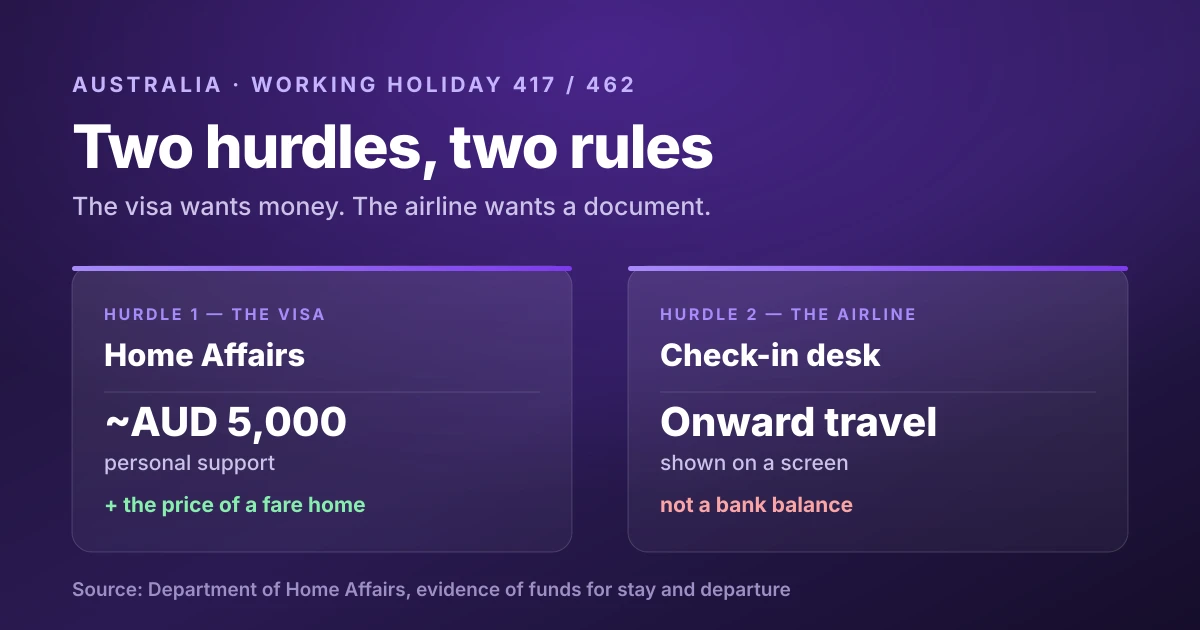
- There are two separate hurdles, and almost every guide blends them into one. Home Affairs decides the visa on your bank balance. The airline decides boarding at the check-in desk, and that is where a one-way traveller gets asked about onward travel.
- The department tells you not to book. Processing is running at around three months, and the official page says in as many words: do not book flights until your visa has been granted.
- 417 and 462 are not the same visa. Subclass 417 runs 18 to 30, or up to 35 for some passports. Subclass 462 is 18 to 30 inclusive, with no extension. Both cost AUD 840 and both give you 12 months.
- Three months of specified work buys a second year, six months buys a third. British passport holders have been exempt from that work requirement since 1 July 2024.
- The refusals cluster around evidence, not eligibility. A balance that appeared last week, a statement with no name on it, or a figure that only just covers the AUD 5,000 and leaves nothing for the fare.
Does Australia want a return ticket, or the money for one?
The money for one. This is the single most misread line in the whole working holiday process, and it is worth reading the official wording slowly, because the Department of Home Affairs chose every word in it:
“Provide evidence that you have sufficient funds for personal support during your stay in Australia (approximately AUD5000) and evidence that you have sufficient funds to purchase a return or onward ticket for a fare to depart Australia at the conclusion of your stay (in addition to your funds for personal support while in Australia).”
Read it twice and three things fall out.
First, the obligation is financial. The words are “sufficient funds to purchase”. Not “a confirmed booking”, not “a ticket”, not “an itinerary”. A case officer who asks you for proof here is asking to see money, and a bank statement answers the question completely.
Second, the two amounts stack. The phrase “in addition to your funds for personal support” is doing real work. The roughly AUD 5,000 is for living. The fare money sits on top of it. An applicant who shows AUD 5,100 and a one-way flight already behind them has, on a strict reading, shown AUD 5,100 for living and nothing for the departure.
Third, “approximately” is not a typo. There is no legislated figure. AUD 5,000 is the number the department publishes as guidance, and a case officer can look at a twelve-month plan with AUD 5,000 and a four-month plan with AUD 5,000 and reach different conclusions about both.
So if you have been hunting for the rule that says you must hold a return flight: it does not exist for this visa. What exists is a rule about your balance.
The two hurdles nobody separates
Here is where most advice goes wrong, including advice from people who mean well. “Do I need an onward ticket for Australia?” is not one question. It is two, and they are answered by two different organisations on two different days against two different rulebooks.
| Hurdle 1 — the visa | Hurdle 2 — the flight | |
|---|---|---|
| Who decides | Department of Home Affairs | The airline at check-in |
| When | Weeks or months before you fly | At the desk, 90 minutes before departure |
| What satisfies it | A bank balance | A document on your screen |
| If you fail it | Refusal, and the AUD 840 is gone | You are not boarded |
Hurdle 1 is settled with a statement from your bank. Hurdle 2 is a different animal. A working holiday visa holder is, by design, someone who does not know when they are leaving — that is the whole point of the visa. You turn up at the airport with a one-way ticket, and a check-in agent runs your details through the airline's document system.
That system does not read your bank account. It reads what is attached to your booking. We have written separately about how the airline document check works and why it is the step travellers understand least.
Why does the department tell you not to book flights?
Because of its own queue. The official subclass pages carry this notice at the top, above the eligibility list:
“To manage high demand and support the long-term sustainability of the WHM program, we are normalising processing timeframes for most WHM visa applications. The average processing time is expected to be around three months. Do not book flights or make travel, work or study commitments until your visa has been granted.”
Sit with the combination for a moment, because it is genuinely awkward and nobody writes it down.
The department asks you to prove you can afford a departure fare. The same department, on the same page, tells you not to buy flights. And the airline you eventually fly with may want to see onward travel at the desk.
Three sentences, three different expectations, and travellers reconcile them by guessing. Usually the guess is expensive: they buy a flexible return fare for several hundred dollars months before they know their plans, on a visa whose entire purpose is that you do not yet have plans.
You do not have to guess. The three expectations resolve cleanly once you stop treating them as one requirement:
- For the visa: show the money. A bank statement covering living costs plus a fare.
- Before you buy anything: wait for the grant. Three months is the department's own figure, and a refused applicant with a paid ticket has lost both.
- For the airport: deal with it once the visa exists and your departure date is near — not nine months early.
How much money do you actually need?
Start from AUD 5,000 and then adjust, because the figure is guidance rather than law.
| Item | Amount | Where it comes from |
|---|---|---|
| Personal support | ~AUD 5,000 | Official evidence guidance |
| Departure fare, on top | Cost of a realistic one-way home | Same guidance, “in addition” |
| Visa application charge | AUD 840 | Published fee, 417 and 462 alike |
The fare figure is the one applicants lowball. From Europe, a one-way economy seat out of Australia in a busy month is not AUD 400. Budget what the flight home would genuinely cost in December, not what you found once in a sale, and your file stops looking optimistic.
Two practical notes that matter more than the headline number:
The money has to look like yours. A balance that arrives in one transfer a week before you apply reads as a loan, because it usually is. Three to six months of ordinary statements showing the balance sitting there is worth more than a bigger number that appeared on Tuesday.
Name, currency, date. A screenshot of a banking app with no name on it is not evidence. A statement issued by the bank, carrying your full name as it appears in your passport, the currency, and a date close to your application is.
417 or 462 — which one applies to you?
They are two visas that behave almost identically once you are in Australia and differ sharply at the application stage. Which one you can apply for is decided by your passport, not by preference.
| Working Holiday (417) | Work and Holiday (462) | |
|---|---|---|
| Age | 18–30, or up to 35 for some passports | 18–30 inclusive, no extension |
| Cost | AUD 840 | AUD 840 |
| Stay | 12 months | 12 months |
| Extra conditions | Passport from an eligible country | Several countries add education, English or a government letter of support |
| Money rule | Identical | Identical |
Both are applied for online from outside Australia, both exclude dependent children, and both are individual applications — you cannot add a partner to your form, even if you travel together.
The 462 extra conditions are where applicants lose time. Depending on the passport, the list can include a minimum level of tertiary study, a functional-English test result, or a letter of support from your own government issued within a quota. None of that applies to 417.
At the airport: the one-way traveller problem
Your visa is granted. You have twelve months, no fixed plans, and a one-way ticket to Sydney. This is the correct way to use a working holiday visa, and it is also the moment where the second hurdle appears.
The check-in agent is not assessing your visa — a granted visa is a fact in the system, and an electronic visa is visible to the airline. What the agent is looking at is the airline's own liability. If a passenger is refused entry on arrival, the airline carries them home at its own cost and may be fined. That risk, not immigration policy, is what produces the question at the desk.
So the question gets asked unevenly. It depends on the airline, the route, the nationality on the passport, and sometimes on how busy the desk is. Plenty of working holiday makers fly one way and are never asked anything. Others are asked and have nothing to show.
What satisfies an agent at that moment is a document: something with a date, a route and a booking reference, visible on a screen. Not a bank statement — the agent has no interest in your balance and no mandate to assess it.
The honest version: an onward travel document solves the airport problem. It does not solve the visa problem, and anyone telling you that a reservation replaces the AUD 5,000 is giving you advice that ends in a refusal. For the visa, show the money. For the desk, have something to show.
If the airline question is the one you are worried about, our guide to how to show proof of onward travel covers the options — a cheap regional flight you intend to take, a refundable fare, or a held reservation — and what each one actually costs you.
A second year, and a third
This is where the working holiday visa stops being a holiday and starts being a plan.
- Second visa: three months of specified work, in a specified area, during your first year.
- Third visa: six months of specified work during your second year.
- British passport holders are exempt. Since 1 July 2024, UK nationals applying for a second or third Working Holiday visa do not have to meet the specified work requirement at all.
“Specified work” is a defined list — the headline examples are plant and animal cultivation, fishing and pearling, tree farming and felling, mining and construction — and it must be done in a postcode the department recognises for that industry. Work that is not on the list, or is on the list but done in the wrong postcode, counts for nothing.
Keep the evidence as you go, not at the end. Payslips, your employer's ABN, bank credits that match the payslips, and the dates. An applicant reconstructing eight months of fruit picking from memory in month eleven is the classic second-visa refusal.
One condition applies throughout: condition 8547 limits you to six months of work with any single employer. There are exemptions for certain industries and regions, but the default is six months, and it catches people who settle into one good job and stay.
Where applications actually go wrong
Not on eligibility. Eligibility is a short list and most applicants either meet it or do not. The refusals cluster around evidence, and the same handful of mistakes repeat.
The balance that appeared last week. A single transfer in, days before the application, with no history behind it. It reads as borrowed money that will be returned the moment the visa is granted. Season the account.
The number that only just covers it. AUD 5,050 in the account and a plan to stay twelve months. The guidance asks for roughly AUD 5,000 plus a fare — on a strict reading, that file is short by the price of a flight home.
The nameless screenshot. Phone banking screenshots with a balance and no account holder on them. They prove nothing and look like they are hiding something.
The ticket bought too early. Not a refusal reason, but the most common avoidable loss. Three months of processing, a non-refundable fare, and a refusal or a delay — and the fare is gone. The department's own notice exists precisely because this keeps happening.
The mismatched name. The passport says one thing, the bank statement another, the flight booking a third. Each document is fine alone; together they create a question that did not need to exist. We looked at this problem in detail in why your visa form and flight booking must match.
A clean sequence that avoids all of it
- Check which subclass your passport allows — 417 or 462 — and whether your country adds education, English or a letter of support.
- Season the account for a few months so the balance has a history, and budget the departure fare on top of the AUD 5,000 rather than inside it.
- Apply online from outside Australia, with bank statements that carry your passport name.
- Do not book anything. Three months is the published average.
- Once granted, book the outbound flight with the dates that suit you.
- Sort the airport question last, close to departure, when you know your route.
Step six is where a reservation earns its place — and only there. Our free onward ticket is built for exactly that moment: a document with a real booking reference for the check-in desk, without committing to a date you have not chosen yet. For the visa itself, go back to step two. The money is the requirement.
What a financial evidence pack looks like
The requirement is one sentence long. Meeting it convincingly takes three or four documents, and the difference between a file that passes without a question and one that triggers a request for more information is almost entirely presentation.
| Document | What it has to show | Common failure |
|---|---|---|
| Bank statement | 3–6 months, your passport name, currency, closing balance | App screenshot with no name |
| Balance confirmation | Issued by the bank, dated near your application | Months old by the time it is read |
| Fare evidence | That the departure money exists beyond the living money | Counted inside the AUD 5,000 |
| Source of funds | Salary credits, savings history, a sale — something ordinary | One large unexplained transfer |
Two files, same amount, different outcomes. The first shows AUD 7,200 that has sat between AUD 6,000 and AUD 8,000 for five months, with a salary landing monthly. The second shows AUD 7,200 that was AUD 300 eleven days ago. The number is identical; only one of them reads as savings.
If somebody else is funding you, say so rather than hiding it. A parent's statement plus a short signed letter explaining the support is a normal, acceptable arrangement. The same money arriving silently in your account, with no history and no explanation, is the version that raises the question.
If your currency is not AUD, leave the conversion to the officer but make it easy: a statement in your own currency with the balance clearly legible beats a hand-made conversion table. Build in a margin, because exchange rates move between the day you apply and the day somebody reads your file.
What if you already booked a flight?
Plenty of people read the department's notice after they have bought the ticket. It is not a problem for your application — a purchased flight neither helps nor harms the visa decision, because the decision is about funds.
It does change the arithmetic, though, and in a direction worth knowing. If you spent AUD 1,400 on flights last month, that money has left your account, and the balance an officer sees is AUD 1,400 smaller. You still need roughly AUD 5,000 of personal support plus departure money on top of it. Buying early can quietly pull your own file under the line.
The other risk is timing. Three months is an average, which means a meaningful share of applications take longer. A dated ticket against an undecided application is a bet, and the only person carrying the downside is you.
Frequently asked questions
Do I need a return ticket for the Australian working holiday visa?
No. The official evidence requirement asks for funds to purchase a return or onward fare, not for a booked flight. A bank statement answers it. The confusion comes from the airport, where a check-in agent may ask a one-way passenger about onward travel — a separate question, asked by the airline rather than by Home Affairs, and answered with a document rather than a balance.
How much money do I need for a working holiday visa in Australia?
Approximately AUD 5,000 for personal support, plus enough on top to buy a departure fare. The published wording says the fare money is “in addition to your funds for personal support”, so the two amounts stack rather than overlap. Budget a realistic one-way fare home in a busy month, not a sale price, and remember the AUD 840 application charge sits outside both figures.
Can I enter Australia on a one-way ticket with a working holiday visa?
Yes, and most people do — not knowing your departure date is the point of the visa. The risk is not immigration but the airline, which carries the cost if a passenger is refused entry and therefore sometimes asks one-way travellers to show onward travel at check-in. Whether you are asked depends on the airline, the route and your nationality.
How long does the Australian working holiday visa take in 2026?
Around three months on average. The department states it is normalising processing times for most working holiday applications and puts the average at roughly three months, with the explicit advice not to book flights or make travel, work or study commitments until the visa is granted. Individual cases run faster or slower.
What is the difference between subclass 417 and 462?
Your passport decides which one you can apply for. Subclass 417 runs from 18 to 30, or up to 35 for certain countries. Subclass 462 is 18 to 30 inclusive with no extension, and for several countries adds requirements such as tertiary study, functional English or a government letter of support. Both cost AUD 840, both grant 12 months, and the financial evidence rule is identical.
How much does the Australian working holiday visa cost?
AUD 840 for the visa application charge, for both subclass 417 and subclass 462. That is separate from the money you must show: the application fee is not counted towards the approximately AUD 5,000 of personal support or the departure fare. A refused application does not return the charge, which is why evidence quality matters more than speed.
Can I apply for a working holiday visa from inside Australia?
No. The first working holiday visa must be applied for online from outside Australia. You also cannot include family members in the application — each person applies individually — and you cannot be accompanied by dependent children while you hold the visa, even if someone else is caring for them in Australia.
How do I qualify for a second working holiday visa?
Three months of specified work in a specified regional area during your first visa. Specified work covers defined industries such as plant and animal cultivation, fishing and pearling, tree farming and felling, mining and construction, and the postcode has to be eligible for that industry. Keep payslips, employer details and matching bank credits as you go rather than reconstructing them later.
Do UK citizens still need specified work for a second visa?
No. Since 1 July 2024, British passport holders do not have to meet the specified work requirement when applying for a second or third Working Holiday visa. The other eligibility rules still apply, including age and the financial evidence, but the three months of regional work no longer stand between a UK applicant and a second year.
Will the airline check my bank balance at check-in?
No. The check-in agent assesses the airline's own risk of carrying a passenger who may be refused entry, and looks at documents attached to the booking — a visa in the system, a passport, and sometimes onward travel. Your funds are evidence for the visa decision, which has already been made by then, and no airline has a mandate to assess them.
The short version
For the visa, Australia wants to see money — roughly AUD 5,000 to live on and the price of a flight home on top of it. It does not want a booked ticket, and it asks you not to buy one until the visa is granted. The airline is the one that may want a document, months later, at a desk. Two hurdles, two answers. Mixing them up is what costs people either a refusal or a wasted fare.
