
Last updated: 28 July 2026 · Reading time: 17 min · Author: Marc Hoffmann, Travel Documentation Writer at MyJet24
TL;DR — Key Facts
- Visa-free does not mean walk-in. Every non-EU visitor must satisfy Article 6 of the Schengen Borders Code at the border: a valid passport, a justified purpose, enough money, and — for tourism — a return or round-trip ticket. The rule applies whether or not you needed a visa.
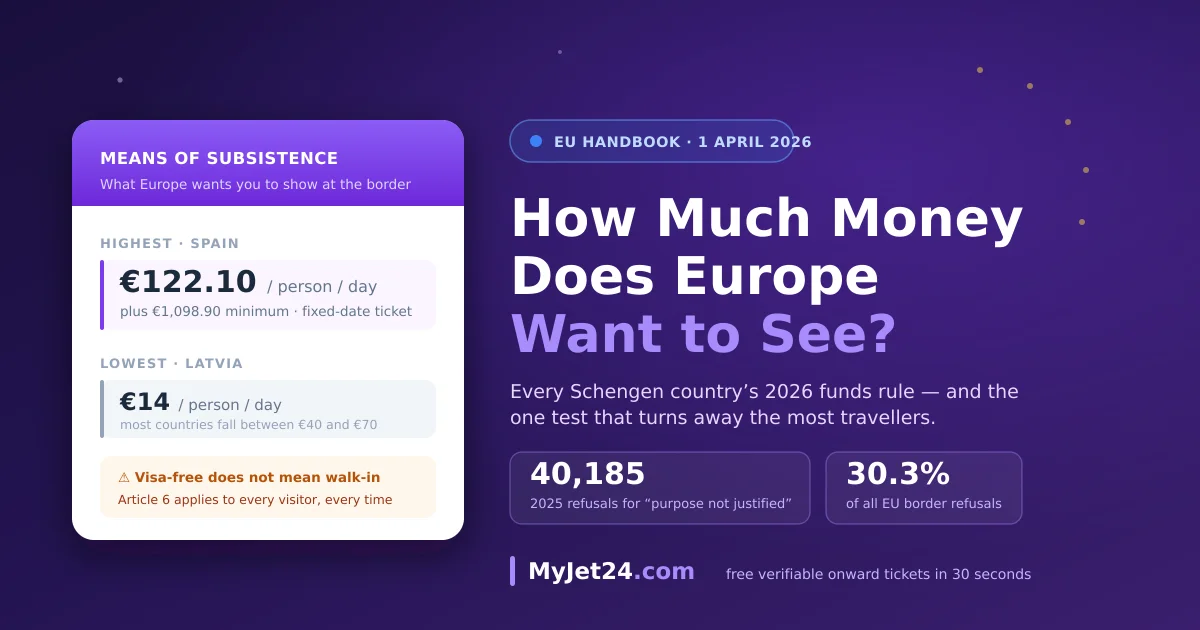
- Each country sets its own daily figure, and they vary wildly. The EU's own handbook (updated 1 April 2026) puts Spain highest at €122.10 per person per day, with a €1,098.90 floor; Latvia lowest at €14 a day. France jumps from €65 to €120 a day if you can't show a hotel booking.
- The single most common reason people are turned away is not a missing visa. In 2025, 40,185 refusals — 30.3% of all refusals, and 40.0% at air borders — were for failing to justify the purpose and conditions of the stay. That is the category a weak funds-and-onward-ticket file falls into.
- Nine countries name a ticket outright. Spain demands a "personal, non-transferable and fixed-date ticket" and refuses to accept internet-printed bank statements as proof of funds.
- On the visa side, one in seven applications is refused (14.6% in 2025), the €90 fee is never refunded, and rejected applicants collectively lost an estimated €157 million last year. Buying a real flight before approval is the worst way to spend money you might not get back.
- The fix is the same everywhere: a verifiable onward ticket, an accommodation booking and funds in a form the officer accepts. This guide gives you every country's number and shows how to assemble the file once.
To enter the Schengen Area in 2026 you must show "sufficient means of subsistence" under Article 6 of the Schengen Borders Code. The required amount is set by each country and ranges from about €14 per person per day (Latvia) to €122.10 per day with a €1,098.90 minimum (Spain). Most states sit between €40 and €70 a day. Alongside the money, border officers can require you to justify your trip and — for tourism — produce a return or round-trip ticket; nine Schengen states name a ticket explicitly. In 2025, 132,600 travellers were refused entry at EU external borders, and the largest single reason (40,185 cases, 30.3%) was failing to justify the purpose and conditions of the stay, which includes a weak funds or onward-travel file.
In this guide
- The rule almost nobody reads: Article 6
- How much money, country by country (2026 table)
- The four things an officer is really checking
- The onward ticket: nine countries name it
- What actually gets people refused: the 2025 numbers
- The visa side: €90 gone, one in seven times
- How to prove funds the way officers accept
- Seven mistakes that cost people entry
- Frequently asked questions
- The bottom line
The rule almost nobody reads: Article 6
Millions of travellers arrive in Europe every year believing that "visa-free" means "cleared to enter." It does not. Visa-free means you don't need a visa sticker to travel — it says nothing about the conditions you still have to meet when you reach the desk. Those conditions are the same for a visa-free American as for an Indian tourist holding a Schengen visa, and they are written into one paragraph of EU law that most people never see.
Article 6 of the Schengen Borders Code (Regulation (EU) 2016/399) lists the entry conditions for any third-country national arriving for a short stay of up to 90 days. In plain terms, you must have:
- a valid travel document — issued within the previous 10 years and valid for at least three months beyond your intended departure;
- a valid visa, if your nationality requires one;
- justification of "the purpose and conditions of the intended stay," and sufficient means of subsistence — for the stay itself and for the return home;
- no alert against you in the Schengen Information System; and
- no status as a threat to public policy, security or public health.
Two of those five are about money and paperwork rather than identity, and they are where ordinary tourists come unstuck. Article 6(3) lets the officer ask for the supporting documents listed in Annex I of the same Regulation. For travel for tourism or private reasons, that annex names three things: confirmation of accommodation, a document showing your travel plans, and — in the Regulation's exact words — "a return or round-trip ticket."
The core misunderstanding: people assume the funds-and-ticket checks apply only to visa applications. They apply again, independently, at the border — and the officer standing in front of you has more discretion than the consulate did. A visa gets you to the border. Article 6 decides whether you cross it.
How much money, country by country (2026 table)
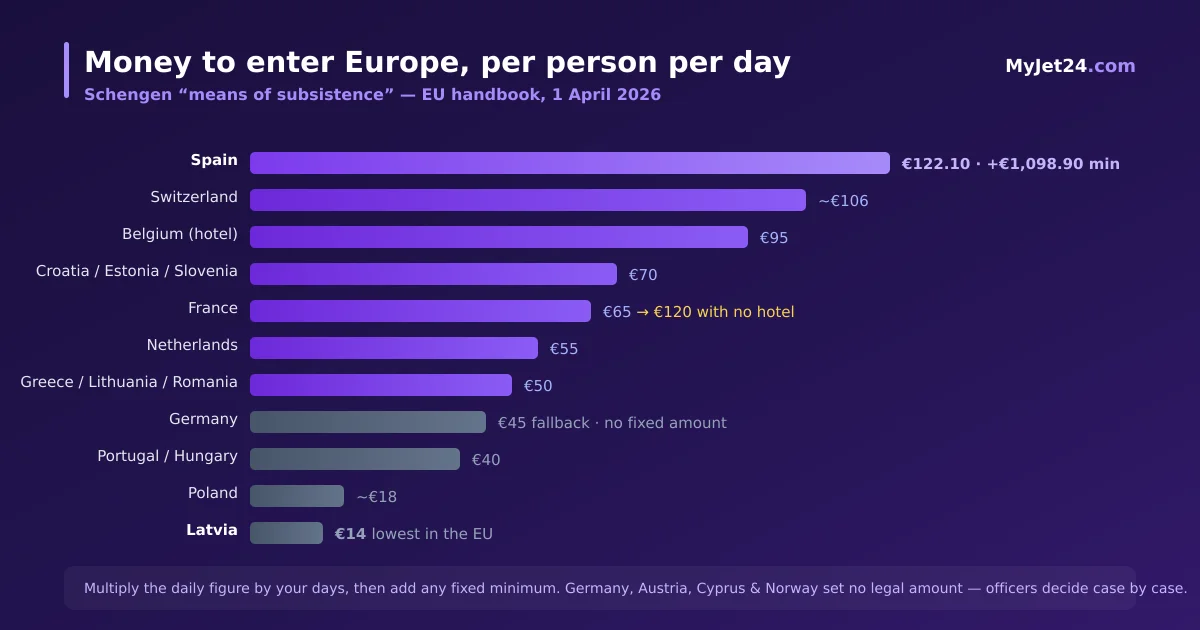
Article 6(4) says the amount of money considered "sufficient" is set by each Member State, which notifies its figure to the European Commission. The Commission publishes them all in one consolidated table — Annex 25 of the Practical Handbook for Border Guards, most recently updated 1 April 2026. It is a genuinely useful document that almost no traveller has ever read, so here it is in full, sorted from the most demanding country to the least.
| Country | Per person, per day | Fixed minimum | Names a ticket? |
|---|---|---|---|
| Spain | €122.10 | €1,098.90 | Yes — strict |
| Switzerland | ~€106 (CHF 100) | Host liability CHF 30,000 | No |
| Liechtenstein | ~€106 (CHF 100) | Host liability CHF 30,000 | No |
| Belgium (hotel) | €95 | — | Yes |
| Croatia | €70 (€30 with guarantee) | — | No (funds) |
| Estonia | €70 | — | No |
| Slovenia | €70 | — | No |
| Luxembourg | ~€67 | — | Yes |
| France | €65 (€120 with no hotel booking) | — | No |
| Czech Republic | ~€63 (CZK 1,565) | — | No |
| Iceland | ~€58 (ISK 8,000) | ~€288 (ISK 40,000) | No (funds) |
| Slovakia | €56 | — | No |
| Netherlands | €55 | — | No |
| Bulgaria | €50 (+€50 lodging) | €500 | Yes (funds or ticket) |
| Greece | €50 | €300 (up to 5 days) | No |
| Lithuania | €50 | — | No |
| Romania | €50 (€30 invitation) | €500 | No (funds) |
| Finland | ~€50 (case-by-case) | — | Yes (funds or tickets) |
| Malta | €48 | — | No |
| Denmark | ~€47 (DKK 350) | — | Yes (example) |
| Belgium (private) | €45 | — | — |
| Germany | €45 (fallback only) | No fixed amount | Yes (example) |
| Norway | ~€43 (NOK 500, indicative) | No fixed amount | Yes (factor) |
| Sweden | ~€41 (SEK 450) | — | No |
| Portugal | €40 | €75 per entry | No |
| Hungary | €40 | — | No |
| Poland | ~€18/day (PLN 75); PLN 300 if ≤4 days | — | No (funds) |
| Latvia | €14 | €700 if over 30 days | No (funds) |
Source: Annex 25 of the Schengen Practical Handbook for Border Guards, version 1 April 2026. Euro figures marked "~" are approximate conversions from national currencies at late-July-2026 rates and will drift. Italy uses a sliding scale instead of a flat daily figure (about €269.60 for a stay of 1–5 days for one person, then roughly €44.93 a day for 6–10 days). Austria and Cyprus set no reference amount at all and decide case by case, as, in law, do Germany and Norway — the figures shown for them are fallbacks or indications only.
A few things jump out. Spain is not merely the highest — it is in a class of its own, the only country combining a steep daily rate, a four-figure minimum floor, and the strictest documentary rules (more on that below). France's headline €65 is misleading: turn up without a hotel reservation and the figure the officer applies is €120 a day. And the range is enormous — a family of four spending ten days would need to demonstrate roughly €560 in Latvia but nearly €4,900 in Spain.
The four things an officer is really checking
Strip away the legal language and a border officer assessing a visa-free or visa-holding tourist is running down a short mental checklist. Money is only one item on it, which is why travellers who arrive with a fat bank balance and nothing else still get turned around.
| What they check | What satisfies it |
|---|---|
| Purpose — why are you here? | A coherent, evidenced story: dates, a place to stay, a plan, and a way out. This is the catch-all that most refusals fall under. |
| Funds — can you support yourself? | The country's daily figure × your days, in a form the officer accepts (see the country table and the "how to prove" section). |
| Departure — will you leave? | A return or onward ticket. Annex I names it; nine countries name it in their own rules; airlines check it at boarding. |
| Accommodation — where will you stay? | A hotel booking or an invitation from a host. In France it changes your funds figure; in Belgium, Croatia and others it can lower it. |
Notice how tightly the four interlock. A return ticket helps prove departure and reinforces purpose. A hotel booking proves accommodation and, in France, halves the money you must show. This is why assembling the file as a set — funds, onward ticket, accommodation — is far stronger than turning up with any one piece. The officer is looking for a consistent picture, not a single document.
The onward ticket: nine countries name it
The Schengen Borders Code names a "return or round-trip ticket" once, in Annex I, as something an officer may request. But when you read the individual country rules in Annex 25, nine Schengen states go further and write a ticket into their own entry conditions. They split into two groups.
Countries where a ticket is effectively mandatory
- Spain is the strictest in Europe. Its rule requires travellers to be able to produce "a personal, non-transferable and fixed-date ticket or tickets for the planned means of transport" for the return or onward journey. Legal basis: Order PRE/1282/2007.
- Luxembourg requires that visitors "must present a transport ticket for return to their country of origin or for transit to a country in which their admission is guaranteed."
- Belgium, for hotel stays, states that "in most cases, the person concerned must in addition produce a travel ticket (airline ticket) enabling him to return to his country of origin or residence."
Countries where a ticket is one accepted proof
Germany ("proof may, for example, take the form of an onward or return travel ticket"), Denmark ("for example in the form of a return ticket"), Italy ("he may also present a return ticket"), Bulgaria and Finland (funds "or tickets"), and Norway (which weighs "whether he or she has a ticket for the return journey") all treat a ticket as a valid or helpful way to show you will leave.
The remaining states require you to have the means to return but don't name a ticket as the proof. In practice, though, the cleanest way to demonstrate you can and will leave — at the border and, crucially, at airline check-in, where the real gatekeeping happens — is to hold an actual onward booking. Our guide to which countries require proof of onward travel maps this out beyond Europe, and whether airlines can deny boarding explains why the carrier, not the border guard, is usually the one who stops you first.
Why not just buy the flight? Because plans change, refundable fares are expensive, and if you're still waiting on a visa you may never board it. A verifiable onward ticket is a real reservation with a genuine airline PNR that an officer or airline can check — valid for the moment it matters, without locking you into a fare. That is exactly the gap between "a ticket" and "a purchased flight" that the Spanish rule, and every airline check-in desk, is really testing.
What actually gets people refused: the 2025 numbers
None of this would matter much if refusals were rare. They aren't, and the reasons are not what most people expect. Eurostat published the 2025 figures on 12 May 2026, and they are unambiguous.
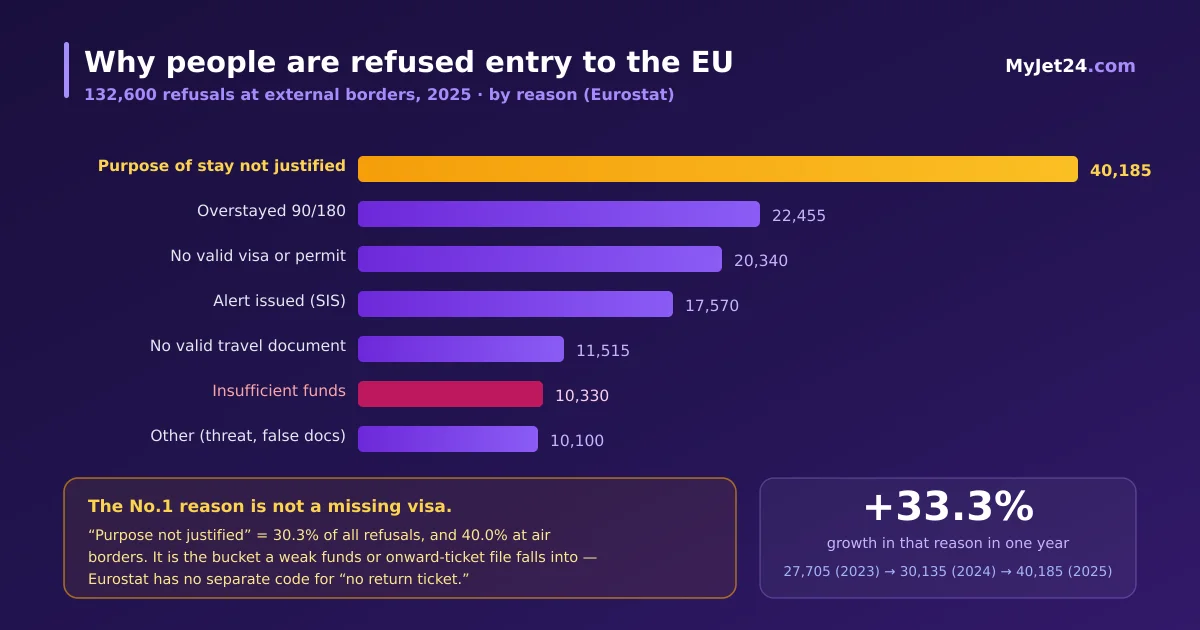
132,600 third-country nationals were refused entry at EU external borders in 2025 — up 7.1% on 2024. The single largest reason was not a missing visa, a false document, or an alert. It was "purpose and conditions of stay not justified": 40,185 refusals, 30.3% of the total, and up 33.3% in a single year. That reason has climbed steadily — 27,705 in 2023, 30,135 in 2024, 40,185 in 2025 — and it now drives most of the overall increase.
At air borders the pattern is even sharper. Of 57,175 air-border refusals, 22,895 — a full 40.0% — were for unjustified purpose of stay, with a further 2,770 (4.8%) for insufficient means of subsistence. Poland refused the most travellers of any state (28,960), followed by France (12,210), Croatia (12,090) and Spain (10,610).
An honest note on what these numbers do and don't say. Eurostat does not have a separate category for "no return ticket." Under the Schengen Borders Code, a missing onward ticket is folded into that leading "purpose and conditions of stay not justified" reason — the same bucket as a vague itinerary, no accommodation, or a story that doesn't add up. So the 40,185 figure is not a count of missing tickets; it is a count of travellers who couldn't convince an officer why they were coming and how they were leaving. The onward ticket is one of the strongest single pieces of evidence for both halves of that question, which is precisely why it carries weight it might not seem to on paper.
The visa side: €90 gone, one in seven times
For the roughly one-third of the world that needs a Schengen visa, the money question starts long before the border. In 2025 there were more than 12 million short-stay visa applications, of which over 10 million were issued — an overall refusal rate of 14.6%, or roughly 1.7 million rejections. That's about one in seven, and the rate is far higher for some nationalities: the Commission's own figures put Burundi at 53.4%, Senegal at 51.9% and DR Congo at 40.1%, against a low of 6.4% for Russia.
Here is the part that turns a statistic into a decision. The Schengen visa fee is €90 for an adult, and it is never refunded if your application is rejected. One analysis of the 2025 consulate data estimated that rejected applicants collectively lost €157 million in non-refundable fees last year — with applicants from Africa bearing about 42% of that cost while making up around 24% of applicants.
Now layer on the common mistake: buying a real, paid flight to attach to the application, before you know whether the visa will be approved. If the visa is refused, you have lost the €90 fee and you are chasing an airline refund on a ticket you can't use. This is the single clearest argument for the way MyJet24's product works. A flight reservation for a Schengen visa gives the consulate a verifiable itinerary with a real booking reference — enough to satisfy the requirement — without spending hundreds on a fare you might have to unwind. If the worst happens, our guides to what happens after a refusal and the appeal process walk through the recovery.
How to prove funds the way officers accept
Having the money is not the same as proving it. Spain's rule is the clearest illustration of a trap that catches travellers across Europe: it accepts cash, certified or traveller's cheques, receipts or credit cards — but the card or cheque must be "accompanied by a recent bank statement or an up-to-date bank book," and it states in black and white that "bank letters or internet bank statements are not acceptable." A screenshot of your banking app, the thing most people would instinctively reach for, is explicitly excluded.
The practical takeaways that travel well across all Schengen states:
- Carry some cash in euros. It is the one form of proof every country accepts without question, and a portion of your daily requirement in notes settles most doubts on the spot.
- Bring a physical, stamped or printed bank statement — not just the app. Where a card is your proof, the statement is what makes it count.
- Match the number to the country and your days. Use the table above: it is your days multiplied by that country's daily figure, plus any fixed minimum (Spain's €1,098.90, Bulgaria's €500, Greece's €300).
- A hosting invitation can lower the bar. In France a hotel booking or an attestation d'accueil cuts the daily figure; in Croatia and several others a certified guarantee reduces or removes it.
- Assemble the set, not a single item. Funds + onward ticket + accommodation, consistent with your stated dates, is what satisfies the "purpose" test that refuses the most people.
If your trip is a longer European stay, remember the funds requirement runs alongside the day-count rule — our Schengen 90/180 day-rule guide covers that arithmetic, and the recent Gibraltar border changes are a live example of Spain's exact funds-and-ticket standard being applied at a new crossing point.
Seven mistakes that cost people entry
- Assuming visa-free means guaranteed entry. Article 6 applies to everyone. The 40,185 people refused for "unjustified purpose" in 2025 included plenty who needed no visa.
- Showing up with a one-way ticket. Annex I names a return or round-trip ticket; nine countries name it in their own rules; airlines enforce it at the gate before an officer ever sees you.
- Relying on a banking-app screenshot. Spain rejects it outright, and others may too. Bring a physical statement and some cash.
- Using the wrong country's number. €14 a day gets you into Latvia and nowhere near the Spanish floor of €1,098.90. Check the country you actually land in.
- Buying a paid flight before a visa decision. One in seven applications is refused and the €90 fee is gone regardless — don't add an unrefunded fare to the loss.
- Forgetting France's hidden jump. No hotel booking turns €65 a day into €120 a day. A reservation is worth real money here.
- Treating the four checks as separate. Officers want a consistent picture. Funds without a plan, or a plan without a way out, reads as a weak file.
Frequently asked questions
How much money do I need to enter the Schengen Area in 2026?
It depends on which country you arrive in. Each Schengen state sets its own "means of subsistence" figure, published in the EU's Annex 25 (updated 1 April 2026). They range from about €14 per person per day in Latvia to €122.10 per day with a €1,098.90 minimum in Spain, with most countries between €40 and €70 a day. Multiply the daily figure by your number of days, add any fixed minimum, and be able to show it in a form the officer accepts.
Do I really need to prove funds if I'm visa-free?
Yes. Visa-free travel removes the visa sticker, not the entry conditions. Article 6 of the Schengen Borders Code requires sufficient means of subsistence from everyone entering for a short stay, and border officers can and do ask visa-free tourists to demonstrate it. Being visa-free is not the same as being cleared to enter.
Which Schengen country asks for the most money?
Spain. Its rule requires €122.10 per person per day — the highest daily figure in the EU handbook — with a minimum of €1,098.90 regardless of how short your trip is. Spain is also the only country combining that steep rate with a strict ticket requirement and an explicit refusal to accept internet-printed bank statements as proof.
Do I need a return ticket to enter Europe?
For tourism, effectively yes. Annex I of the Schengen Borders Code names "a return or round-trip ticket" as a document officers may request, and nine Schengen states — Spain, Luxembourg, Belgium, Germany, Denmark, Italy, Bulgaria, Finland and Norway — name a ticket in their own entry rules. Just as importantly, airlines check for onward travel at boarding, so a missing ticket can stop you before you even reach the border.
Can I show my bank balance on my phone as proof of funds?
Not reliably. Spain's rule explicitly states that "bank letters or internet bank statements are not acceptable," and a banking-app screenshot falls into that excluded category. The safe approach across Schengen is to carry some cash in euros and a recent physical or printed bank statement, and to treat a card as supporting evidence rather than the whole proof.
What is the most common reason people are refused entry to the EU?
Failing to justify the purpose and conditions of the stay. In 2025 this was the reason for 40,185 refusals — 30.3% of all refusals at EU external borders, and 40.0% of refusals at air borders — more than any other single ground, including missing visas. It is the category that a weak funds file, a vague itinerary or a missing onward ticket falls into.
Does a missing onward ticket count as its own refusal reason in the statistics?
No. Eurostat has no separate code for "no return ticket." A missing onward ticket is folded into the "purpose and conditions of stay not justified" reason — the largest category. So while you won't see onward tickets counted separately, they sit inside the very reason that refuses the most travellers, because a ticket is one of the strongest ways to prove both your purpose and your departure.
How much money do I need for France specifically?
France sets €65 per person per day if you can show where you're staying — but only €32.50 a day with a formal attestation d'accueil from a host, and €120 a day if you have no accommodation booking at all. So a hotel reservation doesn't just prove accommodation in France; it nearly halves the money you must demonstrate.
How often are Schengen visas refused, and do I lose the fee?
In 2025 the overall Schengen visa refusal rate was 14.6% — roughly one in seven applications, or about 1.7 million rejections. The €90 adult fee (€45 for children aged 6 to under 12) is a processing fee and is not refunded if your visa is refused. Rejected applicants are estimated to have lost around €157 million in non-refundable fees in 2025.
Should I buy a real flight or use a reservation for my visa application?
A reservation is usually the smarter choice. Consulates require a verifiable itinerary, not a paid ticket, and buying a real fare before a decision means risking hundreds of euros if the visa is refused — on top of the non-refundable fee. A verifiable flight reservation with a genuine airline booking reference satisfies the requirement while keeping your money and your dates flexible.
Which Schengen country asks for the least money?
Latvia, at about €14 per person per day for stays up to 30 days — the lowest daily figure in the handbook. Poland is also low at roughly €18 a day (PLN 75) for longer stays. But arriving in a low-threshold country doesn't help if you then travel onward: you should be able to meet the requirement of wherever you actually intend to spend your time.
Do children need to show the same amount as adults?
Often less. Several countries halve the figure for minors travelling with a parent or guardian — Greece and Slovenia among them — and Lithuania exempts a minor travelling with an adult family member. On the visa side the fee is also lower for children (€45 for ages 6 to under 12, free under 6). Check the specific country's entry in the handbook, since the treatment varies.
Are these amounts a guaranteed pass if I meet them?
No. Meeting the funds figure is necessary but not sufficient. Border officers assess the whole picture — purpose, funds, departure and accommodation together — and retain discretion under Article 6. Someone with the money but no coherent plan, no accommodation and no onward ticket can still be refused. Treat the daily figure as a floor to clear, not a ticket in.
The bottom line
Europe's entry rules are not secret — they are published, in detail, in a handbook the EU updates every few months. What's missing is that almost no traveller reads them, and so the same avoidable file keeps failing at the same desks: money that can't be proven, a purpose that can't be evidenced, a departure that can't be shown. In 2025 that cost 132,600 people their entry, and the largest share of them failed the one test that a well-assembled file passes easily.
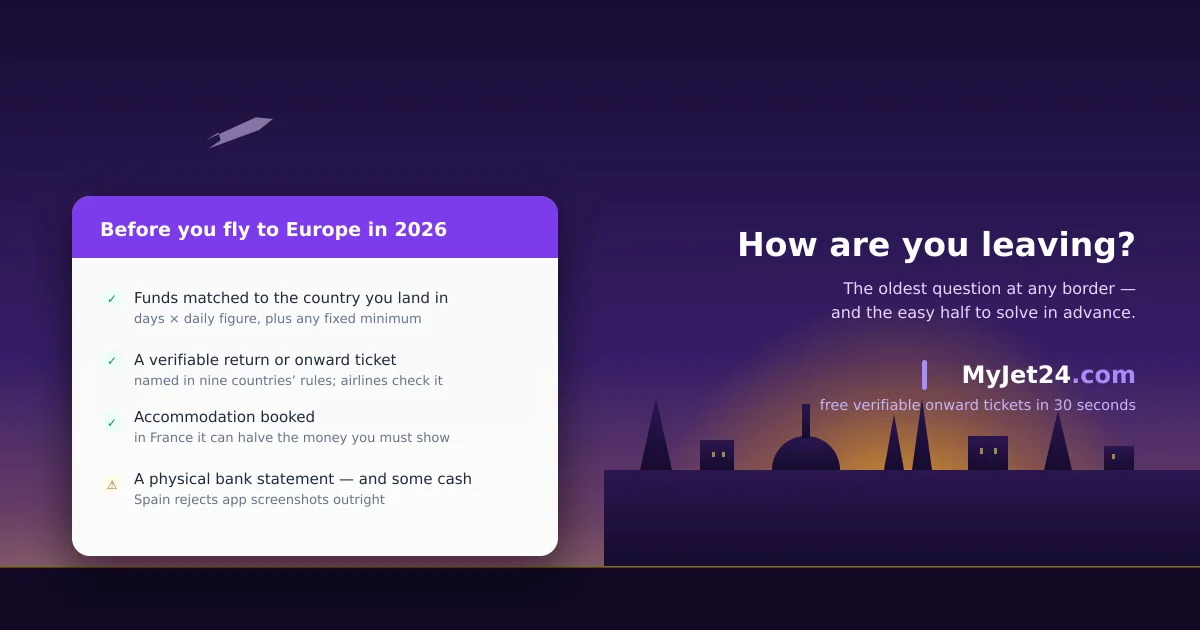
So do the boring thing well. Look up the country you're actually landing in and match your funds to its daily figure, with a physical statement and some euros in cash. Book your accommodation — in France alone it can halve what you need to show. And answer the oldest question at any border before it's asked: how are you leaving? A verifiable proof of onward travel settles that half in about thirty seconds, with a real reservation you can show an officer or an airline without gambling on a fare. The money you need to enter Europe is knowable to the euro. The paperwork that proves it is the part worth getting right.
Sources
- European Commission — Annex 25, Practical Handbook for Border Guards, "Reference amounts required for crossing external borders" (version 1 April 2026): https://home-affairs.ec.europa.eu/document/download/7130e21d-c1c8-41fd-9c83-b6fe312d4f5c_en?filename=handbook-annex_25_en_0.pdf
- Regulation (EU) 2016/399 (Schengen Borders Code), Article 6 and Annex I: https://www.legislation.gov.uk/eur/2016/399/article/6
- Eurostat — Refusals of entry at EU external borders, 2025 (news release, 12 May 2026) and dataset migr_eirfs: https://ec.europa.eu/eurostat/web/products-eurostat-news/w/ddn-20260512-1
- European Commission, DG HOME — Schengen short-stay visa statistics 2025 (28 May 2026): https://home-affairs.ec.europa.eu/news/schengen-short-stay-visa-applications-rise-2025-remain-below-pre-pandemic-levels-2026-05-28_en
- European Commission — Schengen visa fee increased to €90 (11 June 2024): https://home-affairs.ec.europa.eu/news/schengen-visa-fee-increased-11-june-2024-2024-06-13_en
- BOE — Orden PRE/1282/2007 (Spain, means of subsistence and return ticket): https://www.boe.es/buscar/act.php?id=BOE-A-2007-9608
- LAGO Collective / Marta Foresti — "The cost of visa rejections: the €157m" (analysis, June 2026): https://martaforesti.substack.com/p/the-cost-of-visa-rejections-the-157
This guide reflects the Schengen entry rules, per-country reference amounts and refusal statistics published by the European Commission and Eurostat as of 28 July 2026. Reference amounts are set by national authorities and change; currency conversions are approximate. Border officers retain discretion under Article 6 of the Schengen Borders Code. This article is informational and not legal advice.
