
Last updated: 28 May 2026 · Reading time: 15 minutes · Author: Marc Hoffmann, Senior Visa Consultant
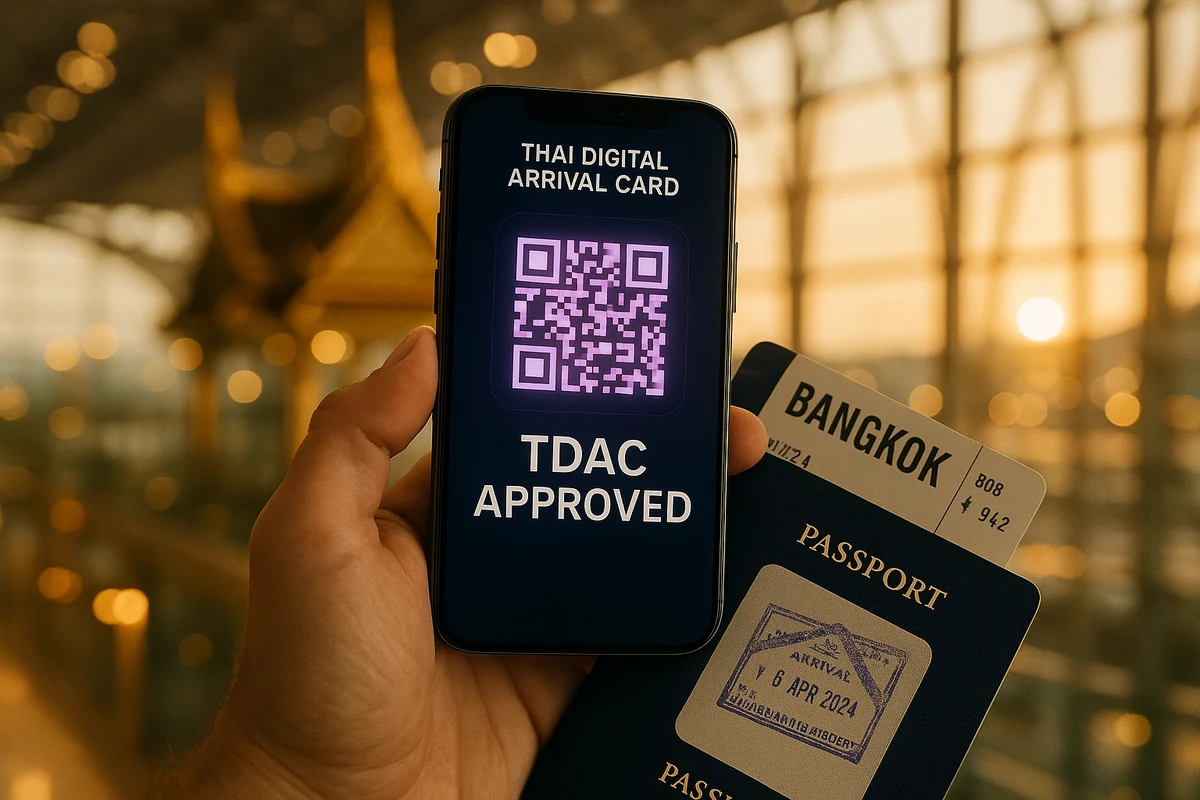
TL;DR — Thailand Digital Arrival Card 2026
- The TDAC is mandatory for every foreign national entering Thailand by air, land or sea since 1 May 2025. The paper TM6 form has been retired.
- File on the only official portal: tdac.immigration.go.th. The system is free, opens a 3-day filing window before arrival (72 hours counted in Bangkok time / ICT, UTC+7), and returns a QR-coded confirmation by email.
- You need your passport, flight number, accommodation address in Thailand and a working email. Allow 5–10 minutes per traveller. Group filing for up to 10 people is supported in a single session.
- Show the QR code on your phone or printed at Thai immigration on arrival. Airlines including Thai Airways, EVA Air, Singapore Airlines and Emirates now spot-check the TDAC at check-in.
- The TDAC is not a visa. Visa-exempt nationals still get the standard 60-day stamp (extended from 30 in 2024); visa holders still need their e-visa or sticker. Proof of onward travel is still required for visa-exempt entries.
Thailand's Digital Arrival Card (TDAC) is the mandatory online entry form every foreign visitor must submit on tdac.immigration.go.th within 72 hours of arriving in Thailand. It replaced the paper TM6 card on 1 May 2025 and is enforced at all international airports, land borders and sea ports. The form is free, takes about five minutes per passenger, and returns a QR-coded confirmation you scan at the immigration counter. Skipping the TDAC means being sent to a manual counter at the airport — expect a 30–90 minute delay during peak hours at Suvarnabhumi (BKK) and Don Mueang (DMK).
On this page
- What is the Thailand Digital Arrival Card?
- Who needs to file a TDAC in 2026
- When to file: the 3-day window explained
- Step-by-step: filing on tdac.immigration.go.th
- Documents and information you need
- At the airport: QR scan and fallback flow
- Common portal errors and how to fix them
- TDAC vs. the old TM6: what changed
- TDAC and proof of onward travel
- Multi-leg trips, cruises and overland entries
- FAQ — 12 questions, answered
- Bottom line and next step
What is the Thailand Digital Arrival Card?
The Thailand Digital Arrival Card (TDAC) is an electronic replacement for the long-standing paper TM6 immigration form. It was launched by the Thai Immigration Bureau on 1 May 2025 under the Ministry of Interior's e-government initiative, and by 2026 it has become the central document every non-Thai citizen submits before crossing the border. The TDAC captures the same basic information the TM6 used to — passport details, flight number, accommodation address, purpose of visit — but routes the data straight into the Immigration Bureau's database before you land.
From a traveller's perspective the change is almost entirely positive: no scribbling on a tiny paper card while the seatbelt sign is still on, no lost forms, no illegible handwriting questioned at the counter. From the immigration officer's side, the QR code on your phone resolves to a pre-checked record, which is why arrival lanes at Suvarnabhumi have visibly accelerated through 2026. The flip side is that without a submitted TDAC, you are now an exception case — sent to a fallback counter that, during peak hours, becomes the longest queue in the terminal.
Who needs to file a TDAC in 2026
The rule is broad and simple: every foreign national entering Thailand, regardless of visa status, must file a TDAC before each arrival. That includes:
- Visa-exempt visitors from the 93 nationalities currently eligible for 60-day visa-free entry (extended from 30 days in mid-2024).
- Visa-on-Arrival (VOA) nationals from the 31 eligible countries.
- Holders of e-visas, tourist visas, education visas, business visas, and Non-Immigrant categories.
- Holders of long-stay programmes: Thailand Privilege Visa (formerly Thailand Elite), DTV (Destination Thailand Visa), Long-Term Resident (LTR) visa.
- Returning expatriates with re-entry permits attached to their existing visa.
Exempt categories are narrow: Thai citizens (they use the Thai passport channel), accredited diplomats arriving on official business, and crew on duty for an airline or shipping line transit. Children of any age — including infants — need their own individual TDAC, although they can be filed in a single group session by a parent.
When to file: the 3-day window explained
The TDAC portal opens exactly 72 hours (3 days) before your scheduled arrival in Thailand. The clock is set in Indochina Time (ICT, UTC+7) — the same time zone as Bangkok. This catches a lot of travellers off guard: if you are flying from Europe or the US West Coast, the "3 days before" point on your local calendar may already be too late or too early depending on direction. A quick rule of thumb — convert your scheduled arrival time at the Thai airport into ICT, then subtract 72 hours.
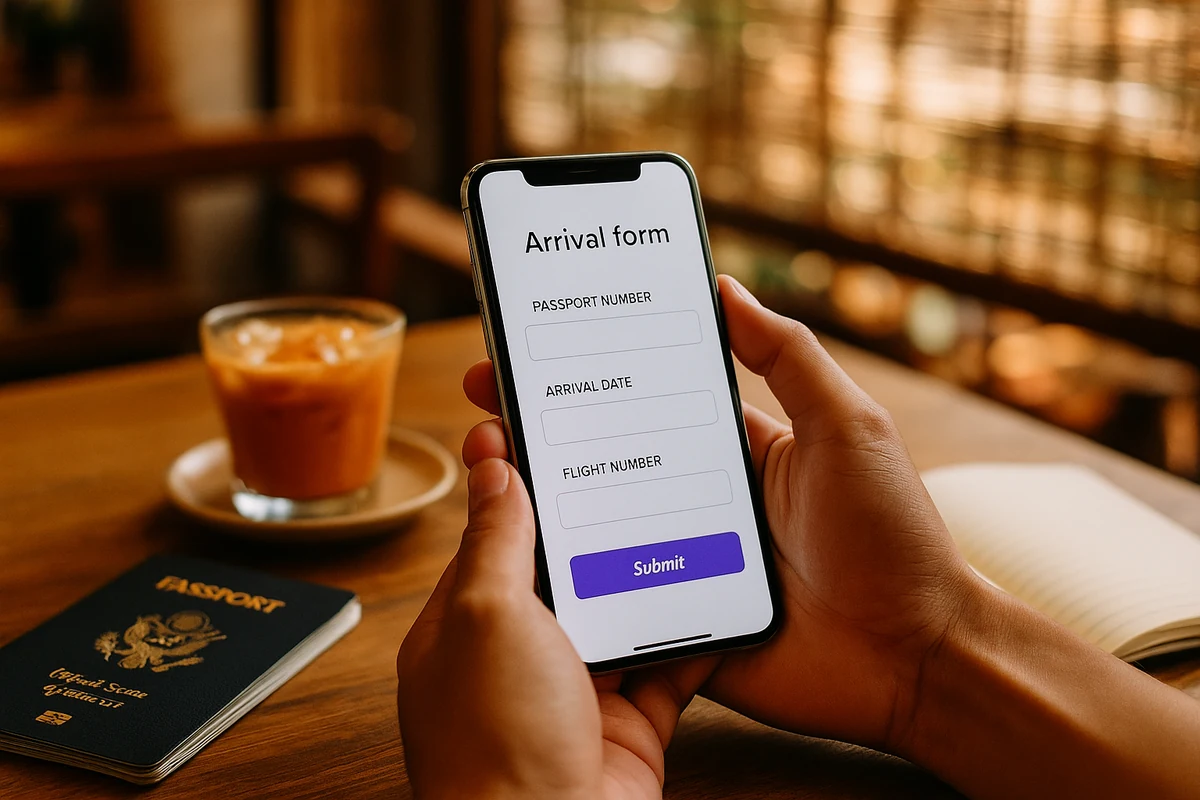
Filing earlier than 72 hours simply returns a polite "submission window not yet open" message. Filing later — for example while you are already in the air — is allowed in practice, but you must complete the form before reaching the immigration counter. Many airports now have free Wi-Fi in the arrival corridor specifically so passengers can file last-minute, but the queue for the fallback counter forms quickly. Filing while still at home or in the airport lounge before departure is the sensible default.
Step-by-step: filing on tdac.immigration.go.th
The official portal is tdac.immigration.go.th. Anything else — tdac-thailand.com, thaitdac.org, "fast TDAC" services on social media — is either a paid intermediary or an outright scam. The official portal is free and bilingual (Thai / English).
- Open tdac.immigration.go.th in any modern browser. Mobile Safari and Chrome work fine; Firefox is occasionally flaky with the date picker.
- Click "Arrival Card" on the landing page, then choose Individual or Group (up to 10 travellers).
- Enter personal details exactly as printed in your passport. Surname / Given name capitalisation does not matter, but spelling must match.
- Enter passport number, nationality, date of birth, gender, occupation. Occupation accepts free text — "Employee", "Self-employed", "Retired" or "Student" all pass.
- Trip details: arrival date, mode of transport (Air / Land / Sea), flight or vehicle number, country of departure.
- Accommodation address in Thailand: hotel name and full address, province, district. Use the printed confirmation from Booking.com or Agoda — the validator is forgiving but expects a recognisable Thai address.
- Health declaration: a short yes/no series about symptoms and recent travel to outbreak zones. Honest answers; "No" to all is the typical path.
- Review the summary screen, tick the consent box, and submit.
- Save the QR code. The browser displays it immediately; an email confirmation also arrives at the address you provided. Screenshot both.
- Print or keep on phone. Either works at the counter. A printed copy is a useful backup if your phone battery dies on a long-haul flight.
Documents and information you need
Have these to hand before opening the portal — the session times out after about 20 minutes of inactivity and partial entries are not saved.
| Item | Why it matters | Where to find it |
|---|---|---|
| Passport (machine-readable) | Passport number, full name, nationality code, expiry date | Photo page |
| Flight or vehicle number | Used to pre-match the airline manifest | Booking confirmation / e-ticket |
| Arrival date and airport | Anchors the 3-day window | Itinerary |
| Accommodation address | First hotel only is required, even for multi-city trips | Booking confirmation |
| Working email address | Confirmation and QR are emailed | Your inbox |
| Onward / return ticket (visa-exempt only) | Not uploaded but the data must match airline records | Booking confirmation |
You do not upload any documents to the TDAC portal. The form is pure data entry. The Immigration Bureau cross-references the airline's API manifest at check-in and on arrival — that is how mismatched flight numbers or names are flagged.
At the airport: QR scan and fallback flow
The arrival experience splits cleanly into two paths.
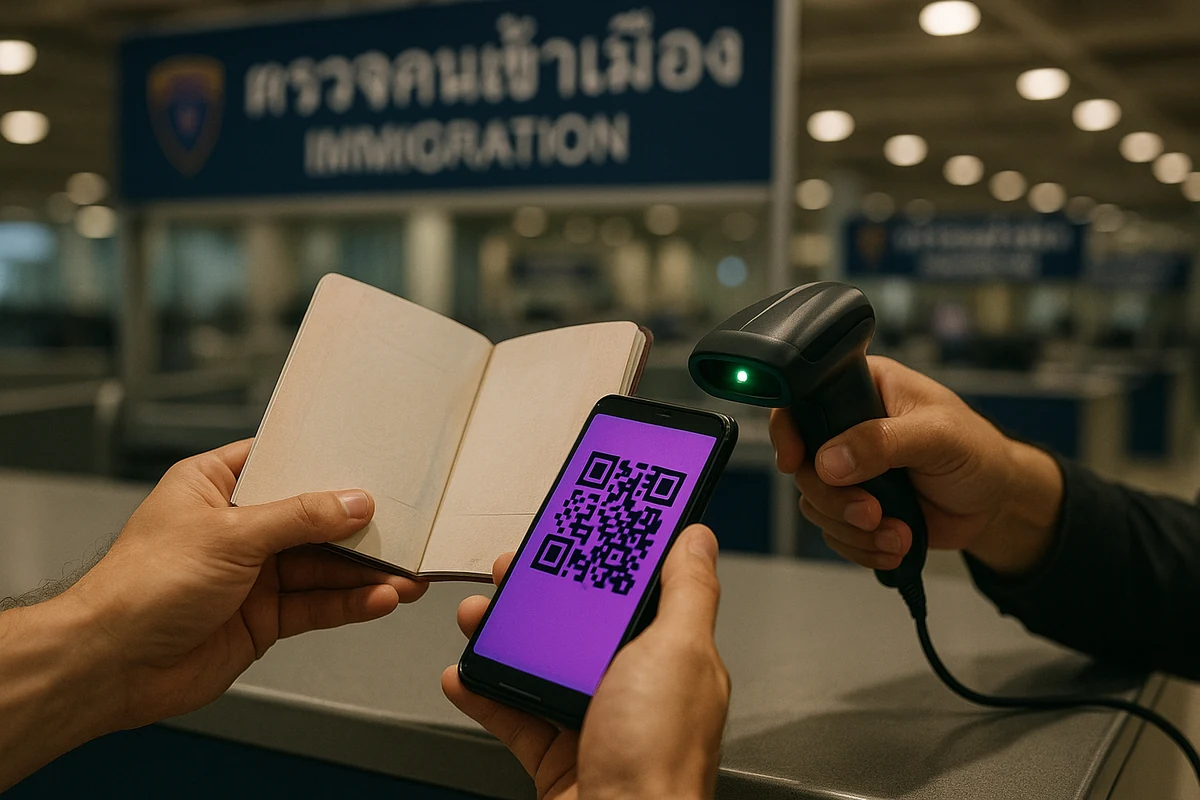
Path A — TDAC filed (the happy path): Walk to any standard immigration counter, hand over your passport, show the QR code on your phone (or the printed copy). The officer scans, the record opens on their screen, you get your stamp. Median end-to-end time at Suvarnabhumi in early 2026 is under 2 minutes per passenger.
Path B — TDAC not filed: Look for the orange "TDAC On-Arrival" signs after the jet bridge. These lead to a row of self-service kiosks (BKK has 36, DMK has 18, Phuket and Chiang Mai have 12 each). The kiosk runs the same portal in a captive-portal browser. Filing on-site takes 5–8 minutes plus the queue. The kiosks accept passport MRZ scanning, which speeds the data entry. After filing, you join the regular immigration queue with the freshly minted QR.
If the kiosks are down, immigration officers at the manual counter will assist directly, but only as a last resort and with priority given to families with young children. Plan to file before you fly — the on-arrival flow is for emergencies, not first choice.
Common portal errors and how to fix them
The TDAC portal is stable in 2026, but a handful of validation errors trip up new users repeatedly. The fix is usually small.
| Error | What it means | Fix |
|---|---|---|
PASSPORT_FORMAT_INVALID | Spaces or hyphens in the passport number field | Remove all separators; enter letters and digits only |
DATE_OUT_OF_RANGE | Arrival date is more than 72 hours in the future | Wait until exactly 72 hours before arrival (ICT) |
FLIGHT_NOT_FOUND | Flight number does not match the IATA database | Use IATA format e.g. TG921, not "Thai Airways 921" |
UPLOAD_FAILED (group filing) | CSV bulk upload schema mismatch | Download the official template again; do not edit column headers |
NATIONALITY_CODE_INVALID | Manual country code entered | Use the dropdown; codes are auto-selected (3-letter ICAO) |
SESSION_EXPIRED | 20 minutes of inactivity | Restart; no partial data is saved |
QR_NOT_DELIVERED (email) | Mail server delay or spam filter | Use the in-browser QR; check spam; resend from "My Submissions" |

TDAC vs. the old TM6: what changed
If you have visited Thailand before mid-2025 you remember the TM6 — the slim white-and-blue paper card handed out by the cabin crew, completed in flight with a borrowed pen, torn in two by the immigration officer, with one half stapled into your passport for departure. The TDAC keeps the same data architecture but updates the workflow.
| Dimension | TM6 (until April 2025) | TDAC (since May 2025) |
|---|---|---|
| Format | Paper card, dual carbon | Web form + QR code |
| When | On the plane or at the counter | Within 72 hours before arrival |
| Cost | Free | Free |
| Departure half | Required — stapled in passport | Not needed; departure auto-logged |
| Group filing | Each family member separate card | Up to 10 in one session |
| Re-entry per visa | New TM6 each time | New TDAC each time |
| Enforcement | Manual stamp matching | QR scan + database lookup |
If you find a half-completed TM6 stuck in an old passport, throw it away — it has no legal standing in 2026 and presenting it at the counter is more confusing than helpful.
TDAC and proof of onward travel
The TDAC does not remove the long-standing onward-ticket requirement for visa-exempt entry to Thailand. Thai Immigration's policy is unchanged: visa-exempt visitors must hold a confirmed ticket out of Thailand within their permitted stay (60 days for most nationalities, 30 for VOA). The TDAC form asks for departure date but does not validate ticket existence — that check happens at airline check-in.
Major carriers including Thai Airways, Singapore Airlines, EVA Air, Cathay Pacific, Emirates and Qatar Airways now run the onward-ticket check at the gate as well, especially on flights from countries with a high rate of overstay applications. A confirmed onward ticket — even to a neighbouring country like Vietnam, Laos or Cambodia — satisfies the rule. Speculative dates are flagged. If your onward plan is still open, a live-PNR onward ticket for Thailand from a verifiable booking system is the standard fix — ours is generated through a real GDS and reads as authentic to airline check-in agents.
Multi-leg trips, cruises and overland entries
The TDAC is filed per entry into Thailand, not per trip. Each time you cross a Thai border you need a fresh TDAC, even if your previous one is hours old. Common scenarios:
- Bangkok → Siem Reap (Cambodia) → Bangkok: two TDACs, one for each Thai arrival. Both can be filed at the start of the trip if both flights are within 72 hours of each other; otherwise file the second one from Cambodia.
- Mekong river cruise (Laos → Thailand at Chiang Khong): single TDAC, mode "Land", port of entry "Chiang Khong". The river crossing counts as land entry for TDAC purposes.
- Cruise ship calling at Phuket and Koh Samui: one TDAC for first Thai port of call (typically Phuket). Subsequent same-cruise stops are not separate entries.
- Singapore → Hat Yai by train (KTM Berhad): TDAC, mode "Land", port "Padang Besar". The train carriage attendants now remind passengers as the border approaches.
- Domestic transit through Bangkok then onward to a third country: if you stay airside (no immigration stamp), no TDAC. If you exit airside even briefly, file one.
FAQ — Thailand Digital Arrival Card 2026
1. Is the TDAC mandatory for transit passengers?
Only if you exit airside. International-to-international transits at BKK and DMK that remain inside the transit area do not require a TDAC. If you collect bags and re-check (split tickets), you have technically entered Thailand and need one.
2. Can I file the TDAC from outside Thailand?
Yes — that is the intended use. The portal works worldwide. There is no geofence on tdac.immigration.go.th.
3. What if my flight is delayed past the TDAC arrival date?
The QR remains valid as long as the new arrival is within 72 hours of the original. If a delay pushes you outside the window, file a new TDAC — the old one is automatically superseded.
4. Does the TDAC replace my Thai visa?
No. The TDAC is an arrival declaration, not an immigration permission. Visa-exempt nationals still get the standard 60-day stamp, visa holders still need their e-visa or sticker.
5. I have a Thailand Privilege / DTV / LTR visa. Do I still file?
Yes. Every non-Thai arrival files a TDAC regardless of visa category. The portal recognises long-stay visa types in the dropdown.
6. Is there a fee for the TDAC?
No. The form is free on tdac.immigration.go.th. Any site charging USD 20–50 for "TDAC processing" is a paid intermediary that fills out the same free form on your behalf.
7. What happens if I do not file at all?
You will be directed to the on-arrival kiosks. Expect a 30–90 minute delay during peak hours. You are not fined or refused entry — the kiosks exist precisely to absorb non-filers.
8. Can I correct a TDAC after submission?
Minor edits (accommodation address, phone number) are available via the "My Submissions" link in the confirmation email. Passport number or arrival date corrections require a fresh submission.
9. Do I need a TDAC for an infant or child?
Yes — every individual needs their own record. Group filing for a family in one session is supported up to 10 travellers.
10. Will my airline check the TDAC before letting me board?
Increasingly yes. Thai Airways, EVA Air, Singapore Airlines and Emirates now spot-check at check-in. A missing TDAC is rarely a hard denial of boarding but expect to be asked to file before the desk closes.
11. How long is the QR code valid?
Until you cross the border. A single TDAC is valid for one arrival only; subsequent Thai entries need new submissions.
12. Is the data secure?
The portal is operated directly by the Thai Immigration Bureau under the Ministry of Interior. It transmits via HTTPS and the published privacy notice limits retention to the immigration period plus one year for audit.
Bottom line and next step
The TDAC is one of those rare immigration changes that genuinely make travel smoother once you know about it. The form is free, takes five minutes, and skips you past the longest queue at Bangkok airport. The cost of forgetting is an hour of your holiday spent at an arrival-hall kiosk. File at home, screenshot the QR, and walk straight through immigration.
One step travellers still miss in 2026: airlines and the Thai immigration desk still want to see proof of onward travel for visa-exempt entries. If you have not yet booked your exit flight, a verifiable onward ticket for Thailand generated through a real GDS gets you through check-in and the visa-exempt gate without needing to commit to a specific exit date or burn money on a refundable ticket. Pair it with a filed TDAC and the arrival is genuinely a 90-second affair.
Marc Hoffmann · Senior Visa Consultant
12 years in cross-border travel documentation. Has filed more than 4,000 client arrivals into Thailand since the TDAC launch, working directly with airline check-in desks at Suvarnabhumi, Don Mueang and Phuket on edge-case escalations. Tracks Thai Immigration policy updates monthly.
