
Last updated: 28 July 2026 · Reading time: 16 min · Author: James Mitchell, Travel Documentation Writer at MyJet24
TL;DR — Key Facts
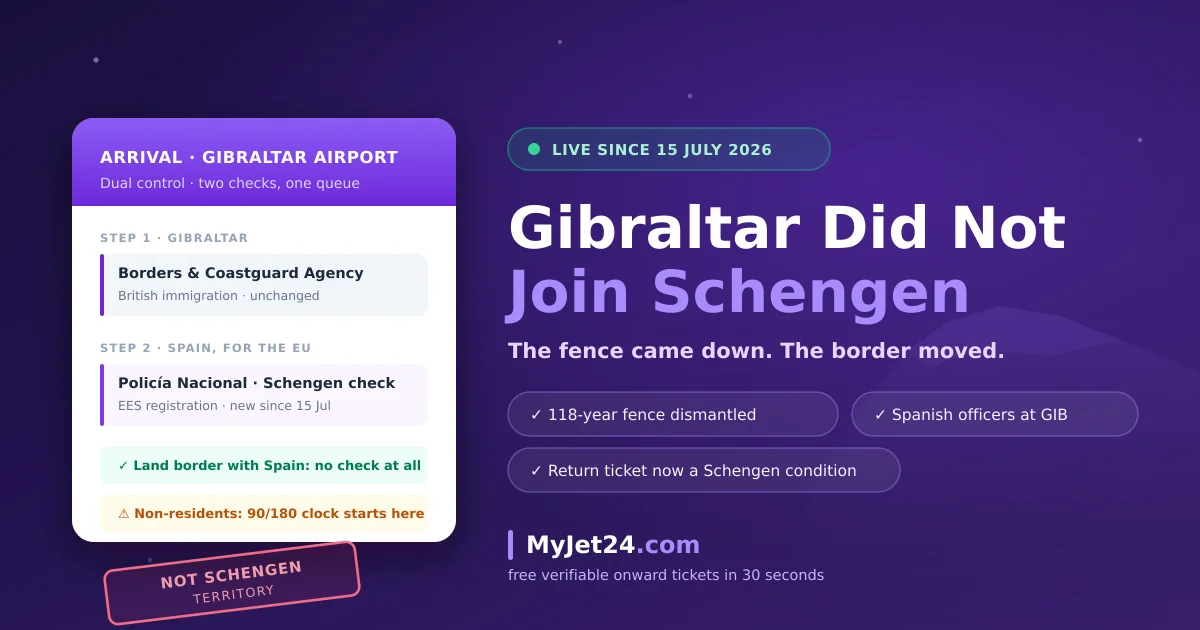
- Gibraltar did not join Schengen. The European Commission's own explanatory memorandum says it plainly: "Although Schengen rules will be applied at the external borders, Gibraltar will not become part of the Schengen area." Dozens of outlets ran the opposite headline.
- The fence came down on 15 July 2026 after 118 years. The land frontier with Spain now has no routine immigration control — but the border did not disappear, it moved to Gibraltar's airport and port.
- Two checks now, not one. On arrival, Gibraltar's Borders & Coastguard Agency checks you first, then Spain's Policía Nacional runs the Schengen check on behalf of the EU. On departure the order reverses. The conditions are cumulative — you must satisfy both.
- The big one for visitors: your Schengen clock now runs in Gibraltar. The FCDO states that "any time you spend in Gibraltar will count alongside time spent in the Schengen Area" towards your 90 days in any 180. Gibraltar used to be a way to pause that clock. It isn't any more.
- A return ticket is now part of the entry test. Gibraltar airport's own guidance tells non-resident British and other third-country nationals: "You may be requested to produce a return flight ticket, travel insurance, proof of sufficient funds, hotel booking." That sentence did not apply to a UK tourist flying to Gibraltar before 15 July.
- Gibraltar residents are the winners. Under Article 42 of the treaty they are exempt from passport stamps, from the Entry/Exit System and from ETIAS — at every Schengen external border, not just their own.
No, Gibraltar has not joined the Schengen Area. Under the EU–UK Agreement in respect of Gibraltar, signed on 14 July 2026 and provisionally applied from 15 July 2026, Gibraltar remains a British Overseas Territory outside both the EU and Schengen, but applies Schengen border rules at its own external border. The land frontier with Spain no longer has routine immigration checks; instead, arrivals at Gibraltar's airport and port face two consecutive checks — Gibraltar's own immigration officers first, then Spanish Policía Nacional performing the Schengen check for the EU. For non-residents, that arrival is now a Schengen external-border crossing: you are registered in the EU Entry/Exit System, your 90-days-in-180 allowance starts running, and you can be asked to prove sufficient funds and show a return or onward ticket. Gibraltar residents are exempt from stamping, EES and ETIAS.
In this guide
- What actually happened on 15 July 2026
- "Gibraltar joined Schengen" — the sentence that settles it
- The three layers people are mixing up
- Dual control: who checks what, and in what order
- Your 90/180 clock now runs in Gibraltar
- EES and ETIAS at Gibraltar airport
- What Spanish officers can actually ask you for
- Who is exempt — and why residents came out ahead
- The port, cruise ships and the Morocco ferry
- Customs: the change nobody is talking about
- It is not a back door into Europe
- What the first two weeks actually looked like
- Seven mistakes to avoid
- Frequently asked questions
- The bottom line
What actually happened on 15 July 2026
At midnight on 15 July 2026, workers began dismantling a fence that had stood between Spain and Gibraltar for 118 years. The images travelled fast: gates lifted, barriers cut up, Spanish and Gibraltarian officials shaking hands at La Línea. Roughly 15,000 people cross that frontier every working day, and for the first time in living memory they crossed it without an immigration queue.
The legal instrument behind it is the Agreement in respect of Gibraltar between the European Union and the European Atomic Energy Community, of the one part, and the United Kingdom of Great Britain and Northern Ireland, of the other part — signed in Brussels on 14 July 2026 by Maroš Šefčovič for the EU and Stephen Doughty for the UK. It runs to 336 articles, 43 annexes and three protocols, and it took three and a half years to negotiate after the post-Brexit framework of 31 December 2020 left Gibraltar's border unresolved.
Here is the part almost every summary skipped: the border did not disappear. It moved. Every check that used to happen at the land frontier now happens at Gibraltar's airport and its port — and it happens twice, because two different authorities are now involved. If you fly into Gibraltar as a visitor, you are doing something you were not doing before 15 July: you are crossing the external border of the Schengen Area.
One status note that matters for the rest of this article: as of 28 July 2026 the treaty is signed and provisionally applied, but not ratified. The UK command paper carries the line "[The Agreement has not been ratified by the United Kingdom]" on its title page. The European Parliament's consent vote is expected later in 2026, and the UK's own ratification clock under the Constitutional Reform and Governance Act had not run down when Parliament rose. Provisional application means the rules below are fully operative today — it does not mean the treaty is finished.
"Gibraltar joined Schengen" — the sentence that settles it
On 15 July, Euronews published a video headlined "Gibraltar enters Schengen as border fence comes down under EU-UK treaty." Africanews ran the same line. Other outlets went further, telling readers Gibraltar had effectively rejoined the EU. All of it is wrong, and the correction is not a technicality — it changes what you have to carry in your hand luggage.
The European Commission's own explanatory memorandum accompanying the proposal, COM(2026) 91 final/2, contains one sentence that ends the argument:
"Although Schengen rules will be applied at the external borders, Gibraltar will not become part of the Schengen area."
The treaty text says the same thing structurally. Article 328, on territorial scope, lists the EU treaties' territories and "the territory of Gibraltar" as two separate items — Gibraltar is deliberately not inside the first. Article 26(h) defines "Member States applying the Schengen acquis in full" as a category Gibraltar is never placed in. And Article 2 freezes the sovereignty question entirely: nothing in the agreement affects "the respective legal positions of the United Kingdom … or of the Kingdom of Spain with regard to sovereignty and jurisdiction."
What Gibraltar actually did is subtler and, for travellers, more consequential. Under Article 19 it took on a duty of dynamic alignment — to have in its own law, and effectively apply, the same provisions as a listed set of EU acts, including the Schengen Borders Code. Under Article 63, those EU rules apply in Gibraltar. Under Article 64, Gibraltar submits to Schengen evaluations, including inspection of its infrastructure. So Gibraltar applies the Schengen rulebook at its border without being inside the club — and keeps full control of its own immigration, residency and settlement law under Article 32(1).
Europe Minister Stephen Doughty put the political version of this to the Commons on 26 February 2026: Gibraltar is not joining Schengen, and immigration, policing and justice remain the responsibility of the Gibraltar authorities. Foreign Secretary David Lammy had earlier said Schengen membership "was never on the table."
The three layers people are mixing up
Almost all of the confusion in the coverage comes from collapsing three separate questions into one. Separate them and the whole thing becomes simple.
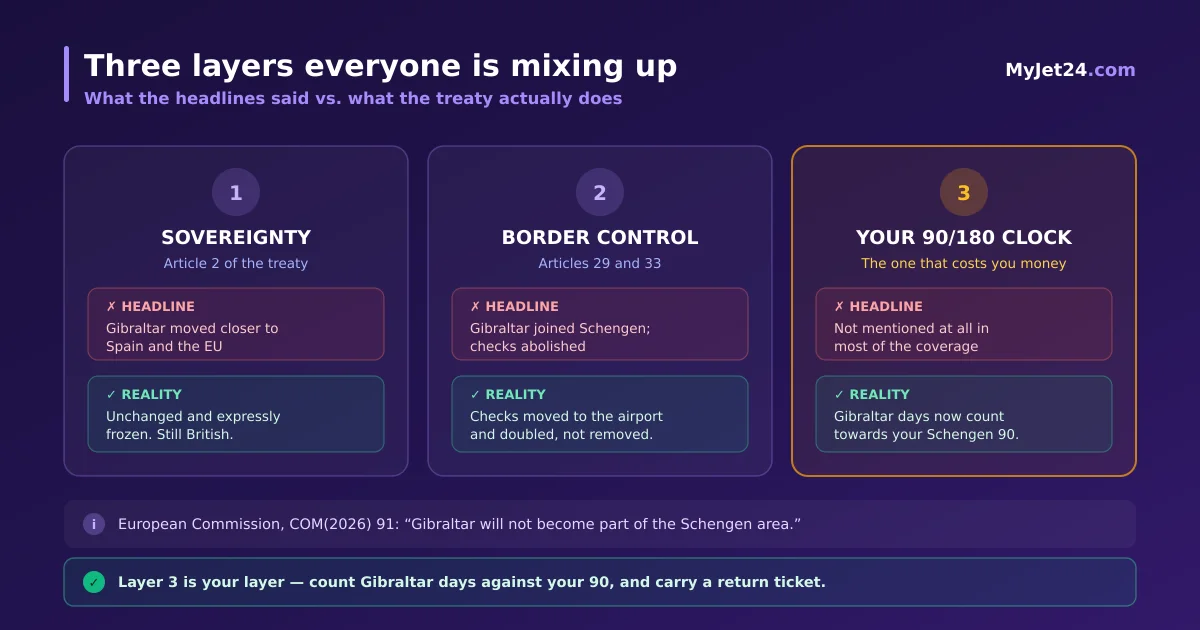
| Layer | What the headlines implied | What the treaty actually does |
|---|---|---|
| Sovereignty | Gibraltar moved closer to Spain / the EU | Unchanged and expressly frozen (Art. 2). Still a British Overseas Territory. Gibraltar sets its own immigration and residency law (Art. 32(1), Art. 45). |
| Border control | Gibraltar joined Schengen; checks abolished | Checks relocated from the land frontier to the airport and port, and doubled: Gibraltar's officers plus Spain's, applying Schengen rules for the EU (Art. 29, Art. 33). |
| Your 90/180 clock | Not mentioned at all | For non-residents, Gibraltar days now count towards the Schengen 90-in-180 allowance. This is the change most likely to actually cost you something. |
Layer one is the political story. Layer two is the operational story. Layer three is your story, and it is the one that got almost no coverage.
Dual control: who checks what, and in what order
The mechanism has a close analogue you may already have used: the juxtaposed controls at London St Pancras, where French officers check passports on British soil before you board the Eurostar. Gibraltar's version is more thorough, because both authorities check everyone.
Article 29(5) sets the sequence in plain terms: border checks on entry are carried out by Gibraltar's authorities "and subsequently by the competent authorities of the Kingdom of Spain." On exit, the order reverses — Spain first, then Gibraltar.
Article 29(7) is the sentence with teeth: the entry conditions of both authorities "shall be cumulative." You are not choosing a lane. You must satisfy Gibraltar's immigration law and the Schengen Borders Code.
The division of labour is clean. Gibraltar's Borders & Coastguard Agency applies the Gibraltar Immigration, Asylum and Refugee Act. Spain's Policía Nacional, under Article 33, performs "any functions which are required to exercise border control … as set out in the Schengen Borders Code," including the express power to refuse entry to third-country nationals who fail Article 6(1) of that Code. Officers work from a joint facility the treaty calls the Second Line Checks Area (Article 26(l)) and which everyone in Gibraltar calls the "Schengen shack."
What happens when the two authorities disagree
This is where reporting has been loosest, and the treaty is actually quite precise.
- Gibraltar refuses, Spain would admit you. Under Article 32(2)–(3), Gibraltar must immediately inform Spain and escort you to the Second Line Checks Area. If Spain finds you have EU free-movement rights or hold a residence permit from a full Schengen state and meet EU entry conditions, Spain lets you into the Schengen area. You do not enter Gibraltar — but you are not trapped either.
- Spain refuses, Gibraltar would admit you. Because the conditions are cumulative and Article 35(2) makes Spain the enforcer of refusals grounded in EU law, a non-resident third-country national refused by Spain does not get into Gibraltar either. In practice, Spain now holds a veto over non-resident entry to Gibraltar.
- You are a Gibraltar resident. The asymmetry is deliberate. Article 33(4)(a)(ii) empowers Spain to refuse entry to third-country nationals "other than persons resident in Gibraltar," and Article 43(2) says residents who fail the Schengen conditions "shall in any event not be prevented from crossing the border crossing points … for the purpose of entering Gibraltar." Spain cannot refuse a Gibraltar resident entry to Gibraltar.
Your 90/180 clock now runs in Gibraltar
If you read one section, read this one. For years, Gibraltar had an informal reputation among long-stay visitors to southern Spain as a place outside the Schengen count. That is over.
The FCDO's Gibraltar travel advice now states it without qualification:
"British nationals do not need a visa to enter Gibraltar for up to 90 days … This 90-day limit applies in any 180-day period. Any time you spend in Gibraltar will count alongside time spent in the Schengen Area towards this limit."
HM Government of Gibraltar's own guidance for British citizens not resident in Gibraltar, updated 11 June 2026, says the same thing — and pairs it with the line that matters: "Gibraltar will remain outside the Schengen Area." Both things are true at once. That is the whole story in two sentences from the same document.
Note what the rule does not say: it is not qualified by how you arrive. Fly in, sail in, or walk across from La Línea — your Gibraltar days count.
| Your route | What happens to your record and your clock |
|---|---|
| Fly into Gibraltar | Two checks on arrival. Spain creates your EES entry record. Clock starts. You then walk or drive into Spain with no further check. |
| Fly into Málaga, drive to Gibraltar and back | EES entry recorded at Málaga. The land frontier has no controls, so no exit or re-entry record is generated — and that is the correct outcome, because Gibraltar days count anyway. Your exit record is created when you finally leave the Schengen area. |
| Resident of Gibraltar | No stamp, no EES, no ETIAS, and frontier crossings do not trigger the 90-day limit (Article 42). |
If you are working out how those 90 days are actually counted — the rolling window catches people out constantly — our guide to the Schengen 90/180 day rule walks through the arithmetic with worked examples.
EES and ETIAS at Gibraltar airport
EES is live and it applies to you. The EU Entry/Exit System reached full operation on 10 April 2026, and non-resident arrivals at Gibraltar airport are enrolled in it by the Spanish officers. First crossing means full enrolment at a booth: facial image, fingerprints, travel-document data. The FCDO notes your digital EES record is valid for three years, so subsequent crossings are verification rather than re-enrolment.
British nationals are squarely in scope — for Schengen purposes a non-resident British citizen is a third-country national. Two exemptions are worth knowing: Britons who are long-term residents of a Schengen state are exempt from EES across all Schengen countries (carry your TIE), and British–Irish dual nationals travelling on the Irish passport are treated as EU citizens, with no 90-day limit, no EES and no ETIAS.
ETIAS is a different matter. Both the FCDO and the Gibraltar Government use the same careful wording: ETIAS "will also apply once it is operational." As of late July 2026 it is not operational, and its timeline has just moved again — the official EU ETIAS site quietly removed its "last quarter of 2026" target in mid-July, and reporting attributes the slip to eu-LISA concluding that a 2026 launch is no longer feasible, with a revised date expected after its September meeting. When it does arrive it will cost €20 and carry a transitional period of at least six months during which travellers meeting every other condition cannot be refused solely for lacking one. We track that timeline in our ETIAS delay explainer, and the difference between the two systems is unpacked in ETIAS vs EES.
What Spanish officers can actually ask you for
This is the practical consequence of the whole treaty, and it is the part that changes what a UK holidaymaker should have on their phone.
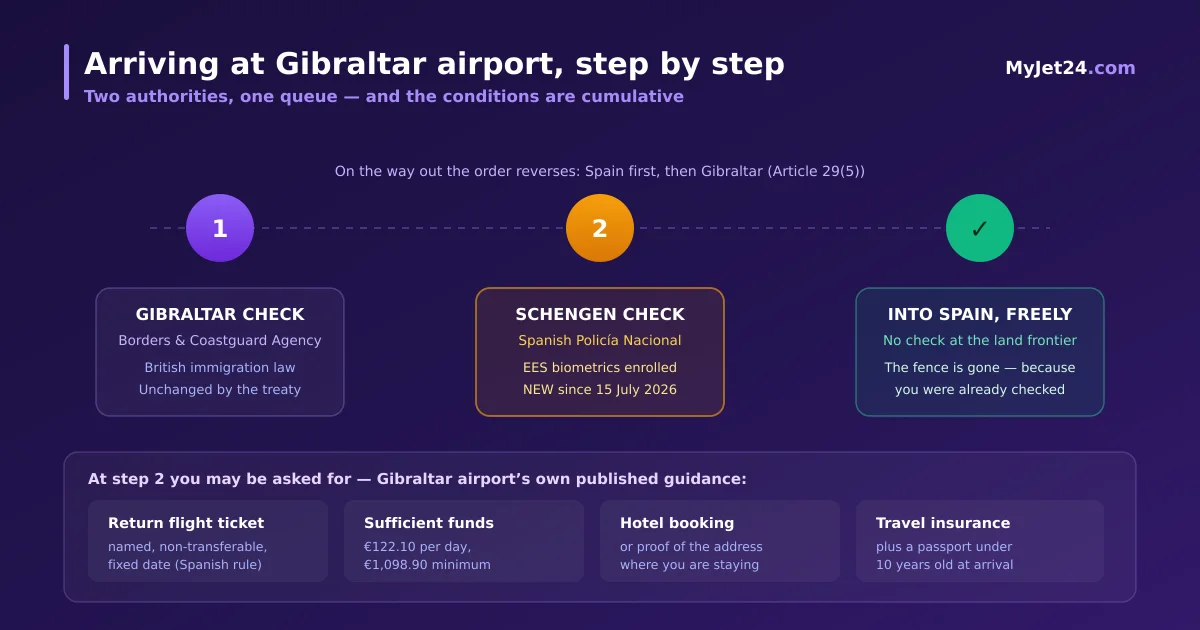
Start with Gibraltar airport's own published guidance. Under the headings for British nationals not resident in Gibraltar and for third-country nationals without a Gibraltar or EU residence card, it states:
"You may be requested to produce a return flight ticket, travel insurance, proof of sufficient funds, hotel booking."
That sentence simply did not apply to a British tourist flying to Gibraltar before 15 July 2026. It applies now because the Spanish officer at the second desk is applying Article 6 of the Schengen Borders Code (Regulation (EU) 2016/399), whose subparagraph (1)(c) requires that third-country nationals "justify the purpose and conditions of the intended stay, and they have sufficient means of subsistence, both for the duration of the intended stay and for the return to their country of origin."
Annex I of the same Regulation lists the supporting documents an officer may request to verify that. For travel for tourism or private reasons, the list includes confirmation of accommodation, documentation of travel plans, and — in the Regulation's own words — "a return or round-trip ticket."
Spain sets the numbers, and Spain's numbers are specific
Because the officers are Spanish, the reference amounts are Spain's. They come from Orden PRE/1282/2007, which pegs them to the national minimum wage. With Spain's 2026 minimum wage set at €1,221 a month by Real Decreto 126/2026, the arithmetic gives:
- €122.10 per person, per day of the intended stay (10% of the gross minimum wage), and
- a floor of €1,098.90 per person (90% of the minimum wage) regardless of how short the trip is.
On the return leg, the Spanish order is unusually precise. It requires travellers to hold "el billete o billetes nominativos, intransferibles y cerrados" — a named, non-transferable, fixed-date ticket for the transport they intend to use. And on proof of funds it excludes something most people would reach for first: internet-printed bank statements are not accepted. Cash, certified or traveller's cheques, or a card accompanied by a recent physical bank statement or passbook are.
The full per-country picture — every Schengen state’s daily figure, from Latvia’s €14 to Spain’s €122.10, and the nine countries that name a return ticket outright — is laid out in our guide to how much money you need to enter Europe.
The honest framing: these checks are discretionary, not universal. Nobody is emptying wallets at Gibraltar airport, and no refusals at the new joint facility were reported in the first fortnight. But the requirement is now real, published and enforceable where it was previously irrelevant — and the cost of being the one person asked, with nothing to show, is your holiday.
Why this is worth taking seriously: the EU's own refusal numbers
Eurostat published 2025's border-refusal statistics on 12 May 2026. There were 132,600 refusals at EU external borders, up 7.1% on the year. The single largest reason was not a missing visa. It was "purpose and conditions of stay not justified" — 40,185 refusals, 30.3% of the total, up 33.3% in one year. At air borders specifically, that reason accounts for 40.0% of all refusals — 22,895 out of 57,175. Spain was the fourth-largest refusing state, at 10,610.
One caveat, stated plainly because it matters: Eurostat has no separate code for "no return or onward ticket." The Schengen Borders Code folds it into the purpose-of-stay category. So that 40,185 is not a count of missing tickets — it is a count of people who could not satisfy an officer about why they were coming and how they were leaving, of which the ticket is one component. That is still the most relevant number in existence for anyone standing in a manual lane.
Two documented incidents at this very frontier show what it looks like in practice, though both pre-date the treaty and happened under the old land-border regime. In November 2023, around 35 non-EU nationals were refused entry into Spain at the Gibraltar frontier over two days; the Gibraltar Government confirmed that "most were asked for the reason of their visit to Spain and for flights or hotel bookings." In December 2022, roughly 90 easyJet passengers whose Gibraltar-bound flight was diverted to Málaga were refused entry to Spain because their boarding passes showed Gibraltar rather than Málaga as the departure point — they could not evidence their exit from Schengen. It was resolved only when new boarding cards showing Málaga were issued.
If you need a verifiable return or onward booking to satisfy that requirement without committing to a fare you may not fly, a free verifiable onward ticket from MyJet24 produces a real, checkable reservation in about 30 seconds. For the Spanish side of a trip specifically, our Spain flight reservation page covers what consulates and border officers look for, and EES and proof of onward travel in Europe explains how the biometric system interacts with the document itself.
Who is exempt — and why residents came out ahead
The treaty's central bargain is that Gibraltar accepted Schengen rules at its border in exchange for its residents being treated, in practice, better than any other third-country nationals in Europe. Article 42 delivers that:
"When crossing the external borders of a Member State … no entry or exit stamp shall be affixed to the travel documents of persons resident in Gibraltar. Persons resident in Gibraltar shall be exempt from the requirements of the Entry/Exit System … [and] shall be exempt from the requirement to be in possession of a valid travel authorisation pursuant to Regulation (EU) 2018/1240."
Read the scope carefully: this applies at every Member State external border, not only Gibraltar's. A Gibraltar resident flying into Frankfurt gets the same exemption. The status attaches to legal residence in Gibraltar irrespective of nationality, evidenced by a valid Gibraltar identity card or residence permit — and Gibraltar residents no longer need a Schengen short-stay visa at all, which is a substantial gain for residents holding visa-required passports.
| Who you are | Lane | EES / ETIAS / 90-180 |
|---|---|---|
| Gibraltar resident (ID or civilian registration card) | Automated e-gate | Exempt from all three. No stamping. |
| EU / EEA / Swiss citizen | Automated e-gate | Not applicable. Passport or national ID card. |
| Non-resident British national | Manual / kiosk lane | EES enrolment; ETIAS when live; Gibraltar days count towards 90/180. |
| Briton long-term resident in a Schengen state | Present your TIE | Exempt from EES across all Schengen states; not subject to 90/180 in your country of residence. |
| Visa-required national | Manual lane | Schengen short-stay visa now required for Gibraltar too — the UK visa route for Gibraltar was closed on 8 July 2026. |
Two caveats worth stating rather than glossing. First, frontier workers and EU nationals gain frictionless crossing but no automatic right of establishment — living or working in Gibraltar still requires Gibraltar immigration clearance, and Article 45 hard-codes anti-abuse conditions, including a bar on obtaining a Gibraltar ID card through investment or payments. Second, one situation has no published answer yet: which lane a Spanish-resident Briton uses if they fly into Gibraltar, and how Spanish officers there treat a TIE for onward entry to Spain. Logically the TIE evidences the exemption, but we found no official statement, so treat that as inference and carry the card.
The port, cruise ships and the Morocco ferry
The treaty establishes border crossing points at both the airport and the port, but Article 29(3) contains a derogation that has actually been used: checks may be carried out at the airport crossing point if port traffic volumes allow, with sea passengers and crew escorted from the port to the airport facility. The Gibraltar Government has confirmed that in practice the port does not operate as a border crossing point — the airport facility is the single control point.
For cruise ships, the Gibraltar Chronicle reports that vessels will have to call at a Schengen port before arriving in Gibraltar, so that passengers are pre-cleared, with no cruise liners calling directly from a third country other than the UK. That is a structural change to itinerary planning rather than a document you carry.
The ferry to Tanger Med has ended. The DFDS link was Gibraltar's only regular passenger connection to Morocco for over two decades, and it was wound up ahead of 15 July. The reported driver is structural rather than commercial: a scheduled third-country sea link would have forced permanent Spanish Schengen checks at the port, defeating the Article 29(3) derogation that keeps the port out of border-crossing-point status. The knock-on effect is that Moroccan nationals travelling to Gibraltar via Spain need a Schengen visa — which Article 47(1) requires in any case, since Schengen visa nationals now need a visa for Gibraltar too. If Morocco is on your itinerary, our Morocco proof-of-onward-travel guide and Morocco flight reservation page cover the documents on that side.
Customs: the change nobody is talking about
Immigration got the headlines; customs is where most travellers will actually feel a difference, and where Gibraltar's freight sector spent its first fortnight in difficulty.
Article 240 establishes a customs union between the EU and the UK in respect of Gibraltar. Article 241 then does something easy to miss: Gibraltar's customs territory becomes "a customs territory separate from the customs territory of the United Kingdom." Gibraltar is in a customs union with the EU and out of the UK's.
Gibraltar does not adopt VAT. Under Article 248 it levies a transaction tax instead, with EU-aligned excise minimums, a mandatory 0% rate on foodstuffs, water, pharmaceuticals, books and domestic solar panels, and an independent consultative body assessing annually whether Gibraltar's rates distort trade with the neighbouring Spanish frontier zone.
For travellers, Annex 23 sets the allowances during the three-year temporary regime:
- €430 per person by air or sea; €300 by land; €175 for travellers under 15. Items may not be split to fit under the threshold.
- Tobacco: 200 cigarettes (80 for crew, and 80 for residents or frontier-zone workers crossing by land), or 100 cigarillos, 50 cigars or 250 g of smoking tobacco — combinations must not exceed 100% in aggregate.
- Alcohol: 1 litre above 22% ABV or 2 litres up to 22%, plus 4 litres of still wine and 16 litres of beer.
- No tobacco or alcohol relief at all for travellers under 17.
- Fuel: the standard tank plus 10 litres in a portable container.
Given Gibraltar's long history as a tobacco-price destination, the 200-cigarette ceiling — and the 80-cigarette limit for people who cross the land frontier regularly — is the single most likely source of a bad afternoon at the red channel.
It is not a back door into Europe
Within a week of the fence coming down, social media produced the predictable theory: fly to Gibraltar, walk into Spain, skip the Schengen border. The Gibraltar Government issued a formal statement on 22 July 2026 to kill it. The relevant lines:
"Any person who is a visa-required national must obtain the necessary visa to enter Gibraltar before travelling." The arrangements at the airport "do not create a general right for individuals who do not otherwise meet the relevant entry requirements to enter Spain," and "the refusal of a UK visa does not create a right to enter Gibraltar or the Schengen Area via Gibraltar."
The statement also advised the public to rely on official information rather than "unverified information circulating on social media." Mechanically, the theory was never going to work: the Schengen check happens on arrival in Gibraltar, before you get anywhere near the land frontier. The frontier is unguarded precisely because everyone crossing it has already been checked.
What the first two weeks actually looked like
Day one did not go smoothly. Gibraltar's broadcaster reported delays on the morning of 15 July because the e-gates were not working — specifically, the EES machines could not read Gibraltar ID cards, and the system had been misbehaving hours before the first of four arrivals. Passengers were processed manually. Chief Minister Fabian Picardo, interviewed at the border, acknowledged the teething problems.
By 18 July the picture had improved markedly. The longest queue recorded was around 50 minutes, for British and other non-EU nationals; the following morning's arrival cleared in 20 minutes. The Government deployed extra staff and tourist information officers, provided water and seating, and installed six additional EES kiosks that week. It also publicly disputed a viral video of long queues as "substantially untrue" after reviewing CCTV.
Scale helps: Gibraltar airport handles roughly 300,000 passengers a year, typically one narrowbody arrival an hour, so the worst case is nothing like Málaga or Alicante. The visible disruption in the second week was freight and customs, not passengers — border freight delays were reported easing by 27 July as the new customs regime bedded in. If you want a sense of how EES queues have behaved across Europe generally, we collected traveller reports in our EES airport wait-times roundup.
Seven mistakes to avoid
- Assuming Gibraltar still pauses your Schengen clock. It doesn't, and this is the error most likely to turn into an overstay. Count your Gibraltar days.
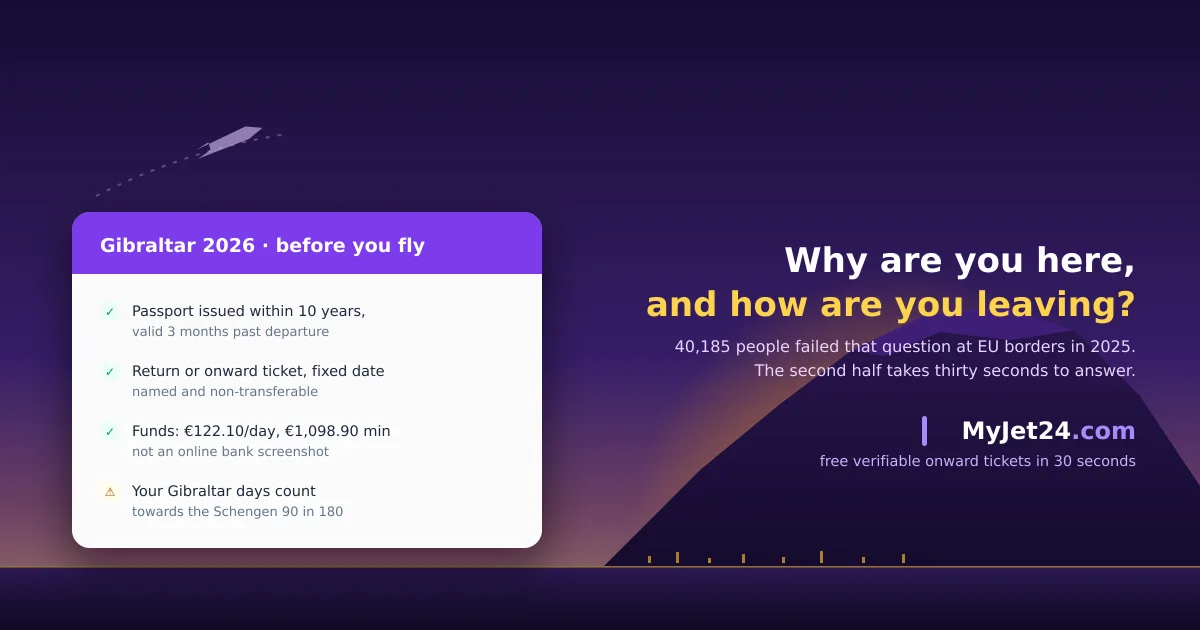
- Travelling on a passport more than ten years old. The Schengen rule requires a document issued within the previous 10 years and valid at least three months beyond your intended departure. Old-style extended UK passports fail the first test even when they look valid.
- Bringing an internet-printed bank statement as proof of funds. Spain's own order excludes it. Bring a card with a recent physical statement, or cash.
- Arriving with a one-way ticket. Annex I of the Schengen Borders Code names "a return or round-trip ticket," and Spain's rule specifies a named, non-transferable, fixed-date ticket. Gibraltar airport's own page confirms you may be asked.
- Believing the "back door to Europe" theory. The Gibraltar Government has formally rebutted it. The Schengen check happens on arrival, not at the frontier.
- Being a Gibraltar resident without your card. The Article 42 exemptions are proved by a valid Gibraltar identity or civilian registration card. Without it, non-EU residents get processed as ordinary third-country nationals.
- Overlooking the customs allowances. €300 by land, 200 cigarettes — 80 if you're a resident or frontier worker crossing by land — and no tobacco or alcohol relief under 17.
Frequently asked questions
Did Gibraltar join the Schengen Area in 2026?
No. The European Commission's explanatory memorandum states that "although Schengen rules will be applied at the external borders, Gibraltar will not become part of the Schengen area." Gibraltar remains a British Overseas Territory outside both the EU and Schengen. It applies the Schengen Borders Code at its own external border under a dynamic-alignment duty, with Spanish officers carrying out the Schengen checks there on behalf of the EU.
Does time in Gibraltar count towards my Schengen 90/180 days?
Yes, if you are not a Gibraltar resident. The FCDO states that "any time you spend in Gibraltar will count alongside time spent in the Schengen Area" towards the 90-days-in-180 limit. The rule is not qualified by how you arrive. Gibraltar residents are exempt: their frontier crossings do not trigger the 90-day limit.
Do I need a return ticket to fly to Gibraltar now?
You may be asked for one. Gibraltar airport's own guidance tells non-resident British and other third-country nationals: "You may be requested to produce a return flight ticket, travel insurance, proof of sufficient funds, hotel booking." The legal basis is Article 6(1)(c) of the Schengen Borders Code, and Annex I of the same Regulation lists "a return or round-trip ticket" among the supporting documents an officer may request. Spain's own rules require a named, non-transferable, fixed-date ticket.
How much money do I need to show to enter Gibraltar?
Because Spanish officers apply Spanish reference amounts, the figures for 2026 are €122.10 per person per day of the intended stay, with a minimum of €1,098.90 per person regardless of trip length. These derive from Orden PRE/1282/2007 as applied to Spain's 2026 minimum wage of €1,221 per month. Internet-printed bank statements are not accepted as evidence; cash, certified or traveller's cheques, or a card with a recent physical statement are.
Is there still a passport check at the Spain–Gibraltar land border?
No. Routine immigration controls at the La Línea frontier ended on 15 July 2026 and the fence was dismantled. Controls can be temporarily reinstated under Article 30 in the event of a serious threat to public policy, public health or internal security — for up to 10 days initially, extendable by 20 days and then monthly to a maximum of six months, with four weeks' notice, or 48 hours in an emergency.
Will I be registered in the EU Entry/Exit System at Gibraltar airport?
Yes, if you are a non-resident third-country national, which includes non-resident British citizens. First arrival means full enrolment — facial image, fingerprints and travel-document data — at a booth. Your EES record is then valid for three years, so later crossings are verification rather than re-enrolment. Gibraltar residents are exempt under Article 42, as are Britons who are long-term residents of a Schengen state.
Will I need ETIAS to visit Gibraltar?
Eventually, but not yet. Both the FCDO and the Gibraltar Government say ETIAS "will also apply once it is operational." ETIAS is not operational as of late July 2026, and its launch target was quietly removed from the official EU site in mid-July; reporting points to a revised date being set after eu-LISA's September 2026 meeting, with 2027 the realistic expectation. The fee will be €20, and there will be a transitional period of at least six months.
Can I use Gibraltar as a back door into Spain or the EU?
No. The Gibraltar Government issued a formal statement on 22 July 2026 confirming that the airport arrangements "do not create a general right for individuals who do not otherwise meet the relevant entry requirements to enter Spain," and that "the refusal of a UK visa does not create a right to enter Gibraltar or the Schengen Area via Gibraltar." The Schengen check takes place on arrival in Gibraltar, before you reach the land frontier.
Which passport rules apply for Gibraltar now?
The Schengen standard: your passport must have been issued within the previous 10 years on the date of arrival, and be valid for at least three months after your intended departure. EU, EEA and Swiss citizens may use a passport or a national ID card. British–Irish dual nationals travelling on the Irish passport are treated as EU citizens.
What happens if Spain refuses me entry but Gibraltar would let me in?
You do not enter Gibraltar. Entry conditions are cumulative under Article 29(7), and Article 35(2) makes Spain the enforcer of refusals grounded in EU law, so a non-resident third-country national refused by Spain is refused overall. The reverse case is gentler: if Gibraltar refuses you but Spain finds you meet EU conditions, you are escorted to the second-line area and admitted to the Schengen area instead. Gibraltar residents cannot be refused entry to Gibraltar by Spain at all.
Do Gibraltar residents still need a Schengen visa?
No. Under the agreement, Schengen states no longer require a short-stay visa from any person legally resident in Gibraltar. Combined with the Article 42 exemptions from stamping, EES and ETIAS — which apply at every Member State external border, not just Gibraltar's — residents are now among the most lightly-processed travellers in Europe. The exemption is proved with a valid Gibraltar identity or civilian registration card, so carry it.
Is the Gibraltar to Morocco ferry still running?
No. The Tanger Med service, Gibraltar's only regular passenger link to Morocco for over two decades, was wound up ahead of the treaty's application. The reported reason is structural: a scheduled third-country sea link would have required permanent Spanish Schengen checks at Gibraltar's port, which the current arrangement avoids by routing sea arrivals to the airport facility instead.
How long are the queues at Gibraltar airport now?
They spiked and then settled. E-gate and EES failures on 15 July forced manual processing; by 18 July the longest recorded queue was about 50 minutes for non-EU nationals, and the next morning's arrival cleared within 20 minutes. Six additional EES kiosks were installed that week. Gibraltar airport handles around 300,000 passengers a year, which limits the worst case compared with larger Spanish airports.
Is the treaty actually in force?
Not fully. It was signed on 14 July 2026 and has been provisionally applied since 15 July 2026, which makes every rule described here operative today. But the UK command paper still carries the line "[The Agreement has not been ratified by the United Kingdom]," and the European Parliament's consent vote is expected later in 2026. Provisional application also carries an unusual feature: under Article 336(5), the border regime falls away if the underlying Spain–Gibraltar administrative arrangements are suspended or terminated.
The bottom line
The fence coming down is a genuinely historic thing, and the people it helps most are the 15,000 who cross that line to work every day. But the traveller-facing summary is almost the inverse of the headlines. Gibraltar did not join Schengen. It agreed to enforce Schengen's rules at its own door in exchange for its residents being waved through Europe's. If you live there, the treaty is a gift. If you are visiting, it is a new set of conditions.
So the practical checklist is short. Count Gibraltar days against your 90. Carry a passport issued within ten years and valid three months beyond departure. Expect a manual lane, biometric enrolment and a queue that is currently around twenty minutes. Have your accommodation confirmed and your funds in a form Spain actually accepts — not a screenshot of online banking.
And be able to answer the oldest question at any border, the one that 40,185 people failed at EU borders last year: why are you here, and how are you leaving? The second half of that question is the easy half to solve in advance. A verifiable proof of onward travel takes about thirty seconds and turns the one document you might be asked for into the one you already have. The Rock has been welcoming visitors since 1713 under British administration and considerably longer before that — it just now expects you to have a plan for leaving it.
Sources
- UK Government — EU/EAEC and UK Agreement in respect of Gibraltar, Miscellaneous No. 9 (2026), CP 1645 (treaty text): https://www.gov.uk/government/publications/ukeu-and-eaec-agreement-in-respect-of-gibraltar-ms-no92026
- European Commission — COM(2026) 91 final/2, proposal and explanatory memorandum: https://www.exteriores.gob.es/es/PoliticaExterior/Documents/COM_2026_91_1_EN_annexe_proposition_cp_part1_v5.pdf
- FCDO — Gibraltar travel advice, entry requirements: https://www.gov.uk/foreign-travel-advice/gibraltar/entry-requirements
- FCDO — EU Entry/Exit System guidance: https://www.gov.uk/guidance/eu-entryexit-system
- Sir Joshua Hassan Gibraltar International Airport — Passports & Identity Cards: https://www.gibraltarairport.gi/at-the-airport/passports-and-identity-cards
- HM Government of Gibraltar — Government Statement on Entry Requirements and Travel (582/2026): https://www.gibraltar.gov.gi/press-releases/government-statement-on-entry-requirements-and-travel-5822026-12228
- HM Government of Gibraltar — Treaty Delivers Fluidity at the Frontier While Preserving Control of Immigration (148/2026): https://www.gibraltar.gov.gi/press-releases/treaty-delivers-fluidity-at-the-frontier-while-preserving-control-of-immigration-1482026-11759
- Regulation (EU) 2016/399 (Schengen Borders Code), Article 6 and Annex I: https://www.legislation.gov.uk/eur/2016/399/article/6
- BOE — Orden PRE/1282/2007 (means of subsistence and return ticket): https://www.boe.es/buscar/act.php?id=BOE-A-2007-9608
- BOE — Real Decreto 126/2026 (2026 minimum wage): https://www.boe.es/buscar/doc.php?id=BOE-A-2026-3815
- Eurostat — Refusals of entry at EU external borders, 2025 (news release 12 May 2026): https://ec.europa.eu/eurostat/web/products-eurostat-news/w/ddn-20260512-1
- Gibraltar Chronicle — Agreement sets out detail of new dual immigration controls: https://www.chronicle.gi/agreement-sets-out-detail-of-new-dual-immigration-controls/
- GBC — Issues at airport being resolved, Government introduces measures: https://www.gbc.gi/news/issues-at-airport-being-resolved-government-introduces-measures-to-ensure-a-smooth-experience
- House of Commons Library — UK–EU Agreement on Gibraltar (CBP-10572): https://commonslibrary.parliament.uk/research-briefings/cbp-10572/
This guide reflects the EU–UK Agreement in respect of Gibraltar as signed on 14 July 2026 and provisionally applied from 15 July 2026, together with FCDO, HM Government of Gibraltar, Gibraltar airport, Spanish and Eurostat sources as of 28 July 2026. The treaty is provisionally applied but not yet ratified, ETIAS has no confirmed launch date, and border checks are discretionary by nature — verify against official channels before you travel. This article is informational and not legal advice.
