
Last updated: 27 August 2026 · Reading time: 13 min · Author: Joshua White, Travel Documentation Writer at MyJet24 · Reviewed by: Marc Hoffmann, Senior Visa Consultant
TL;DR — Key facts
- Yes — a child needs their own of almost everything. Own passport, own travel authorisation, own arrival card, own onward ticket. No scheme in this space has a family application.
- There is no single age at which a child becomes an adult traveller. Across ten common rules the threshold lands on seven different ages: 2, 6, 12, 15, 16, 17 and 18.
- Britain charges babies full price; Europe charges them nothing. The UK ETA is £20 for "babies and children"; the ETIAS fee is waived for under-18s — though the application is still required.
- A child's passport is the part that fails first. UK and US child passports run five years, not ten, so the six-month validity rule bites roughly five years earlier than a parent's.
- Fee exemptions are not entry exemptions. Free almost always still means apply, register and be counted.
Children need their own travel documents. Every traveller, including a newborn on a parent's lap, requires an individual passport, an individual travel authorisation where one applies, and an individual arrival card. What changes with age is the price and the biometrics, not the requirement — and each country sets that age differently.
One booking per name, including lap infants — issued in about 30 seconds.
Do children need their own passport?
Yes. Every child needs an individual passport in their own name, including a newborn and including a baby travelling on a parent's lap without a seat. Adding a child to a parent's passport was phased out worldwide roughly two decades ago, and no major country still issues a shared document.
This catches families with very young children more than anyone else, because the intuition runs the other way. A three-week-old baby with no seat, no luggage and no fare still needs a booklet with their own photograph and their own number. The photograph is the part parents underestimate: most passport authorities require an open-eyed, plain-background image of an infant who cannot yet hold their own head up.
The practical consequence is one of timing rather than paperwork. A first passport is applied for in person, and the appointment queue is the constraint, not the printing. Families who decide to travel eight weeks out routinely discover the child's document is the reason they cannot.
Key takeaway: One traveller, one passport, at any age. A lap infant is a traveller.
Do babies and children need their own visa or travel authorisation?
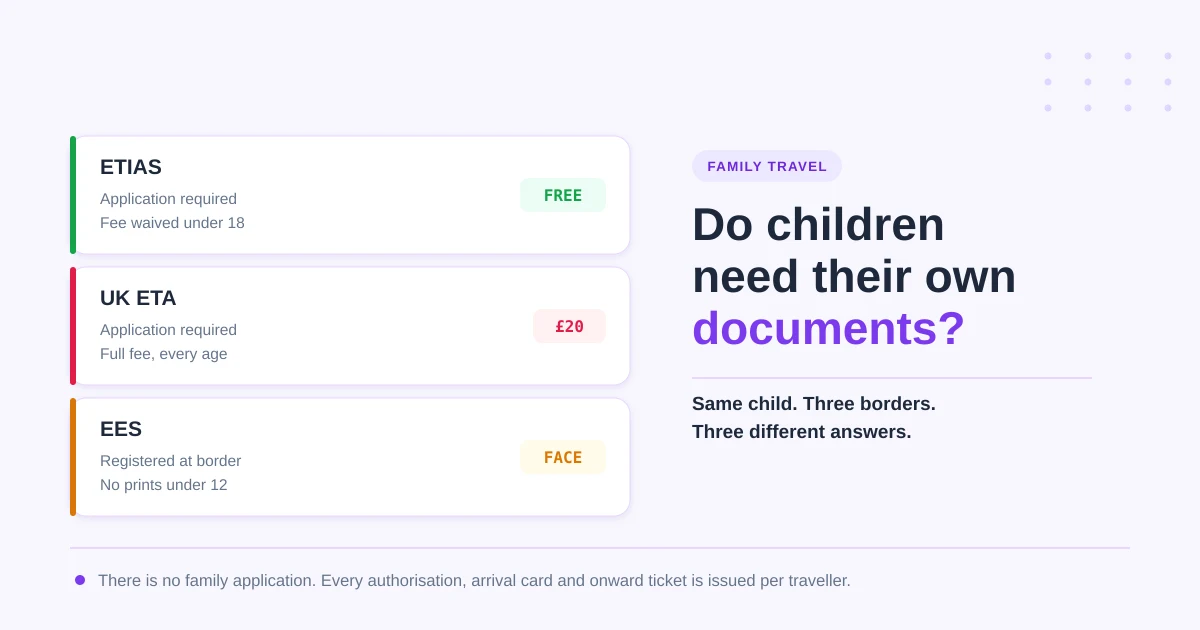
Yes — a child needs their own visa, ETA or eVisa wherever an adult would need one, and there is no family application anywhere in this space. The authorisation attaches to the child's passport number, so it cannot be shared with a parent's.
The UK states this more bluntly than anyone. Its official guidance on the Electronic Travel Authorisation says: "Each person travelling needs an ETA, including babies and children." The fee is £20 per person with no age concession — a family of five pays £100 before anyone has bought a ticket.
Europe took the opposite decision on price. Article 18 of the regulation that created ETIAS states that "the travel authorisation fee shall be waived for applicants under 18 years or above 70 years of age at the time of the application." The application is still compulsory; only the money is waived. The US takes a third position again: an ESTA is required at every age, at a single flat price, with no child rate.
Three systems, one child, three answers. Britain charges a newborn full price, Brussels charges nothing, Washington charges the adult rate. None of them lets you skip the form.
If you are unsure which of these your route triggers at all, the distinction between the four permission types is set out in our guide to visa-free versus ETA, eVisa and visa on arrival, and the UK scheme specifically in our UK ETA guide.
Key takeaway: Budget one authorisation per passport. Where a child is free, they are free from the fee — never from the form.
Why does every rule use a different age for children?
Because each rule was written for a different purpose, and none of them defines a child the same way. There is no shared legal definition of a child in travel: the threshold is set by whichever regulation, fee schedule or biometric standard you happen to be crossing.
Pulled together from rules we have verified individually, the spread is wider than most parents expect. It runs from age 2 to age 18 across ten everyday requirements — and two of the most common, the EES fingerprint rule and Thailand's cash rule, happen to agree on 12 purely by coincidence.
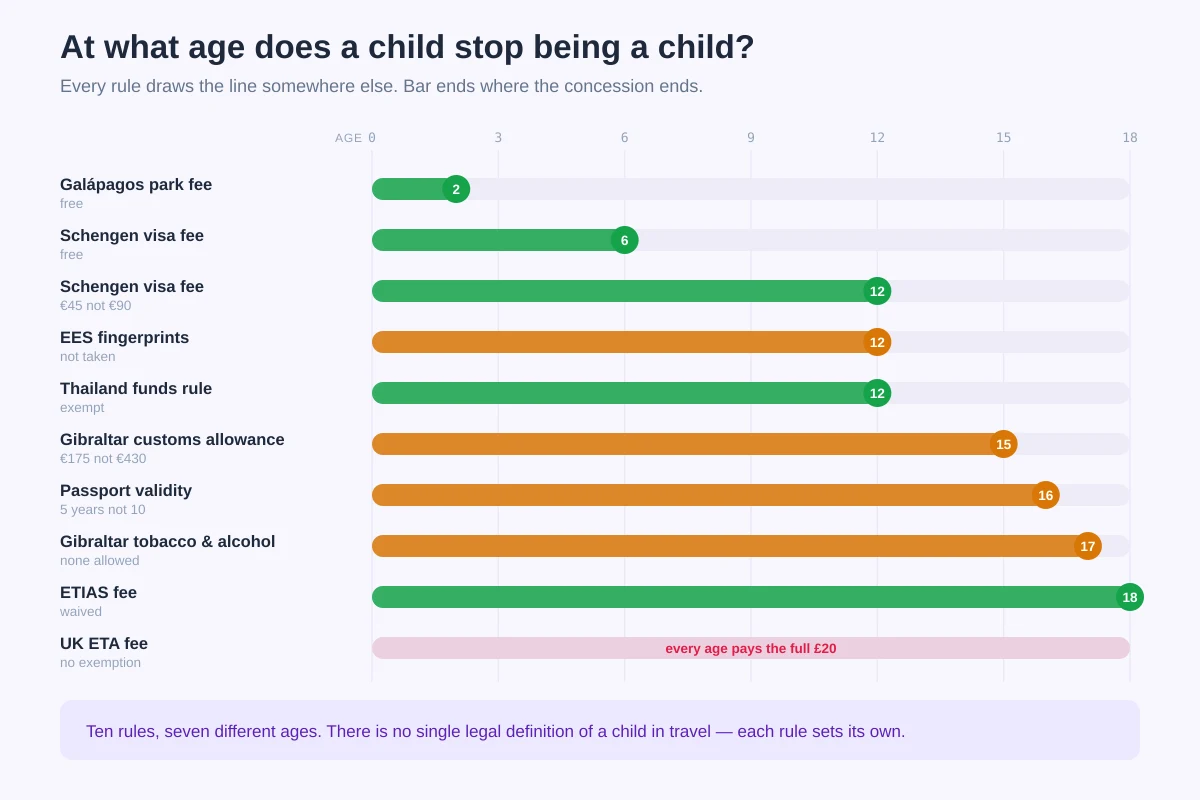
| Rule | Child threshold | What changes at that age |
|---|---|---|
| Galápagos park fee | 2, then 12 | Free under 2, $100 under 12, $200 above |
| Schengen visa fee | 6, then 12 | Free under 6, €45 from 6 to under 12, €90 above |
| EES fingerprints | 12 | Facial image only below; fingerprints from 12 |
| Thailand proof of funds | 12 | Exempt below; counted as a person above |
| Gibraltar customs allowance | 15, tobacco 17 | €175 below 15; no tobacco or alcohol allowance under 17 |
| Passport validity (UK, US) | 16 | 5-year booklet below; 10-year above |
| ETIAS fee | 18 | Waived below 18 and above 70 |
| UK ETA fee | none | £20 at every age, babies included |
| Edinburgh visitor levy | none | No child exemption; charged per person |
| Kyoto lodging tax | none | Per person, children included |
The pattern worth internalising is that the newer the charge, the less likely it exempts a child. Long-standing visa fees carve out young children; the tourist levies written in the past two years mostly do not, which is covered in our breakdown of the 2026 tourist taxes.
Key takeaway: Never assume a child concession exists. Check the specific rule, because the age changes with the rule.
Why does my child’s passport expire before mine?
A child's passport is issued for half the term of an adult's. In the UK and the US a passport issued to someone under 16 runs five years rather than ten, because a young face changes too fast for a ten-year photograph to remain usable.
Then the six-month rule takes a further bite off the end. Many destinations require a passport to remain valid for six months beyond the date of entry, so the last half-year of any booklet is issued but not usable. On an adult document that leaves roughly nine and a half working years. On a child's, four and a half.
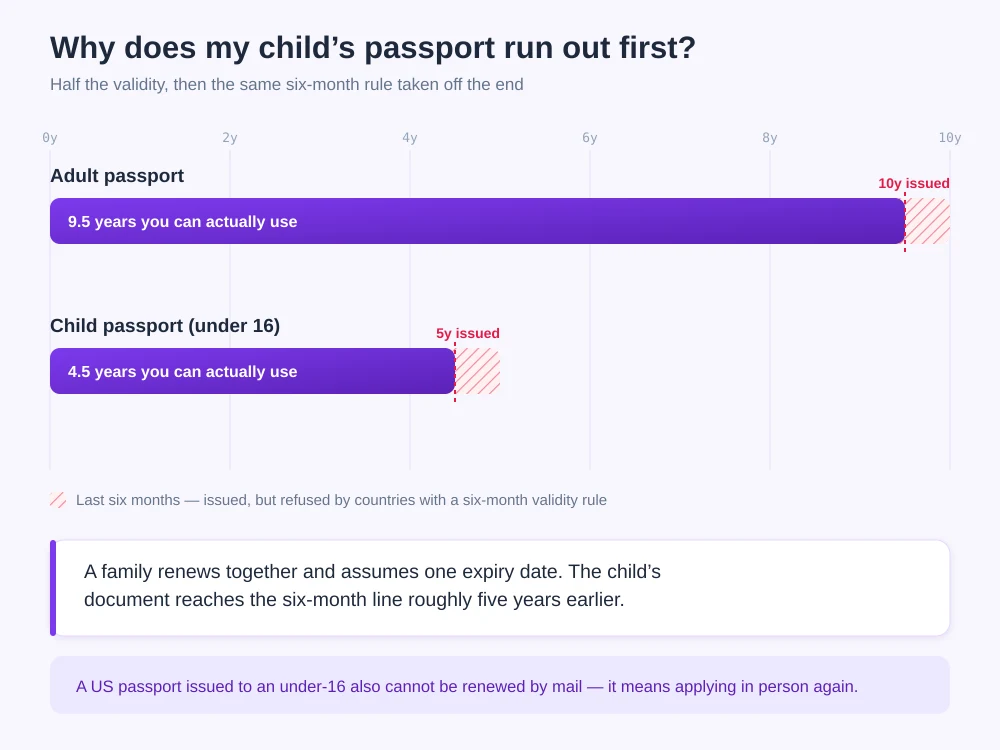
The trap is a family that renewed together. Parents and children apply in the same week, everyone gets a document with the same issue date, and the household files it mentally as one expiry. Five years later the adults are still fine and the child is already inside the six-month window. Which countries enforce that window, and how strictly, is set out in our guide to passport validity and the six-month rule.
There is a second sting on US documents. A passport issued to a child under 16 cannot be renewed by mail — the family has to attend in person again, with both parents or documented consent. Renewal is not a form; it is an appointment.
Key takeaway: Check the child's expiry date first, not the adults'. It is almost always the earliest constraint in the household.
Do children have to give fingerprints at the border?
Not below the age of twelve in Europe. The EU's Entry/Exit System records every non-EU traveller crossing an external Schengen border, children included, but the biometric requirement differs by age. The EU's own guidance states that "children under the age of 12 shall be exempt from the requirement to give fingerprints."
Exempt from fingerprints is not exempt from the system. A child under twelve is still registered, still has a facial image captured, and still has their entries and exits counted against the permitted stay. The exemption removes a step at the kiosk; it does not remove the child from the record.
This matters at the queue rather than in law. A family arriving together at a first-time EES enrolment moves at the speed of its slowest registration, and the parents — not the toddler — are the ones giving four fingerprints each. Families who expect a child-free process are surprised by the opposite: the adults take longer. The difference between EES and ETIAS, which parents routinely conflate, is unpicked in our ETIAS versus EES comparison.
Key takeaway: Under twelve means no fingerprints, not no registration. The child is in the database either way.
Do children need their own proof of onward travel?
Yes. Proof of onward travel is assessed per traveller, so a child needs a booking in their own name — including an infant flying on a parent's lap without a seat of their own.
The logic is admission, not seating. The requirement exists so a country can see that each admitted person intends to leave, and a child is admitted as a person. A lap infant has no seat and often no fare, but they still receive a stamp or an electronic entry record, and that record needs a matching departure.
Airlines apply the same arithmetic at check-in for their own reasons. A carrier that boards a family of four to a destination requiring onward proof is exposed for four passengers, not two, so the desk expects four names. The six ways to satisfy that requirement, ranked, are in our guide to showing proof of onward travel.
Each in the traveller’s own name, with a locator an airline agent can look up.
Key takeaway: Count names, not seats. A lap infant needs onward proof exactly like everyone else.
How much money do I have to show for a child?
Usually less than for an adult, and occasionally nothing — but the rule differs by country and several make no reduction at all. Proof-of-funds requirements are written per person, then adjusted for children in some jurisdictions and not others.
Thailand is the clean example of a carve-out. Its long-standing cash rule asks for 20,000 baht per person on a tourist visa or 10,000 on a visa exemption, doubled for a family — and children under 12 are exempt entirely, so a family of two adults and two young children shows the family figure rather than four individual ones. The detail sits in our guide to Thailand's proof of funds rule.
Schengen is the messy example. Reference amounts are set by each member state, several halve the figure for a minor, and several do not mention children at all — in which case the adult amount is the safe assumption. The full country-by-country table is in our breakdown of how much money you need to enter the Schengen area.
Key takeaway: Where a country is silent on children, budget the adult figure. Silence is not a discount.
Does a child need their own arrival card?
In almost every digital arrival-card system, yes — each traveller files their own record, and a parent submits it on the child's behalf rather than adding the child to their own. The QR code that comes back belongs to the child's passport, not the family.
Systems differ in how they present this. Some let a parent file several travellers inside one session and then issue separate codes; others require a fresh submission per person. Either way the output is per traveller, which is the part that matters when an officer scans at the counter and gets one record per passport.
The mistake families make is filing for the adults on the plane, assuming the children are covered, and arriving with two codes for four people. There is no partial credit at an arrival kiosk — the missing traveller is simply not registered, and the family is sent to a desk to do it there.
Key takeaway: Count the codes before you land. One per passport, every time.
Why do some tourist taxes charge children and others don’t?
Because a tourist tax is a local revenue measure rather than an immigration rule, and each city decides its own exemptions. Older lodging taxes commonly exempt young children; several of the levies introduced recently deliberately do not.
Edinburgh's visitor levy, live since July 2026, is the clearest case. Its exemptions are social — people at risk, those fleeing domestic abuse, asylum seekers and refugees — and there is no child exemption and no business-traveller carve-out. Kyoto's lodging tax is likewise charged per person with children included, which on its top band is a meaningful sum for a family.
Entry fees behave the same way but with their own numbers. The Galápagos park fee is $200 for a foreign adult, $100 for a child under 12 and free under 2 — three tiers on a single payment, in cash, as covered in our Galápagos entry guide.
A per-person charge means a family of four pays four times the headline number. That is the single most expensive assumption in family travel budgeting.
Key takeaway: Multiply every per-person fee by the number of passports, not the number of adults.
How can I prove I’m allowed to travel with my own child?
With a consent letter from the parent who is not travelling, plus documents linking you to the child. Border officers in several countries ask a travelling adult to demonstrate they have the right to take that specific child out of the country, and a shared surname is not evidence.
The situations that trigger questions are predictable: one parent travelling alone with a child, separated or divorced parents, a grandparent or family friend accompanying a child, or a parent whose surname differs from the child's. The check exists because international child abduction is most often committed by a parent.
What settles it in practice is a signed letter naming the child, the travel dates and the accompanying adult, with the absent parent's contact details, carried alongside a birth certificate showing the relationship. The template and the country-specific detail are in our guide to the child travel consent letter. Where a child is flying without any parent, the airline's own regime applies instead, which we cover in unaccompanied minors.
Key takeaway: Carry the letter even where it is not formally required. It costs nothing and answers the question in seconds.
How do I get a child’s documents sorted, in the right order?
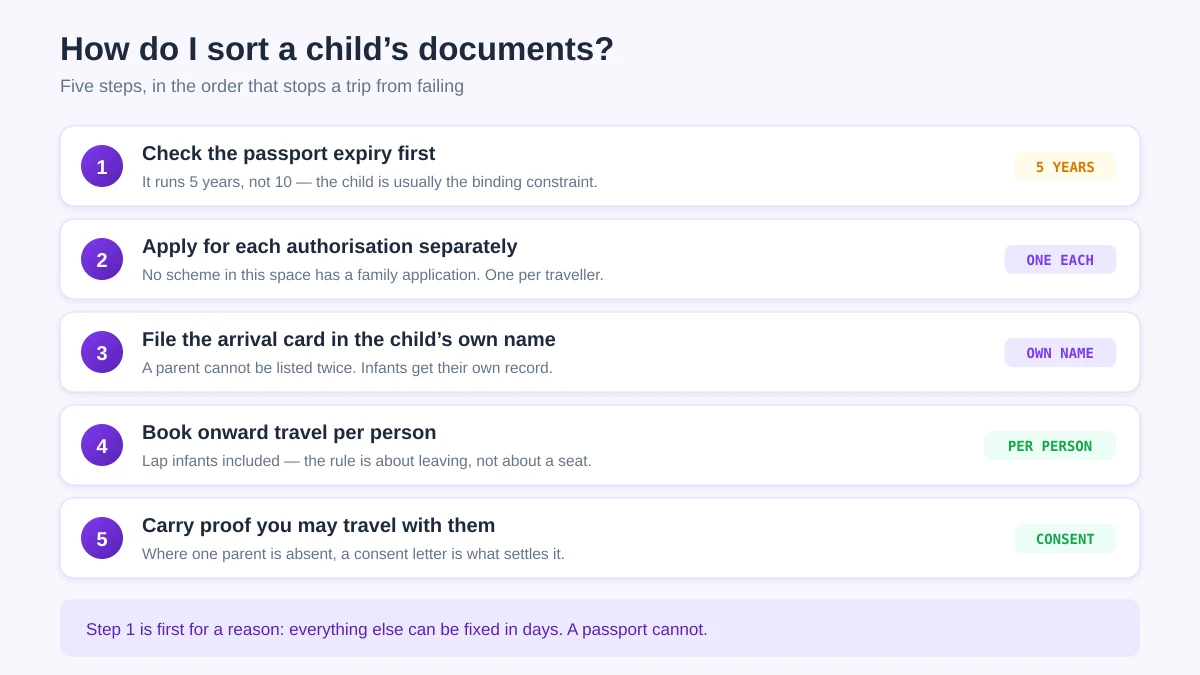
Work backwards from the item with the longest lead time, which is always the passport. Everything else in this list can be arranged in days; a first passport or an in-person renewal cannot.
- Check the child's passport expiry before you book anything. Add six months to your return date and confirm the document still clears it. If it does not, that is the trip's real deadline.
- Apply for each authorisation separately. One ETA, ESTA, ETIAS or eVisa per passport. Where the child's fee is waived, submit anyway — the record has to exist.
- File the arrival card in the child's own name. Check you have one confirmation code per traveller before departure, not one per booking.
- Book onward travel for every name, lap infants included. The desk counts passports, and so does immigration.
- Pack the consent letter and a birth certificate if any parent is missing from the trip, or if surnames differ across the party.
In the reservations we issue for families, the correction we make most often is a missing infant. The booking comes in for two adults and one child because the parents counted seats, and the lap baby — who has a passport, an authorisation and an entry record like everyone else — was left off. It is a two-minute fix before departure and an argument at a counter afterwards.
Key takeaway: Sequence matters. Passport first, because it is the only step measured in weeks.
What do families get wrong most often?
Nearly every failure traces to one of five assumptions, and all five are reasonable until you meet the rule that contradicts them.
Assuming a family application exists. It does not, anywhere in this space. Every authorisation, arrival card and onward booking is issued against one passport.
Reading free as exempt. A waived ETIAS fee still requires the application. A waived park fee still requires the traveller to be counted.
Trusting one expiry date for the household. The child's document is on a five-year cycle and reaches the six-month line years before the parents'.
Counting seats instead of passports. A lap infant has no seat and every obligation.
Budgeting headline prices. Per-person charges multiply by the whole party, and the newest levies are the least likely to spare a child.
Key takeaway: When in doubt, treat each child as a full traveller and be pleasantly surprised by the discounts.
The numbers a family actually pays
- £20 — UK ETA, per person, every age, babies included (gov.uk).
- €0 — ETIAS fee for anyone under 18 or over 70; the application remains compulsory (Reg. (EU) 2018/1240, Art. 18).
- 12 — the age from which the EU's Entry/Exit System takes fingerprints; below it, facial image only.
- €90 / €45 / €0 — Schengen visa fee for an adult, a child aged 6 to under 12, and a child under 6.
- $200 / $100 / free — Galápagos park fee for a foreign adult, a child under 12, and a child under 2.
- 5 years — validity of a UK or US passport issued to an under-16, against 10 for an adult.
Figures read from the cited primary sources on 27 August 2026. Fees change; the age thresholds change far less often.
What should I do next?
Open your children's passports and read the expiry dates before anything else. Add six months to your intended return date. If a child's document does not clear that line, you have found the real deadline for the trip, and it is measured in appointment slots rather than clicks.
Then count passports and match every requirement to that number — one authorisation, one arrival card, one onward booking per name. Where a family needs verifiable reservations in each traveller's name, including the infant with no seat, that is the specific thing MyJet24 issues.
One verifiable reservation per traveller, lap infants included — about 30 seconds each.
About the author
Joshua White is a Travel Documentation Writer at MyJet24. He tracks entry requirements across the schemes covered here and handles the family bookings where a child’s paperwork and a parent’s do not line up.
Reviewed by Marc Hoffmann, Senior Visa Consultant at MyJet24, who has worked with consular documentation requirements for more than a decade.
Last reviewed on 27 August 2026 by Marc Hoffmann.
Sources
- UK Government — Apply for an Electronic Travel Authorisation (“Each person travelling needs an ETA, including babies and children”; £20)
- Regulation (EU) 2018/1240, Article 18 — ETIAS fee waived for applicants under 18 or over 70
- European Commission — Children (Schengen IT systems glossary) — EES fingerprint exemption below age 12
- Official ESTA application, US Customs and Border Protection
Methodology note: the ETIAS waiver is quoted from the text of the founding regulation; the fee itself was later raised from the €7 stated there to €20 by amendment, so the amount and the waiver come from different instruments. Figures for the Thailand funds rule, the Galápagos park fee, the Schengen visa fee and the Edinburgh and Kyoto levies are carried over from our own country reporting, each verified against primary sources at the time of writing and linked above. Fees change more often than age thresholds — check the current figure before you pay.
Last updated: 27 August 2026 · Reviewed by Marc Hoffmann, Senior Visa Consultant, MyJet24
