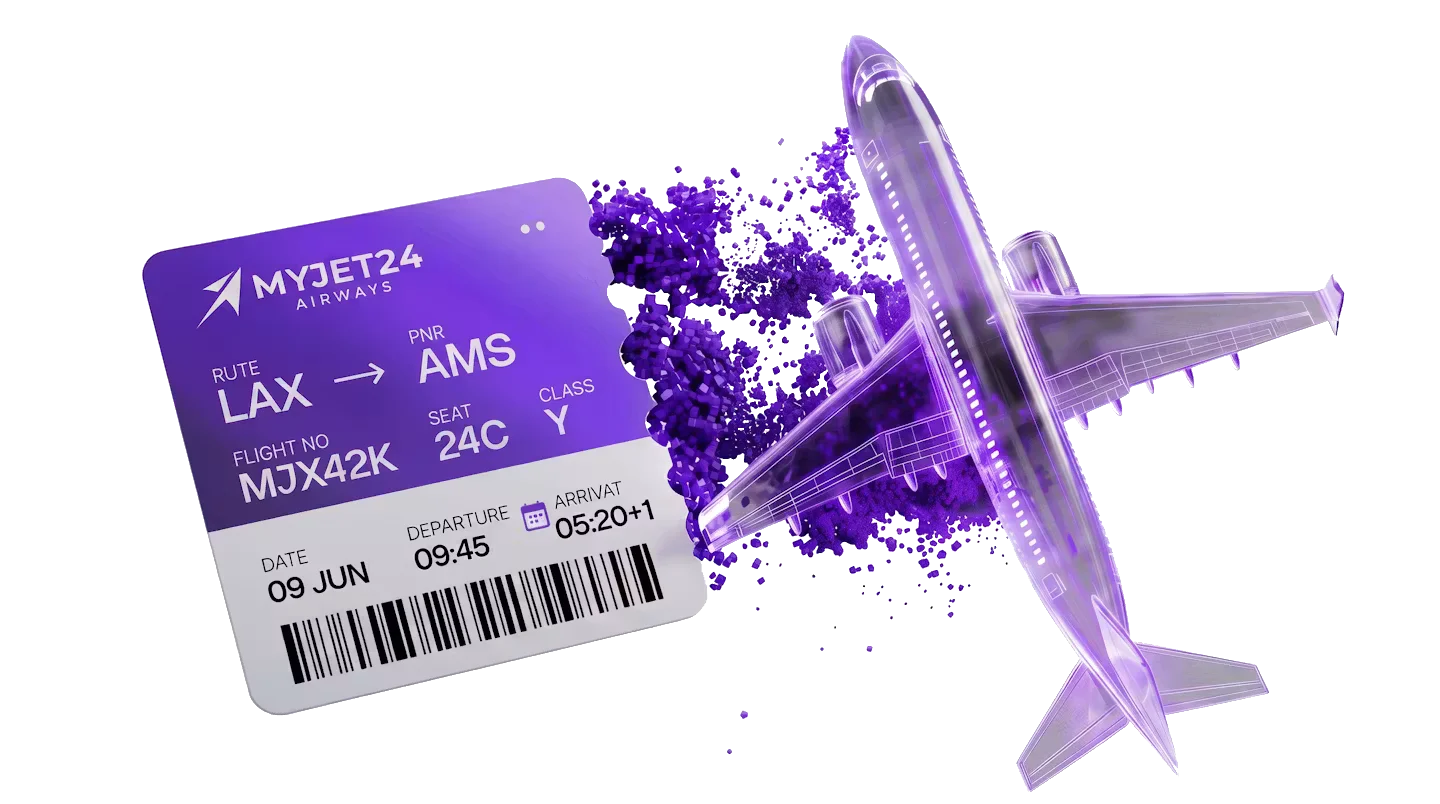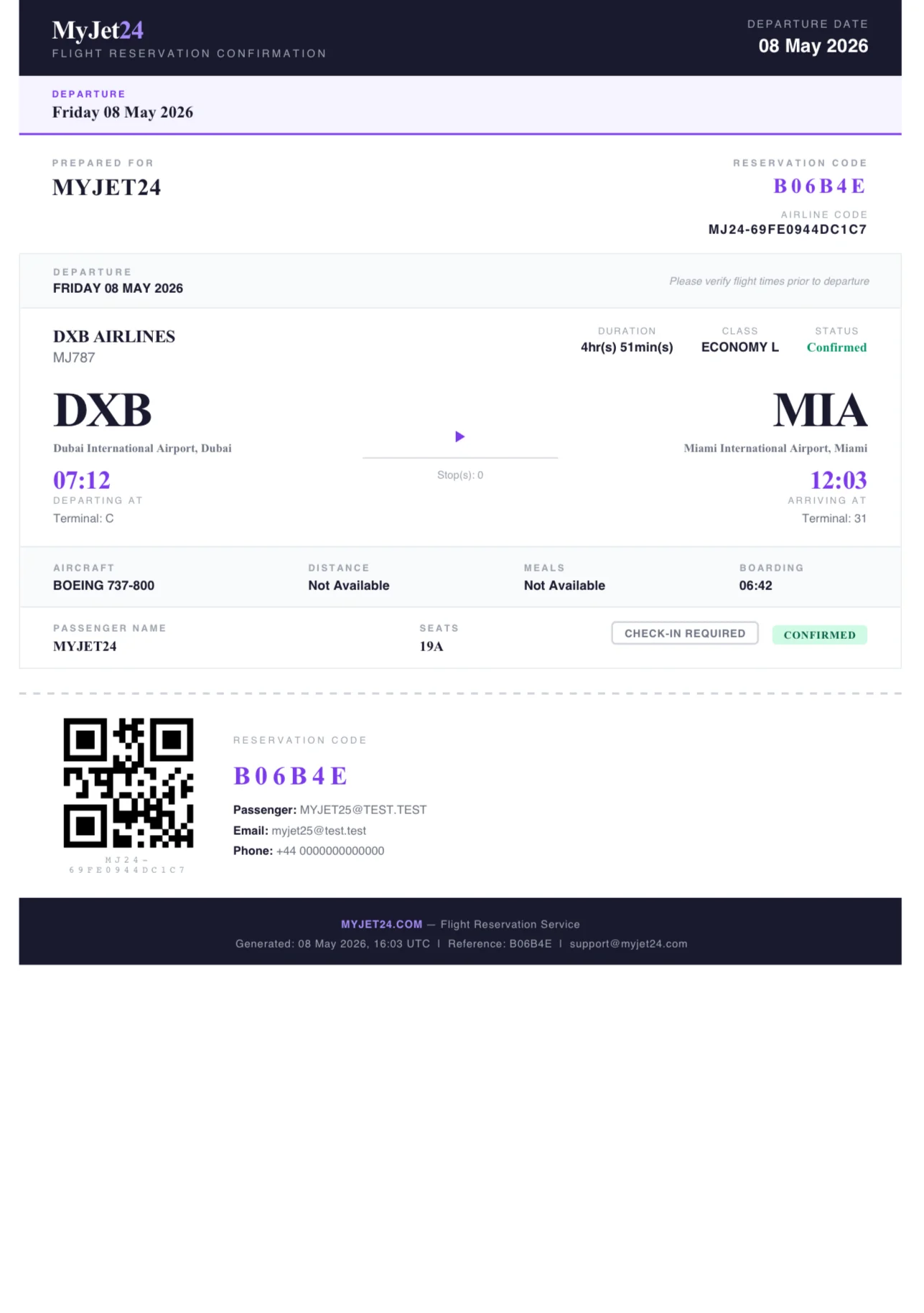
Schengen Areaへの出国チケットは、Schengen Areaを出発する意図があることを示すフライト予約であり、90 days within 180 daysビザまたはビザなし滞在が期限切れになる前に出国する必要があります。Schengen Areaの航空会社や入国管理局は、搭乗時または国境管理時にこの証明を求める場合があります。MyJet24は、実際の予約参照番号を持つプロフェッショナルなフライト予約PDFを30秒で生成します — 無料、クレジットカード不要。
A flight itinerary is REQUIRED for the Schengen visa application. No confirmed ticket needed — a dummy ticket is fully accepted. Most Schengen consulates explicitly advise applicants not to purchase confirmed flights before visa approval. A free dummy ticket from MyJet24 meets all Schengen documentation requirements.
How do I apply for a Schengen visa step by step in 2026?
Schengen Type C visa application follows 8 steps: (1) Determine your MAIN destination country per Article 5 EU Visa Code (most days, or first entry if equal). (2) Identify the Visa Application Centre — Germany uses VFS Global, France uses VFS Global or TLS Contact depending on country, Spain uses BLS International, Italy uses VFS Global, Netherlands uses VFS Global. (3) Book an appointment online — current 2026 wait times are 4-12 weeks in major hubs. (4) Complete the harmonised Schengen Application Form (8 pages, 37 fields). (5) Gather documents — passport (3 months validity beyond return + 2 blank pages), 2 ICAO photos (35×45 mm), travel insurance (EUR 30,000 minimum + repatriation), flight reservation, accommodation proof, 3-6 months bank statements, employment letter, cover letter. (6) Attend appointment for biometric enrolment (fingerprints + photo) and document submission. (7) Pay EUR 90 (adults) / EUR 45 (children 6-12) fee, non-refundable. (8) Wait 15 calendar days (standard) to 45 days (peak season June-August). Apply 6 weeks to 6 months before travel.
What documents do I need for a Schengen visa application in 2026?
Schengen visa documents fall into 5 mandatory categories: (1) IDENTITY — passport (3+ months validity beyond return date, 2 blank pages, issued within 10 years), 2 biometric photos (35×45 mm, white background, ICAO 9303 compliant, taken within 6 months). (2) TRAVEL — return flight reservation showing entry and exit (a dummy ticket from MyJet24 is accepted), hotel/Airbnb booking or invitation letter covering entire stay, detailed day-by-day itinerary. (3) FINANCIAL — 3-6 months bank statements showing daily-rate funds per destination country (Germany EUR 45/day, France EUR 65/day, Spain EUR 113.40/day plus EUR 1,020 minimum), payslips or tax returns. (4) INSURANCE — Schengen-compliant travel policy covering minimum EUR 30,000 medical and repatriation, valid in all 29 Schengen states for entire stay plus 15-day buffer. (5) PURPOSE — employment letter, business invitation (for business visas), proof of accommodation, cover letter explaining purpose, ties to home country (property deed, rental contract, family). Always check the specific embassy's checklist as Germany, France, Spain, Italy, and Netherlands each add country-specific requirements.
How much money do I need in my bank account for a Schengen visa application?
Schengen consulates apply Commission Implementing Decision C(2020) 1242 daily rates per destination country: Germany EUR 45/day, France EUR 65/day (or EUR 120/day without prepaid accommodation), Spain EUR 113.40/day plus a EUR 1,020 minimum, Italy approximately EUR 45/day (EUR 269 minimum for 1-5 days), Netherlands EUR 55/day, Belgium EUR 95/day, Switzerland CHF 100/day, Austria approximately EUR 100/day, Greece EUR 50/day, Portugal EUR 75/day. Multiply daily rate by stay length, then add 20-30 percent buffer. Show funds via 3-6 months bank statements with stable balance trend, not a single recent deposit. Avoid suspicious large deposits within 30 days of application. Acceptable proof also includes credit card with documented limit, prepaid hotel reservations reducing accommodation requirement, and sponsor declarations with the sponsor's own bank proof. The amount may be re-verified at the EES border under the sufficient-means check.
Why was my Schengen visa refused — what do refusal codes 1 to 15 mean?
Schengen Annex VI refusal codes follow Article 32 EU Visa Code: (1) False/forged travel document. (2) Purpose and conditions of stay not justified. (3) Insufficient means of subsistence for stay duration. (4) Insufficient means for return travel. (5) Already 90 days in current 180-day period. (6) Alert issued in Schengen Information System (SIS) for refusal of entry. (7) Considered a threat to public policy, internal security, public health or international relations. (8) Travel medical insurance not valid or insufficient. (9) Information submitted regarding purpose unreliable. (10) Intention to leave before visa expiry could not be established. (11) Sufficient proof of unable to apply for visa in advance not provided (airport transit). (12) Failure to provide justification for application at the border (border visas). (13) Application reviewed in light of consultation with member states. (14) Reasonable doubts about applicant's identity, authenticity of supporting documents or veracity of statements. (15) Other reasons (specified in writing). You have the right to appeal — in Germany within 1 month at the consulate, France within 2 months at the Commission de Recours, Spain within 1 month at the consulate then administrative court.
How long does a Schengen visa take to process after biometrics enrolment?
Standard Schengen processing is 15 calendar days from biometrics submission per Article 23 EU Visa Code. Real-world 2026 averages by embassy: Germany Berlin/Munich/Frankfurt 12-21 days standard, peak season 30-45 days. France Paris 10-15 days standard, peak season 25-40 days. Spain Madrid/Barcelona 8-15 days standard, peak 21-35 days. Italy Rome/Milan 15-25 days, peak 30-60 days (Italy is consistently the slowest). Netherlands Amsterdam 12-18 days, peak 25-40 days. Czech Republic Prague 5-15 days (fastest hub). Extended cases requiring consultation between member states (background checks for certain nationalities) can take up to 45 calendar days under Article 23(2), and exceptional cases up to 60 days. Apply at least 6 weeks before travel — embassies accept applications up to 6 months in advance. Express service exists in France (VFS Premium Lounge EUR 100-200 extra) and selected German posts but does not guarantee faster decision — only faster appointment and document return.
What is ETIAS and when does it launch for Schengen visa-free travelers?
ETIAS (European Travel Information and Authorisation System) is the EU visa-waiver authorisation required for nationals of 60+ visa-exempt countries (US, UK, Canada, Australia, Japan, South Korea, etc.) before entering the Schengen Area. The system launches in the second half of 2026 (Q3-Q4 2026 estimated). Application costs EUR 7, takes minutes online at etias.europa.eu, and remains valid for 3 years or until your passport expires. Travelers under 18 or over 70 are exempt from the fee. ETIAS is NOT a visa — it is a pre-travel screening for those who already enjoy visa-free Schengen entry.
Is the EU Entry/Exit System (EES) mandatory for Schengen entry in 2026?
Yes. The EES (Entry/Exit System) launched on 12 October 2025 across all Schengen external borders. Every non-EU short-stay visitor must register biometrically — facial scan and fingerprints — at first entry. EES replaces passport stamping for non-EU travelers and tracks the 90-in-180-day rule automatically. Data is retained 4 years. Children under 12 are exempt from fingerprints (facial scan only). Long-term residence permit holders, EU/EEA citizens, and diplomats are fully exempt.
Which Schengen country embassy should I apply at — the first I enter or my main destination?
Per EU Visa Code Article 5, you must apply at the embassy of your MAIN destination — the country where you will spend the most time or where the main purpose of your trip lies. If your stay is equally split between multiple countries, apply at the embassy of your FIRST entry point. This is enforced strictly: applying at the wrong embassy is grounds for refusal. A MyJet24 dummy ticket showing your first entry airport supports this rule at the application stage.
Can airlines deny me boarding for a Schengen flight without proof of onward travel?
Yes. Under EU Council Directive 2001/51/EC (supplementing Schengen Convention Article 26), carriers face fines of EUR 3,000 to EUR 5,000 per inadmissible passenger transported into the Schengen Area. Germany imposes up to EUR 10,000 in some cases. Airlines must verify visa, passport validity, sufficient funds, and proof of onward travel at check-in. Lufthansa, Air France, KLM, Iberia, and ITA Airways all enforce this rule consistently. A MyJet24 onward ticket satisfies the verification.
How much money per day do I need to show for a Schengen visa?
Sufficient means of subsistence vary by Schengen country and follow Commission Implementing Decision C(2020) 1242. Germany requires EUR 45/day, France EUR 65/day (or EUR 120/day without prepaid accommodation), Spain EUR 113.40/day plus EUR 1,020 minimum, Italy approximately EUR 45/day, Netherlands EUR 55/day, Belgium EUR 95/day, Switzerland CHF 100/day, and Austria approximately EUR 100/day. Show the required amount via bank statements (3-6 months), credit card limit, or cash declaration. The amount is verified at visa application and may be re-verified at the border under EES.
What is a Schengen visa flight itinerary?
A flight reservation showing your entry and exit from the Schengen Area. A dummy ticket from MyJet24 works perfectly.
Do I need a confirmed ticket for Schengen visa?
No. Embassies accept a flight itinerary / dummy ticket.
Do I need a visa to visit Schengen Area?
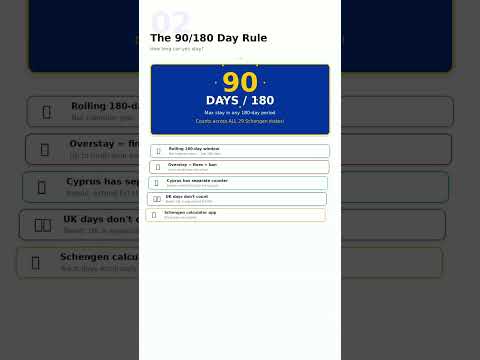
Schengen Area is part of the Schengen Area. Citizens of visa-exempt countries (such as the US, UK, Canada, Australia, Japan, and South Korea) can enter without a visa for up to 90 days within any 180-day period. Citizens of most other countries need a Schengen visa (Type C) issued by a Schengen Area embassy or consulate. The 90-day limit applies across all 27 Schengen member states combined.
Does Schengen Area require proof of onward travel?
Yes. Schengen Area immigration may ask for proof that you plan to leave the country before your visa or permitted stay expires. Airlines flying to Schengen Area frequently check for a return or onward ticket at check-in. If you do not have proof of onward travel, you may be denied boarding or refused entry at immigration. A free dummy ticket from MyJet24 satisfies this requirement.
Can I use a dummy ticket for a Schengen Area visa application?
Yes. A dummy ticket (also called a flight itinerary or flight reservation) is accepted for Schengen Area visa applications. Embassies recommend applicants provide a flight reservation rather than purchasing expensive tickets before visa approval. MyJet24 generates a free dummy ticket PDF with booking reference, QR code, and professional airline format in 30 seconds.
How much does a Schengen Area Schengen visa cost?
A Schengen visa for Schengen Area costs EUR 90 for adults and EUR 45 for children aged 6-12. Children under 6 are exempt from fees. Some nationalities pay reduced fees based on bilateral agreements. The fee is paid at the visa application center (such as VFS Global or TLS Contact) and is non-refundable, even if the visa is denied.
How long does it take to get a Schengen Area Schengen visa?
Standard Schengen visa processing for Schengen Area takes 15 calendar days from the date of application. During peak travel season (June-August), processing can take up to 45 days. Some consulates offer express processing for an additional fee. Apply at least 6 weeks before your planned travel date. You can apply up to 6 months in advance.
What documents do I need for a Schengen Area visa application?
A standard Schengen Area visa application requires: a valid passport with at least 6 months validity and 2 blank pages, completed application form, passport-sized photos (specifications vary by embassy), proof of financial means (bank statements covering the last 3-6 months), travel insurance (mandatory for Schengen), flight reservation or dummy ticket, proof of accommodation, and a cover letter explaining your travel purpose. Specific requirements vary by visa type and embassy.
What are the main international airports in Schengen Area?
The main international airports in Schengen Area are Frankfurt (FRA), Amsterdam (AMS), Paris CDG (CDG). Frankfurt (FRA) is the primary gateway for international flights. When generating your dummy ticket on MyJet24, select any of these airports as your arrival destination. The airport shown on your dummy ticket should match the city where you plan to stay or where your embassy appointment is located.
Do I need a hotel booking for my Schengen Area visa?
Most Schengen Area visa applications require proof of accommodation for your entire stay. This can be a hotel reservation, Airbnb booking, or an invitation letter from a host in Schengen Area. If you are staying at a hotel, you can generate a free hotel booking confirmation using MyJet24's Hotel Booking tool. If staying with a friend or family member, you need an invitation letter instead.
Can I get a flight reservation for Schengen Area without buying a ticket?
Yes. You do not need to buy an actual airline ticket for your Schengen Area visa application. Embassies accept flight reservations (also called dummy tickets or flight itineraries) as proof of intended travel. MyJet24 generates a free flight reservation PDF with booking reference and QR code in 30 seconds. This is the recommended approach because buying a non-refundable ticket before visa approval risks losing money if your visa is denied.
How long can I stay in Schengen Area on a tourist visa?
On a standard tourist Schengen visa, you can stay in Schengen Area for up to 90 days within 180 days. Overstaying your permitted duration can result in fines, detention, deportation, and future visa bans. Always ensure your dummy ticket departure date falls within your allowed stay period. Some visa types may allow extensions applied for within Schengen Area before your current permission expires.
Where is the Schengen Area embassy or consulate in my country?
Schengen Area maintains embassies and consulates in most countries worldwide. To find the nearest Schengen Area embassy or consulate, including addresses, phone numbers, appointment booking links, and office hours, use MyJet24's free Embassy Finder tool. Some countries process Schengen Area visas through external service providers like VFS Global or TLS Contact rather than directly at the embassy.
Do I need travel insurance for Schengen Area?
Yes, travel insurance is mandatory for all Schengen visa applications including Schengen Area. Your policy must provide minimum coverage of EUR 30,000, cover medical emergencies and repatriation, and be valid for the entire duration of your stay plus a buffer of 15 days. The insurance certificate must explicitly state coverage for all Schengen member states. Many insurance providers offer Schengen-specific policies starting from EUR 10-30.
Is there a visa interview for Schengen Area?
Some Schengen Area consulates require a brief visa interview as part of the Schengen visa application. The interview typically lasts 5-10 minutes and focuses on your travel purpose, itinerary, financial situation, and ties to your home country. Bring all original documents including your dummy ticket, hotel booking, and bank statements. Be prepared to explain your travel plans clearly and concisely.
What currency is used in Schengen Area and how much money should I bring?
The currency in Schengen Area is the Euro (EUR) and others. For visa applications, you typically need to show sufficient funds in your bank account to cover your stay. A general guideline is $50-100 USD equivalent per day of travel. ATMs are widely available in Multiple capitals and major cities. Inform your bank about your travel dates to prevent your cards from being blocked. Carry some cash in local currency for arrival expenses.
Is Schengen Area safe for tourists in 2026?
Schengen Area is generally safe for tourists who take standard precautions. As in any country, be aware of pickpockets in tourist areas, use official taxis or ride-hailing apps, and keep copies of important documents separate from originals. Check your government's travel advisory for Schengen Area before departure for the latest safety information. Register with your embassy in Schengen Area for emergency notifications during your stay.
What is the best time to visit Schengen Area?
The most popular time to visit Schengen Area is during summer (June to August) when the weather is warmest. However, this is also peak season with higher prices and longer visa processing times. Spring (April-May) and autumn (September-October) offer pleasant weather, lower prices, and shorter queues at tourist attractions. Winter (November-March) can be cold but offers Christmas markets, skiing, and the lowest prices.
What language is spoken in Schengen Area?
The primary language in Schengen Area is Multiple official languages. In Multiple capitals and major tourist areas, English is widely understood in hotels, restaurants, and tourist attractions. However, learning a few basic phrases in Multiple official languages is appreciated by locals and can enhance your travel experience. For visa applications to Schengen Area, documents are typically accepted in English, but some embassies may require certified translations of documents in other languages.
Do I need a cover letter for my Schengen Area visa?
A cover letter is strongly recommended for Schengen Area visa applications, even when not explicitly required. The cover letter explains your travel purpose, itinerary, financial situation, ties to your home country, and reason for returning after your visit. It gives the visa officer context that other documents cannot provide. You can generate a professional cover letter using MyJet24's Visa Support Letter tool. Address it to the Schengen Area embassy or consulate in your country.
What are common reasons for Schengen Area visa denial?
Common reasons for Schengen Area visa denial include: insufficient financial proof, weak ties to your home country (no stable job, property, or family), incomplete application forms, inconsistent information between documents, missing required documents, previous immigration violations, and failure to demonstrate a genuine travel purpose. To reduce denial risk, ensure all documents are consistent, your bank statements show stable income, and your dummy ticket dates match your application form exactly.
How do I get a free dummy ticket for Schengen Area on MyJet24?
Getting a free dummy ticket for Schengen Area on MyJet24 takes 30 seconds: visit myjet24.com, select your departure airport, choose Frankfurt (FRA) as your destination, enter your travel dates matching your visa application, add passenger details exactly as they appear on your passport, and click generate. Your PDF with booking reference and QR code downloads instantly. No credit card, no registration, no hidden fees. The dummy ticket is accepted by Schengen Area embassies and immigration worldwide.
An onward ticket is one part of your Schengen Area visa and travel documentation. Use MyJet24's free tools to prepare all required documents in one place.