
Last updated: 31 July 2026 · Reading time: 16 min · Author: Marc Hoffmann, Travel Documentation Writer at MyJet24
TL;DR — Key Facts
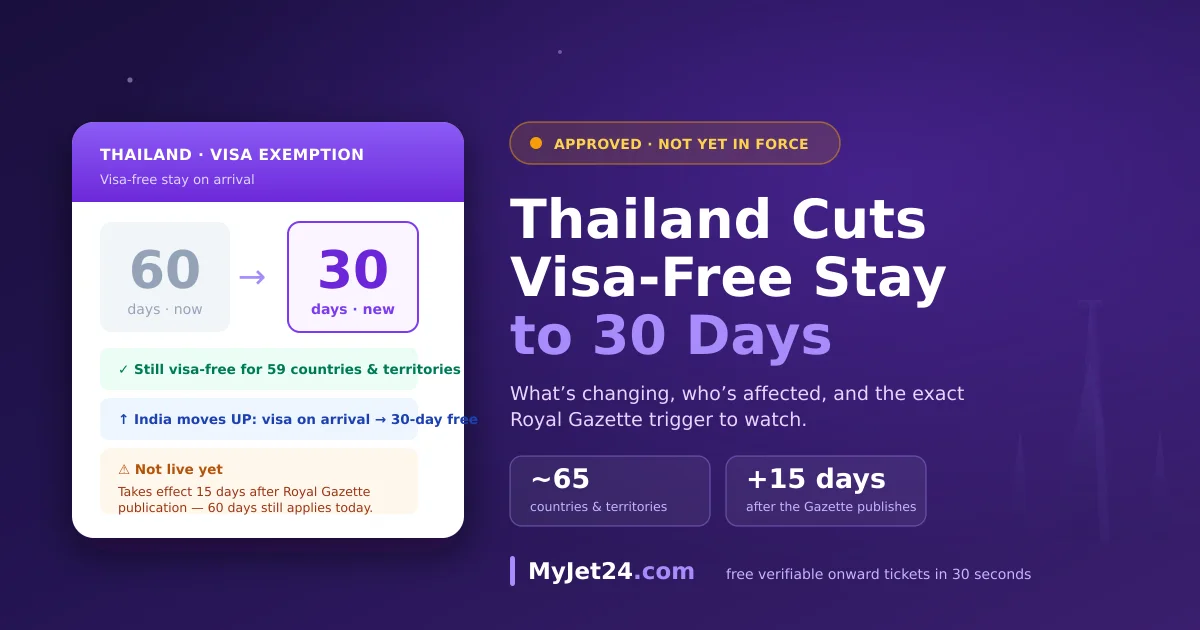
- Thailand is cutting its visa-free stay from 60 days to 30. The Cabinet approved it — first on 19 May 2026, refined on 14 July — but it is not yet law.
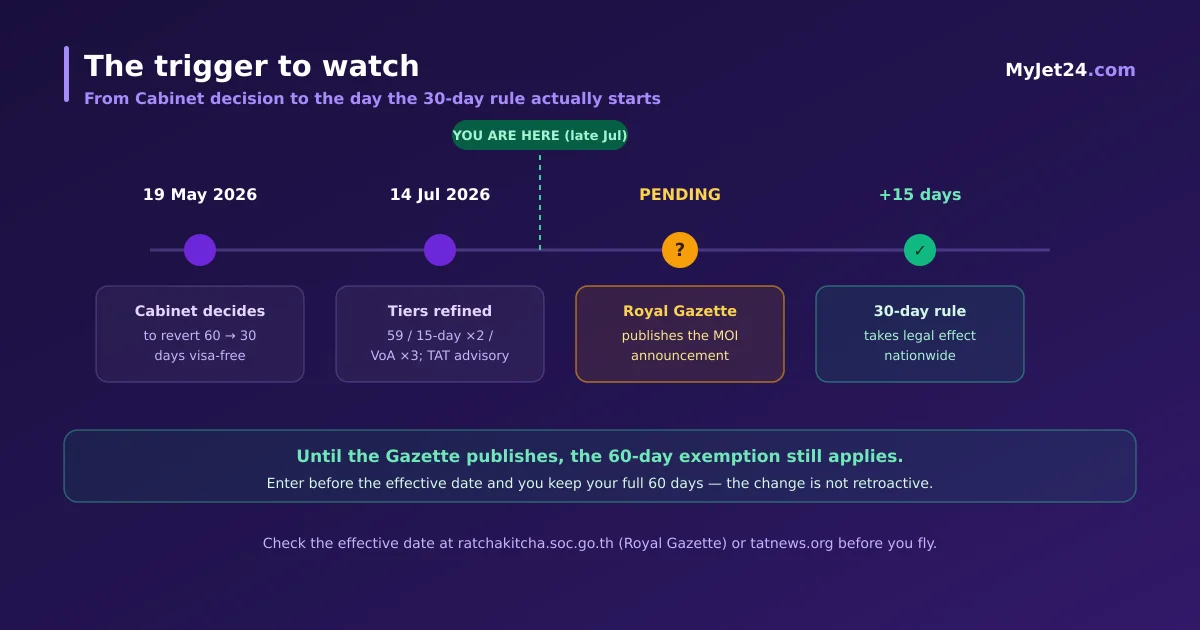
- The trigger to watch: it takes effect 15 days after the Ministry of Interior announcement is published in the Royal Gazette. As of late July 2026 that publication had not happened, so the 60-day exemption still applies right now.
- The new tiers: 59 countries and territories keep visa-free entry but at 30 days (all 27 EU states, the UK, US, Australia, India and more); only Mauritius and Seychelles drop to 15 days; and just Azerbaijan, Belarus and Serbia move to visa on arrival.
- India is moving up, not down: from visa on arrival to the 30-day visa exemption — the opposite of what several reports claimed.
- Enter before the switch and you keep your 60 days. The change is not retroactive: your permitted stay is set at the moment you arrive.
- A 30-day window changes your paperwork. Your onward or return flight must now fall inside 30 days, and airlines check that against your ticket at check-in — so a verifiable onward ticket matters more, not less.
Thailand's Cabinet has approved cutting the visa-exemption stay from 60 days to 30 days for most nationalities, but as of late July 2026 it is not yet in force. The measure takes legal effect 15 days after the Ministry of Interior announcement is published in the Royal Gazette, which had not yet happened — so the 60-day visa-free stay still applies until then. Under the new rules, 59 countries and territories keep visa-free entry at 30 days, Mauritius and Seychelles drop to 15 days, and Azerbaijan, Belarus and Serbia move to visa on arrival. India moves up from visa on arrival to the 30-day exemption. Anyone who enters Thailand before the effective date keeps their existing 60-day permitted stay.
In this guide
- What was decided — and why it isn't live yet
- The new tiers: 30 days, 15 days, visa on arrival
- The India correction most reports got wrong
- What a 30-day window actually changes
- Enter before the switch, keep your 60 days
- The rules that don't change (but still catch people)
- Why Thailand is doing this
- Seven mistakes to avoid
- Frequently asked questions
- The bottom line
What was decided — and why it isn't live yet
In July 2024, Thailand doubled its visa-free window from 30 days to 60 as a post-pandemic tourism boost. Two years later it is reversing course. The Thai Cabinet decided to revert to a 30-day exemption on 19 May 2026, then refined the exact country tiers on 14 July 2026, with the Tourism Authority of Thailand publishing traveller guidance on 16 July.
But an approval is not a law. In Thailand, a change like this only takes effect once the Ministry of Interior announcement is published in the Royal Gazette — and then only after a further 15-day waiting period. That is the single most important thing to understand about this change today.
Status as of late July 2026: approved, but not yet in force. The Ministry of Interior announcement had not been published in the Royal Gazette, so no effective date exists yet and the 60-day visa exemption is still the rule. When the Gazette publishes, the clock starts: the 30-day rule begins 15 days later. If you're planning a trip, this is the one detail to re-check against the Royal Gazette (ratchakitcha.soc.go.th) or the Tourism Authority of Thailand before you fly.
So there are effectively two questions a traveller needs answered: what is changing (the tiers below), and when (the Gazette trigger). We'll keep this guide updated as the date firms up — but the mechanics won't change, so you can plan around them now.
The new tiers: 30 days, 15 days, visa on arrival
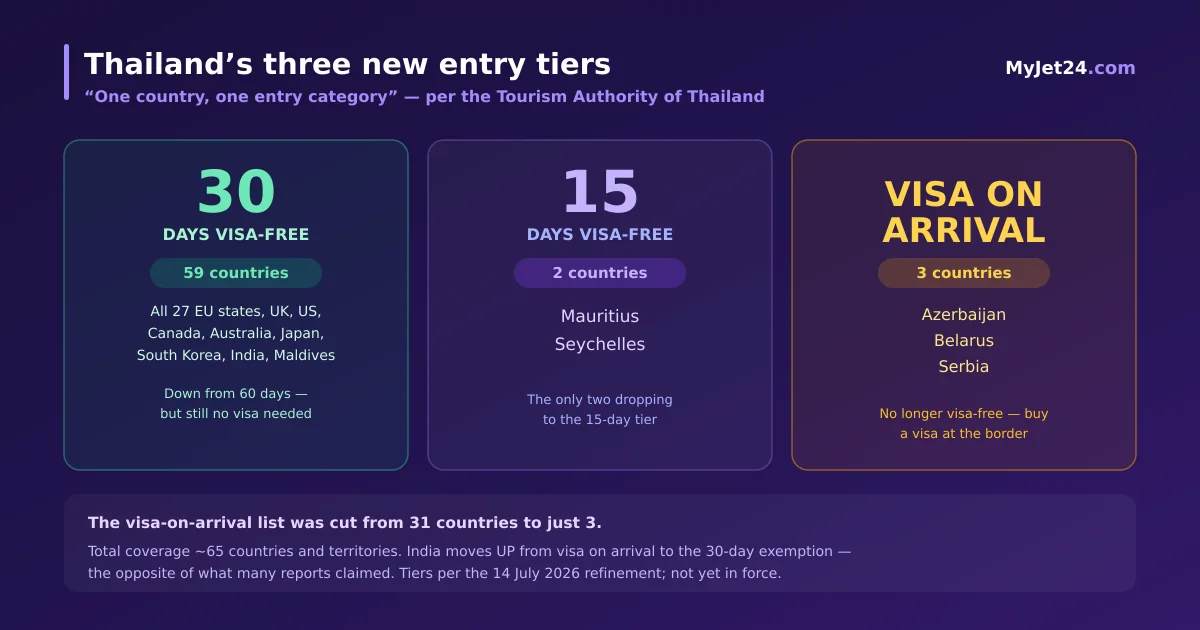
The headline "60 to 30" is true for the overwhelming majority of visitors, but the Cabinet actually sorted countries into three buckets, guided by a principle it calls "one country, one entry category." Here's how it breaks down, per the Tourism Authority of Thailand.
| Tier | How many | Who |
|---|---|---|
| 30-day visa exemption | 59 countries & territories | All 27 EU states, the UK, US, Australia, Canada, Japan, South Korea, India, the Maldives, and most other visa-exempt nationalities. Down from 60 days, but still visa-free. |
| 15-day visa exemption | 2 | Mauritius and Seychelles only. |
| Visa on arrival | 3 | Azerbaijan, Belarus and Serbia — no longer visa-free, but able to buy a visa at the border. |
The Tourism Authority of Thailand gives total coverage as roughly 65 countries and territories. One point worth pinning down before you travel: a few secondary reports placed the Maldives in the 15-day tier, but the authoritative TAT list keeps the Maldives at 30 days — only Mauritius and Seychelles drop to 15. These figures reflect the 14 July refinement; earlier May-era numbers (which revoked the 60-day stay for 93 countries) have been superseded.
For the vast majority of travellers — anyone from Europe, North America, Australia or India — the practical takeaway is simple: you still don't need a visa for a short trip, but your free stay is halved from 60 days to 30.
The India correction most reports got wrong
If you searched this change when it broke, you may have read that India was being downgraded to visa on arrival. That is backwards. According to the Tourism Authority of Thailand, India is moving in the other direction — from visa on arrival up to the 30-day visa exemption.
The reasoning TAT gave is telling: it cited India's "importance in terms of its economy, trade, investment, and international relations, as well as the longer average length of stay by Indian visitors, at around 7.17 days per trip." In other words, Indian tourists stay longer and spend more, so Thailand is making entry easier for them, not harder. For Indian travellers the net effect is a genuine upgrade: no more paying for a visa on arrival, just a visa-free 30-day entry — the same terms as an EU or US visitor.
What a 30-day window actually changes
Losing 30 days sounds abstract until it collides with a real itinerary. Here's where a halved window actually bites.
Your onward ticket has to move
Under the 60-day rule, a return or onward flight booked seven weeks out was comfortably inside your permitted stay. Under 30 days, that same flight is now an overstay waiting to happen. Every visa-exempt entry requires you to be leaving within the window, and — this is the part travellers forget — the airline checks it before you even board. Carriers screen onward and return tickets against the destination's permitted stay through the Timatic system, because they're liable for flying back anyone refused entry — the mechanics we cover in whether airlines can deny boarding without proof of onward travel. A one-way ticket, or a return dated day 45, can cost you your boarding pass at the departure gate.
This is exactly the situation a verifiable onward ticket is built for: a real, checkable reservation dated inside your 30-day window that satisfies the airline and immigration without locking you into a fare. Our guide to proof of onward travel for Thailand covers exactly what's accepted, and the Thailand dummy-ticket guide walks through how to produce one.
Extensions and border runs get tighter
A 30-day exemption can still be extended once by 30 days at an immigration office for a 1,900-baht fee, as now — but the maths of a long stay changes. Where 60 days plus an extension gave you three comfortable months, 30 days plus an extension gives you two. Travellers who used to string together long stays on the 60-day exemption will feel the squeeze, and Thai immigration has signalled tighter scrutiny of "visa runs" — hopping the border to reset the clock — as part of the same tightening.
Enter before the switch, keep your 60 days
Here's the clean, quotable rule that resolves most of the anxiety around timing. The Tourism Authority of Thailand states it plainly: "Foreign nationals who enter Thailand before the new measures take effect will be permitted to remain for the duration of their existing permitted stay."
In other words, the change is not retroactive. Your permitted stay is fixed at the moment you're stamped in. If you arrive while the 60-day exemption is still in force — which, as of late July 2026, it is — you get your full 60 days, even if the 30-day rule takes effect during your trip. That makes the practical advice unusually simple: if a longer stay matters to you and you can travel before the Gazette trigger, do it. If you arrive after, plan around 30 days.
The rules that don't change (but still catch people)
It's worth being precise here, because a lot of coverage blurs this change together with rules that already exist. The Cabinet measure changes the length of the visa exemption and which tier some countries sit in. It does not introduce the following — but these are the requirements that trip up visa-exempt visitors regardless, and a shorter window makes getting them right more important.
| Requirement | What to know |
|---|---|
| Thailand Digital Arrival Card (TDAC) | A mandatory online arrival form, filed before you land, separate from your visa status. TAT has tied this visa change to a planned TDAC upgrade that links agency databases for risk screening at the point of departure. |
| Proof of funds (~20,000 baht) | A long-standing rule that visa-exempt and tourist entrants may be asked to show around 20,000 baht per person (40,000 per family). Rarely checked, but discretionary — and enforcement has tightened. |
| Onward/return ticket | Not new, but now measured against 30 days instead of 60. Checked by airlines at check-in and occasionally by immigration. |
| Land-border entry limits | A pre-existing cap on visa-exempt entries by land (commonly cited as two per calendar year) still applies. Land crossings give 30 days already, so this change hits air arrivals hardest. |
Two of these are worth pairing with this change directly: our guides to filing the TDAC and the 20,000-baht proof-of-funds rule cover the two requirements most likely to surprise a visa-exempt arrival, and both matter more when your margin for error is 30 days rather than 60.
Why Thailand is doing this
The official rationale is consistent across the Tourism Authority, the Ministry of Foreign Affairs and government statements. The 60-day exemption, introduced to juice tourism, had a side effect: it became a tool for people to live semi-permanently in Thailand — working illegally, running businesses, or endlessly "running" the border — without ever holding an appropriate visa.
The stated goals are to "align entry facilitation with current conditions, improve screening, reduce overlapping entry categories, and ensure visa privileges are used for their intended purpose." Nation Thailand summarised the security framing bluntly: to "enhance national security, prevent misuse of visas for non-tourism activities, and streamline privileges." The "one country, one entry category" principle is about ending situations where a nationality had several overlapping ways in. For genuine tourists, none of this is aimed at you — 30 days visa-free is still generous by global standards. It's aimed at the grey-zone long-stayer the 60-day window quietly enabled. If you do need a longer or purpose-specific stay, our complete Thailand visa guide covers the visa types that fit.
Seven mistakes to avoid
- Assuming it's already live. As of late July 2026 it isn't. The 60-day exemption still applies until the Royal Gazette publishes the change and 15 more days pass.
- Believing India was downgraded. India is moving up — from visa on arrival to the 30-day exemption, not the other way around.
- Booking an onward flight for day 45. Under 30 days that's an overstay. Your departure must fall inside the permitted window.
- Flying in one-way. Airlines check onward travel against the 30-day stay at check-in and can deny boarding. Carry a verifiable onward ticket.
- Putting the Maldives (or others) in the wrong tier. Per TAT, the Maldives stays at 30 days; only Mauritius and Seychelles drop to 15.
- Planning a long stay on back-to-back exemptions. Border runs are under tighter scrutiny, and land entries are capped. For real long stays, get the right visa.
- Forgetting the TDAC and proof-of-funds rules. Neither changed, but both are easy to overlook and more consequential inside a 30-day window.
Frequently asked questions
Is Thailand's 30-day visa exemption in effect yet?
Not as of late July 2026. The Cabinet approved the cut from 60 to 30 days, but it only becomes law 15 days after the Ministry of Interior announcement is published in the Royal Gazette, which had not yet happened. Until then, the 60-day visa exemption remains in force. Check the Royal Gazette or the Tourism Authority of Thailand for the confirmed effective date before you travel.
When does Thailand's 60-to-30-day change take effect?
It takes effect 15 days after the Ministry of Interior announcement is published in the Royal Gazette. The Cabinet decided the measure on 19 May 2026 and refined the country tiers on 14 July 2026, but the Gazette publication — which starts the 15-day countdown — had not occurred by late July 2026, so no firm effective date exists yet.
Which countries drop to a 30-day visa-free stay in Thailand?
59 countries and territories, including all 27 EU states, the UK, US, Canada, Australia, Japan, South Korea, India and the Maldives. They keep visa-free entry but at 30 days instead of 60. Separately, Mauritius and Seychelles drop to a 15-day exemption, and Azerbaijan, Belarus and Serbia move to visa on arrival.
Did India lose visa-free entry to Thailand?
No — the opposite. India is moving up from visa on arrival to the 30-day visa exemption, meaning Indian travellers get visa-free entry on the same terms as EU or US visitors. The Tourism Authority of Thailand cited India's economic importance and the longer average stay of Indian tourists (around 7.17 days) as the reason. Reports that said India was downgraded to visa on arrival were incorrect.
If I enter Thailand before the change, do I keep 60 days?
Yes. The change is not retroactive. The Tourism Authority of Thailand confirmed that anyone who enters before the new measures take effect keeps their existing permitted stay. So if you arrive while the 60-day exemption is still in force, you get the full 60 days even if the 30-day rule begins during your trip.
Can I still extend a 30-day visa exemption in Thailand?
Yes. As now, a visa exemption can be extended once by 30 days at a Thai immigration office for a fee of 1,900 baht. But a 30-day base plus a 30-day extension gives you two months rather than the three you could reach from a 60-day base, so long-stay plans need rethinking.
Do I need a return ticket to enter Thailand visa-free?
Effectively yes. Airlines check for an onward or return ticket at check-in and screen it against your permitted stay through the Timatic system, because they bear the cost of returning anyone refused entry. Immigration can also ask. Under the 30-day rule your departure must fall inside 30 days, so a one-way ticket or one dated too late risks denied boarding. A verifiable onward ticket avoids the problem.
Why is Thailand cutting the visa-free period?
To curb misuse of the 60-day exemption, which had become a way for some visitors to live semi-permanently in Thailand — working illegally or running the border — without an appropriate visa. The government cites improved screening, national security, and a "one country, one entry category" principle to end overlapping entitlements. Genuine short-stay tourists are not the target, and 30 days visa-free remains generous internationally.
How many countries are affected by the Thailand visa change?
Around 65 countries and territories in total: 59 at the 30-day visa exemption, 2 (Mauritius and Seychelles) at 15 days, and 3 (Azerbaijan, Belarus, Serbia) moving to visa on arrival. The visa-on-arrival list was cut sharply, from 31 countries down to those few.
Does the 30-day change affect the TDAC or proof-of-funds rules?
No. The Thailand Digital Arrival Card and the roughly 20,000-baht proof-of-funds rule are separate, pre-existing requirements that the Cabinet measure doesn't alter. That said, TAT has linked this change to a planned TDAC upgrade for better departure-point screening, and both requirements are more consequential when your permitted stay is only 30 days.
Can I still do visa runs to stay in Thailand longer?
It's getting harder. Visa-exempt entries by land are capped (commonly cited as two per calendar year), and Thai immigration has signalled tighter scrutiny of back-to-back "visa runs" used to live in the country long-term. With a 30-day base window, stringing exemptions together is both more frequent and more scrutinised. For a genuine long stay, apply for the appropriate visa instead.
Is 30 days enough for a Thailand holiday?
For most trips, comfortably. The average visitor stays one to two weeks, well inside 30 days. The change mainly affects long-stay travellers, digital nomads on tourist entries, and anyone who used the 60-day window to base themselves in Thailand. If that's you, plan an extension or the correct visa, and make sure your onward ticket falls inside the permitted stay.
The bottom line

Thailand's shift from 60 days back to 30 is a real change, but a manageable one — and, for now, one that hasn't actually started. The smart way to hold it in your head is as two separate facts: the what is settled (30 days for almost everyone, with India quietly upgraded), and the when is still pending on a Royal Gazette publication that starts a 15-day countdown. Until that publishes, the 60-day stay you may be planning around is still valid.
Whichever side of the switch your trip falls on, the checklist is the same and short: know your tier, file your TDAC, and make sure the one document that a shorter window makes non-negotiable — your way out — is sorted before you reach the airport. A verifiable proof of onward travel dated inside your permitted stay answers the airline's question at check-in and immigration's at the border, in about thirty seconds. Thirty days is plenty for a great trip. It's just less room for a paperwork mistake — so make the paperwork the easy part.
Sources
- Tourism Authority of Thailand — "Thai Cabinet approves updated visa measures pending Royal Gazette publication" (16 July 2026): https://www.tatnews.org/2026/07/thai-cabinet-approves-updated-visa-measures-pending-royal-gazette-publication/
- Royal Thai Government PR Department — visa measures, 19 May & 14 July 2026 decisions: https://foreign.prd.go.th/th/content/category/detail/id/2881/iid/522681
- Ministry of Foreign Affairs, Consular Affairs Department: https://consular.mfa.go.th/
- Royal Gazette of Thailand (for the confirmed effective date): https://ratchakitcha.soc.go.th/
- Nation Thailand — "Thailand revamps visa rules for 65 countries and territories": https://www.nationthailand.com/news/policy/40068630
This guide reflects Thailand's visa-exemption changes as approved by the Cabinet (19 May and 14 July 2026) and published by the Tourism Authority of Thailand as of 31 July 2026. The measure was not yet in force at the time of writing and takes effect 15 days after Royal Gazette publication; tiers and dates can change. Verify against the Royal Gazette and the Tourism Authority of Thailand before you travel. This article is informational and not legal or immigration advice.
