
Last updated: 8 May 2026 · Reading time: 11 min · Author: James Mitchell, CEO & Founder of MyJet24
TL;DR — Key Facts
- Thailand law requires proof of onward travel for all visa-exempt arrivals under Section 12 of the Immigration Act B.E. 2522.
- AirAsia, Scoot, Cebu Pacific, and Lion Air enforce this at the gate on every Southeast Asia route to Bangkok and Phuket — denied boarding is the most common outcome.
- Suvarnabhumi (BKK) is stricter than Don Mueang (DMK); Phuket and Chiang Mai enforce moderately; land borders are inconsistent.
- Thailand's Digital Arrival Card (TDAC), mandatory since 2026, asks for your departure flight details — you need a ticket number before you even board.
- A free dummy ticket from MyJet24 generates a valid PDF with PNR, QR code, and flight details in 30 seconds — accepted at all Thai airports and by every airline.
Thailand requires proof of onward travel for travelers entering on a visa exemption or tourist visa. Airlines operating to Bangkok, Phuket, and Chiang Mai check this at the departure gate — especially budget carriers. Immigration officers at Suvarnabhumi International Airport also verify onward plans, particularly for backpackers arriving on one-way tickets. A free dummy ticket satisfies this requirement instantly.
Does Thailand Actually Require Proof of Onward Travel?
Yes — and this is not a rumor or an informal airline policy. Thailand's requirement for proof of onward travel is codified in Section 12(6) of the Immigration Act B.E. 2522 (1979), which authorizes immigration officers to refuse entry to any foreigner who cannot demonstrate that they intend to leave the country within the permitted stay period. The requirement applies to every nationality, including those entering on a 30-day or 60-day visa exemption.
In practice, enforcement happens at two distinct stages:
- Pre-boarding: The airline checks before you leave your home country. If they deny you, you never reach Thailand.
- On arrival: Thai immigration officers at the primary inspection counter may ask for your onward ticket, particularly if your travel profile raises flags (one-way ticket, backpacker appearance, frequent entries, no hotel booking).
Thailand denied entry to approximately 56,000 foreign nationals in 2024 for a range of immigration violations, including missing travel documentation and overstay history, according to Thailand's Immigration Bureau annual report. Missing onward travel proof is among the most common document-related grounds for denial.
"A visa exemption stamp in your passport is permission to seek entry. It is not a guarantee of entry. Immigration officers retain full discretion to ask for supporting documents at the primary counter — including proof of onward travel." — Thai Immigration Bureau guidance document
The 20,000 THB per-person funds requirement is a separate rule. Both can be checked simultaneously. Many travelers prepare for the money check and forget the onward travel requirement entirely — which is why airlines catch so many passengers at the departure gate before they even reach Bangkok.
Which Airlines Check — and Exactly Where They Check
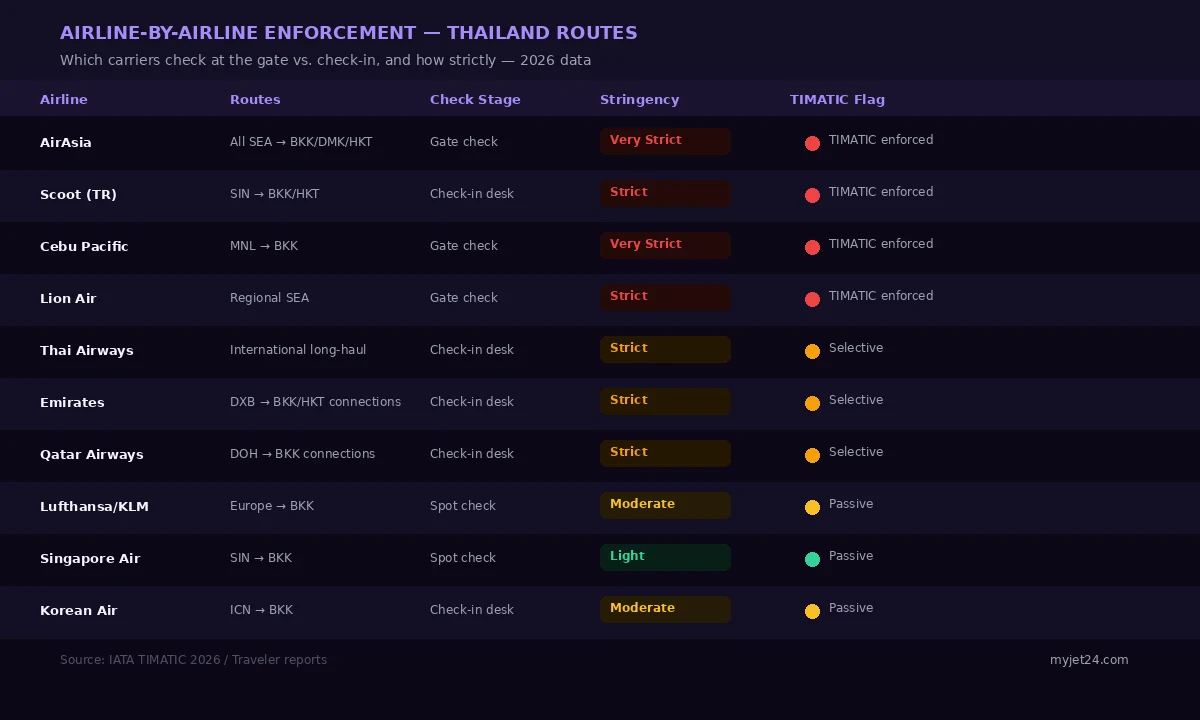
The most common way travelers discover this requirement too late is at the check-in desk or departure gate — not at Thai immigration. Airlines operating routes to Thailand are legally liable under IATA carrier agreements if they transport passengers who are subsequently refused entry: fines range from $3,000 to over $30,000 USD per passenger plus the cost of the involuntary return flight. This financial incentive makes budget Asian carriers the most rigorous enforcers.
| Airline | Check Stage | Stringency | Notes |
|---|---|---|---|
| AirAsia (AK/FD/QZ) | Gate check | Very Strict | All SEA routes to BKK/DMK/HKT/CNX. Hard stop at gate — no exceptions reported. |
| Scoot (TR) | Check-in desk | Strict | SIN → BKK/HKT. Checked consistently at SIN Changi T1 counter. |
| Cebu Pacific (5J) | Gate check | Very Strict | MNL → BKK. Philippines departure strict; also verified at NAIA gate. |
| Lion Air (JT/SL) | Gate check | Strict | Regional SEA routes. Indonesian departures via CGK particularly strict. |
| Thai Airways (TG) | Check-in desk | Strict | Long-haul international. TIMATIC result determines whether agent asks. |
| Emirates (EK) | Check-in desk | Strict | DXB → BKK/HKT connections. Particularly thorough on one-way tickets. |
| Qatar Airways (QR) | Check-in desk | Strict | DOH → BKK connections. TIMATIC enforced by check-in agents. |
| Lufthansa / KLM / AF | Spot check | Moderate | Europe → BKK. Risk-based spot checks. Not every passenger is asked. |
| Singapore Airlines (SQ) | Spot check | Light | SIN → BKK. Rarely checked for premium cabin. Economy may be spot-checked. |
| Korean Air (KE) | Check-in desk | Moderate | ICN → BKK. Check-in agents trained to verify TIMATIC output. |
Source: IATA TIMATIC carrier responsibility framework 2026; traveler reports via TripAdvisor Thailand forum and Thaivisa.com community (Jan–May 2026).
Key insight competitors miss: AirAsia's enforcement is not discretionary — it is system-enforced. When an AirAsia check-in agent scans your booking, their internal system automatically flags the TIMATIC onward travel requirement for Thai destinations. The agent cannot override it without supervisor approval. This is why travelers report 100% checking rates on AirAsia routes to Thailand, regardless of nationality or travel history.
BKK vs. DMK vs. HKT: What Immigration Officers Actually Do
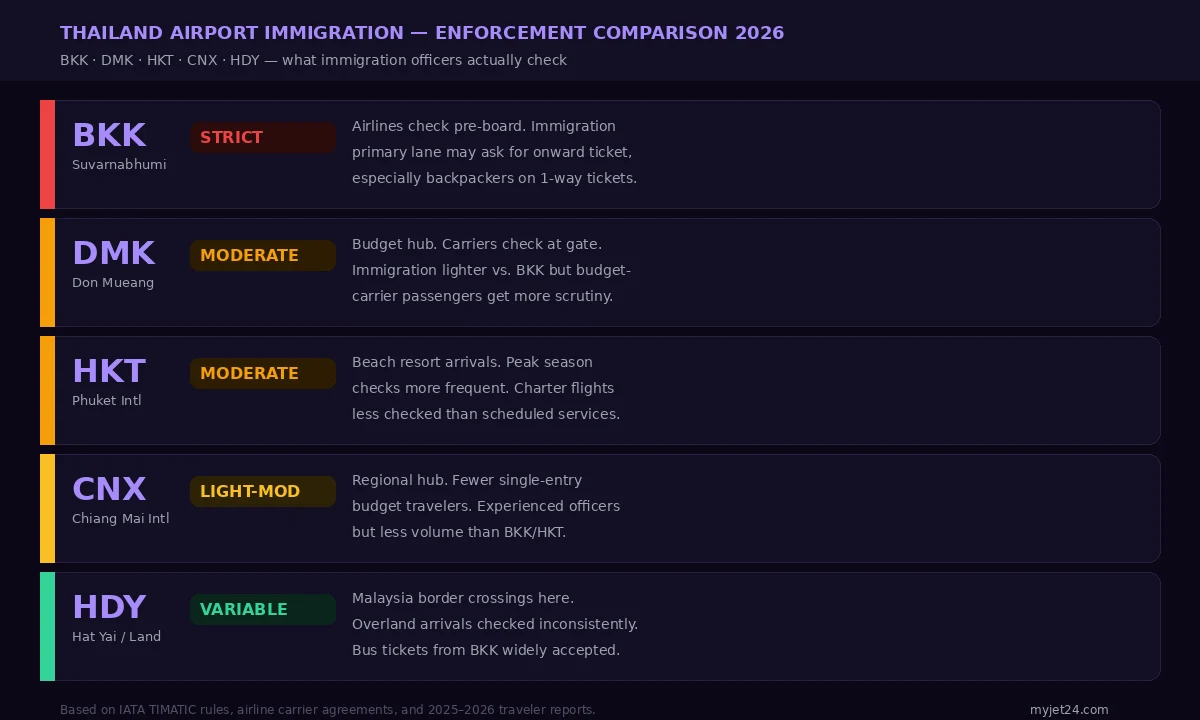
Suvarnabhumi (BKK) — Strictest
Suvarnabhumi handles the largest volume of long-haul international arrivals in Thailand and has the most experienced immigration corps. Officers at BKK are trained to identify risk profiles: travelers arriving on single-entry visa exemptions with one-way tickets, no confirmed accommodation, and short travel histories are the most likely to be pulled aside at the primary counter. The check happens fast — usually within 90 seconds — but officers will ask to see an onward ticket if your profile triggers it. During peak season (November–February), secondary inspection rates increase significantly.
Don Mueang (DMK) — Moderate
Don Mueang is Bangkok's low-cost carrier hub. Because most flights arriving here are intraregional (Kuala Lumpur, Jakarta, Ho Chi Minh City, Manila), immigration officers at DMK see a higher proportion of budget travelers — which also means they encounter more passengers without return tickets. In practice, DMK immigration checks are less frequent at the primary counter than BKK, but the carrier-level checks (AirAsia, Nok Air, Lion Air) mean most passengers who were going to be caught got caught before they boarded.
Phuket International (HKT) — Moderate, Peak-Seasonal Spikes
Phuket sees the highest concentration of leisure travelers of any Thai airport — many arriving on charter flights from Russia, Germany, Scandinavia, and Australia. Charter passengers are less frequently checked by their carriers (charter operators have different liability structures), but Thai immigration at HKT does conduct targeted checks during peak season. European travelers on charter flights have reported being asked for onward tickets at HKT primary immigration with increasing frequency since 2024.
Chiang Mai (CNX) — Lighter, But Not Zero
Chiang Mai is Thailand's second largest northern city and attracts a different traveler profile — longer-stay visitors, digital nomads, and repeat entry travelers. CNX immigration is generally lighter than BKK, but travelers with multiple prior visa exemption stamps who arrive on a one-way ticket are still flagged. Officers at CNX are known to ask for hotel bookings and return tickets simultaneously.
Land Border Crossings: A Different Set of Rules
Land border enforcement in Thailand is inconsistent but underestimated. The major crossing points each have their own culture, volume, and enforcement patterns.
Poipet / Aranyaprathet (Cambodia–Thailand)
High-volume border. Many backpackers use this crossing from Siem Reap to Bangkok. Immigration officers here rarely ask for onward travel proof unless you are arriving on a 6th or 7th visa-exempt entry — at which point they check everything. A bus booking from Bangkok to Kuala Lumpur is widely accepted at this crossing.
Padang Besar / Hat Yai (Malaysia–Thailand)
Rail and road crossings from Penang and Kuala Lumpur. This crossing is used both by backpackers and workers. Officers here actively check for proof of accommodation and onward travel during periods when overstay enforcement is heightened (post-Songkran, post–New Year). A KTM train booking from Hat Yai to KL satisfies the onward travel requirement here.
Mae Sai (Myanmar–Thailand) & Nong Khai (Laos)
Mae Sai is a border notorious for "visa runs" — same-day exit and re-entry to reset the visa exemption clock. Since 2023, Thai immigration has tightened scrutiny at Mae Sai specifically for this pattern. Officers now regularly ask travelers with multiple recent stamps for proof of onward travel and accommodation. Nong Khai (Laos–Thailand Friendship Bridge) sees moderate enforcement.
Important: A flight itinerary showing departure from Bangkok (BKK or DMK) works at land borders too — even if you crossed by land to get in. What matters is that the document shows you leaving Thailand before your visa exemption expires. A bus ticket from Bangkok to Kuala Lumpur, a train from Hat Yai to Penang, or a flight from BKK to Bali all satisfy the requirement.
Thailand Digital Arrival Card (TDAC): The 2026 Rule Change That Matters
Thailand launched the Thailand Digital Arrival Card (TDAC) as a mandatory pre-arrival requirement for most nationalities in early 2026. The TDAC replaced the previous paper TM6 landing card and must be completed at tdac.immigration.go.th — either before departure or at self-service kiosks at airports.
This is the detail no competitor is covering: Section 5 of the TDAC form asks for your departure details — including your flight number or transport type and your departure date. This means that before you even board a flight to Thailand, you are being asked by the Thai government for your exit plan.
If you complete the TDAC without departure details — leaving fields blank or entering vague responses — your TDAC submission may be flagged when the immigration officer scans it on arrival. Officers can see the TDAC responses on their screen in real time.
Practically, this creates a second enforcement layer that did not exist in 2025:
- Your airline checks at the gate or check-in desk (carrier-level enforcement).
- Your TDAC submission records your departure details (government pre-arrival enforcement).
- The immigration officer on arrival sees both your TDAC and your passport simultaneously.
A dummy ticket with a confirmed flight number and date satisfies all three layers. You fill in the TDAC using the flight details from your dummy ticket. The carrier checks the same document at the gate. Immigration sees the consistent information on arrival.
What Documents Count as Valid Proof of Onward Travel
Valid proof of onward travel is any document that demonstrates a confirmed, dated plan to leave Thailand. Here is what is and is not accepted across Thai airports:
| Document Type | Accepted? | Notes |
|---|---|---|
| Confirmed return flight ticket | ✅ | Best option. Self-explanatory — shows departure date, name, booking ref. |
| Onward flight to third country | ✅ | Bangkok → Bali, Bangkok → KL, Bangkok → Hanoi — all valid. |
| Dummy ticket / flight itinerary (PNR + QR) | ✅ | Widely accepted by all Thai airports and carriers. Must include PNR and passenger name matching passport. |
| Bus / train / ferry booking | ✅ | Bangkok → KL bus, Hat Yai → Penang train — accepted at most checkpoints. |
| Screenshot of booking email | ⚠️ | Often accepted but risky — officers may require the full booking page or PDF. Don't rely on this alone. |
| Open-jaw "flex" booking (no confirmed date) | ❌ | Must show a specific departure date. "Open return" without a confirmed date is rejected. |
| Hotel booking confirmation | ❌ | Hotel bookings prove accommodation, not departure. Not a substitute for onward travel proof. |
| Bank statement showing flight purchase | ❌ | Does not prove a confirmed booking. Not accepted as onward travel proof. |
The dummy ticket is the most flexible option because it provides every element an officer or airline agent needs — name (matching passport), departure date, flight number, PNR code, and QR code — without requiring you to commit to a date before your plans are confirmed.
How Immigration Officers Decide Who to Question
Thai immigration officers do not check every single passport for onward travel proof. They use risk-based profiling at the primary counter — which means understanding their criteria protects you even when you have the correct documents.
The most common trigger factors for deeper scrutiny at Thai airports in 2026:
- One-way ticket to Thailand with no return stamp visible in passport — the single strongest trigger. Officers can see your entry and exit stamps instantly.
- Multiple recent visa exemption entries — three or more entries in the past 12 months flags "visa run" behavior. Mae Sai and Poipet entries specifically are flagged.
- No confirmed accommodation — if the officer sees no hotel listed on your TDAC, they are more likely to ask for all travel documents simultaneously.
- Budget appearance on routes typical of overstayers — this is not official policy but is confirmed by immigration officers themselves in press interviews. Backpacks, Southeast Asia budget routes, and young single travelers all correlate with higher scrutiny.
- Long intended stay (60-day tourist visa) — officers apply more scrutiny to 60-day tourist visa holders because overstay risk is statistically higher in this group.
- Nationality-based risk flags — certain nationalities with historically higher overstay rates receive more thorough checks. Thai immigration's annual report identifies these nationalities but does not publish the list publicly.
If you carry a dummy ticket with a departure date within your visa exemption period, you resolve the primary trigger (one-way entry) immediately. You do not need to explain anything — you simply hand it over with your passport.
What Actually Happens If You Are Stopped
Most content about proof of onward travel gives vague answers here. This is what the process actually looks like at Thai airports, step by step:
- Primary counter stop: The immigration officer holds your passport and asks: "Do you have a return ticket?" or "Can you show proof of departure?" This takes under 30 seconds.
- Phone access window: If you have data roaming or can access airport WiFi, some officers will wait while you pull up a booking on your phone. This window is 2–5 minutes. If you have a MyJet24 PDF downloaded to your phone (offline-accessible), you can show it immediately.
- Secondary inspection: If you cannot produce the document, you are escorted to a secondary inspection room. Your passport is held. Wait time is typically 30 minutes to 3 hours depending on volume and duty officer decision-making.
- Purchase on the spot: Some officers will allow you to purchase a one-way bus ticket or flight on your phone while in secondary inspection. This is not guaranteed — it depends entirely on the individual officer. The cost of a same-day flight out of Bangkok to a neighbouring country is 3–10 times the standard advance booking price.
- Formal entry refusal: If you cannot provide documentation and cannot purchase it on the spot, immigration issues a formal entry refusal stamp in your passport. You are returned to the airline that carried you to Thailand at their expense — but the refusal record stays in your passport permanently and must be disclosed on future visa applications.
Refusal cost breakdown (real figures)
A formal entry refusal at BKK means: emergency return flight (Bangkok → origin, economy, same day): USD 350–900 · Lost accommodation and tour bookings: USD 200–1,500 · No-show airline rebooking fees: USD 150–400. Total: USD 700–2,800 for a situation that a free dummy ticket prevents entirely.
How to Get a Free Dummy Ticket in 30 Seconds
A dummy ticket — also called a flight itinerary or flight reservation — is a standard booking document with a real PNR (Passenger Name Record) code, QR code, and airline details. It is legal, widely used, and accepted by every Thai airport, all the airlines in the table above, and TDAC form submission.
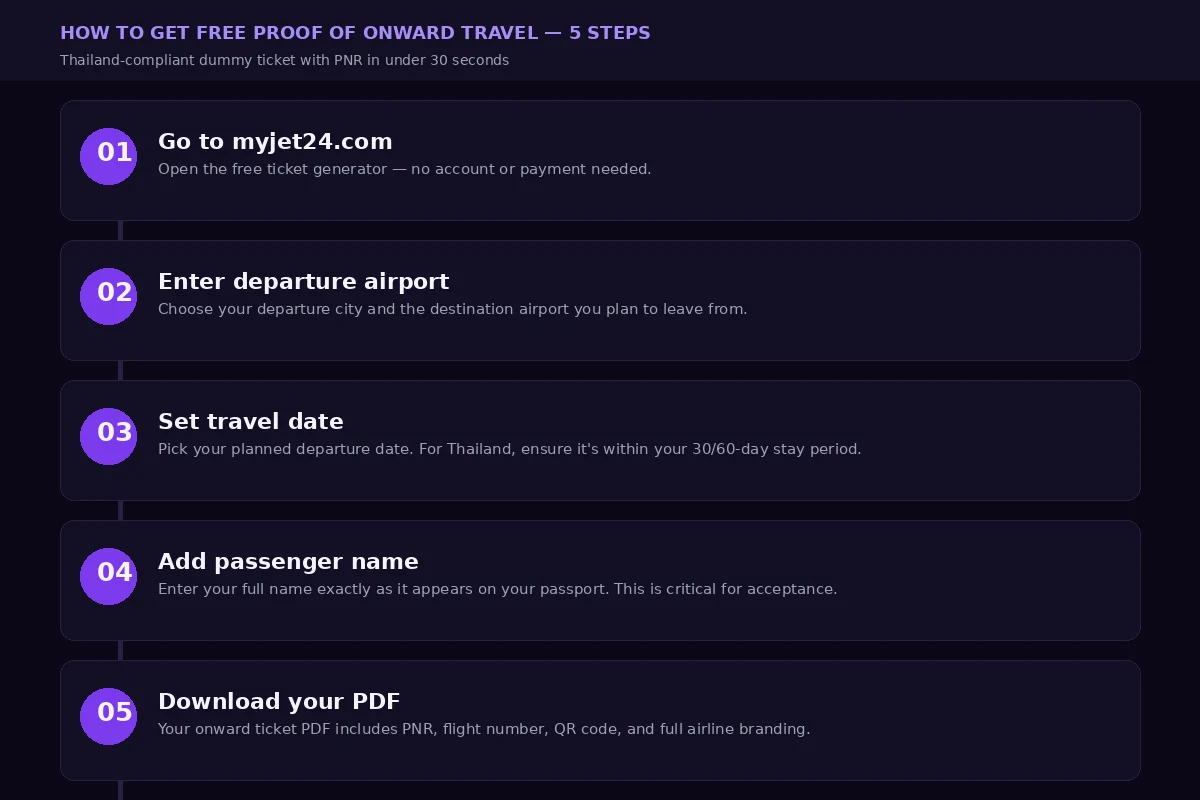
Here is how to get one for free using MyJet24:
- Go to myjet24.com — the free ticket generator. No account required.
- Enter your departure airport — for Thailand onward travel, choose your Bangkok departure airport (BKK or DMK) or any Thai airport.
- Choose your destination — Kuala Lumpur (KUL), Bali (DPS), Singapore (SIN), Hanoi (HAN), or any airport you plan to travel to next.
- Set the travel date — pick a date within your Thailand visa exemption period (within 30 days for most nationalities, within 60 days for tourist visa holders).
- Enter your passenger name — exactly as it appears on your passport. This is critical; a name mismatch is the only reason dummy tickets are rejected.
- Download the PDF — your document is generated instantly, includes a real PNR code, QR code, airline branding, departure terminal, and seat class. Download to your phone for offline access before flying.
The document is valid for use with airlines, immigration officers, TDAC form submission, and visa applications worldwide. For Thailand specifically, the Thailand onward ticket generator pre-selects Thai departure airports for convenience.
Get Your Free Thailand Onward Ticket
PDF with PNR + QR code · Ready in 30 seconds · No registration · 100% free
Get Free Dummy Ticket →Other related guides for routes travelers commonly use when transiting through Thailand:
- Full list: which countries require proof of onward travel (2026)
- Can airlines legally deny boarding without an onward ticket?
- Proof of onward travel for Bali/Indonesia
- Proof of onward travel for Philippines
Frequently Asked Questions
Does Thailand require a return ticket for all nationalities?
Yes, Thailand's Immigration Act requires proof of onward travel for all visa-exempt arrivals, regardless of nationality. The rule applies to the 66 nationalities that receive a 30-day visa exemption stamp on arrival, as well as holders of tourist visas (TR), and transit entrants. There is no nationality that is categorically exempt from this requirement — though enforcement frequency varies by traveler profile.
Which Bangkok airport is stricter — Suvarnabhumi (BKK) or Don Mueang (DMK)?
Suvarnabhumi (BKK) has stricter immigration scrutiny due to its higher volume of long-haul and international arrivals. Immigration officers at BKK are more experienced at profiling and more likely to ask for onward tickets at the primary counter. Don Mueang (DMK) handles mostly budget carriers from Southeast Asia — so most passengers who lack onward proof get caught by the airline before reaching Thai immigration at all, not by immigration officers themselves.
Will AirAsia deny boarding if I have no return ticket to Thailand?
Yes. AirAsia's check-in system automatically surfaces the TIMATIC onward travel flag for Thai destinations, and agents cannot issue a boarding pass without resolving it. This is not a discretionary check — it is a system-enforced requirement. AirAsia checks this at the gate or check-in desk on all routes to Bangkok (BKK and DMK), Phuket (HKT), and Chiang Mai (CNX). Approximately 100% of AirAsia passengers to Thailand are checked.
Can I use a bus ticket from Bangkok to Kuala Lumpur as proof of onward travel?
Yes. A confirmed bus booking from Bangkok (Ekkamai or Mo Chit terminal) to Kuala Lumpur, Penang, or Singapore is valid proof of onward travel at Thai airports and for the TDAC form. The booking must show your name, departure date, a bus company booking reference, and the destination. Easybook, Busbud, and direct bus operator confirmation emails are accepted. A confirmed bus ticket from Bangkok also satisfies the airline gate check at DMK on routes where the carrier does check.
Does the Thailand Digital Arrival Card (TDAC) require onward flight details?
Yes. The 2026 TDAC form requires you to enter your planned departure details — including departure date and, ideally, a flight or transport booking number. These details appear on the immigration officer's screen when they scan your QR code on arrival. Travelers who leave these fields blank or enter vague information are more likely to be asked for supporting documents at the primary counter.
Can I show proof of onward travel on my phone at Thai immigration?
Yes, showing the document on your phone is accepted at Thai airports. Most travelers show the PDF on their screen at the immigration counter or at the airline gate — this is standard practice. The critical point is that the PDF must be downloadable and accessible offline, since airport WiFi can be slow or unreliable. Download the PDF to your phone's local storage before your departure day, not when you are standing at the gate.
Do overland border crossings in Thailand check for onward travel proof?
Yes, but inconsistently. Land border crossings — particularly Mae Sai (Myanmar), Poipet (Cambodia), and Padang Besar (Malaysia) — check for onward travel proof mainly when officers identify travelers who may be using visa runs. If you have three or more recent Thai visa exemption entries in your passport, expect a more thorough document check at land borders. Carrying a dummy ticket or bus booking out of Thailand resolves this in all cases.
How far in advance should I get proof of onward travel before flying to Thailand?
Get it before you check in — not at the airport. Airlines perform the check when you drop your bag or at the gate, which means you need the document on hand in the check-in line. Getting a dummy ticket from MyJet24 takes 30 seconds; you can do it the night before. Practically, make it part of your pre-flight checklist alongside your passport check: passport ✓, visa ✓, onward ticket ✓.
Is a dummy ticket for Thailand legal?
Yes. A dummy ticket is a standard flight reservation with a real PNR code — it is the same document type used for visa applications by millions of travelers annually. It is not a forged or falsified document; it is a flight itinerary at the pre-payment or hold stage. Thai immigration officers, airlines, and the Thai Embassy accept it as valid proof of onward travel. There is no legal restriction on holding a flight itinerary without having paid for the final ticket.
What if my dummy ticket's departure date has passed when I reach immigration?
An expired dummy ticket (where the departure date has already passed) is not valid. Immigration officers check the departure date against today's date. If your trip is delayed or extended, generate a new dummy ticket with the updated departure date — the process takes under a minute on MyJet24. Generating a new ticket when your plans change is the correct approach, not trying to present an outdated document.
Conclusion: The One Document That Solves All of This
Thailand's onward travel requirement exists at three enforcement layers in 2026: the airline system (TIMATIC at check-in), the TDAC pre-arrival card, and the immigration officer on arrival. All three layers ask the same question: how do you plan to leave?
A free dummy ticket answers that question with the exact format every enforcement layer is looking for — a flight number, departure date, passenger name matching your passport, PNR code, and QR code. It costs nothing, takes 30 seconds, and is reusable for any destination from any Thai airport.
If you are flying to Thailand on a one-way ticket for any reason — scouting for a longer stay, on a budget trip, not sure of your onward plans yet — the simplest protection against denied boarding and a formal refusal stamp in your passport is already available for free.
Get Thailand Onward Ticket Free →
James Mitchell
CEO & Co-Founder, MyJet24
James has been building travel documentation tools since 2021 and has researched onward travel enforcement at 40+ airports across Southeast Asia, Latin America, and Europe. He writes on visa documentation, airline policy, and the intersection of AI and travel compliance.
Last updated: 8 May 2026. Thailand immigration enforcement policies and TDAC requirements change frequently. While this guide reflects current rules as of May 2026, always verify requirements with your airline and the Thai Immigration Bureau before travel.
