
Last updated: 3 September 2026 · Reading time: 14 min · Author: Joshua White, Travel Documentation Writer at MyJet24 · Reviewed by: Marc Hoffmann, Senior Visa Consultant
TL;DR — Key facts
- A date mismatch is not a refusal ground anywhere in the Visa Code. Article 32(1)(a) lists the mandatory refusal grounds and a document disagreement is not among them. A mismatch can only reach a decision through Article 32(1)(b) — “reasonable doubts”.
- The refusal form proves it. Annex VI of the Visa Code has 17 tick-boxes. None says your documents did not match. A mismatch has to be recorded in box 10, 11, 12 or 13 — and which one is ticked tells you what the officer actually concluded.
- Four fields must match exactly; the rest never had to. Dates, destination, first port of entry and your name carry the decision. Airline, route, flight number, fare and seat are not conditions of entry.
- An inconsistency is not a lie. UK guidance orders caseworkers not to refuse for deception where there may have been an innocent mistake or “minor but immaterial inaccuracies”. US law needs the misstatement to be both willful and material.
- The common fix is the dangerous one. Editing a PDF so the dates agree does not repair an inconsistency — it converts it into a forged document, which is a mandatory refusal ground.
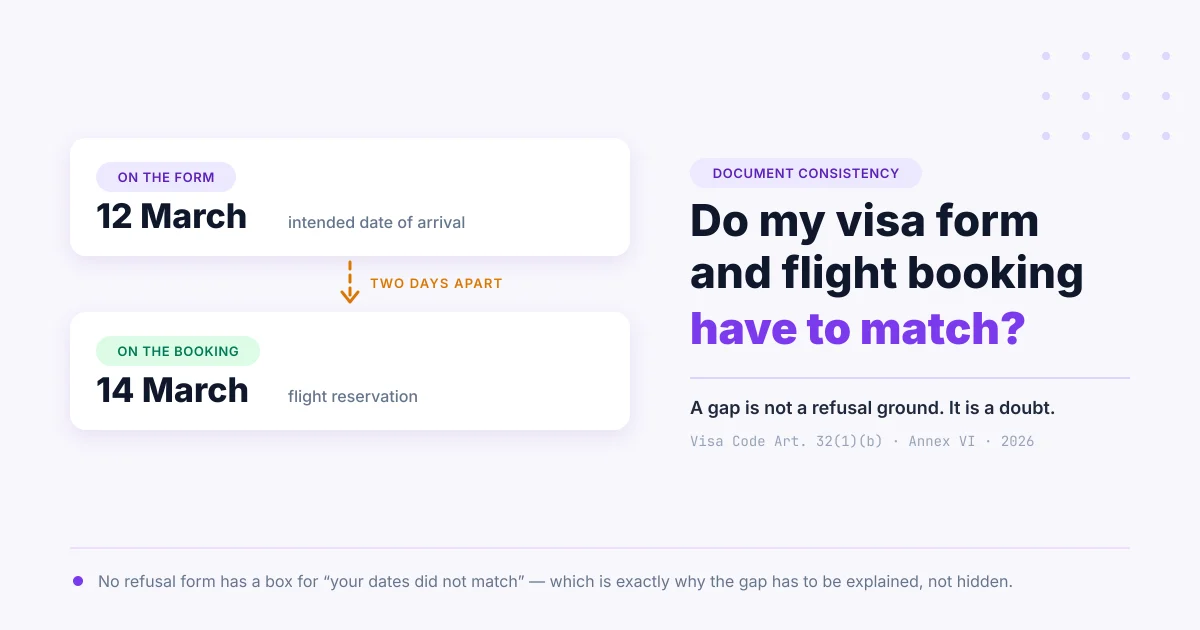
Your visa application form and your flight booking do have to match — but only on four fields: the arrival and departure dates, the destination country, the first port of entry and the passenger name. Those four define the trip you are asking permission for. Everything else on the reservation, including the airline and the flight number, is a detail you are free to change. A mismatch on the four does not refuse you automatically; it creates a doubt an officer then has to resolve.
Set your declared dates first, then generate the booking around them — free, with a verifiable reference.
What actually has to match on a visa application?
Document consistency is the requirement that the trip described in your application form is the same trip described in every document attached to it. It is not a rule written in any visa law. It is a consequence of how the decision is made: an officer reads your declared trip, then reads your evidence, and decides whether the second supports the first.
That framing matters, because it tells you which differences count. A field only carries weight if it describes the trip the consulate is being asked to authorise. The Schengen Visa Code sets out what a consulate must examine in Article 21: whether you meet the entry conditions, and “whether the applicant presents a risk of illegal immigration or a risk to the security of the Member States and whether the applicant intends to leave the territory of the Member States before the expiry of the visa applied for”. Nothing in that sentence is about your airline.
Key takeaway: four fields describe the trip — dates, destination, first port of entry, name. Those are the ones consistency applies to. The rest of the reservation is logistics.
Why do consulates compare your form against your documents?
Consulates compare documents because credibility, not paperwork volume, is what they are assessing. Article 21(7) of the Visa Code says the examination “shall be based notably on the authenticity and reliability of the documents submitted and on the veracity and reliability of the statements made by the applicant”. Two sources for the same fact is the cheapest reliability test available, and it costs the officer nothing to run.
The comparison is also structural. The reservation you attach is not decorative. Annex II of the Visa Code lists it explicitly under documents that let a consulate assess your intention to leave: “reservation of or return or round ticket”. A reservation is named in the law as sufficient — you were never required to buy a ticket. But because the reservation is evidence of your intention to leave, its dates are evidence, and evidence that contradicts your own statement weakens rather than supports you.
The consulate is not checking whether you are organised. It is checking whether the same trip appears twice. A mismatch does not make you look careless — it makes the trip look unsettled, and an unsettled trip is harder to grant.
Key takeaway: the form states the trip; the documents corroborate it. Corroboration that disagrees with the statement stops being corroboration.
Which fields must match exactly, and which only have to be plausible?
Not every field is graded the same way. Three tiers exist in practice, and only the top one can carry a refusal. A field belongs in the top tier when it is a condition of the visa itself; in the middle tier when it makes the story coherent; and in the bottom tier when it is simply how you happen to be travelling.
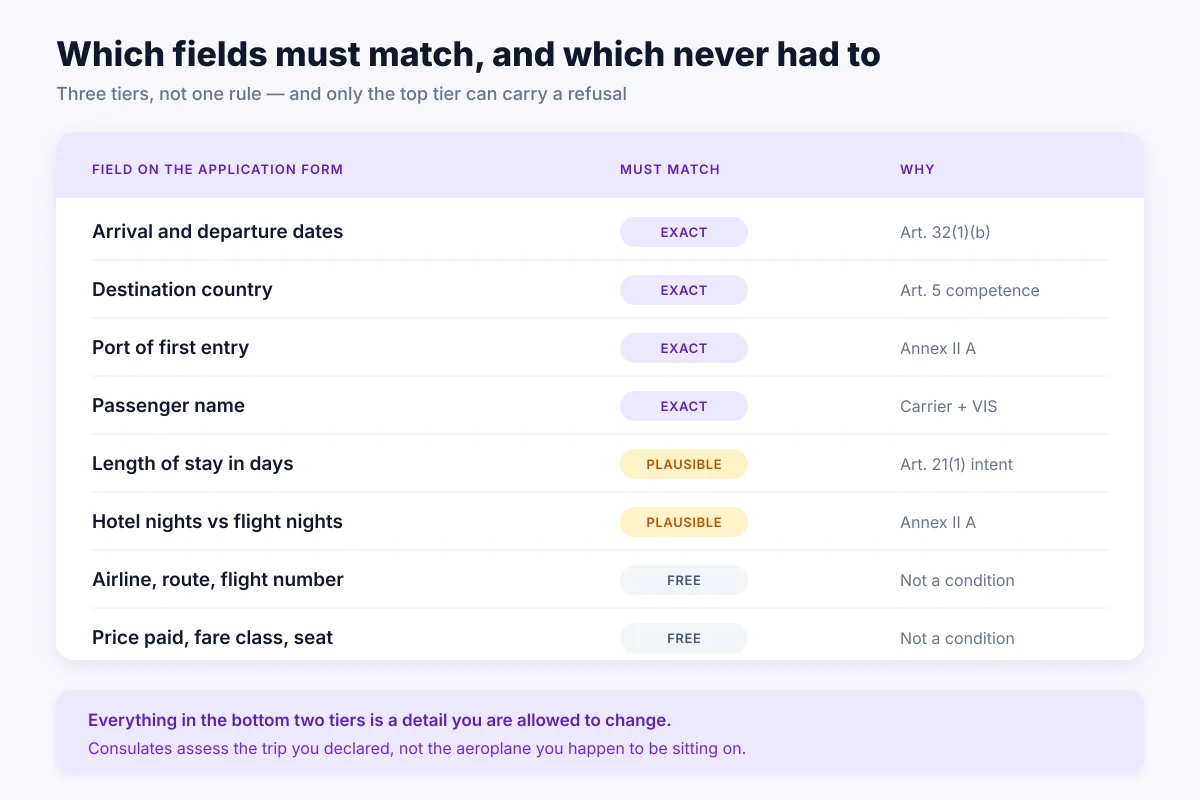
| Field | Tier | What a difference actually signals |
|---|---|---|
| Arrival and departure dates | Must match exactly | The visa is issued for a window. A different window is a different application. |
| Destination country | Must match exactly | In the Schengen Area it decides which state is even competent to decide. |
| First port of entry | Must match exactly | Border records are built against it, and it corroborates the declared route. |
| Passenger name | Must match exactly | A reservation in another name is evidence about someone else. |
| Length of stay in days | Must be plausible | A stay longer than the visa asks for reads as intent to overstay. |
| Hotel nights vs flight nights | Must be plausible | Unexplained uncovered nights invite the question of where you will be. |
| Airline, route, flight number | May differ freely | Not a condition of entry anywhere in the Visa Code. |
| Price, fare class, seat | May differ freely | Never assessed. A cheap ticket is not a weak application. |
The bottom tier is larger than most applicants believe. If you declared Lisbon and fly to Lisbon on the declared date, changing from a morning TAP flight to an afternoon one on a different carrier changes nothing that was ever examined. This connects directly to what happens after approval, covered in our guide on whether you have to fly the exact flight you showed.
Key takeaway: if a field is not a condition of the visa, a difference in it is not a defect.
What happens if my flight dates do not match my application form?
A date mismatch triggers a doubt, and a doubt has three possible outcomes: nothing, a request for clarification, or a refusal recorded under one of four specific headings. It never triggers an automatic refusal, because there is no provision under which it could.
The Visa Code separates its refusal grounds into two kinds. Article 32(1)(a) lists the mandatory ones — a false, counterfeit or forged travel document; no justification for “the purpose and conditions of the intended stay”; no proof of sufficient means; a SIS alert; and so on. A disagreement between two of your own documents appears nowhere on that list. Article 32(1)(b) then adds a discretionary ground: a visa may be refused where there are “reasonable doubts as to the authenticity of the supporting documents submitted by the applicant or the veracity of their contents, the reliability of the statements made by the applicant or his intention to leave the territory”.
Before that point, Article 21(8) lets the consulate “carry out an interview with the applicant and request additional documents”. In ordinary files, a two-day gap resolves there — with a question, not a decision.
The four boxes a mismatch can land in
The most direct evidence that a mismatch is not its own refusal ground is the refusal form itself. Annex VI of the Visa Code is the standard form every Schengen consulate must use, and it carries 17 numbered tick-boxes. Sixteen of them describe something missing, forged, expired or prohibited. Not one describes documents that disagree.
So a mismatch has to be routed into one of four doubt boxes — and the box that is ticked is the single most useful piece of information on a refusal letter, because each one names a different problem and each one is answered by a different document.
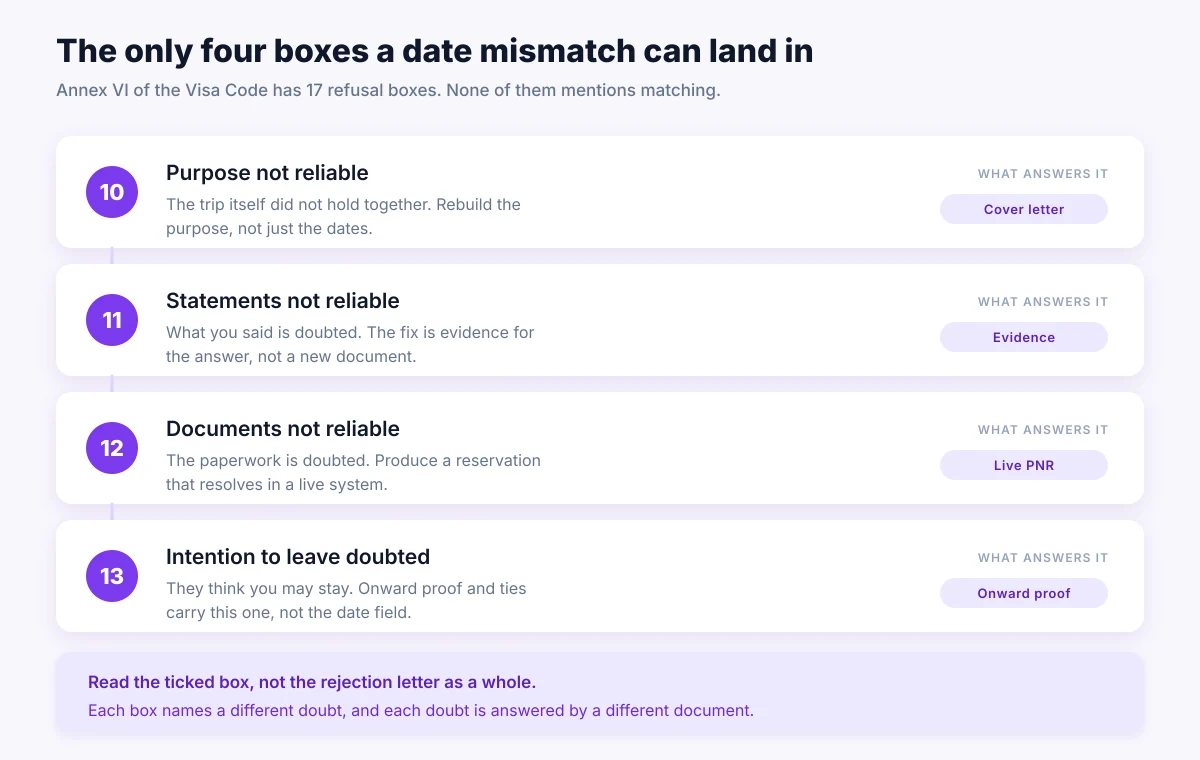
- Box 10 — “the information submitted regarding the justification for the purpose and conditions of the intended stay was not reliable”. The trip did not hold together. Fixing the dates alone will not answer it.
- Box 11 — “there are reasonable doubts as to the reliability of the statements made”. What you said is doubted, so the answer is evidence for the statement, not a replacement document.
- Box 12 — “reasonable doubts as to the reliability, as to the authenticity of the supporting documents submitted or as to the veracity of their contents”. The paperwork is doubted, which usually means it did not resolve when checked.
- Box 13 — “reasonable doubts as to your intention to leave the territory of the Member States before the expiry of the visa”. This one is answered by onward-travel evidence and ties, not by editing a date.
An applicant who reads “box 12” and rewrites their cover letter has answered the wrong question. One who reads “box 13” and produces a stronger, verifiable return reservation has answered the right one. If you are at this stage, our walkthrough of Schengen refusal appeals and win rates by country shows how the boxes map onto appeal arguments.
Key takeaway: a mismatch is never the reason on the form. It is the route to one of four reasons, and only the ticked box tells you which.
The numbers behind the doubt
Eurostat recorded 132,600 refusals of entry at EU external borders in 2025. The largest single category — 40,185 cases, or 30.3% — was “purpose and conditions of stay not justified”, rising to 40.0% at air borders. A further 10,330 cases (7.8%) were insufficient means. Both categories are about an unconvincing trip, not a missing stamp — which is the same test a consulate applies months earlier.
When does an inconsistency become a false representation?
An inconsistency becomes a false representation when a statement you made is untrue, rather than merely unsupported. The two sit on different rungs of a three-tier ladder, and nearly every article on this subject collapses them into one — which is why the advice online is so much more frightening than the law.
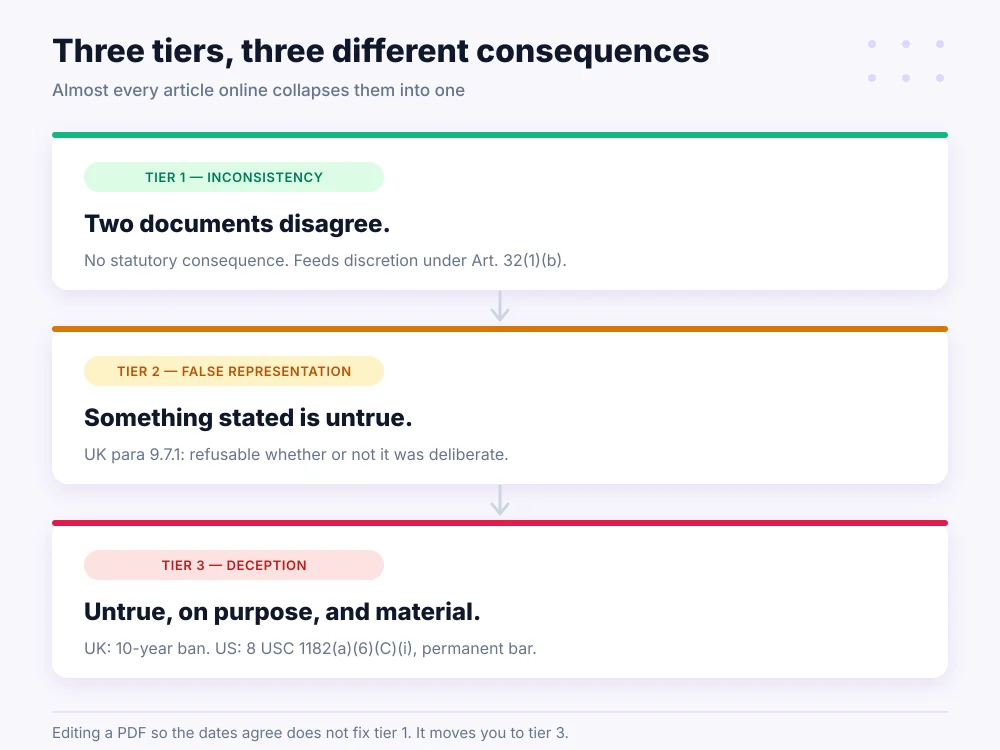
Tier one is an inconsistency. Two documents disagree. Nothing has been asserted falsely — your form says one thing and your reservation says another, and at most one of them is wrong. There is no statutory consequence attached to it anywhere. It feeds discretion, and that is all.
Tier two is a false representation. Something stated in the application is untrue. Under UK Immigration Rules paragraph 9.7.1 this is a discretionary refusal ground and it does not require dishonesty — an application can be refused on this basis whether or not the false representation was deliberate. It is the tier most applicants are actually in when they enter a date they later change.
Tier three is deception. The statement is untrue, deliberate and material. Here the consequences change character entirely. In the UK, a finding of deception normally carries a ten-year re-entry ban. In the US, 8 U.S.C. § 1182(a)(6)(C)(i) makes inadmissible “any alien who, by fraud or willfully misrepresenting a material fact, seeks to procure ... a visa”. Both qualifiers do real work: the misstatement must be willful, and it must be material — capable of affecting the outcome. A two-day arrival date that changes nothing about eligibility is neither.
The distance between tier one and tier three is not a matter of degree. It is the difference between a question at the counter and a decade-long exclusion — and what moves you between them is intent, not the size of the gap.
The US adds a second layer worth understanding, because it explains why B1/B2 applicants feel more scrutinised. Under 8 U.S.C. § 1184(b), every applicant “shall be presumed to be an immigrant” until they satisfy the consular officer otherwise. You start the interview on the back foot by statute, so inconsistencies are read against a presumption you are already working to overcome. Our guide to what officers actually ask at interview covers how that presumption shapes the questions.
Key takeaway: a wrong date is tier one or tier two. Only intent moves it to tier three, and only tier three carries a ban.
Who decides whether your mismatch was an honest mistake?
A single caseworker decides, and in the UK the test they apply is published. Home Office guidance for staff, current as of 11 November 2025, is explicit about the threshold: caseworkers “must not refuse on grounds of deception or false representations grounds if there may have been an innocent mistake, or because there are minor but immaterial inaccuracies”.
The guidance then lists the questions a caseworker asks themselves before treating an inaccuracy as dishonesty. Read them as a checklist of what your file is being measured against:
- How easy would it have been to make an innocent mistake?
- How likely is it that the applicant was unaware the information had been provided?
- How likely is it that the person providing the information knew it was incorrect?
- Does the false information benefit the applicant?
- Is it contradicted by other answers on the application form, or by any information in any documents provided?
- Does any endorsement or stamp in the passport contradict an answer given?
- Has a new passport been presented, and if so why?
- Has this “innocent mistake” also been made on a previous application?
Question four is the one that decides most date cases. A date that moves your trip two days later gains you nothing, so it fails the benefit test and reads as an error. A date that quietly extends your stay past what your funds or your leave letter support does benefit you, and reads very differently. Question eight is the one people underestimate: the same “mistake” twice stops being one.
The standard of proof is high on purpose. In Balajigari v Home Secretary [2019] EWCA Civ 673 the Court of Appeal held that the decision-maker “must be satisfied that dishonesty has occurred, the standard of proof being the balance of probabilities but bearing in mind the serious nature of the allegation and the profound consequences which follow from such a finding of dishonesty”.
Key takeaway: the decisive question is not whether the documents differ. It is whether the difference helped you.
Where do mismatches most often appear?
Mismatches cluster at the seams between documents that were produced at different moments by different people. In files we help applicants assemble, six seams account for nearly all of them.
- Form versus reservation. The form was filled in first, from a plan; the reservation was made a week later, from availability. Nobody went back to the form.
- Reservation versus hotel. An overnight arrival lands after midnight, so the first hotel night is technically the previous calendar day — or is missing entirely. This is the single most common one, and it is usually genuine.
- Cover letter versus everything. The letter was drafted early and quotes dates that later moved. See our cover letter templates for the block that should carry the dates.
- Insurance versus stay. Cover starts on the flight date but ends before the declared departure, leaving a day uninsured.
- Employer leave letter versus itinerary. Leave is approved to a round date; the trip is not round.
- Name versus passport. A middle name entered in one system and not another. This is its own topic, covered in how names must match on a flight ticket.
Only the first three are usually treated as substantive. Insurance and leave gaps are almost always resolved with an amended document rather than a refusal, because they are so obviously administrative.
Key takeaway: mismatches are produced by sequence, not carelessness. Anything drafted before the booking existed is where to look first.
Free, verifiable, and reissuable if your dates move before you submit.
How can I fix a mismatch before I submit?
Fix a mismatch by choosing one authoritative date set and rebuilding every other document around it. The order matters, because reversing it is what creates mismatches in the first place.
- Decide the declared window first. Pick the arrival and departure dates you will actually put on the form. Nothing else is fixed until this is.
- Rebuild the reservation to those dates, not the other way around. A reservation is the cheapest document to reissue, so it should be the one that moves.
- Re-check the hotel against arrival time, not arrival date. If you land at 01:40, your first night starts the evening before. Book it that way and the gap disappears.
- Reissue the cover letter last. It quotes every other document, so it can only be correct once they are.
- Read the file in the officer's order: form, then reservation, then accommodation, then funds, then letter. Any date that appears twice should appear identically.
- Verify the reservation resolves before you attach it. A reference that returns nothing is a box-12 problem regardless of whether the dates agree; our guide on verifying a booking reference covers how.
If a gap genuinely cannot be closed — an event that starts on the 14th but the only affordable flight lands on the 12th — do not hide it. Name it in one sentence in the cover letter. An explained gap is not a doubt; it is a detail you have already addressed.
Key takeaway: the form leads and the reservation follows. Every mismatch we see comes from doing that in reverse.
Why is editing the PDF the worst fix available?
Editing the PDF is the worst available fix because it does not repair the tier-one problem and it creates a tier-three one. The dates now agree on paper, but the underlying booking still says what it said, and the document no longer matches the system it claims to come from.
That distinction is the whole point. An inconsistency is a discretionary matter under Article 32(1)(b). An altered document is not: presenting a false or forged document is a mandatory refusal ground, and on the Annex VI form it is box 1 — the first box on the sheet, ticked before any of the doubt boxes are reached. You have moved from a question an officer might not even ask, to a finding that ends the application and follows you.
The mechanism that exposes it is unglamorous. A reservation is a record in an airline or GDS system, and the document is only a printout of that record. Anyone who queries the reference sees the record, not your file. If the two disagree, the printout is the thing that is wrong. We cover what that record actually contains in what airlines see when a booking is held but not ticketed, and the difference between the document types in dummy ticket vs onward ticket vs flight reservation.
Key takeaway: change the booking, never the printout. The booking is the fact; the PDF is only a picture of it.
How can I keep documents consistent while my plans are still moving?
Keep documents consistent by not committing money to dates you have not yet declared. The reason applicants end up with mismatched files is almost always that they bought something before they had decided what to ask for.
Three practical rules follow from that. First, do not buy a ticket before approval — the law does not require it, since Annex II names a reservation as sufficient, and a purchased ticket becomes the most expensive document to move. Our breakdown of whether you need a flight ticket before applying sets out each method and its cost.
Second, watch the validity of what you attach. A reservation that expires while the file is being processed can leave you with a reference that no longer resolves — a box-12 risk that has nothing to do with matching. The timing question is covered in how long a reservation stays valid and when to time it.
Third, keep one source of truth. A single line — arrival date, departure date, destination, first port of entry, name as printed in the passport — written down once and copied into every document is a two-minute habit that removes the entire problem. Our full document checklist lists everything that line has to feed, and the day-by-day itinerary guide shows how it flows into the plan.
Key takeaway: declare first, reserve second, buy last. Consistency is a by-product of that order.
What should I do if I already submitted with a mismatch?
If the file is already submitted, do not submit a corrected document unprompted at most consulates — an unexplained second version of a document you have already filed can read worse than the original difference. What to do depends on where the application is.
If the appointment has not happened yet, bring the corrected document with you and mention it in one sentence when you hand the file over. If the file is already with the consulate and there is a contact route, a short factual note naming the field, the correct value and the reason is appropriate. If there is no contact route, wait — Article 21(8) exists precisely so that the consulate can ask, and most do.
If a refusal has already arrived, read the ticked box before doing anything else. Boxes 10 to 13 point at four different problems, and preparing the wrong evidence is the most common reason a second application fails the same way as the first.
Key takeaway: unprompted corrections raise questions; requested ones answer them. Wait to be asked unless you are handing the file over in person.
Frequently asked questions
Will a two-day difference between my form and my flight booking get me refused?
On its own, almost never. A two-day gap gains you nothing, so it fails the benefit test that decision-makers apply, and it is not a refusal ground in its own right. It can still prompt a question or a request for a corrected document under Article 21(8) of the Visa Code.
Do the flight number and airline on my reservation have to match anything?
No. Neither appears as a condition of entry in the Visa Code, and neither is examined as part of the risk assessment. They are logistics. Only the dates, destination, first port of entry and passenger name describe the trip being authorised.
Does my hotel booking have to cover every single night of the trip?
It should be plausible rather than perfect. An overnight arrival often means the first hotel night starts on the previous calendar date, which looks like a gap but is not one. Genuine uncovered nights are fine if the cover letter says where you will be — with family, in transit, on an overnight train.
Is an inconsistency treated as lying on a visa application?
No, and the distinction is legally meaningful. Lying requires the statement to be untrue and, for the serious consequences, deliberate and material. UK guidance instructs caseworkers not to refuse for deception where an innocent mistake is possible or where inaccuracies are minor and immaterial.
Can I change my flight reservation after I have submitted the application?
You can, but the file was assessed on what you filed. If the change moves the dates you declared, the safer route is to inform the consulate rather than silently reissue. If it only changes the carrier or the flight number, nothing that was examined has moved.
What does box 12 on a Schengen refusal letter actually mean?
Box 12 records reasonable doubts about the authenticity of your supporting documents or the truth of their contents. In practice it usually means a document could not be verified or did not resolve when checked — not that the officer thinks you forged it. The answer is a reservation that resolves in a live system.
Do US visa applications treat mismatches more harshly than Schengen ones?
The framework is stricter in one specific way. Under 8 U.S.C. § 1184(b) you are presumed to be an intending immigrant until you prove otherwise, so inconsistencies are read against a presumption you must already overcome. The misrepresentation standard itself is narrower, requiring the statement to be both willful and material.
Should I explain a date gap in my cover letter, or leave it alone?
Explain it, in one sentence, if the gap is visible on the face of the documents. An unexplained difference is a doubt the officer has to resolve alone; an explained one is a detail you have already resolved for them. Do not write a paragraph — length signals anxiety.
Does the length of stay on my form have to equal the days between my flights?
It has to be consistent with them, not identical to the day. Declaring 10 days against a 14-day flight window is the version that causes problems, because the surplus days read as an intention to stay beyond what you asked for. Declaring the full window and travelling less is not a defect.
Is a flight reservation enough, or do consulates want a purchased ticket?
A reservation is named in the law. Annex II of the Visa Code lists “reservation of or return or round ticket” among the documents that let a consulate assess your intention to leave. Some consulates ask for a paid ticket after approval, which is a separate stage from the assessment itself.
What should I do next?
Consistency is a sequencing habit, not a document. Decide the window you will declare, build the reservation around it, and let every later document quote the same five values. That order removes the problem before it exists, and it costs nothing.
What it does not require is buying a ticket. The law names a reservation as sufficient evidence of your intention to leave, which means the cheapest document in the file is also the one the Visa Code actually asks for — and the one you can reissue for free if your dates move before you submit.
Enter the dates you declared on your form. Verifiable reference, no card required.
Sources
- Regulation (EC) No 810/2009 (Visa Code), Article 32 — refusal grounds, mandatory and discretionary.
- Visa Code, Annex VI — the standard refusal form and its 17 tick-boxes.
- Visa Code, Article 21 — verification of entry conditions, and the power to interview and request more documents.
- United States, 8 U.S.C. § 1182(a)(6)(C)(i) and § 1184(b) — misrepresentation, and the presumption of immigrant status.
- UK Home Office, Suitability: deception, false representations, false documents and non-disclosure of relevant facts, published for Home Office staff 11 November 2025 — the innocent-mistake test and the standard of proof.
- Eurostat, refusals of entry at EU external borders, 2025 — 132,600 refusals; 40,185 for purpose and conditions of stay not justified.
About the author
Joshua White is a Travel Documentation Writer at MyJet24. He writes research-backed guides on visa applications, flight reservations and embassy requirements, working from primary legislation and published decision-maker guidance rather than second-hand summaries. His work covers Schengen, UK, US and Asia-Pacific documentation standards.
Reviewed by Marc Hoffmann, Senior Visa Consultant and founder of MyJet24, who has guided more than 50,000 travellers through visa documentation across 195+ countries.
Last reviewed: 3 September 2026 by Marc Hoffmann. Methodology: every legal provision quoted here was retrieved from the official text and checked verbatim; no requirement is stated on the basis of secondary reporting.
This guide is general information about documentation practice, not legal advice on an individual application.
