
Last updated: 19 July 2026 · Reading time: 14 min · Author: Joshua White, Travel Documentation Writer at MyJet24
TL;DR — Key Facts
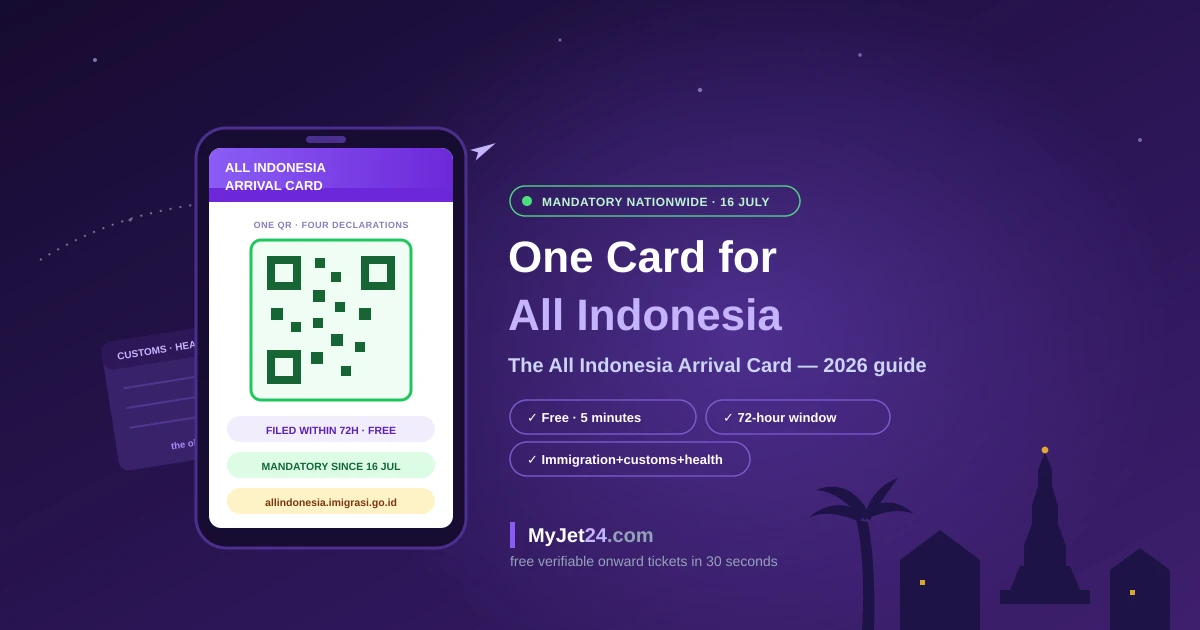
- Indonesia has one arrival form now — and since 16 July 2026 it's compulsory everywhere. The All Indonesia Arrival Card (AIAC), live as the official platform since September 2025, is required at Bali and every other international gateway for all arriving travelers, Indonesians included.
- One QR covers four layers: immigration details, the customs declaration (animals, plants, restricted goods, baggage), a health declaration listing the countries you visited in the past 21 days — and, for long stays, IMEI registration for your phone so it works on local networks.
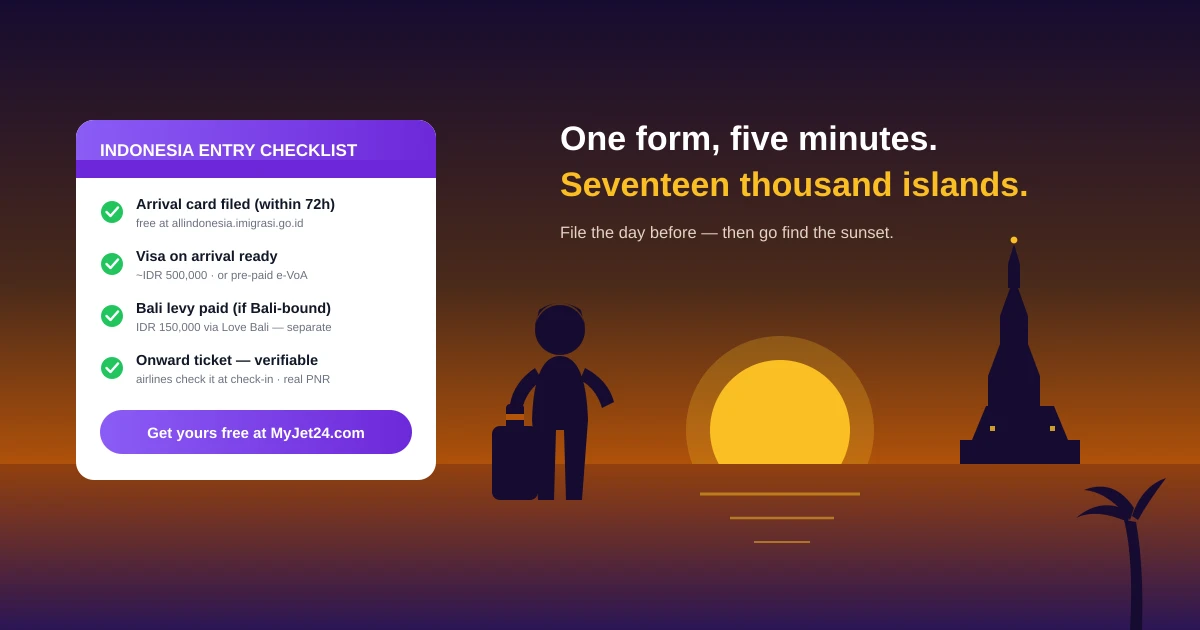
- The window is strict: 72 hours. The form only opens within 3 days of arrival at allindonesia.imigrasi.go.id or the All Indonesia app — earlier submissions simply aren't possible. It's free and takes about five minutes.
- The AIAC replaces forms, not fees. Visa on arrival (~IDR 500,000), the separate Bali tourist levy of IDR 150,000 and Indonesia's onward-ticket requirement all still apply — the card is the paperwork, not the permission.
- Copycat sites are already charging for it. As with every free arrival form we've covered this year, paid lookalikes rank in search. Only the .imigrasi.go.id address and the official app are real.
The All Indonesia Arrival Card is a free digital arrival form, filed at allindonesia.imigrasi.go.id or through the All Indonesia app within 72 hours before arrival, that has been mandatory for every traveler entering Indonesia — foreign visitors and Indonesian citizens alike — at all international gateways since 16 July 2026. The single QR code it generates combines immigration data, the customs declaration, a health declaration covering the previous 21 days of travel, and optional IMEI device registration, and is scanned by officers on arrival in Bali, Jakarta and every other port. It is not a visa: visa-on-arrival fees, the Bali tourist levy and Indonesia's onward-ticket requirement remain separate.
In this guide
- What is the All Indonesia Arrival Card?
- What changed on 16 July 2026
- Who must file — Indonesians, foreigners, kids
- The 72-hour rule and how to register, step by step
- Four declarations in one QR — including the IMEI rule
- The airport flow in Bali and Jakarta
- Copycat alert: only .imigrasi.go.id is official
- AIAC ≠ visa ≠ levy ≠ onward ticket: Indonesia's four gates
- Six mistakes to avoid
- Frequently asked questions
What is the All Indonesia Arrival Card?
For years, landing in Indonesia meant a small stack of separate obligations: an electronic customs declaration with its own QR code, a health pass left over from the pandemic era, immigration questions at the counter — and for anyone staying long enough, a trip to a phone shop to register a foreign handset. The All Indonesia Arrival Card folds all of it into one online form and one QR code, operated by the Directorate General of Immigration at allindonesia.imigrasi.go.id and through the All Indonesia mobile app.
Three fundamentals up front:
- It's free. The official platform charges nothing for registration or corrections — any site asking for a "processing fee" is not the official platform (a pattern worth its own section below).
- It's a declaration, not a permission. The card registers your data; your right to enter still comes from your visa, visa on arrival or exemption. Nothing about Indonesian visa policy changed with the AIAC.
- It's for arrivals. The card is an arrival formality — there is no equivalent departure form for visitors to worry about when they leave.
What changed on 16 July 2026
The platform itself isn't new — the enforcement is. All Indonesia became the Directorate General of Immigration's official integrated arrival platform on 1 September 2025, rolling out through Bali and the major gateways over the months that followed, with paper fallbacks and patchy airline checks during the transition. As of 16 July 2026, the card is compulsory for every international arrival at every gateway — Bali's Ngurah Rai, Jakarta's Soekarno-Hatta, Surabaya, Medan, the ferry ports from Singapore and Malaysia, all of it.
Practically, the change shows up in two places:
- At check-in, airlines flying into Indonesia now ask for the QR code alongside your passport and onward ticket — the same carrier-liability logic that made the Philippines' eTravel check universal;
- On arrival, the QR scan is the standard first step at immigration, and the old separate customs QR is gone — the AIAC is the customs declaration now.
Indonesia thereby joins the pattern we've tracked all year: Vietnam, India, Australia, South Africa, the Philippines — the paper arrival form is dying worldwide, and the 72-hour pre-arrival window is the new packing list item.
Who must file — Indonesians, foreigners, kids
| Traveler | AIAC required? | Notes |
|---|---|---|
| Foreign tourists & visitors | Yes | Regardless of visa type — VoA, e-VoA, visa-free or full visa |
| Indonesian citizens | Yes | Returning residents file the same form |
| Children & infants | Yes | Every traveler needs a record; parents file for minors |
| Airside transit passengers | Generally no | The card registers entries; if you clear immigration, you file |
| Departing travelers | No | Arrival formality only — no exit form for visitors |
The inclusion of Indonesian citizens surprises people: this is not a foreigners-only screen like a visa, but a universal arrival declaration like the Philippines' eTravel or South Africa's SARS form. One record per person, one QR per person — a family of four lands with four codes.
The 72-hour rule and how to register, step by step
Like Thailand's TDAC and the Philippines' eTravel, the AIAC has a hard 72-hour window: the application only opens within 3 days of your arrival date. You cannot file it at booking time — set the reminder for the day before departure.
Step 1 — Open the official platform
Type allindonesia.imigrasi.go.id directly into your browser, or use the All Indonesia app. Skip the search-ad results entirely — that's where the paid imitations live.
Step 2 — Passport and trip details
Enter your passport manually or scan the MRZ (the two machine-readable lines) with your phone camera. Then: travel dates, visa type or exemption, purpose of visit, mode of transport, flight number and your first address in Indonesia — the hotel or villa booking for night one.
Step 3 — The declarations
Answer the health section (current symptoms plus every country you visited in the past 21 days), the customs questions (animals, plants, restricted goods, currency, baggage details) and — if relevant — the IMEI registration for your devices (next section explains when it matters).
Step 4 — Submit and save the QR twice
Submission is instant and free. Screenshot the QR code and keep the confirmation email — airport basements and fresh SIM cards are where cloud-only documents go to die.
Four declarations in one QR — including the IMEI rule
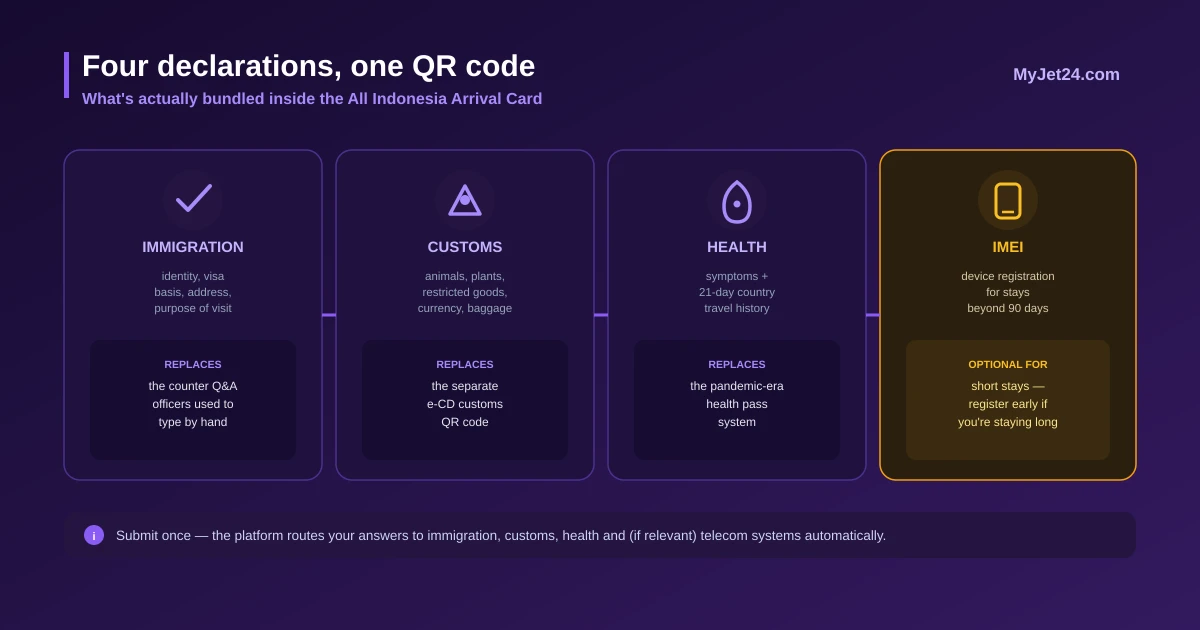
What makes the AIAC genuinely unusual is how much it consolidates. Behind the single QR code sit four formerly separate processes:
- Immigration — identity, visa basis, address, purpose: the data an officer used to type at the counter;
- Customs — the full declaration that used to be the separate e-CD QR: restricted goods, animal and plant products, currency and baggage;
- Health — a symptom check plus your 21-day country history, the successor to the pandemic-era health pass, kept alive for outbreak response (the same logic behind Vietnam's dormant health declaration framework);
- IMEI registration — Indonesia blocks unregistered foreign phones from local mobile networks on stays beyond 90 days. The AIAC lets you register your device's IMEI up front instead of discovering the rule at a phone counter in week thirteen. Short-stay tourists on roaming or a 30-day SIM don't need it; long-stayers, digital nomads and repeat visitors absolutely do.
The 21-day country history deserves a highlight: it's the health layer's core question, and it's exactly what gets cross-checked during regional outbreak alerts — answer it accurately, because inconsistencies between your passport stamps and your declaration are the kind of thing secondary inspection exists for.
The airport flow in Bali and Jakarta
- Check-in abroad: your airline asks for passport, onward ticket and — since 16 July — the AIAC QR. No code means registering on your phone at the counter, with all the queue-stress that implies.
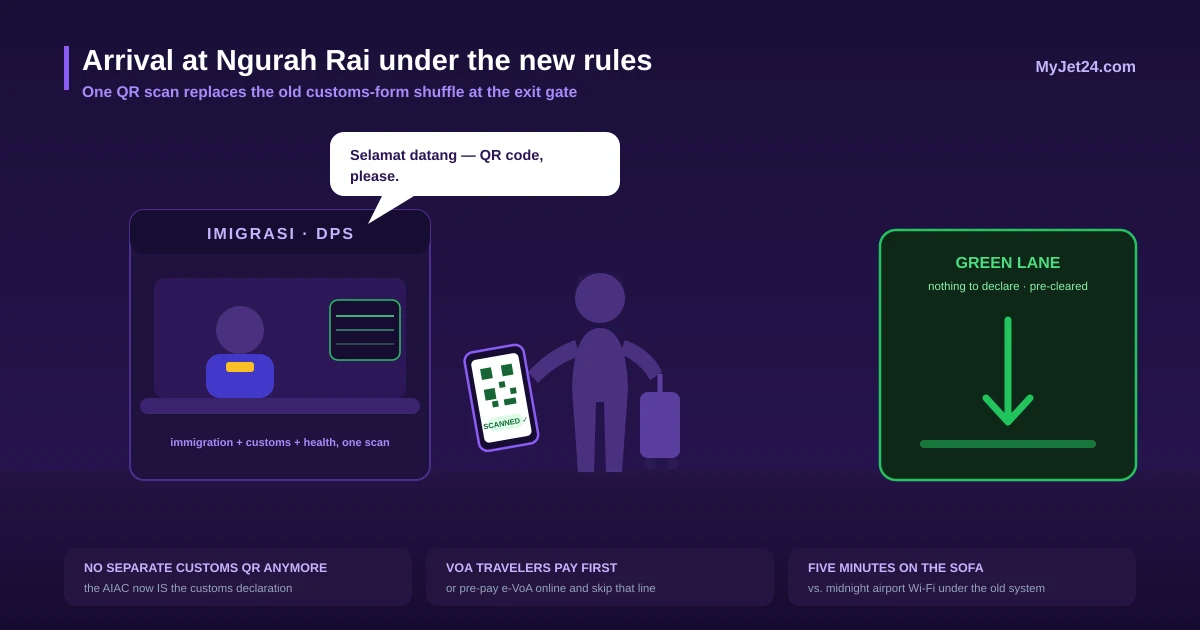
- Landing: follow the arrival-card signage. Officers scan the QR; the immigration, customs and health data appear together. Visa-on-arrival travelers pay their VoA first (or pre-pay via e-VoA and skip that line).
- Customs exit: because your declaration is already in the system, the old customs-QR shuffle at the exit scanners is gone — green channel unless your declaration flags something.
Where the old system produced the classic Bali arrival scene — passengers crouched over phones filling the customs form on airport Wi-Fi at midnight — the AIAC moves that moment to your sofa, 72 hours earlier. Five minutes online buys back an hour in the terminal.
Copycat alert: only .imigrasi.go.id is official
Every free arrival form we've covered in 2026 has grown a paid shadow — Vietnam, South Africa, the Philippines — and Indonesia is no exception. Search "Indonesia arrival card" and the results fill with plausible-looking portals offering to "process" the free form for a fee, some dressed in government blues, some bundling it with visa services you may not need.
The reliable filters, in order:
- The domain: the official card lives at allindonesia.imigrasi.go.id — an imigrasi.go.id government address. No .com, no .org, no "official partner."
- The price: the real form is free. A checkout page is a wrong turn, not a convenience.
- The bundle: legitimate paid products exist around Indonesian entry (the e-VoA, the Bali levy) — but they're bought on their own official channels, not stapled to an "arrival card service."
Already paid a lookalike site? Verify whether a real registration exists by filing yourself at allindonesia.imigrasi.go.id (free, five minutes), dispute the charge with your card issuer, and treat the passport data you entered there as exposed — the fee is annoying, the data is the real loss.
AIAC ≠ visa ≠ levy ≠ onward ticket: Indonesia's four gates
Indonesia now checks four separate things on a typical tourist arrival — the AIAC is just the newest and cheapest of them:
| Requirement | Cost | Who checks it |
|---|---|---|
| All Indonesia Arrival Card | Free | Airline at check-in + officers on arrival |
| Visa on arrival / e-VoA (eligible nationalities, 30 days, extendable) | ~IDR 500,000 | Immigration (pay on landing or pre-pay online) |
| Bali tourist levy (Bali only) | IDR 150,000 | Love Bali system — our payment guide |
| Onward/return ticket | Free PDF; verifiable reservation $7.90 (Premium) | Airline at check-in (hard check), immigration (sometimes) |
The last row is the one that strands one-way travelers. Indonesia expects proof you'll leave — VoA rules are explicit about a return or onward ticket, and carriers enforce it at check-in long before an Indonesian officer would. Our Indonesia & Bali dummy ticket guide covers how airlines verify reservations; the short version is that a verifiable onward reservation for Indonesia with a live PNR — generated at MyJet24 with Premium for $7.90 in about 30 seconds — satisfies the check that no arrival card can.
Six mistakes to avoid
- Filing on a .com portal. Only allindonesia.imigrasi.go.id and the All Indonesia app are official — and free. Everything else is a middleman charging for a government form.
- Trying to register a week ahead. The window opens 72 hours before arrival, full stop. Pair it with online check-in the day before departure.
- Confusing the AIAC with the Bali levy. The arrival card is free and national; the IDR 150,000 levy is a separate Bali-only payment through Love Bali. Paying one does nothing for the other.
- Fudging the 21-day country history. The health layer's core question gets cross-checked against passport stamps during outbreak alerts — accuracy costs nothing, inconsistency costs an afternoon.
- Ignoring IMEI registration on a long stay. Beyond 90 days, an unregistered foreign phone drops off Indonesian networks. Register through the AIAC now or queue at a service counter later.
- Arriving one-way with only the QR. The arrival card doesn't answer the onward-ticket question — airlines ask it separately, and it's the check that actually stops boardings.
Frequently asked questions
Is the All Indonesia Arrival Card mandatory in 2026?
Yes. Since 16 July 2026 the AIAC is compulsory for every international arrival at all Indonesian gateways — Bali, Jakarta, Surabaya, Medan and the sea ports included. The platform has been the official arrival system since 1 September 2025; the July change made it universal and consistently enforced.
How much does the All Indonesia Arrival Card cost?
Nothing — registration and corrections are completely free at allindonesia.imigrasi.go.id and in the All Indonesia app. Any website charging a service fee for the card is an unofficial middleman.
When should I fill in the arrival card?
Within 72 hours (3 days) before arrival — the form won't open earlier. The practical routine is to file it the day before departure, together with online check-in, and screenshot the QR code.
Do Indonesian citizens need the arrival card too?
Yes — the AIAC applies to all arriving travelers, Indonesian citizens and foreign visitors alike. It's a universal arrival declaration, not a foreigners-only screen.
Do children need their own arrival card?
Yes, every traveler needs an individual record regardless of age — a parent or guardian completes the form on a child's behalf. A family of four arrives with four QR codes.
What information does the form ask for?
Passport details (typed or scanned via the MRZ), travel dates, visa type, purpose, flight and first address in Indonesia; a health declaration with symptoms and all countries visited in the past 21 days; the customs declaration (animals, plants, restricted goods, currency, baggage); and optional IMEI registration for your devices.
What is the IMEI registration and do I need it?
Indonesia blocks unregistered foreign phones from local mobile networks on stays beyond 90 days. The AIAC lets you register your device's IMEI during arrival registration. Short-stay tourists using roaming or a 30-day tourist SIM don't need it; long-stayers and digital nomads should register up front.
How is the QR code used at the airport?
Twice: your airline checks it at check-in before issuing a boarding pass, and Indonesian officers scan it on arrival, where it feeds immigration, customs and health processing in one step. Save it offline — screenshot plus the confirmation email.
Do I need the arrival card when leaving Indonesia?
No. The AIAC is an arrival formality only — there is no equivalent departure form for visitors. You file once per entry into Indonesia.
Does the arrival card replace a visa or the visa on arrival?
No. The AIAC is a declaration. Visa policy is untouched: eligible nationalities still buy the visa on arrival (~IDR 500,000, 30 days, extendable once) or pre-pay the e-VoA; others need visas or use exemptions. The card carries your visa information — it doesn't grant it.
Is the Bali tourist levy included in the arrival card?
No — the IDR 150,000 Bali levy is a separate, Bali-only payment through the Love Bali system, unchanged by the AIAC. Travelers to Bali handle both: the free national arrival card plus the provincial levy.
Do I still need an onward ticket for Indonesia?
Yes. Indonesia's visa-on-arrival rules expect a return or onward ticket, and airlines enforce it at check-in regardless of your arrival card. One-way travelers can satisfy the check with a verifiable onward reservation carrying a live PNR, like MyJet24's Premium onward ticket ($7.90).
What happens if I arrive without the arrival card?
Since the July 2026 enforcement, airlines ask for the QR at check-in — no card usually means registering on your phone at the counter before you're issued a boarding pass. On landing without one, you'd be directed to complete it before immigration processing: recoverable, but the slowest possible version of your arrival.
Where is the official All Indonesia website?
Only allindonesia.imigrasi.go.id — note the imigrasi.go.id government domain — and the official All Indonesia app on iOS and Android. Type the address directly; don't trust ads or search shortcuts.
The bottom line
The All Indonesia Arrival Card is the tidy ending to one of travel's messier paperwork stories: customs QR here, health pass there, IMEI counter in the corner — now one free form, filed from your sofa within 72 hours of arrival, scanned once in Bali or Jakarta. Since 16 July 2026 it's non-negotiable at every gateway, which mostly means one thing: put it on the same day-before checklist as online check-in, and it will never cost you a minute.
Just remember what the QR doesn't do. Your visa or VoA, the Bali levy if the island is your destination, and the onward ticket airlines demand from one-way travelers are all separate gates — the last one closable in about 30 seconds with a verifiable onward ticket from MyJet24 Premium ($7.90). File the form, stack the trio, and save your energy for the first sunset at Uluwatu.
Sources
- Directorate General of Immigration — All Indonesia official portal: https://allindonesia.imigrasi.go.id
- Come2Indonesia — The new All Indonesia Arrival Card: https://come2indonesia.com/all-indonesia-arrival-card/
- Wego — All Indonesia Arrival Card 2026: What It Is, Who Needs It, and How to Apply: https://blog.wego.com/all-indonesia-arrival-card/
- Bali Easy — All Indonesia Arrival Card: Definition, Requirements & 2026 Updates: https://visa.balieasy.com/blog/all-indonesia-arrival-card/
- Welcome Back To Bali — The new All Indonesia Arrival Card: https://www.welcomebacktobali.com/blog/latest-updates/the-new-all-indonesia-arrival-card
This guide reflects the All Indonesia Arrival Card rules as published on the official immigration platform and reported as of 19 July 2026. Filing windows, enforcement practice and related fees can change — verify against allindonesia.imigrasi.go.id before you travel. This article is informational and not legal advice.
