
Last updated: 31 August 2026 · Reading time: 13 min · Author: Marc Hoffmann, Senior Visa Consultant at MyJet24 · Reviewed by: James Mitchell, CEO & Founder
TL;DR — Key facts
- Whether you can extend was decided before you landed. Either the destination built an extension route into its law, or it did not — nothing you do at the counter creates one.
- There are three states, not two. Extendable by design, extendable only on exceptional grounds, and not extendable at all.
- Europe puts it in one article. A Schengen visa "shall be extended" for force majeure or humanitarian reasons, free of charge, and "may be extended" for serious personal reasons, for €30.
- The lighter your entry, the harder it is to prolong. Indonesia's free 30-day entry is strictly non-extendable while its paid visa on arrival extends once — same country, opposite answers.
- A refusal moves nothing. If an extension is refused, the original end date still governs, and it may already have passed.
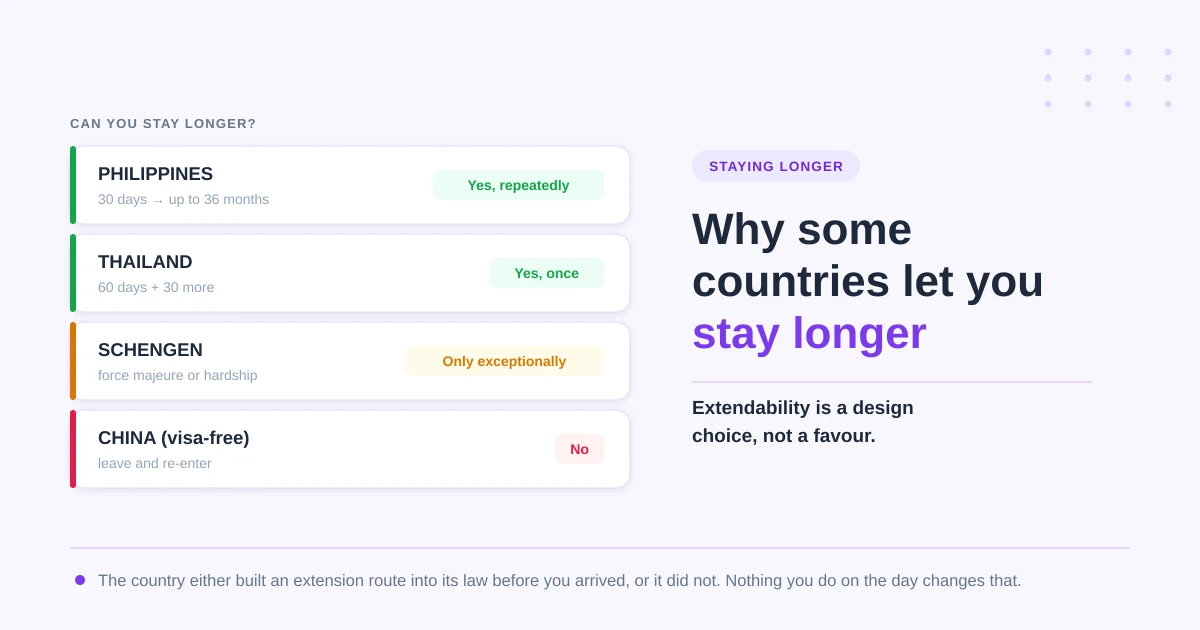
Some countries let you extend because they wrote an extension procedure into their immigration law, and others did not. It is a design choice made long before your trip, not a discretion exercised on the day. Which state you are in depends on your entry type, and you can look it up before you book.
Where an extension is not possible, a dated departure is what the border wants to see.
What does extending your stay actually mean?
An extension is a new end date granted by the country you are already inside, without you leaving it. It replaces the date you were given on arrival with a later one, using a procedure that exists in that country's own law.
Two things it is not. It is not a new visa — the permission type usually stays the same, only the deadline moves. And it is not a conversion: most extension routes let you stay longer as a tourist, not become something else, so an extended visitor is still a visitor with the same restrictions.
The distinction that matters most is between extending a visa and extending a visa-free stay. They are different procedures under different rules, and a country that offers one may not offer the other. Indonesia is the cleanest example: its paid visa on arrival can be extended once, while its free 30-day entry cannot be extended at all.
Key takeaway: An extension moves a date. It does not change what you are permitted to do, and it is not available everywhere.
Why can some travellers extend and others cannot?
Because extendability is a property of the entry type, written into law in advance. Every arrival falls into one of three states, and which one you are in was fixed before your flight took off.
Some entries are extendable by design: a procedure exists, an office handles it, a fee is published. Some are extendable only on exceptional grounds, where the law permits it but restricts it to circumstances you would not wish on yourself. And some are not extendable at all, with no mechanism to invoke, in which case leaving and re-entering is the only route to more time.
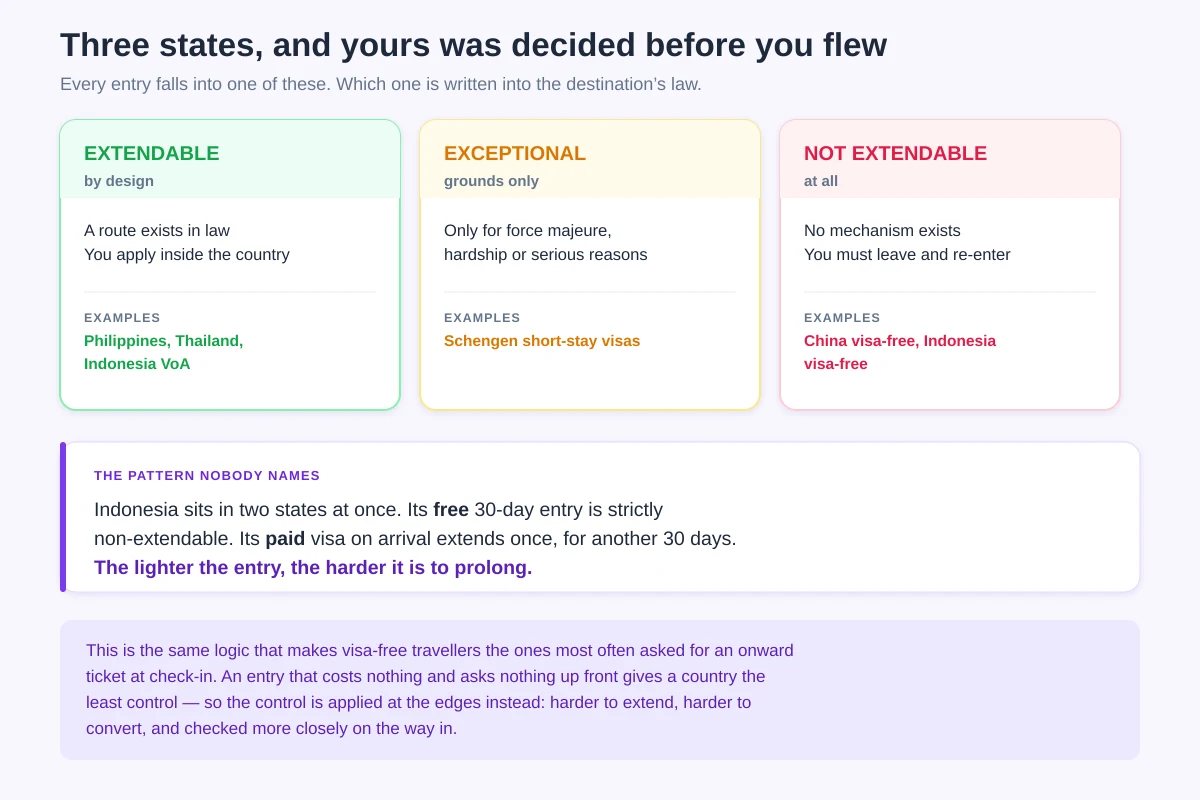
The practical consequence is that being polite, prepared or sympathetic changes nothing in the third state. Officers there are not refusing you; they have no button to press. Recognising which state you are in is therefore the whole of the planning problem, and it takes minutes.
In the third state nobody is turning you down. There is simply no procedure to apply to — and no amount of documentation invents one.
Key takeaway: Find your state before you travel. It determines whether a longer trip is a form to fill in or a flight to book.
Where is the European rule written down?
In a single article of the Visa Code, and it is unusually direct about the difference between must and may. Article 33 of Regulation (EC) No 810/2009 sets two separate tests with two different outcomes.
The first is mandatory. A visa shall be extended where the authority considers that the holder has provided proof of force majeure or humanitarian reasons preventing them leaving before the visa expires — and that extension is granted free of charge. The second is discretionary. A visa may be extended where the holder provides proof of serious personal reasons, and that one carries a €30 fee.
Those two verbs carry the whole meaning. Shall means the authority has no room to refuse once the proof is accepted; may means it does. Wanting a longer holiday belongs to neither category, which is why the practical answer for Schengen tourists is almost always no.
Visa-free visitors have it stricter still. The 90-days-in-any-180 allowance for exempt nationals comes from Article 4 of Regulation (EU) 2018/1806, and that regulation contains no extension procedure at all — the arithmetic of which is set out in our guide to the Schengen 90/180-day rule.
Key takeaway: Shall means free and unavoidable. May means €30 and discretionary. Neither covers wanting more holiday.
Who grants an extension, and where do I go?
The immigration authority of the country you are standing in, not a consulate. Consulates issue permissions to people who are outside; extensions are handled internally, which is why the office you dealt with before your trip is the wrong one to contact now.
Names and formats differ. The Philippines handles it at Bureau of Immigration offices, and it is one of the most permissive systems anywhere — the initial 30-day visa-free period extends to 59 days for around PHP 3,030, then continues in one- and two-month increments, as we set out in our Philippines entry guide. Thailand extends a 60-day visa exemption by a further 30 days at a local immigration office for 1,900 THB, covered in our Thailand visa guide.
Two constants hold almost everywhere: you attend in person, and you go before the deadline rather than after it. Postal and online extensions exist in some systems but are the exception, and the queue is usually the binding constraint rather than the decision.
Key takeaway: Inside the country, in person, before the date. Consulates cannot help you once you have arrived.
When should I apply for an extension?
Earlier than feels necessary, and never on the final day. Most systems expect the application days or weeks before your permitted stay ends, and applying late removes the one option that always works — leaving.
The reason is the gap between applying and being decided. A pending application usually protects your status while it sits with the authority, but that protection only exists if you filed while you were still lawfully present. File on the last afternoon and a slow decision leaves you with no margin at all.
Work backwards from the date stamped or recorded on arrival, not from your flight home. Those two are frequently different, and the entry record is the one that counts — the distinction we cover in our guide to overstay penalties and how to fix them.
Key takeaway: Apply while you still have time to leave instead. That margin is the whole safety net.
How do I apply for more time?
Five steps, and the first one happens before you leave home. Getting the order right is what separates a routine errand from an emergency.
- Check the route exists before you book. If your entry type has no extension mechanism, no amount of paperwork will create one, and the trip needs planning around that.
- Count backwards from your permitted end date. Give yourself a working buffer rather than aiming at the deadline.
- Attend the right office in person. The immigration authority inside the country, with your passport, the entry record, and whatever proof of onward travel and funds it publishes.
- Keep the receipt for the pending application. It is usually what evidences your status while the decision is outstanding, and it is worth photographing.
- If it is refused, leave by the original date. The refusal grants nothing, and the date you already had is the one that still applies.
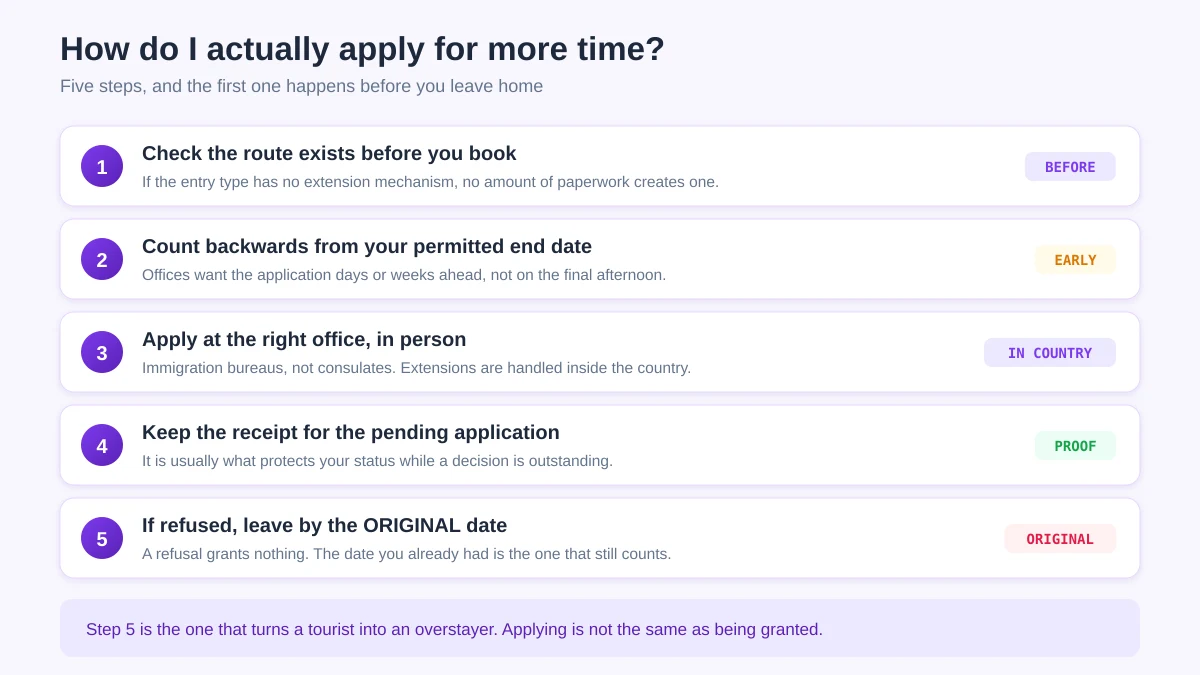
In the applications we support, step three is where preparation pays. Extension counters routinely ask for the same evidence a border officer would — where you are staying, how you are funded, and when you intend to leave. A departure that can be verified answers the last of those in a sentence.
Key takeaway: Treat the extension counter like a second border check. It asks the same three questions.
A real reservation via MyJet24 Premium with a locator the officer can look up — about 30 seconds.
What happens if my extension is refused?
The original end date applies again immediately, and it may already have passed. A refusal does not create a grace period — it confirms that the date you were given on arrival was always the operative one.
This is the sharpest edge in the whole subject and the one travellers ask about most. While an application is pending you are generally treated as lawfully present. The moment it is decided against you, that protection ends, and every subsequent day is an overstay with the penalties that attach to it.
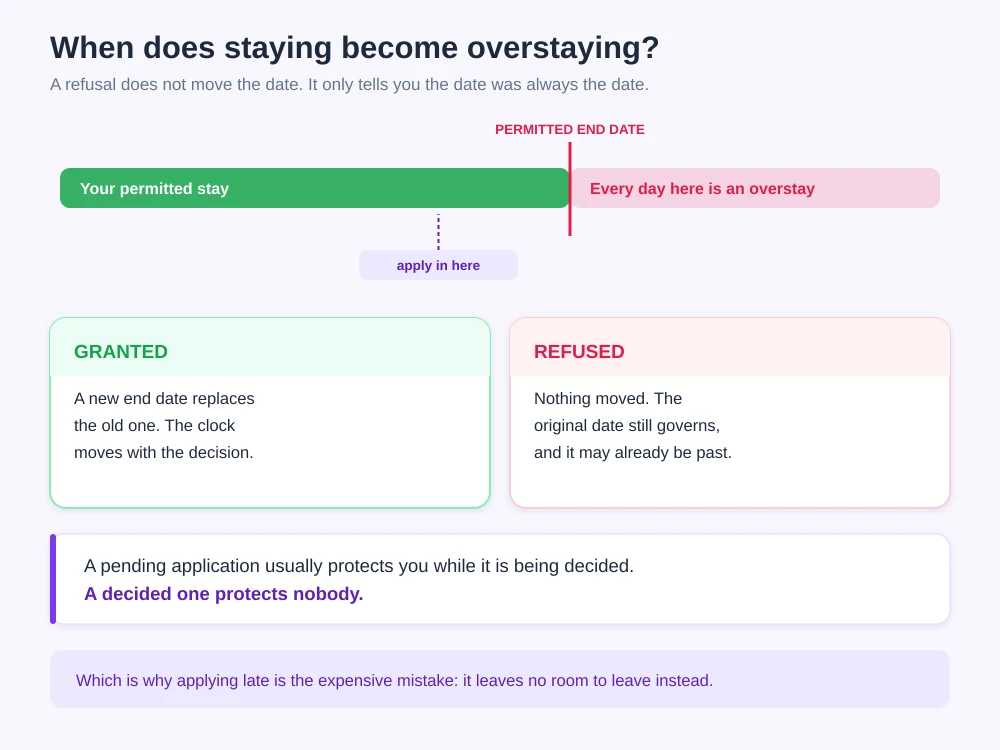
Which is why applying with a margin matters more than applying with a strong case. A refusal received a week before your permitted end date is an inconvenience; the same refusal received two days after it is a records problem that follows you into future applications.
Key takeaway: A pending application protects you. A decided one does not. Build the buffer for the second outcome.
Why is a visa-free entry the hardest to extend?
Because the country gave up its screening on the way in, so it keeps its control at the edges instead. The less a state checked before you arrived, the less flexibility it tends to offer once you are inside.
Indonesia demonstrates it within one border. Its free 30-day visa exemption is, in the government's own framing, strictly non-extendable and cannot be converted to another type. Its paid visa on arrival — same country, same 30 days — extends once for another 30 days at a local immigration office. Paying at the gate buys flexibility that arriving free does not, as we set out in our Indonesia and Bali entry guide.
China's current visa-free scheme goes further: the 30 days cannot be extended and cannot be converted inside the country, so leaving and re-entering is the only mechanism — the detail sits in our piece on China's 30-day visa-free entry.
Free entry is the least flexible entry. The convenience sits entirely at the front, and the rigidity is waiting at the back.
It is the same asymmetry that decides who gets questioned at check-in: the traveller nobody vetted in advance is the one who gets asked to prove they are leaving. The wider pattern is set out in our guide to why your passport decides what you need.
Key takeaway: If you might want longer, the paid entry is often worth more than the free one — before you fly, not after.
What does an extension cost, and how long does it buy?
Anything from nothing to several hundred dollars, and the fee rarely predicts the value. What matters is how much time it buys and how often it can be repeated.
| Entry | Extendable? | Cost and outcome |
|---|---|---|
| Philippines, visa-free | Repeatedly | ≈PHP 3,030 takes 30 days to 59; further increments follow |
| Thailand, visa exemption | Once | 1,900 THB adds 30 days to the 60 granted |
| Thailand, visa on arrival | Once | 1,900 THB adds 15 days to the 15 granted |
| Indonesia, visa on arrival | Once | IDR 500,000 adds 30 days, to 60 total |
| Indonesia, visa-free | No | Strictly non-extendable, no conversion |
| China, visa-free | No | Leave and re-enter is the only route |
| Schengen short-stay visa | Exceptionally | Free for force majeure; €30 for serious personal reasons |
| US student status (F-1, J-1) | By application | Form I-539, $470 base fee plus biometrics |
Read the middle column before the right one. A cheap extension you can only take once is worth less than a moderately priced one that repeats, which is why the Philippines attracts long-stay travellers and the fee is beside the point. The US student case shows the other extreme — the change that turned an open-ended stay into a fixed four-year term with a paid checkpoint is covered in our piece on the end of duration of status.
The figures that decide it
- €0 — a Schengen extension on force majeure or humanitarian grounds, which the authority shall grant on proof (Visa Code, Art. 33).
- €30 — the fee where the ground is serious personal reasons, which the authority may grant.
- 90 / 180 — the visa-free allowance with no extension route written into the regulation (Reg. 2018/1806, Art. 4).
- 36 months — how far repeated extensions can carry a visa-free stay in the Philippines.
- $470 — the base fee for a US extension of stay on Form I-539, plus biometrics.
- 0 — extension routes in China's visa-free scheme and Indonesia's visa-free entry.
EU articles read in the consolidated legislative text on 31 August 2026. Country figures are carried from our own dated reporting on each destination and were verified against official sources at the time of writing; fees move, so confirm the current amount with the authority before you attend.
Key takeaway: Repeatability beats price. Ask how many times, not how much.
What do travellers get wrong about this?
Assuming an extension exists because it existed elsewhere. A traveller who extended twice in Manila arrives in Jakarta expecting the same counter. The procedure is national, and so is its absence.
Treating a refusal as a grace period. It is the opposite — a refusal restores a date that may already be behind you.
Counting from the return flight. The clock runs from the entry record, and the two dates are often different.
Confusing extending with converting. Staying longer as a tourist and becoming something else are separate procedures, and many countries allow the first while forbidding the second.
Believing a border run always resets the count. Where a rolling window applies, leaving and returning changes nothing about the days already used — the arithmetic is unforgiving and is set out in our 90/180 guide.
Key takeaway: Every one of these is a rule imported from another country. Check the one you are actually in.
What should I do before I book?
Decide which of the three states your entry falls into, and plan the trip around that answer rather than around hope. If a route exists, note the office, the fee and the window. If it does not, the trip length is fixed and your onward flight is part of the plan rather than an afterthought.
Where an extension is not possible — or where you would rather not depend on one — a verifiable onward reservation is what satisfies both the border on arrival and the extension counter if you do end up at one. It answers the departure question without committing you to a fare you may not fly, which is the specific thing MyJet24 Premium ($7.90) issues.
A genuine reservation via MyJet24 Premium with a locator that resolves — about 30 seconds.
About the author
Marc Hoffmann is a Senior Visa Consultant at MyJet24. He has spent more than a decade working with consular and immigration documentation, and handles the cases where a traveller’s permitted stay and their plans have stopped lining up.
Reviewed by James Mitchell, CEO & Founder of MyJet24.
Last reviewed on 31 August 2026 by James Mitchell.
Sources
- Visa Code, Article 33 — extension of the period of validity and duration of stay
- Regulation (EU) 2018/1806, Article 4 — the visa-free allowance and its 90/180 limit
- UK Government — extending a Standard Visitor visa
Methodology note: the EU articles were read in the consolidated legislative text rather than in summaries, on 31 August 2026. The country figures — Philippines, Thailand, Indonesia, China and the United States — are carried from our own dated country reporting, each verified against official or primary sources at the time that piece was written and linked above. Immigration fees and stay lengths change more often than the underlying procedures; confirm the current figure with the relevant authority before you rely on it. Nothing here is legal advice.
Last updated: 31 August 2026 · Reviewed by James Mitchell, CEO & Founder, MyJet24
