
Last updated: 15 July 2026 · Reading time: 14 min · Author: Joshua White, Travel Documentation Writer at MyJet24
TL;DR — Key Facts
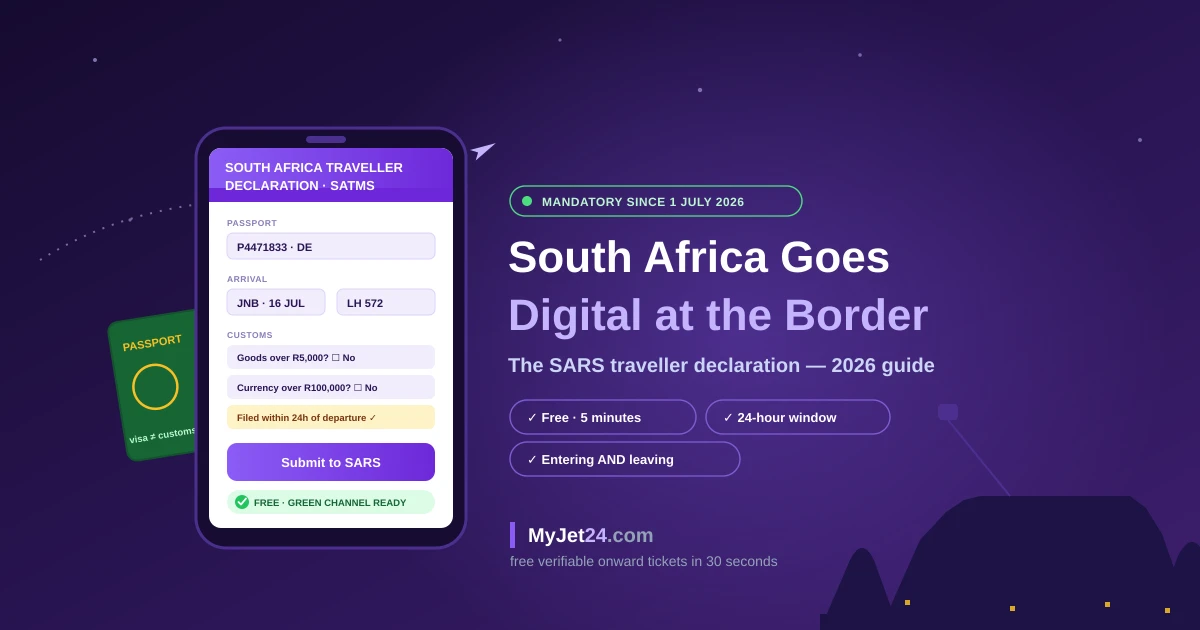
- Since 1 July 2026, South Africa requires an online traveller declaration from everyone — citizens, residents and foreign visitors alike — every time they enter or leave the country by air, land, sea or rail. The form is filed with SARS (the South African Revenue Service), it is free, and it replaced a system that had been voluntary since its 2022 pilot.
- The timing rule is unusual: you can only file within 24 hours of departure. Not "at least 24 hours before" — no more than 24 hours before you depart for South Africa (or leave it). On a multi-leg trip, the clock runs from the final direct leg.
- Forgetting it won't get you turned away. SARS states travelers will not be denied entry or departure solely for arriving without a declaration — customs officials and self-service kiosks at the port will help you file on the spot. Expect queues and delays, though, not a free pass.
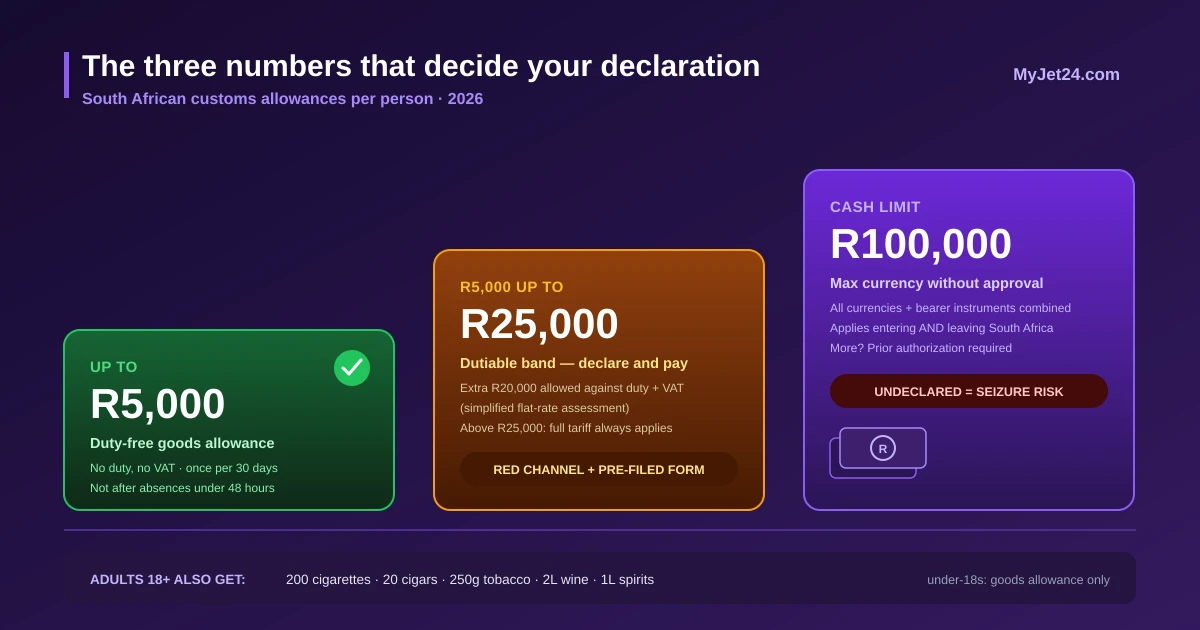
- Three numbers decide most declarations: R5,000 (duty-free goods allowance), R25,000 (the ceiling above which full duties and VAT always apply) and R100,000 (the maximum cash you may carry in or out without prior approval).
- It's a customs form, not an immigration form. The declaration doesn't replace your visa or visa exemption, and it doesn't touch South Africa's long-standing immigration rule that visitors hold a return or onward ticket — that requirement still applies exactly as before.
The South African Traveller Declaration is a free online customs form, filed through the SARS Traveller Management System (SATMS), that became mandatory on 1 July 2026 for every person entering or leaving South Africa by air, land, sea or rail. Travelers submit it no more than 24 hours before departure — via the SARS web portal, the SATMS mobile app, a Scan-to-Declare QR code or a self-service kiosk — declaring goods above the R5,000 duty-free allowance and any currency up to the R100,000 carry limit. It is a customs formality: visas, visa exemptions and South Africa's return/onward ticket requirement remain entirely separate.
In this guide
- What is the South African Traveller Declaration?
- What changed on 1 July 2026
- Who must file — and who is exempt
- From airport pilot to national mandate: 2022–2026
- How to file, step by step (and the 24-hour rule)
- What you must declare: R5,000 / R25,000 / R100,000
- What happens if you don't file
- Customs is not immigration: what the form does NOT replace
- Six mistakes to avoid
- Frequently asked questions
What is the South African Traveller Declaration?
The South African Traveller Declaration is an electronic customs declaration operated by the South African Revenue Service (SARS) through its Traveller Management System — usually shortened to SATMS. It records who you are, your trip details, any goods you are bringing in or taking out that exceed your allowances, and any currency or bearer instruments you are carrying.
Two things make it different from the arrival cards most travelers know from Asia or, more recently, Australia's new Travel Declaration:
- It's run by the tax authority, not immigration. SARS is South Africa's revenue and customs agency. The declaration exists to enforce customs law — duty-free limits, prohibited goods, currency controls — not to decide whether you may enter the country. Immigration (visas, entry stamps, proof of onward travel) is handled separately by the Department of Home Affairs.
- It works in both directions. Most countries only ask arriving passengers to declare. South Africa's system covers departure too: anyone leaving the country is equally required to file, largely because of South Africa's exchange-control rules on taking currency out.
The declaration is free of charge, takes roughly five minutes online, and generates a confirmation tied to your passport that customs officers can pull up when you pass through the green or red channel.
What changed on 1 July 2026
The system itself is not new — what changed is the word "mandatory." From its launch in late 2022 until 30 June 2026, filing was voluntary: a convenience for travelers who wanted a faster customs experience. As of 1 July 2026, SARS requires a declaration from every traveler on every international journey, in both directions, across every mode of transport:
- Air — all international flights into and out of South Africa;
- Land — all road border posts (Beitbridge, Skilpadshek, Lebombo and the rest);
- Sea — cruise and ferry passengers at ports like Cape Town and Durban;
- Rail — international train travelers, who must file before reaching the first (or last) railway station inside South Africa.
The obligation sits with each individual traveler — including children and infants, whose declarations a parent or guardian completes on their behalf. The only carve-out is for genuine transit passengers who never leave the designated transit area (more on that below).
Don't confuse the two July systems: South Africa's declaration became mandatory on 1 July 2026 — the same month Australia announced its digital arrival card (13 July). The systems are unrelated: Australia is replacing a paper immigration/biosecurity card with a digital one, while South Africa is making an existing digital customs form compulsory. Neither replaces a visa.
Who must file — and who is exempt
SARS drew the net deliberately wide. If you cross a South African border in either direction, the default answer is: you file.
| Traveler | Declaration required? | Notes |
|---|---|---|
| Foreign tourists & business visitors | Yes — arrival and departure | Applies regardless of nationality or visa status |
| South African citizens & residents | Yes — arrival and departure | No exemption for locals; expats visiting home included |
| Children & infants | Yes — every traveler must be covered | Parent or guardian files on the child's behalf; minors get no alcohol/tobacco allowance |
| Air/sea passengers in transit | No — exempt | Only if you stay inside the designated transit area; step through immigration and the duty applies |
| Land-border & rail travelers | Yes | Rail: file before the first/last station in South Africa; road: before the border post |
Note the direction of the transit exemption: it is about the transit area, not the length of the layover. A 12-hour connection in Johannesburg where you stay airside needs no declaration; a 4-hour stop where you clear immigration to smoke or collect bags does.
From airport pilot to national mandate: 2022–2026
South Africa took the slow road to mandatory digital declarations — nearly four years of voluntary operation before flipping the switch:
- 29 November 2022 — Phase-1 pilot goes live at King Shaka International (Durban), voluntary only.
- 28 February 2023 — Cape Town International joins the pilot.
- 23 March 2023 — O.R. Tambo International (Johannesburg), the country's biggest hub, follows.
- Through 2023–2025 — gradual expansion to remaining airports, then land posts (starting with Beitbridge and Skilpadshek), seaports and rail — still voluntary.
- 1 July 2026 — the declaration becomes compulsory for all travelers at all ports of entry and exit, in both directions.
That arc mirrors what is happening worldwide: paper arrival forms are disappearing in favor of pre-arrival digital filings. Asia moved first — see our guide to Asia's digital arrival cards, India's e-Arrival Card and Vietnam's pre-arrival form — and Australia announced its own transition this month. South Africa's twist is that its version is a customs instrument with an outbound leg, which almost no other country requires from ordinary tourists.
How to file, step by step (and the 24-hour rule)
Filing is quick; the only genuinely tricky part is when you're allowed to do it.
Step 1 — Wait for your 24-hour window
The declaration may be submitted no more than 24 hours before departure from the country you are traveling from. File earlier and the system won't accept it for your trip. If your journey has connections, the window is measured from the final direct leg to South Africa — flying Berlin → Doha → Johannesburg, you file within 24 hours of the Doha → Johannesburg departure. The same logic applies outbound.
Step 2 — Pick any of the four channels
- Web portal: the Traveller Management System on the SARS website (sars.gov.za/travellerdeclaration) — no account or app needed;
- Mobile app: the SATMS app / SARS MobiApp on iOS and Android;
- Scan-to-Declare: QR codes displayed at airports and border posts that open the form directly on your phone;
- Self-service kiosk: terminals at the port of entry, intended as the fallback for anyone who couldn't file in advance.
Step 3 — Complete one declaration per traveler
Enter passport details, trip information, and answer the customs questions: goods above the allowance, restricted or prohibited items, and currency. Parents complete declarations for children. Submit, and keep the confirmation (email/reference) on your phone.
Step 4 — Choose the correct channel on arrival
Nothing to declare and inside every allowance → green channel, where officers can verify your submitted declaration if they stop you. Anything to declare → red channel, where the pre-filed form speeds up the assessment and payment of any duty or VAT.
What you must declare: R5,000 / R25,000 / R100,000
Ordinary personal effects — your clothes, phone, laptop, camera for personal use — do not need to be itemized. The declaration cares about new or additional goods (gifts, shopping, items you'll leave behind) and money. Three thresholds do almost all the work:
| Threshold | What it means |
|---|---|
| R5,000 (goods) | Duty-free allowance per person for new/additional goods — below this, no duty and no VAT. Usable once per person in any 30-day period, and not after an absence of under 48 hours. |
| R5,000–R25,000 (goods) | A further R20,000 of goods may be brought in against payment of duty and VAT (SARS applies a simplified flat-rate assessment in this band). |
| Above R25,000 (goods) | Full customs duties and VAT apply under the normal tariff — always via the red channel. |
| R100,000 (money) | Maximum in cash or bearer negotiable instruments (any currency combined) you may carry in or out without prior approval — amounts at or beyond this need authorization and always full declaration. |
On top of the rand thresholds, adults (18+) have the classic consumables allowances: 200 cigarettes, 20 cigars and 250g of tobacco, plus 2 litres of wine and 1 litre of spirits or other alcohol per person. Travelers under 18 get the goods allowance but no alcohol or tobacco allowance at all.
Restricted and prohibited items — unlicensed firearms, narcotics, pirated goods, certain plant and animal products — must always be declared or left at home, allowance or no allowance.
What happens if you don't file
Here is the part that separates the headlines from the law. SARS has been explicit: travelers will not be denied entry into or departure from South Africa solely because they haven't completed the declaration before reaching the port. Customs officials and self-service kiosks are stationed at ports of entry precisely to catch late filers and walk them through the form on the spot.
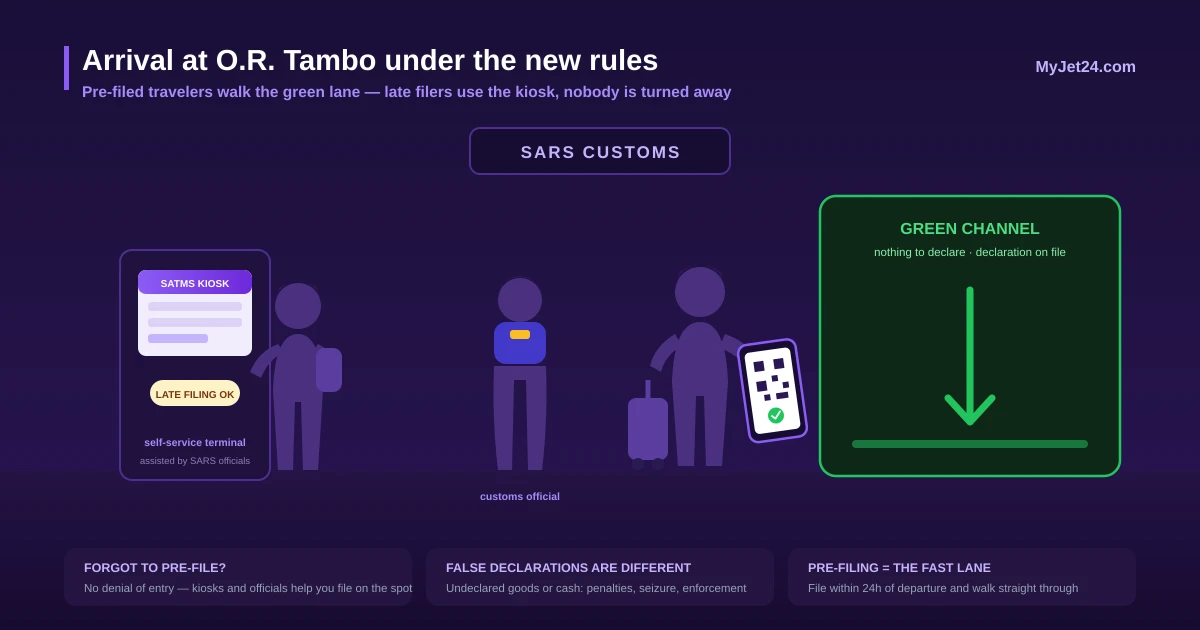
So "mandatory" means you'll be made to do it, not you'll be turned away. That said, the relaxed enforcement posture has hard edges:
- Time cost: filing at a kiosk while a queue of pre-filed passengers walks past you is exactly the friction the system was built to remove — budget 15–30 extra minutes at busy ports;
- False or missing declarations are a different animal: failing to declare goods or currency, or declaring them falsely, can lead to detention or forfeiture of the goods, monetary penalties and enforcement action under customs legislation — the polite kiosk assistance does not extend to undeclared cash discovered in a bag search;
- The R100,000 currency rule has no grace: carrying more without approval is a violation whether or not you filed a declaration.
Watch for copycat websites. The declaration is free and lives only on sars.gov.za (or the official SATMS app). As with Vietnam's pre-arrival form, expect third-party sites to appear charging "service fees" for something the government gives away. File directly with SARS.
Customs is not immigration: what the form does NOT replace
The traveller declaration answers exactly one question: what are you carrying? Everything about whether you may enter is governed by separate immigration rules that have not changed:
- Visa or exemption: travelers from visa-exempt countries (the UK, US, most of the EU, and others, typically for up to 90 days) still enter on the exemption; nationals who need a visa still need one. The declaration is not an entry authorization.
- Passport validity and blank pages: South Africa's requirement of at least 30 days' validity beyond departure and empty pages for stamps still applies.
- Proof of onward travel: South African immigration law has long required visitors to demonstrate a return or onward ticket — airlines routinely verify it at check-in because they carry the liability (and the fine) if you're refused entry. Filing a perfect customs declaration does nothing to satisfy this.
That last point trips up more travelers than any customs allowance. If you're flying one-way — open-ended trip, overlanding through Southern Africa, or continuing by land to Namibia or Mozambique — check-in staff will still ask for evidence you're leaving. A verifiable onward reservation for South Africa with a real PNR (MyJet24 Premium, $7.90) covers exactly that gap; see our proof of onward travel guide for how airlines check it, or generate a free onward ticket in about 30 seconds before you head to the airport.
Six mistakes to avoid
- Filing too early. The window opens 24 hours before departure — a declaration submitted three days out won't stand. Set a reminder for the day before, not the week before.
- Forgetting the outbound declaration. Unique to South Africa: you must also file when leaving. Two-way trip, two declarations (each within its own 24-hour window).
- Skipping the kids. Every traveler needs to be covered, including the baby. Parents file on behalf of minors — one per child, not one per family.
- Assuming transit means "short stop." The exemption applies only if you never leave the transit area. Clearing immigration for any reason — hotel layover, bag re-check, a quick city visit — puts you back under the obligation.
- Treating the declaration as an entry permit. It is a customs form. Your visa or exemption, passport validity and return/onward ticket are checked separately — and the ticket check happens at check-in, before you ever meet a SARS officer.
- Rounding down your cash. The R100,000 limit counts all currencies and bearer instruments combined, per person. Undeclared money is the single most expensive thing to get caught with — forfeiture is on the table.
Frequently asked questions
Is the South African traveller declaration mandatory in 2026?
Yes. Since 1 July 2026, every person entering or leaving South Africa by air, land, sea or rail must submit the online traveller declaration through the SARS Traveller Management System. It had been voluntary from its pilot launch in November 2022 until 30 June 2026.
Who has to complete the SARS traveller declaration?
Everyone crossing the border in either direction: foreign visitors, South African citizens and residents, business travelers and children (a parent or guardian files for minors). The only exemption is for air or sea transit passengers who remain inside the designated transit area.
How much does the traveller declaration cost?
Nothing. The declaration is free on the SARS website, the SATMS app, Scan-to-Declare QR codes and airport kiosks. Any website charging a fee to "process" it is an unofficial middleman — file directly at sars.gov.za.
When should I submit the declaration?
Within 24 hours before departure — that's a maximum, not a minimum. The system accepts declarations no more than 24 hours before you depart for (or from) South Africa, so the practical routine is: file the evening before your flight or on the morning of travel.
How does the 24-hour rule work with connecting flights?
The window is measured from the final direct leg to South Africa. On London → Dubai → Cape Town, you file within 24 hours of the Dubai → Cape Town departure, not the London one. Outbound journeys mirror the rule.
Do transit passengers need to file a declaration?
No — provided they stay within the designated transit area of the airport or seaport. Passengers who pass through immigration (to collect and re-check bags, leave the airport, or overnight in a hotel) are no longer "in transit" and must file.
Do children and infants need their own declaration?
Yes — every traveler must be covered by a declaration, regardless of age. Parents or guardians complete the form on behalf of children. Note that travelers under 18 have no alcohol or tobacco allowance.
Will I be denied entry if I don't file before landing?
No. SARS states that travelers will not be refused entry or departure solely for not having filed in advance — officials and self-service kiosks at the port help late filers complete it on arrival. Expect delays, though, and note that failing to declare goods or currency (as opposed to failing to pre-file) can trigger penalties and forfeiture.
What do I have to declare at South African customs?
Goods above the R5,000 per-person duty-free allowance, anything in the R5,000–R25,000 dutiable band, all goods above R25,000, restricted or prohibited items, and currency or bearer instruments — with R100,000 as the maximum you may carry without prior approval. Ordinary personal effects for your own use don't need itemizing.
How much cash can I take into or out of South Africa?
Up to R100,000 (or the equivalent across all currencies and bearer negotiable instruments combined) per person without prior approval — in either direction. Larger amounts require authorization, and undeclared excess cash can be seized.
What are South Africa's duty-free allowances in 2026?
Per adult: R5,000 in new or additional goods duty-free (once per 30 days, not after absences under 48 hours), then up to R20,000 more against duty and VAT; plus 200 cigarettes, 20 cigars, 250g tobacco, 2 litres of wine and 1 litre of spirits. Under-18s get the goods allowance only.
Does the declaration replace a visa or any immigration requirement?
No. It is purely a customs formality run by the revenue service. Visas and visa exemptions, passport validity rules and South Africa's requirement to hold a return or onward ticket are all unchanged and checked separately — the ticket usually by your airline at check-in.
Does the declaration apply at land borders and on trains?
Yes — the mandate covers air, land, sea and rail. Road travelers file before reaching the border post; rail travelers must submit electronically before the first railway station in South Africa (or the last one when leaving).
Do I need proof of onward travel for South Africa?
Yes — independently of the customs declaration, South African immigration expects visitors to hold a return or onward ticket, and airlines verify it at check-in. One-way travelers can cover the requirement with a verifiable onward reservation carrying a live PNR, such as the MyJet24 Premium onward ticket ($7.90), ready in about 30 seconds.
The bottom line
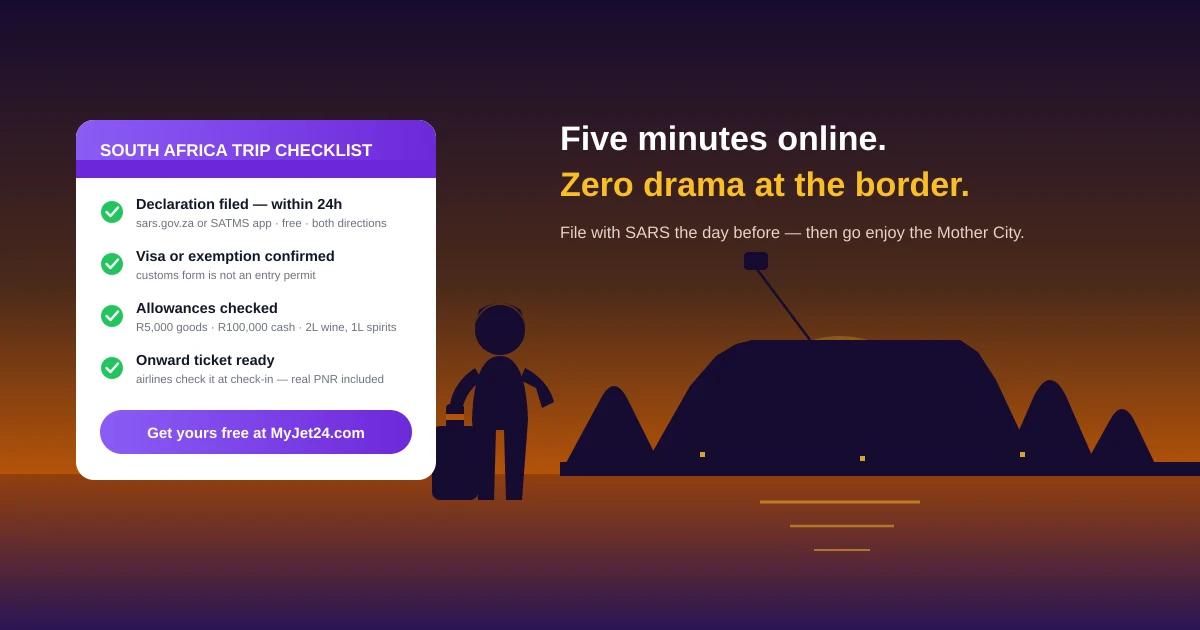
South Africa's traveller declaration is the least dramatic "mandatory" form of 2026: it's free, it takes five minutes, nobody gets turned away for forgetting it, and it digitizes questions customs was always allowed to ask. The three things actually worth engraving in your trip plan are the 24-hour filing window (late-opening, easy to miss), the outbound declaration almost everyone forgets on the way home, and the fact that the form has nothing to do with immigration — your visa or exemption and your return/onward ticket still decide whether you board and enter.
Handle the customs form with SARS, and handle the immigration side before you reach the airport: check your passport validity, confirm your visa position, and if you're traveling one-way, secure a verifiable onward reservation for South Africa — free with a booking reference, or with a real PNR for $7.90 (Premium), in about half a minute at MyJet24. Then the only queue you'll stand in at O.R. Tambo is the one for coffee.
Sources
- SARS — Customs Online Traveller Declaration portal: https://www.sars.gov.za/travellerdeclaration/
- SARS — Required Online Traveller Declarations from 1 July 2026 (announcement): https://www.sars.gov.za/latest-news/required-online-traveller-declarations-from-1-july-2026-2/
- SARS — FAQs for the Required Online Traveller Declarations from 1 July 2026: https://www.sars.gov.za/travellerdeclaration/faqs-for-the-required-online-traveller-declarations-from-1-july-2026/
- SARS — Duty-free allowances for travellers (external guide): https://www.sars.gov.za/customs-and-excise/travellers/arrival-in-sa/
- Cape Town Tourism — Online Traveller Declaration Mandatory from 1 July 2026: https://www.capetown.travel/travelling-to-or-from-south-africa-online-declaration-now-mandatory-from-1-july-2026/
- IOL — South Africa's new compulsory SARS declaration explained (2 July 2026): https://iol.co.za/news/south-africa/2026-07-02-travelling-overseas-south-africas-new-compulsory-sars-declaration-explained/
- The Citizen — New mandatory online traveller declaration takes effect July 1 (1 July 2026): https://www.citizen.co.za/review-online/news-headlines/local-news/2026/07/01/new-mandatory-online-traveller-declaration-takes-effect-july-1/
This guide reflects the rules as published by the South African Revenue Service as of 15 July 2026. Customs allowances, currency limits and filing procedures can change — always verify against sars.gov.za before you travel. This article is informational and not legal advice.
