
Last updated: 30 August 2026 · Reading time: 13 min · Author: Joshua White, Travel Documentation Writer at MyJet24 · Reviewed by: Marc Hoffmann, Senior Visa Consultant
TL;DR — Key facts
- Entry requirements attach to your nationality, not to the destination. The same flight, on the same day, produces different paperwork for different passengers.
- In Europe it is literally a list. Regulation (EU) 2018/1806 carries two annexes: Annex I nationals need a visa, Annex II nationals do not for stays up to 90 days in any 180.
- Nobody assesses you individually at this stage. The annexes name countries, never people — your file, your income and your travel history play no part in which list applies.
- Lists move, and there is a published timetable for it. Article 7 sets a reciprocity ladder running from a 30-day notification to a 12-month suspension at the 24-month mark.
- Who gets asked for an onward ticket follows the same asymmetry. It is not random and it is not personal — it tracks the same country pairs.
Your passport decides what you need because entry rules are written per nationality, not per destination. A requirement is a property of the pair — which passport you hold and which border you cross. Change either half and the answer changes, which is why two people on one flight can face completely different paperwork.
If your passport is one that gets asked, this is the document that answers it.
What actually decides which documents you need?
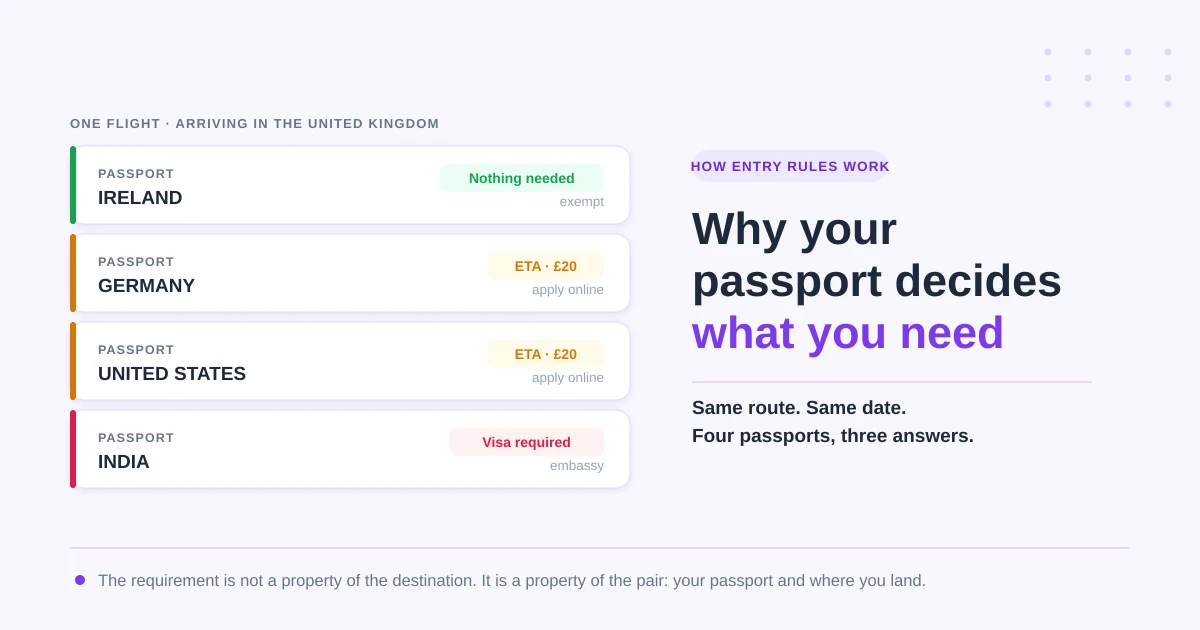
The deciding factor is a pair, not a place. An entry requirement is the answer to a two-part question — which nationality is on the passport, and which border is being crossed — and changing either half changes the answer entirely.
This is why "what do you need for Thailand?" has no single answer, and why the question is malformed as asked. Thailand does not have a requirement. Thailand has a set of requirements, one per nationality, and yours is only visible once you supply the missing half.
The clearest demonstration sits on any long-haul aircraft. Four passengers in the same row, arriving at the same border on the same afternoon: an Irish citizen who needs nothing at all, a German and an American who each needed to buy an electronic authorisation before departure, and an Indian citizen who needed an appointment at a consulate weeks earlier. Identical plans, three different processes.
Key takeaway: Never ask what a country requires. Ask what it requires of your passport — the first question has no answer.
Why does my passport matter more than my destination?
Because the destination sets the rules once and then applies them by nationality. Your passport is the variable you carry into every one of those rule sets, and it is the only part of the equation that stays with you across borders.
Think of it as a lookup rather than a judgement. A border authority does not begin by evaluating you; it begins by finding your country in a table it wrote in advance. Everything personal — your job, your savings, your travel history, whether you look organised at the desk — enters the process later, and only if the table says you may approach at all.
That ordering explains a lot of the frustration around this subject. A well-prepared traveller with a strong file can still need a visa that a completely unprepared traveller does not, because the first filter never looked at either of them. It is not a judgement of the person; it is a property of the document they hold.
The first gate is not about you. It is about the cover of the booklet in your pocket, and it closes or opens before anyone has read a single page of your application.
Which permission type you then face — visa-free entry, an ETA, an eVisa or a visa on arrival — is a separate axis, set by the destination and explained in our breakdown of visa-free versus ETA, eVisa and visa on arrival.
Key takeaway: The destination writes the table. Your passport is the row it reads. Personal circumstances come after, not before.
Where is this written down?
In Europe it sits in a single regulation with two annexes. Article 3 of Regulation (EU) 2018/1806 states it without ornament: "Nationals of third countries listed in Annex I shall be required to be in possession of a visa when crossing the external borders."
Article 4 does the reverse for Annex II, exempting those nationals from the visa requirement for stays of no more than 90 days in any 180-day period. Two lists, one regulation, and every short-stay Schengen question begins by finding which of the two names your country.
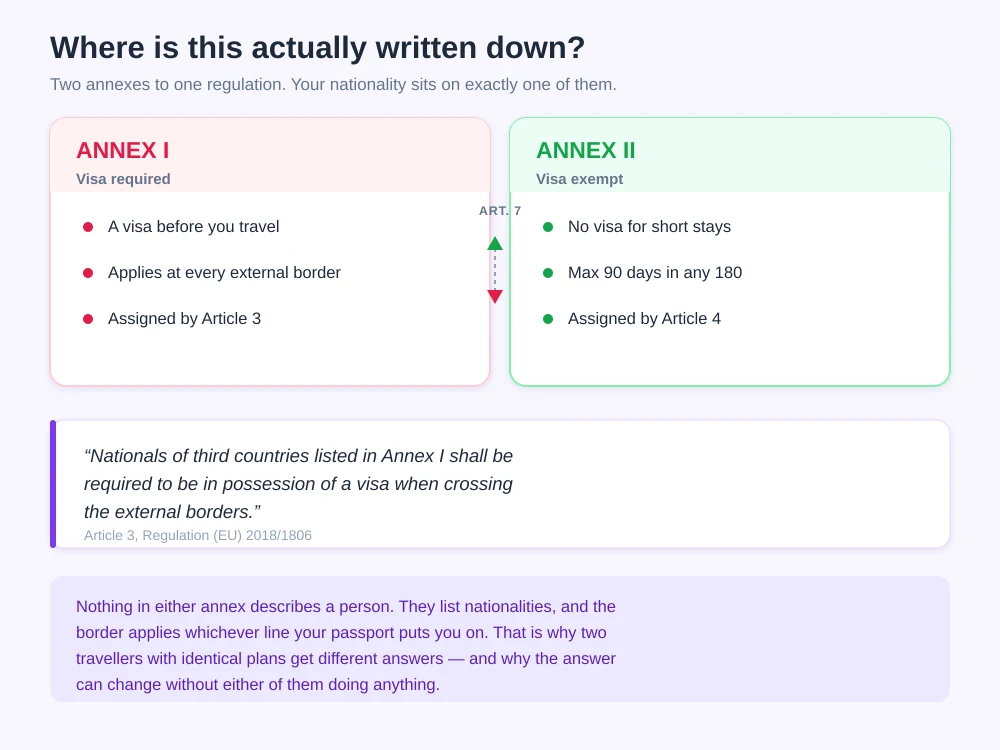
Read the annexes and the point becomes concrete: they contain country names and nothing else. There is no clause about the applicant's finances, employment or intentions, because those belong to a different stage. The 90/180 arithmetic that governs Annex II nationals once they are inside is set out in our guide to the Schengen 90/180-day rule.
Other regions do the same thing with different paperwork. Britain publishes its own visa-national list and layers an ETA on top for those who are exempt; the United States runs the Visa Waiver Program the same way. The instrument differs, the logic does not.
Key takeaway: It is a published list, not a discretionary decision. You can look up which one you are on before you book anything.
Who decides which list my country is on?
Governments do, and they do it politically rather than administratively. Placement on a visa-free list is a foreign-policy decision negotiated between states, which is why it correlates with diplomatic relations, overstay statistics and reciprocity rather than with anything about individual travellers.
Two mechanisms dominate. Reciprocity means a country grants access on the terms it receives: Saudi Arabia's electronic authorisation for British citizens, launched in 2026, mirrors Britain's own ETA almost exactly in shape, as we covered in our guide to Saudi Arabia's ETA for UK citizens. Unilateral opening means a country grants access without asking for anything back, usually to attract visitors — China's current visa-free access is the largest live example, and the distinction between its unilateral list and its separate mutual agreements is one most coverage gets wrong, as set out in our piece on China's 30-day visa-free entry.
A third pattern is worth naming because it confuses people badly: a fee waiver is not an access grant. Ghana waives the e-visa fee for African nationals while keeping the e-visa itself compulsory — free, but not exempt. We unpicked that three-tier structure in our guide to Ghana's mandatory e-visa.
Key takeaway: Your access is the product of negotiations you were not part of. Free and exempt are not the same word.
Why do the lists change, and how fast?
They change when the political basis under them changes, and in Europe there is a published timetable for one of the commonest causes. Article 7 sets out a reciprocity mechanism with hard deadlines at every rung.
If a country on the exempt list starts demanding visas from one member state's nationals, that state has 30 days to notify Parliament, Council and Commission. The Commission publishes the notification and approaches the country. After 90 days without resolution, the member state may request a suspension. Within six months the Commission either suspends the exemption for certain nationals or explains why it has not. At 24 months a delegated act suspends the exemption for twelve months and amends the annex itself.
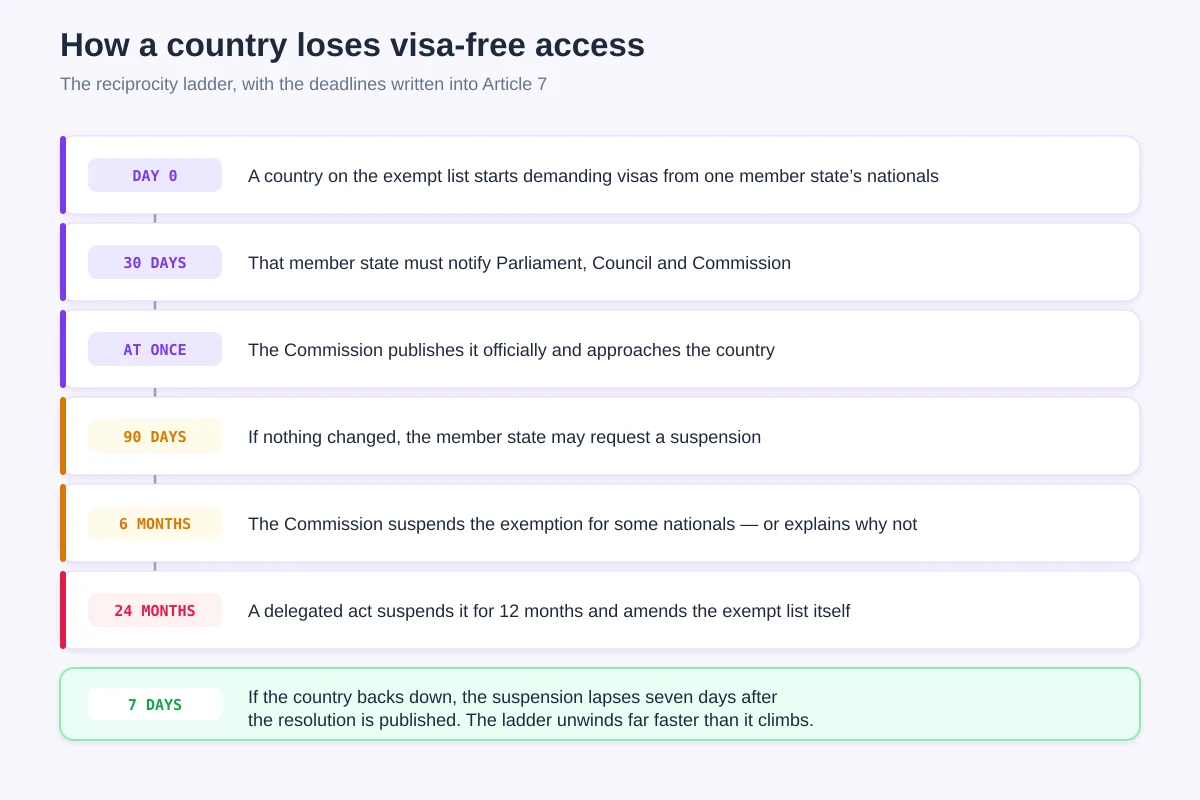
The asymmetry at the end is the interesting part. Climbing the ladder takes two years; coming back down takes a week. Where the country lifts its requirement, the suspension expires "seven days after the publication" of the notification that it has done so. Restrictions are built slowly and dismantled almost instantly, which tells you the machinery is designed as pressure rather than as punishment.
Two years to lose it, seven days to get it back. That ratio is the whole intent of the mechanism, written into the timings.
Key takeaway: Changes are slow, public and procedural. Nothing here happens overnight, and the steps are published in advance.
When does a change actually affect my trip?
On the date it enters into force, not on the date it is announced — and the gap between the two is where most traveller confusion lives. A rule can be agreed, reported worldwide and still not apply to the flight you are taking next week.
Thailand is the live example. A move from 60 to 30 days of visa-free stay for around 59 nationalities was approved by cabinet and refined in mid-2026, and it was reported everywhere as though it had happened. It takes effect fifteen days after publication in the Royal Gazette, and until that publication the longer allowance still stands. We track that specific trigger in our piece on Thailand's 30-day visa-free rule.
The practical rule is to distinguish three states: announced, in force, and enforced. Only the middle one changes your obligations, and only the third one changes what happens to you at a desk. Headlines almost never make the distinction.
Key takeaway: Announced is not in force. Check the commencement date before you re-plan anything.
How can I check what applies to my passport?
Start from the passport and work outwards. Five checks settle it, and the first one is the step most people skip — they search the destination and read an answer written for somebody else's nationality.
- Begin with your passport, not the country. If you hold two, decide which one you are travelling on before you look anything up, because the answer differs.
- Read the destination government's own page. Aggregators lag behind changes and often fail to state which nationality their answer applies to.
- Check the airline separately. Carriers enforce earlier than borders and against their own rulebook, which is why a document that satisfies immigration can still fail at check-in.
- Treat every transit stop as its own border. Changing planes can trigger a requirement the final destination never had, particularly where you clear immigration to change terminals.
- Re-check close to departure. What was true when you booked may not be true when you fly, and nobody will tell you.
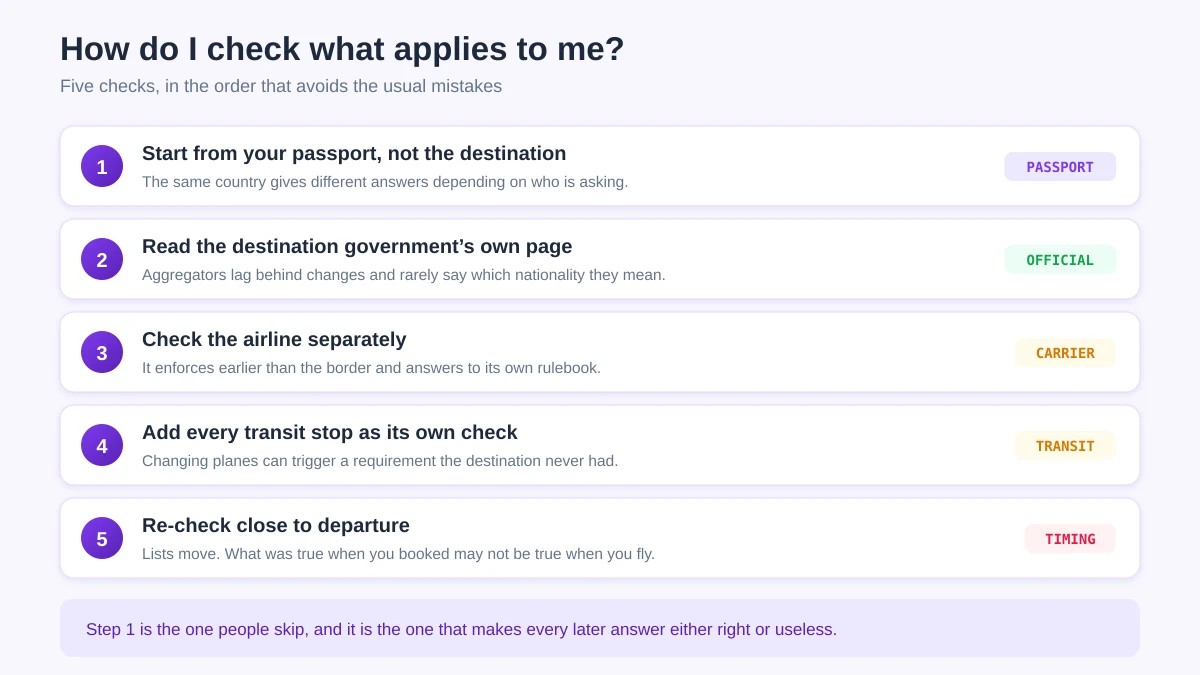
The airline step is the one that surprises people most often. A check-in agent works from a commercial rules engine rather than from the border's own systems, and it applies the destination's requirements to your nationality before you have left. The mechanics of that check are set out in our guide to the database that decides whether you board.
Key takeaway: Five minutes of checking in the right order beats an hour of reading answers written for a different passport.
A verifiable reservation via MyJet24 Premium ($7.90), with a locator an agent can look up.
What if I hold two passports?
Then you hold two different sets of rights and you choose which one to use, subject to one hard constraint. Dual nationals face a genuine decision at every border, and the wrong choice creates avoidable work.
The general principle is to travel on the passport that gives the easiest entry to where you are going. The constraint is that many countries require their own citizens to enter and leave on their own passport, so if you are a citizen of the destination, that passport is not optional there.
| Situation | Which passport | Why |
|---|---|---|
| You are a citizen of the destination | That one | Many states require nationals to enter on their own document |
| One passport is visa-exempt, the other is not | The exempt one | Removes the whole application step |
| Both are exempt, different stay lengths | The longer one | The allowance travels with the document, not with you |
| You already hold a valid visa in the other book | The one with the visa | A visa cannot be transferred between passports |
| Transiting a third country en route | Check both | The transit country runs its own list, independently |
Whichever you choose, the authorisation and the booking must name the same document, and the passport must satisfy the destination's validity rules on its own terms — the thresholds are in our guide to passport validity and the six-month rule.
Key takeaway: Two passports means two rule sets, not double the rights. Pick one per trip and stay consistent across every document.
Why does the same trip cost me more than my colleague?
Because fees are set per nationality too, and reciprocity applies to price as readily as to access. Two colleagues on the same business trip routinely pay different amounts for the same permission, and neither figure is negotiable.
The pattern has three layers. Some nationalities pay nothing because they are exempt outright. Some pay a flat authorisation fee that is identical for everyone who needs one — the UK charges £20 per person for its ETA regardless of nationality, and its guidance states plainly that "each person travelling needs an ETA, including babies and children". Some pay a full visa fee plus an appointment, plus the travel to reach it.
The invisible cost is usually the largest. A visa-required traveller pays in time and risk as well as money: weeks of lead time, a non-refundable fee whatever the outcome, and the possibility of refusal. An exempt traveller books a flight the night before. The headline fee is the smallest part of the gap.
Key takeaway: The real difference is lead time and refusal risk, not the fee. Compare the process, not the price.
Who actually gets asked for an onward ticket?
Travellers whose nationality gives them the lightest pre-departure screening get asked the most. That sounds backwards until you see the mechanism: the fewer checks a country ran before you boarded, the more it relies on the check at the gate.
A visa holder was assessed weeks ago by a consulate that already saw an itinerary. A visa-exempt traveller was assessed by nobody. The airline carries the liability for an inadmissible passenger either way, so it closes the gap where the gap is widest — and that is precisely the exempt and visa-on-arrival cases.
The result feels personal and is not. Two passengers at the same desk, one asked for proof of departure and one waved through, are being sorted by the same lists this article has been describing. Which countries enforce it, and how strictly, is mapped in our guide to which airlines actually check onward travel.
Key takeaway: Lighter screening before the flight means heavier questioning at the gate. The onward ticket is what closes that gap.
What do travellers get wrong about this?
Reading someone else's answer. A forum post, a friend's experience or an aggregator page is worthless unless it names the same nationality you hold. Most do not.
Assuming a strong passport means no requirements. Visa-free is a permission to travel, not a guarantee of entry, and it usually comes with the heaviest gate-side questioning.
Treating free as exempt. A waived fee still means an application, a record and a document to carry.
Believing an announcement. Rules take effect on a commencement date, not on a press release.
Forgetting transit. The country you change planes in runs its own list and does not care what your destination decided.
The numbers behind the lists
- 2 — annexes in Regulation (EU) 2018/1806. Annex I requires a visa, Annex II exempts.
- 90 / 180 — the days an Annex II national may stay, in any rolling 180-day window (Art. 4).
- 30 days — the notification deadline that starts the reciprocity mechanism (Art. 7).
- 24 months — the point at which a delegated act may suspend an exemption for 12 months and amend the annex.
- 7 days — how long a suspension survives after the dispute is resolved and published.
- £20 — the UK ETA fee, per person, with no age exemption (gov.uk).
Articles read in the consolidated legislative text on 30 August 2026. These are EU and UK instruments; other regions publish their own equivalents, and the mechanism — a list keyed to nationality — is close to universal even where the paperwork differs.
Key takeaway: Every mistake in this list comes from generalising an answer that was never general. Requirements are per pair, always.
What should I do before I book?
Look up your own pair before anything else: your passport, your destination, and every country you change planes in. That takes minutes and determines whether your trip needs a consular appointment weeks out or nothing at all.
If your nationality falls on the lighter side of the lists, plan for the trade-off rather than celebrating it. Less paperwork before departure means more questions at the desk, and the question that most often lands is when you intend to leave. A verifiable reservation answers it without committing you to a fare you may not fly — which is the specific thing MyJet24 Premium ($7.90) issues.
A genuine reservation via MyJet24 Premium with a locator that resolves — about 30 seconds.
About the author
Joshua White is a Travel Documentation Writer at MyJet24. He tracks entry requirements across the visa, ETA and arrival-card systems covered here, and handles the cases where two travellers on one booking need entirely different paperwork.
Reviewed by Marc Hoffmann, Senior Visa Consultant at MyJet24, who has worked with consular documentation requirements for more than a decade.
Last reviewed on 30 August 2026 by Marc Hoffmann.
Sources
- Regulation (EU) 2018/1806, Article 3 — the visa requirement for Annex I nationals
- Article 4 — the Annex II exemption, 90 days in any 180
- Article 7 — the reciprocity mechanism and its deadlines
- UK Government — Apply for an Electronic Travel Authorisation
Methodology note: the articles above were read in the consolidated legislative text rather than in summaries, on 30 August 2026. The Regulation binds the Schengen states; Britain and the United States operate comparable lists under their own law, and the country examples given here are drawn from our own dated reporting on each. Individual annex membership changes over time — check the current text for your nationality rather than relying on any article, including this one.
Last updated: 30 August 2026 · Reviewed by Marc Hoffmann, Senior Visa Consultant, MyJet24
