
Last updated: 31 July 2026 · Reading time: 16 min · Author: James Mitchell, Travel Documentation Writer at MyJet24
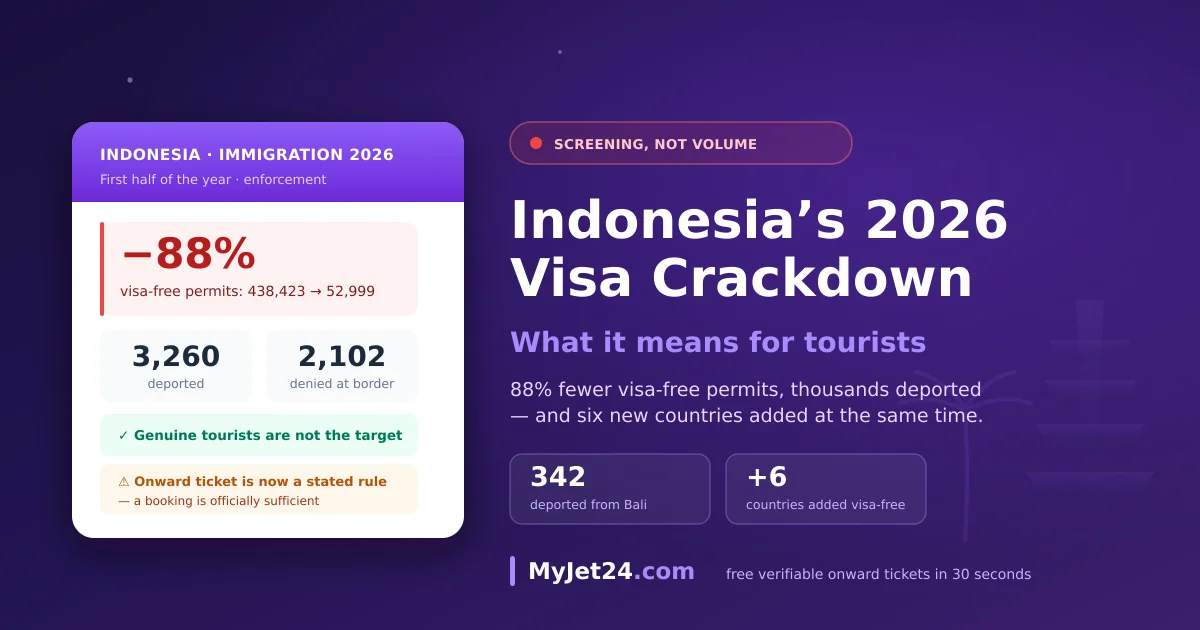
TL;DR — Key Facts
- Indonesia cut visa-free approvals by 88% in the first half of 2026 — from 438,423 permits to just 52,999 — as part of a deliberate shift from volume to "selective" screening.
- 3,260 foreigners were deported and 2,102 were denied entry at the border in the same six months, the vast majority for immigration violations.
- Bali deported 342, mostly for overstaying or misusing residence permits — the two violations that dominate Indonesia's enforcement.
- The paradox: even as approvals were slashed, a July 2026 regulation added six countries to the visa-free list. Indonesia isn't closing the door — it's checking who walks through it more carefully.
- The rule that now matters more: a return or onward ticket. It's a stated requirement for visa-free entry and Visa on Arrival, and with screening this tight, it's no longer something to leave to chance.
- Good news on that front: Indonesia's own e-VoA portal confirms a booking is sufficient — you don't need a paid final ticket.
In the first half of 2026, Indonesia's Directorate General of Immigration cut visa-free visit approvals by 87.91% — from 438,423 to 52,999 — deported 3,260 foreigners, and denied entry to 2,102 at the border, as part of a "selective policy" prioritising screening over volume. Bali alone deported 342 people, mainly for overstays and residence-permit misuse. At the same time, a new regulation expanded the visa-free list by six countries, signalling a shift from volume to quality rather than a closed door. For ordinary tourists, the practical consequence is that entry requirements — especially a valid passport and a return or onward ticket — are now enforced more strictly, though Indonesia's e-VoA portal confirms a booking reservation is sufficient for the onward-ticket requirement.
In this guide
- The crackdown by the numbers
- Bali and Batam: where enforcement landed
- The paradox: fewer approvals, more countries
- What actually gets foreigners deported
- How to enter Indonesia the right way in 2026
- The onward-ticket rule now worth taking seriously
- Seven mistakes to avoid
- Frequently asked questions
- The bottom line
The crackdown by the numbers
For years, the story of Indonesian tourism was one of opening up — visa-free lists growing, arrivals climbing, Bali booming. In 2026 the headline flipped. Indonesia's Directorate General of Immigration, under the new Ministry of Immigration and Corrections, published mid-year figures that show one of the sharpest enforcement pivots any major destination has made in recent memory. The numbers, released by Director General Hendarsam Marantoko in July, are stark.
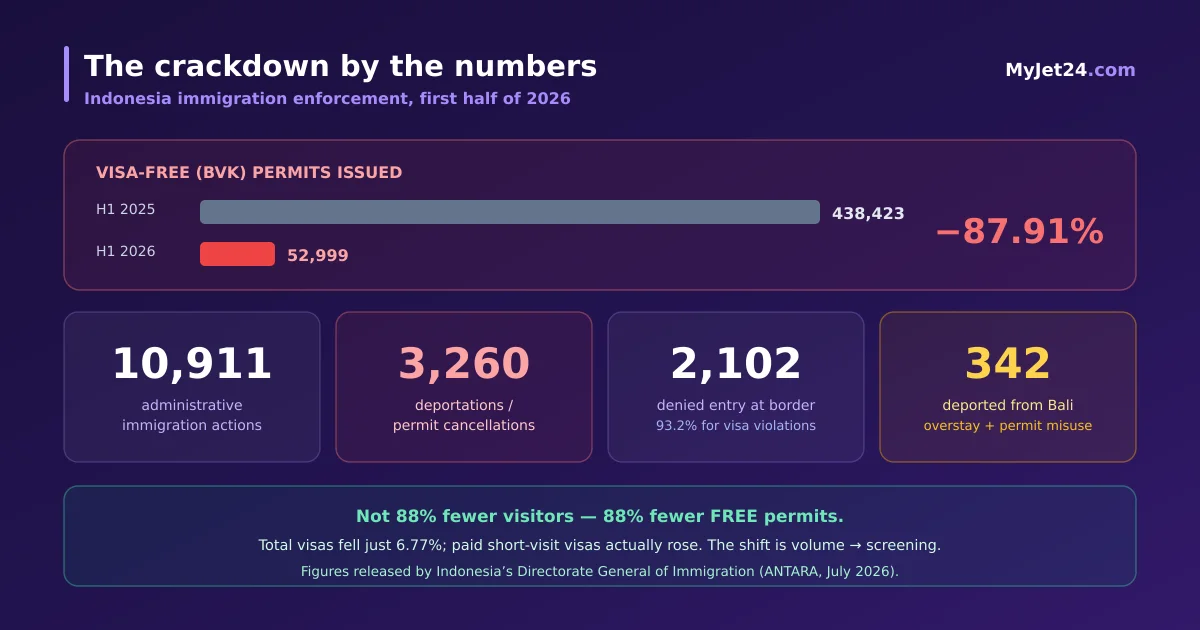
| Measure (first half of 2026) | Figure |
|---|---|
| Visa-free (BVK) permits issued | 52,999 — down 87.91% from 438,423 a year earlier |
| Administrative immigration actions | 10,911 |
| Deportations / permit cancellations | 3,260 |
| Denied entry / blacklisted at the border | 2,102 (93.2% for immigration violations) |
| Criminal cases against foreigners | 23 |
The 88% collapse in visa-free approvals is the number that made headlines, but read it carefully: it's not that 88% fewer people came. It's that immigration granted the free, no-cost visa-free visit permit to far fewer applicants, steering more travellers toward paid visas that carry more scrutiny. Total visas issued fell only 6.77%, and paid short-visit visas actually rose. In the government's own framing, this is a switch from waving people through to checking them first.
Bali and Batam: where enforcement landed
Two places show what the crackdown looks like on the ground.
Bali deported 342 foreign nationals in the first six months of 2026. The head of the Bali Immigration Regional Office, Felucia Sengky Ratna, was specific about the causes: "most violations involved misuse of residence permits and overstaying." In a single operation nicknamed the "Dharma Dewata Patrol," running from mid-April into early May across the Denpasar and Singaraja tourism zones, immigration detained 62 foreigners for overstays, permit misuse and unauthorised work — the classic trio of digital-nomad-era violations.
Batam produced the raid that arguably triggered the whole tightening. On 6 May 2026, immigration detained 210 foreigners — 125 Vietnamese, 84 Chinese and one from Myanmar — running an online investment-scam operation, seizing hundreds of laptops, phones and 198 passports. The detail that mattered to policymakers: 209 of the 210 had entered Indonesia on temporary visit or visa-free stays. When a scam compound turns out to be staffed almost entirely by people who walked in visa-free, the visa-free channel gets a very hard second look. It did.
The paradox: fewer approvals, more countries
Here's the twist that confuses a lot of the coverage. In the very same month that immigration was publicising an 88% cut in visa-free approvals, the Ministry expanded the visa-free list. Regulation No. 10 of 2026, signed by Minister Agus Andrianto on 7 July 2026, added six countries to the visa-free-eligible roster: Turkey, Brazil, Peru, Kazakhstan, Macau and Belarus.
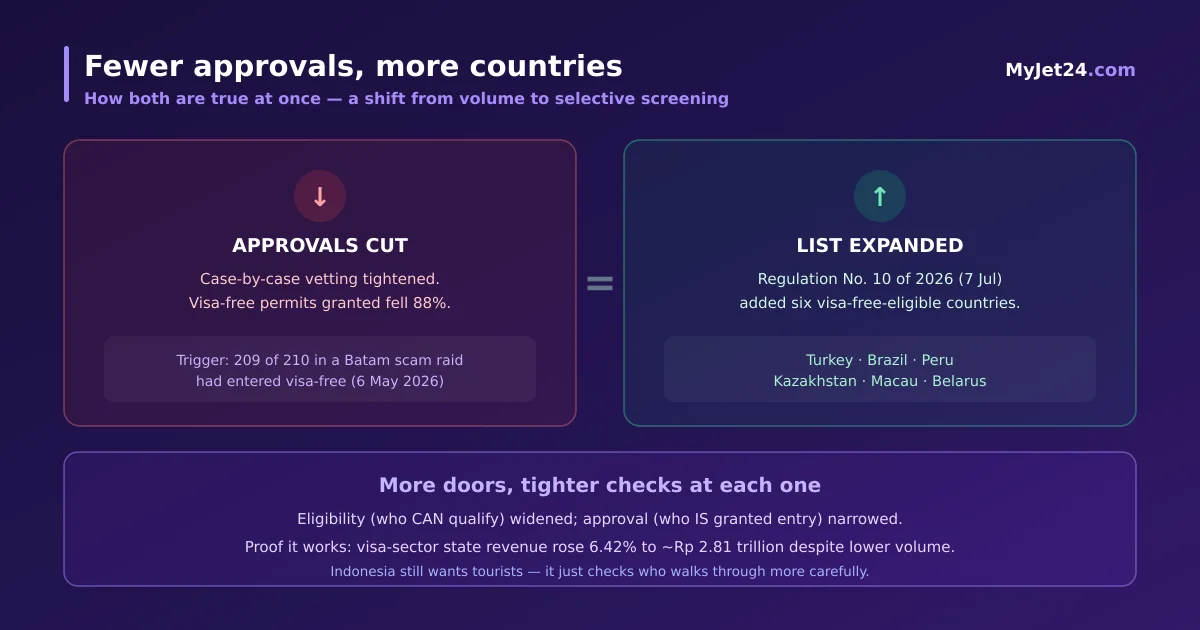
How can both be true at once? Because eligibility and approval are different levers. Widening the list of countries whose nationals can qualify for visa-free entry is about openness and reciprocity. Slashing the number of permits actually granted is about case-by-case screening at the point of decision. Indonesia is doing both deliberately: more doors, tighter checks at each one. The government calls it a shift "from volume to quality," and it has a metric to prove the strategy pays: visa-sector state revenue rose 6.42% to about 2.81 trillion rupiah even as raw volumes fell — fewer entries, but higher-value ones.
For a traveller, the takeaway is reassuring and cautionary at once. Indonesia still wants tourists — it is not pulling up the drawbridge. But it is now far less willing to overlook a thin application, a vague plan, or a missing document. The margin for a sloppy entry has shrunk.
What actually gets foreigners deported
Strip away the headline numbers and the enforcement clusters around a short, consistent list of violations. If you're a genuine tourist, none of them should worry you — but knowing them tells you exactly where the tripwires are.
- Overstaying. The single most common cause. Indonesia's visa-free and Visa-on-Arrival stays are 30 days, and the fine for overstaying is 1 million rupiah per day — with deportation and a re-entry ban beyond a short overrun.
- Misusing a residence permit. Living on tourist entries, or using a social/cultural stay to do something it doesn't cover, is the violation Bali immigration names most often.
- Unauthorised work. Working — including remote work in some interpretations, and certainly local paid work — on a tourist entry. The nomad grey zone is exactly what the sweeps target.
- Visa-free channel abuse. As Batam showed, entering visa-free with no intention of being a tourist. This is what put the whole visa-free system under review.
The pattern is clear: Indonesia is not deporting tourists for taking too many beach photos. It's targeting people who used a light-touch entry to do something the entry never permitted. The way to stay comfortably on the right side of it is to enter on the correct basis for your actual plans — and to be able to prove your plans if asked. Our guide to visa overstay penalties and how to fix them covers the consequences in detail, and onward tickets for digital nomads speaks directly to the grey-zone traveller.
How to enter Indonesia the right way in 2026
For a normal holiday, entering Indonesia is still straightforward — you just need to pick the right channel and carry the right documents. Here are the three tourist routes, kept clearly distinct.
| Route | Cost & stay | Who / notes |
|---|---|---|
| Visa-free (BVK) | Free · 30 days · non-extendable, non-convertible | A limited list — ASEAN members plus specific countries (now including the six added in July 2026). Not the same as the much longer VoA list. |
| Visa on Arrival (VoA) | IDR 500,000 · 30 days · extendable once (+30) | Around 90+ nationalities. Paid at the airport (card or cash), single entry. The default for most Western tourists. |
| e-VoA | IDR 500,000 · 30 days · extendable once | The same as VoA, but applied for online at molina.imigrasi.go.id before you fly — skips the airport counter. |
Two more requirements apply to everyone, regardless of route: the mandatory All-Indonesia Arrival Card, a free online customs and health declaration filed within 72 hours of arrival, and — if you're heading to Bali — the IDR 150,000 tourist levy. We cover both in the All-Indonesia Arrival Card guide and the Bali tourist levy guide. Neither is affected by the crackdown, but both are the kind of small formality that a tightened border is less likely to forgive you for skipping.
The onward-ticket rule now worth taking seriously
Of all the entry requirements, the one that most rewards getting right in a crackdown year is proof of onward travel — and it's worth being precise about it, because unlike some countries where it's a soft airline convention, in Indonesia it's a stated rule.
The UK government's official guidance is unambiguous: to get a Visa on Arrival, you "must meet passport validity requirements and have a return or onward ticket." The same requirement applies to visa-free entry and the e-VoA. The reasoning is the one every country shares — an onward ticket is evidence you intend to leave, and in a year when overstays are the number-one deportation trigger, that evidence carries more weight than usual.
The detail that saves you money: Indonesia's own e-VoA portal confirms that a booking or reservation is sufficient for the onward-ticket requirement — you do not need to have bought a final, paid ticket. That's exactly what a verifiable onward ticket provides: a real, checkable reservation that satisfies the requirement without committing you to a fare or a fixed departure date you may want to change. It's the cleanest way to meet a rule that's now enforced with real teeth.
In practice, the requirement is enforced in two places. Immigration officers can ask for it on arrival — more likely now than a year ago. And airlines check it at check-in as a matter of routine, because under international carrier-liability rules they foot the bill if you're refused entry. That second check is the one most travellers actually meet, and it's the reason a one-way ticket to Bali can end at the departure gate rather than in Denpasar. Our explainer on whether airlines can deny boarding covers exactly how that plays out, and the Indonesia and Bali flight-reservation guide shows what to prepare.
Seven mistakes to avoid
- Assuming visa-free still applies to you. The visa-free list is short and specific; most Western tourists use the paid Visa on Arrival, not BVK. Check which one is actually yours.
- Overstaying "just a few days." It's 1 million rupiah per day, and beyond a short overrun it means deportation and a ban. The 30-day limit is firm.
- Working on a tourist entry. The sweeps specifically target unauthorised work and nomads in the grey zone. If you're working, get the right permit.
- Flying in one-way with nothing to show. A return or onward ticket is a stated requirement — and the airline will check it at check-in even if immigration doesn't.
- Buying an expensive throwaway flight to satisfy it. Indonesia's own portal says a booking is enough. A verifiable reservation does the job without the cost.
- Skipping the Arrival Card or Bali levy. Both are quick and cheap, and a tightened border is less forgiving of missing formalities.
- Trying to convert or extend a visa-free stay. BVK is non-extendable and non-convertible. If you might stay longer, enter on a VoA, which extends once.
Frequently asked questions
Is Indonesia still safe and open for tourists in 2026?
Yes. The 2026 crackdown targets immigration violations — overstays, permit misuse, unauthorised work and visa-free abuse — not ordinary tourism. Indonesia actually expanded its visa-free-eligible country list in July 2026. Genuine visitors who enter on the correct basis, respect the 30-day limit and carry the required documents are not the target. If anything, arrivals remain strong; the change is in scrutiny, not welcome.
Why did Indonesia cut visa-free entry by 88%?
To shift from volume to "selective" screening. In the first half of 2026, Indonesia's immigration authority granted 52,999 visa-free visit permits, down from 438,423 a year earlier — an 87.91% cut — after finding that visa-free channels were being abused, most visibly in a Batam scam raid where 209 of 210 detainees had entered visa-free. The policy steers travellers toward paid visas with more scrutiny while still admitting genuine tourists.
How many people did Indonesia deport in 2026?
In the first half of 2026, Indonesia carried out 10,911 administrative immigration actions, deported or cancelled the permits of 3,260 foreigners, and denied entry to 2,102 at the border — 93.2% of those for immigration violations. Bali alone deported 342 people, mostly for overstaying or misusing residence permits.
Do I need a return or onward ticket to enter Indonesia?
Yes. A return or onward ticket is a stated requirement for visa-free entry, Visa on Arrival and the e-VoA, confirmed by official guidance including the UK government's. Importantly, Indonesia's e-VoA portal says a booking or reservation is sufficient — you don't need a paid final ticket. Airlines also check for onward travel at check-in and can deny boarding without it, so carry a verifiable booking.
Does a flight reservation count, or do I need a paid ticket?
A reservation counts. Indonesia's official e-VoA portal explicitly states that a booking or reservation confirmation is sufficient to meet the onward-ticket requirement — a fully paid ticket is not required. A verifiable onward ticket, which is a genuine reservation an airline or officer can check, satisfies the rule without locking you into a fare or a fixed departure date.
How long can I stay in Indonesia as a tourist?
Thirty days on either visa-free entry or Visa on Arrival. The difference: visa-free (BVK) cannot be extended or converted, while the Visa on Arrival can be extended once for a further 30 days at an immigration office, giving up to 60 days. Overstaying is fined at 1 million rupiah per day and, beyond a short overrun, leads to deportation and a re-entry ban.
What's the difference between visa-free and Visa on Arrival for Indonesia?
Visa-free (BVK) is free but limited to a short list of nationalities (ASEAN members plus specific countries), gives 30 non-extendable days, and cannot be converted. Visa on Arrival costs IDR 500,000, is open to around 90+ nationalities, gives 30 days extendable once to 60, and can be bought at the airport or online in advance as an e-VoA. Most Western tourists use the Visa on Arrival.
Can I work remotely in Indonesia on a tourist visa?
No — and this is exactly what the 2026 sweeps target. Tourist entries (visa-free or VoA) do not permit work, and immigration has been detaining foreigners for unauthorised work and for living in Indonesia on repeated tourist entries. If you intend to work, including as a digital nomad, look into the appropriate visa (such as Indonesia's remote-worker options) rather than relying on a tourist entry.
Which six countries did Indonesia add to visa-free entry in 2026?
Under Minister of Immigration and Corrections Regulation No. 10 of 2026, signed on 7 July 2026, Indonesia added Turkey, Brazil, Peru, Kazakhstan, Macau and Belarus to its visa-free-eligible list. The expansion sits alongside the sharp cut in approvals — Indonesia is widening who can qualify while screening applicants more tightly.
What happens if I overstay my visa in Indonesia?
A short overstay is fined at 1 million rupiah (about US$60) per day, payable on departure. A longer overstay — beyond roughly 60 days over your permitted period — is treated as a criminal immigration offence and can lead to detention, deportation and a re-entry ban. In 2026, with enforcement tightened, overstaying is the single most common reason foreigners are deported, so track your 30-day limit carefully.
Do I still need the Indonesia arrival card and Bali tourist tax?
Yes, both, and they're unaffected by the crackdown. The All-Indonesia Arrival Card is a free online customs and health declaration you file within 72 hours of arrival, required of all travellers. The Bali tourist levy is IDR 150,000 (about £8) per foreign visitor to Bali, payable online or on arrival. In a stricter enforcement climate, it's wise to complete both before you travel.
Is Bali cracking down on tourists specifically?
Bali is enforcing immigration rules more actively, but against violators, not tourists as such. Its 342 deportations in the first half of 2026 were overwhelmingly for residence-permit misuse and overstaying — issues that affect long-stayers and those working illegally, not short-stay holidaymakers. A tourist who enters correctly, doesn't overstay and doesn't work has nothing to fear from the campaign.
The bottom line

Indonesia's 2026 crackdown reads like a warning, but the real message underneath the deportation figures is narrower than the headlines suggest. The country cut visa-free approvals by 88%, deported thousands, and put Bali and Batam on notice — yet in the same breath it opened the visa-free door to six more countries. This isn't a nation closing itself off. It's one that decided to look more closely at who it lets in, and to stop tolerating the people who abused a generous system.
For the honest traveller, that makes the path clearer, not harder. Enter on the right visa for your actual plans, respect the 30-day limit, file the arrival card, and pay the Bali levy. And because a tightened border checks the exit as carefully as the entry, carry the one document that proves you intend to leave: a verifiable proof of onward travel. Indonesia's own portal says a booking is enough — so the requirement that a crackdown makes non-negotiable is also the one that takes thirty seconds and no fixed fare to satisfy. Get that right, and the only thing waiting for you in Bali is the beach.
Sources
- ANTARA (Indonesian state news agency) — Immigration cuts visa-free entry 87% to screen quality foreign nationals (July 2026): https://www.antaranews.com/berita/5646408/imigrasi-pangkas-bebas-visa-87-persen-untuk-saring-wna-berkualitas
- Ministry of Immigration and Corrections (Kemenimipas) — six countries added to visa-free entry (Regulation No. 10 of 2026): https://kemenimipas.go.id/berita-utama/kemenimipas-menambah-enam-negara-penerima-bebas-visa-kunjungan-ke-indonesia
- ANTARA — Indonesia detains 210 foreigners in Batam online-scam raid (6 May 2026): https://en.antaranews.com/news/415123/indonesia-detains-210-foreigners-in-major-online-investment-scam-raid
- UK Government (FCDO) — Indonesia travel advice, entry requirements: https://www.gov.uk/foreign-travel-advice/indonesia/entry-requirements
- Indonesia official e-VoA portal (molina.imigrasi.go.id): https://evisa.imigrasi.go.id/
This guide reflects Indonesia's 2026 immigration enforcement data as reported by ANTARA and the Ministry of Immigration and Corrections, and entry requirements per the UK FCDO and Indonesia's official e-VoA portal, as of 31 July 2026. Enforcement figures cover the first half of 2026; visa rules, fees and eligibility can change. Verify with Indonesian immigration (imigrasi.go.id) and your carrier before you travel. This article is informational and not legal or immigration advice.
