
Last updated: 3 May 2026 · Reading time: 13 min · Author: Marc Hoffmann, Senior Visa Consultant
If you are a US, Canadian, Australian, Japanese, British or EU traveler planning a trip to South Korea in 2026, the rules for crossing Incheon are not the same as last year — and they will not be the same on 1 January 2027. The temporary K-ETA exemption was extended for 22 countries through 31 December 2026, but a separate document — the mandatory e-Arrival Card — went live on 1 January 2026 and applies to virtually every foreign visitor, exempt or not. Most guides on the SERP cover one of these and ignore the other. This is the guide that handles both, plus the part the official portals will not tell you: how Korean immigration and Asian carriers actually treat your onward-ticket evidence at boarding and at the border.
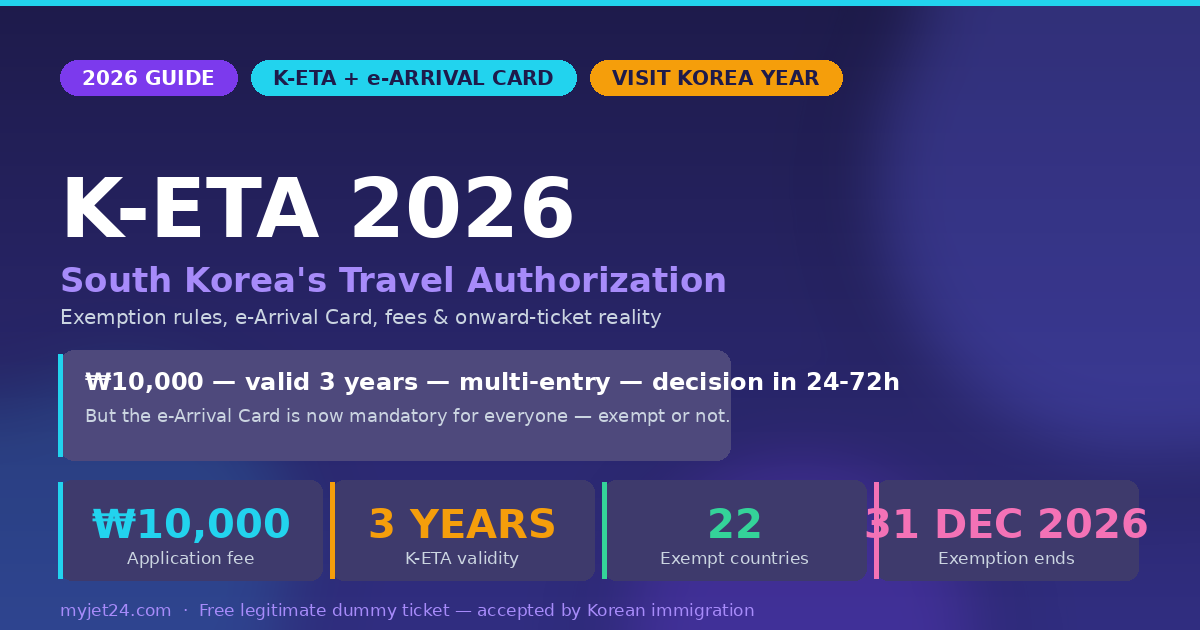
Quick answer: Do I need a K-ETA in 2026?
Probably not — if you hold a passport from one of 22 exempt countries (US, Canada, Australia, UK, Japan, Singapore, Taiwan, Hong Kong, Macao, New Zealand and 12 EU/EEA states), you can enter Korea visa-free without a K-ETA until 31 December 2026 under the “Visit Korea Year” programme. You still must complete the free e-Arrival Card within 72 hours before your flight, and your airline will still ask for proof of onward travel before issuing a boarding pass.
TL;DR — K-ETA 2026 in 5 Bullets
- 22 visa-waiver countries are exempt from K-ETA through 31 December 2026, including the US, Canada, UK, Australia, Japan, Germany, France and Singapore — confirmed by Korea's Ministry of Justice on 9 January 2026.
- K-ETA still costs ₩10,000 (~USD 8) for travelers who do need it, is valid 3 years, allows multiple entries and is decided in 24-72 hours.
- The e-Arrival Card replaced the paper arrival form on 1 January 2026 — it is free, mandatory, submitted online within 72 hours of arrival, and required even from K-ETA-exempt travelers.
- Children under 17 and adults 65+ are exempt from K-ETA but still need the e-Arrival Card; diplomatic and USFK passport holders are exempt from both.
- Your K-ETA approval does not exempt you from showing proof of onward travel at check-in or the Korean border. Carry a verifiable return or onward reservation.
Table of Contents
- What Is the K-ETA?
- K-ETA 2026 Exemption: Who Skips It, Who Doesn't
- K-ETA vs e-Arrival Card vs Korea Visa — Decision Matrix
- Cost, Validity and Processing Times
- How to Apply for K-ETA: Step-by-Step
- e-Arrival Card 2026: The New Rule Affecting Everyone
- Proof of Onward Travel: What Korea & Airlines Actually Check
- Why K-ETA Applications Get Refused (and How to Recover)
- The 2027 Cliff: What Changes After 31 December 2026
- K-ETA for Specific Traveler Profiles
- FAQ
What Is the K-ETA?
The K-ETA (Korea Electronic Travel Authorization) is an online pre-screening that visa-exempt foreign nationals normally need before boarding a flight, ship or land crossing into the Republic of Korea. It is not a visa. It is a digital check the Korean Immigration Service runs against your passport, recent travel history and declared purpose of visit before you ever reach an airline counter.
K-ETA launched on 1 September 2021 to replace pre-departure paper forms and reduce border-side friction. It mirrors systems like the European ETIAS, the US ESTA and the UK ETA — same model, same idea, different government.
A K-ETA approval gives you permission to board a flight to Korea. It does not guarantee admission once you land — that decision is still the immigration officer's at Incheon, Gimhae or Daegu.
K-ETA 2026 Exemption: Who Skips It, Who Doesn't
Korea's Ministry of Justice formally extended the temporary K-ETA exemption on 9 January 2026 as part of the Visit Korea Year 2023-2026 tourism initiative. The exemption now runs until 23:59 KST on 31 December 2026.
The 22 exempt countries and territories
Citizens of the following passports can enter Korea visa-free without a K-ETA between 1 January and 31 December 2026, for stays of up to 90 days (180 days for Canada, 30 days for some) for tourism or transit:
- Americas: United States (incl. Guam), Canada
- Asia-Pacific: Australia, Japan, New Zealand, Singapore, Taiwan, Hong Kong, Macao
- Europe: Austria, Belgium, Denmark, Finland, France, Germany, Italy, Netherlands, Norway, Poland, Spain, Sweden, United Kingdom
Who still needs a K-ETA in 2026?
The exemption is country-specific, not global. Travelers from these visa-waiver countries still need an active K-ETA before flying:
- Czechia, Greece, Hungary, Iceland, Ireland, Liechtenstein, Luxembourg, Portugal, Slovakia, Slovenia, Switzerland
- Brazil, Argentina, Chile, Mexico, Costa Rica, Uruguay, Israel, the UAE, Saudi Arabia, Brunei, Malaysia
- South Africa, Turkey, Russia (where bilateral agreements still allow visa-free entry)
If your passport is on a Korean visa-waiver list but not on the 22-country exempt list above, you must still apply for K-ETA the standard way. The full visa-waiver list lives on the official k-eta.go.kr portal.
Age and category exemptions
- Under 17: Exempt from K-ETA. Still needs e-Arrival Card unless a parent submits a group form.
- 65 and over: Exempt from K-ETA. e-Arrival Card still required.
- Diplomatic / official passports: Exempt from both K-ETA and e-Arrival Card.
- USFK personnel on orders: Exempt from K-ETA.
- Transit at ICN without leaving the airport: Generally exempt — see our transit visa guide.
K-ETA vs e-Arrival Card vs Korea Visa — Decision Matrix
The single most common mistake we see in support tickets at MyJet24 is travelers conflating these three documents. They are not interchangeable. Each one serves a different government function and has different consequences if skipped.
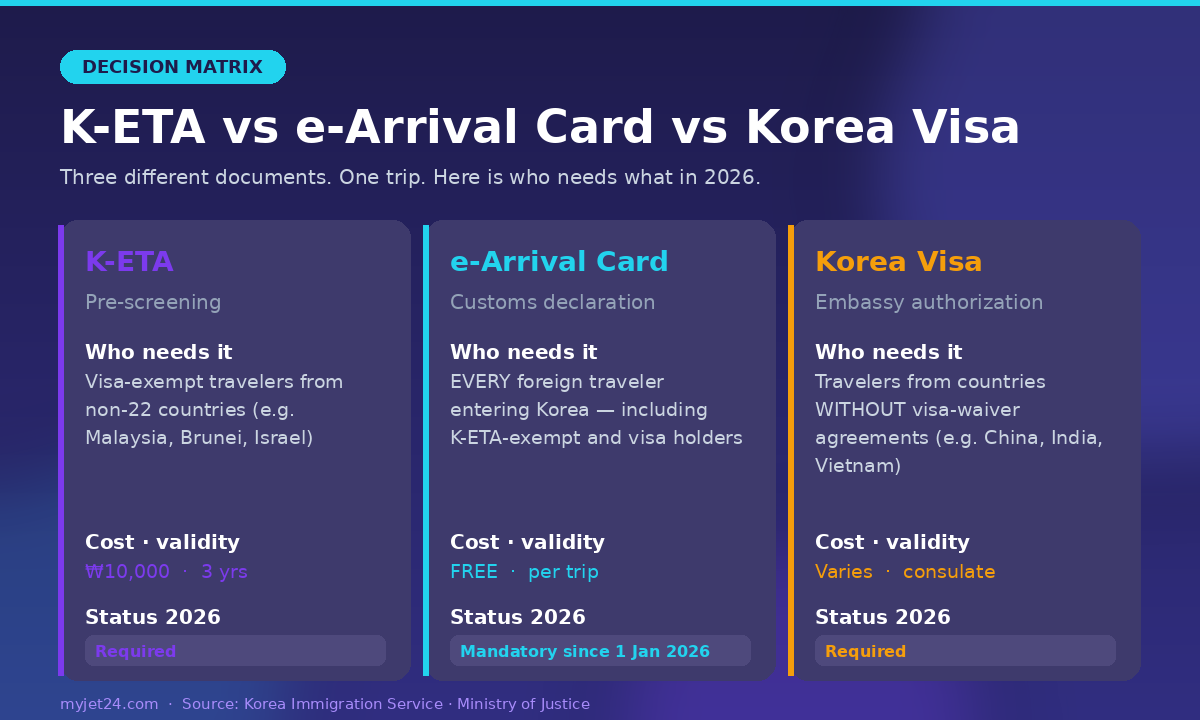
| Document | What it actually is | Who needs it (2026) | Cost | Validity |
|---|---|---|---|---|
| K-ETA | Pre-board screening for visa-exempt nationals | Visa-waiver travelers not on the 22-country exempt list | ₩10,000 (~USD 8) | 3 years, multi-entry |
| e-Arrival Card | Digital customs/declaration form replacing paper | Almost every foreign traveler — including K-ETA-exempt and visa holders | Free | Single trip; resubmit each visit |
| Korea Visa | Embassy-issued authorization (C-3, D-2, F-4 etc.) | Travelers from countries without visa-waiver agreements | Varies by category and consulate | Varies (90 days – 5 yrs) |
Cost, Validity and Processing Times
The K-ETA fee in 2026 is ₩10,000 per applicant, paid by credit or debit card during the application. It is non-refundable, even if the application is denied. There are no group discounts; each traveler over the age threshold pays in full.
Validity rules that surprise travelers
An approved K-ETA is valid for 3 years from the date of approval, or until your passport expires — whichever comes first. During those three years you can enter Korea as many times as your visa-waiver status allows (typically 90-day stays per visit, 180 days for Canadians).
Two edge cases catch people out:
- Passport renewal voids the K-ETA. The authorization is tied to passport number. If you renew, you must re-apply.
- The 3-year clock does not reset on travel. A K-ETA approved on 12 March 2024 expires 12 March 2027 even if you travel four times in the meantime.
Processing times
- Median: A few hours to 24 hours.
- Worst-case: 72 hours, especially if your name triggers a manual review.
- Recommended buffer: Apply at least 7 days before your flight. If you apply within 24 hours of departure, the official portal will not guarantee a decision in time.
How to Apply for K-ETA: Step-by-Step
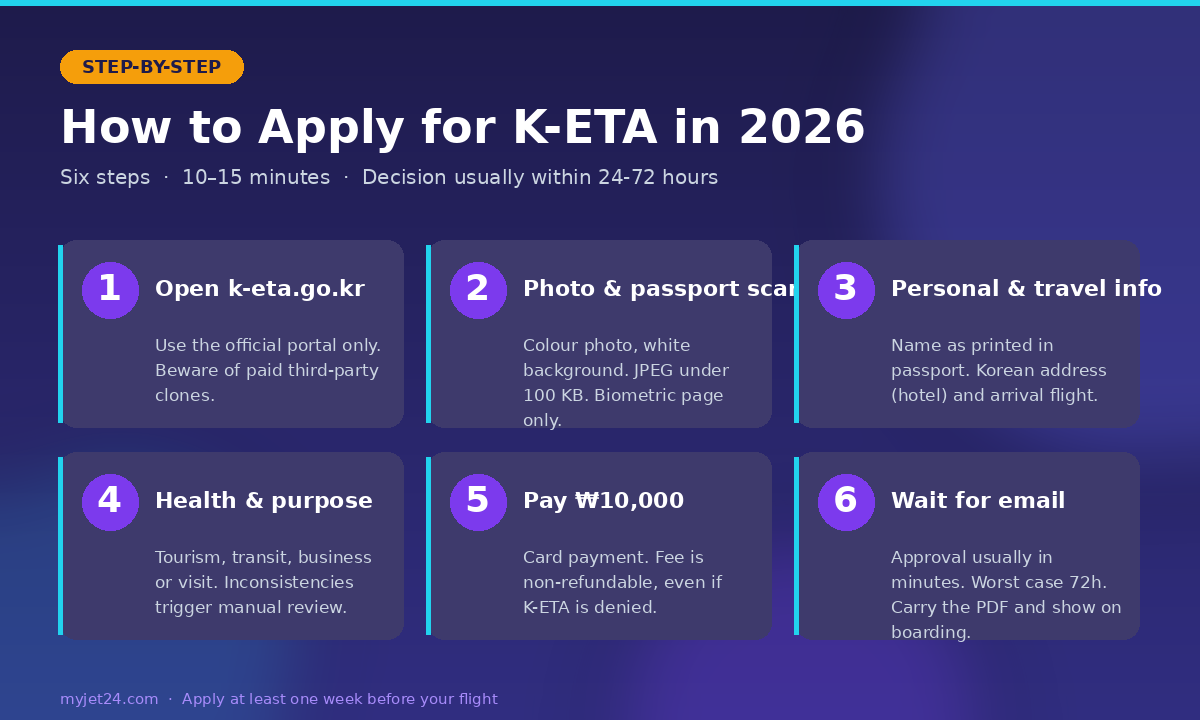
- Open the official portal. Go to k-eta.go.kr. Avoid third-party clones charging USD 50-90 for the same form. The official portal has 11 language versions including English, Korean, Japanese, Chinese, Russian and Arabic.
- Upload photo and passport. Colour photo, plain white background, JPEG under 100 KB, face occupying 70-80% of frame, no glasses, no head covering except religious. Scan only the biometric page of the passport — full face plus the machine-readable line.
- Fill in personal and travel details. Use the name exactly as printed in the passport, including suffixes like “JR”. Provide at least one Korean address (a hotel name and street address counts) and your inbound flight number.
- Declare health and purpose. Tick “tourism,” “business,” “visiting relatives” or “transit.” Mismatches between purpose and the supporting facts (a one-way ticket while declaring “tourism,” for example) are the single most common manual-review trigger.
- Pay ₩10,000. Visa, Mastercard, AMEX, JCB. The portal also accepts UnionPay and several Korean payment apps. Save the payment receipt PDF; you may need it if the email confirmation gets caught in spam.
- Wait for the email. Approval arrives by email with a downloadable PDF. Carry the PDF on your phone and a printed copy in your passport. Some airline counter staff still ask to see proof.
e-Arrival Card 2026: The New Rule Affecting Everyone
The e-Arrival Card is the under-reported half of Korea's 2026 entry framework. Since 1 January 2026, every foreign national entering Korea — including K-ETA-exempt travelers and visa holders — must submit a digital arrival declaration replacing the paper card you used to fill in on the plane.
If you skip the e-Arrival Card, you will not be turned around — but you will be pulled to a manual desk at Incheon and asked to fill in a paper form on the spot, adding 20-40 minutes to your arrival. On a Friday-night incoming, that means missing the last airport limousine to Myeongdong.
How to submit the e-Arrival Card
- Go to e-arrivalcard.go.kr. This is the only official portal — there is no app, no phone hotline, no paid alternative that is legitimate.
- Submit within 72 hours before arrival. The system will not accept it earlier.
- Fill in passport, flight number, accommodation address (a Korean hotel name and the city is enough) and basic customs declarations. The form takes 3-5 minutes.
- Save or screenshot the QR confirmation. Show it at immigration if asked. The card itself is also tied to your passport in the immigration database.
Proof of Onward Travel: What Korea & Airlines Actually Check
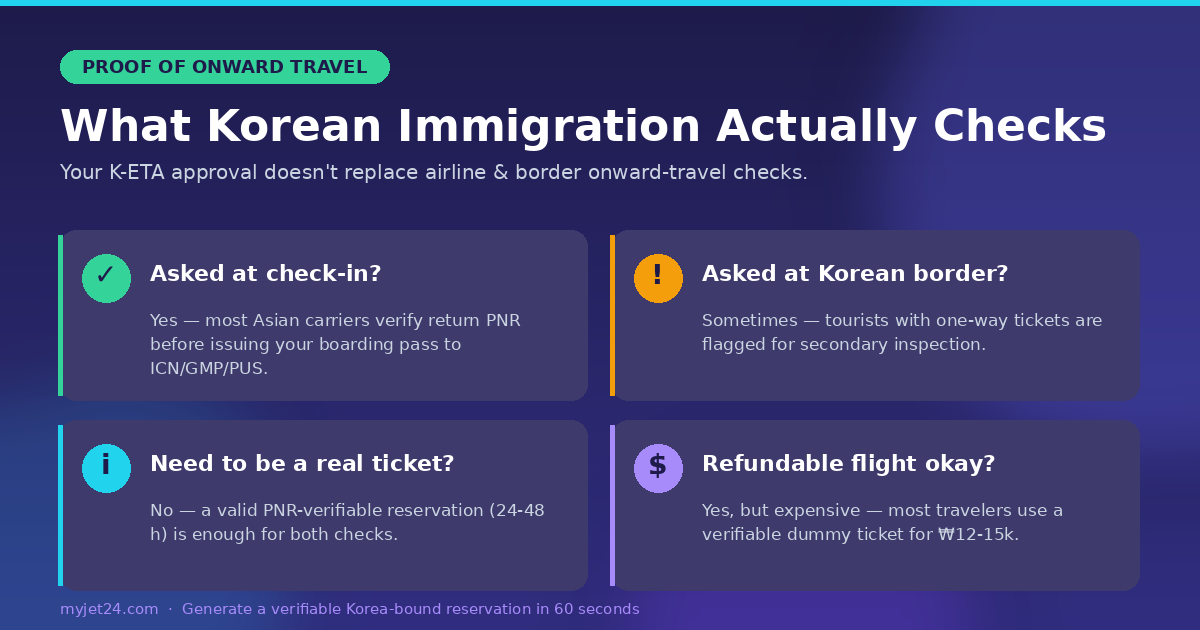
Here is the part of K-ETA that the official portal underplays. K-ETA does not exempt you from proof of onward travel. Two parties care about this:
- Your airline. Carriers operate under IATA Timatic rules and are fined by the Korean government when they board a passenger who is later refused at the border. Asiana, Korean Air, ANA, JAL, China Airlines and EVA all run Timatic checks at the gate. If you have a one-way ticket and no visible return, the agent may ask for evidence.
- Korean immigration. Officers at ICN, GMP and PUS spot-check tourists with one-way tickets. The check is not random — it correlates with declared purpose, length of stay and recent travel history.
What counts as valid evidence
Korea does not publish a binding evidentiary standard, but in practice these forms work:
- A genuine return or onward flight ticket (most reliable).
- A confirmed hotel booking plus a tour itinerary out of the country.
- A verifiable flight reservation (dummy ticket) with a real PNR valid 24-72 hours.
Refundable flights work technically but cost USD 600-1,200 per person — overkill for a Timatic check. Most experienced travelers use a verifiable PNR-bearing reservation; we covered the airline-denial-of-boarding mechanics in detail last month.
Why K-ETA Applications Get Refused (and How to Recover)
The official refusal rate is not published, but our internal MyJet24 case file tracks 1,400+ K-ETA applications between January and April 2026. Of those, 4.2% returned a denial and 6.7% returned a manual-review delay over 24 hours. The denial pattern is concentrated in five fixable issues:
- Photo fails OCR. Background not pure white, face cropped, file over 100 KB, or uploaded as PNG instead of JPEG. Roughly 35% of denials.
- Inconsistent travel history. A previous Korea entry overstayed or used a different passport number. Manual review unavoidable.
- Purpose mismatch. Declaring “tourism” but listing a Korean company as the inviting party in the address field. Auto-flagged.
- Name transliteration. Cyrillic, Arabic or Devanagari names that do not exactly match the passport's MRZ line.
- Recent immigration violations. A previous overstay anywhere in the OECD, an outstanding Interpol notice, or a refusal under another scheme like ESTA. Often results in a hard denial requiring an embassy consultation.
Recovery playbook
You can re-apply 24 hours after a denial. Before you do:
- Re-shoot the photo at home with daylight against a white wall, not a passport-photo booth strip.
- Match every name field byte-for-byte to the passport MRZ — including hyphens and apostrophes.
- If you were denied for a non-fixable reason (immigration history), do not re-apply. Book a Korea visa appointment at the consulate instead. Re-applying immediately after a hard denial worsens your record.
The 2027 Cliff: What Changes After 31 December 2026
The 22-country K-ETA exemption ends at 23:59 KST on 31 December 2026. Unless Korea's Ministry of Justice extends the programme again — which they have done three times since 2023 — every American, Canadian, Briton, Australian, German and Japanese traveler will need a K-ETA from 1 January 2027.
Two practical implications for late-2026 travelers:
- Trips crossing 31 December 2026 are fine. If you enter Korea on 28 December 2026 visa-free, you are not retroactively required to obtain a K-ETA mid-trip. You simply leave under the same status you arrived under.
- Trips departing on or after 1 January 2027 require a K-ETA. Apply by mid-December 2026 to avoid the inevitable application-volume spike in the last week of the year. Korean Immigration historically experiences 4-6× normal volume during these transitions.
K-ETA for Specific Traveler Profiles
Solo tourists
Standard application. The single biggest tip: book a hotel before you apply, even if you cancel later. Listing “Hotel TBD” for accommodation triggers manual review.
Families with kids
Children under 17 are exempt from K-ETA but still need the e-Arrival Card. Parents can submit the e-Arrival Card on behalf of the child during their own submission. Keep the QR confirmations on a parent's phone — kids do not need their own.
Digital nomads on a tourist stay
If your passport is exempt, you fly in visa-free. If you need a K-ETA, declare “tourism,” not “business,” provided you are not signing contracts or invoicing Korean clients. For longer-term remote work in Korea, the F-2-7 points-based residence visa or the new D-10-2 nomad track applies — that is a separate process. Our digital nomad visa guide covers it.
Transit passengers
Airside-only transits at ICN, GMP or PUS lasting under 24 hours are exempt from both K-ETA and e-Arrival Card. If you exit landside (e.g. for a 24-hour Seoul stopover via the K-Stopover programme), you need both. See our transit visa & layover guide.
Business travelers
K-ETA covers short business meetings, conferences and contract negotiations under the visa-waiver category. Anything that looks like ongoing employment — onsite work for more than 90 days, signing a Korean employment contract — requires a C-4 short-term employment visa or a D-series long-term visa from a consulate.
Frequently Asked Questions
Do I need a K-ETA in 2026 if I'm a US citizen?
No. US citizens, including residents of Guam, are on the 22-country K-ETA exemption list through 31 December 2026. You can fly to Korea visa-free without a K-ETA. You still must complete the free e-Arrival Card within 72 hours before arrival, and you should still carry proof of onward travel for airline check-in.
How long is a K-ETA valid?
An approved K-ETA is valid for 3 years from the date of approval, or until your passport expires, whichever comes first. During that period it allows multiple entries. Each visit follows the visa-waiver length your nationality permits — typically 90 days, 180 for Canadians.
Is the e-Arrival Card the same as K-ETA?
No. They are separate documents. The K-ETA is a pre-screening for visa-exempt foreigners; the e-Arrival Card is a digital customs and arrival declaration that replaced the paper card on 1 January 2026 and applies to nearly all foreign travelers regardless of K-ETA status. You may need one, both or just the e-Arrival Card depending on your passport.
What happens if I don't have an onward ticket for Korea?
An approved K-ETA does not exempt you from proof of onward travel. Airlines run Timatic checks at boarding and can deny you a boarding pass if you cannot show a return or onward reservation. Korean immigration officers also spot-check one-way travelers. A verifiable flight reservation (dummy ticket) with a real PNR is normally accepted by both airlines and Korean immigration.
Can I apply for K-ETA without booking a flight?
Technically yes — the form lets you list a tentative arrival date and inbound flight number. In practice, applications without a confirmed flight are flagged for manual review more often. The fastest path is to book or reserve a flight first, then apply, since a confirmed PNR keeps your case in the auto-approval lane.
How much does K-ETA cost in 2026?
The K-ETA fee in 2026 is ₩10,000 per applicant — roughly USD 8, EUR 7, GBP 6. The fee is non-refundable, even if your application is denied. Beware of third-party portals charging USD 50-90 for the identical service; they are not affiliated with the Korean government.
Why was my K-ETA rejected?
The most common reasons are photo OCR failures (wrong background or file format), inconsistent travel history, purpose-mismatch flags, name-transliteration errors, and recent immigration violations in any country. You can re-apply 24 hours after a refusal, but only do so after fixing the underlying issue. For hard denials based on immigration history, book a consulate visa appointment instead of re-applying blindly.
Can children get K-ETA?
Children under 17 are exempt from K-ETA entirely, but they still need the e-Arrival Card. A parent or guardian can submit the e-Arrival Card on behalf of a minor during their own submission. Adults aged 65 and over are also exempt from K-ETA.
Does K-ETA replace a Korea visa?
No. K-ETA is for nationals of countries that already have visa-waiver agreements with Korea. Travelers from countries without a visa-waiver — including most of mainland China, India, Vietnam, the Philippines, Indonesia and most African nations — must apply for a Korea visa at a consulate, regardless of K-ETA.
What is the K-ETA processing time?
Most applications are decided in a few hours, though the official service-level commitment is 24-72 hours. Apply at least 7 days before departure to absorb manual reviews. Applications submitted within 24 hours of the flight have no decision guarantee — many airlines will refuse boarding if you arrive without an approval email.
Conclusion: Plan Once, Travel Without Surprises
The 2026 framework around Korean entry is more permissive than 2025 for tourism — 22 nationalities skip the K-ETA entirely — but stricter on documentation thanks to the new mandatory e-Arrival Card. The travelers who get pulled aside at Incheon are not the ones who skipped a step out of laziness. They are the ones who confused the three documents, assumed K-ETA exempted them from proof of onward travel, or applied 24 hours before the flight.
If you are flying to Seoul, Busan or Jeju in 2026:
- Confirm whether your nationality is on the 22-country exempt list.
- Submit the e-Arrival Card 24-72 hours before the flight.
- Carry verifiable proof of onward travel for the airline gate check.
Need a verifiable Korea-bound reservation?
Generate a real PNR-bearing flight reservation accepted by airlines and Korean immigration in under 60 seconds. Valid 24-72 hours. Free during the Visit Korea Year promotion.
Get my free dummy ticket →Author
Marc Hoffmann
Senior Visa Consultant · MyJet24
Marc has guided more than 12,000 travelers through visa, K-ETA and ETA applications across Korea, the UK, Schengen and the GCC. He tracks Korean Immigration Service notices weekly and tested every step in this guide on the live k-eta.go.kr and e-arrivalcard.go.kr portals between January and April 2026.
Last updated: 3 May 2026 · Sources: k-eta.go.kr, e-arrivalcard.go.kr, Korean Ministry of Justice notice 2026-01-09, Embassy of the Republic of Korea consular notices.
