
Last March, a travel blogger from London named Sam arrived at Heathrow Terminal 3 with his Vietnam Airlines boarding pass printed, his 90-day e-visa approved, and a loose plan to take a slow boat to Laos once he’d figured out his route south.
The check-in agent asked one question: Do you have a return or onward flight from Vietnam?
Sam had his approved e-visa. He had hotel bookings for Hanoi. He had $3,000 in his travel account. He did not have an onward ticket — and the agent would not check him in without one.
Forty minutes and $340 later — an emergency last-minute return fare — Sam made his flight. He never used that return ticket. He crossed into Laos by bus three weeks later, just as he’d planned.
What he didn’t know: a $7.90 dummy ticket with a verified PNR would have done exactly the same job at the check-in desk — and Vietnamese immigration would have accepted it too.
This guide explains exactly what proof you need, when you need it, which airlines enforce it, and how to satisfy every check for under $5.
Quick answer
A dummy ticket for Vietnam is a flight reservation with a real, verifiable PNR (Passenger Name Record) that proves you have an exit plan before your visa expires. Vietnam’s e-visa application does not require one in the form itself — but airlines operating flights to Vietnam enforce onward travel rules at check-in, and land border officers routinely ask for departure proof. A verified dummy ticket satisfies both requirements for $7.90.
TL;DR — Key Takeaways
- Vietnam’s e-visa ($25, 90 days, all nationalities) does not require an onward ticket in the application form
- Airlines to Vietnam — including Vietnam Airlines, VietJet, AirAsia, and Emirates — enforce onward travel checks at boarding
- Land border crossings (Cambodia, Laos, China) apply stricter departure-proof checks than international airports
- A dummy ticket with a real PNR ($7.90 at MyJet24) is accepted by check-in agents and border officers
- Get your dummy ticket before flying; book your real exit once you’ve confirmed your plans in Vietnam
Table of Contents
- Vietnam’s e-Visa in 2026: The Basics
- Does Vietnam Immigration Require Onward Travel Proof?
- Why Airlines Check Before Boarding
- Which Airlines Enforce Onward Travel to Vietnam?
- What Counts as Valid Proof of Departure?
- Dummy Ticket vs. Refundable Flight: Real Cost Comparison
- How to Get a Dummy Ticket for Vietnam (Step by Step)
- Entering Vietnam at Land Borders vs. Airports
- Timing Your Dummy Ticket Perfectly
- 5 Costly Mistakes Vietnam Travelers Make
- Frequently Asked Questions
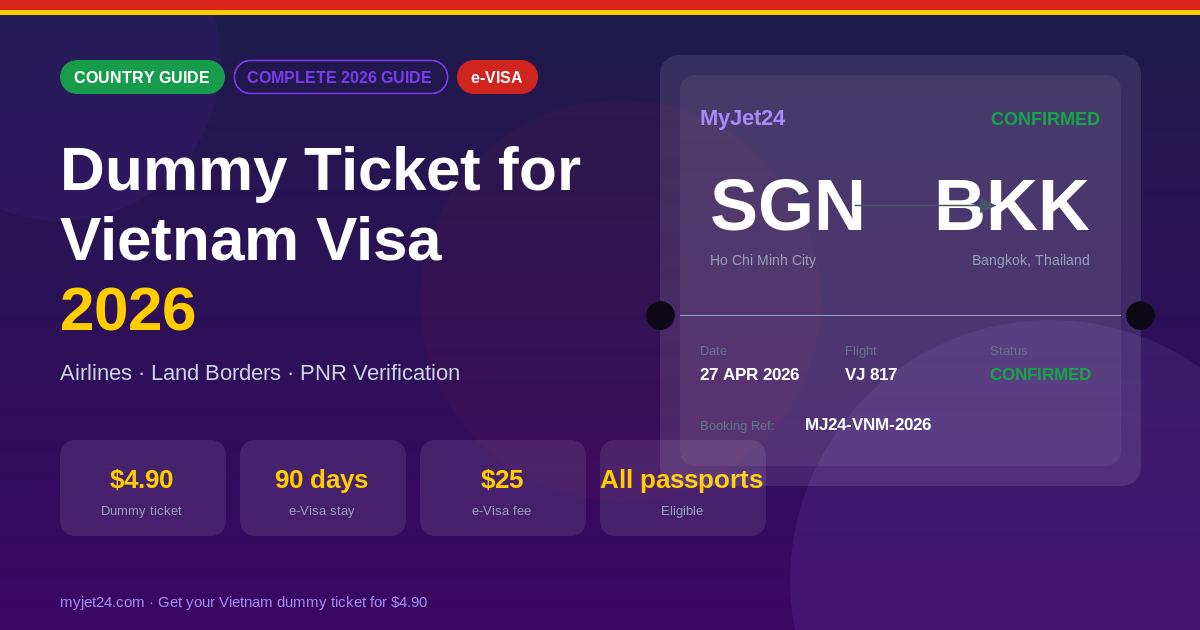
Vietnam’s e-Visa in 2026: The Basics
Vietnam’s e-visa is a single government-issued travel authorization that grants entry to Vietnam for up to 90 days, available to citizens of all countries since August 2023. It replaced the old visa-on-arrival approval letter system as the primary entry route for tourists and business travelers worldwide.
Key facts for 2026:
- Fee: $25 USD (single entry) or $50 USD (multiple entry)
- Maximum stay: 90 days per visit
- Processing time: 3–5 business days (weekends and Vietnamese public holidays excluded)
- Eligible nationalities: All countries — Vietnam opened the e-visa to all passports in August 2023
- Valid entry points: 83 international airports, land borders, and seaports
- Official portal: evisa.gov.vn (Vietnam Immigration Department)
What the e-Visa Application Does NOT Require
The official Vietnam Immigration Department e-visa form does not include a field for onward or return flight details. You do not need to prove departure as part of the application itself. You need a passport photo, passport biographical page scan, intended entry date, exit date, and port of entry — that is it.
This is where most travelers stop reading. The problem starts later — at the airline check-in counter, or at the land border post.
“The e-visa approval does not mean you will board the plane. Airlines are a separate authority — and they have their own rules about departure proof that have nothing to do with Vietnam’s government.”
Does Vietnam Immigration Require Proof of Onward Travel?
Vietnam’s Immigration Law does not contain a statutory requirement for onward or return tickets for e-visa holders. However, Article 32 of Vietnam’s Law on Entry, Exit, Transit and Residence of Foreigners grants immigration officers full discretion to request evidence of departure intent if they have reason to suspect an overstay risk.
In practice, enforcement varies significantly by entry point:
International Airports (Hanoi, Ho Chi Minh City, Da Nang)
At Noi Bai International (HAN), Tan Son Nhat (SGN), and Da Nang International (DAD), most travelers with approved e-visas pass through without being asked for onward travel proof. Officers typically stamp passports and wave travelers through. However, immigration checks are not random — travelers who present with multiple indicators of long-stay risk face a higher probability of being asked:
- No hotel booking visible
- A history of repeated long stays in Vietnam
- Passports showing dense multi-year Southeast Asia circuits
- Arrival on budget airlines from regions with elevated overstay rates
Having a dummy ticket ready removes any ambiguity and prevents a secondary screening delay that can last 30–90 minutes.
Land Border Crossings
Land border checks operate on a different level of scrutiny. At crossings like Moc Bai (Vietnam–Cambodia), Lao Bao (Vietnam–Laos), and Huu Nghi Quan (Vietnam–China), departure proof requests are routine rather than selective. Officers at these posts see high proportions of long-stay visitors and experienced backpackers, and apply systematic checks as standard procedure. Border veterans universally recommend having a clear, printed departure record at every land crossing.
Why Airlines Check Before Boarding (And Who Bears the Risk)
Airlines enforce onward travel requirements not because Vietnam told them to, but because they are financially liable for passengers who get denied entry at destination.
Under IATA Timatic regulations — the global documentation database airlines reference at check-in — carriers that transport passengers subsequently denied entry must:
- Return the denied passenger to their origin country at the airline’s cost
- Pay Vietnamese authorities any applicable fines
- Cover accommodation and meals during the deportation wait period
In 2025, the average total cost to an airline per deportation was approximately $1,200–$2,800 USD depending on origin country and wait time. Check-in agents are therefore strongly incentivized to perform thorough documentation checks before boarding.
This is why the check happens in your home country — at the originating airport — before you ever board the plane. It is entirely independent of Vietnam’s official entry rules, and it will occur regardless of whether your e-visa is already approved.
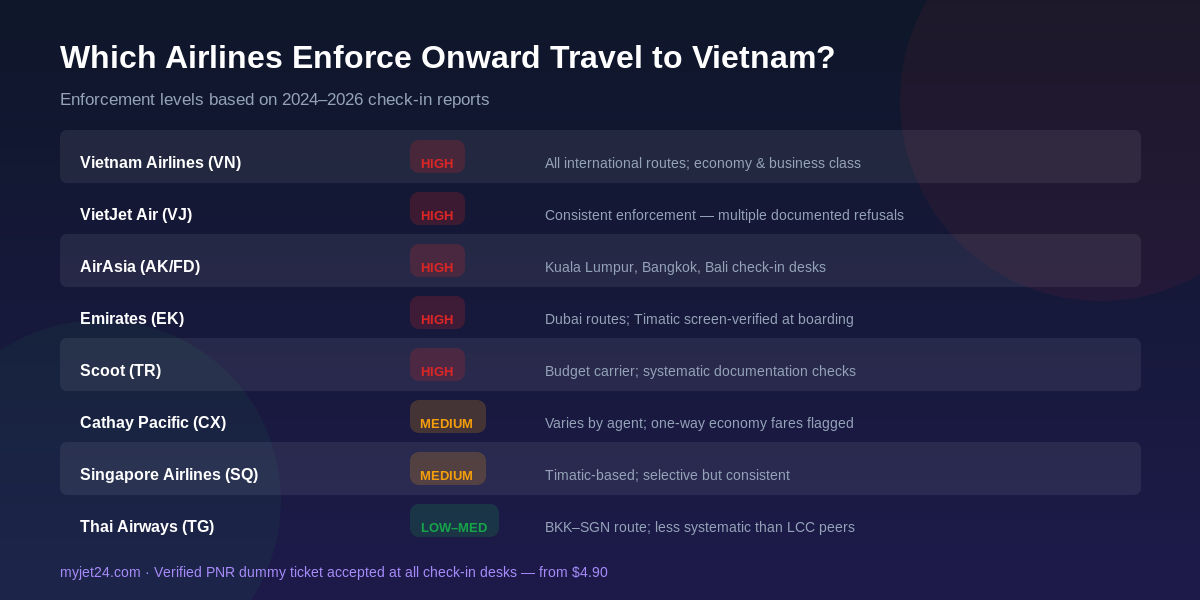
Which Airlines Enforce Onward Travel to Vietnam?
Enforcement varies by carrier. Based on documented traveler reports from 2024–2026, this is the realistic picture by airline:
| Airline | Enforcement | Notes |
|---|---|---|
| Vietnam Airlines (VN) | High ✓ | Enforces on most international routes; economy and business class |
| VietJet Air (VJ) | High ✓ | Multiple documented boarding refusals; very consistent enforcement |
| AirAsia (AK/FD) | High ✓ | Documented refusals from Kuala Lumpur, Bangkok, Bali check-in desks |
| Emirates (EK) | High ✓ | Dubai–SGN/HAN routes; strict; Timatic screen-verified at check-in |
| Scoot (TR) | High ✓ | Budget carrier; systematic documentation checks; no exceptions observed |
| Cathay Pacific (CX) | Medium | Varies by agent and origin; one-way economy fares flagged more often |
| Singapore Airlines (SQ) | Medium | Timatic-based; economy one-way passengers checked more consistently |
| Bamboo Airways (QH) | Medium | Inconsistent; long-stay travelers and repeat visitors flagged more often |
| Thai Airways (TG) | Low–Medium | BKK–SGN route; selective checks; less systematic than LCC peers |
Bottom line: On budget airlines to Vietnam (AirAsia, VietJet, Scoot), treat onward travel proof as mandatory. For full-service carriers (Emirates, Cathay, SQ), have it ready regardless. No carrier has a formal policy of not checking.
What Counts as Valid Proof of Departure from Vietnam?
Proof of onward travel from Vietnam is any verifiable document that demonstrates you will exit the country before your visa expires. The following are accepted by both airlines and immigration officers:
Accepted Documents
- Confirmed outbound flight booking — any airline, any class; must show passenger name, travel date, route, and booking reference number
- Dummy ticket with verifiable PNR — a temporary booking carrying a real, live airline PNR code; accepted by check-in systems and immigration officers identically to a paid ticket
- Bus or coach ticket — departing Vietnam to Cambodia (e.g., Ho Chi Minh City to Phnom Penh), Laos, or China; must show date, route, and passenger name
- Train ticket — international rail crossing, or domestic Vietnam Railways ticket to a border-adjacent city
- Cruise itinerary — if your ship departs a Vietnamese port before your visa expiry date
What Does NOT Work
- A hotel checkout date (shows accommodation end, not departure from Vietnam)
- A verbal assurance or letter of intent
- A non-verifiable PDF without a traceable PNR code
- A dummy ticket whose PNR has already expired (verify PNR is active before travel)
Dummy Ticket vs. Refundable Flight: The Real Cost Comparison
Two options exist for flexible travelers who have not yet fixed their return date: a dummy ticket, or a fully refundable paid ticket. Here is the honest comparison:
| Factor | Dummy Ticket (PNR) | Refundable Flight |
|---|---|---|
| Cost | $7.90 | $180–$600+ (Vietnam–Europe) |
| Flexibility | Full — exit date not fixed | Partial — refund takes 5–15 days |
| Accepted at check-in | Yes — PNR verifiable live | Yes |
| Accepted at immigration | Yes — same as any booking | Yes |
| Capital tied up | $7.90 | $180–$600+ until refund arrives |
| Risk of losing money | None — not a real ticket purchase | Refund fees and admin errors possible |
| PNR validity window | 48–72 hours typically | Until ticket expiry (months) |
For travelers with genuinely flexible plans — backpackers, slow travelers, digital nomads — the dummy ticket is almost always the superior choice. For travelers who already know their exit date, a real ticket they will use anyway makes more sense financially and logistically.
Full analysis: Dummy Ticket vs. Refundable Flight for Visa 2026: The Honest Cost & Risk Comparison
How to Get a Dummy Ticket for Vietnam (Step by Step)
Getting a verified dummy ticket for Vietnam takes under ten minutes. Here is the exact process from order to verification:
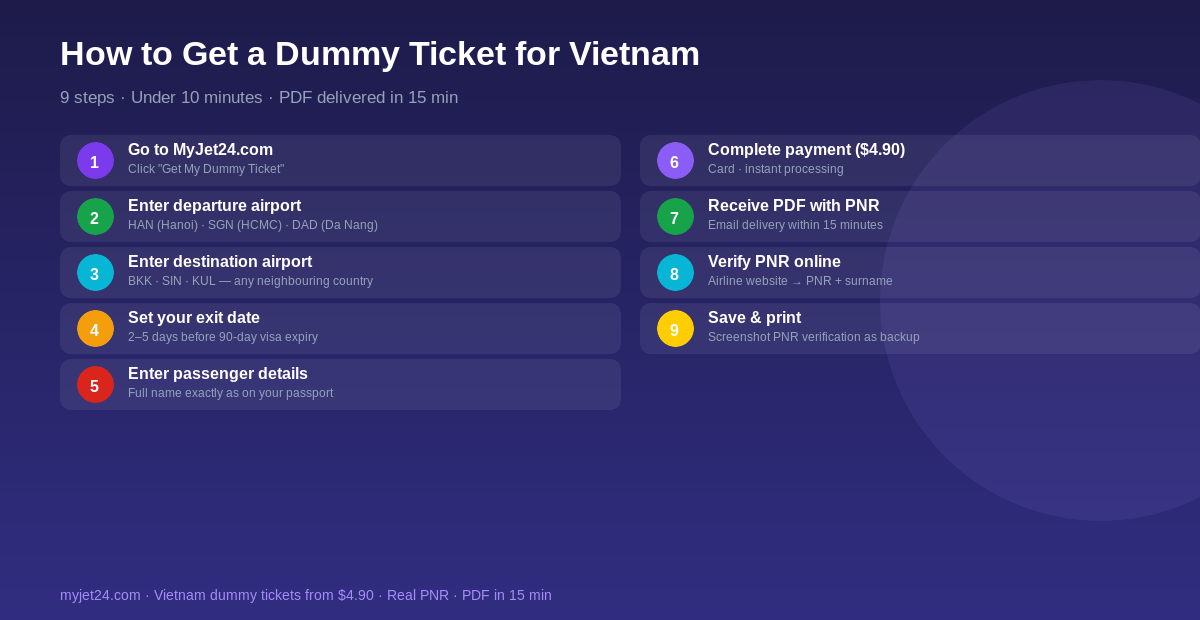
- Go to MyJet24.com — click the “Get My Dummy Ticket” button on the homepage
- Enter your departure airport — the first Vietnamese city you will fly out from: Hanoi (HAN), Ho Chi Minh City (SGN), or Da Nang (DAD) are the main options
- Enter your destination airport — choose any neighboring country airport: Bangkok (BKK), Singapore (SIN), and Kuala Lumpur (KUL) are common Vietnam exit routes
- Enter your target exit date — ideally 2–5 days before your visa’s 90-day maximum expiry
- Enter passenger details — full name exactly as it appears on your passport
- Complete payment — $7.90 by card; instant processing
- Receive your PDF — booking confirmation with PNR arrives by email, typically within 15 minutes
- Verify the PNR — visit the airline’s website, enter the PNR code and your surname to confirm it shows as a live booking
- Save and print the PDF — screenshot the PNR verification page as backup; present both documents if asked
Pro tip: Get your dummy ticket before you fly — within 24 hours of departure for maximum PNR validity at check-in. Some travelers also request one during the e-visa application phase (though not required), then get a fresh one for the actual trip. For PNR verification walkthrough: How to Verify Your Dummy Ticket PNR
Entering Vietnam at Land Borders vs. Airports: Different Enforcement in Practice
Vietnam has 23 international land border crossings, 8 international airports, and several seaport entry points. Your entry method significantly affects the likelihood of being asked for departure proof.
Major Land Border Crossings and Their Enforcement Reality
- Moc Bai (Vietnam–Cambodia, Ho Chi Minh City side) — the busiest land crossing for international travelers; officers familiar with the perpetual “Southeast Asia circuit” pattern; departure proof checks are common and systematic here
- Lao Bao (Vietnam–Laos, Highway 9 crossing) — moderate enforcement; having bus or flight departure evidence strongly recommended for all travelers
- Huu Nghi Quan / Friendship Pass (Vietnam–China, Lang Son Province) — stricter checks for travelers entering from China; departure proof often requested and sometimes required
- Tay Trang (Vietnam–Laos, Dien Bien Phu side) — remote crossing; enforcement inconsistent but departure documentation always worth carrying
- Nam Can / Vinh Xuong (Vietnam–Cambodia, Mekong Delta route) — popular slow-boat route; onward proof recommended at both sides of this crossing
Land Border Strategy
At land borders, have your dummy ticket printed or clearly displayed on your phone screen before you reach the officer window. The ticket should show a route departing from a Vietnamese city to another country, dated before your e-visa expiry. Officers at busy crossings process hundreds of travelers per hour — a clear exit date visible within seconds is the fastest path through.
Timing Your Vietnam Dummy Ticket Perfectly
Vietnam’s e-visa takes 3–5 business days to process, creating a timing window that catches many travelers off guard. Here is the optimal sequence:
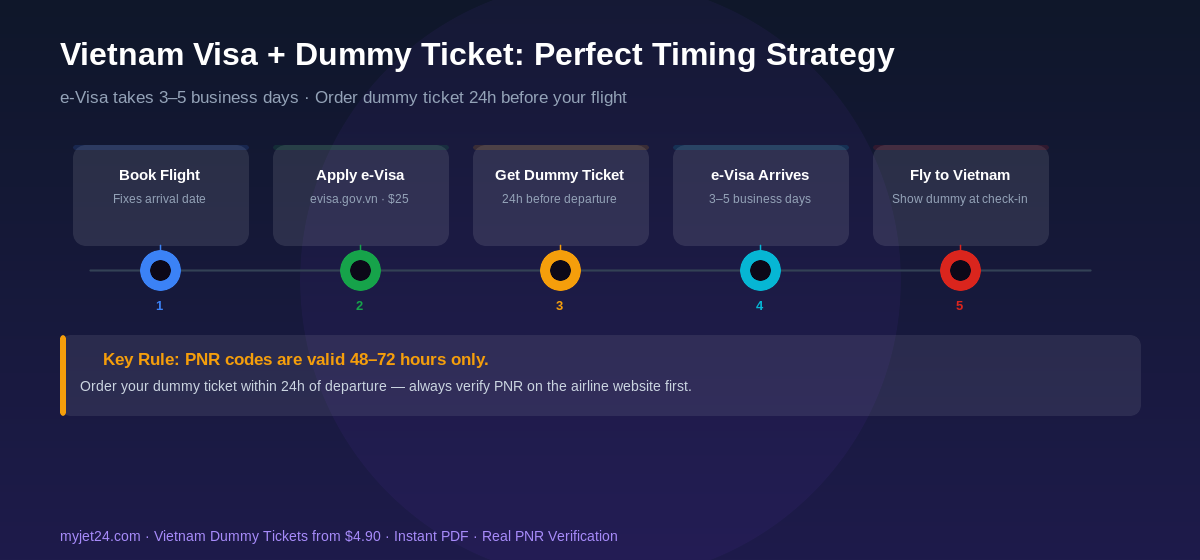
- Book your inbound flight to Vietnam — this fixes your arrival date and gives you the entry point for your e-visa form
- Submit your Vietnam e-visa application immediately at evisa.gov.vn; processing begins on the next working day
- Get your dummy ticket within 24 hours of your departure flight — not a week in advance; PNRs expire in 48–72 hours
- Receive your approved e-visa PDF — save it, print a copy, store it separately from your phone
- Check in at the airport — present the dummy ticket PDF if asked; the PNR is live and verifiable in real time
- Arrive in Vietnam — if asked at immigration, present the same dummy ticket document
- Book your real exit — once your plans are confirmed, book an actual bus, train, or flight out
Critical timing rule: PNR codes typically remain active for 48–72 hours. Do not order your dummy ticket a week before travel — order it the day before your flight. Always verify the PNR is live on the airline’s website before departing for the airport. Full details: How Long Is a Dummy Ticket Valid? PNR Expiry & Embassy Rules Explained
5 Costly Mistakes Vietnam Travelers Make With Onward Travel Proof
- Ordering the dummy ticket too early. PNRs expire in 48–72 hours. Ordering a week before travel means an expired, unverifiable booking at check-in. Always order within 24 hours of departure.
- Using a non-verifiable PDF. Screenshot mockups and non-PNR documents are rejected. Airlines run live PNR lookups in their systems during check-in. Only services that provide real, airline-system PNR codes work reliably.
- Booking departure from the wrong Vietnamese city. Your dummy ticket exit must show a Vietnamese airport matching your actual plans — HAN for Hanoi travelers, SGN for Ho Chi Minh City, DAD for Da Nang. A ticket from a city you are not visiting raises questions.
- Relying solely on your phone. Phones die. Apps crash. Networks fail at border crossings. Print the PDF, or have it downloaded offline. At land border posts especially, a printed copy is much faster to present.
- Assuming e-visa approval covers everything. Many travelers believe that because Vietnam approved their e-visa, no further documentation is needed. Visa approval and airline boarding are separate processes governed by different authorities. Passing one does not guarantee the other.
For the full breakdown of dummy ticket errors across all visa types: The Dummy Ticket Trap: What Thousands of Visa Applicants Get Wrong Every Year
Frequently Asked Questions
Does Vietnam require an onward ticket for the e-visa application?
No. Vietnam’s official e-visa application form at evisa.gov.vn does not include a field for onward or return flight details. You do not need to prove departure to obtain the e-visa. However, airlines operating flights to Vietnam and land border immigration officers may independently request proof of departure when you travel.
Will Vietnam Airlines deny boarding if I don’t have an onward ticket?
Yes — Vietnam Airlines has multiple documented cases of check-in agents requesting proof of onward travel and refusing to process passengers who cannot provide it. This applies to international routes from Europe, North America, and Australia. A dummy ticket with a real PNR resolves the issue instantly, as agents verify it on their terminal within seconds.
Can I use a bus ticket as proof of onward travel from Vietnam?
Yes. A confirmed bus ticket from a Vietnamese city to Cambodia (e.g., Ho Chi Minh City to Phnom Penh), Laos, or China counts as valid departure proof. The ticket must show your name, departure date, route, and booking reference. Operators like Mekong Express and Giant Ibis provide bookable tickets that work for this purpose at both airlines and border crossings.
Is a dummy ticket legal for Vietnam travel?
Yes. A dummy ticket is a legitimate flight reservation that has not yet been ticketed (fully paid). It uses a real PNR from the airline’s reservation system and is accepted by check-in agents and immigration officers as proof of travel intent. You are not presenting a forged document — you are presenting a real but temporary booking. The practice is widely used by flexible travelers and digital nomads globally. Full legal analysis: Is a Dummy Ticket Legal? Everything Travellers Need to Know
How long is a Vietnam dummy ticket PNR valid?
PNR codes typically remain active for 48–72 hours before the booking is automatically cancelled by the airline’s ticketing system. Some carriers allow up to 7 days. For Vietnam travel, order your dummy ticket within 24 hours of your departure flight. Always verify the PNR on the airline’s website before heading to the airport — if it shows as cancelled, order a fresh one.
Do I need a dummy ticket if I already have a return flight booked?
No. If you have a confirmed return or onward flight already purchased, you have real proof of departure. Simply show that booking confirmation at check-in and border. Dummy tickets exist for travelers who have not yet fixed their exit date and need a flexible, low-cost way to satisfy the requirement without committing to a full fare in advance.
Which Vietnam border crossing enforces onward travel checks most strictly?
Moc Bai (Vietnam–Cambodia), Lao Bao (Vietnam–Laos), and Huu Nghi Quan (Vietnam–China) report the most consistent departure proof requests. Moc Bai in particular processes large volumes of backpackers and long-stay visitors and applies relatively systematic checks. At major airport arrivals in Hanoi, Ho Chi Minh City, and Da Nang, enforcement is selective but still possible for certain traveler profiles.
Can I extend my Vietnam e-visa if my plans change?
Yes. Vietnam allows e-visa extensions in certain circumstances, processed through the Immigration Department. If your plans change after arrival, you can apply to extend your stay legally rather than feeling bound by the exit date on your dummy ticket. The dummy ticket shows departure intent, not a binding commitment. Book your actual departure whenever suits your travel, as long as it falls before your visa’s legal expiry.
What is the cheapest way to get proof of onward travel for Vietnam?
A dummy ticket from MyJet24 at $7.90 is the most cost-effective option for flexible travelers. It provides a verified PNR, PDF delivery within 15 minutes, and is accepted by all major airlines and Vietnamese immigration. For travelers on tight budgets, this compares favourably to the cheapest refundable flights ($180+) or to the emergency same-day fares ($300–$600+) some travelers end up buying at the airport.
Next Steps: Get Your Vietnam Dummy Ticket in 10 Minutes
Vietnam is one of Southeast Asia’s most rewarding destinations — Ha Long Bay, Hoi An’s lantern-lit old town, the hill stations of Sapa, the Mekong Delta, 3,000 km of coastline. None of it should be derailed by a $340 emergency ticket purchased at the airport because a check-in agent asked a question you weren’t ready for.
Vietnam received over 17.5 million international visitors at its 2019 peak and is projected to exceed that figure in 2026. The vast majority of those travelers arrive with their documentation sorted. Here is yours:
- Apply for your Vietnam e-visa at evisa.gov.vn — $25, 90 days, all passports
- Get your dummy ticket at MyJet24 — verified PNR, PDF in 15 minutes, $7.90
- Verify the PNR on the airline’s website before your flight
- Travel with both PDFs: your approved e-visa and your dummy ticket confirmation
- Book your real exit once you have confirmed your Vietnam plans on the ground
Smart travelers arrive prepared. The ones scrambling at the check-in desk simply weren’t told about this beforehand — now you have been.
About the Author
Marc Hoffmann is a Berlin-based travel writer and visa documentation specialist with over 12 years of experience covering Southeast Asia entry requirements, airline policies, and travel documentation standards. He has personally crossed Vietnam’s land borders at Moc Bai, Lao Bao, and Huu Nghi Quan, and has written for major European travel publications. Marc is the lead content strategist at MyJet24.
Last updated: April 27, 2026. Vietnam e-visa fees and processing times are set by the Vietnam Immigration Department and subject to change. Always verify current requirements at the official portal evisa.gov.vn before submitting your application.
