
Last updated: 27 August 2026 · Reading time: 13 min · Author: Marc Hoffmann, Senior Visa Consultant at MyJet24 · Reviewed by: James Mitchell, CEO & Founder
TL;DR — Key facts
- No, you are not bound to the flight you showed. The itinerary evidenced your plan on the day of the decision. It is not a field on the visa and not a commitment you signed.
- Three fields bind you, and none of them is a flight number: the valid-from and valid-until dates, the permitted duration of stay, and the number of entries.
- A visa can only be taken away on two grounds. Article 34 of the Visa Code allows annulment where the conditions "were not met at the time when it was issued", and revocation where they "are no longer met". A changed booking touches neither.
- The one change that does carry risk is moving your main destination to a different country, because that is what decided which consulate was competent to issue the visa in the first place.
- There is nobody to notify. No consulate operates a mechanism for reporting a changed flight, and no rule requires it.
You do not have to fly the exact flight you showed. A visa grants permission to enter within a date range, for a number of days, on a number of entries — it does not attach to a specific booking. Change dates, airline or route freely, provided the new trip still fits inside those three limits.
A real booking via MyJet24 Premium an officer can look up — without buying a fare you may not fly.
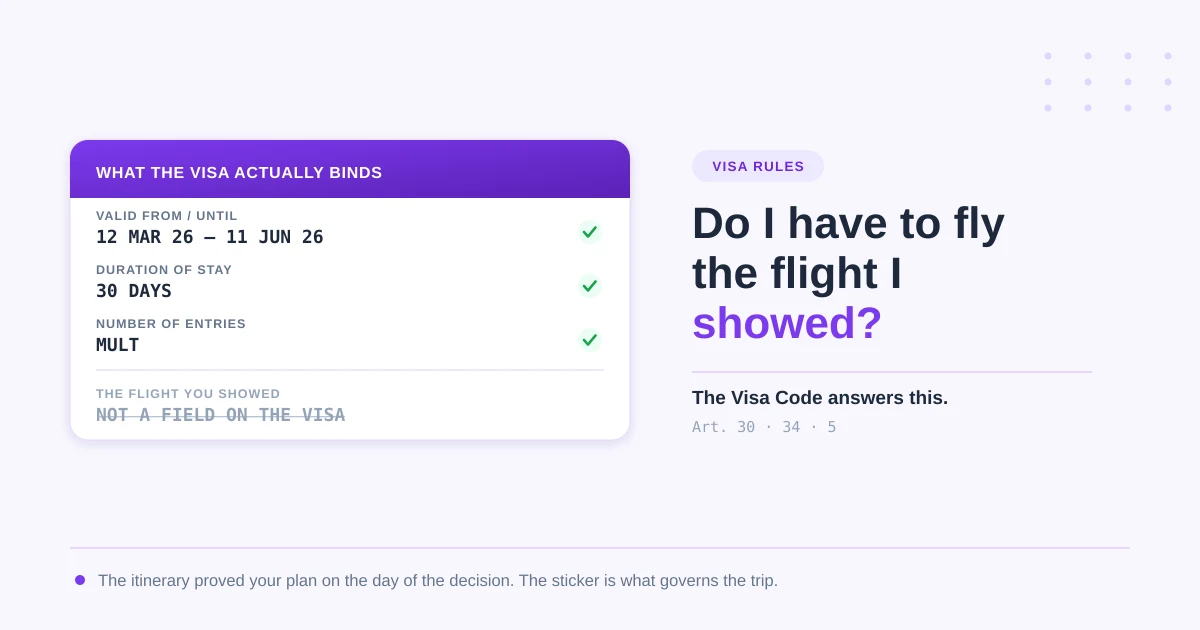
Do I have to fly the exact flight I showed?
No. A flight reservation submitted with a visa application is evidence, not an undertaking. It demonstrates that your stated plan was coherent and time-bounded on the day the officer assessed it, and its job ends there.
The confusion is understandable, because the document looks like a commitment. It has your name, dates and a booking reference, and you handed it to a government. But nothing on the visa that comes back refers to it. The consulate does not record your flight number, does not check whether you flew it, and has no process that would notice if you did not.
Compare it to the bank statement in the same application. Nobody believes they are obliged to spend exactly that balance in exactly that way. The statement proved a condition was met at a point in time. The itinerary works identically.
Key takeaway: The itinerary answered a question that has already been asked and answered. It does not follow you onto the plane.
What does the visa actually bind me to?
A visa binds you to three fields printed on it: the period in which it is valid, the number of days you may stay, and the number of times you may enter. Everything else about your trip is yours to arrange.
Read the sticker rather than your memory of the application. Valid from / valid until is the window in which entry is permitted — arriving a day early is refused entry, not a formality. Duration of stay is the days granted, which is frequently more than you asked for; a request for eight days often comes back as thirty. Number of entries is where single-entry visas catch people, because a side trip out of the area consumes the entry and there is no way back in.
None of those three is a flight. That is the whole answer to the question this article is about, and the reason the answer is so short.
People plan their trip around the itinerary they submitted and ignore the sticker that actually governs it. The document you should be reading is the one the consulate gave you, not the one you gave the consulate.
The days themselves are counted separately again if you are travelling visa-free elsewhere in the same period — the arithmetic is set out in our guide to the Schengen 90/180-day rule.
Key takeaway: Validity window, duration, entries. Fit your new plan inside those three and you are compliant.
Can my visa be revoked because I changed my flight?
No. A visa can be withdrawn on exactly two grounds, and a changed booking is neither of them. The grounds are written into Article 34 of the Visa Code and they are narrow.
A visa is annulled where it becomes evident that "the conditions for issuing it were not met at the time when it was issued" — in practice, where the application was fraudulent or materially untrue. It is revoked where "the conditions for issuing it are no longer met". Both tests look at the truthfulness and the substance of the application, not at the shape your trip eventually took.
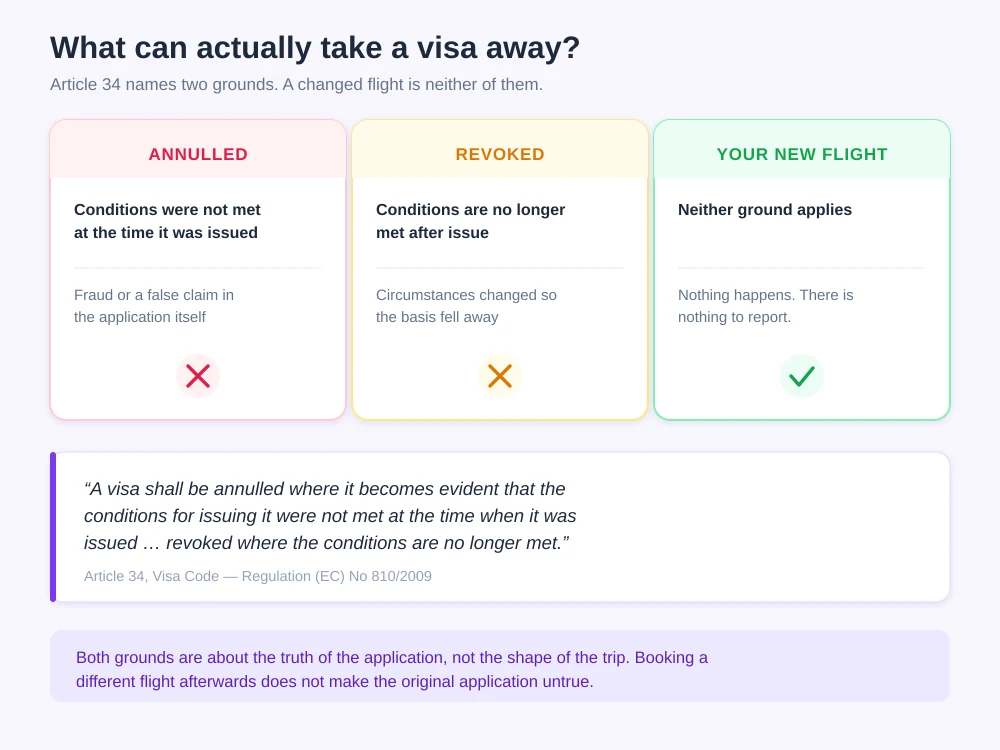
The distinction that matters: booking a different flight afterwards does not make the original application untrue. Submitting an itinerary you never intended to use, for a trip you never intended to take, is a different matter — that goes to the truthfulness of the application itself, which is the line examined in our guide to whether a flight reservation is legal.
Key takeaway: Both grounds test the application, not the trip. Genuine plans that change are outside them.
Which change actually carries a risk?
Moving your main destination to a different country is the one change with real consequences, because that is what decided which consulate could issue your visa at all. Dates, airlines and routes are free; the centre of gravity of the trip is not.
Article 5 of the Visa Code makes the competent Member State the one whose territory is "the main destination of the visit(s) in terms of the length of stay, counted in days, or the purpose of stay". If no main destination can be determined, competence falls to the state whose external border you intend to cross first. You applied to a particular consulate because of that rule.
So a trip that was mostly Spain and becomes mostly Poland has not just changed shape — it has undermined the basis on which Spain was the right place to apply. This is the scenario that reassurance articles skip, and it is the only one worth planning around. A few days shifting between countries is noise. A wholesale relocation of the trip is not.
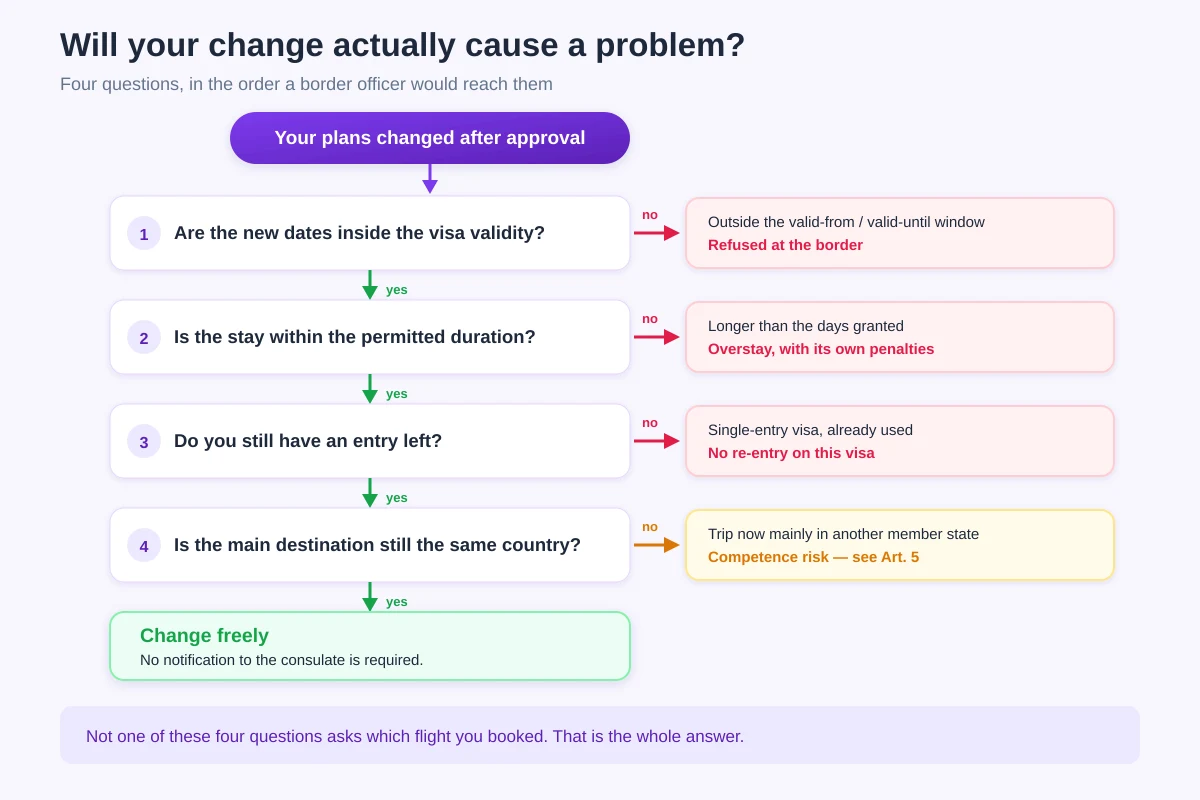
Key takeaway: Change when and how you fly freely. Be careful about changing where you mainly are.
Why doesn’t a visa guarantee I get in?
Because a visa authorises travel to the border, not admission through it. Article 30 of the Visa Code is a single sentence and leaves no room: "Mere possession of a uniform visa or a visa with limited territorial validity shall not confer an automatic right of entry."
The officer at the border runs their own assessment of the entry conditions on the day you arrive. That is where your current documents matter and your old ones do not. A traveller arriving with a visa and an itinerary that stopped being true two months ago is answering questions about a trip they are not taking.
This cuts both ways, and it is the practical reason to keep your paperwork current rather than sentimental. What happens when that assessment goes badly is set out in our guide to refusal of entry at the border.
Key takeaway: The visa gets you to the counter. Your current, coherent plan gets you past it.
How can I change my flights safely after approval?
Run three checks against the sticker, then update what you carry. The whole process takes a few minutes and involves nobody but you.
- Read the three fields on the visa. Valid from and until, duration of stay, number of entries. Write them down rather than working from memory of what you requested.
- Fit the new trip inside all three. Entry after the valid-from date, departure before valid-until, days within the grant, and an entry still available if you plan to leave and return.
- Keep the main destination the same country. The state you applied to should still hold the longest stay or the purpose of the trip.
- Carry the booking you are actually using. Replace the old reservation in your travel wallet. What you show at the border should describe the trip you are on.
- Notify nobody. There is no channel for this and no obligation to use one. Consulates do not track post-issue itinerary changes.
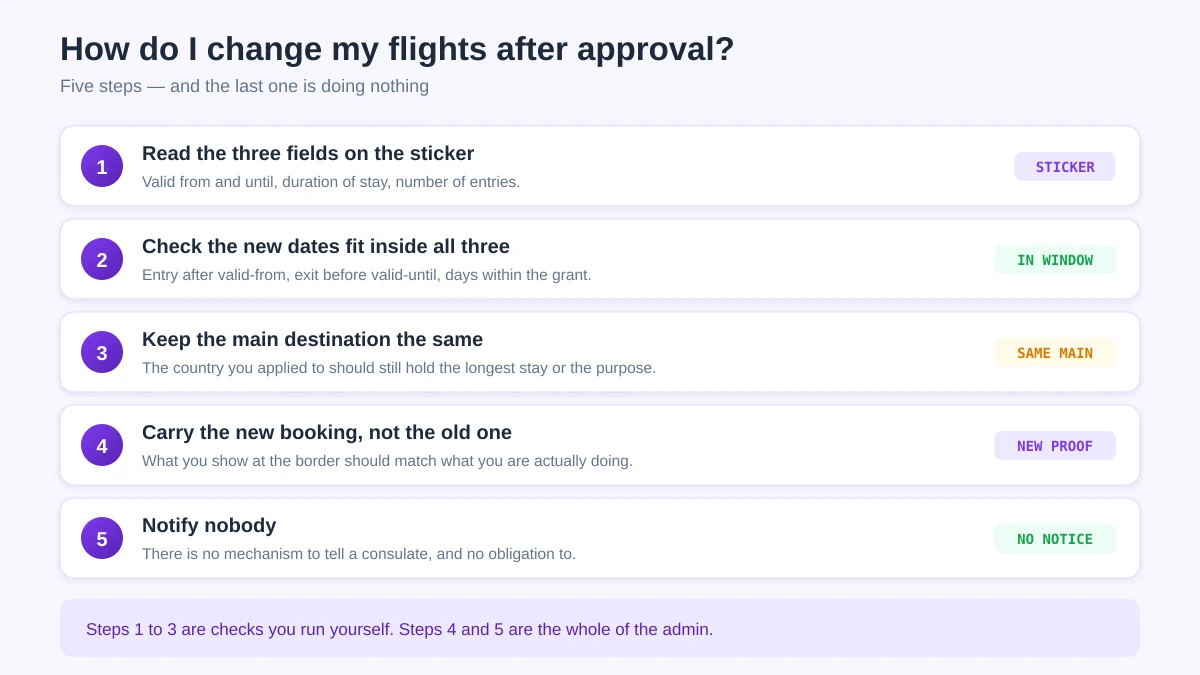
In the applications we support, step four is the one people skip. They change the trip, keep the original PDF in the folder because it is the one the consulate saw, and arrive at check-in with a document describing flights that no longer exist. The agent is not checking it against the visa file — they are checking whether you have onward travel now.
Key takeaway: Update the document you carry. Nobody is comparing it to the one you submitted.
Issued in about 30 seconds via MyJet24 Premium, with a locator that resolves on the airline’s system.
What if I never take the trip at all?
Nothing happens. An unused visa simply expires on its valid-until date, and there is no penalty, no report and no obligation to explain. Travel plans fall through constantly, and the system anticipates it.
The nuance worth knowing is about future applications rather than this one. Consulates can see your visa history, including issued visas with no corresponding entry. A single unused visa is unremarkable. A repeated pattern of applying, being approved and never travelling invites a question about purpose on the next application — not because a rule was broken, but because the stated purpose starts to look thin.
That is a very different situation from an overstay, which is a recorded breach with defined consequences. The two are frequently confused; the penalties that actually exist are set out in our guide to visa overstay penalties and bans.
Key takeaway: Not travelling breaks no rule. Doing it repeatedly just makes the next application harder to argue.
Why is changing before a decision different from changing after?
Before a decision, your file is still being assessed, so a change alters the thing being judged. After a decision, the assessment is closed and the change alters nothing that was judged. The two situations look similar and behave completely differently.
While an application is pending, an itinerary that no longer matches the rest of the file is a genuine problem — the dates on the reservation, the hotel booking and the cover letter are read together, and an inconsistency between them reads as carelessness at best. That is the window in which timing actually matters, which is why we treat expiry so carefully in our guide to how long a flight reservation stays valid.
After approval, there is no file being read. Nobody re-opens a granted visa to compare it against your eventual boarding pass.
| Change | Before the decision | After approval |
|---|---|---|
| Different airline, same dates | Irrelevant | Irrelevant |
| Dates shift by a few days | Update the file if you can | Free, if still inside validity |
| Stay extended beyond the grant | Request the longer stay now | Not allowed — that is an overstay |
| Extra country added to the trip | May change the competent consulate | Fine, unless the main destination moves |
| Leaving and re-entering | Request multiple entries | Only if entries remain |
| Trip cancelled entirely | Withdraw or let it run | Nothing to do; it expires |
Key takeaway: Before the decision, consistency is the goal. After it, only the sticker's limits are.
Do I still need proof of onward travel if my visa is approved?
Often yes, because the two requirements come from different parties for different reasons. The consulate wanted evidence of a coherent plan; the airline wants protection against carrying someone who will be refused entry.
An approved visa satisfies the first and does not touch the second. A check-in agent on a route where onward travel is enforced is looking at whether you can leave, and a visa that permits a thirty-day stay does not by itself show a departure. That is why travellers with valid visas are still asked at the desk.
The requirement is separate again from anything the consulate asked for, and it applies on the day you fly rather than the day you applied — which is precisely why the booking you carry should be current. The mechanics of who enforces it, and where, are in our breakdown of what the EU Visa Code requires for Schengen applications.
A visa answers the consulate’s question. It does not answer the airline’s. Those are two different counters with two different concerns, and passing one does not clear the other.
Key takeaway: The visa and the onward ticket serve different parties. Approval does not retire the second requirement.
What do travellers get wrong here?
Reading the application instead of the visa. People plan around the dates they requested. The grant is frequently different and more generous, and it is the grant that counts.
Assuming a duty to report. There is no form, no inbox and no rule. Writing to a consulate about a changed flight produces no answer and no record.
Carrying the submitted PDF instead of the real booking. The old document has no standing anywhere and describes a trip you are not taking.
Burning a single entry on a side trip. The most expensive avoidable mistake in this list, because there is no remedy once you are outside.
Treating a cancelled trip as a problem. It is not. Confusing it with an overstay causes real anxiety over nothing.
What the law actually says
- 2 — the number of grounds on which a visa may be withdrawn: annulment and revocation (Visa Code, Art. 34).
- 0 — references to a flight booking anywhere in those grounds.
- 3 — the binding fields on the visa itself: validity window, duration of stay, number of entries.
- Art. 30 — "Mere possession of a uniform visa … shall not confer an automatic right of entry."
- Art. 5 — competence follows the "main destination … in terms of the length of stay, counted in days, or the purpose of stay".
Articles quoted from Regulation (EC) No 810/2009 as consolidated, read 27 August 2026. Schengen rules; other countries write their own equivalents, and the principle — the visa binds, the itinerary evidences — is close to universal.
Key takeaway: Almost every mistake here comes from treating the submitted file as if it were still live. It is not.
What should I do next?
Take the visa out and read the three fields. Check your new plan against each one: entry inside the validity window, days inside the grant, an entry still available if you intend to leave and come back. If all three clear, book what suits you.
Then replace what you carry. The reservation in your travel wallet should describe the trip you are actually taking, because that is the document a check-in agent or a border officer will read — and neither of them has your application file. Where you need a current reservation without committing to a fare you may change again, that is the specific thing MyJet24 Premium ($7.90) issues.
A genuine reservation via MyJet24 Premium with a locator that resolves — about 30 seconds.
About the author
Marc Hoffmann is a Senior Visa Consultant at MyJet24. He has spent more than a decade working with consular documentation requirements and handles the cases where an applicant’s plans and their submitted file have stopped matching.
Reviewed by James Mitchell, CEO & Founder of MyJet24.
Last reviewed on 27 August 2026 by James Mitchell.
Sources
- Visa Code, Article 34 — annulment and revocation of visas
- Visa Code, Article 30 — possession of a visa confers no automatic right of entry
- Visa Code, Article 5 — the Member State competent to examine an application
- Schengen Borders Code, Article 6 — entry conditions assessed at the border
Methodology note: every article above was read in the consolidated legislative text rather than in a summary, on 27 August 2026. These are Schengen instruments and bind Schengen states; other countries legislate their own equivalents, so check the issuing authority’s own wording for a non-Schengen visa. Nothing here is legal advice, and a consulate’s own published conditions always take precedence over a general rule.
Last updated: 27 August 2026 · Reviewed by James Mitchell, CEO & Founder, MyJet24
