
Last updated: 28 July 2026 · Reading time: 15 min · Author: James Mitchell, Travel Documentation Writer at MyJet24
TL;DR — Key Facts
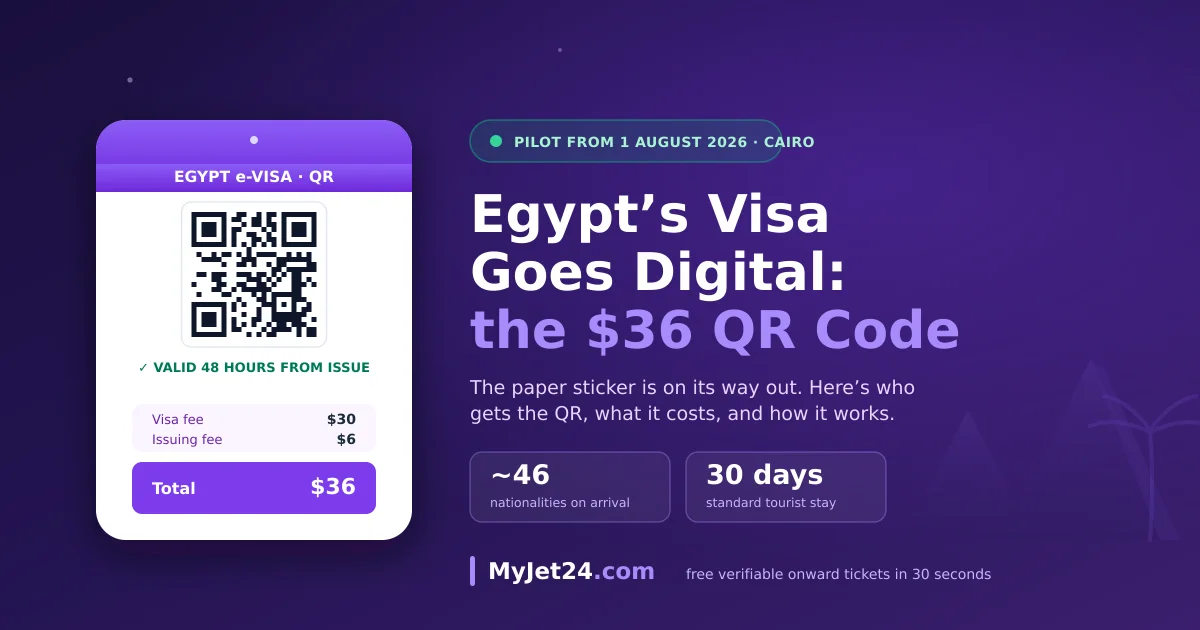
- Egypt is moving its visa-on-arrival to a digital QR code. The Ministry of Tourism and Antiquities announced it on 23 July 2026, with a pilot starting 1 August 2026 at Cairo International Airport before a nationwide rollout.
- The new price is $36 — the $30 visa fee plus a $6 issuing fee. You generate the QR code online, on an app, or at an airport kiosk, and it's valid for 48 hours from issuance.
- The paper sticker isn't gone yet. During the pilot the QR runs alongside the traditional sticker at Cairo; other airports (Hurghada, Sharm El-Sheikh, Luxor) still issue the paper visa for now.
- It only applies to the roughly 46 nationalities already eligible for visa-on-arrival — including the EU, UK, US, Canada and Australia. Others need the e-Visa or a consular visa, and some nationalities need prior security clearance.
- A tourist visa still means a 30-day stay, and your passport must be valid for at least six months with a blank page.
- Egypt doesn't legally require an onward ticket — but airlines and immigration can ask, so a confirmed return or onward booking is cheap insurance, especially when applying for the e-Visa in advance.
Egypt's new digital visa-on-arrival is a QR-code visa that replaces the paper sticker, piloting at Cairo International Airport from 1 August 2026. It costs $36 in total — a $30 visa fee plus a $6 issuing fee — and you generate the QR code before departure, in flight, or on arrival via an official portal, a mobile app, or an airport kiosk. The code is valid for 48 hours from issuance and is scanned against your passport at the border. It applies to the roughly 46 nationalities already eligible for visa-on-arrival, grants the standard 30-day tourist stay, and runs alongside the paper visa during the pilot before the sticker is phased out. Nationalities not eligible for visa-on-arrival must use Egypt's e-Visa at visa2egypt.gov.eg or apply through a consulate.
In this guide
- What changed on 1 August 2026
- The $36 cost, and 2026's run of fee rises
- How to get the QR code, step by step
- Who's eligible: visa-on-arrival, e-Visa or consulate
- e-Visa vs visa-on-arrival: which to use
- The Sinai exception: when you need no visa
- Entry requirements beyond the visa
- Seven mistakes to avoid
- Frequently asked questions
- The bottom line
What changed on 1 August 2026
For decades, arriving in Egypt as a tourist meant the same ritual: queue at a bank counter in the arrivals hall, hand over cash, and get a stamp-sized visa sticker pressed into your passport. On 23 July 2026 the Egyptian Ministry of Tourism and Antiquities announced that this is being replaced by a digital, QR-code visa — and the first travellers to use it arrive on 1 August 2026 at Cairo International Airport.
The idea is to move the visa off the passport page and onto a screen. Instead of buying a sticker at the airport, you generate a QR code — before you fly, during the flight, or after you land — and the border officer scans it against your passport. No sticker, no bank queue, in principle a faster arrival.
Status, stated plainly. As of publication the details here come from the Ministry's 23 July 2026 announcement, and the pilot had not yet started. It launches at Cairo only, running alongside the existing paper sticker; Hurghada, Sharm El-Sheikh and Luxor continue issuing the traditional visa for now. No firm date has been given for when the paper sticker disappears nationwide. Treat the rollout as staged, and check the official portal before you travel.
The $36 cost, and 2026's run of fee rises
The headline number is $36, and the Ministry's announcement breaks it down exactly: the $30 visa fee plus a $6 issuing fee for the digital processing. Payment goes through the portal via Egyptian banks (National Bank of Egypt and Banque Misr).
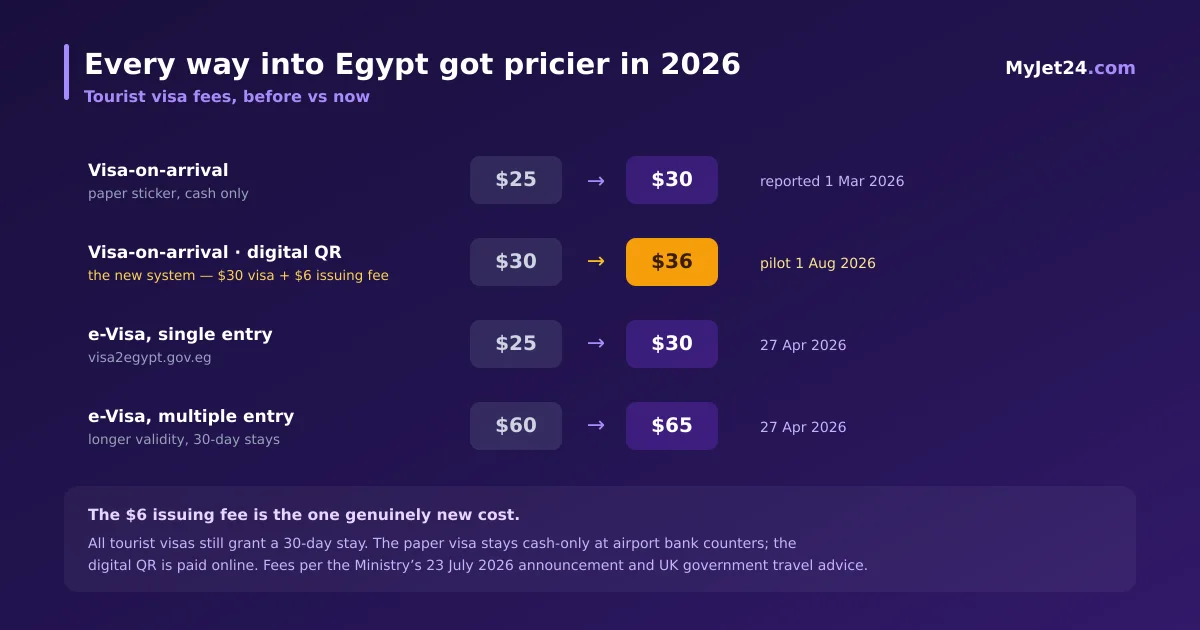
That $6 is the genuinely new cost — but it lands at the end of a year in which every way into Egypt got more expensive. Here's the 2026 picture:
| Route into Egypt | Before | 2026 | When |
|---|---|---|---|
| Visa-on-arrival (paper) | $25 | $30 | reported effective 1 March 2026 |
| Visa-on-arrival (new digital QR) | $30 | $36 ($30 + $6) | pilot from 1 August 2026 |
| e-Visa, single entry | $25 | $30 | effective 27 April 2026 |
| e-Visa, multiple entry | $60 | $65 | effective 27 April 2026 |
The visa-on-arrival is still cash-only at the airport bank counters (US dollars preferred; euros and pounds usually accepted) where the paper sticker is issued; the digital QR is paid online through the portal. The $25→$30 March rise was first reported via Egypt's travel-agent association rather than a formal decree, but the UK government's travel advice now lists the on-arrival fee as $30, so treat it as in force.
How to get the QR code, step by step
The mechanics are close to the digital arrival systems rolling out across Asia and beyond — a form, a payment, and a QR code you show at the border. What's unusual is the flexibility on when you can do it.
- Choose your channel. The Ministry says the QR can be generated through an official online portal, a dedicated mobile app, or self-service kiosks in the arrival halls — by you or by a travel agency on your behalf.
- Enter your details and pay. Payment runs through the portal via Egyptian banks. The total is $36.
- Generate the code close to arrival. The QR is valid for 48 hours from issuance, so this is not a weeks-ahead task — create it in the day or two before you land, or even mid-flight or after landing at a kiosk.
- Show it at the border. Have the QR on your phone (by email) or printed. The officer scans it against your passport, and you're admitted for the standard 30-day stay.
The 48-hour trap. Because the code expires 48 hours after you create it, generating it too early is a real mistake — a QR made a week before your flight will be dead on arrival. If in doubt, the airport kiosks exist precisely so you can create it on the spot. This mirrors the tight windows on digital arrival cards elsewhere; our overview of entry-document requirements by country puts Egypt's new system in context.
Who's eligible: visa-on-arrival, e-Visa or consulate
The digital QR changes how the visa-on-arrival is issued, not who qualifies for it. It applies only to the roughly 46 nationalities already eligible to buy a visa on arrival. Everyone else uses the e-Visa or a consulate, and a specific set of nationalities needs prior security clearance.
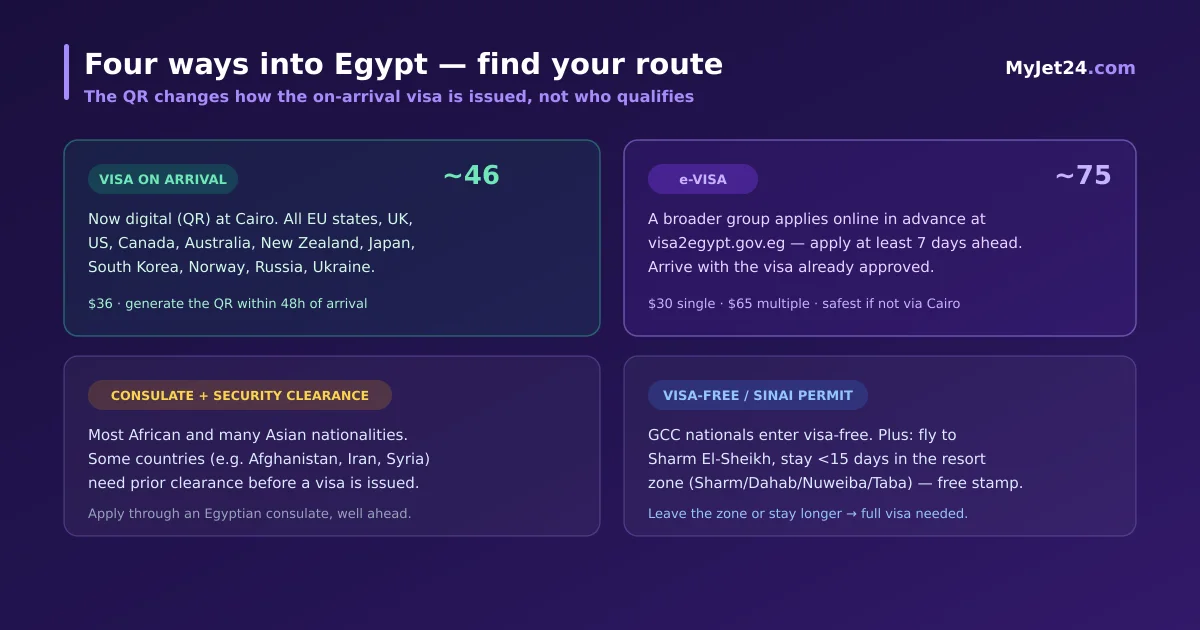
| Route | Who |
|---|---|
| Visa-on-arrival (now digital at Cairo) | ~46 nationalities, including all EU states, the UK, US, Canada, Australia, New Zealand, Japan, South Korea, Norway, Russia and Ukraine. |
| e-Visa (visa2egypt.gov.eg) | A broader group — around 75 nationalities — can apply online in advance instead of, or as an alternative to, visa-on-arrival. |
| Consulate + security clearance | Most African and many Asian nationalities; nationals of certain countries (among them Afghanistan, Iran, Syria and others) need prior clearance before a visa is issued. |
| Visa-free / resort permit | Mainly GCC nationals; plus the Sinai resort exemption for short stays (see below). |
The "around 46" figure is journalists' shorthand — the Ministry's announcement didn't publish a nationality list, and exact lists vary slightly by source. Confirm your own nationality's route on the official e-Visa portal or with an Egyptian consulate before you travel.
e-Visa vs visa-on-arrival: which to use
If your nationality can do either, the choice comes down to certainty versus convenience.
The e-Visa, applied for at the official portal visa2egypt.gov.eg, is the belt-and-braces option. You apply at least seven days before departure, pay online ($30 single entry, $65 multiple entry), and arrive with an approved visa already in hand — no dependence on airport systems or the pilot's teething problems. It's the safer choice if you want zero uncertainty at the border, or if you're flying into an airport that isn't Cairo.
The digital visa-on-arrival is faster to obtain and doesn't need a week's notice — useful for last-minute trips — but during the pilot it's a Cairo-only, brand-new system. If you value predictability, the e-Visa is the more conservative pick until the QR rollout is proven and nationwide. Either way, a tourist visa admits you for 30 days; the single-entry e-Visa is generally valid for three months from issue, the multiple-entry version longer.
The Sinai exception: when you need no visa at all
One of Egypt's most useful and least-known rules survives untouched. If you arrive by air at Sharm El-Sheikh and stay fewer than 15 days within the Red Sea resort zone — Sharm El-Sheikh, Dahab, Nuweiba or Taba — you don't need a visa at all. Immigration issues a free entry-permission stamp on arrival.
The catch is the boundary: the exemption covers the resort strip only. The moment you want to leave that zone — to visit St Catherine's Monastery, Cairo, or the Nile Valley — or to stay longer than 15 days, you need a full tourist visa (the e-Visa or the on-arrival QR). For a beach-and-diving trip to the South Sinai coast, though, it remains the cheapest entry in the country: free. Reports suggest Sharm and Taba now handle this "Sinai only" permission digitally at the immigration desk, in step with the broader move away from paper — the same trend behind South Africa's digital traveller declaration and arrival systems across the region.
Entry requirements beyond the visa
A visa is permission to apply for entry, not a guarantee of it. Two things sit alongside it, and it's worth being precise about which is a hard rule and which is prudence.
The hard rule: your passport. It must be valid for at least six months beyond your arrival date and have at least one blank page for the stamp. This one is non-negotiable and checked every time.
The prudent part: proof you'll leave. Here's the honest position, because a lot of travel sites overstate it. Egypt's official entry requirements — as published by, for example, the UK government — do not list a mandatory onward or return ticket, proof of funds, or a hotel booking for entry. Unlike Spain or the Schengen area, where a return ticket and funds are codified requirements — or neighbouring Morocco, where onward travel is commonly checked — Egypt doesn't put those in its rules.
That said, two real-world pressures make a confirmed onward booking worth carrying:
- Airlines. Carriers can and sometimes do ask for evidence of onward travel at check-in, because they bear the cost of flying back anyone refused entry — the same dynamic covered in our guide to whether airlines can deny boarding.
- Discretionary checks. Immigration officers can request a return ticket, proof of funds or accommodation at their discretion, particularly for one-way arrivals — and if you're applying for the e-Visa, a clear itinerary strengthens the application.
Cheap insurance, not a legal must. If you're travelling one-way or your plans are open, a verifiable onward ticket answers the "how are you leaving?" question in about thirty seconds — a real, checkable reservation you can show an airline or officer without committing to a fare. For travellers applying for the Egyptian visa itself, our Egypt visa flight-reservation guide covers exactly what to attach and how.
Seven mistakes to avoid
- Generating the QR code too early. It's valid for 48 hours only. Make it the day before you fly, in flight, or at an arrival kiosk — not a week ahead.
- Assuming the digital visa is everywhere. The pilot is Cairo-only. Flying into Hurghada, Sharm or Luxor still means the paper sticker for now.
- Turning up with the wrong route for your nationality. Only about 46 nationalities get visa-on-arrival; others must use the e-Visa or a consulate, and some need security clearance in advance.
- Bringing a card for the paper visa. The on-arrival sticker is cash-only at the bank counter — carry US dollars.
- Leaving the Sinai resort zone on a free stamp. The "Sinai only" permission doesn't cover Cairo, Luxor or day-trips beyond the resort strip. That needs a full visa.
- Ignoring the six-month passport rule. Under six months' validity, or no blank page, and you can be refused regardless of the visa.
- Travelling one-way with nothing to show. Egypt doesn't mandate an onward ticket, but an airline or officer may still ask — carry a confirmed booking so it's never a problem.
Frequently asked questions
How much is the Egypt visa-on-arrival in 2026?
The new digital visa-on-arrival costs $36 in total — a $30 visa fee plus a $6 issuing fee — according to the Ministry's July 2026 announcement. The older paper visa-on-arrival is $30, cash only, paid at a bank counter in the arrivals hall. Both grant a 30-day tourist stay.
When does Egypt's digital QR visa start?
The pilot begins on 1 August 2026 at Cairo International Airport, across all arrival terminals, as the first stage of a nationwide rollout. During the pilot the QR runs alongside the traditional paper sticker, and other airports — Hurghada, Sharm El-Sheikh, Luxor — continue issuing the paper visa until the rollout reaches them.
How do I get the Egypt QR-code visa?
You generate the QR code through an official online portal, a mobile app, or a self-service kiosk in the arrival hall — either yourself or via a travel agency. You can create it before departure, during your flight, or after landing. Pay the $36 online, then show the QR (by email or printed) to the border officer, who scans it against your passport.
How long is the Egypt QR code valid?
The QR code is valid for 48 hours from the moment it's issued. That's why you should generate it close to arrival rather than weeks ahead — a code created too early will have expired by the time you land. Airport kiosks let you create it on the spot if needed.
Who is eligible for Egypt's visa-on-arrival?
Around 46 nationalities, including all EU states, the UK, US, Canada, Australia, New Zealand, Japan, South Korea, Norway, Russia and Ukraine. The digital QR applies to this same group. Nationalities not on the visa-on-arrival list must apply for Egypt's e-Visa online or through a consulate, and some nationalities require prior security clearance.
Should I get an e-Visa or a visa-on-arrival for Egypt?
If you want certainty, the e-Visa from visa2egypt.gov.eg is the safer choice — you arrive with the visa already approved, which matters especially if you're not flying into Cairo, since the QR pilot is Cairo-only for now. The visa-on-arrival is faster to get and needs no advance notice, good for last-minute trips. Both give a 30-day stay; the single-entry e-Visa costs $30, multiple entry $65.
How long can I stay in Egypt on a tourist visa?
The standard tourist visa — whether on arrival or e-Visa — permits a stay of up to 30 days. A single-entry e-Visa is generally valid for three months from issue (meaning you must enter within that window), and the multiple-entry version is valid longer, but each stay is still capped at 30 days.
Do I need a return ticket to enter Egypt?
Egypt's official entry rules do not list a mandatory onward or return ticket, so it isn't a codified requirement the way it is for Spain or the Schengen area. However, airlines can ask for proof of onward travel at check-in, and immigration officers may request it at their discretion — particularly for one-way arrivals. Carrying a confirmed onward or return booking is sensible insurance rather than a legal must.
Does the QR visa replace the paper visa completely?
Not yet. During the pilot the digital QR runs alongside the paper sticker at Cairo. The Ministry says that once the pilot concludes, the sticker will be phased out and the QR code will become the sole entry method — but no firm nationwide end-date for the paper visa has been announced. For now, expect the paper sticker at airports other than Cairo.
Can I visit Sharm El-Sheikh without a visa?
Yes, within limits. If you arrive by air at Sharm El-Sheikh and stay under 15 days within the Red Sea resort zone — Sharm El-Sheikh, Dahab, Nuweiba or Taba — you get a free entry-permission stamp and need no visa. To travel beyond that zone (to Cairo or the Nile Valley) or to stay longer than 15 days, you need a full tourist visa.
What passport validity does Egypt require?
Your passport must be valid for at least six months beyond your date of arrival in Egypt, and have at least one blank page for the entry stamp. This is a hard requirement checked at the border, independent of your visa, and travelling with less can lead to refusal.
Can I pay the Egypt visa-on-arrival by card?
The traditional paper visa-on-arrival is cash only, paid in US dollars (euros and pounds are usually accepted) at bank counters before immigration. The new digital QR visa is paid online through the portal via Egyptian banks, so the move to digital is also a move away from needing cash at the airport.
Is the $36 fee confirmed by the Egyptian government?
The $36 figure — $30 visa plus a $6 issuing fee — comes from the Ministry of Tourism and Antiquities' own announcement of 23 July 2026, distributed publicly. As of publication it had been widely reported but the pilot had not yet begun, so verify the current fee and process on the official portal before you travel, as pilot details can change.
The bottom line
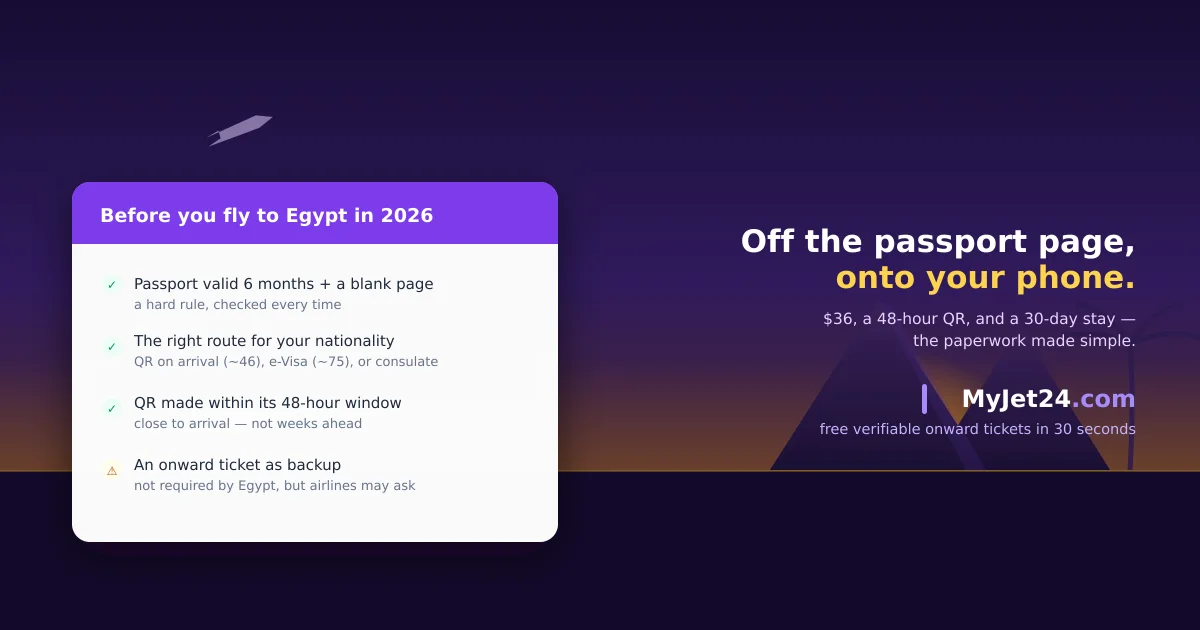
Egypt's move to a QR-code visa is a small, sensible modernisation — the same shift from paper to phone that arrival systems worldwide are making — wrapped around a familiar reality: entering the country now costs a little more, and the rules depend on your nationality and where you land. For the roughly 46 visa-on-arrival nationalities flying into Cairo, the new system should mean a faster arrival for $36, provided you generate the code inside its 48-hour window. For everyone else, the e-Visa and the consular route are unchanged.
Get the fundamentals right and the rest is easy: a passport with six months and a blank page, the right visa route for your nationality, and the QR code made close to arrival, not weeks before. And while Egypt won't demand it at the gate, travel with a verifiable proof of onward travel if your ticket is one-way — it's the cheapest way to make sure the only thing waiting for you in Cairo is the queue for a taxi, not a question you can't answer.
Sources
- Egyptian Ministry of Tourism and Antiquities — "Egypt Launches New Digital Visa-On-Arrival System" (announcement, 23 July 2026): https://www.prnewswire.com/news-releases/egypt-launches-new-digital-visa-on-arrival-system-for-a-faster-seamless-arrival-experience-302832533.html
- UK Government (FCDO) — Egypt travel advice, entry requirements: https://www.gov.uk/foreign-travel-advice/egypt/entry-requirements
- Egyptian e-Visa official portal: https://visa2egypt.gov.eg/
- iVisa — Egypt increases tourist e-Visa fees (27 April 2026): https://www.ivisa.com/news/2026-04-28-eg-egypt-increases-tourist-e-visa-fees
- Wego — Egypt digital visa-on-arrival details and eligibility: https://www.wego.com/news/egypt-digital-visa-on-arrival
This guide reflects Egypt's visa rules and the digital visa-on-arrival as announced by the Ministry of Tourism and Antiquities on 23 July 2026, with UK government and official e-Visa portal sources as of 28 July 2026. The digital system is a pilot that had not begun at the time of writing; fees, eligibility and rollout can change. Verify on visa2egypt.gov.eg and with your carrier before you travel. This article is informational and not legal or immigration advice.
