
Last updated: 26 August 2026 · Reading time: 13 min · Author: James Mitchell, CEO & Founder of MyJet24 · Reviewed by: Joshua White, Travel Documentation Writer
TL;DR — Key facts
- Whoever sold you the ticket controls it. If an agency or online travel site issued it, that seller holds the record, and the airline will decline to change it even though it can see it.
- The deciding field is "merchant of record" — US regulation defines it as whoever appears on your card statement. That single name settles who owes you a refund.
- The runaround is not a loophole; the rules already close it. 14 CFR § 260.9(d) makes the carrier tell your agent without delay whether a refund is due, and § 260.9(e) makes it transfer the money to the agent.
- The agent's deadline is 7 business days for card purchases and 20 calendar days otherwise, in your original form of payment — a failure to meet it is a named unfair and deceptive practice under § 399.80(l).
- "Significant change" has a legal threshold, not an opinion: 3 hours domestic, 6 hours international, a different airport, an extra connection, or a downgrade.
When you book through a third party, that seller owns and controls your ticket, not the airline. The carrier can see the reservation but will not amend, refund or reissue it, because the selling agent holds those rights until control passes to the airline shortly before departure. For refunds, the party named on your card statement is the one legally responsible.
A real reservation, issued by a named seller you can actually reach.
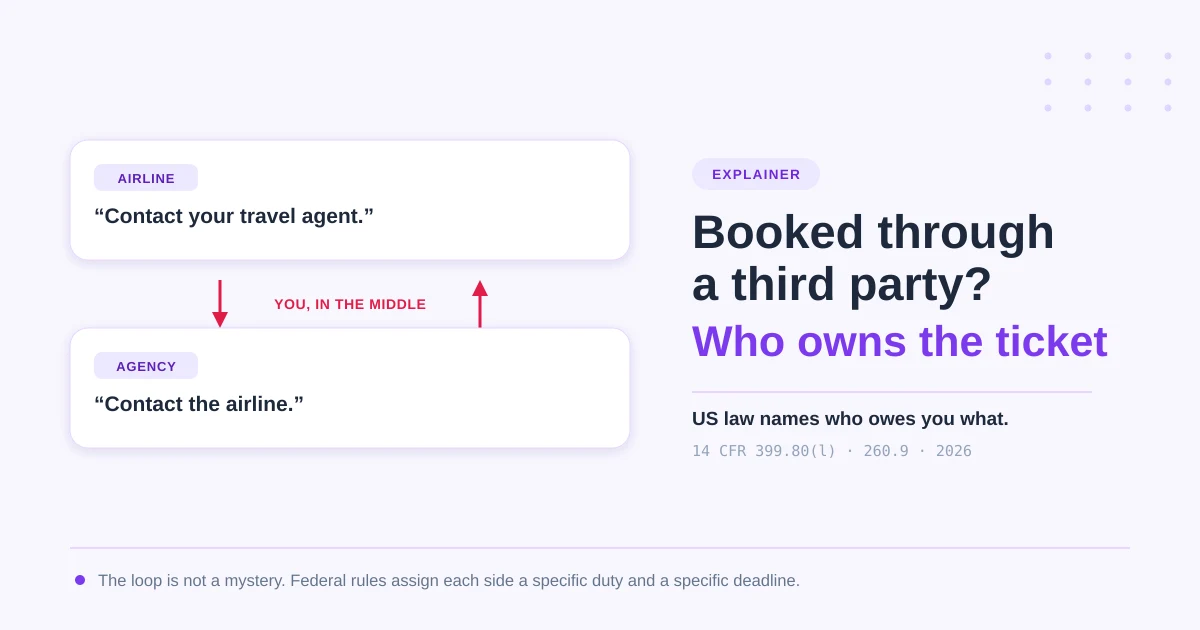
Who owns your ticket after you pay
Ticket ownership is the right to change, reissue or refund a booking, and it belongs to whichever party issued the ticket. Book on the airline's own site and the airline owns it. Book through an online travel site, a corporate tool or a high-street agency and that seller owns it — even though the flight, the aircraft and the crew are the airline's.
The reservation itself lives in a shared system both parties can read. What is not shared is authority. The agency that created the record is recorded as its responsible office, and the airline's staff see the booking flagged as belonging to someone else. An agent looking at your booking is not being obstructive when they say they cannot help; in most cases their screen will not let them commit the change.
The practical consequence is that "I booked with Lufthansa" and "I booked a Lufthansa flight through Expedia" are different transactions with different counterparties. In the first, one company sold and operates. In the second, one company sold and another operates, and every service question has to be routed to the correct one.
Key takeaway: The airline flies you. The seller owns the paperwork. Those are two different companies whenever you did not buy direct.
Merchant of record: the one field that settles everything
Merchant of record is the entity that processed your payment, and US regulation defines it by a test you can run in thirty seconds. Under 14 CFR § 260.2 it is "the entity (carrier or ticket agent) responsible for processing payments by consumers for airfare or ancillary services or products … as shown in the consumer's financial charge statements, such as debit or credit card charge statements."
Open your banking app and read the line. If it says the airline, the airline took your money and owes you the refund. If it says a travel site, an agency or a payment processor acting for one, that company took your money and owes you the refund. This is not a matter of who was more helpful on the phone — it is the legal hook the whole refund regime hangs on.
It also explains a split that confuses people. You can be an airline customer for one part of a trip and an agency customer for another: seats and bags bought afterwards on the carrier's own site make the airline the merchant of record for those fees, while the fare stays with the agency. Two charges, two counterparties, one trip.
Before you spend an hour on hold, spend thirty seconds in your banking app. The name on the charge is the name of the company that has to pay you back.
Key takeaway: Your card statement, not your memory of the booking, identifies who is responsible.
Control transfer: why the airline suddenly can help on the last day
Control transfer is the moment authority over your booking moves from the selling agency to the operating carrier, and it typically happens when the flight opens for check-in, roughly 24 to 48 hours before departure. Before that point the airline generally will not act. After it, the airline is the party that handles you.
This single mechanism explains a symptom travellers usually blame on a website bug. If online check-in refuses to open on an agency booking, that is often not an error at all — the record has simply not been released yet, which is one of the causes covered in our breakdown of why online check-in will not open. Waiting a few hours frequently resolves what an hour of support chat cannot.
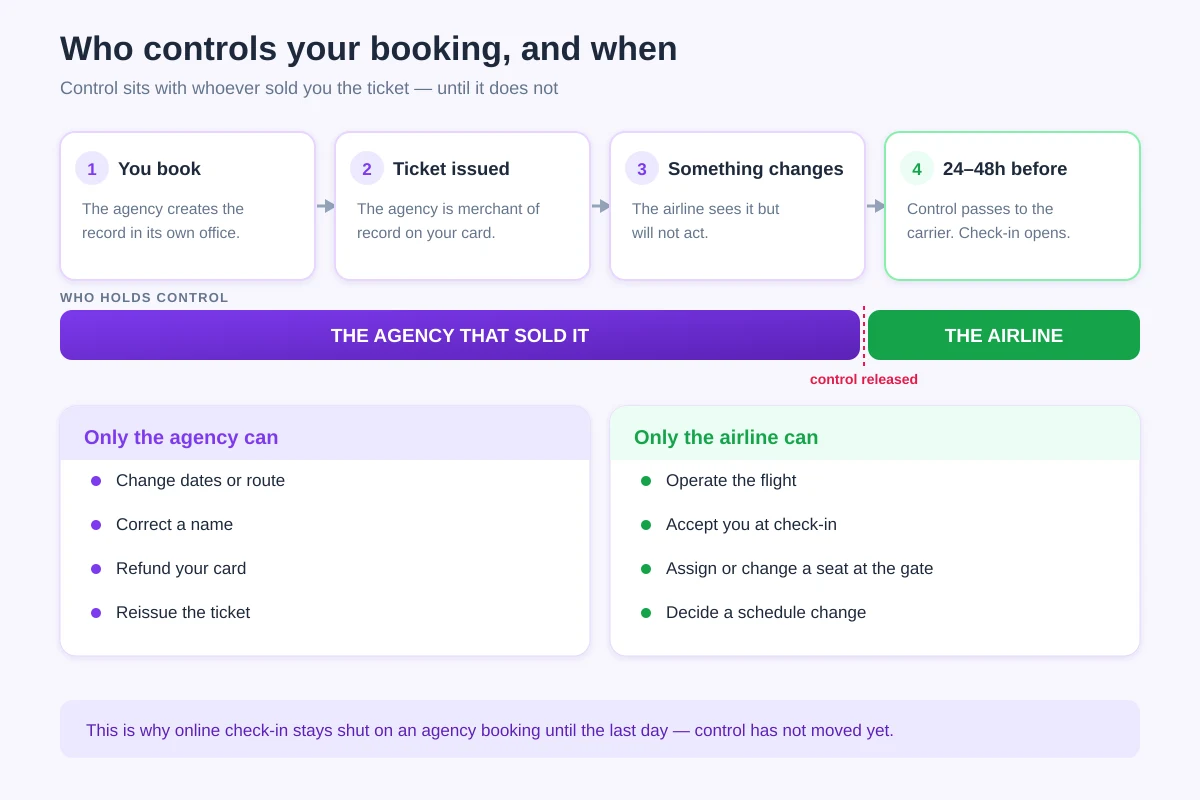
Compare two problems on the same reservation. A date change requested three weeks out has to go through the agency, because the agency holds the ticket. A gate agent moving your seat on the day of travel is the airline acting on a record it now controls. Same booking, different owner, different answer — and the difference is the calendar.
Key takeaway: Timing changes who can help you. A question that is impossible on Tuesday can be routine on Friday.
The runaround is already illegal, and the rules say so by name
The loop — the airline telling you to call the agent, the agent telling you to call the airline — is a compliance failure rather than a grey area. US regulation assigns each side a specific duty, and the duties are written to make the loop impossible if both parties follow them.
Two paragraphs do the work. 14 CFR § 260.9(d) obliges the carrier to answer the eligibility question, and § 260.9(e) obliges it to hand over the money so the agent can pay you.
"Carriers' obligation to transfer funds to ticket agents. In situations where a ticket agent is responsible for providing the refund to the consumer pursuant to 14 CFR 399.80(l) and the ticket agent does not possess the funds of the consumer, that carrier that has the funds must promptly transfer the funds to the ticket agent."
— 14 CFR § 260.9(e)
Read that against the excuse you were given. "We are waiting on the airline" is a real constraint — but the carrier is required to inform the agent "without delay" and to move the funds promptly. "The agency has your money" may be true, and the rule anticipates exactly that by naming who must send it where. Neither party is permitted to sit still.
| What you are told | Who actually has the duty | Rule |
|---|---|---|
| "Contact your travel agent." | Correct for the payout if the agent is merchant of record — but the carrier still owes the agent an answer. | § 260.9(d) |
| "We are still waiting on the airline." | The carrier must inform the agent without delay once you have requested the refund. | § 260.9(d) |
| "The airline has not sent us the money." | The carrier holding the funds must promptly transfer them to the agent. | § 260.9(e) |
| "Refunds take eight to twelve weeks." | 7 business days for card purchases, 20 calendar days otherwise. | § 399.80(l) |
| "We can offer you a travel credit." | They must first tell you a refund is available; credits need at least 5 years' validity. | § 399.80(l) |
| "There is a refund processing fee." | Carriers may not retain a processing fee on a refund that is due. | § 260.10 |
Key takeaway: Every line in that left-hand column has a paragraph number sitting against it. Quoting the number changes the conversation.
"Significant change" is a threshold, not an opinion
A significant change is a delay or itinerary change that crosses a defined line, and crossing it is what entitles you to a refund instead of a rebooking. The definition sits in 14 CFR § 399.80(l)(1)(vii) and it is refreshingly concrete.
A change qualifies when you are scheduled to depart three hours or more earlier (six for international itineraries), arrive three hours or more later (six international), depart from or arrive at a different airport, travel on an itinerary with more connection points than the original, or are downgraded to a lower class of service. Two further limbs cover travellers with a disability affected by a change of connecting airport or by aircraft substitution that removes an accessibility feature.
This matters because agencies and airlines both tend to present a rebooking as the only option. If the replacement itinerary crosses one of those thresholds and you do not want it, the refund is yours — and you do not have to argue about whether four hours "feels" significant. On a domestic itinerary, it is.
Key takeaway: Three hours domestic, six hours international, a different airport, an added connection, or a downgrade. Measure the new itinerary against that list before accepting it.
The numbers that decide your case
- 7 business days — the ticket agent's deadline to refund a card purchase, running from when the carrier informs them (§ 399.80(l)).
- 20 calendar days — the deadline for cash, cheque, debit card and other payment forms.
- 3 hours / 6 hours — the domestic and international thresholds that make a delay or change "significant" (§ 399.80(l)(1)(vii)).
- 5 years — the minimum validity of any voucher or credit an agent offers in place of a refund.
- No processing fee — carriers "may not retain a processing fee for issuing refunds that are due" (§ 260.10).
All figures read from the eCFR text of 14 CFR Parts 260 and 399 as in force on 26 August 2026. These are US rules and apply to flights to, from and within the United States.
Issued in about 30 seconds, with a locator that resolves on the airline's own system.
Who to call, by situation
The right counterparty depends entirely on what you need done. Anything that edits the ticket goes to the seller; anything that happens at the airport goes to the carrier. Getting this wrong costs an afternoon, not a fare, but it costs the afternoon every single time.
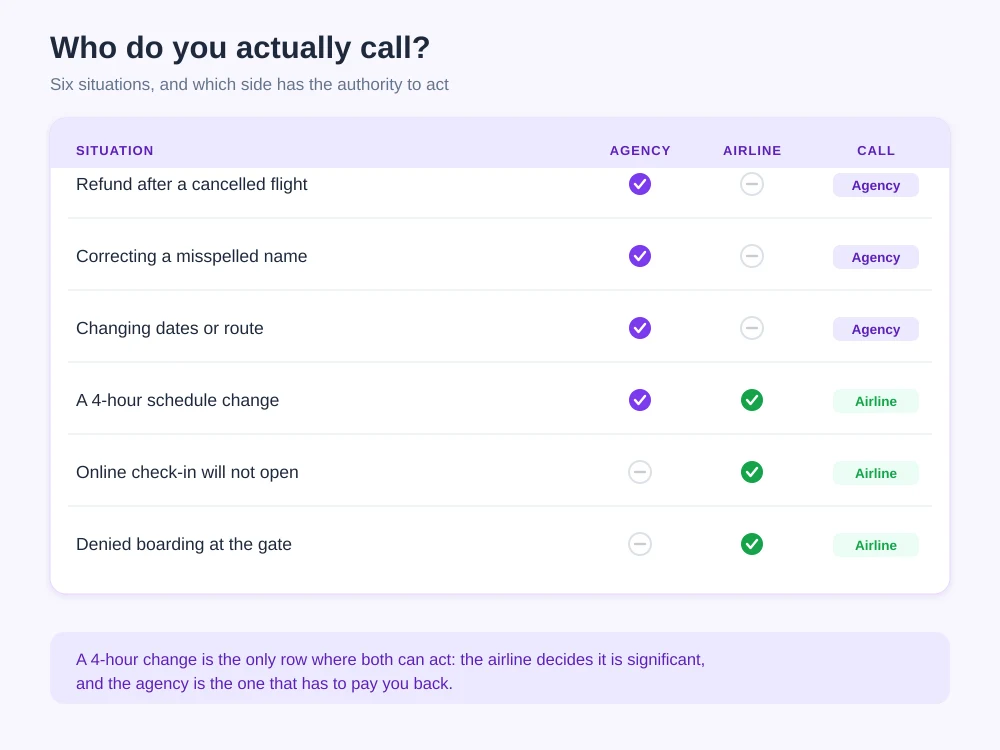
One row in that matrix behaves differently from the rest, and it is the row people fight about. A four-hour schedule change is decided by the airline — it is the carrier that moved the flight and the carrier that determines what it is offering — but if the agency is merchant of record, the agency is the party that has to put the money back on your card. Both sides genuinely have a role, which is precisely why this is the scenario that stalls.
Name corrections deserve their own warning. Only the ticket's owner can touch the name, so on an agency booking the airline will refuse even a single-letter fix, and the clock is unforgiving because the correction has to happen before travel. The rules on what must match and what does not are in our guide to the name on a flight ticket.
Key takeaway: Ticket edits go to the seller. Airport events go to the carrier. Money follows the merchant of record.
Breaking the loop: five steps that work
The way out of the runaround is to stop asking each party to help and start asking each party to perform a specific duty, in order. Vague requests get vague answers; a named obligation with a deadline gets escalated.
- Identify the merchant of record. Read the name on your card statement. That is the company that must return your money, whatever either party tells you on the phone.
- Make the airline produce a decision. Ask it, in writing, to confirm to your ticket agent whether you are eligible for a refund. § 260.9(d) requires it to do so without delay once you have made the request through the agent.
- Put the request to the agent in writing and start the clock. Their deadline is 7 business days from the carrier's answer for a card purchase. Ask them to confirm the date they received it — that date is the start of the clock.
- Decline the voucher unless you actually want it. A refund must be offered first, in your original form of payment. If you do accept a credit, it has to remain valid for at least five years.
- Escalate if the loop restarts. Failing to make a prompt refund is a named unfair and deceptive practice, which makes it a regulatory complaint rather than a customer-service grievance.
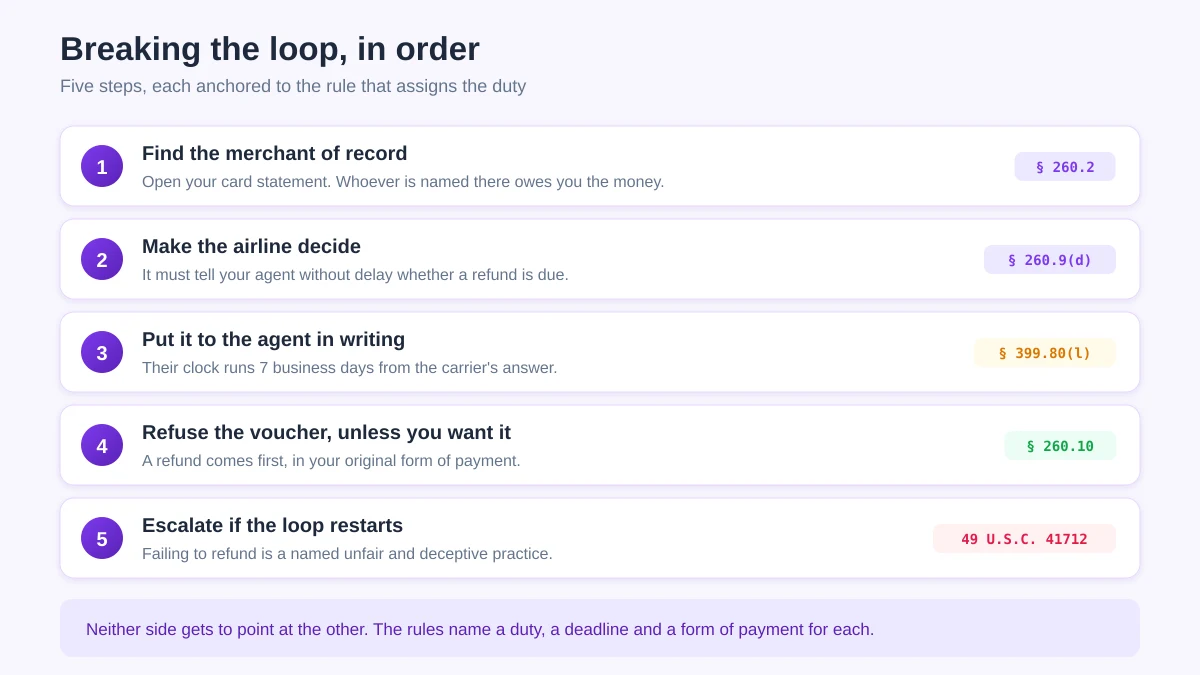
In handling escalations for travellers, the change that moves a stalled case is almost always step two. Most people ask the agency for a refund and then wait, which leaves the agency genuinely blocked and legitimately able to say it is waiting on the carrier. Forcing the eligibility decision out of the airline first removes that answer, and the file starts moving because the deadline in step three can finally begin.
Stop asking either company to be helpful. Ask each one to do the specific thing a rule already requires, and put the paragraph number in the message.
Key takeaway: The order matters. Airline decision first, agent deadline second — reversing them is what keeps most cases stuck.
Outside the United States, the duties sit elsewhere
The rules above are US Department of Transportation rules, and they reach flights to, from and within the United States. On a purely intra-European or intra-Asian itinerary bought from a European seller, a different set applies — and the difference is worth knowing before you quote a paragraph number at someone in Frankfurt.
In Europe the strongest consumer instrument is the air passenger rights regulation, which places its obligations on the operating carrier rather than the seller. That inverts the picture: for cancellation compensation the airline is your counterparty even when an agency sold the ticket, which is covered in our guide to delay and cancellation compensation under EU261 and, for the denied-boarding case, in what you are owed when you are bumped. The fare refund still tends to route through the seller; the statutory compensation does not.
The practical rule of thumb: statutory compensation follows the operating carrier, while the money you actually paid follows the merchant of record. Two different pots, two different counterparties, frequently on the same booking.
Key takeaway: Ask which regime covers your route before you decide who to chase. US rules bind the seller; European rules bind the flyer.
The separate-ticket trap
Separate tickets are two or more bookings that happen to connect, and they carry none of the protection a single through-booked itinerary gives you. If the first flight is late and you miss the second, the second airline owes you nothing — you simply failed to turn up for a booking it sold you.
Third-party sellers make this easy to do accidentally, because a search engine can display two unrelated tickets as one attractive result. The signals to look for are two different record locators, two confirmation emails, and baggage that will not be checked through. Our guide to layovers, stopovers and minimum connection times covers how much slack a genuine connection needs.
The ownership problem compounds here. With one ticket, one seller owns the whole itinerary and one party has to fix a disruption. With two tickets you may have two sellers, neither of whom regards the other's flight as their problem, and a disruption that no single counterparty is obliged to solve.
Key takeaway: Two locators means two contracts. Count the record locators before you count the savings.
What this means when the booking is for a visa or a border check
If a reservation exists to satisfy a document requirement rather than to fly, the seller question changes shape but does not disappear. What an officer or a check-in agent needs is a record that resolves on the airline's system, and what you need is a seller who can still be reached if the reservation has to be reissued or re-dated.
Both of those are seller properties, not airline properties. A reservation is only as verifiable as the booking behind it — the distinction we set out in booked but not ticketed — and it is only as fixable as the company that issued it. A cheap PDF from a service that does not answer email fails both tests at once.
Check-in staff work from the rules engine described in Timatic, the database that decides if you board, and it reads the live record rather than your document. That is the whole argument for using a seller that issues a genuine booking with a resolvable record locator, and for knowing which company to contact when something needs changing. If you are comparing providers on exactly that basis, our honest comparison of ten services is the place to start.
Key takeaway: Pick the seller on two questions: does the booking resolve, and will they answer you when it needs changing.
The mistakes that keep people stuck
Calling the wrong party first. Most stalled cases are ownership errors, not bad luck. A ticket edit asked of the airline, or a gate problem asked of the agency, produces a genuine "we cannot do that" and burns the afternoon.
Accepting a voucher to end the conversation. Credits are offered because they cost the seller less than cash. You are entitled to be told a refund exists before the alternative is put to you.
Never putting anything in writing. The deadlines only start when a request is made and an answer is received. A phone call you cannot date is a clock you cannot start.
Treating a rebooking as compulsory. If the replacement crosses the three-hour or six-hour line, or lands you at a different airport, or adds a connection, you may refuse it and take the money.
Buying add-ons from the airline on an agency ticket, then expecting one refund. Two merchants of record produce two separate refund claims, on two separate clocks.
Key takeaway: Nearly every version of this problem is solved by identifying the right counterparty and giving them a dated, written request.
Next steps
If you are in the loop right now, do three things in this order: read the merchant name on your card statement, ask the airline in writing to confirm your refund eligibility to your agent, then give the agent that answer and ask them to confirm the date they received it. Those three moves convert an open-ended complaint into a deadline someone has to meet.
If you are choosing where to book, the seller is not a detail. It decides who can change your ticket, who owes you money, and whether anyone answers when a border officer's question turns into a paperwork problem at short notice.
A genuine reservation with a locator that resolves — and a named seller who replies.
About the author
James Mitchell is the CEO and founder of MyJet24. He built the company's reservation issuing and verification workflow and works the escalation queue himself when a booking has to be reissued against a consular or airline deadline.
Reviewed by Joshua White, Travel Documentation Writer at MyJet24.
Last reviewed on 26 August 2026 by Joshua White.
Sources
- 14 CFR § 399.80 — Unfair and deceptive practices of ticket agents, eCFR (paragraph (l), refund duty, deadlines, significant-change definition)
- 14 CFR § 260.9 — Notification to consumers, eCFR (paragraphs (d) and (e), carrier duties toward ticket agents)
- 14 CFR Part 260 — Refunds for Airline Fare and Ancillary Service Fees, eCFR (§ 260.2 definitions, § 260.10 prompt refunds)
- Lufthansa Group Airlines — Booking & Ticketing Policy for Travel Agents, v01SEP25 (agency obligations to ticket or cancel)
Methodology note: every figure and quotation above was read from the eCFR text of 14 CFR Parts 260 and 399 as in force on 26 August 2026, not from secondary summaries. These are United States rules and bind carriers and ticket agents for flights to, from and within the US; other jurisdictions place the equivalent duties differently. Nothing here is legal advice.
Last updated: 26 August 2026 · Reviewed by Joshua White, Travel Documentation Writer, MyJet24
