
Last updated: 27 August 2026 · Reading time: 13 min · Author: James Mitchell, CEO & Founder of MyJet24 · Reviewed by: Joshua White, Travel Documentation Writer
TL;DR — Key facts
- Usually not, if your prints are less than 59 months old. The Visa Code copies them forward from your earlier application instead of collecting them again.
- The clock runs from your FIRST enrolment, not your last one. Article 13 says "entered in the VIS for the first time" — applying again does not reset it, which is the detail almost every guide omits.
- Two different periods get confused. The 59-month reuse window starts when your prints were taken; VIS storage runs up to five years from the visa's expiry date. They are measured from different events.
- Being inside the window is a likelihood, not a right. A consulate may re-take prints anyway, and must do so where there is reasonable doubt about identity.
- Children under 12 are exempt entirely, along with people for whom fingerprinting is physically impossible and certain heads of state and official delegations.
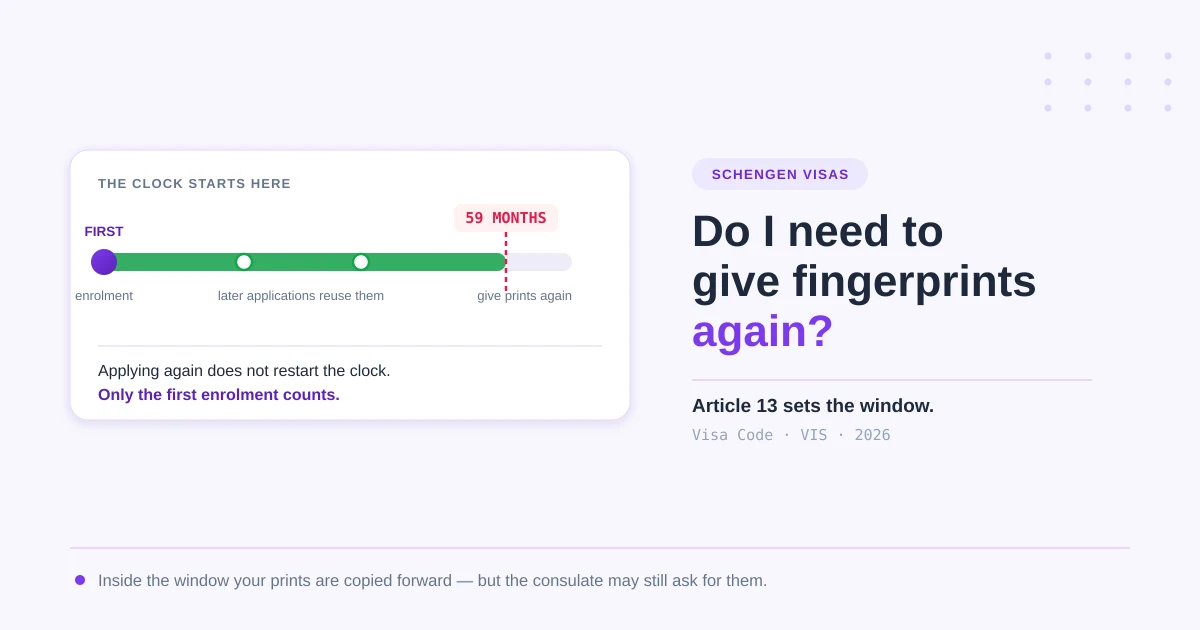
Usually not. If your fingerprints were first entered in the Visa Information System less than 59 months ago, they are copied to your new application rather than taken again, and you may not need to attend in person. The window runs from your first enrolment, and the consulate can still ask for prints at its discretion.
A verifiable booking for the file via MyJet24 Premium ($7.90) — without buying a ticket before a decision.
Do I have to give fingerprints again?
Usually not. Fingerprints given for an earlier Schengen visa application are reused for a new one if they are recent enough, which means many repeat applicants never attend a biometric appointment a second time.
The rule sits in Article 13 of the Visa Code, and its wording is precise: "Where fingerprints collected from the applicant as part of an earlier application were entered in the VIS for the first time less than 59 months before the date of the new application, they shall be copied to the subsequent application."
Two words in that sentence do most of the work. Shall makes the copying mandatory rather than optional where the condition is met. First time decides when the clock started — and it is not the date most applicants assume.
Key takeaway: Inside 59 months, the law says your prints are copied forward. You are not starting from scratch.
When does the 59-month clock actually start?
It starts on the day your fingerprints were first entered into the Visa Information System — your earliest Schengen application, not your most recent one. Each subsequent application copies those original prints forward without restarting the period.
This is where the common assumption goes wrong. People count 59 months back from today, find a visa they were issued two years ago, and conclude they are comfortably inside the window. If that two-year-old visa merely reused prints taken six years earlier, the window has already closed and they will be attending in person.
Work from the earliest Schengen visa in your passport history rather than the latest. If your first application was in March 2021, your window closed in February 2026 regardless of how many visas you were granted in between.
Applying again does not top the clock up. The 59 months are counted once, from the first time your prints entered the system, and they run out whether or not you travelled in between.
Key takeaway: Find your first Schengen visa, not your last. That appointment date is the one that matters.
Why do people get different answers about this?
Because two separate periods govern your biometric data, and they are measured from different events. Confusing them produces confident, contradictory advice from people who are each half right.
The reuse window is the 59 months in Article 13, counted from your first enrolment. The storage period is set by Article 23 of the VIS Regulation: each application file is kept "for a maximum of five years", running from the visa's expiry date where one was issued, from the decision date where it was refused, or from the file-creation date where the application was withdrawn.
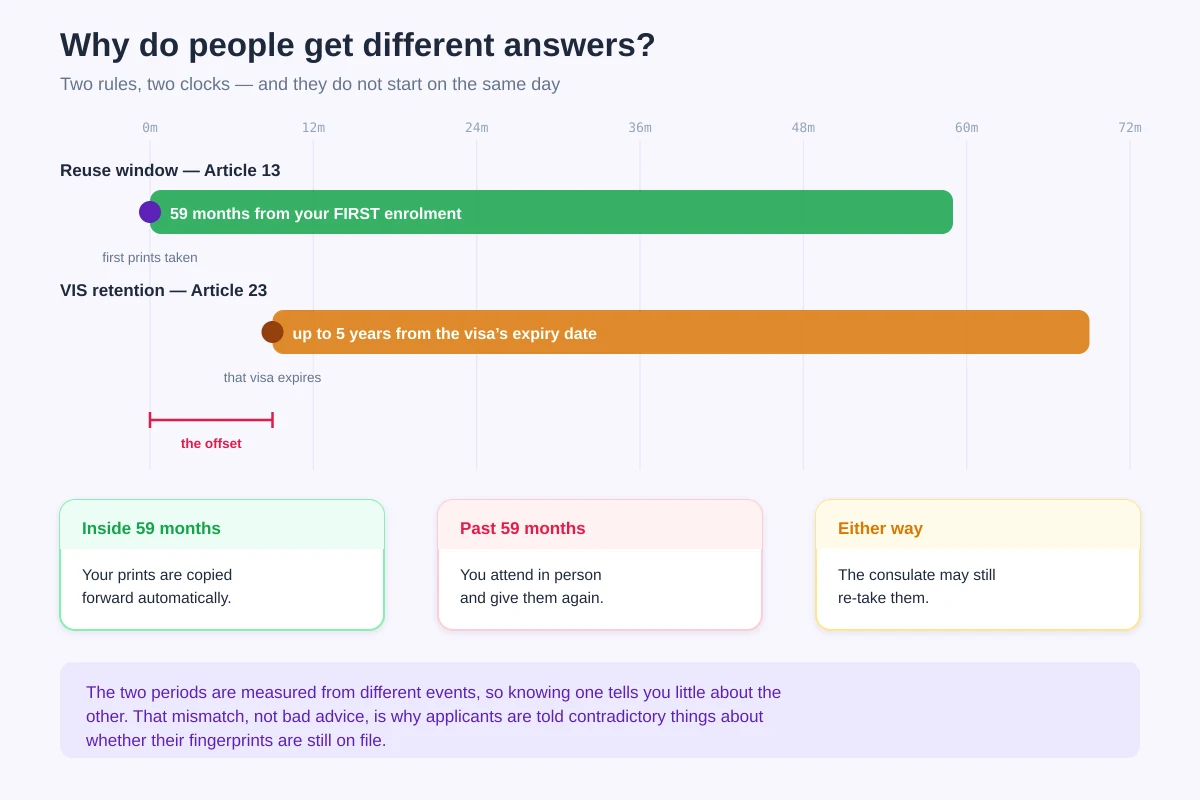
So your file can still exist in the VIS while your reuse window has closed, and the reverse is possible too. Someone telling you "your data is kept for five years" is describing storage, not reuse. Both statements are accurate; only one answers the question about your appointment.
Key takeaway: Storage and reuse are different rules with different start dates. Ask specifically about the 59-month window.
Can the consulate take my prints anyway?
Yes. Reuse is the default inside the window, not a right you can insist on. A consulate may collect fresh fingerprints whenever it chooses, and it must do so where there is reasonable doubt about the applicant's identity.
That doubt threshold is lower than people expect. A name change, a new passport with a different transliteration, a poor-quality original scan, or a gap of several years between applications can all prompt a fresh enrolment. Missions also differ in practice: some reuse routinely, others ask most applicants to attend regardless.
The practical consequence is about planning rather than rights. Treat reuse as likely, not certain, and leave room in your timeline for an appointment you may not need — which is easier when you know how the appointment system behaves, covered in our guide to booking a visa appointment through VFS Global.
Reuse is what the system does by default, not something you can hold a consulate to. The rule tells you what will probably happen; the mission decides what does.
Key takeaway: Plan as though you will attend. Being pleasantly surprised is cheaper than being caught short.
Who never has to give fingerprints at all?
Four groups are exempt from the fingerprint requirement outright, and Article 13 lists them. The exemption removes the fingerprints only — the photograph is still required.
| Exempt group | What still applies |
|---|---|
| Children under 12 | A photograph is still taken; the child still needs their own application |
| People for whom fingerprinting is physically impossible | Where impossibility is temporary, prints are taken at the next application |
| Heads of State and government, members of national governments, accompanying spouses and official delegations | Applies to invited official travel, not private trips |
| Sovereigns and senior members of royal families on official invitation | Same condition — the invitation is what triggers it |
The under-12 exemption has a consequence parents miss. A child fingerprinted at 11 was never enrolled at all, so at 13 they are a first-time applicant with nothing to copy forward. The rest of what a child needs in their own name is set out in our guide to whether children need their own travel documents.
Key takeaway: Exempt means no fingerprints, never no application. The photograph and the file still exist.
Why did I give fingerprints at the border too?
Because Europe runs two separate biometric systems, and being in one does not put you in the other. The Visa Information System enrols you at the consulate before you travel. The Entry/Exit System enrols you at the external border when you arrive.
They collect different things for different reasons. The VIS takes ten fingerprints and a photograph as part of assessing a visa application. The EES records a facial image and four fingerprints to log the crossing itself and count your days. Neither substitutes for the other, which is why a visa holder gives prints twice on a single trip.
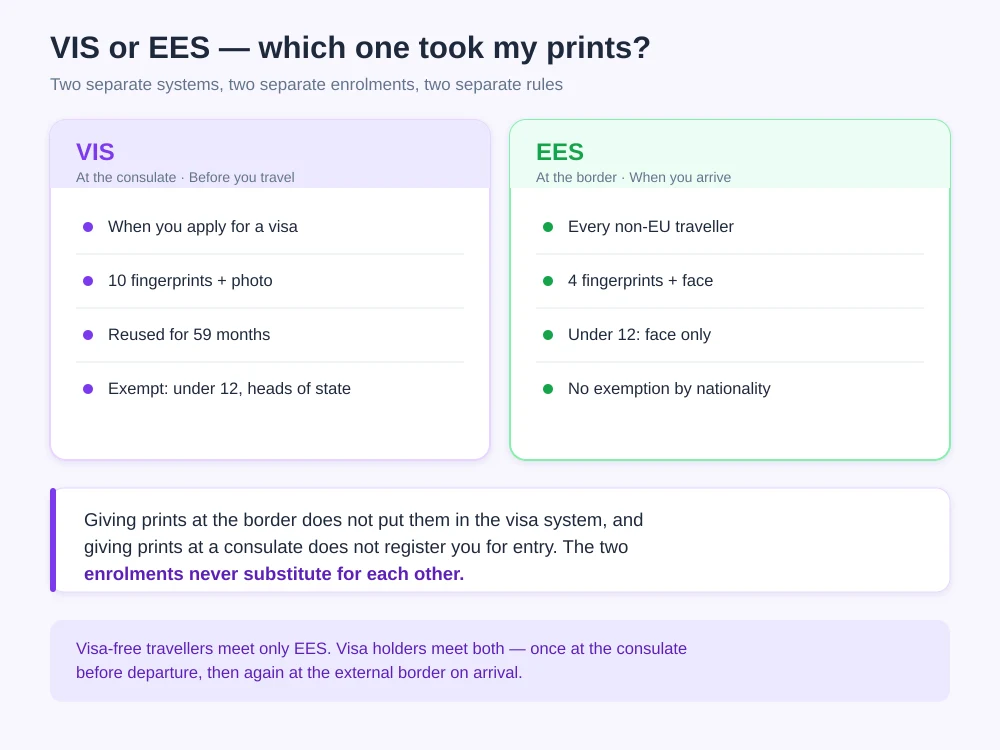
Visa-free travellers meet only the EES and never the VIS, which is the source of a lot of crossed wires in traveller forums — two people describing "European biometrics" are often describing different systems entirely. The border side is covered in our comparison of ETIAS versus EES and in more depth in our guide to how the Entry/Exit System changed travel documentation.
Key takeaway: Consulate biometrics and border biometrics are different enrolments. Doing one never satisfies the other.
How can I work out whether I’m inside the window?
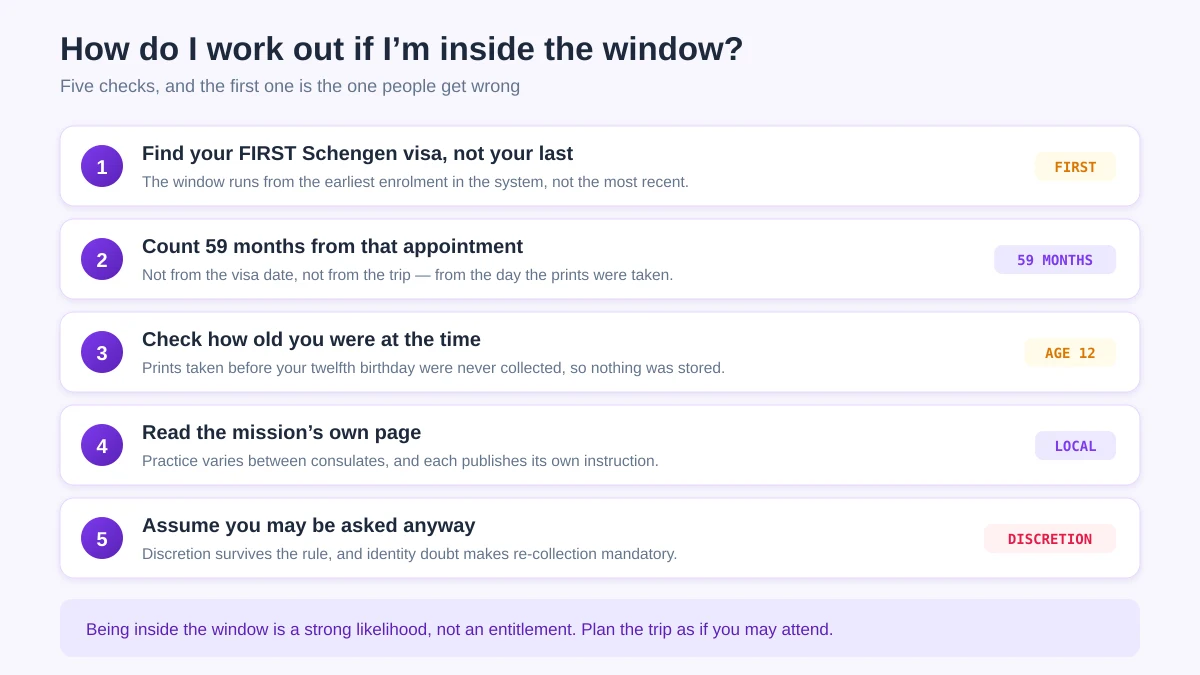
Five checks, and the first is the one people get wrong. None of them requires contacting anyone — you can settle it from your own passport in a few minutes.
- Find your first Schengen visa, not your most recent. Go back through old and current passports to the earliest one. That application is where your prints entered the system.
- Count 59 months from the appointment date. Not from the visa's issue date, not from the trip — from the day you attended and gave the prints.
- Check how old you were. If you were under 12 at that appointment, no fingerprints were collected and there is nothing to copy forward, whatever the date says.
- Read the mission's own instruction. Practice varies between consulates and between the centres that act for them, and each publishes its own page on when personal attendance is required.
- Assume you may be asked anyway. Build the possible appointment into your timeline rather than your budget of luck.
In the applications we support, the correction we make most often is at step one. An applicant counts back from a 2024 visa, concludes they are fine, and has forgotten a 2019 application in a passport they no longer carry. The prints from 2019 are the ones the system holds, and the window closed in 2024.
Key takeaway: Dig out the old passport. The answer is in the earliest visa, not the newest.
A verifiable booking via MyJet24 Premium ($7.90), with a locator the consulate can check — about 30 seconds.
Why does this change how early I should apply?
Because the answer decides whether your application needs an appointment slot at all, and appointment scarcity — not processing time — is what usually delays a Schengen application.
If your prints are reusable, many missions accept the file by courier or through a centre without you attending, and the constraint becomes the decision itself. If they are not, you join the queue for a biometric slot, which in busy seasons at busy missions is measured in weeks before the file is even opened.
That distinction is worth resolving before you build a timeline, because the two paths have very different lead times. The decision side of the equation is covered in our breakdown of Schengen processing times by country and consulate.
There is a second-order effect worth planning for. A visa may be applied for up to six months before travel, and the reuse window is the reason some applicants should use that lead time and others should not. If your 59 months expire in, say, four months, applying before that date keeps you on the reuse path; applying after it puts you in the appointment queue for the same trip. The window closing is a deadline in its own right, and it is one nobody notifies you about.
The same logic runs the other way for a first-time applicant. There is no reuse to lose, so the only question is slot availability, and the answer is to book the appointment before assembling the rest of the file rather than after. Everything else in a Schengen application — the itinerary, the accommodation, the cover letter — can be produced in an afternoon, which is why our Schengen document checklist is best worked through once the date is fixed rather than while you are waiting for one.
Key takeaway: Settle the fingerprint question first. It determines whether you are queuing for a slot or only for a decision.
Do prints from a refused application still count?
Yes. The reuse rule turns on when your fingerprints entered the system, not on whether the application succeeded. A refusal creates a VIS file in the same way an approval does.
The two rules diverge on storage, though. Where a visa was issued, the five-year retention runs from the visa's expiry date. Where it was refused, annulled or revoked, it runs from the date of the decision — so a refused application's file starts ageing immediately rather than after a trip.
None of that affects the fresh application on its merits. What a previous refusal does affect is how the next file is read, which is a separate question handled in our guide to appealing a Schengen refusal.
Key takeaway: A refusal still enrols you. The prints count; only the storage clock starts from a different date.
What do applicants get wrong here?
Counting from the wrong visa. The window runs from the first enrolment. The most recent visa is usually irrelevant to the calculation.
Assuming reuse is guaranteed. It is the default, not an entitlement, and identity doubt makes fresh collection mandatory.
Confusing storage with reuse. "Kept for five years" and "reusable for 59 months" are different rules answering different questions.
Expecting border prints to help. An EES enrolment does nothing for a visa application, and a VIS enrolment does nothing at the border.
Forgetting the child aged out. A twelfth birthday between applications turns a previously exempt child into a first-time enrollee.
The numbers in the rules
- 59 months — the reuse window, counted from first entry into the VIS (Visa Code, Art. 13).
- 10 — fingerprints collected at the consulate, alongside a photograph.
- 12 — the age below which no fingerprints are collected at all.
- 5 years — the maximum VIS storage period, running from the visa's expiry or the decision date (Reg. 767/2008, Art. 23).
- 4 — categories exempt from fingerprinting under Article 13.
Read from the consolidated legislative texts on 27 August 2026. These are Schengen rules; other visa regimes set their own biometric validity periods, and a mission's published instruction always governs its own practice.
Key takeaway: Almost every error here is a date measured from the wrong event. Fix the start date and the rest follows.
What should I do next?
Find your oldest passport and the earliest Schengen visa in it. Count 59 months from that appointment date and check whether you were 12 or older at the time. Those two facts settle whether you are booking a biometric slot or only submitting a file.
Then build the rest of the application while the answer is still open, because nothing else in the file depends on it. The flight reservation, the accommodation and the cover letter are all needed either way — and a verifiable booking that a consulate can look up, without buying a fare before a decision, is the specific thing MyJet24 Premium ($7.90) issues.
Issued in about 30 seconds via MyJet24 Premium, with a locator that resolves on the airline’s own system.
About the author
James Mitchell is the CEO and founder of MyJet24. He built the company’s reservation issuing and verification workflow and works the escalation queue where an applicant’s documents and a consulate’s requirements have stopped matching.
Reviewed by Joshua White, Travel Documentation Writer at MyJet24.
Last reviewed on 27 August 2026 by Joshua White.
Sources
- Visa Code, Article 13 — biometric identifiers, the 59-month reuse rule and the exemptions
- VIS Regulation 767/2008, Article 23 — the five-year storage period and its start dates
- Visa Code, Article 30 — a visa confers no automatic right of entry
- Schengen Borders Code, Article 6 — entry conditions assessed at the border
Methodology note: each article was read in the consolidated legislative text rather than in a summary, on 27 August 2026. Where this article describes consulate practice rather than the rule — reuse rates, when missions choose to re-collect — that is observation from applications we handle, not law, and individual missions publish their own binding instructions. Nothing here is legal advice.
Last updated: 27 August 2026 · Reviewed by Joshua White, Travel Documentation Writer, MyJet24
