
Last updated: 13 July 2026 · Reading time: 14 min · Author: Joshua White, Travel Documentation Writer at MyJet24
TL;DR — Key Facts
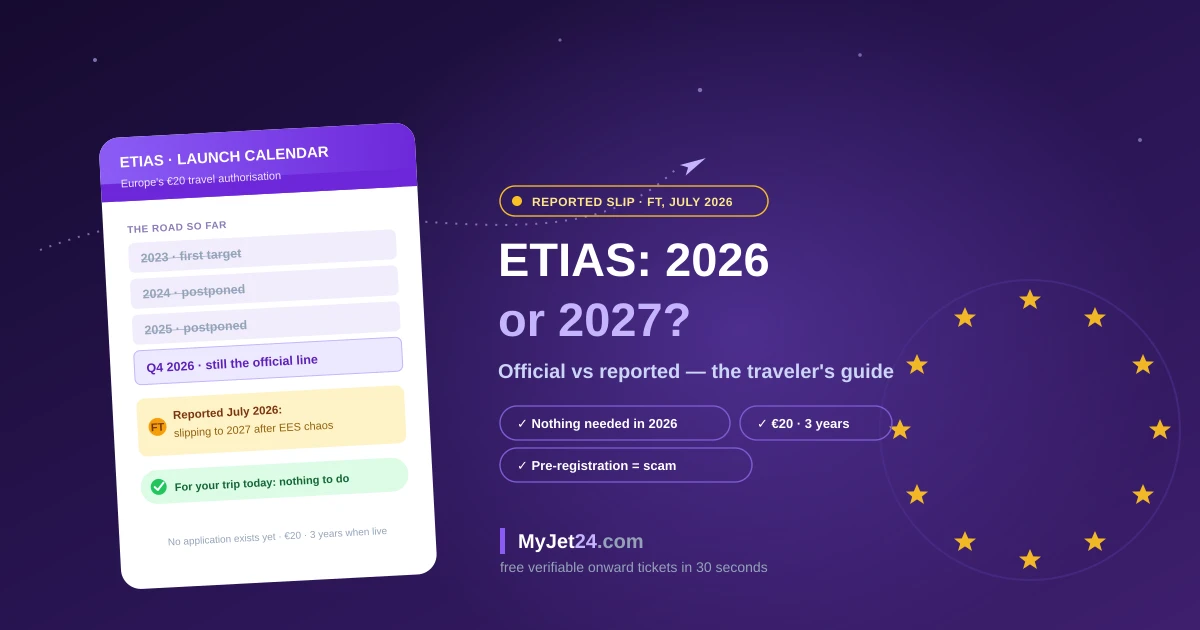
- The Financial Times reported in early July 2026 that the EU will push ETIAS to 2027 — sources briefed on the discussions called a 2026 launch "illusory" after the troubled EES rollout. The European Commission has not formally confirmed the postponement; the official site still says "last quarter of 2026."
- Nothing changes for your 2026 trip either way. ETIAS is not live, cannot be applied for, and no airline or border can ask you for it. Visa-exempt travelers (US, UK, Canada, Australia and ~55 other nationalities) keep entering Europe exactly as today.
- The system affecting you right now is EES, fully operational since 10 April 2026: biometric registration replacing passport stamps, with long queues at ~20 pressure-point borders this summer. That's the queue to plan for — not ETIAS.
- Anyone selling ETIAS "pre-registration" today is a scam. There is no waiting list, no early application, no €20 to pay yet. When ETIAS does launch, the only place to apply will be the official EU site or app — and generous transition periods (6 + 6 months) mean no one gets stranded on day one.
- What Schengen still checks today: passport validity, the 90/180-day rule, and — at check-in — proof of onward or return travel. A verifiable onward ticket (MyJet24 Premium, $7.90) covers that last one in 30 seconds.
Has ETIAS been delayed to 2027? Officially, not yet: the EU's ETIAS website still lists a launch in the last quarter of 2026. But in early July 2026 the Financial Times reported, citing sources briefed on the discussions, that the launch will slip to 2027 after the Entry/Exit System's chaotic rollout produced technical glitches and severe border queues — one source said a 2026 start was "illusory." Either way, nothing changes for travelers now: ETIAS is not live, cannot be applied for, no one can demand it, and when it does launch, a six-month transitional period plus a six-month grace period will apply before it's strictly enforced. The only European border system affecting trips today is EES.
Few travel systems have been announced, delayed, re-announced and re-delayed as often as ETIAS — Europe's €20 travel authorisation for visa-exempt visitors. It was coming in 2023. Then 2024. Then 2025. The official line settled on "last quarter of 2026," and half the internet's travel guides carved that date into stone. Then, in the first week of July 2026, the Financial Times reported that EU officials have privately concluded it won't happen this year either: 2027 is the new target, because the system ETIAS depends on — the biometric Entry/Exit System — spent its first fully-operational summer generating exactly the border chaos critics predicted.
If you're planning a European trip, the reporting spike has probably reached you as a confusing blur of "delayed again," "starts October," and ads offering to "secure your ETIAS now." This guide separates the three layers cleanly — what's officially published, what's credibly reported, and what actually affects your trip — plus the transition mechanics that mean even the eventual launch won't ambush anyone, the scam pattern to avoid this year, and the border system that does deserve your attention in 2026. It updates our standing ETIAS complete guide and pairs with ETIAS vs EES explained.
Official vs Reported vs Reality: the Three-Layer Timeline
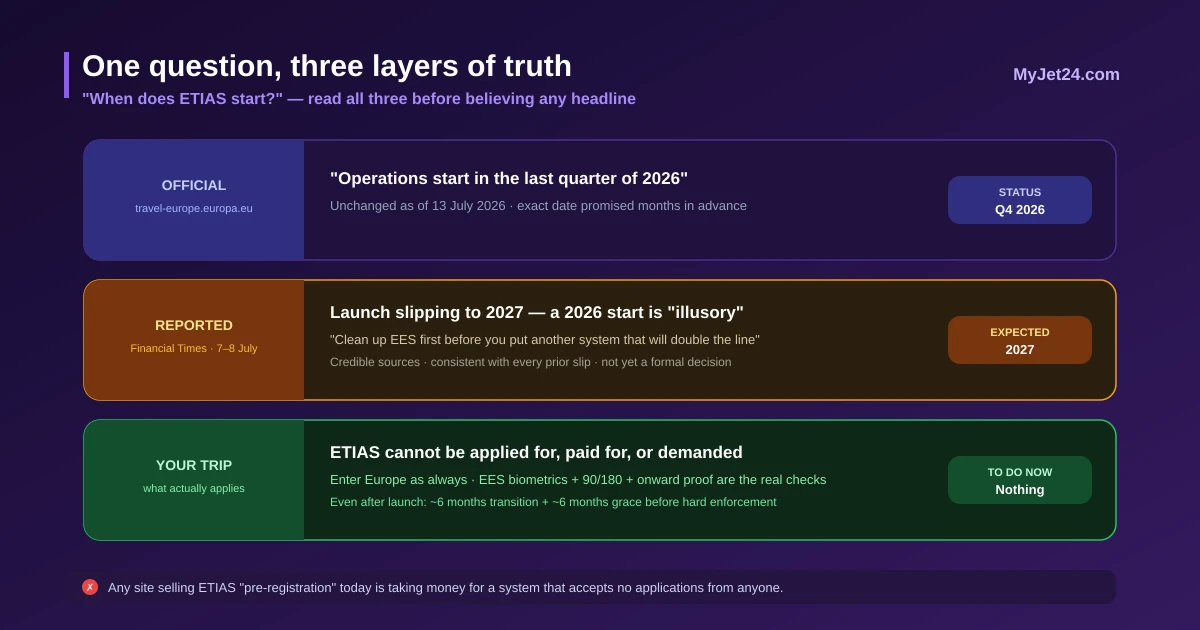
| Layer | What it says | Weight |
|---|---|---|
| Official (travel-europe.europa.eu) | ETIAS starts operations "in the last quarter of 2026"; exact date to be announced months in advance. | The formal position — unchanged as of mid-July 2026, no postponement decision published. |
| Reported (Financial Times, 7–8 July 2026) | Launch slipping to 2027; sources briefed on discussions call 2026 "illusory"; "let's clean up EES first before you put another system that will double the line again." | Credible, consistent with every prior ETIAS slip — but not yet an official decision. |
| Reality for travelers | ETIAS does not exist operationally: no application, no fee, no check anywhere. Visa-exempt entry works exactly as before. | The only layer that decides what you pack and pay in 2026. |
How to hold all three at once: plan every 2026 trip as if ETIAS doesn't exist (it operationally doesn't), treat the Q4-2026 date as the earliest theoretical start rather than a promise, and expect the official announcement — whenever it comes — to arrive months before anything is enforced, followed by a full year of soft-launch buffers described below. Panic has never been less justified by a border system's timeline.
Why the Delay: What "EES Chaos" Actually Means
ETIAS was always sequenced to start "a few months after" the Entry/Exit System reached full operation, because ETIAS decisions ride on EES data. EES did reach full Schengen-wide operation on 10 April 2026 — and its first peak season has been rough in exactly the ways that matter for adding another layer on top:
- Technical glitches in the biometric registration flow since the April switchover, slowing kiosks and manual booths alike.
- Severe queues at roughly 20 pressure-point crossings — major hubs and ferry/rail chokepoints — described as reaching "critical point" conditions in the summer peak, with aviation and travel industry groups issuing formal appeals.
- A political bind: Brussels concedes EES is "not perfect" but says suspension is neither needed nor possible — so the fix is time, tuning and throughput, not a rollback.
Against that backdrop, the logic attributed to EU officials is hard to argue with: stacking a second untested checkpoint interaction (ETIAS validity checks at boarding and borders) onto queues that already strain is how you turn a bad summer into two. Hence the reported slip to 2027 — a sequencing decision, not a cancellation. Every institution involved continues to treat ETIAS as a matter of when, not if.
ETIAS in 60 Seconds — for Everyone Who Skipped the Saga
When it eventually launches, ETIAS (European Travel Information and Authorisation System) will work like the US ESTA or UK ETA: visa-exempt visitors to 30 European countries apply online before travel, pay €20 (free under 18 and over 70), and receive an authorisation valid for three years or until their passport expires. It's linked to your passport, checked by carriers at boarding, and covers unlimited trips within the normal 90/180-day short-stay rule. Around 59–60 visa-exempt nationalities are in scope — including the US, UK, Canada, Australia, Japan and Brazil. It is not a visa: no interview, no documents beyond your passport, approval mostly in minutes. The full mechanics live in our ETIAS complete guide.
What Changes for You Now vs When It Launches
| Question | Today (mid-2026) | After launch (2027, reportedly) |
|---|---|---|
| Do I need ETIAS to board a flight to Europe? | No — impossible. The system isn't live. | Eventually yes — after the transition windows below. |
| Can I apply or join a waiting list? | No. Anyone taking your €20 today is not the EU. | Only via the official EU website/app, announced well in advance. |
| What do borders check instead? | EES biometrics, passport validity, 90/180 compliance, onward/return proof at check-in. | All of the same, plus ETIAS validity — verified electronically by carriers. |
| Does my 2026/early-2027 booking need anything? | Nothing ETIAS-related. Book normally. | Apply once when live; the 3-year validity covers years of trips. |
The 6+6 Month Safety Net Nobody Mentions
Buried under every "new EU border rule!" headline is the fact that ETIAS is designed to launch softly. The regulation builds in two consecutive buffers after go-live:
- Transitional period (first ~6 months): travelers without ETIAS are still admitted, provided they meet all other entry conditions. Carriers and borders warn rather than refuse.
- Grace period (following ~6 months): first-time arrivals since launch are still let through without ETIAS; only returning visitors who "should have known" are expected to hold one.
Translated: even after the eventual launch — 2026, 2027, whenever — there is roughly a year of runway before a missing ETIAS strands anyone at a gate. Combined with the promise to announce the exact start date months ahead, the realistic worst case for an informed traveler is a €20 form filled in ten minutes, once, covering three years. That's the context every scary headline omits.
The "Pre-Register for ETIAS" Scam Economy
Every delay extends the golden age of ETIAS middlemen. The pattern is identical to what we documented around Vietnam's Pre-Arrival Form: official-looking sites sell "pre-registration," "priority processing" or "guaranteed approval" for a system that does not accept applications from anyone. Right now, every euro paid for ETIAS is a euro lost. The checklist that protects you:
- There is no ETIAS application today. Not expedited, not waitlisted, not "locked in at current pricing." None.
- When live, the only channel is the official EU website and app — travel-europe.europa.eu — for €20 flat. Any other domain is a reseller at best.
- The EU announces the start date months in advance. You will not need to "act fast." Urgency is the scammer's tell.
- Airlines will never ask for ETIAS before it exists. If a booking site "requires your ETIAS number" in 2026, it's harvesting data.
EES Is Your Real 2026 Border Story — Handle It Well
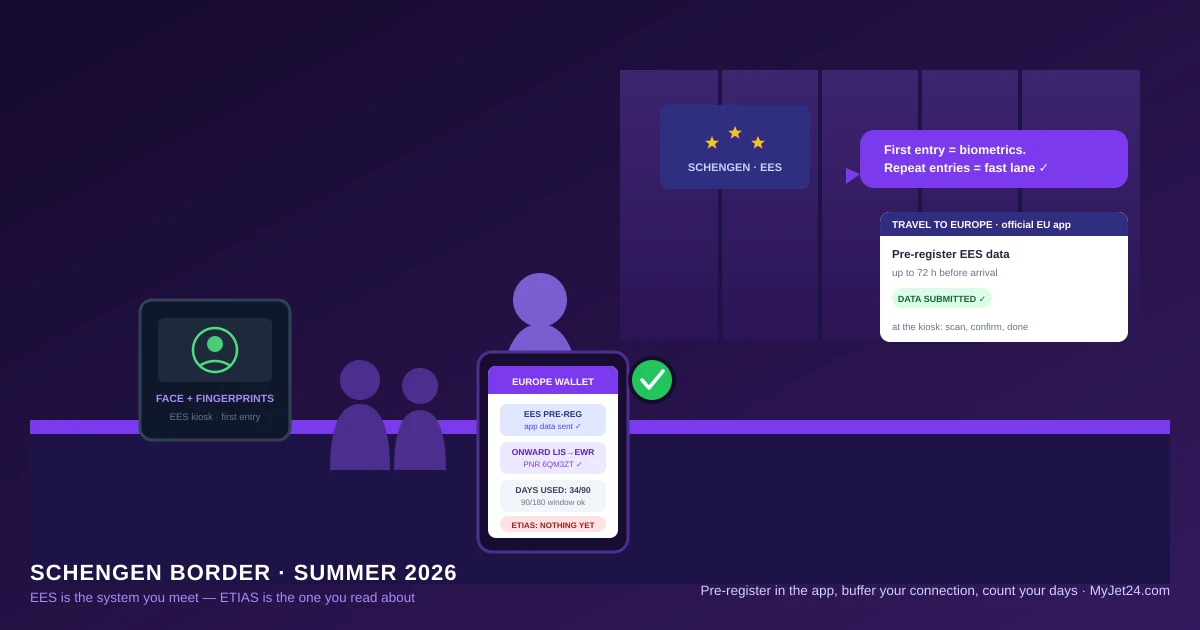
While ETIAS remains theoretical, EES is concrete: since 10 April 2026 every visa-exempt visitor's entry and exit is recorded biometrically — fingerprints and a facial image on first registration, replacing passport stamps. Three practical moves make it painless:
- Pre-register in the app where offered. The EU's "Travel to Europe" app (live since 16 March 2026) lets you submit data up to 72 hours before arrival at participating entry points, cutting kiosk time to a scan-and-confirm.
- Budget for the queue at first entry. First-time biometric capture takes minutes per traveler; at ~20 known pressure points (major hubs, ferry ports, Eurostar-style rail borders) summer waits have been long. Connections under two hours through a first EES registration are brave.
- Know that EES enforces 90/180 automatically. The overstay math that was once a stamp-deciphering argument is now a database record — track your own days with the same discipline the system does. Our 90/180 rule guide covers the counting.
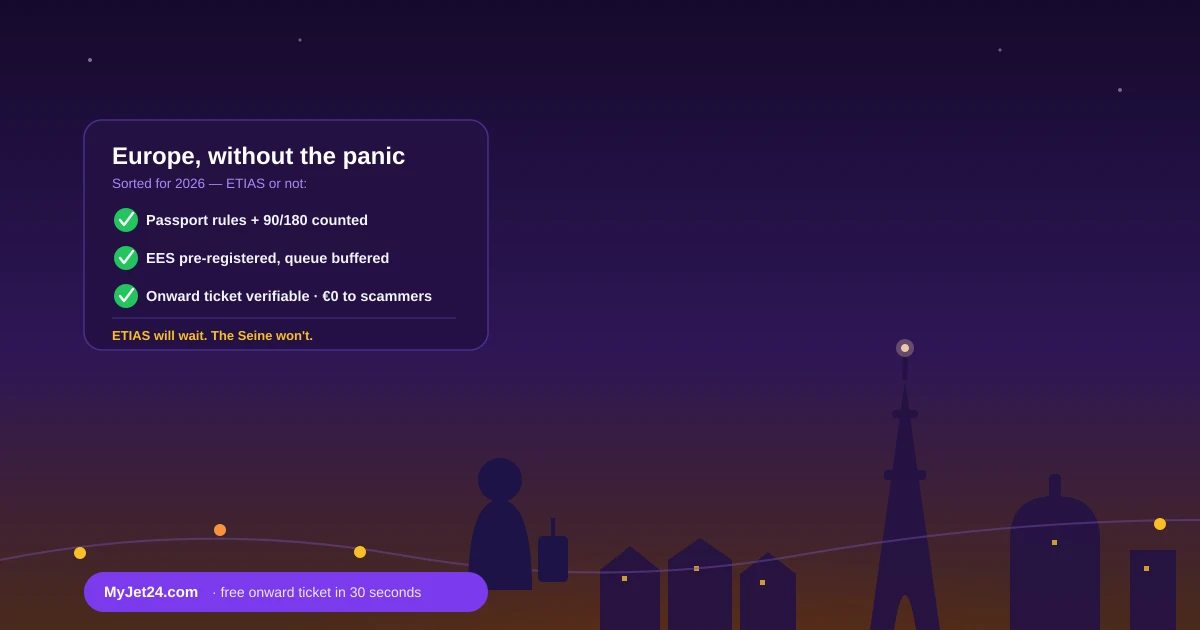
The Only Europe Checklist You Need This Year
- Passport: issued within 10 years, valid 3+ months beyond departure from Schengen — the two rules that actually deny boarding daily.
- 90/180 compliance: count your Schengen days; EES counts them for the border.
- Onward or return proof: airlines checking in visa-exempt travelers to Schengen routinely ask for it. A verifiable onward ticket with a live PNR (MyJet24 Premium, $7.90) answers the desk in 30 seconds without buying a flight your plans haven't earned yet.
- EES readiness: app pre-registration where available, queue buffer at first entry.
- ETIAS: nothing. Ignore every seller. Revisit when the EU announces a real date — we'll update this post and the main guide the day it happens.
Six Misunderstandings Spreading Right Now
- "ETIAS starts this October — I need it for my autumn trip." Even under the official (pre-delay) timeline, launch would come with a year of transition buffers. Under the reported 2027 slip, autumn 2026 needs exactly nothing.
- "The delay is confirmed, the Q4 date is dead." Not formally. The FT report is credible and consistent with history, but the Commission hasn't published a postponement. Both facts are true at once — that's why this guide separates the layers.
- "I can pre-register to be safe." You cannot. Anyone accepting money or data for ETIAS today is not the EU.
- "ETIAS is a visa." It's a travel authorisation for visa-exempt nationalities — €20, online, three years. Travelers who need Schengen visas are entirely outside ETIAS.
- "EES was delayed too, so I can ignore both." EES is live everywhere since April. Ignoring it means discovering biometric queues with a tight connection.
- "Once ETIAS exists, airlines stop checking anything else." Passport rules, 90/180 and onward-proof checks all survive. ETIAS adds a layer; it removes none.
Frequently Asked Questions
Has ETIAS been officially delayed to 2027?
Not officially — as of mid-July 2026 the EU's ETIAS website still says operations begin in the last quarter of 2026. But the Financial Times reported in early July, citing sources briefed on the discussions, that the launch will slip to 2027 after the EES rollout's technical problems and border queues. Treat Q4 2026 as the earliest theoretical start and expect a formal announcement months before anything is enforced.
Do I need ETIAS to travel to Europe in 2026?
No. ETIAS is not operational: there is no application, no fee, and no airline or border can request it. Visa-exempt travelers enter the Schengen area in 2026 exactly as before — subject to passport validity rules, the 90/180-day limit, EES biometric registration and the usual onward-ticket checks at check-in.
Why is ETIAS being delayed again?
Because it's sequenced on top of EES, and EES's first fully-operational summer produced technical glitches and severe queues at roughly 20 pressure-point crossings. The logic reported from EU discussions: stabilize the biometric system before adding another checkpoint layer — "clean up EES first before you put another system that will double the line again."
What is the difference between EES and ETIAS?
EES is the biometric entry/exit database that replaced passport stamps — live since April 2026, it registers fingerprints and facial images at the border. ETIAS is a pre-travel authorisation (like ESTA) that visa-exempt visitors will buy online for €20 before flying — not yet launched. EES happens at the border; ETIAS happens before you book the taxi. Full comparison in our ETIAS vs EES guide.
Can I apply for ETIAS early or join a waiting list?
No. No early application, waiting list or pre-registration exists. Websites offering these for a fee are scams or data harvesters. When ETIAS launches, the only application channel will be the official EU website and app, announced well in advance, at the flat €20 fee.
How much will ETIAS cost and how long is it valid?
€20, free for travelers under 18 and over 70, valid for three years or until your passport expires — whichever comes first — and good for unlimited short stays within the 90/180 rule across 30 European countries. One application covers years of trips.
What happens if ETIAS launches while I'm traveling or right before my trip?
Nothing abrupt. The regulation includes a ~6-month transitional period (travelers without ETIAS are still admitted if they meet other conditions) followed by a ~6-month grace period (first-time arrivals still exempt). Combined with months of advance notice of the start date, there is roughly a year of runway before a missing ETIAS could actually stop anyone.
Which nationalities will need ETIAS?
The ~59–60 visa-exempt nationalities that enter Schengen without a visa today — including the US, UK, Canada, Australia, New Zealand, Japan, South Korea and Brazil. Travelers who currently need a Schengen visa are outside ETIAS entirely; their process doesn't change.
Is EES causing delays at European airports right now?
At specific pressure points, yes — since full operation began on 10 April 2026, roughly 20 crossings (major hubs, ferry ports, rail terminals) have seen long queues in the summer peak, prompting industry appeals. First-time biometric registration is the slow step; the EU's "Travel to Europe" app can pre-submit your data up to 72 hours ahead where supported, and repeat entries are faster once registered.
Does the ETIAS delay change the 90/180-day rule?
No. The 90-days-in-any-180 limit for visa-exempt visitors applies regardless of ETIAS, and EES now enforces it with database precision. Count your days as carefully as the border does.
Will airlines check ETIAS at check-in once it launches?
Yes — carriers will verify ETIAS electronically against your passport before boarding, exactly as they do with ESTA for the US and the UK ETA. And the existing checks survive alongside it: passport validity, and proof of onward or return travel for visa-exempt visitors, which a verifiable reservation with a live PNR satisfies.
Do I need proof of onward travel for Europe in 2026?
Expect it at check-in: airlines boarding visa-exempt travelers to Schengen routinely ask how you'll leave, and border officers may too under the entry conditions. A verifiable onward or return reservation — real PNR, checkable by the agent — answers it without locking money into flights before your plans are fixed.
Where will official ETIAS updates be published?
On the EU's official travel site, travel-europe.europa.eu — the only authoritative source for the launch date, the application portal and the app. Any date you read elsewhere (including this guide) is journalism about that source, not a substitute for it; we update our ETIAS coverage whenever the official position moves.
Should I delay booking my 2027 Europe trip until ETIAS is sorted?
No — book normally. Whether ETIAS launches in late 2026 or during 2027, the advance-notice promise plus the transitional and grace periods mean your booking cannot be stranded by the system's arrival. Worst case, you'll spend ten minutes and €20 on a form that then covers you for three years.
Sources & further reading
- European Union — official ETIAS site (authoritative timeline and future application portal)
- Euronews (8 July 2026) — FT-reported delay to 2027 and the EES rollout problems
- European Union — official EES site and the Travel to Europe app
- Fragomen — EES/ETIAS launch-status tracker
The ETIAS timeline has moved repeatedly and may move again; the official EU site outranks every secondary report, including this one. This guide reflects conditions documented as of 13 July 2026.
