
Last updated: 28 July 2026 · Reading time: 16 min · Author: Joshua White, Travel Documentation Writer at MyJet24
TL;DR — Key Facts
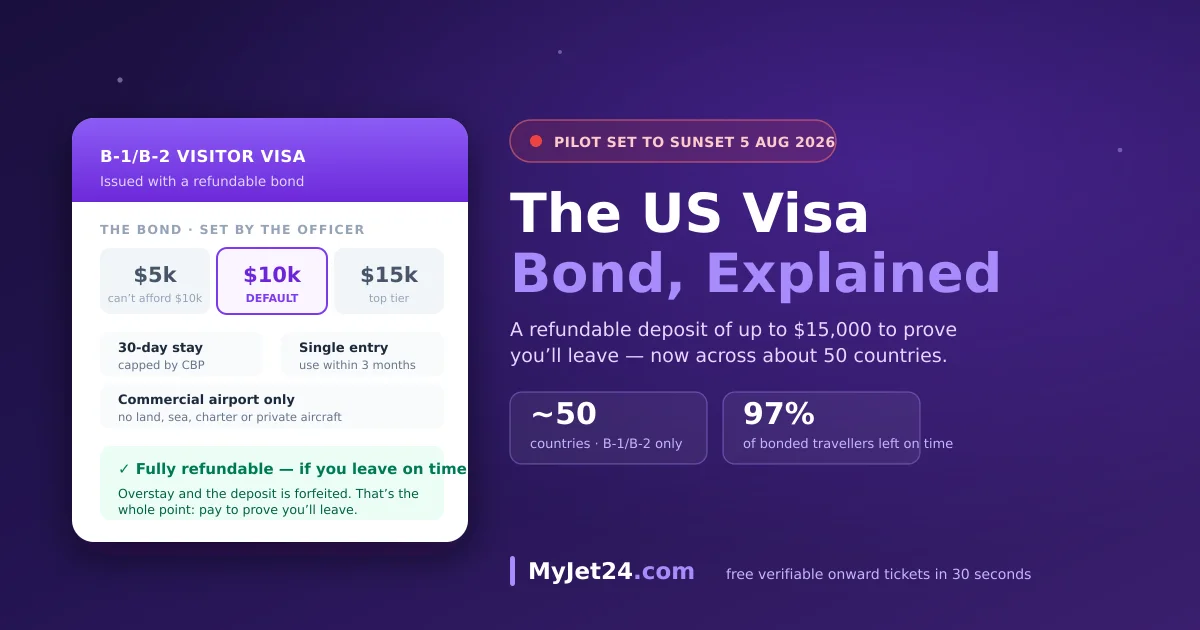
- The US now asks some visitor-visa applicants to post a refundable cash bond of $5,000, $10,000 or $15,000 as a condition of getting a B-1/B-2 visa. The default is $10,000; the consular officer sets the amount.
- It applies to nationals of about 50 countries — roughly one in four in the world — selected mainly for high visa-overstay rates. The list is heavily Sub-Saharan African, with large markets like Nigeria and Bangladesh now included.
- A bonded visa comes with hard strings: single entry, you must arrive within three months, CBP caps your stay at 30 days, and you must enter and leave through a commercial airport — no land, sea, charter or private-aviation crossings.
- The bond is fully refundable — if you leave on time and in compliance. Overstay, break status, or fail to leave within 10 days of a denied extension, and the money is forfeited.
- The whole mechanism exists to guarantee one thing: that you depart. That makes a verifiable onward or return ticket — evidence you will leave inside the 30-day window — more relevant here than for almost any other US visa.
- Time-sensitive: the pilot is scheduled to sunset on 5 August 2026, and as of publication no extension had been published. It may be renewed, made permanent, or allowed to lapse — check the official sources before you rely on it.
The US visa bond is a refundable cash deposit of $5,000, $10,000 or $15,000 that consular officers can require from B-1/B-2 (business or tourism) visa applicants from about 50 designated countries, chosen mainly for high overstay rates. The default amount is $10,000. A bonded visa is single-entry, must be used within three months, limits the stay to 30 days, and requires the traveller to enter and exit through a commercial airport. The bond is returned in full if the traveller departs on time and in compliance, and forfeited if they overstay or break the terms. Created by a Federal Register rule in August 2025, the pilot is scheduled to end on 5 August 2026 unless renewed.
In this guide
- What the visa bond is — and the deadline hanging over it
- How much: the three tiers and who sets them
- The 50 countries, and why they were chosen
- The strings attached: 30 days, single entry, airports only
- How to pay it — and how to get it back
- Bond vs $250 fee vs ESTA: three things people confuse
- What it means if you're applying: the departure question
- Six mistakes to avoid
- Frequently asked questions
- The bottom line
What the visa bond is — and the deadline hanging over it
For most of the last century, a US visitor visa was a yes-or-no decision: the consular officer either trusted you to leave or refused you. Since August 2025 there has been a third option for travellers from certain countries — yes, but leave a deposit. The visa bond pilot lets an officer issue a B-1/B-2 visa on the condition that the applicant posts a refundable cash bond, returned only when they leave the United States on time.
The legal basis is a Temporary Final Rule published in the Federal Register on 5 August 2025 (document 2025-14826), and the word "temporary" matters. The rule is written to run for exactly twelve months: effective from 20 August 2025 until 5 August 2026. That makes this both a live policy and a countdown.
Status as of publication (28 July 2026). The pilot is scheduled to sunset on 5 August 2026, and no extension, renewal, or permanent rule had been published in the Federal Register at the time of writing. It may be renewed, made permanent, or allowed to expire — immigration-law trackers describe it as "slated to end 5 August 2026, but could be renewed." Two things are worth knowing regardless: bonds already posted remain in effect until released or forfeited even if the program ends, and given the current administration's stance a renewal is widely expected. Verify the current status at federalregister.gov and travel.state.gov before relying on any detail here.
Set the countdown aside and the mechanism itself is straightforward, and likely to outlast this particular pilot in one form or another. It answers a question every visa officer has always asked — will this person go home? — with money instead of a judgement call.
How much: the three tiers and who sets them
The headlines all say "$15,000," and that is the top of the range — but it is not the default. The rule sets three tiers, and the consular officer chooses which applies based on the applicant's circumstances.
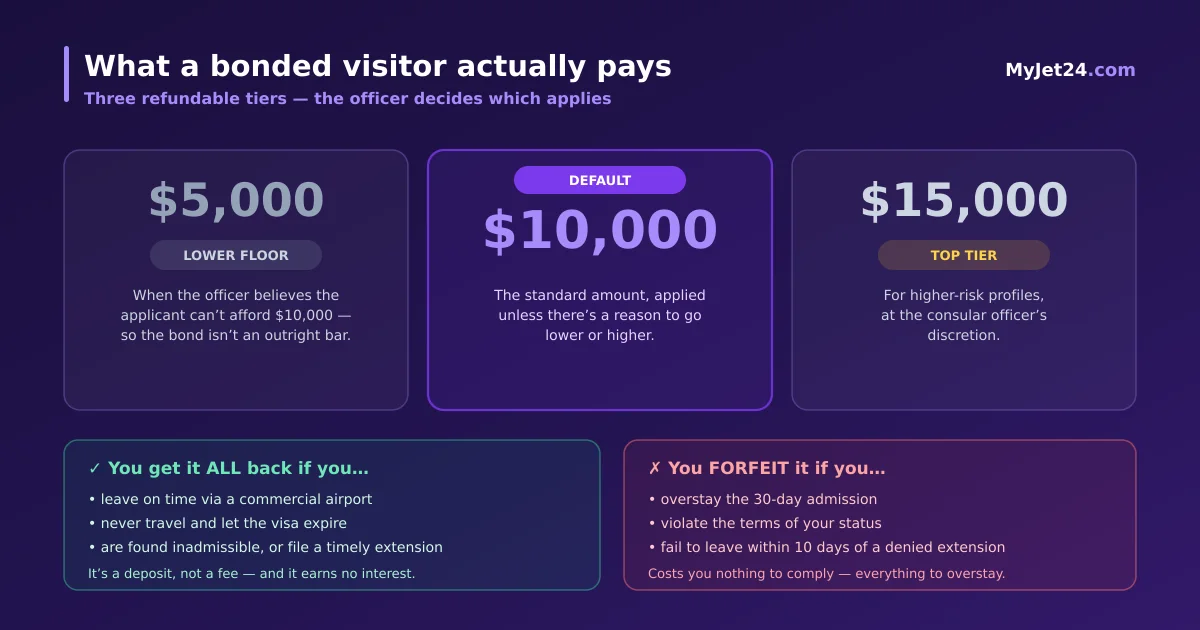
| Tier | When it applies |
|---|---|
| $5,000 | When the officer believes the applicant could not pay $10,000 — a lower floor so the bond doesn't become an outright bar. |
| $10,000 (default) | The standard amount, applied unless there's a reason to go lower or higher. |
| $15,000 | The top tier, for higher-risk profiles at the officer's discretion. |
The bond is a cash deposit, not a fee — the crucial difference being that you get it back if you comply. It is also paid on top of the ordinary visa costs, which for many of these applicants now include the separate $250 visa integrity fee (more on how those differ below). A bonded applicant from a covered country could therefore face the standard visa fee, the $250 fee, and a $10,000 deposit before they ever board a plane.
The 50 countries, and why they were chosen
The pilot began tiny — just Malawi and Zambia in August 2025 — and expanded in stages. By the most recent expansion, effective 2 April 2026, it covered roughly 50 countries, which one law firm summed up as "one in four countries" on Earth. The list is dominated by Sub-Saharan Africa, with clusters in Central Asia, the Caribbean, the Pacific and South Asia.
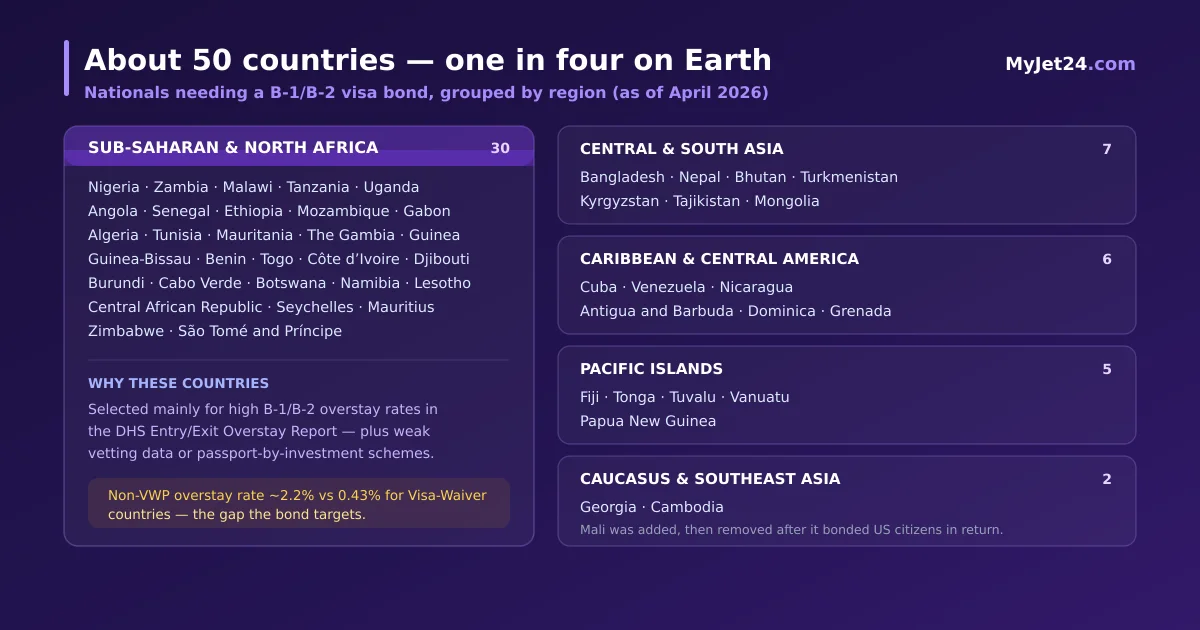
| Added | Countries |
|---|---|
| Aug 2025 | Malawi, Zambia |
| Oct 2025 | The Gambia, Mauritania, São Tomé and Príncipe, Tanzania |
| Jan 2026 | Bhutan, Botswana, Central African Republic, Guinea, Guinea-Bissau, Namibia, Turkmenistan, Algeria, Angola, Antigua and Barbuda, Bangladesh, Benin, Burundi, Cabo Verde, Côte d'Ivoire, Cuba, Djibouti, Dominica, Fiji, Gabon, Kyrgyzstan, Nepal, Nigeria, Senegal, Tajikistan, Togo, Tonga, Tuvalu, Uganda, Vanuatu, Venezuela, Zimbabwe |
| Apr 2026 | Cambodia, Ethiopia, Georgia, Grenada, Lesotho, Mauritius, Mongolia, Mozambique, Nicaragua, Papua New Guinea, Seychelles, Tunisia |
Mali was added in October 2025 and then removed on 23 October 2025 after it imposed reciprocal bonds on US citizens, so it nets out of the total. The count of 50 is well corroborated across multiple immigration-law firms but the official travel.state.gov list is the authority — verify it before relying on any single country's status, as the list can change.
Why these countries?
The rule names three selection criteria: high B-1/B-2 overstay rates, deficient screening or vetting information, or citizenship-by-investment programs that grant a passport without a residency requirement. Overstay data is the main driver, and it comes from the DHS Entry/Exit Overstay Report. The gap the policy targets is real: the overall suspected in-country overstay rate runs under 1%, but for visa-required (non-Visa-Waiver) countries excluding Canada and Mexico it sits above 2%.
The State Department's own rationale, published with the April 2026 expansion, put numbers on it: around 44,000 visitors from the program's countries overstayed in a single prior year, at an average removal cost of roughly $18,000 per person, which it framed as up to $800 million a year in potential savings. It also reported the pilot's early results — nearly 1,000 bonded visas issued, and 97% of those travellers returning home on time.
The strings attached: 30 days, single entry, airports only
A bonded visa is not an ordinary ten-year, multiple-entry B-1/B-2. It is a deliberately constrained document, and the constraints are where travellers most often trip up.
| Condition | What it means |
|---|---|
| Single entry | One trip only. Leave the US and the visa is spent. |
| Three-month window | You must enter the US within three months of the visa being issued. |
| 30-day stay | CBP limits the admission to 30 days at the port of entry — far shorter than the usual six months for a B-2. |
| Commercial airports only | You must both arrive and depart through a commercial airport of entry, including CBP preclearance locations. No land borders, sea ports, charter flights or private aviation. |
That last rule has a history worth knowing. When the airport restriction first tightened in January 2026, bonded travellers were limited to just nine named airports — Boston, JFK, Dulles, Newark, Atlanta, Chicago O'Hare, Los Angeles, plus preclearance at Toronto and Montréal. That narrow list was loosened on 18 March 2026 to any commercial airport of entry. So if you read an older guide insisting on a nine-airport list, it is out of date: the current rule is simply that you enter and exit by commercial air, never by land, sea, charter or private plane.
How to pay it — and how to get it back
Unlike a failed 2020 attempt at visa bonds that never had a working payment system, this pilot runs on existing federal infrastructure, so the money actually moves and can actually come back.
Paying the bond
After the interview, the bond is posted using Form I-352 through the US Treasury's pay.gov system, generally within 30 days of the visa interview. A single third-party payer can post it on the applicant's behalf, which matters when the traveller can't move that much money internationally themselves. The funds sit with the Treasury and earn no interest — you get back exactly what you put in, no more.
Getting it back — and losing it
The bond is returned in full in any of these cases:
- you depart the US on time and in compliance, through a commercial airport;
- you never travel and simply let the visa expire unused;
- you are found inadmissible by CBP and don't enter; or
- you file a timely, proper extension or change of status.
It is forfeited — the money becomes payable to the government — if you overstay the authorized period, violate the terms of your status, file an extension late, or fail to depart within 10 days of a denied extension. In other words, the bond does exactly what it says: it costs you nothing to comply and everything to overstay. And the forfeited deposit is on top of the ordinary consequences of overstaying — the re-entry bars and future-visa damage covered in our guide to visa overstay penalties.
Bond vs $250 fee vs ESTA: three things people confuse
Three separate 2025–2026 changes to US travel keep getting mixed together. They are genuinely different regimes, and a traveller can be hit by more than one at once.
| Visa bond | $250 integrity fee | ESTA / Visa Waiver | |
|---|---|---|---|
| What it is | Refundable cash deposit, $5k–$15k | A $250 surcharge on most visas | A travel authorization, no visa needed |
| Who | B-1/B-2 applicants from ~50 countries | Most nonimmigrant visa holders | Visa-Waiver nationals only |
| Refundable? | Yes, on compliant departure | In theory; mechanism not yet working | n/a (a fee, not a deposit) |
| Overlap | A bonded applicant from a covered country can owe the visa fee, the $250 fee AND the bond. Visa-Waiver travellers pay none of them — they use ESTA. | ||
The clearest dividing line is the Visa Waiver Program. If your country is in it, you travel on ESTA rather than a B-1/B-2 visa, so neither the bond nor the $250 fee touches you. The bond countries are all outside the VWP. For the separate $250 charge, our guide to the US visa integrity fee breaks down who actually pays it and when.
What it means if you're applying: the departure question
Step back and the entire apparatus — the deposit, the 30-day cap, the single entry, the mandatory airport exit — exists to guarantee one outcome: that you leave. The Federal Register describes the bond's purpose plainly as "ensuring the legally required departure of an alien." That reframes what a bonded applicant should be trying to prove, at two separate moments.
At the consulate. By definition, an applicant offered a bond has already been flagged as an overstay risk. The officer still has to be satisfied under section 214(b) that you intend to return — the bond doesn't replace that judgement, it backs it. The single cleanest piece of documentary evidence that you plan to depart within the window is a concrete onward or return itinerary. A verifiable flight reservation for a B-1/B-2 application, alongside the rest of your interview documents, shows intent to leave without committing you to a fare before you even know the visa's outcome.
At the border and on the way out. A 30-day admission, single entry, and a required commercial-airport exit mean you need a dated departure that lands inside the window and routes through an eligible airport. That itinerary supports CBP's admission decision on arrival and, crucially, demonstrates the compliant exit your refund depends on. It's the same evidence airlines increasingly ask for at check-in — see whether airlines can deny boarding without proof of onward travel — and the situation a verifiable onward ticket is built for.
Why a reservation rather than a bought flight? A bonded traveller is already parting with up to $15,000 in deposit plus fees. Locking in a paid, dated return fare on top — before the visa is even approved — adds real money at risk if plans shift or the application fails. A verifiable onward ticket gives an officer a real, checkable booking that proves the intended departure, without gambling a fare on an uncertain outcome. When the entire point is proving you'll leave, that's the document doing the work.
Six mistakes to avoid
- Assuming everyone pays $15,000. The default is $10,000, and $5,000 exists for those who can't afford more. The officer sets the tier.
- Treating the bond as a fee you lose. It's a refundable deposit — you get all of it back if you leave on time and in compliance.
- Booking through the wrong port. No land, sea, charter or private-aviation entry or exit. It must be a commercial airport, both ways.
- Planning a stay longer than 30 days. CBP caps the admission at 30 days regardless of what a normal B-2 would allow — and overstaying forfeits the bond.
- Confusing the bond with the $250 integrity fee or with ESTA. They're three different things, and you can owe more than one.
- Ignoring the sunset date. The rule is scheduled to end on 5 August 2026. Whether it's renewed changes everything — check the official sources before you plan around it.
Frequently asked questions
What is the US visa bond?
It's a refundable cash deposit — $5,000, $10,000 or $15,000 — that a US consular officer can require from certain B-1/B-2 (business or tourism) visa applicants as a condition of issuing the visa. It was created by a Federal Register rule in August 2025 to reduce visa overstays. The money is returned in full if the traveller leaves the United States on time and in compliance with the visa terms.
How much is the US visa bond in 2026?
There are three tiers: $5,000, $10,000 and $15,000. The default is $10,000; $5,000 applies when the officer believes the applicant couldn't afford $10,000, and $15,000 is the top tier for higher-risk profiles. The consular officer decides the amount at or after the interview. It's a cash deposit paid on top of the normal visa fees.
Which countries are subject to the US visa bond?
As of the April 2026 expansion, about 50 countries — roughly one in four worldwide. The list is heavily Sub-Saharan African (including Nigeria, Zambia, Uganda, Tanzania, Angola and Senegal), with additions across Central Asia (Turkmenistan, Kyrgyzstan, Tajikistan, Bhutan, Mongolia), the Caribbean and Central America (Cuba, Venezuela, Nicaragua, Antigua and Barbuda, Dominica, Grenada), South Asia (Bangladesh, Nepal) and the Pacific (Fiji, Tonga, Tuvalu, Vanuatu, Papua New Guinea). Always check the official travel.state.gov list, as it changes.
Do I get the visa bond money back?
Yes, if you comply. The bond is refunded in full if you depart the US on time through a commercial airport, if you never travel and let the visa expire, if CBP finds you inadmissible, or if you file a timely and proper extension or change of status. It's forfeited if you overstay, break the terms of your status, or fail to leave within 10 days of a denied extension. The deposit earns no interest, so you get back exactly what you paid.
How long can I stay on a bonded visa?
CBP limits the admission to 30 days at the port of entry — much shorter than the six months a standard B-2 visitor usually receives. The visa is also single-entry and must be used within three months of issuance, and you must enter and leave through a commercial airport, not a land or sea border.
Which visas does the bond apply to?
Only B-1 (business) and B-2 (tourism and pleasure) visitor visas. It does not apply to student, work, or other nonimmigrant categories, and it does not apply to travellers from Visa Waiver Program countries, who use ESTA rather than a visa and are not in scope.
Is the visa bond the same as the $250 visa integrity fee?
No. They're separate. The $250 visa integrity fee is a statutory surcharge that applies to most nonimmigrant visa issuances; the bond is a refundable $5,000–$15,000 deposit that applies only to B-1/B-2 applicants from about 50 designated countries. A bonded applicant could owe both — the standard visa fee, the $250 fee, and the bond.
Which airports can I use with a bonded visa?
Any commercial airport of entry, including CBP preclearance locations abroad. You cannot enter or exit through a land border, sea port, charter flight or private aircraft. An earlier version of the rule (January to March 2026) restricted bonded travellers to nine specific airports, but that was loosened on 18 March 2026 to any commercial airport.
How do I pay the visa bond?
After the interview, the bond is posted using Form I-352 through the US Treasury's pay.gov system, generally within 30 days of the visa interview. A single third-party payer can post it on your behalf. The funds are held by the Treasury and earn no interest until they're returned.
Can someone else pay the visa bond for me?
Yes. The bond can be posted by a single third-party payer on the applicant's behalf through the pay.gov system using Form I-352. This matters for applicants who cannot easily move $10,000 or more internationally themselves. Whoever pays it receives the refund when the traveller complies with the visa terms.
Do I need a return ticket for a bonded visa?
It's strongly advisable. The entire purpose of the bond is to guarantee your departure, so evidence that you'll leave within the 30-day window carries real weight — both at the interview, where the officer must be satisfied you intend to return, and at the border, where a dated departure supports admission and the compliant exit your refund depends on. A verifiable onward or return reservation is the cleanest way to show it.
Why did the US introduce visa bonds?
To reduce visa overstays from countries with high overstay rates or weak vetting data. The State Department cited around 44,000 overstays from the program's countries in a single year, an average removal cost near $18,000 per person, and potential savings of up to $800 million a year. It reported that of nearly 1,000 bonded travellers, 97% returned home on time.
Is the visa bond program permanent?
Not yet. It was created as a twelve-month pilot scheduled to end on 5 August 2026. As of publication no extension had been published in the Federal Register, though it may be renewed or made permanent. Bonds already posted stay in effect until released or forfeited even if the program lapses. Check federalregister.gov and travel.state.gov for the current status.
The bottom line
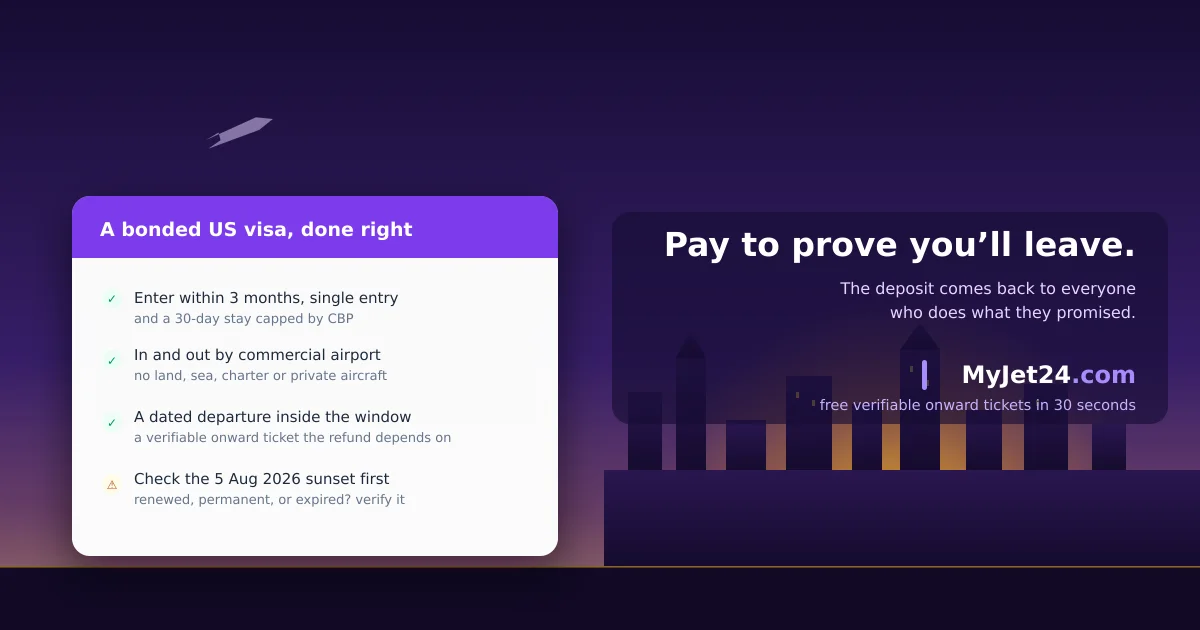
The visa bond is a blunt instrument for an old problem. Rather than refuse a traveller outright or wave them through on trust, the US now lets some visitors buy that trust back with a deposit — and hands it straight back to everyone who does what they promised. For the roughly 50 nationalities affected, it turns a yes-or-no decision into a manageable, if expensive, condition. And whatever happens to this particular pilot on 5 August 2026, the logic behind it — pay to prove you'll leave — is unlikely to disappear; it's the same instinct that drives Europe's proof-of-funds rules and the onward-ticket checks that dozens of countries already run.
If you're applying, treat the whole thing as one question with one answer. The deposit, the 30-day cap, the single entry, the airport-only exit all ask the same thing: how do we know you'll go home? Show a concrete, dated way out. A verifiable proof of onward travel answers that in about thirty seconds — a real reservation an officer can check, without adding a paid fare to the money you already have on the line. When your deposit depends on leaving on time, the ticket that proves you will is the cheapest insurance you can carry.
Sources
- Federal Register — "Visas: Visa Bond Pilot Program," document 2025-14826 (5 August 2025): https://www.federalregister.gov/documents/2025/08/05/2025-14826/visas-visa-bond-pilot-program
- US Department of State — "State Department Expands Visa Bonds to Combat Illegal Overstay Rates" (March 2026): https://www.state.gov/releases/office-of-the-spokesperson/2026/03/state-department-expands-visa-bonds-to-combat-illegal-overstay-rates
- US Customs and Border Protection — Implementation of the Visa Bond Pilot Program (February 2026): https://www.cbp.gov/sites/default/files/2026-02/ofo_implementation_of_the_visa_bond_pilot_program.pdf
- US Department of State — Countries Subject to Visa Bonds (official list): https://travel.state.gov/content/travel/en/News/visas-news/countries-subject-to-visa-bonds.html
- DHS — Entry/Exit Overstay Report FY2024: https://www.dhs.gov/publication/entry-exit-overstay-report
- NAFSA — Visa Bond Pilot Program summary: https://www.nafsa.org/regulatory-information/visa-bond-pilot-program
- Berry Appleman & Leiden — expanded countries and ports of entry (2026): https://www.bal.com/immigration-news/
This guide reflects the US visa bond pilot as established by Federal Register rule 2025-14826 and expanded through April 2026, with State Department, CBP and DHS sources as of 28 July 2026. The pilot is scheduled to sunset on 5 August 2026 and may be renewed, modified or allowed to expire; the country list and bond terms can change. Verify against travel.state.gov and federalregister.gov before acting. This article is informational and not legal or immigration advice.
