
Last updated: 1 September 2026 · Reading time: 17 min · Author: James Mitchell, CEO & Founder of MyJet24 · Reviewed by: Marc Hoffmann, Senior Visa Consultant & Travel Documentation Expert
TL;DR — Key facts
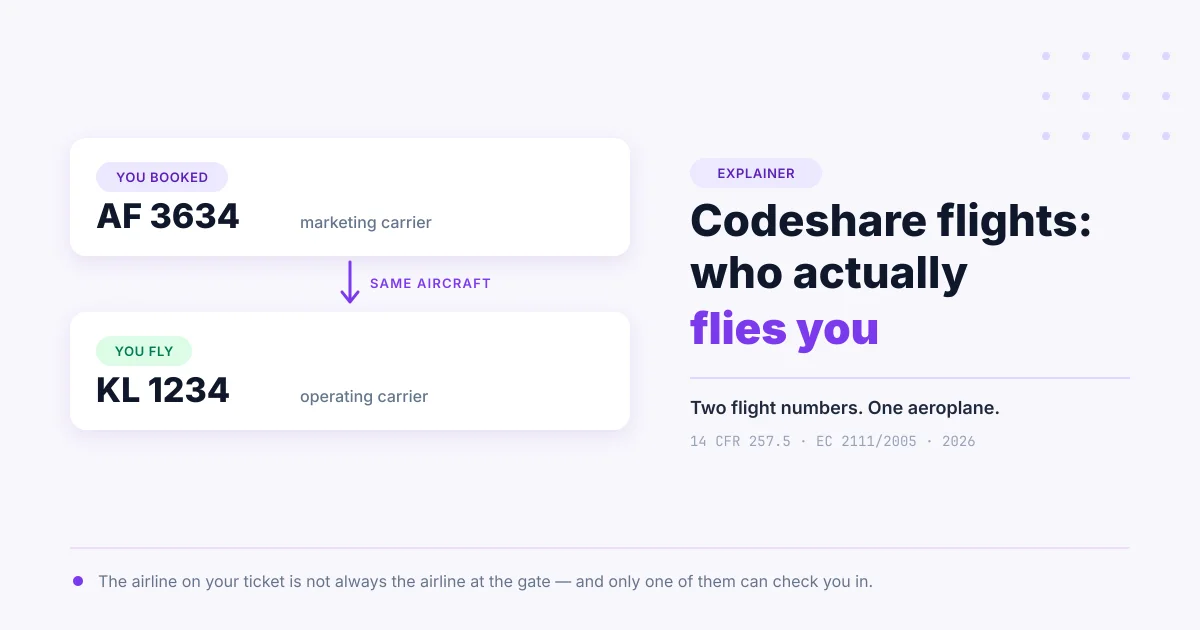
- A codeshare flight is one aircraft sold under two or more airline codes. The airline whose code you booked is the marketing carrier; the airline flying the plane is the operating carrier.
- You check in with the operating carrier, in its app and at its desk — not with the airline whose name is on your confirmation email.
- US law dictates the exact wording. 14 CFR § 257.5(c) requires the notice to state “Operated by” followed by the operator’s corporate name, and § 257.5(a)(1) states that “roll-over, pop-up and linked disclosures do not comply”.
- EU law adds a second duty: tell you again if it changes. Under Regulation (EC) No 2111/2005 Article 11, passengers must also be informed “at check-in, or on boarding where no check-in is required for a connecting flight”.
- On a visa form, write the marketing flight number — the one printed on your ticket and stored against your booking reference. The operating number belongs in a note, not in the box.
A codeshare flight is a single flight sold by more than one airline under different flight numbers. You buy from the marketing carrier, but a different airline — the operating carrier — owns the aircraft, employs the crew and applies its own baggage and check-in rules. Your ticket shows the marketing code; the phrase “operated by” next to it names the airline you will actually fly with.
Paste your reservation and see the operating carrier, flight numbers and segments in plain text.
What a codeshare flight actually is
A codeshare flight is one physical departure that two or more airlines sell under their own flight numbers. Only one of them puts an aircraft on the tarmac. The others buy the right to attach their code to that seat and sell it as though it were their own service.
The word comes from the two-letter designator code every airline carries: LH for Lufthansa, AA for American, EK for Emirates. On a codeshare, the seat you bought as LH8865 may push back from the gate as UA905, with a United aircraft, United crew and United catering. Nothing about the flight changes; only the label you bought it under does.
Airlines do this because it lets them sell routes they do not fly. A carrier can advertise a network far larger than its own fleet, feed passengers into its hub from cities it never serves, and keep the customer inside its own booking system. For the passenger, the arrangement is invisible until the moment it stops being invisible — usually at an airport, in front of the wrong desk.
Booking a flight and boarding a flight are two different transactions with two different companies. The codeshare is where those two companies stop being the same one.
Key takeaway: a codeshare changes who sold you the seat, never which aircraft you sit in. The operating carrier is the one fact that determines your day at the airport.
Marketing carrier vs operating carrier
The marketing carrier is the airline whose code and flight number appear on your ticket; the operating carrier is the airline that actually flies the aircraft. Every codeshare has exactly one operating carrier per segment and at least one marketing carrier, and the two are different by definition.
The distinction decides more than trivia. The marketing carrier owns the commercial relationship: it took your payment, it holds the fare rules, and it is the one that can rebook or refund you. The operating carrier owns the flight itself: its baggage allowance applies, its seat map applies, its cabin crew apply its rules, and its ground staff issue your boarding pass.
A worked example makes the split obvious. You book Air France AF3634 from Amsterdam to Paris. The ticket says AF, the confirmation email is from Air France, and the fare rules are French. The aircraft is a KLM Boeing 737, the crew are Dutch, the baggage allowance is KLM’s, and check-in happens in the KLM app. One flight, two companies, each responsible for a different half of it.
Key takeaway: marketing carrier answers for the money, operating carrier answers for the aircraft. Send every question to the half that owns it.
The five arrangements people confuse
An interline agreement is a commercial arrangement that lets airlines accept each other’s tickets and transfer baggage, without either selling the other’s flight number. That is the arrangement most often mistaken for a codeshare, and the difference matters when something goes wrong.
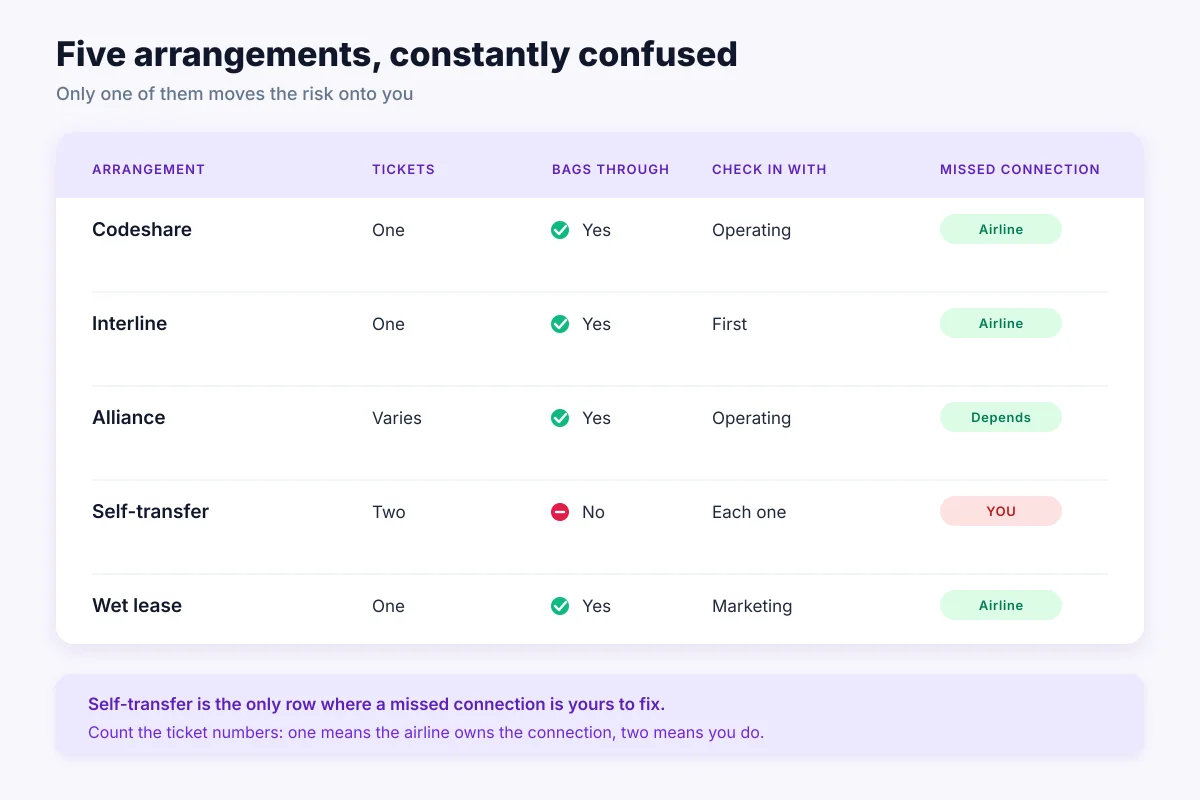
Five arrangements sit behind almost every question travellers ask about who is responsible for what. They are routinely used as synonyms and they are not synonyms.
| Arrangement | One ticket? | Bags through? | Check in with | Missed connection is |
|---|---|---|---|---|
| Codeshare | Yes, one number | Yes | Operating carrier | Airline’s problem |
| Interline | Usually yes | Usually yes | First carrier | Airline’s problem |
| Alliance | Depends on fare | Usually yes | Operating carrier | Depends on ticket |
| Self-transfer | No, two tickets | No | Each separately | Your problem |
| Wet lease | Yes, one number | Yes | Marketing carrier | Airline’s problem |
A wet lease deserves its own line because it looks like a codeshare from the outside and is not one. In a wet lease, one airline rents an aircraft and its crew to another and flies under the renting airline’s number. You will see an unfamiliar livery at the gate with a familiar flight number on the screen. US disclosure rules treat long-term wet leases exactly as they treat codeshares, which is a good indication of how confusing regulators expect them to be.
Key takeaway: only the self-transfer row moves the risk onto you. The other four leave the airline responsible for getting you to the destination.
Four places to find your operating carrier
The operating carrier is disclosed in your booking in at least four places, and checking takes under a minute. Travellers usually discover it in a fifth place instead: at an empty check-in desk, forty minutes before departure.
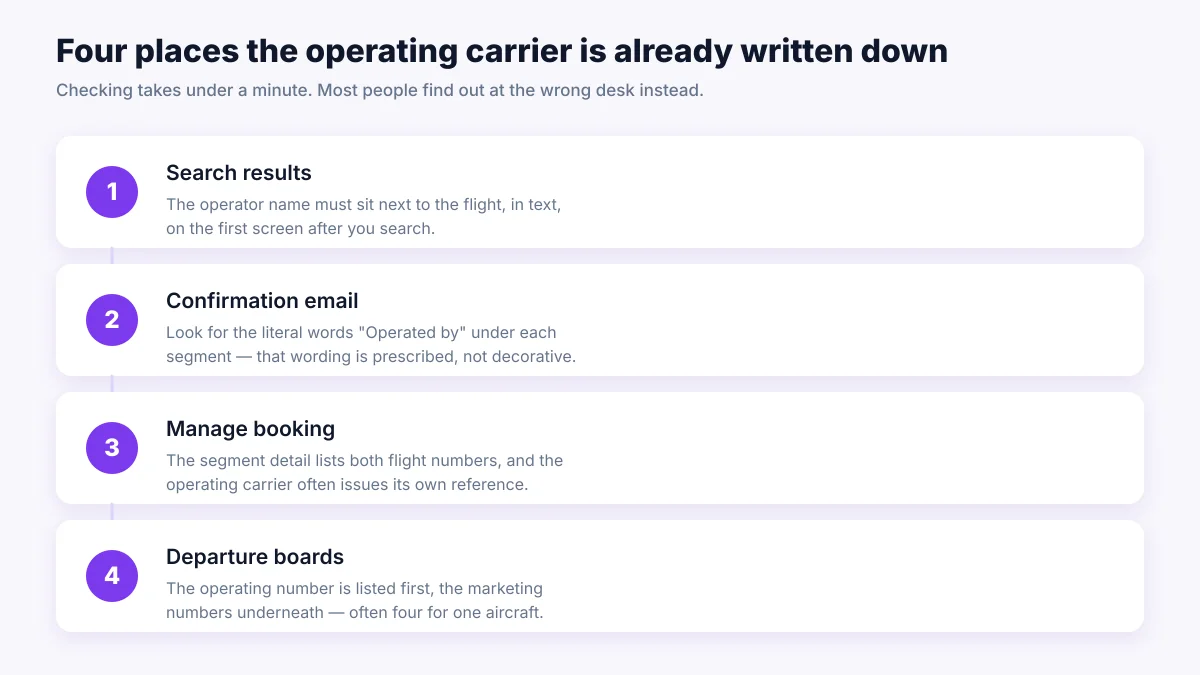
- The search results page. For itineraries sold to US consumers, the operator’s corporate name has to appear as text next to the flight, at the same size as the itinerary, on the first screen after you search.
- The confirmation email or e-ticket receipt. Look for the literal words “Operated by” under each segment. That phrase is not marketing language; in the US it is the wording the regulation prescribes.
- Your booking reference in the airline’s manage-booking page. The segment detail lists both the marketing and the operating flight number. If you have a raw reservation printout, the operating carrier sits in the segment line beside the equipment code — this is what our PNR converter reads out, and it is the same field explained in our breakdown of the passenger name record.
- The departure boards. Airport screens list the operating flight number first and the marketing numbers underneath, often abbreviated. A flight with four numbers on one line is a codeshare sold four times.
Key takeaway: if the words “operated by” appear anywhere in your booking, treat the airline named after them as the one that matters from the airport door onwards.
What the law forces airlines to tell you
Codeshare disclosure is a legal obligation in both the United States and the European Union, not a courtesy. The two regimes place the duty at different moments, and knowing which one covers your flight tells you what you were entitled to be told.
In the United States, 14 CFR Part 257 governs it. Section 257.5(c) is the sharpest provision: at the time of purchase the seller must give written disclosure of the actual operator, and the notice “shall state ‘Operated by’ followed by the corporate name of the transporting carrier and any other name in which that service is held out to the public”. The regulation even supplies a model sentence. Section 257.5(a)(1) then closes the obvious loophole, requiring the operator’s name in text at no smaller than the itinerary’s font size on the first results screen, and stating flatly that “roll-over, pop-up and linked disclosures do not comply with this paragraph”. There is also an oral duty under § 257.5(b): on a phone call, the agent must tell you the first time the flight is offered.
The European Union approaches the same problem from the other end. Article 11 of Regulation (EC) No 2111/2005 requires that “upon reservation, the air carriage contractor shall inform the passenger of the identity of the operating air carrier or carriers”, whatever the booking channel. If the operator is not known yet, you must be told the likely carriers and then the real one “as soon as such identity is established”. The provision that has no US equivalent covers changes: when the operating carrier changes after reservation, the contractor must inform you as soon as possible, and passengers must additionally be told “at check-in, or on boarding where no check-in is required for a connecting flight”.
The practical difference in one line: US rules are strongest at the point of sale and prescribe exact wording. EU rules are weaker on wording but keep running after you have paid, because they cover the swap that happens two days before departure.
Key takeaway: a hidden codeshare on a US itinerary is a compliance failure, not bad luck. An unannounced operator swap on an EU booking is one too.
Check-in: which airline, which app, which desk
On a codeshare you check in with the operating carrier, because that airline holds the departure control system that issues boarding passes for the aircraft. The marketing carrier can take your booking, choose your seat and sell you a bag, but it cannot put you on the flight.
This single fact explains most codeshare disasters. A passenger books with Airline A, downloads Airline A’s app, and finds check-in unavailable twenty-four hours before departure. Nothing is broken; they are simply asking the wrong company. Codeshare is one of the most common reasons online check-in fails, and it sits alongside the other causes covered in our guide to check-in that refuses to open.
There is a wrinkle worth knowing. The operating carrier often issues its own record locator for the same trip, so you may hold two booking references for one trip — one from the airline you paid, one from the airline flying you. Both are valid. The operating carrier’s reference is the one its app and its kiosks will recognise, and it is normally printed on the confirmation under a heading such as “airline reference” or “operated by reference”.
Key takeaway: if check-in will not open, switch to the operating carrier’s app and try its record locator before you call anyone.
Correct carrier, correct flight number, embassy-ready formatting.
Two flight numbers, one visa form
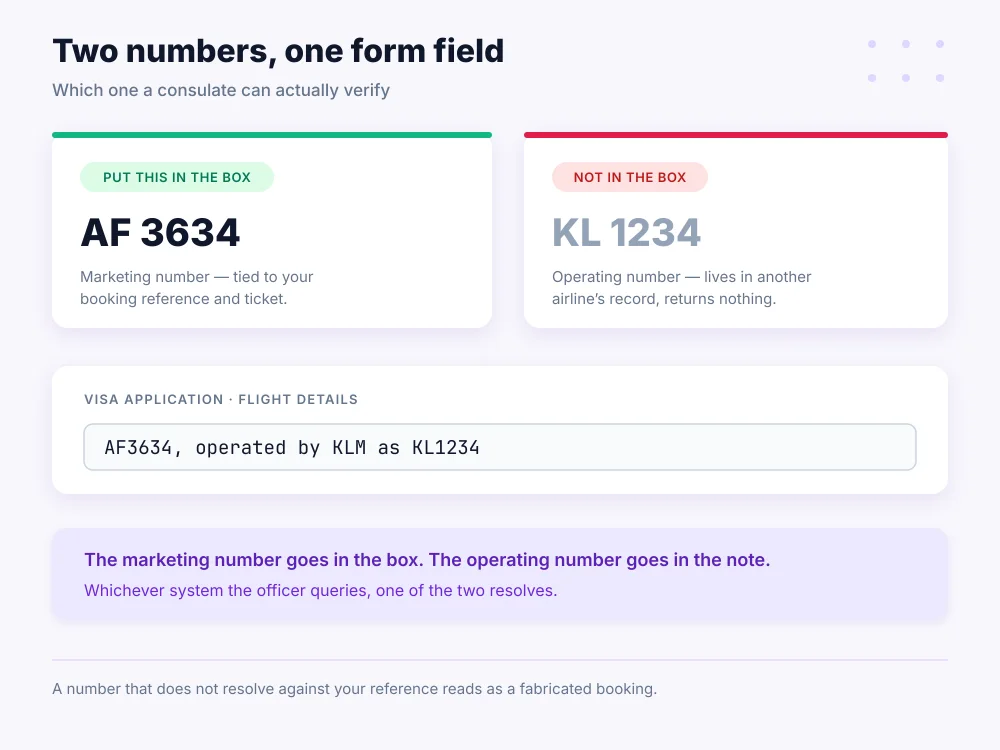
On a visa application form, enter the marketing flight number — the one printed on your ticket and held against your booking reference. A codeshare gives you two valid numbers for the same aircraft, and only one of them is retrievable from the reservation the consulate can verify.
The reasoning is mechanical rather than legal. A visa officer who checks a flight looks it up against your booking reference or your ticket number. Both of those live in the marketing carrier’s system, under the marketing flight number. The operating number is real, but it belongs to a different airline’s record, and searching for it against your reference returns nothing. A blank result reads as a fabricated booking, which is the outcome you were trying to avoid.
| Where you are asked | Which number to give | Why |
|---|---|---|
| Visa application form | Marketing | Matches your booking reference and ticket |
| Airline check-in desk | Operating | That system controls the departure |
| Immigration officer on arrival | Either, say both | They read the boarding pass, which shows the operator |
| Travel insurance application | Marketing | The policy attaches to the ticket you bought |
Where a form offers a free-text field, the clean answer names both: “AF3634, operated by KLM as KL1234”. That sentence survives every check, because whichever system the officer queries, one of the two numbers resolves. A dummy or placeholder itinerary should follow the same rule — the document you submit needs to match a record that exists, which is the difference between a verifiable reservation and a piece of paper, as set out in our explanation of bookings that were never ticketed.
Key takeaway: the marketing number goes in the box, the operating number goes in the note. Never swap them.
Baggage, seats and frequent flyer status
On a codeshare, the operating carrier’s baggage rules generally apply to the flight you are on, while the fare you bought sets what you paid for. This is where two sets of rules meet and where travellers are most often charged twice.
Baggage follows a principle rather than a fixed rule. For itineraries touching the United States, the allowance of the carrier that operates the first marketed segment usually governs the whole ticket. Elsewhere, the operating carrier of each segment tends to apply its own. The practical consequence is that a generous allowance shown at booking can shrink at the airport if a partner airline operates the leg.
Seats are simpler and more annoying. A seat you pick in the marketing carrier’s app may not transfer to the operating carrier’s seat map, particularly on a long-haul partner. The reliable move is to select the seat again directly with the operating carrier once your booking appears in its system. Loyalty points behave the opposite way: you earn miles with the programme you choose, usually based on the marketing carrier and fare class, even though a different airline flew you.
Bags and boarding follow the aircraft. Money and miles follow the ticket. Almost every codeshare surprise is one of those two rules applied to the wrong half.
Key takeaway: confirm the baggage allowance with the operating carrier before you get to the airport, not with the airline that sold you the fare.
When it goes wrong: who owes you what
For delays, cancellations and denied boarding, the operating carrier is the party that owes passenger compensation, not the airline that sold the ticket. Both major compensation regimes attach the duty to the airline that performed or failed to perform the flight.
That allocation is deliberate. The operating carrier controls the aircraft, the crew and the decision to cancel, so it carries the liability. If your Air France-numbered flight is operated by KLM and cancels, the claim goes to KLM even though your money went to Air France. Passengers frequently spend weeks claiming from the wrong airline for exactly this reason, then start again from zero.
Refunds run the other way. A refund is a commercial matter tied to the contract of sale, so it goes back through whoever sold the ticket — the marketing carrier, or the agency if one was involved. Compensation and refund are different claims with different addressees, which is why they so often need to be pursued in parallel. We cover the money side in more detail in the guide to overbooking and denied boarding compensation, and the seller-versus-airline question in who actually controls a third-party booking.
Key takeaway: compensation goes to the operating carrier, refunds go to the seller. Sending either to the wrong one costs you the delay, not the entitlement.
The separate-ticket trap
A separate-ticket itinerary is two independent bookings that happen to share an airport, and it offers none of the protection a codeshare gives you. This is the single most expensive misunderstanding in this subject, because the two look identical on a screen.
On a codeshare or interline itinerary, the airline is responsible for the whole itinerary. Miss the second leg because the first one arrived late, and you get rebooked at the airline’s cost. On two separate tickets, the second airline has no relationship with the first and no obligation to you beyond the flight you booked. You bought a seat, you missed it, that is the end of the contract.
Two signals separate them reliably. A single ticket has one ticket number for all segments and one booking reference in the issuing system. Two tickets have two of each, usually two separate payments, and the baggage is not checked through. Booking platforms that combine unrelated airlines into one price rarely make this distinction loudly. The mechanics of connection timing are set out in our guide to layovers and minimum connection times.
Key takeaway: count your ticket numbers. One number means the airline owns the connection; two means you do.
Mistakes that cost people the flight
Most codeshare failures are the same handful of errors, and all of them are avoidable in the days before departure rather than on the morning of it.
- Going to the wrong terminal. Airlines in the same alliance often use different terminals at the same airport. The marketing carrier’s terminal is irrelevant; the operating carrier’s is the one you need.
- Waiting for check-in in the wrong app. It will not open, and the twenty-four-hour window will close while you wait.
- Assuming the baggage allowance shown at booking. Confirm it against the operating carrier once the flight is within a week.
- Claiming compensation from the seller. Correct address for a refund, wrong address for compensation.
- Putting the operating flight number on a visa form. It will not resolve against your booking reference.
- Ignoring an operator change notice. Under EU rules you must be told; the notice usually means a different terminal, a different app and a different baggage policy.
Key takeaway: check the operating carrier once, a week out, and five of these six mistakes disappear.
Next steps
Open your confirmation and find the words “operated by”. If they are there, note the airline named after them, check its baggage rules, and plan to check in with it. If you are preparing a visa application, put the marketing flight number in the form field and mention the operator in any free-text box.
If your reservation printout is a wall of codes rather than a readable itinerary, the PNR converter will read the segment lines and show you the operating carrier directly. If you need a flight itinerary document for a visa application without buying a ticket you may never use, the free itinerary generator produces one with the carrier and flight number formatted the way consulates expect.
Frequently asked questions
Is a codeshare flight safe?
Yes. A codeshare says nothing about safety standards; it is a commercial selling arrangement. The operating carrier holds the operating certificate and is subject to its own regulator’s oversight. In the EU, carriers subject to an operating ban appear on a published list, and the same regulation that requires operator disclosure created that list.
Why does my booking have two different flight numbers?
Because two airlines sell the same seat. The number you booked belongs to the marketing carrier, and the number the aircraft departs under belongs to the operating carrier. Both refer to one departure, and airport screens usually show both.
Can I check in online for a codeshare flight?
Usually yes, but with the operating carrier rather than the airline you booked. If the marketing carrier’s app refuses, try the operating carrier’s site using its own booking reference. Some partner combinations only allow airport check-in, and that is a known limitation rather than a fault with your booking.
Which airline do I claim compensation from?
The operating carrier. Compensation for delays, cancellations and denied boarding attaches to the airline that ran the flight, regardless of whose code you bought. Refunds are the exception and go back through whoever sold you the ticket.
Do I get frequent flyer miles on a codeshare?
Usually yes, credited to the programme you nominate, based on the marketing carrier and fare class. Deeply discounted fares sometimes earn nothing on partner-operated flights, so check the earning table for the specific fare class before you assume.
Whose baggage allowance applies?
Generally the operating carrier’s for the flight you are on. For itineraries touching the United States, the allowance of the carrier operating the first marketed segment usually governs the full ticket. Confirm directly with the operating carrier before departure rather than relying on the booking screen.
What is the difference between a codeshare and an interline agreement?
A codeshare puts a second airline’s flight number on the same flight. An interline agreement lets airlines accept each other’s tickets and transfer baggage without sharing flight numbers. Every codeshare relies on an interline relationship underneath, but most interline itineraries are not codeshares.
Which flight number goes on my visa application?
The marketing flight number, because it is the one tied to your booking reference and ticket number. If the form has space, add the operating carrier and its number as a note. Entering only the operating number can make the booking unverifiable against your reference.
Can the operating carrier change after I book?
Yes, and airlines change aircraft and partners regularly. Under EU Regulation 2111/2005 you must be informed of the change as soon as possible, and again at check-in or on boarding. Treat such a notice as a prompt to recheck the terminal and baggage rules.
Are codeshare flights more expensive?
Not inherently, though the same seat is sometimes cheaper booked directly from the operating carrier because you skip the marketing carrier’s margin. Comparing both codes for the identical departure is worth a minute, and the price difference on partner-operated long-haul can be substantial.
Sources
- 14 CFR § 257.5 — Notice requirement, Legal Information Institute (disclosure in itineraries, oral communications, ticket confirmations and advertising)
- Regulation (EC) No 2111/2005, Article 11 — Information on the identity of the operating air carrier
Methodology note: the regulatory wording quoted above was read from the full text of 14 CFR § 257.5 and Article 11 of Regulation (EC) No 2111/2005 on 1 September 2026, not from secondary summaries. Part 257 binds carriers and ticket agents for flights within, to and from the United States; Regulation 2111/2005 applies to carriage departing from, and in defined cases to, the European Union. Baggage and loyalty practices vary by carrier and fare and are described here as general patterns, not as rules. Nothing here is legal advice.
Last updated: 1 September 2026 · Reviewed by Marc Hoffmann, Senior Visa Consultant & Travel Documentation Expert, MyJet24
