
Last updated: 12 September 2026 · Reading time: 15 min · Author: Joshua White, Travel Documentation Writer at MyJet24
TL;DR — Key facts
- Visiting a partner is a lawful reason to travel. The US lists “Visit with friends or relatives” as a B-2 purpose, and the Schengen Visa Code expects “an invitation from the host” when you stay with one.
- The relationship is not the problem; the way home is. A partner in the destination is exactly the kind of fact that makes an officer ask whether you will leave.
- Officers are told to test the relationship. UK caseworkers may ask where and how you met and how often you communicate. Canada asks about family in Canada and their immigration status.
- The visa must match the ending of the trip. Visit and go home: visitor visa. Marry in the UK and leave: Marriage Visitor visa. Marry in the US and stay: K-1.
- A partner who asks you to pay for their visa or ticket is a warning sign. The FTC lists both as standard romance scam requests.
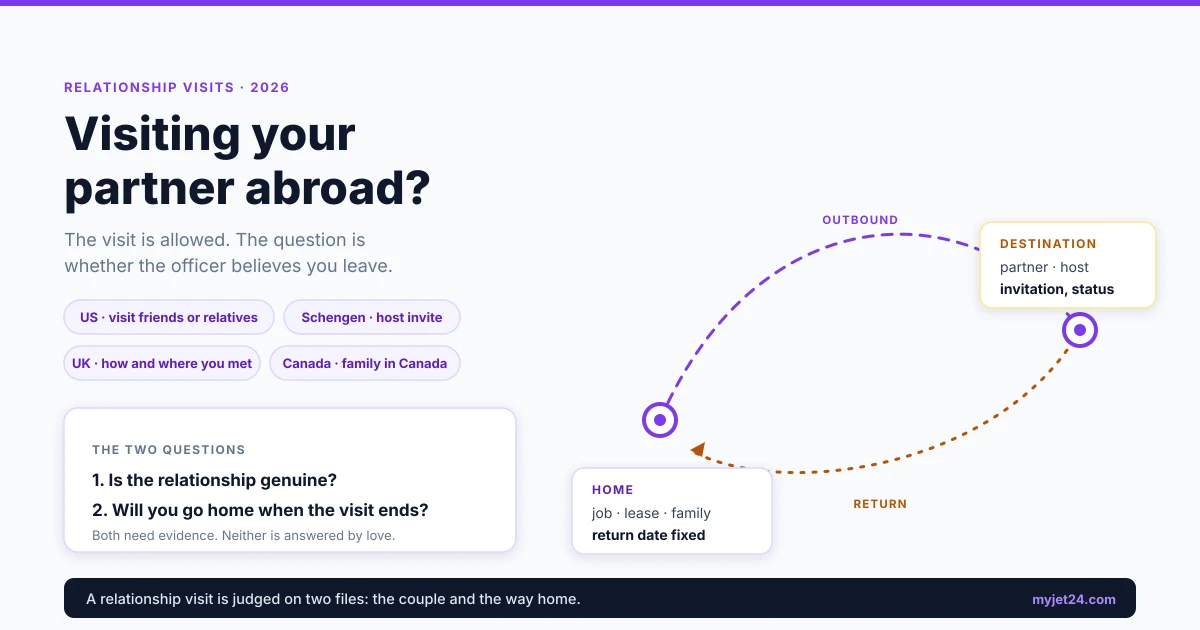
Yes, you can get a visitor visa to see your partner abroad. The purpose is allowed in the US, the Schengen Area, the UK and Canada. What decides the application is evidence of two things: that the relationship is genuine, and that your life at home will bring you back on a fixed date.
A verifiable flight reservation for the visa file. Free, no card required.
Can you get a visitor visa to see your partner?
A relationship visit is a trip whose main purpose is spending time with a boyfriend, girlfriend, fiancé or spouse who lives in another country. It is a lawful purpose for a visitor visa in every major system, and none of the rules cited in this guide treats it as suspicious in itself.
The US State Department lists the purposes a B-2 tourist visa covers, and “Visit with friends or relatives” is on the list next to vacation and medical treatment. The Schengen Visa Code, in Annex II, groups trips made “for the purposes of tourism or for private reasons” together and names “an invitation from the host if staying with one” as accommodation evidence. The UK allows support from “family members, friends and other people with whom the applicant has a genuine personal or professional relationship”.
So the honest answer to “am I allowed to visit my partner?” is yes. The harder question is the one the officer is actually paid to answer: once the visit ends, will you leave?
Key takeaway: never disguise a partner visit as generic tourism. The purpose is allowed; hiding it is what creates a problem.
Why are partner visits refused so often?
A partner visit is refused when the officer cannot rule out that the relationship will keep you in the destination. The partner is the reason for the trip and, at the same time, the strongest reason an officer can imagine for not leaving.
Canada’s instructions to its officers show the logic plainly. Before asking about your home country, they ask: “What ties do you have with Canada? … Who invited the person to Canada? Is there proof of an invitation? Does the person have family in Canada? If so, what is their immigration status in Canada?” The destination side of your life is assessed as closely as the home side.
In the United States the starting point is set by law. Under 8 U.S.C. § 1184(b), every visitor-visa applicant is “presumed to be an immigrant” until they show otherwise. A tourist visiting a museum and a tourist visiting a fiancé face the same presumption, but the second applicant has one more fact working against them.
Data: how often visitor visas are refused
- 14.6% of Schengen short-stay visa applications were refused in 2025 (European Commission, 28 May 2026).
- US B-visa adjusted refusal rates, fiscal year 2025: Brazil 14.87%, Mexico 21.36%, India 22.04%, Vietnam 22.08%, Philippines 30.76%, Colombia 32.84%, Nigeria 57.00%, Kenya 68.23% (U.S. Department of State).
Method: figures copied from the published tables. Neither source breaks refusals down by trip purpose, so no official statistic exists for relationship visits specifically.
Key takeaway: your application has to answer a question the officer is already asking — what brings you home — before they have to ask it.
What do officers check in a relationship visit?
A relationship check is the part of the assessment that tests whether the relationship is real and whether it changes the likelihood that you leave. Each system points its officers at a slightly different piece of evidence.
| United States | Schengen Area | United Kingdom | Canada | |
|---|---|---|---|---|
| Purpose allowed | B-2: visit with friends or relatives | Short stay for tourism or private reasons | Standard Visitor; Marriage Visitor to marry | Visitor visa |
| What is tested | Ties outside the US against the presumption of immigrant intent | Intention to leave before the visa expires | Where and how you met; how often and how you communicate | Family in Canada and their immigration status |
| Host evidence | Supporting, never decisive | Invitation from the host if you stay with one | Host must afford your stay and their own household | Who invited you, and proof of the invitation |
| On a refusal | Section 214(b) | Box 13: doubts about your intention to leave | Not satisfied you are a genuine visitor | Not satisfied you will leave |
The UK guidance is the most explicit about the relationship itself. When a third party supports a visitor, caseworkers look at “the relationship between the applicant and the third party” and at the host’s “previous history of ‘sponsoring’ visitors”.
“For visa applications, you may want to check with the applicant or third party: where and how they met; how often and by what method they communicate.”
— UK Home Office, Visit guidance version 17.0, 25 February 2026
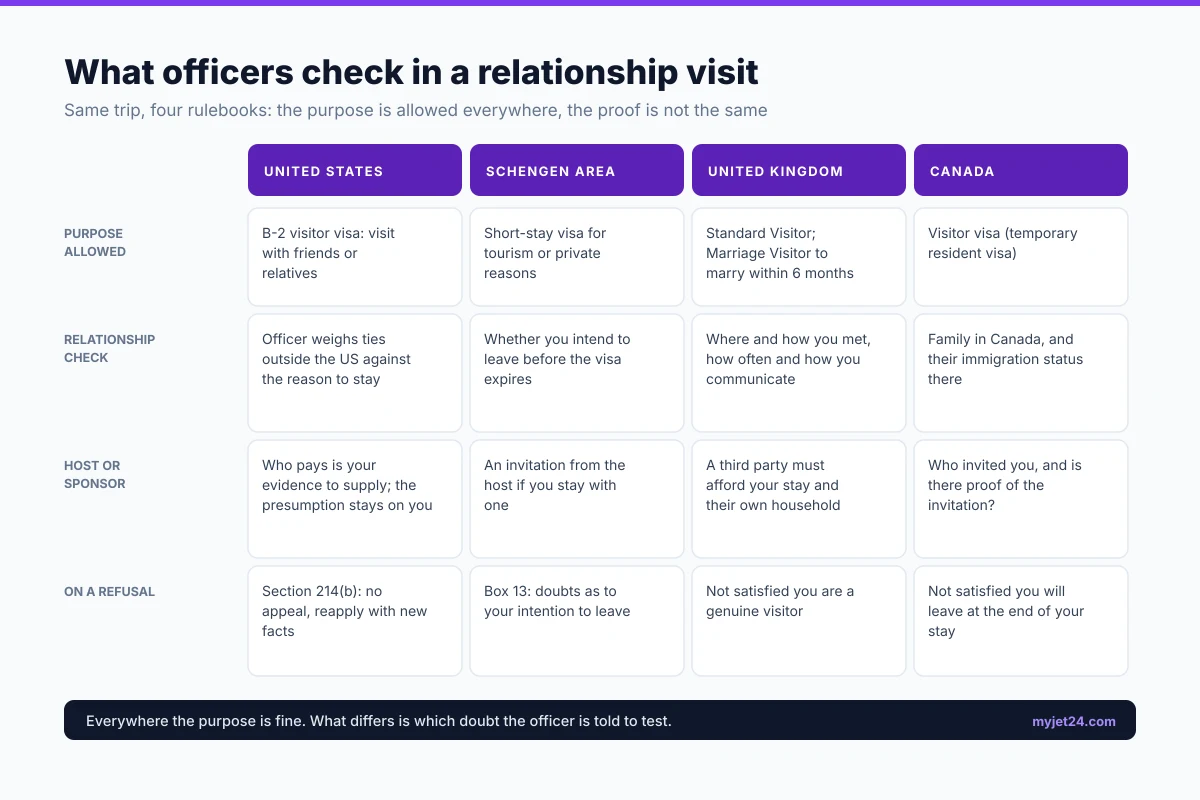
Key takeaway: expect two questions about the couple — how you met and how you stay in touch — and have dated answers ready before anyone asks.
What evidence shows the relationship is genuine?
Evidence of a genuine relationship is material that a stranger could check and that shows the relationship existed before the visa application. Volume matters far less than dates.
- Meetings in person. Boarding passes, entry stamps, hotel bookings or photos from trips where you were together, with the dates visible. These answer “where and how they met” directly.
- A communication history with dates. A few screenshots spread over months say more than a hundred messages from one week, because they answer “how often and by what method they communicate”.
- The host’s identity and status. A copy of the partner’s passport or residence permit and their address. Canada asks about the host’s immigration status; the UK requires that a UK-based host is not “in breach of immigration law”.
- An invitation. In the Schengen Area it is named evidence when you stay with the host. Our guide to writing an invitation letter covers the format country by country.
Compare two couples who met online. The first has visited each other twice, with boarding passes from both trips and a year of dated messages. The second has never met and has a week of chat logs. Both relationships may be sincere, but only the first can be shown to an officer.
Relationship evidence proves one half of the case. The other half is your life at home, which is covered in how to prove ties to your home country. A file with a perfect relationship history and no reason to return still fails the second test.
Key takeaway: pick evidence with dates on it. An undated love letter proves feeling; a boarding pass proves history.
How do you prepare the application, step by step?
A partner-visit application is a file that tells one consistent story: who you are visiting, where you will stay, who pays, and when you go home. Building it in this order keeps the story straight.
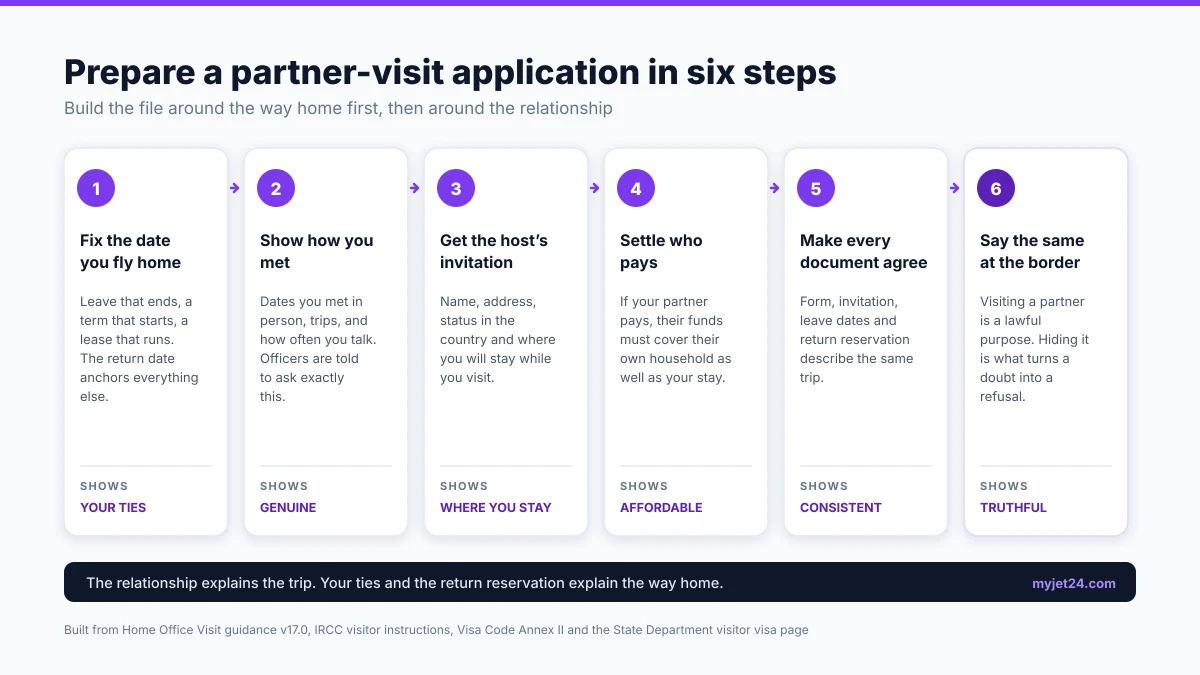
- Fix the date you fly home. Choose it from your obligations at home — leave that ends, a term that starts — not from how long you would like to stay.
- Collect dated proof of how you met. Trips together, boarding passes, and a short sample of messages spread over time.
- Get the host’s invitation and status documents. Name, address, the partner’s passport or residence permit, and where you will sleep.
- Decide who pays, and document it. If your partner pays, include their financial evidence. Our guide to bank statements for visa applications explains how to present a sponsored trip.
- Make every document agree. The form, the invitation, your leave dates and your return reservation must describe the same dates. See why your visa form and flight booking have to match.
- Prepare to say the same thing out loud. If there is an interview or a border check, give the same purpose you wrote down. Our guide to what officers ask at a visa interview shows how the question usually comes.
Key takeaway: start with the return date and finish with consistency. The relationship evidence sits in the middle, not at the front.
Who should pay for the trip?
A sponsored visit is one where someone else covers your accommodation or costs, and it is allowed as long as the sponsor can genuinely afford it. The rules test the sponsor’s finances, not just their willingness.
The UK guidance is precise. A friend or family member providing financial support “must satisfy you that they have enough funds available to adequately support themselves and anyone normally dependent on them, as well as the applicant.” A partner with a modest salary and two children may be a real host and still not be an adequate sponsor.
Paying for yourself is usually simpler to prove, because the question of the sponsor’s household disappears. A split works too: you pay flights, your partner provides accommodation. Whatever you choose, the documents must show the same arrangement the form declares.
Flights deserve a separate decision. The UK Marriage Visitor rules, for example, require that you can pay for your return or onward travel, or that someone else funds it — they ask for the ability to pay, not a ticket bought months before a decision. The Schengen Visa Code lists a “reservation of or return or round ticket”, so a reservation is enough for the file.
Key takeaway: sponsorship is judged on the sponsor’s whole household budget. If that budget is tight, pay for part of the trip yourself.
Put the return date in the file before anyone buys a ticket
A verifiable flight reservation dated to the day you come home.
Create a reservation for your datesWhich visa fits: visit, marriage or fiancé?
The right visa is the one that matches what happens at the end of the trip, not the one that feels closest to the relationship. Visiting, marrying and moving in are three different legal purposes.
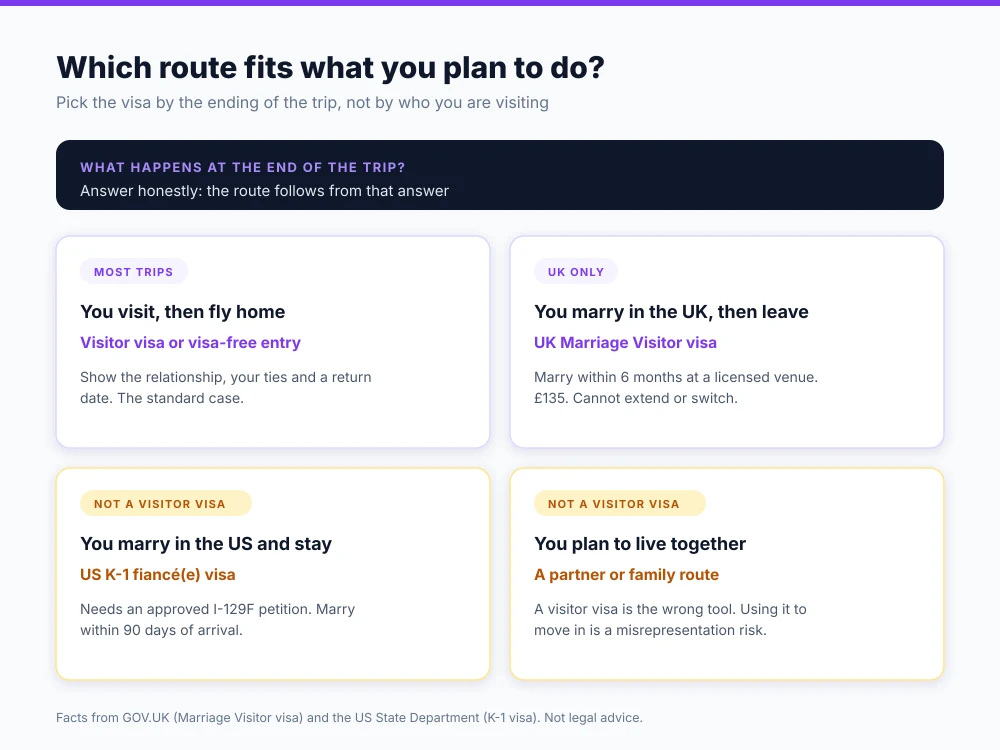
You visit and go home. A visitor visa, or visa-free entry where your passport allows it, is the standard route. Everything in this guide applies.
You marry in the UK and leave. The Marriage Visitor visa lets you “marry or enter into a civil partnership in the UK within 6 months of your arrival” at a licensed venue. It costs £135, a decision usually comes within 3 weeks, and you cannot “extend your visa or switch to another visa”. You must still prove you are “in a genuine relationship” and will “leave the UK at the end of your visit”.
You marry in the US and stay. The K-1 visa lets a foreign fiancé(e) “travel to the United States and marry his or her U.S. citizen sponsor within 90 days of arrival”, and it starts with a Form I-129F petition filed by the US citizen.
You plan to live together. That is a partner or family route, not a visit. Using a visitor visa while intending to move in contradicts the core condition of every visitor category, and US law makes anyone who seeks a visa “by fraud or willfully misrepresenting a material fact” inadmissible under 8 U.S.C. § 1182(a)(6)(C)(i).
Key takeaway: decide the ending first. If the honest ending is “we stay together there”, a visitor visa is the wrong application.
Should you tell the officer you are visiting a partner?
Yes. Telling the officer is disclosure of a lawful purpose, while hiding it is a misstatement about a fact the officer considers material. The first can be weighed; the second can end the application and follow you into later ones.
Travellers sometimes write “tourism” because a partner feels like a risk. The problem is that the evidence points the other way: an invitation, an address that is the partner’s home, messages on the phone, a partner waiting at arrivals. Once the officer sees a different purpose from the one declared, the question is no longer whether you will leave but whether anything else you said is true.
The same logic applies at the border for visa-free travellers. In the United States, the presumption of immigrant intent binds “the immigration officers, at the time of application for admission”, not just consular officers. Carry the host’s address and your return booking even when no visa was needed.
Key takeaway: a declared partner visit is a normal case. An undeclared one that comes out at the desk is a credibility case.
How do you tell a real visit from a romance scam?
A romance scam is a fake relationship built to extract money, and the visa and the plane ticket are among its most common pretexts. If the person you are meant to visit, or who says they will visit you, asks you to pay for either, treat it as a warning.
The US Federal Trade Commission describes the pattern: once scammers gain your trust, “they’ll ask for your help to pay medical expenses (for them or a family member), buy their ticket to visit you, pay for their visa, or help them pay fees to get them out of trouble.” In April 2026 the FTC reported that “nearly 60% of people who reported losing money to a romance scam in 2025 said it started on a social media platform.”
“Never send money or gifts to a sweetheart you haven’t met in person.”
— US Federal Trade Commission, consumer advice on romance scams
A real visitor applies for their own visa and holds their own booking. If someone sends you a flight confirmation as proof they are coming, check the booking reference yourself on the airline’s website; our guide to verifying a booking reference shows how. A document you cannot look up is a picture, not a booking.
Key takeaway: genuine partners can apply without your money. A request to pay for their visa or ticket before you have met is the single clearest red flag.
What if the visa is refused?
A refusal is a decision that the evidence in that application did not meet the test, and the route back depends on the system. In every system, resubmitting the same file rarely produces a different answer.
United States. The State Department says a 214(b) refusal is “for that specific application” and that “There is no appeal process.” You may reapply when there are “significant changes in your circumstances since your last application”.
Schengen Area. Article 32(3) of the Visa Code gives refused applicants “the right to appeal” under the national law of the deciding state. Our guide to Schengen appeals and appeal letters covers the process.
United Kingdom and Canada. Read the refusal notice closely; it names the rule applied and the options open to you. For couples, the most useful change is usually on the home side: a dated obligation that was missing, or clearer proof of who pays. See what happens after a visa refusal.
Key takeaway: fix the weakest half of the file before reapplying. For most couples that is the way home, not the relationship.
Frequently asked questions
Can I stay at my partner’s home instead of a hotel?
Yes. Staying with a host is normal, and the Schengen Visa Code names an invitation from the host as accommodation evidence when you stay with one. Include the full address and the host’s identity documents, and make sure the address on your form is the same one.
Is there a minimum length a relationship must have?
None of the rules cited in this guide sets a minimum. What officers look for is evidence that the relationship exists, such as where and how you met and how often you communicate. A longer, documented history is simply easier to show than a short one.
We have never met in person. Can I still apply?
You can, but the relationship evidence will be thinner, because the most persuasive proof is a meeting that already happened. Put more weight on your ties at home and a clear return date. If the other person asks you to pay for anything before you meet, stop and read the FTC guidance on romance scams.
Does an invitation letter guarantee the visa?
No. An invitation is evidence about the purpose and the accommodation, not a promise about the decision. The officer still decides whether you will leave at the end of the visit, and that depends mainly on your own circumstances.
Does it matter if my partner is only on a temporary visa there?
It can. Canada’s officers ask about the host’s immigration status, and in the UK support from a host who is in breach of immigration law must be disregarded. Include your partner’s visa or residence permit so the officer can see their status is lawful.
Can I visit my partner visa-free if my passport allows it?
Yes, but the border officer still decides whether to admit you. In the United States the presumption of immigrant intent applies to immigration officers at the time of admission. Carry the host’s address and proof of your return date in case you are asked.
Can we get married while I am on a normal visitor visa?
In the UK you need a Marriage Visitor visa to marry or register a civil partnership, and it does not let you stay afterwards. In the United States, the K-1 visa exists for a fiancé who will marry and stay. Other countries have their own rules, so check the official page before planning a wedding.
Can my children come with me on a relationship visit?
Each traveller needs their own permission to enter. The UK Marriage Visitor visa, for example, does not cover family members, who must apply separately. Children also need their own passports and, when travelling with one parent, often a consent letter.
Next steps
A visa to visit your partner is an ordinary application with one extra question attached. Answer the relationship question with dated evidence, answer the return question with your obligations at home, and make every document tell the same story.
The return date is the part most couples leave vague, and it is the part officers weigh most. A reservation dated to your real return lets you show that date without buying a ticket before the decision.
Show when you come home
A flight reservation with a real booking reference, dated to your return.
Create your free flight reservationVerifiable reference, no card required.
Sources
- U.S. Department of State, Visitor Visa and Nonimmigrant Visa for a Fiancé(e) (K-1); Visa Denials; FY2025 adjusted refusal rates for B visas.
- 8 U.S.C. § 1184(b) and § 1182(a)(6)(C)(i).
- Regulation (EC) No 810/2009 (Visa Code), Annex II, Article 32 and Annex VI; European Commission, visa statistics 2025.
- UK Home Office, Visit guidance, version 17.0 (25 February 2026); GOV.UK, Marriage Visitor visa.
- IRCC, Temporary residents: Eligibility and admissibility considerations.
- US Federal Trade Commission, What to know about romance scams; press release of 27 April 2026.
About the author
Joshua White is a travel documentation writer at MyJet24. He writes the site’s guides on visa evidence and works from the official rules and the published instructions that visa officers themselves follow.
Last reviewed: 12 September 2026 by Joshua White. Methodology: every quotation was checked against the official source linked above, including the full Home Office Visit guidance and the IRCC officer instructions. Refusal rates are copied from published government tables; no official source breaks refusals down by relationship visits, and this guide does not estimate one.
This guide is general information about visitor visas, not legal advice on an individual application. Marriage, fiancé and partner routes have their own detailed rules; check the official page for the country concerned before applying.
